What Is Staff Augmentation: Working Principles, Types, and More
Updated 08 Dec 2025
16 Min
2591 Views
Employee augmentation helps companies scale engineering capacity fast without inflating costs or slowing delivery. This engagement model is now in great demand due to its flexibility and cost-effectiveness. But before choosing any collaboration model, it’s essential to understand when staff augmentation becomes a real strategic advantage. Below are the situations where staff augmentation works best and delivers the strongest impact:
- You need to scale your team fast
- You need specific expertise temporarily
- You want flexibility without growing fixed costs
- You need full control over delivery
At Cleveroad, we’ve supported a bunch of products and enterprise teams with tailored augmentation models. Based on our personal experience, we’ve created this guide to show when the model becomes a real growth lever, and when it doesn’t. You’ll learn how to use staff augmentation strategically to shorten time-to-hire, add niche expertise on demand, and keep teams flexible as priorities shift.
What Is Staff Augmentation Model?
IT staff augmentation is a flexible staffing approach that allows companies to extend their existing team with external specialists on a temporary basis, closing skill gaps and accelerating delivery without long-term hiring commitments. Instead of spending weeks searching for talent or expanding office space, you tap into a broader talent pool and get the exact expertise required for ongoing staff augmentation projects. This model also helps companies choose the right approach for evolving workloads, whether they need one engineer or a larger self-managed service group to support long-term delivery.
Below, we explain how staff augmentation works and the key benefits that make it a strategic alternative to traditional hiring.
How IT staff augmentation works
Under the staff augmentation model, external engineers provided by a service provider join your existing staff and work as part of your internal delivery structure. Unlike hiring a full-time employee, augmentation may add the needed skills instantly while keeping all management and prioritization fully on your side. Your CEO, CTO, or PM directs both the in-house and augmented specialists, ensuring unified workflows and consistent productivity.
This structure reflects the core resource augmentation meaning: expanding your team’s capacity on demand without long-term commitments.
How the operating mechanism looks in practice:
- Your in-house team and the augmented team work in parallel under shared leadership.
- The in-house CEO/CTO/PM manages tasks, communication, quality, and delivery expectations.
- The augmented engineers integrate into your workflow, tools, and development process as if they were internal team members.
- The service provider handles sourcing, vetting, contracts, and administrative overhead while you retain day-to-day control.
This model keeps governance centralized on your side while giving you rapid, flexible access to talent: exactly what the below diagram illustrates.
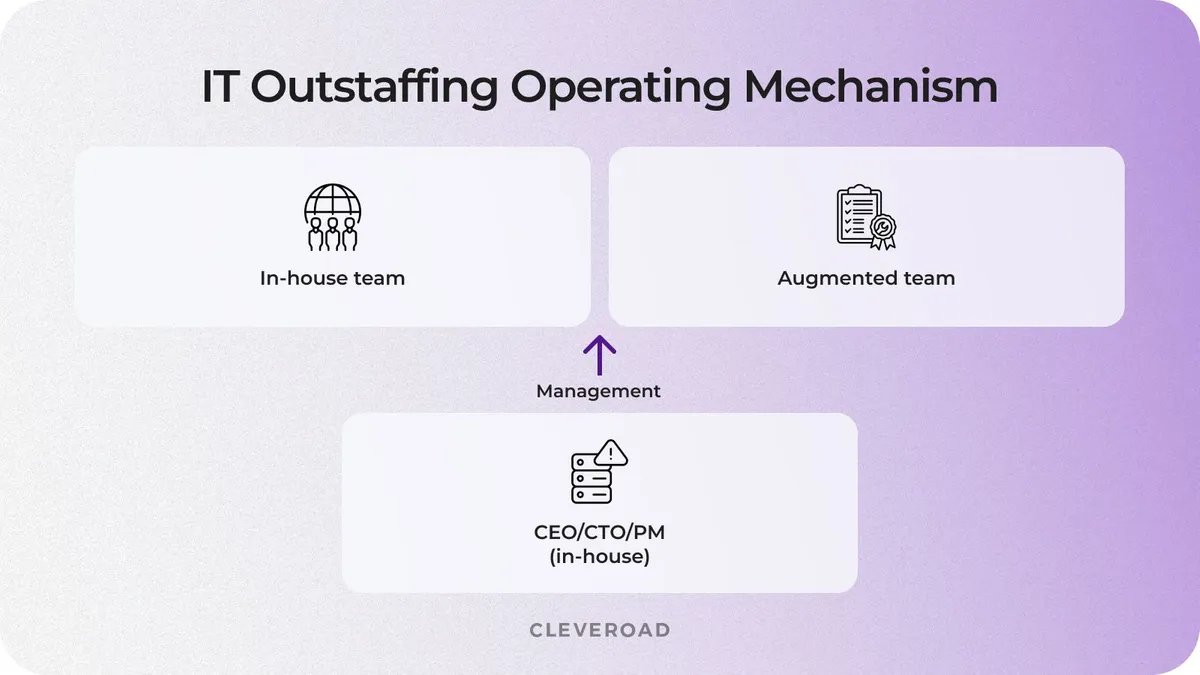
Staff augmentation working mechanism
Key benefits of IT staff augmentation
Staff augmentation strengthens delivery capacity without inflating fixed costs or slowing down execution, when applied strategically. It helps companies respond to shifting priorities, secure niche expertise on demand, optimize hiring efforts and maintain control over project outcomes.
These are the core advantages teams gain from this model:
Access to tech expertise
Quickly close capability gaps by bringing in specialists with the experience your project requires right now.
Reduced time-to-hire
Avoid lengthy recruitment cycles; vendors deliver vetted candidates in days, not weeks.
Flexibility to scale
Expand or shrink your team as priorities shift, avoiding overhead linked to traditional hiring.
Lower risks
Work with engineers who already have domain experience, improving delivery predictability across all right staff augmentation scenarios.
Optimized costs
Pay only for needed capacity, without long-term employment expenses or additional infrastructure.
Major Types of Staff Augmentation
Choosing the right types of staff augmentation helps companies scale efficiently, match specialists to project demands, and maintain delivery control. While the staff augmented model always extends your in-house team with external experts, each variation supports different operational needs.
We’ve grouped the four core formats used by modern teams and augmentation companies when delivering a staff augmentation solution.
On-site staff augmentation
On-site staff augmentation places external specialists directly in your office, working alongside your team. Such an arrangement is especially valuable for projects that require close supervision, sensitive data handling, or rapid feedback cycles.
This model of staff augmentation means tighter collaboration, faster communication loops, stronger knowledge transfer, and immediate alignment with in-house standards. It is best suited for initiatives that require physical presence, sensitive data environments, or highly synchronized teamwork.
Team-based staff augmentation
Team-based augmentation allows you to expand capacity by adding a cohesive group of engineers, rather than sourcing individuals one by one. The format, like team-based staff augmentation, is useful for accelerating delivery across multiple workstreams or replacing an entire capability layer. The model is common in nearshore staff augmentation, where proximity and overlapping time zones make cross-team integration seamless.
Explore more about nearshore staff augmentation in our recent guide!
Remote staff augmentation
Remote staff augmentation allows companies to integrate external engineers who work entirely off-site. This approach helps access global talent quickly, especially when local hiring is slow or costly. A staffing agency or vendor provides vetted specialists who collaborate through shared tools and processes, functioning as augmented staff embedded into your internal workflow. Companies looking to broaden their reach even further often combine this model with offshore staff augmentation to scale efficiently across international markets.
Project-based staff augmentation
Project-based augmentation supports companies that need temporary specialists for a defined scope, milestone, or feature set. Here, staff augmentation offers short-term expertise without committing to long-term hiring. The vendor supplies talent tailored to your stack, and your team manages execution directly. The model is best used when timelines are compressed or when rare skills are needed for a limited part of the project.
Choose our Staff Augmentation services to close your delivery gaps fast and keep product development moving without delays
When to Use Augmented Staff Services
Choosing an employee augmentation model is most effective when you clearly understand the scenarios where outstaffing delivers the strongest impact. Since staff augmentation involves adding external experts to reinforce your in-house team, the approach works best when a company needs targeted capacity, faster delivery, or specialized capabilities without long hiring cycles.
So, staff augmentation makes sense if you:
- Need to hire skilled engineers quickly to unblock delivery or close critical expertise gaps
- Want to scale your team temporarily without adding long-term headcount
- Must accelerate a project while keeping full control over execution
- Face shifting priorities and need flexible access to talent on demand
Staff augmentation vs dedicated development team
Outsourcing essentially simplifies the hiring task offering companies the most common relationship models for such a situation: staff augmentation vs. dedicated team. The most common distinctions of employee augmentation and dedicated dev team models are given in the table below.
| Parameter | IT staff augmentation | Dedicated development team |
|---|---|---|
Range of IT professionals available | Tech specialists on demand | Any-scale software development team |
Control over the team | Direct control by the client | Managed by the software development vendor |
Flexibility | Adaptable to changing project requirements | Can be tailored to align with client's business goals |
Efficiency | Cost-effective for smaller, well-defined projects | More efficient for larger, complex projects requiring a full-service solution |
Scalability | On-demand scaling | Highly scalable to meet fluctuating project needs |
Focused on | Providing supplemental resources to address specific skill gaps | Delivering complete project outcomes |
Cleveroad presents companies with both outstaffing and dedicated team services to hire. In most situations, recruiting dedicated team specialists is reasonable because:
- Ded team model lets to adapt the project to dynamic plan changes
- There are no expenses for hiring, administration, or training processes
- Specialists with solid experience in outsourcing IT development can assist you
- The outsourcing cooperation model is easily adaptable to your business needs
However, there are cases when resource staff augmentation services are more fitting and necessary. They become indispensable when you require specialized skills or expertise on a temporary basis, need to rapidly scale your team up or down, or prefer direct control over the augmented personnel.
Find out staff augmentation vs. IT outsourcing comparison to determine which approach best suits your business goals
Staff augmentation will fit you if
When you need to scale delivery fast without compromising product quality, staff augmentation closes your talent gaps and strengthens your in-house team with vetted engineers who blend into your workflow from day one.
- You have an in-house team. You extend your current team to cover expertise gaps or boost delivery speed, bringing in specialists with the required tech stack or domain skills.
- You need to expand the team fast. Instead of a long hiring cycle, you access pre-vetted engineers through a vendor, review CVs, and interview only relevant candidates.
- You have a tech-savvy manager on your side. You stay in charge of product development and daily coordination, with augmented engineers reporting to your CTO or PM.
- You need better communication with the team. Engineers fully integrate into your processes, report daily, and operate as part of your internal team to ensure transparency and alignment.
Staff augmentation is ideal when you need to retain control over your project and manage your team directly. However, if you're looking for a more hands-off approach, where an external provider takes full responsibility for project execution, IT outsourcing might be the better option. Understanding the differences between staff augmentation and full IT outsourcing can help you choose the right strategy based on your specific needs and resources.
You should avoid outstaffing if
While the benefits of staff augmentation are substantial, the model is not equally effective for every situation. Some staff augmentation projects become harder to manage, more expensive, or simply inefficient when the underlying needs point to another cooperation model.
You should reconsider augmentation if:
- Your specific project requires an end-to-end delivery team rather than individual contributors you must supervise daily.
- You cannot dedicate internal management capacity to oversee an augmented staff member, validate output, and coordinate workflows.
- The work demands strict accountability for outcomes. Since augmentation involves hiring individuals rather than a delivery organization, outsourcing may be more suitable.
- You need rapid execution across multiple disciplines where a single staff augmentation partner cannot supply the breadth of roles needed or ensure cross-functional coordination.
When these conditions arise, a dedicated development team model may be a stronger choice, giving you predictable ownership and unified delivery. Still, staff augmentation remains a strategic asset for many teams. By knowing where staff augmentation fits and where it doesn’t, you’re better positioned to leverage the model and navigate the challenges ahead.
Let’s sum up when you should use IT staff augmentation for your business, and where you shouldn’t:
| Staff augmentation fits you if | You should avoid staff augmentation if |
|---|---|
You have an in-house team to manage external engineers | You lack internal management to oversee augmented staff |
You need to scale fast with niche skills | You need a full end-to-end delivery team |
You want direct control and daily communication | You require strict accountability for outcomes |
You prefer flexible, temporary team expansion | You need multi-discipline execution from a single vendor |
IT Staff Augmentation Challenges
The staff augmentation role won’t be appropriately played, if we forget the key challenges that the companies can face.
Timezone difference and communication issues
When you staff augment teams, one of the most common challenges is maintaining consistent communication flows. Misaligned expectations, delayed feedback cycles, and fragmented context can easily appear when developers and product owners do not share overlapping working hours or communication habits.
Staff augmentation may also be challenging due to time zone difference. Distributed teams sometimes struggle to secure enough overlap for daily syncs or to keep discussions moving at the required pace.
Our experience shows that time zone gaps do not have to slow teams down. For example, one of our US partners from AVFX runs events across multiple states with a 7+ hour difference from our delivery centers. Despite this, our engineers stayed fully engaged: they joined late-night calls, guided the client through technical questions in real time, and ensured the app worked flawlessly during each event. Even weekend activities were covered, as our specialists remained available whenever the AVFX team needed support.
See the full review:
AVFX & Cleveroad: A Successful Technology Partnership
Maintaining quality standards
Low-quality staffing is one of the biggest risks in staff augmentation. If a vendor sends engineers without proper technical screening or domain fit, the impact becomes visible immediately: code slows down delivery, tasks require rework, and the team spends time fixing instead of moving forward. Many issues arise simply because some providers prioritize speed over quality. Reviewing a vendor’s portfolio, assessment approach, and proven expertise helps ensure you bring in specialists who match your delivery standards from day one.
Cleveroad reduces quality risks by applying ISO 9001:2015-certified delivery processes and strict control practices at every stage of development. Our engineers work within a framework that validates functionality, integrations, performance, usability, and security, ensuring your product meets defined standards. You also gain access to multi-level technical support and maintenance options, so software quality remains consistent throughout the entire lifecycle.
Security and IP protection risks
Because a staff augmented model connects third-party contributors to internal systems, any gaps in access control, data handling, or IP governance can pose significant risks, regardless of project scope or project duration. These risks increase when companies scale quickly or bring in temporary staff to cover urgent staffing needs, especially without clear policies or verified security practices.
To ensure complete protection, it’s essential to partner with a staffing vendor that enforces strict security protocols, transparent access policies, and proper contractual safeguards around confidentiality and intellectual property. At Cleveroad, we conduct regular security audits, apply least-privilege access controls, and require NDA compliance for every engineer involved, ensuring your sensitive data and IP remain fully protected from day one. In addition, all our processes follow ISO 27001:2022 standards, which guarantees that your information assets stay secure at every stage of our collaboration.
Capability gaps and tech misfit
Capability and technology mismatches often surface in employee augmentation scenarios when external engineers lack the specific skills or domain knowledge required for your stack. Even though staff augmentation is a powerful way to scale quickly, the model can stall delivery if the specialists provided cannot adapt to your architecture, tooling, or workflows. The risk of misalignment grows when the vetting process is weak or responsibilities are unclear, because staff augmentation involves hiring individuals rather than a managed team.
Cleveroad solves this challenge by giving you access to 280+ in-house engineers and over 3,000 vetted specialists in our talent pool, ensuring we always match you with experts who fit your stack and domain. Our certified professionals integrate into existing workflows fast, respond to new requirements without delays, and maintain team consistency throughout the entire project thanks to an extensive and stable talent pool. If required, we also supply dedicated project managers to maintain alignment, track progress, and keep communication transparent, helping your team avoid capability gaps and ensuring seamless integration throughout development.
How to Choose the Right Staff Augmentation Vendor for Your Business?
Choosing the right staff augmentation vendor determines how smoothly external engineers integrate into your team and how quickly you can scale without risking quality or delivery stability. To make the model work, you need a partner with proven expertise, transparent processes, and strong security and quality standards throughout the entire engagement.
Below are five essential criteria for evaluating companies that offer staff augmentation services.
Technical experience
Evaluate whether the vendor has proven expertise in the specific software development services your product requires. This includes capabilities in custom solutions development, legacy modernization, mobile, web, or cross-platform development, and UI/UX design. A technically mature partner ensures smooth integration, compatible tooling, and fewer delivery risks.
Beyond evaluating a vendor’s capabilities, ensure they can cover a wide range of on-demand IT services so your team gets all required expertise from a single, reliable partner. Cleveroad provides end-to-end software development across multiple technical domains, including:
- Custom software development: full-cycle engineering for web, mobile, and enterprise systems
- Software modernization: upgrading legacy systems for performance, scalability, and security
- UI/UX design: product-focused design services that support usability and fast adoption
- Cloud application development: building scalable cloud-native and hybrid solutions
- IT consulting: architecture audits, technology advisory, and product strategy support
- Quality assurance & testing: functional, performance, and security validation at every stage
- AI software development: creation of AI-driven applications, predictive analytics systems, and ML workflows
Industry-specific expertise
Look for a vendor with deep experience in your domain and familiarity with industry-specific development rules. It may include compliance with HIPAA, PIPEDA and so on for Healthcare. You may need secure payment flows and regulatory controls for FinTech. Developing software for logistics requires adherence to supply chain standards. Domain fluency enables faster onboarding and fewer rework cycles.
Our experts bring domain expertise across the following business industries: Healthcare, FinTech, Logistics, Retail, Media, eCommerce, Travel, Education, and Real Estate. This breadth allows us to align with your regulatory landscape, user workflows, and operational constraints from day one, reducing onboarding time and minimizing domain-related risks.
Portfolio and case studies
A trustworthy employee augmentation vendor should demonstrate successful project delivery across your business domain or required technology stack. Case studies reveal how the company handles complexity, adapts to changing requirements, and collaborates with internal teams. A strong portfolio confirms that the vendor can replicate success on your project.
Let us share one of our staff augmentation cases when we created a Field Service Management System.
Our client, a US-based company providing on-site appliance repairs, needed to build a comprehensive field service management platform that automated scheduling, routing, job tracking, and technician workflows. Cleveroad assembled a staff-augmented team of backend engineers, mobile developers, QA specialists, and UI/UX designers to develop a system that supports real-time technician assignment, optimized route planning, transparent job status updates, and secure customer data handling. As a result, the client improved operational efficiency, reduced manual coordination, and launched a robust FSM solution that scaled their service capacity and enhanced customer experience.
Explore our portfolio to see how we deliver staff augmentation services in real projects and help companies scale with the right talent
Reputation and client reviews
Reputation is a critical signal when choosing a staff augmentation partner. Explore reviews on Clutch, GoodFirms, or industry forums to understand how the vendor performs in real engagements and handles real-world challenges. Transparent feedback helps you gauge reliability, communication quality, and long-term partnership potential.
Cleveroad maintains a strong reputation on Clutch, with 70+ client reviews and an average rating of 4.9 out of 5, reflecting consistent service quality and long-term client trust. These evaluations highlight our ability to integrate seamlessly, deliver predictably, and support projects across various technical and business domains.
- Discover our Clutch profile to see how we deliver reliable staff augmentation services and support clients across complex, fast-moving projects
Talent pool and team stability
Assess the vendor’s ability to supply the full range of specialists your project requires, like engineers, QA, DevOps, business analysts, and designers. Ask whether they can keep a consistent, unchangeable team throughout the engagement, which is essential for maintaining product knowledge and a comfortable partnership rhythm. Strong communication and project management practices ensure that the augmented team remains aligned and predictable.
Cleveroad fully meets these expectations by maintaining a large and diverse network of specialists, allowing us to close even highly specific roles without compromising on skill match or timing. With a strong core team of 280+ in-house engineers and access to thousands of pre-vetted experts, we can assemble stable lineups that stay with you for the entire project lifecycle. Our talent structure helps preserve product knowledge, reduces the need for replacements, and keeps delivery predictable even as your requirements evolve.
IT Staff Augmentation Services at Cleveroad
Cleveroad is an outsourcing software development company that has been providing IT staff augmentation services for more than 15 years. We are headquartered in Estonia and have R&D centers in Estonia, Poland, Ukraine, the US, and Norway to let clients scale teams quickly, access diverse engineering expertise, and work with specialists across convenient time zones.
Having gathered a solid experience in this sphere, we want to tell more about how the staff augmentation process works in our company:
- We shortlist candidates within 24 hours. Our team scans internal CVs, selects specialists who match your tech stack and domain, and sends you a curated list. You pick the profiles you want to interview.
- We organize interviews in 1–3 days. We schedule calls with shortlisted engineers so you can evaluate their skills, communication style, and hands-on experience. You choose the best-fitting experts.
- We finalize terms and sign the SLA. Together, we define engagement conditions and responsibilities in detail. Once the SLA is signed, we confirm the developers’ allocation and thoroughly prepare the team for onboarding.
- We onboard and integrate the team smoothly. Selected engineers join your workflow in 1–3 days. We set up communication routines with your PM or CTO, align expectations, and ensure every specialist becomes productive as fast as possible.
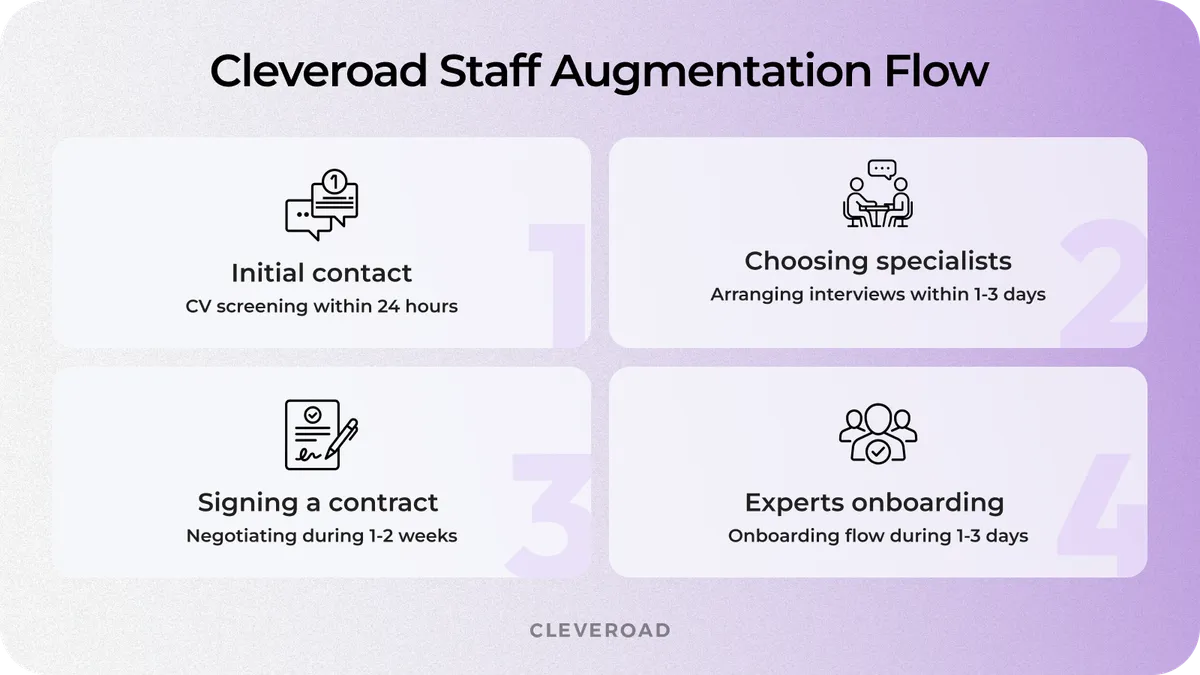
Staff Augmentation software development flow at Cleveroad
The specialists we provide have good communication skills and an Upper-Intermediate to Advanced English level. They're usually middle or senior-level engineers or team leads if there's a need to oversee the team's work.
Our team has succeeded with a lot of staff augmentation projects, and we want to share with you the most vibrant examples:
- Versatile Video-On-Demand Platform. With the help of our IT outstaffing services, our Danish client accelerated their digital transformation and expanded their reach to a wider audience through a modern VOD platform.
- Appointment management system for in-home care. Our client, the US nursing home provider, augmented their development team with our healthcare IT experts. It helped our client to efficiently develop a new appointment management system for in-home care.
- B2B reward-based cashback service system. By outstaffing services, our client efficiently accessed the necessary expertise to build and launch their robust cashback service system within budget and timeline constraints.
Hire skilled engineers fast with Cleveroad
Strengthen your team with vetted developers joining your project in under 2 weeks. Our staff augmentation model closes expertise gaps, accelerates delivery, and keeps your product on track
Staff augmentation is a cooperation model where a company expands its in-house staff by temporarily hiring one or several outsourcing IT specialists. Augmented specialists become a part of an in-house team and cooperate with the company's employees for a short time as usual.
Resource augmentation is a strategic approach where businesses supplement their internal team with external experts.Augmentation isn't about full-time hires but allows companies to access specialized skills on a project basis. Consider staff augmentation when you need to quickly scale your workforce or fill specific skill gaps.
Workplace augmentation is a strategic approach that involves supplementing an internal team with external talent. By partnering with a right staff augmentation partner, businesses can access different types of staff augmentation to address specific project needs.
Augmentation enables organizations to scale their workforce flexibly, maximizing the benefits of specialized skills without the overhead of full-time employment.
Staff augmentation allows companies to access specialized talent on-demand, accelerating project timelines. The benefits of staff augmentation extend to cost-efficiency, scalability, and focus on core competencies, making augmentation a flexible option for businesses facing evolving project needs.

Evgeniy Altynpara is a CTO and member of the Forbes Councils’ community of tech professionals. He is an expert in software development and technological entrepreneurship and has 10+years of experience in digital transformation consulting in Healthcare, FinTech, Supply Chain and Logistics
Give us your impressions about this article
Give us your impressions about this article
Comments
1 commentsWow!! Great post. Thanks for sharing this Blog here with us.