How Much Does It Cost to Build a Chatbot: A Complete Budgeting Guide
Updated 08 Jan 2026
19 Min
3163 Views
Cost of chatbot development varies by orders of magnitude depending on the chatbot type, scope, level of customization, and technical depth. As a result, there is no single average price point that fits all use cases.
Real-world chatbot budgets fall into several clear ranges:
- Rule-based or basic chatbots: $2,000 – $15,000+
- AI-powered virtual assistants of medium complexity: $18,000 – $80,000+
- Generative AI bots: $35,000 – $120,000+
- Advanced chatbots for enterprises: $50,000 – $250,000+
These numbers explain why the AI chatbot development costs cannot be reduced to a single figure. Pricing depends on the chosen chatbot platform, the level of AI sophistication, integrations with existing systems, deployment in a mobile app or web environment, long-term maintenance requirements, and so on.
Below, we break down what drives these costs in real projects and how companies reduce budgets in practice without sacrificing quality. We'll provide you with expert insights based on Cleveroad’s experience with AI chatbots in FinTech, Healthcare, Education, and other domains.
Why Should You Invest in Chatbot Development?
The price of conversational assistant creation varies widely, but the business case stays clear when investments are tied to measurable outcomes. Business chatbots reduce operating costs, speed up service, improve response consistency, and scale customer interactions at enterprise scale without linear headcount growth.
Let’s find out the key reasons to invest in intelligent virtual agent development and how the cost to build a chatbot pays off at scale.
Reduced customer support costs
Chatbots help businesses reduce customer support costs by automating the handling of simple and repetitive requests. Instead of expanding support teams to manage growing inquiry volumes, an AI chatbot resolves common questions instantly and routes only complex cases to human agents. According to an IBM report, companies using AI-powered virtual agents can reduce customer service costs by up to 30%.
From a technical perspective, this benefit shifts a large share of Tier-1 interactions to automated flows, which stabilizes cost per request, reduces dependency on headcount growth, and allows support operations to scale without proportional increases in staffing or infrastructure.
More efficient customer support
Chatbots don't replace your employees; they make them more efficient. They automatically answer FAQs, cut response times, and let your support teams focus on complex issues. Gartner predicts that by 2027, chatbots will become the primary customer service channel for a significant share of organizations over the next years.
Boosting productivity through integrations
Chatbots increase team productivity by automating routine customer requests and working alongside helpdesks and CRMs. They handle common questions independently and route complex cases to agents with full conversation context, allowing support teams to scale request volumes without increasing headcount.
Their impact is measured through metrics such as automation rate, response and resolution time, and customer satisfaction. When integrated with business systems like CRMs, e-commerce platforms, or payment gateways, chatbots also automate tasks such as order tracking or scheduling, helping reduce support costs while keeping service quality consistent.
24/7 availability
AI-powered live chat ensures customers get instant responses, even outside business hours. Outgrow reveals that 64% of customers consider 24/7 service the best chatbot feature. Such a circumstance leads to better customer retention and stronger brand loyalty.
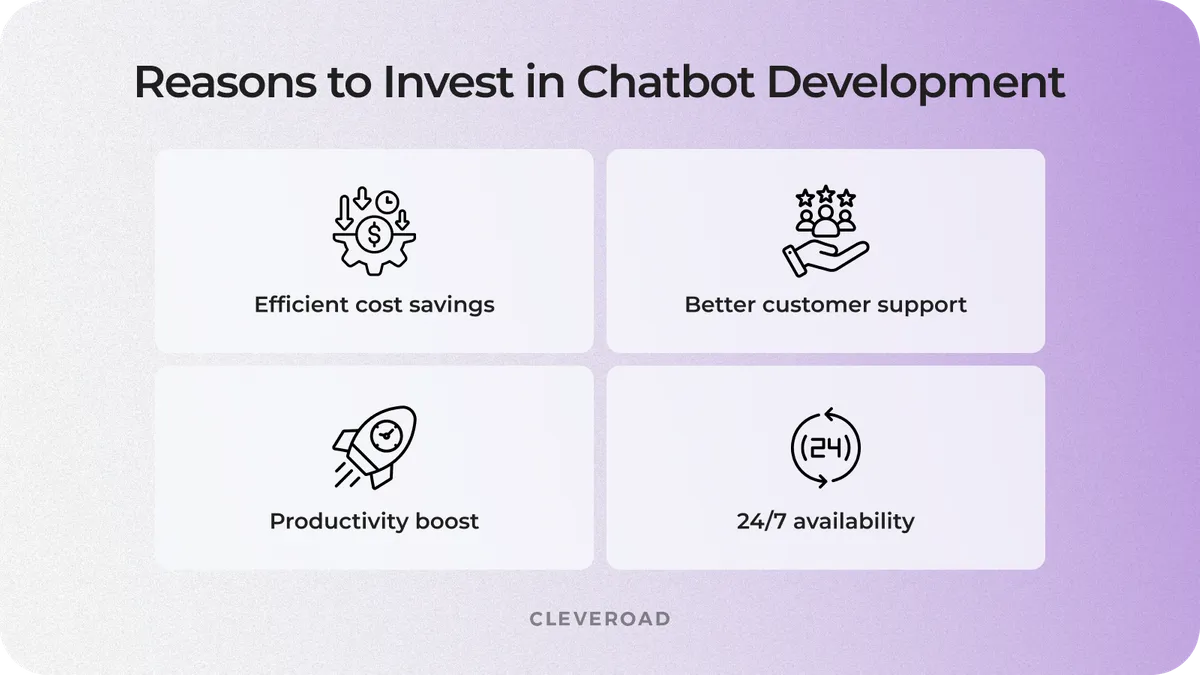
Reasons to invest in chatbot development
Factors Affecting the Chatbot Development Cost
How much does it cost to build a chatbot for your business? In practice, chatbot budgets start at around $10,000 for small FAQ-based solutions and can grow to $250,000+ for enterprise-grade or generative AI chatbots. Such a wide range exists because chatbot development cost depends on many factors, including the complexity of business workflows, required integrations, deployment scope, and the level of AI involved.
So, before we get straight to the detailed estimation, you have to know more about chatbot development cost-forming factors.
Chatbot use cases and estimated cost
The cost of chatbot development primarily depends on what the chatbot is built to do. Different use cases require different levels of automation, reliability, and operational support, which directly affects project scope and AI development cost. Below are the most common chatbot use cases with typical budget ranges.
Typical chatbot use cases and cost ranges include:
- FAQ and basic support: $2,000 – $10,000+. Designed to answer predefined questions and reduce incoming inquiries to human support teams.
- Lead qualification and sales assistance: $8,000 – $25,000+. Used to engage prospects, guide structured conversations, collect contact details, and filter inbound leads for sales teams.
- Customer support with natural language understanding: $20,000 – $60,000+. Focused on processing free-text input and resolving common issues before escalating complex cases to agents.
- Internal support and knowledge access: $25,000 – $70,000+. Built to help employees find information across internal documents, tools, and systems with access controls.
- Transactional and workflow-driven chatbots: $50,000 – $150,000+. Designed to trigger actions such as scheduling, ticket creation, or data updates across business systems.
- Generative AI assistants: $35,000 – $120,000+. Used for open-ended conversations and complex queries, often requiring higher investment in governance and monitoring.
These ranges provide a general reference, but final costs depend on how complex the business workflows are that the chatbot is expected to support and automate.
To estimate the cost of building a chatbot, you need a clear feature scope. Contact us to define the feature set and get a realistic project estimate.
Chatbot complexity and conversation logic
Chatbot cost depends on the complexity of its conversation logic and the scope of functionality it is expected to handle. Simple bots rely on scripted flows and keyword matching. More advanced solutions use intent recognition, track context across messages, and support multiple dialogue paths powered by specialized AI tools. As interactions become more flexible and human-like, development, testing, and validation efforts grow, which directly increases cost.
The complexity of conversations directly impacts the cost to develop an AI chatbot, as more advanced logic requires additional design, implementation, and testing. Over time, this complexity can also increase maintenance effort, but those costs typically arise after the initial development phase and as the chatbot evolves.
Bots with advanced logic require continuous tuning, fallback handling, and performance monitoring to keep response quality stable as user behavior evolves. In large-scale or regulated environments, this complexity often aligns with enterprise AI requirements, where predictability and control matter as much as accuracy.
The table below provides a practical cost comparison across chatbot complexity levels to support early-stage budget planning:
| Chatbot complexity level | Conversation capabilities | Use cases | Estimated cost range |
|---|---|---|---|
Basic | Scripted flows, keyword matching, no context memory | FAQs, simple customer inquiries | $2,000-$15,000+ |
Intermediate | Intent detection, limited context handling, basic integrations | Lead qualification, order status, booking | $18,000-$80,000+ |
Advanced | Context-aware dialogs, multi-step logic, system integrations | Customer support, internal assistants | $35,000-$120,000+ |
Enterprise-grade | Adaptive logic, compliance controls, and monitoring | Banking, healthcare, large-scale platforms | $50,000-$250,000+ |
Conversation design and prototyping complexity
Design and prototyping directly affect chatbot development cost by defining the complexity of conversation logic before development begins. At this stage, teams map conversation flows, user intents, fallback scenarios, and handoff logic across channels. This helps validate assumptions early and prevents expensive changes later.
For custom chatbots, prototyping plays a key role in clarifying scope and aligning technical decisions with business goals. Well-defined design artifacts reduce uncertainty, support more accurate cost estimates, and make future changes easier to manage as the chatbot evolves.
Design and prototyping usually fall within the following budget ranges:
- Basic conversation flows and low-fidelity wireframes: $1,000–$3,000+, suitable for simple FAQ or support bots
- Interactive prototypes with defined user journeys and handoff logic: $3,000–$7,000+, common for lead generation and service chatbots
- Advanced UX design with multi-channel flows, edge cases, and validation workshops: $7,000–$15,000+, often required for enterprise or AI-driven solutions
Platform choice and deployment environment
The deployment environment directly affects chatbot development cost and scope. Supporting chatbots across messaging apps, websites, and mobile platforms requires additional APIs, UI adaptations, and security measures, which increases both development and maintenance effort.
In-app and internal chatbots often require deeper integration with existing systems and authentication mechanisms. External messengers, in turn, introduce platform-specific limitations and compliance requirements. Choosing the deployment environment early helps define a realistic cost structure, reduce rework, and better control long-term ownership costs.
Typical cost ranges for chatbot deployment (excluding development):
- Single messenger chatbot (e.g., WhatsApp or Facebook Messenger): $2,000–$5,000+, depending on platform APIs and conversation complexity
- Website or in-app chatbot: $1,500–$12,000+, driven by UI integration, authentication, backend connectivity, and access control
- Multi-platform chatbot (web + messenger + mobile): $8,000–$25,000+, due to cross-platform logic, testing, and synchronization
- Internal chatbot for enterprise workflows: $3,000–$15,000+, based on system integrations and access control requirements
Integrations with business systems
Integrations often drive the cost of building a chatbot, as each external system introduces additional dependencies. Connecting a chatbot to CRMs, e-commerce platforms, payment systems, or internal APIs requires additional integration work. This includes data mapping, security setup, and support for different API versions. Each of these elements increases both development effort and long-term maintenance cost. Typically, cost grows with system maturity, authentication requirements, and the stability of third-party APIs.
The more systems a chatbot interacts with, the higher the effort needed to keep data consistent and responses reliable, increasing overall development time and cost, and making the right development approach critical for long-term stability.
Our business analysts estimated the average costs of major integrations you may have with your chatbot in production environments:
| Integration type | Estimated cost ($) | Notes |
|---|---|---|
CRM integration | $2,000 - $5,000+ | Depends on the complexity of data mapping and API usage |
E-commerce platform integration | $1,500 - $4,000+ | Cost varies based on the number of products and order management features |
Payment gateway integration | $1,000 - $3,000+ | Primarily depends on security requirements and transaction processing logic |
Messaging app integration | $1,500 - $3,500+ | Cost is affected by the features of the messaging platform and the complexity of the chatbot's responses |
Custom API integration | $3,000+ | Highly variable, depending on the complexity and scope of the API |
AI complexity and generative models usage
Chatbot cost grows as AI capabilities become more advanced. The simplest solutions rely on predefined rules. They follow fixed scripts, handle predictable questions, and do not analyze free-text input. This makes them easy to build, test, and maintain, especially for basic support scenarios.
The next level introduces machine learning. These chatbots can understand natural language, detect user intent, and keep limited context during a conversation. They require training data and ongoing tuning. Accuracy matters more here, so development effort increases as usage grows.
The highest level of AI complexity involves generative models. LLM-based chatbots generate responses dynamically and handle open-ended questions. They offer more flexibility and natural interactions, but they also require closer control, monitoring, and quality assurance to ensure consistent results.
If your solution must not only answer questions but also reason, trigger actions, and work across several business systems, estimate the cost to build an AI agent separately. AI agents usually require tool orchestration, memory, access control, and more advanced testing than standard chatbots.
Chatbot cost by AI complexity level:
- No AI (rule-based): $2,000 – $15,000+
- Machine learning-based: $18,000 – $80,000+
- Generative AI (LLM/GPT): $35,000 – $120,000+
Explore how to effectively implement AI in your business chatbot with our AI development services
Team expertise and location
The delivery team directly influences both the quality of the chatbot and the total development cost. Engineering expertise, communication practices, and experience with similar projects often matter more than individual technologies.
If you are outsourcing your chatbot creation to an experienced team abroad, the company's location plays a prominent role in the total cost of the virtual assistant development.
| Region | Typical hourly rate | Notes |
|---|---|---|
North America / Western Europe | $100–$200 | Higher rates, strong enterprise experience, not always the best cost-efficiency |
Central and Northern Europe | $50–$80 | Balanced price-quality ratio, strong engineering standards, high English proficiency |
Asia / India | $20–$50 | Lower rates, but quality, communication, and long-term maintainability may vary |
However, kindly note that the lower price, like for the chatbot development services in Asia or India, doesn’t mean the perfect outcome for your chatbot building. North American or Western European developers may request higher prices, but that doesn't always translate to a more effective investment. A well-experienced team from Central and Northern Europe (particularly Estonia) will provide you with the best cost-to-performance ratio you can expect from the entire chatbot creation market.
Knowing these price drivers for the cost of chatbot development is important when you calculate the project budget. Let`s learn what features you would want your business chatbot to have.
How Chatbot Features Affect Your Development Budget
A functional chatbot is built around four core elements:
- Conversational logic
- Omnichannel messaging
- Basic integrations
- Data handling with personalization
Together, these features define how the chatbot understands users, operates across channels, and connects to business systems. Choosing the right feature set upfront helps maintain a consistent user experience while keeping development scope and costs under control.
Core chatbot functionality: lower cost impact
Defining core functionality early helps control chatbot implementation cost and avoid unnecessary complexity later. While every chatbot serves a different business purpose, its foundation usually consists of four core capabilities that determine scope, architecture, and budget.
Conversational logic
Conversational logic defines how the chatbot interprets user input, manages dialogue flow, and responds to requests. As logic evolves from simple rule-based flows to intent recognition and contextual understanding, development and testing effort increases, directly affecting cost. This becomes especially important when the chatbot must handle open-ended or unpredictable user queries rather than fixed FAQs.
Omnichannel messaging
Omnichannel messaging allows users to interact with the chatbot across multiple channels, such as websites, mobile apps, and messaging platforms, while maintaining conversation continuity. Supporting multiple channels increases development scope due to platform-specific APIs, UI constraints, and synchronization logic. This feature is typically justified when users expect consistent support across devices or when customer journeys span several touchpoints.
Basic integrations
Basic integrations connect the chatbot to internal systems like CRMs, helpdesks, or content databases to retrieve and update information in real time. Each integration adds data mapping, authentication, and maintenance requirements, increasing overall development effort. These integrations are most valuable when the chatbot needs access to live business data rather than static content.
Data handling and personalization
Data handling and personalization allow the chatbot to adapt responses based on user attributes, conversation history, or behavior. This capability requires structured data models, secure storage, and clear logic for using context safely.
As a result, chatbot development cost depends heavily on data quality, compliance requirements, and the depth of personalization. It is justified when tailored interactions improve conversion, retention, or support efficiency.
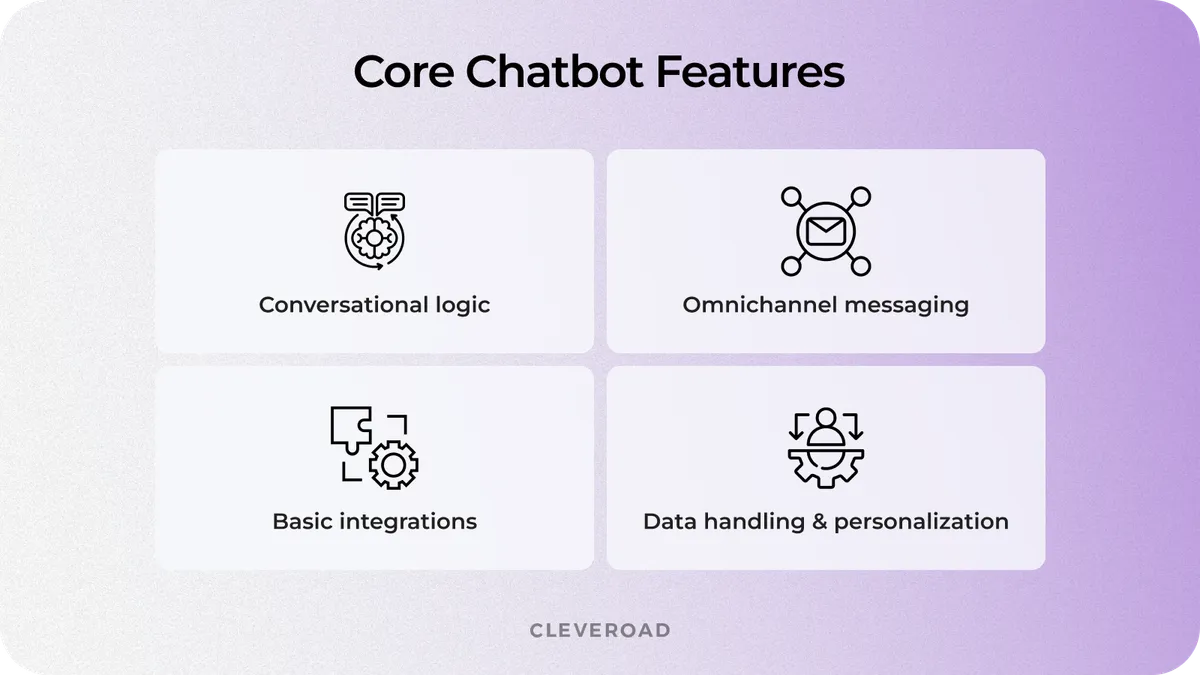
Core features for chatbot creation
Examining these key add-ons can help streamline bot performance without breaking the bank. Although the AI chatbot cost depends on the features you want, integrations, and scalability, a well-planned solution easily pays for itself in overall efficiency and greater customer satisfaction.
Advanced chatbot features: higher cost impact
Advanced chatbot features go beyond core functionality and significantly increase development cost by adding complexity at the data, infrastructure, and logic levels. These capabilities are typically selected based on chatbot purpose, industry requirements, and expected scale.
Smart location services
Smart location services allow a chatbot to use geolocation data to personalize responses, suggest nearby options, or enforce region-specific rules such as pricing or availability. This feature increases costs due to external API usage, real-time data processing, and additional privacy and compliance requirements, especially in regulated regions. It is justified for use cases like delivery, travel, retail, or localized services where context-aware responses directly affect conversion or user satisfaction.
Order and transaction handling
Order and transaction handling enables a chatbot to place orders, process payments, manage refunds, or track transactions directly within the conversation. This functionality raises the cost of building an AI solution because it requires secure payment flows, backend integrations, error handling, and strict compliance with financial or data protection standards.
It is typically justified for eCommerce, fintech, and on-demand platforms where the chatbot acts as an active transaction channel rather than a support tool.
Deep AI personalization
Deep AI personalization allows the chatbot to adapt responses based on user behavior, history, preferences, and predictive models rather than static rules. This significantly impacts the cost of building an AI system due to the need for high-quality data, model training, continuous optimization, and performance monitoring. Such personalization is justified when long-term engagement, retention, or recommendation accuracy directly drives business value, such as in enterprise platforms or data-intensive consumer products.
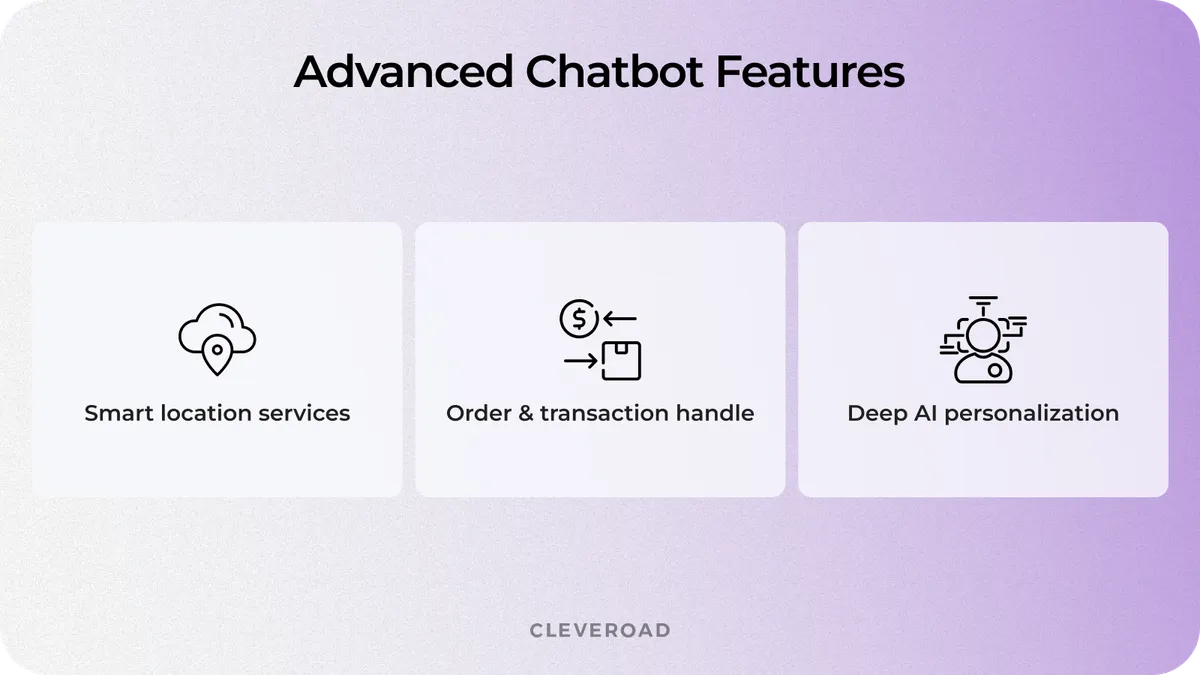
Advanced chatbot development features
Cost to Build a Chatbot: The Rough Estimate
The cost of building a chatbot depends on multiple variables, including feature scope, technical depth, and the complexity of the assistant itself. Chatbot creation costs range widely in practice, especially when moving from basic conversational flows to advanced AI-driven functionality.
The estimates below show how costs are usually distributed across the digital assistant’s features and supporting development activities. They are based on an average hourly rate of $50 in Central and Northern Europe and delivery by an experienced chatbot development company.
Functional scope of chatbot features
The functional scope determines what the chatbot can do, how it interacts with users, and how much logic and data processing it requires. Feature selection at this stage directly affects implementation effort and overall development cost.
The following breakdown illustrates the implementation effort behind core chatbot features that shape user-facing behavior and system intelligence, highlighting why chatbot development costs range depending on feature depth and technical complexity.
| Feature | Approx time (h) | Approx cost ($) |
|---|---|---|
Conversational logic | 80 h – 160 h | $4,000–$8,000+ |
Omnichannel messaging | 30 h – 70 h | $1,500–$3,500+ |
Basic integrations | 60 h – 120 h | $3,000–$6,000+ |
Data handling & personalization | 60 h – 100 h | $3,000–$5,000+ |
Smart location services | 40 h – 80 h | $2,000–$4,000+ |
Order & transaction handling | 80 h – 140 h | $4,000–$7,000+ |
Deep AI personalization | 80 h – 150 h | $4,000–$9,000+ |
Subtotal (features) | 430 h – 820 h | $21,500–$42,500+ |
Together, these capabilities shape the chatbot’s functional behavior and determine the level of automation and intelligence it can support. As feature depth increases, the system requires more complex data pipelines, tighter integrations, and AI-driven decision logic to operate reliably at scale.
Chatbot development and delivery work
Feature development alone does not represent the full scope of chatbot delivery. The activities listed here represent the non-feature development work needed to deploy, operate, and maintain a chatbot in production.
| Type of work | Approx time (h) | Approx cost ($) |
|---|---|---|
UI/UX design | 100 h – 200 h | $5,000–$20,000+ |
Quality assurance and testing | 300 h – 600 h | $15,000–$50,000+ |
DevOps and deployment | 80 h – 180 h | $8,000–$30,000+ |
Project management and coordination | 150 h – 300 h | $12,000–$40,000+ |
Combined feature implementation and delivery activities typically require around 1,400 hours of work, resulting in an estimated project cost of about $70,000+ for a mid-to-advanced chatbot solution. Actual budgets may vary depending on security, compliance, performance requirements, and long-term support needs.
Remember, the price above is approximate. It's hard to tell how much does it cost to build a chatbot without project details. Feel free to contact our Senior Business Analysts to get a consultation and request project cost estimation.
How to Reduce the Cost of Chatbot Development
As it becomes clear, many aspects can increase the price. But what can you do to lower the financial pressure? In this section, we'll cover some practical and proven tools that will help you reduce your chatbot development cost.
Using ready-made AI toolkits and agent builders
One of the most effective ways to reduce chatbot development costs for LLM-based solutions is to build on top of ready-made AI toolkits instead of developing the entire agent infrastructure from scratch.
Cleveroad works with modern agentic AI builders such as Amazon Bedrock AgentCore, Google AgentKit, and OpenAI Agent Kit to create production-ready chatbots faster and at a lower cost. These toolkits provide prebuilt components for orchestration, memory, tool calling, and safety controls, which eliminates the need to implement core agent mechanics manually. That’s why our specialists can focus on business logic, integrations, or user experience rather than low-level AI infrastructure when building virtual assistants.
Check our chatbot development guide to learn more about the development steps and architecture behind a chatbot.
MVP development
If you want to launch a product faster so that it starts generating revenue, it's a great idea to start by creating a MVP. This way, the team builds a lean version of the basic chatbot that contains the minimum required set of features. Later, after you get the first customer feedback, you can add more advanced features. If you build a chatbot with standard features first, this approach allows you to significantly reduce the initial cost of AI chatbot development.
Outsourced development
When it comes to the chatbot pricing model, the cost of its development plays an important role. In order to find an option with the most acceptable quality-price ratio, it is worth looking at outsourced software providers. This way you can get a number of advantages as follows:
- A wide selection of regions with a variety of hourly rates — you can easily find the most acceptable price for you. For example, it is worth paying attention to Central and Eastern Europe (CEE Region). This area is known for its cost-effectiveness and many software companies that charge $50-$80 per hour while providing a high level of competence.
- A vast array of specialists in different areas — you're sure to find someone who will make the perfect solution faster when assembling a team for building a chatbot in-house.
- A lot of outsourcers on the market — for example, there are more than 10000 companies on the Clutch platform.
- Choice of cooperation models for your needs — for example, you can augment your team with required specialists or hire a dedicated development team.
- Access to a wide range of technologies for implementation — outsourcing companies are much more likely to find specialists who are experienced working with different technologies
Partnering with our outsourcing team means gaining access to top-tier expertise at competitive rates, ensuring you get the perfect balance of quality and cost-efficiency for your business requirements and chatbot development needs.
A real-world example of this approach is our collaboration with AVFX. In the video below, the client explains how Cleveroad offered the best price-quality ratio compared to other vendors and delivered a high-quality solution without compromising technical standards or delivery speed.
AVFX & Cleveroad: A Successful Technology Partnership - Client Testimonial
Natural Language Processing
Using Natural Language Processing (NLP) allows your tech partner’s experts to improve how an AI-powered chatbot understands user intent without overengineering conversation logic. Instead of hardcoding every scenario, NLP enables conversational AI patterns that adapt to real user input, which helps control the complexity of the chatbot as it grows. From a cost perspective, leveraging a ready or fine-tuned AI model reduces the cost of chatbot development compared to building advanced language understanding entirely in-house.
NLP is justified when the chatbot must handle varied phrasing, ambiguous requests, or multi-step conversations, but it should be introduced selectively. Overusing NLP in simple use cases can increase the price of creating a chatbot without delivering proportional value.
Existing code reutilizing
Reusing existing code components is another practical way to reduce development effort and avoid building a chatbot from scratch. This includes shared authentication modules, integration connectors, conversation templates, and deployment scripts that have already been tested in production. Code reuse lowers implementation risk, shortens delivery time, and reduces the need for repetitive AI integration work across projects.
This approach is especially effective for long-term products with ongoing updates, where maintenance and hosting costs are calculated per month. By relying on proven components, IT vendor teams can focus resources on business-specific logic instead of recreating foundational elements, which keeps overall development costs predictable.
How Cleveroad Can Help You in Chatbot Development
Cleveroad is a professional company that has been providing software development services for more than 15 years. Our team delivers chatbot development solutions for businesses across Healthcare, FinTech, Education, Logistics, Tourism, and other industries. The Cleveroad staff is based in Central and Northern Europe with R&D centers in Estonia, Poland, Norway, the US and Ukraine.
By creating a chatbot with Cleveroad, you can get a lot of benefits:
- You'll be able to choose the cooperation option matching your needs the best: IT staff augmentation, dedicated development team, Project-Based model.
- Our specialists use modern agentic AI toolkits (e.g., AWS Bedrock AgentCore, OpenAI AgentKit, etc.) and proven components to reduce development time without limiting flexibility.
- Our team carries out complete quality control at all stages of your chatbot development proved by the ISO certificate 9001:2015 for quality management.
- We start with structured Solution Design Workshop and Discovery Phase services to validate chatbot development requirements, user flows, and technical assumptions early.
- Our experts use cross-platform development, third-party service integration, and APIs to reduce development costs and provide you with a top-quality end product.
Let us demonstrate our experience in building AI-powered chatbots by sharing one of our real estate app development projects.
A real estate company from Australia approached Cleveroad to improve how buyer and renter inquiries were handled across web and mobile channels. Their sales team faced a high volume of unqualified leads, slow response times, and heavy manual work during the pre-sales stage.
Cleveroad built a custom AI chatbot for real estate lead qualification that automated initial conversations, asked structured screening questions, and captured key buyer intent data such as budget, property type, and timeline. The chatbot routed qualified leads directly to sales and filtered out low-intent inquiries.
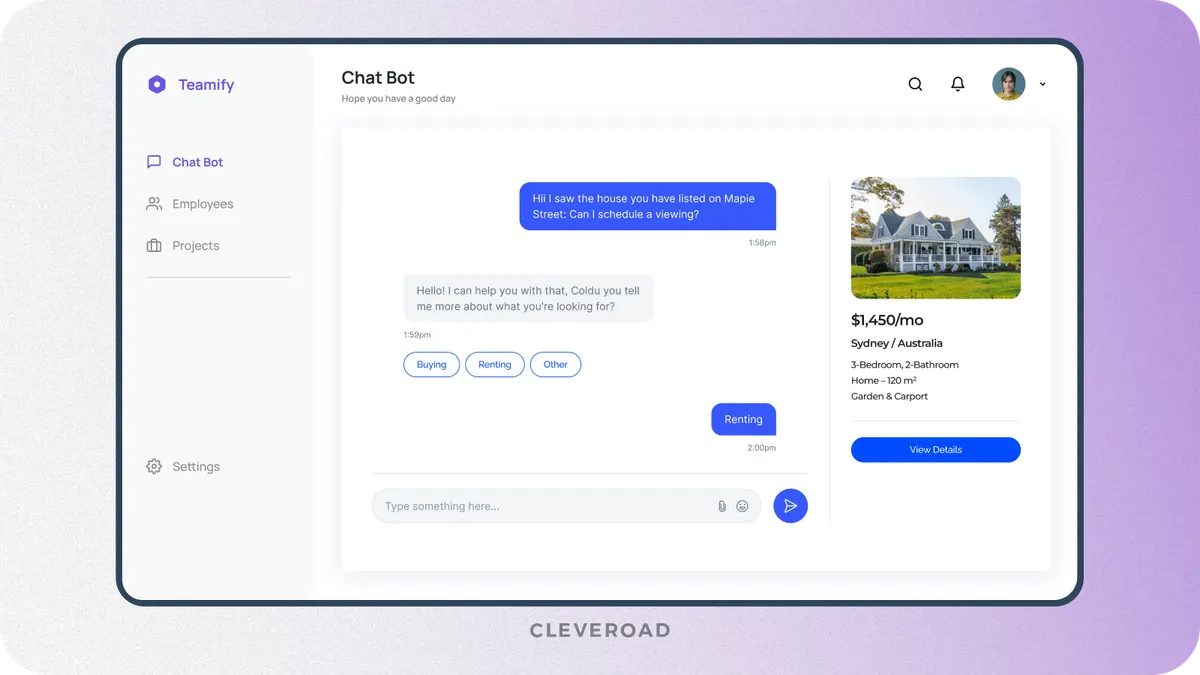
AI chatbot for real estate lead qualification developerd by Cleveroad
As a result, the client reduced manual lead handling by 60%, improved response quality, and increased sales team efficiency with a scalable pre-sales automation solution available around the clock.
If you need to create a chatbot, contact our experts. They will be able to advise you and create a product that will satisfy your customers. A quality chatbot is a huge step ahead of your competitors to boost the success of your business flows.
Improve your business with custom domain chatbot
Our experts with 15+ years in chatbot development will assess your use case, define the right architecture, and provide a realistic cost estimate tailored to your business goals
There's no one-size-fits-all answer to this question. On average, chatbot development costs vary from $40,000 to $150,000+. The price heavily depends on the factors like business goals, types of your chatbot, data analysis, etc.
An AI-based chatbot (e.g. built on IBM Watson, Google Dialogflow, etc.) will typically be more costly than a simple bot built into a chatbot platform. Different platforms can be loaded with chatbots, typically a custom AI chatbot costs anywhere from $5,000 to $150,000+. To manage costs, evaluate your needs, compare the capabilities of AIs and select the software that strikes the right balance between features and cost.
It costs anywhere between $1,000 and $150,000+ to build a chatbot, depending on types and complexity. Businesses use chatbots for different purposes including customer support, internal automation, or AI-powered interactions — all of which affect development costs.
If a chatbot is less complex and does not need AI or other advanced integrations, then the cost will be much lower, especially in the case of chatbots on platforms like Facebook messenger or WhatsApp.
The chatbot development cost can range from $40,000 to $50,000+ and depends on the set of features you need and the tools you use.
With the help of special platforms, you may build a chatbot in a couple of hours. However, this chatbot will be short of features and have strict user limitations. That's why it's better to go for a custom solution. Depending on the complexity of features and amount of platforms for integration, it may take from 100 to 500 hours to build a chatbot.

Evgeniy Altynpara is a CTO and member of the Forbes Councils’ community of tech professionals. He is an expert in software development and technological entrepreneurship and has 10+years of experience in digital transformation consulting in Healthcare, FinTech, Supply Chain and Logistics
Give us your impressions about this article
Give us your impressions about this article
Comments
1 commentsLike