How Much Does It Cost to Build a Marketplace Website [Full Estimate]
Updated 30 Mar 2026
13 Min
8475 Views
Wondering what the marketplace app development cost is? The exact price depends on various services that aren't cheap, and your idea could run into the tens of thousands of dollars. For anyone who wants to know the cost of building a marketplace website, our comprehensive guide shows prices feature by feature and the total cost of building across different regions.
To put it simply, the cost of building an online marketplace ranges from $41,000 to $281,000 or more. The cost will depend on the complexity of the features. At $50 per hour, the average price will be:
- Simple online marketplace: $41,000-$80,000
- Medium online marketplace: $80,000 - $150,000
- Complex online marketplace: $150,000-$280,000 and more
Please note the numbers are approximate; every marketplace business is unique and should be estimated individually. So, read our article to find out exactly what factors affect cost and how much your particular marketplace idea could cost you.
What Is an Online Marketplace Concept and Why Is It Beneficial?
An online marketplace is an e-commerce platform that aggregates products or services from multiple third-party vendors, offering users a wider selection, flexible pricing, and a built-in shopping cart. Despite differences in marketplace models, each marketplace website includes a centralized system to manage operations, clear terms for vendor cooperation, such as commissions and service standards, and well-defined processes that enable sellers to list and trade their offerings efficiently.
Marketplace website monetization models
The marketplace business model should be carefully selected if you plan to cover the cost of creating an online marketplace website. Let's list what options you have to make your business fruitful.
Fee from each transaction
This type of monetization is highly appreciated by the sellers who place their products. This is because, when operating under these terms, they are not charged by the online platform until they generate their first revenue. For the marketplace owner, this is also convenient, since all cash flows are handled and processed by the web solution.
Membership fee
This model assumes that specific (or all) users of the marketplace are obliged to pay a set fee to access the platform and to attract new audiences or providers. In contrast to the approach above, this type is well suited to an online platform that offers expensive products or services.
Ads posting fee
Online stores that aggregate a vast number of ads are described as using a pay-per-placement monetization model. Its concept is similar to the posting of paid ads. This model is a brilliant choice when the supplier would like to expand its capacity to engage a broader client base, and the platform can ensure a sufficient audience. The ad-fee business model is also beneficial for the B2B segment.
Customer contact fee
Paying the owner for contacting the customer or generating leads is a popular business model used by many modern marketplace platforms. Their users leave requests and wait for offers and responses from appropriate vendors. The marketplace charges a fee to connect a performer with a potential client interested in the performer's services.
Extended features fee
The essence of this monetization model is that the consumer can use the service's basic marketplace functions for free and pay for advanced features if desired. Also called freemium, this type differs from a trial version, in which the user gets free access for a set period. This model allows you to use the site's essential functionality without time restrictions.
Featuring ads fee
Featuring is an opportunity for vendors to reserve a more beneficial placement for their product or service. This model is similar to advertising. Yet, in this case, as a rule, ads are placed on the site for free, and vendors can pay the marketplace to get their listings in higher, more-viewed positions on the website, such as the home page or the top positions in certain categories.
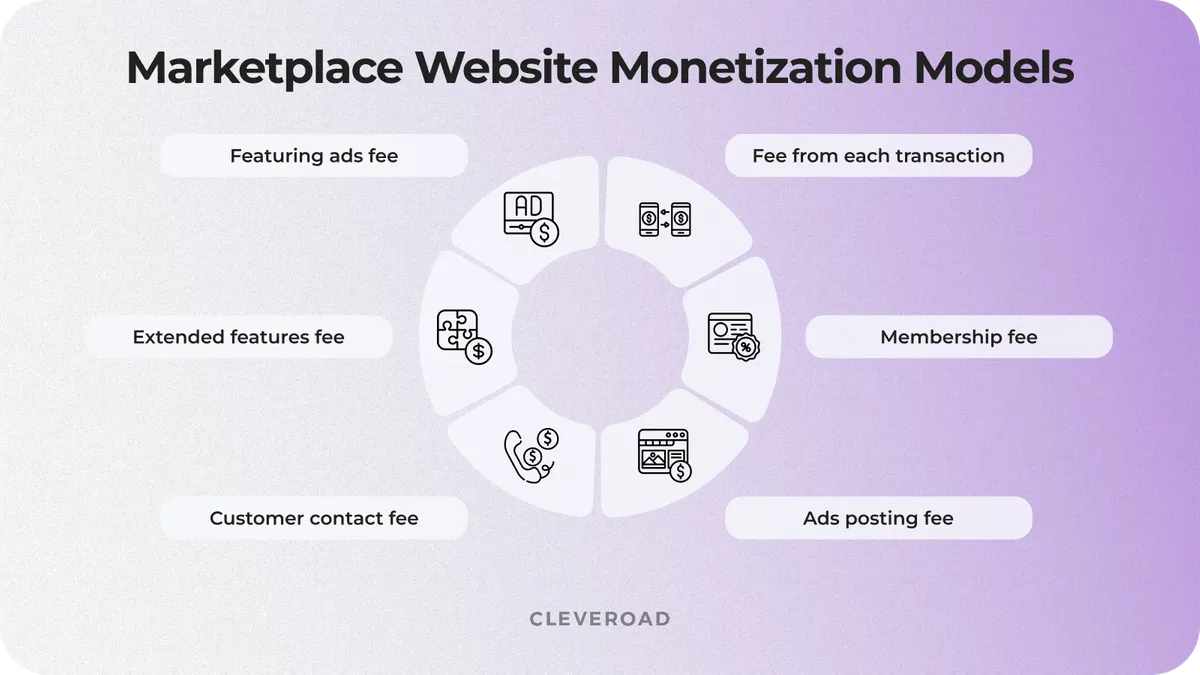
Marketplace website monetization models
Types of Online Marketplace Solutions
Before we jump right into how much it costs to start a marketplace, let’s see the examples of marketplace types. It is important because the kind of marketplace determines its functionality, the complexity of its web or app development, and, consequently, the cost.
Let’s take a more detailed look at types of online marketplace solutions.
Types of marketplace websites by business model
A marketplace website allows platforms to differ based on how broadly they cover products and audiences. The business model defines the scope of offerings, target users, and competitive strategy, all of which are core principles of platform-based systems. (Source: MDPI)
- Vertical marketplace. Focuses on a specific niche or industry. It offers specialized products or services tailored to a particular audience, such as healthcare, real estate, or travel platforms.
- Horizontal marketplace. Covers a wide range of products across different categories but targets a specific type of user or need. For example, platforms that sell a variety of goods for businesses or specific lifestyles.
- Global marketplace. Provides a broad selection of products and services for a wide audience without niche limitations. These platforms operate at scale and support multiple vendors and regions.
Types of marketplace websites by participants
Marketplace platforms can also be classified based on who interacts within the system. This model defines how transactions occur between different user groups.
- B2B (business-to-business). Connects companies that sell products or services to other businesses. These marketplaces often involve bulk orders, long-term contracts, and negotiated pricing.
- B2C (business-to-consumer). Allows businesses to sell directly to individual customers. This is the most common model, focused on convenience and personalized shopping experiences.
- C2C (consumer-to-consumer). Enables individuals to sell products or services to other individuals. These platforms typically support peer-to-peer transactions, often with built-in review.
Our marketplace development services cover various e-commerce solutions types. Learn how we can help you in creating your own online marketplace idea
Factors Affecting the Cost of Building a Marketplace Website
Various factors influence the overall cost to build a marketplace app, such as platform complexity, technology stack, developers’ hourly rates, and more. So now, let’s discuss the most common marketplace website and cost drivers.
Development approach
The cost and flexibility of your marketplace depend on the development approach you choose. This is a key factor if you want to estimate how much does it cost to build an online marketplace. Each option balances speed, customization, and long-term scalability.
No-code / SaaS platforms ($100–$500/month + setup). The fastest and most affordable way to launch. Platforms like Sharetribe or Kreezalid provide ready-made functionality instead of building from scratch, allowing you to start with minimal upfront investment, often under $5,000 per year.
Open-source solutions and templates ($10,000–$30,000). Built on platforms such as WooCommerce or Magento, this approach offers greater flexibility through plugins and themes. It requires additional development effort but allows for better customization than SaaS tools.
Custom development ($40,000–$150,000+). A fully tailored solution built from scratch by a development team. This option provides maximum control, scalability, and security, making it suitable for complex, high-load, or unique marketplace platforms.
Marketplace app complexity
Marketplace app complexity is one of the most crucial parameters in determining the cost of a website development. Consequently, a simple marketplace MVP would be restricted to catalog displaying and checkout processes, which makes it less expensive but also greatly deficient in features. Medium-level solutions include multi-vendor marketplace services, possibly enhanced filtering, and third-party integrations. Complex marketplace apps must scale horizontally in marketplace architecture, resulting in orders-of-magnitude higher development costs.
Check the approximated cost estimation for different marketplace complexities:
| E-marketplace complexity | Features | Cost ($) |
|---|---|---|
Simple platform | User authentication, product listings, basic checkout | $41,000-$80,000 |
Medium platform | Multi-vendor support, advanced search, payment | $80,000 - $150,000 |
Complex platform | AI-driven recommendations, real-time analytics, custom dashboards | $150,000-$280,000+ |
Custom UI/UX design
Your platform design also affects the cost of creating an online marketplace. There are two types you can choose from - ready-made templates and custom designs.
Let’s discuss them in more detail with estimated costs:
- Ready-made templates – $5,000-$15,000+. Ready-made templates tend to be less expensive than custom UI/UX design services, but they have limited customization, making it difficult to create a unique product that immediately evokes brand associations.
- Custom UI/UX – $30,000+. Designing a marketplace website like Amazon from scratch requires more resources and time to deploy, including UI/UX branding, wireframing, prototyping, and testing.
So, custom UI/UX requires a higher cost to design and build your marketplace than ready-made templates for online marketplaces, but a custom design offers more opportunities for branding, increases brand awareness, and improves customer loyalty.
We’ve discussed how much does it cost to design a mobile app in our article. Check out to learn more
Technology stack
To determine how much it costs to develop a marketplace website in 2026, you should first identify the essential features. Some features developers can build from scratch using programming languages, frameworks, and libraries, while others can be implemented faster with third-party APIs. An IEEExplore study shows that there’s a good chance the product creation will require implementing in-app search (Elasticsearch), payments (Braintree, Stripe), and online chat (Firebase). Each integration requires unique resources and the developer’s expertise, so it will increase the cost of marketplace development.
Here are some technologies we typically use for e-commerce and retail software development:
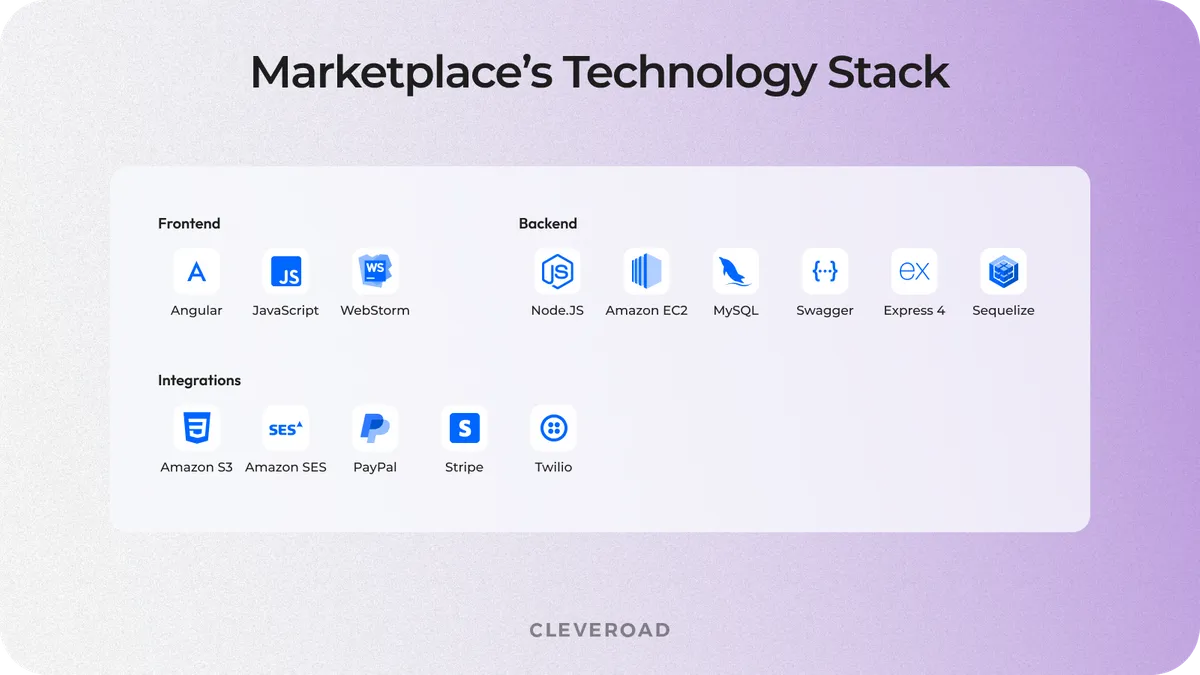
Marketplace’s technology stack used by Cleveroad’s team
Cooperation option
The cooperation option you choose directly influences the cost of building a marketplace website. You can choose between in-house development and outsourcing.
The in-house team requires you to hire skilled developers, designers, and project managers. This approach provides full control over development but consumes a lot of expenses, including salaries, social benefits, office space rent, hardware, and software licenses.
Outsourcing to an experienced IT vendor, also called dedicated team development services, significantly reduces the cost of creating an online marketplace while ensuring quality. It’s possible because you can hire qualified developers in a country with a lower cost of living and, hence, hourly rates. Also, such cooperation gives access to the global talent pool – you can hire any expert from anywhere in the world.
We’ve comprehensively compared in-house vs outsourcing software development. Read our article to learn more.
Specialists' hourly rates
To determine the cost of developing an online marketplace, you need to know the specialists' hourly rates. They greatly differ depending on the region you want to get experts from. Let’s look in more detail at the online marketplace specialists’ hourly rates by region.
| Online marketplace specialists | CEE | Western Europe | North America | South America | Asia | Australia |
|---|---|---|---|---|---|---|
Software developers | $30-$100 | $50-$150 | $60-$180 | $30-$80 | $15-$70 | $40-$140 |
UI/UX designers | $40-$80 | $70-$120 | $80-$140 | $40-$70 | $20-$60 | $60-$100 |
Business analysts | $50-$90 | $80-$130 | $90-$150 | $50-$80 | $30-$70 | $70-$120 |
Solution architects | $60-$110 | $90-$160 | $100-$180 | $60-$90 | $40-$80 | $80-$140 |
QA engineers | $25-$70 | $40-$100 | $50-$120 | $30-$60 | $10-$50 | $30-$90 |
DevOps experts | $40-$90 | $60-$130 | $70-$150 | $40-$70 | $20-$60 | $50-$110 |
Project managers | $50-$100 | $70-$140 | $80-$160 | $50-$80 | $30-$70 | $60-$130 |
This table shows that North American and Western European providers increase the overall marketplace app development cost due to higher salaries. In contrast, IT outsourcing Eastern Europe can reduce development expenses without sacrificing the product's level of quality.
Hosting and maintenance
Hosting and maintenance affect the cost of starting a marketplace. To understand the amount of expenses you may need for this part, here is a list of the monthly prices of popular web hosts:
- AWS: 100$ – 500$+
- Google Cloud: 100$ – 400$+
- DigitalOcean: 40$ – 200$+
- Shared Hosting: 10$ – 50$+
A high-traffic marketplace website like eBay requires cloud hosting for scalability and uptime guarantees, which increases costs. A budget-conscious marketplace website may start with shared or VPS hosting before upgrading as traffic grows. Regular maintenance, bug fixes, and security updates add $5,000–$20,000+ annually to operational costs.
Tips to Reduce Marketplace Website Cost
There are many ways to reduce the cost of developing an online marketplace – from working with a trusted marketplace website development partner to adopting an Agile SDLC. Let’s take a closer look at the key tips for reducing marketplace website costs.
Work with a trusted marketplace development partner
Choosing the correct development partner directly affects your marketplace development cost. A reliable vendor streamlines the workflow and prevents costly errors, improving product quality and on-time, on-budget delivery. An experienced marketplace development vendor understands the costs involved in developing an online marketplace and provides you with the most adequate solutions.
Also, it is important to look for a partner with proven experience, whose portfolio must show. Don’t forget to check vendor client reviews on platforms such as Clutch to assess the quality of their services.
Select a suitable engagement model
The selection of an engagement model also impacts the cost of developing a marketplace. To maximize the collaboration efficiency with Cleveroad for our clients, we offer a row of adjustable cooperation models:
- Dedicated Team. By working with a dedicated team, you get top-class developers with a comprehensive experience in the industry you need. You can expand your team with additional specialists, gather an agile-oriented team for a new project, or maintain and update the existing one.
- IT staff augmentation. IT Staff augmentation services let you onboard external developers with the necessary domain competencies on a temporary basis. You can augment your in-house team with the specialists you need who have experience in your business domain, or hire a few specialists solely dedicated to your product.
- Custom development. This cooperation model ensures that you receive end-to-end software development services. We handle all development processes, and you get a tailored marketplace solution aligned with your startup’s needs.
Prioritize MVP development
Marketplace Minimum Viable Product (MVP) development is also a method to lower the cost of building online marketplace platforms. Instead of investing upfront in a feature-rich product, focus on addressing core functionalities that solve pivotal users' problems.
Deciding to build an MVP, you get the opportunity to check your idea and make improvements to your product. Such an approach prevents you from wasting resources on features that will not add appropriate value. Thanks to this, you create a marketplace that meets real customer needs without additional expenses. After successfully launching the MVP, consider more advanced features.
Optimize the marketplace for SEO
Search Engine Optimization (SEO) will also help reduce long-term marketing expenses. It helps improve visibility and minimize the need for expensive paid advertising. An ideally optimized marketplace, however, will gain organic search traffic and will not depend much on paid promotions.
We at Cleveroad build websites with SEO in mind to lay the foundation for cost-effective promotion. With 15+ years in the IT market, Cleveroad has helped many entrepreneurs optimize their products.
We provided dedicated development team services to our client - a company from the USA called NURSING. The core idea behind NURSING.com is to solve the nursing shortage by improving and simplifying education. Their platform has 300,000+ students. NURSING.com was listed among the Inc. 5,000 Fastest-Growing Private Companies in America (319th place) and featured on Fast Company's World Changing Ideas list as well.
Cleveroad developed a new web solution to replace their outdated one, making it SEO-optimized and aligned with the NURSING marketing team's requirements (according to Google Page Speed Insights) to drive more traffic to their website.
See what Daniel Jones, CTO at NURSING, says about cooperation with Cleveroad:
Daniel Jones, CTO at NURSING. Feedback about Cleveroad's Dedicated Development Team Services
Follow Agile SDLC
Agile SDLC development allows for continuous improvements, faster releases, and efficient use of costs. It removes unnecessary features, improves adaptability, and optimizes average cost in creating a marketplace website and mobile app. Following Agile methodology also minimizes rework and maximizes the efficiency of the available budget.
Use an AI-assisted development approach
AI-assisted development helps you launch a marketplace faster and with fewer wasted hours. By automating repetitive work and supporting technical decisions, it reduces delivery time and development cost without lowering quality.
Faster development cycles. AI accelerates routine engineering tasks such as code generation, testing, and documentation updates. Teams release features faster and shorten time-to-market
Lower development costs. Automation reduces time spent on repetitive work and manual processes. Teams focus on high-value features instead of routine tasks, which lowers overall project costs Improved code quality and consistency. AI detects errors early, highlights code issues, and enforces shared development standards. This results in cleaner code and a more consistent codebase
Stronger scalability planning. AI supports architecture decisions by analyzing growth scenarios. Teams design systems that handle more users and transactions without expensive rework
Cleveroad provides AI-assisted development services that combine human engineering expertise with AI tools to improve delivery workflows, reduce avoidable effort, and build marketplace solutions that are ready to scale.
Cleveroad’s Experience in Marketplace Web Development
Cleveroad is a skilled marketplace software development company headquartered in Estonia, Central and Eastern Europe.
With 15+ years of experience, we provide robust and flexible marketplace software services, including custom marketplace development, software modernization, third-party integrations, and digitalization and optimization. The Cleveroad team develops optimized marketplace solutions that increase traffic, boost conversion, and grow sales. We also build custom marketplaces, such as B2C, B2B, C2C, P2P, multi-vendor, market network, and services marketplace.
To prove our expertise, we'll shoe you one of our recent cases. We’ve developed a P2P marketplace called AYIO for our client from Switzerland. The main idea of the AYIO app was to provide users with an opportunity to find a specialist in different fields – from travel to plumbing. The Cleveroad team was challenged with the following tasks:
- Adjusting quick switching between two roles to provide users with high-quality service
- Providing UI and UX that should be as simple and intuitive as possible
- Creating a functional and user-friendly platform remaining within the budget for MVP
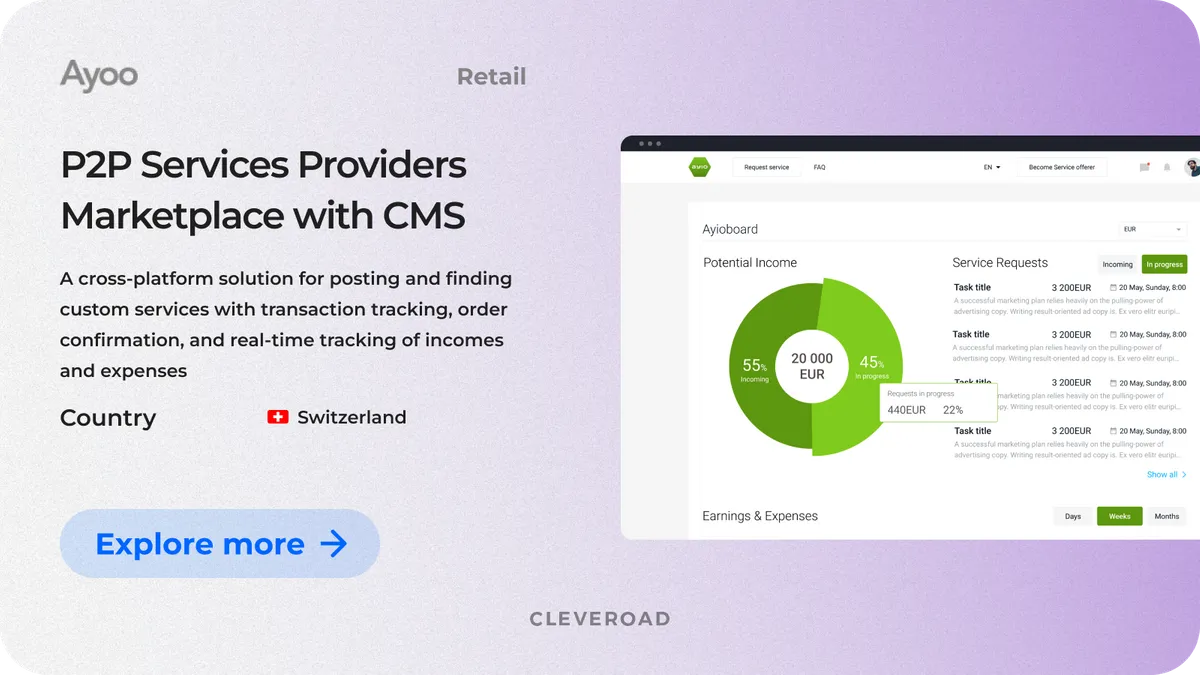
P2P marketplace developed by Cleveroad
We provided a customer with an online marketplace solution that enabled them to build a service with a good-looking UI/UX and high performance. Their platform includes a complex search system, a custom payment account, and real-time tracking of income and expenses.
See what the client has to say about collaborating with Cleveroad on the marketplace creation:

 Switzerland


Marketplace development cost varies from $41,000 to $281,000 and higher. The overall cost of building a marketplace from scratch depends on the project's complexity, features, and the region where you hire developers.
Marketplace website development cost depends on the type you choose. The online marketplace involves such types:
- Vertical that occupies one area or niche
- Horizontal that offers goods from a few categories with a secondary character in common
- Global that offers items or services from a wide range of categories
There are such factors that affect the marketplace website development cost. Let’s look from what the costs of the marketplace depend on:
- Marketplace app complexity
- Custom UI/UX design
- Technology stack
- Cooperation option
- Specialists' hourly rates
- Hosting and maintenance
There are such tips to reduce the costs of a marketplace website in 2025:
- Work with trusted marketplace development partner
- Select a suitable engagement model
- Prioritize the minimum viable version of your marketplace
- Follow Agile SDLC
- Optimize marketplace for SEO

Evgeniy Altynpara is a CTO and member of the Forbes Councils’ community of tech professionals. He is an expert in software development and technological entrepreneurship and has 10+years of experience in digital transformation consulting in Healthcare, FinTech, Supply Chain and Logistics
Give us your impressions about this article
Give us your impressions about this article
Comments
2 commentsReally Nice information, which help me to get an idea of costing.
Wow! That’s actually not what I expected. It’s quite easy and affordable. Thanks for gathered information!