How to Make a Question and Answer Website in 2026: Benefits, Build Steps, and Monetization
Updated 06 Mar 2026
17 Min
15861 Views
How to build a question and answer website in 2026? A scalable Q&A platform requires structured knowledge architecture, community incentives, smart moderation, and a clear monetization model from day one.
If you plan to build a Q&A website like Quora, focus on the following steps:
- Define niche and business model
- Choose a development method for Q&A site
- Select a cooperation model for website development
- Define platform requirements and system architecture
- Design user experience and contribution flow
- Develop core features and implement Quality Assurance
- Launch, seed content, and optimize growth
In this guide, you will learn how Q&A websites work, what benefits and risks they bring, how to approach development step by step, which monetization models are relevant in 2026, and how much it may cost to launch such a platform in this guide. At Cleveroad, we have delivered community-driven and knowledge-based solutions across Healthcare, Education, Logistics, and FinTech domains. The insights shared below are based on our hands-on experience in building scalable platforms.
What Is Quora-Like Website and How Does It Work?
A Quora-like website is a community-driven knowledge platform where users ask questions, publish answers, evaluate contributions through voting mechanisms, and build a reputation based on expertise and engagement. Its core value lies in structuring user-generated content into searchable and topic-based knowledge that scales over time.

How to make a question and answer website: Quora interface
How does a Q&A website work?
A Q&A website turns community discussions into an organized knowledge base. The workflow begins when a user posts a question. Other members submit answers, and the platform ranks them using voting signals and reputation metrics. This ranking system highlights the most accurate responses while preventing low-quality content from dominating results.
Unlike traditional forums, Q&A websites prioritize structured answers that remain useful over time. The system highlights the best answer and makes it a permanent reference for future visitors. Such an approach allows platforms such as Stack Overflow or Quora to accumulate large knowledge libraries that attract continuous search traffic.
The functional architecture of a Q&A website typically includes the following parts as: content structure, community reputation models, moderation workflows, search architecture.
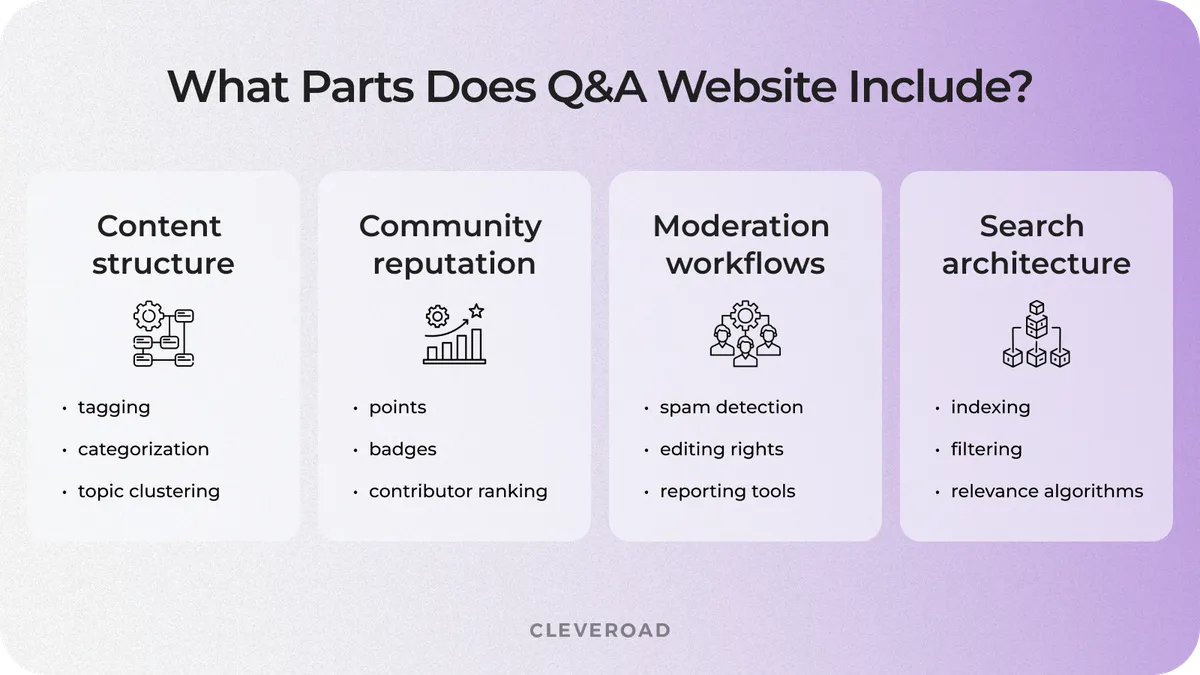
What parts does Q&A website include?
This architectural foundation enables the platform to scale to a knowledge engine that drives user retention, organic search traffic, community engagement, contributor participation, and long-term content value.
What types of Q&A websites exist?
Q&A platforms vary depending on the audience they serve and the type of knowledge they organize. So, if you plan to build a question and answer website, you should start by defining what type of community interaction or knowledge workflow the platform should support.
- Public knowledge communities. Open platforms such as Quora or Stack Overflow where users ask questions across many domains. Voting systems, reputation scores, and moderation help highlight the correct answer and surface the most useful responses.
- Industry-specific expert communities. These are platforms focused on a single domain such as programming, healthcare, or finance. Contributors often follow established best practices for asking questions, validating answers, or organizing knowledge.
- Corporate knowledge platforms. Such internal Q&A systems help users document expertise and solve operational questions faster. Corporate knowledge platforms are integrated directly into a company website or internal portal.
- Customer support Q&A platforms. Communities for customers built around a product where users help each other resolve issues. Many modern systems also include an automated bot that suggests existing answers before a new question is submitted.
- Educational Q&A platforms. These are learning environments where students discuss course material and instructors expand on complex topics. Some platforms allow instructors to make a quiz or run an interactive quiz alongside discussion threads to reinforce learning.
To keep discussions consistent as the knowledge base grows, many platforms rely on a structured page template for questions and answers. Scalable question-and-answer website solutions typically combine this structure with robust tagging systems and moderation workflows, as well as search indexing.
Major Benefits and Drawbacks to Make Question and Answer Website
Building a Q&A website can create long-term value by transforming community discussions into a searchable knowledge base. Over time, this content attracts organic traffic and supports peer-to-peer problem solving within the community.
We’ll examine both the key benefits and potential drawbacks that companies from different domains should consider before launching a Q&A platform.
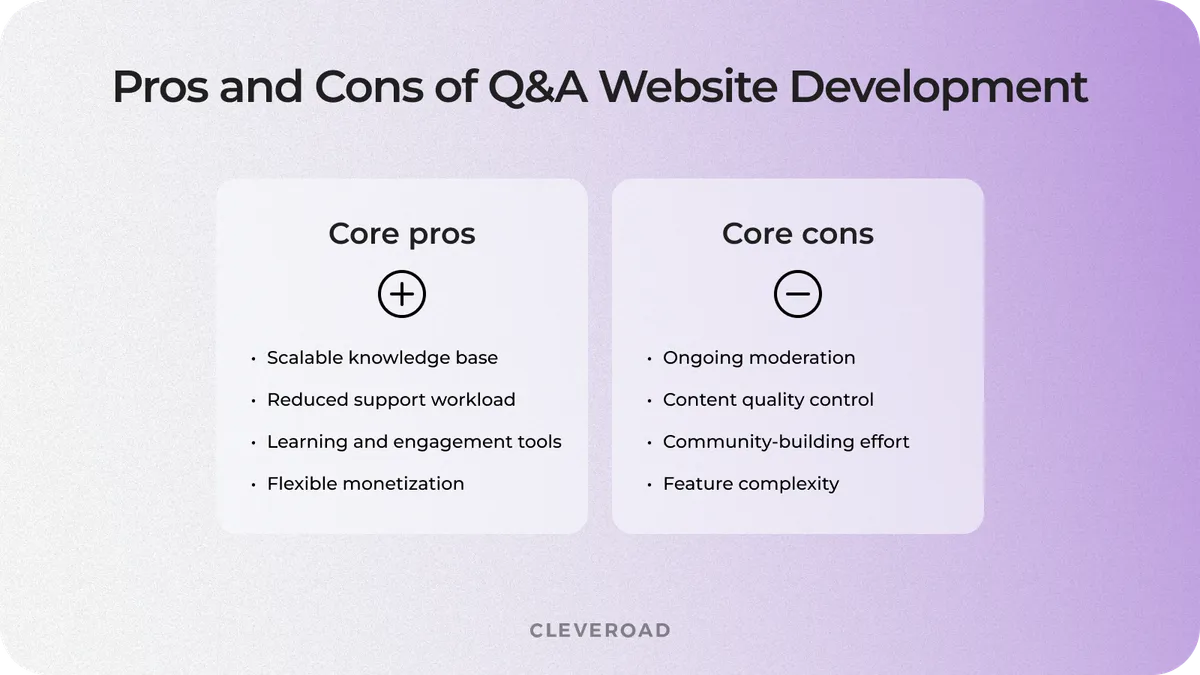
Benefits and drawbacks of question & answer website building
Core pros of Q&A website development
Developing a Q&A platform helps you support users at scale and create a continuously growing information resource. When implemented correctly, such platforms strengthen community engagement while reducing operational overhead.
So, let’s consider the core advantages that make Q&A platforms an effective tool for knowledge sharing and user engagement.
Scalable knowledge base. A Q&A platform accumulates answers over time and turns them into a searchable knowledge library. Many organizations that create a question and answer website use it to document expertise and reduce repetitive support requests.
Lower support workload through self-service. Users can find solutions independently instead of contacting support teams. This benefit allows your organization to resolve common issues through existing discussions and verified answers.
Additional learning and engagement tools. Many platforms expand beyond simple discussions by adding training features. For example, administrators can publish quizzes or short tutorials to reinforce knowledge sharing within the community.
Flexible monetization opportunities. Q&A platforms can generate revenue through premium features, advertising, or subscription models for advanced access, expert content, or professional communities.
Core cons of Q&A website development
Despite their advantages, Q&A platforms also introduce operational and technical challenges. Without proper governance and platform design, content quality and user trust may decline.
Continuous moderation requirements. Communities generate large volumes of content that require active review and moderation. Moderators often need tools to review posts and review posts, removing spam or inaccurate answers.
Quality control challenges. Ensuring that discussions produce reliable answers is not always straightforward. Low-quality contributions or outdated information can reduce the credibility of the Q&A platform.
Initial community building. A Q&A platform provides value only when enough contributors participate. Organizations building a Q&A website must invest in expert participation early on.
Feature complexity and product scope. As the platform evolves, additional tools, such as a additional learning tools such as quiz modules, may be added to increase engagement, which expands development scope and maintenance effort.
The benefits of Q&A platforms often outweigh their challenges when the system is supported by strong moderation policies and structured content management. Moreover, Q&A functionality can be especially powerful for educational platforms. When combined with learning tools such as quizzes and structured discussion threads a Q&A website turns into an interactive educational environment where learners not only consume information but also actively exchange knowledge.
How to create educational website for your organization? Read our guide and consider!
Step-by-Step Guide to Building a Scalable Q&A Website
Building a scalable Q&A website requires more than a discussion interface. The platform must combine community governance, structured content management, and search architecture so that questions and answers remain discoverable as the knowledge base grows.
The steps below outline how to design, develop, and launch a Q&A platform capable of supporting an active community and long-term knowledge accumulation.
Step 1. Define niche and business model
Before you build a question and answer website, it is important to clearly define the platform’s niche and business model. These decisions determine who will use the platform and what type of problems the community will solve. A focused niche helps users quickly answer a question by connecting them with people who share relevant expertise. It also allows the platform to develop a recognizable brand that differentiates it from large general communities.
To build a strong foundation, platform owners should analyze the following factors:
- Target audience. Identify who will ask and answer questions and what expertise they bring to the platform.
- Value proposition. Define what makes the platform unique and why users should choose it over competitors.
- Monetization strategy. Consider revenue sources such as advertising, premium content, or paid access.
- Competitive analysis. Evaluate existing platforms and identify gaps in their functionality or user experience.
- Content seeding strategy. Prepare initial discussions so the platform does not appear empty at launch.
In the early stages, many product owners seed the platform with structured content such as expert discussions, a poll, or a simple knowledge test where users can create a quiz using a predefined quiz template. The interface can also include elements such as a sidebar that highlights trending topics or curated questions.
Step 2. Choose a development method for a Q&A site
After defining the platform concept, the next step is choosing the development approach. The two most common options are custom development and AI-assisted development, each offering different levels of flexibility, cost, and scalability. The choice depends on factors such as technical requirements, expected user growth, and long-term product strategy.
The differences between these approaches become clearer when comparing their typical use cases, advantages, and limitations in the table below:
| Development method | Best for | Key advantages | Limitations |
CMS-based development (WordPress + Q&A plugins) |
|
|
|
AI-assisted development |
|
|
|
Custom development |
|
|
|
Step 3. Select a cooperation model for Q&A website development
After defining the product idea and development method, the next step is choosing how the platform will be built. Most companies decide between assembling an internal development team and partnering with an external vendor experienced in building community platforms. The cooperation model can affect how quickly you make a question and answer website operational and ready for user growth. It also significantly influences the overall cost, as it affects how efficiently the product team can implement advanced features like real-time notifications, moderation tools, and AI-based automation.
Let’s find out more about the cooperation model to choose for your successful Q&A website development:
| Cooperation model | Advantages | Limitations |
In-house development |
|
|
Outsourcing to a software vendor |
|
|
Many companies across different domains choose outsourcing because experienced vendors already have the specialists required to build question and answer website solutions. When evaluating a vendor, companies should review technical experience and a portfolio of relevant projects delivered in similar domains. It is also important to check reputation, client reviews, technical expertise, and the vendor’s ability to provide a stable team capable of handling project development from the early stages to release and post-launch activities.
Cleveroad is an outsourcing web development vendor with over 15 years of experience delivering custom software solutions for businesses worldwide. Our teams help companies launch scalable digital products, including community platforms, marketplaces, and social media solutions.
Here is what Sarah Timm, CEO of Parthenon, says about the staff augmentation services we provided during their product development journey:
Sarah Timm, CEO of Parthenon. Feedback about Cleveroad's IT staff augmentation services
Step 4. Define platform requirements and system architecture
The platform concept must be translated into a clear technical blueprint. This process usually starts with Discovery phase services, where business analysts and solution architects analyze your business idea and define how your platform will function from both user and technical perspectives.
During this phase, the development team defines the core components of the platform architecture:
- Functional requirements. Features such as question posting, tagging, voting, and answer validation that help surface the one answer most relevant to a user’s question.
- Non-functional requirements. Performance, security, and system reliability for growing communities.
- Moderation logic and reputation system. Mechanisms that maintain answer quality, sometimes supported by AI moderation or a chatbot that guides users before they post.
- Data model and search architecture. The structure that allows users to quickly find relevant answers.
- Scalability planning. Infrastructure that supports tools such as multiple choice quizzes, integrations with a free online quiz maker, or learning features where instructors can create your quiz.
Step 5. Design user experience and contribution flow
User experience plays a critical role in the success of any Q&A platform. The first step is designing an interface that makes it easy for users to participate without unnecessary complexity. When people can quickly post questions, respond to discussions, and search for solutions, they are more likely to remain active contributors. A well-designed platform should feel intuitive, even for first-time users.
There are several UX principles especially important for Q&A platforms. Low-friction posting ensures users can submit questions with minimal effort, while intuitive tagging helps categorize discussions for future discovery. Clear reputation visibility allows contributors to see how their activity affects their standing in the community, while voting simplicity helps surface the best responses to a query. Designers also prioritize mobile-first design to ensure the platform works smoothly on smartphones, where many users participate in discussions.
Step 6. Develop core features and implement QA
Once the design and architecture approved, the tech partner starts the development of the platform features. The experts typically follow Agile methodologies, working in short development cycles that allow them to release new functionality step by step. This approach helps organizations create question answer website platforms that evolve based on feedback and real user behavior.
At this stage, developers implement core platform functionality while QA engineers ensure stability and reliability. QA processes include manual testing, automated testing, and performance validation to identify issues early. Some platforms also include learning tools such as a quiz generator, which can expand community engagement through educational content. Modern platforms may also support integrations that allow administrators to import datasets or export community insights for analytics and reporting.
Below is an example of a technology stack commonly used to build scalable Q&A platforms:
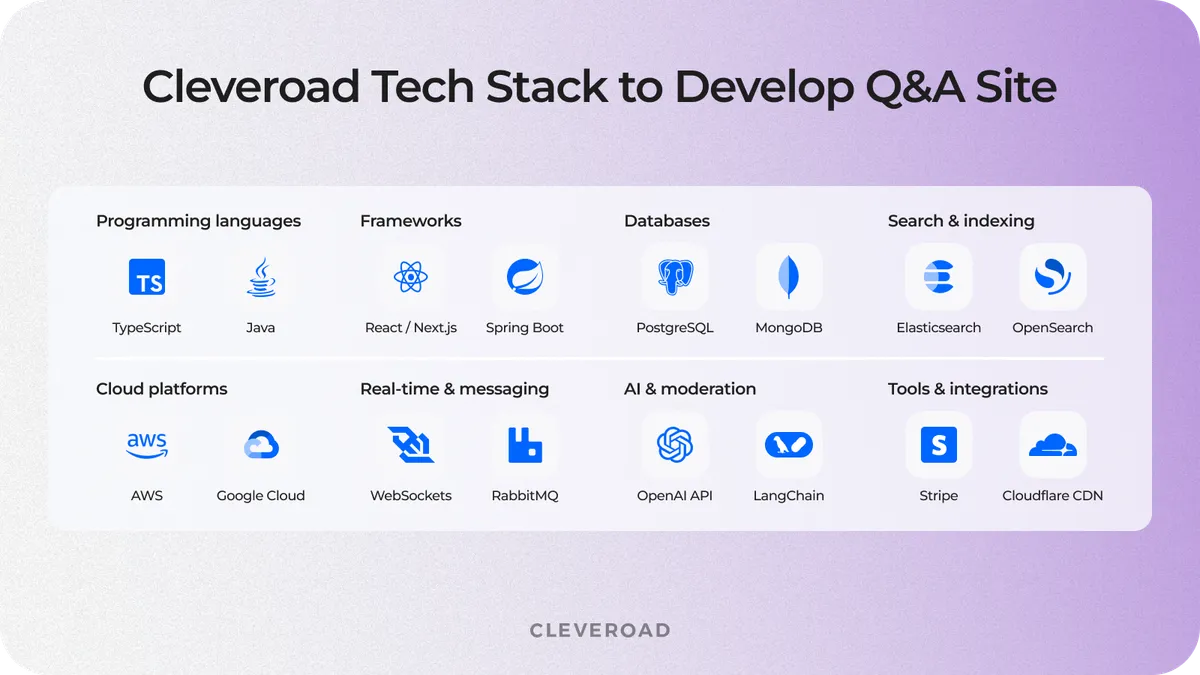
Cleveroad tech stack for question and answer site development
Step 7. Launch, seed content, and optimize growth
When development and testing are complete, the Q&A platform moves to the launch stage. Many organizations begin with a controlled beta release that allows early users to test the system and provide feedback.
At the same time, you can start seeding the Quora-like solution with initial questions and expert answers to prevent the “empty platform” problem. Inviting industry specialists and publishing high-quality discussions helps attract early users and establish credibility. Growth strategies often include SEO optimization, analytics tracking, and performance monitoring to ensure the platform scales effectively as the community expands.
Core Features to Build Question and Answer Website
A well-designed Q&A platform requires several essential features that allow users to ask questions and contribute knowledge efficiently. These capabilities also help maintain content quality and organize discussions, supporting community growth as the platform scales. When planning to build a website like Quora, it is crucial to understand the features you need to build a successful, scalable platform.
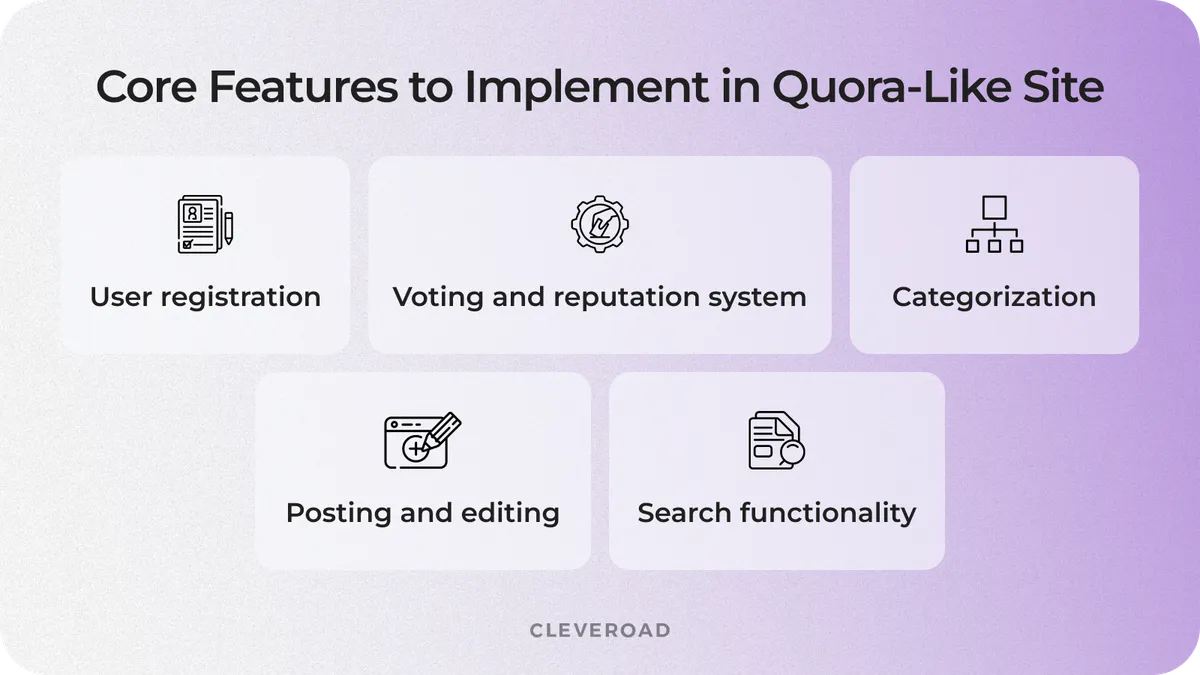
Core features to implement in a Q&A website
User registration and profiles
A Q&A website should allow users to create accounts through email registration or social authentication providers such as Google or Facebook. Customizable user profiles help track participation history, questions asked, answers provided, and reputation points earned within the community. Profiles also strengthen trust, as contributors can demonstrate their expertise and build credibility over time. This makes it easier for contributors to engage with others and collaborate on solving user queries.
Question posting and editing
Users must be able to post questions easily and update them when additional information becomes available. Hyperlinking to other relevant questions or articles enriches and informs discussions. Editing capabilities allow authors to clarify the problem, correct mistakes, or add supporting materials such as links or images. This feature helps maintain the accuracy and relevance of discussions as new knowledge appears, addressing user pain points such as outdated or incomplete answers.
Search functionality
Efficient search functionality allows users to quickly find existing answers before submitting a new question. Predictive search suggestions and autocomplete, as well as relevant query results, help reduce duplicate content and guide users to previously solved discussions. A strong search engine becomes one of the main entry points for organic traffic, making the platform more accessible and easier to navigate.
Voting and reputation system
When you create a question and answer website, voting mechanisms allow your community to identify the most useful answers. Users can upvote helpful responses or downvote less relevant ones, helping the platform highlight the best contributions. A reputation system rewards active contributors and motivates users to provide high-quality answers. This system also helps support center functionality by making it easier to identify trustworthy contributors who can moderate or assist others.
Content categorization and tagging
Questions should be organized by categories, topics, or tags to simplify navigation. A structured tagging system helps users explore discussions related to specific domains and improves content discoverability across the platform. Customizable tags also allow users to focus on areas of interest, enabling efficient browsing and participation. Proper categorization also supports search functionality and keeps the knowledge base well-organized.
These core features form the functional foundation of a successful Q&A platform. When combined with scalable architecture and thoughtful user experience design, they transform simple discussions into a structured knowledge ecosystem. If you’re planning long-term growth, consider that investing in professional web development ensures the platform can support center operations, handle increasing traffic, and evolve to meet user needs as new pain points arise.
Discover Cleveroad's web development services to build scalable Q&A platforms and knowledge portals, tailored to your business needs
What Monetization Models to Choose After Q&A Website Development?
According to the most recent research from Resourcera, Quora has about 400 million monthly active users and was valued at $1,8 billion. The platform has been open to advertisers since 2016. Let’s discover the most practical ways to monetize a growing Q&A community like Quora.
Contextual advertising
Contextual advertising is one of the most common monetization strategies for Q&A platforms. Once you make a question and answer website with a growing user base, relevant ads can be displayed next to discussions related to specific topics. Because users search for answers to very specific questions, contextual ads can match their interests and provide higher engagement rates. This model works especially well for platforms with large volumes of organic search traffic.
Premium analytics for contributors
Some Q&A platforms offer advanced analytics tools for experts and frequent contributors. These tools allow users to analyze the performance of their answers and understand audience engagement, identifying trending topics. Premium analytics can help professionals position themselves as industry experts while gaining deeper insights into their audience.
B2B lead generation model
Q&A websites can also serve as powerful lead generation channels for businesses. Companies often participate in discussions related to their expertise, answering questions or sharing valuable insights with the community. Over time, this activity builds credibility and helps attract potential clients who are searching for solutions. Platforms can monetize this model by offering sponsored answers, expert profiles, or verified company accounts.
AI-powered research reports
Another emerging monetization model involves transforming community knowledge into structured research insights. By analyzing large volumes of discussions, platforms can generate trend reports, industry insights, or market intelligence. When you create question answer website platforms that collect valuable domain knowledge, AI tools can summarize this data into premium reports. These reports can then be sold to businesses interested in industry trends, user needs, or emerging technologies.
Choose the monetization model that best fits your business goals for your Q&A website. Contact us to explore the most effective options and how we can help implement them for your platform’s growth.
How Much Does It Cost to Develop a Q&A Website For Your Business?
The cost to develop a Q&A website typically ranges from $10,000 to $150,000+, depending on the platform's complexity, the features you require, the development method you choose, and other factors. Simple platforms with basic functionalities such as question posting and voting may cost less, while more advanced platforms with AI-powered moderation, custom user experiences, and mobile responsiveness will be on the higher end of the spectrum.
Now, let’s explore the key cost-forming factors and why outsourcing to a vendor in Central and Northern Europe can be a cost-effective choice.
Key cost-forming factors to create question answer website
Understanding the core price-building aspects to develop a Q&A platform will help you make an informed decision about your platform's scope, required features, as well as the best development approach. Below, we’ll outline the primary factors that affect the overall cost of building a Q&A website, so you can plan your budget accordingly.
| Development stage | Estimated cost | Description |
Basic Q&A platform | $10,000 - $25,000+ | Basic features like question posting, voting, or search |
Intermediate platform | $25,000 - $50,000+ | Includes more advanced features like user profiles, reputation systems, and integrations with third-party services |
Advanced platform | $50,000 - $150,000+ | Full-featured platform with AI-powered moderation, advanced analytics, real-time notifications, and mobile responsiveness |
Why hiring a Q&A site development vendor is a cost-effective option?
Choosing the right development partner is just as important as defining the platform features. The expertise of the vendor, their development processes, and the availability of skilled engineers can significantly influence both project cost and product quality. For many companies building community platforms or knowledge hubs, outsourcing development becomes a practical way to access experienced teams without the overhead of building an internal department.
One of the most popular outsourcing destinations today is Central and Northern Europe, where companies can find a strong combination of technical expertise, reliable development practices, and competitive pricing. Countries such as Estonia, the Baltic region, Poland, and Ukraine have become well-known technology hubs supporting international software projects.
Key advantages of working with vendors from this region include:
- High talent density. Strong engineering education systems and large pools of experienced developers.
- Cost–quality balance. Competitive development rates compared to Western Europe or North America while maintaining high technical standards.
- Mature tech ecosystem. Established outsourcing companies with experience delivering scalable web platforms for global clients.
- Reliable collaboration. Cultural compatibility with Western markets, and well-established remote work practices.
Because of this combination of expertise, pricing, tech ecosystem, and collaboration culture, many businesses choose development partners from Central and Northern Europe to build scalable platforms such as Q&A websites.
Why Choose Cleveroad For Web Development
Cleveroad is a custom web development company based in the Central and Northern Europe region. For over 15 years, we have helped businesses build complex web platforms, including community-driven solutions, knowledge portals, social networking sites, and Q&A websites that support growing user bases and structured knowledge sharing.
Working with Cleveroad means gaining a technology partner that supports your product from concept validation to development and long-term platform scaling. Our experts combine engineering expertise with modern development practices to turn your business ideas into reliable web solutions.
By partnering with Cleveroad, you receive the following benefits:
- End-to-end web development services from discovery and solution architecture drafting to development and post-launch support
- Experienced product team: business analysts, solution architects, developers, designers, and QA engineers working as a dedicated unit
- Trustworthy web development partnership with certifications in both ISO 9001:2015 for quality management and ISO/IEC 27001:2013 for security of information
- Security and quality assurance at every stage: testing and performance validation throughout the development lifecycle
- Proven delivery experience: 200+ successfully launched web products across Healthcare, Education, FinTech, Logistics, and other industries
Our experience in building knowledge-based, community-driven platforms enables us to design scalable Q&A websites with advanced moderation, search, and reputation systems. If you're planning to launch a platform that connects experts, builds communities, and transforms discussions into structured knowledge, Cleveroad can help bring your product to market efficiently.
Ready to build your scalable Q&A website?
Start creating a high-performing Q&A website. Contact us to discuss your requirements and get expert assistance in developing your custom solution in no time
If you plan to build a Q&A website like Quora, focus on the following steps:
- Define niche and business model
- Choose a development method for Q&A site
- Select a cooperation model for website development
- Define platform requirements and system architecture
- Design user experience and contribution flow
- Develop core features and implement Quality Assurance
- Launch, seed content, and optimize growth
The price always depends on your project requirements and business goals. It can vary from $10,00, to $150,000+.
There’s a list of features you should implement answering how to develop an app Quora for web or a website:
- User registration and profiles
- Question posting and editing
- Search functionality
- Voting and reputation system
- Content categorization and tagging
- Contextual advertising
- Premium analytics for contributors
- B2B lead generation model
- AI-powered research reports

Evgeniy Altynpara is a CTO and member of the Forbes Councils’ community of tech professionals. He is an expert in software development and technological entrepreneurship and has 10+years of experience in digital transformation consulting in Healthcare, FinTech, Supply Chain and Logistics
Give us your impressions about this article
Give us your impressions about this article
Comments
4 commentsExcellent blog. I am a business analyst and your blog posts are the best knowledge source for me. I hope you will publish more blogs like this....
Nice
Nice information
Nice blog.