How to Create an Investment App in 2026: Steps, Features, and Cost
Updated 18 Nov 2026
18 Min
5415 Views
Investing has moved from brokers’ offices to the smartphone. Anyone who opens an investment app today expects quick onboarding and fractional shares, with fees clear enough to understand at a glance. The hardest part of the product stays behind the screen: licenses, broker integrations, bank connections, and the security controls that protect money and personal data.
At Cleveroad, we have been building FinTech products for startups and financial companies for 15+ years and have delivered 200+ successful projects. Our team has built portfolio management platforms, robo-advisory solutions, micro-investing apps, and crypto investment platforms. In this guide, we share what we have learned about how to create an investment app, from picking the app type to budgeting your first release.
Key takeaways
- The type of investment app you build defines the licenses and integrations you need, how deep the features go, and how soon you can launch.
- A focused investment app MVP covers KYC onboarding, bank linking, a portfolio dashboard, and basic buy and sell flows.
- An investment app MVP costs $90,000–$160,000 and takes 4–8 months; multi-market platforms start at $220,000.
- Third-party services for an investing app (KYC, market data, brokerage APIs, bank linking) add monthly operating costs on top of the build budget.
6 Common Types of Investment Apps
The investing market includes several distinct product models, each built around different user goals and asset classes. The type of app you choose defines which licenses you need and which features go into your first release. Our team covers all six app types within our investment software development services.
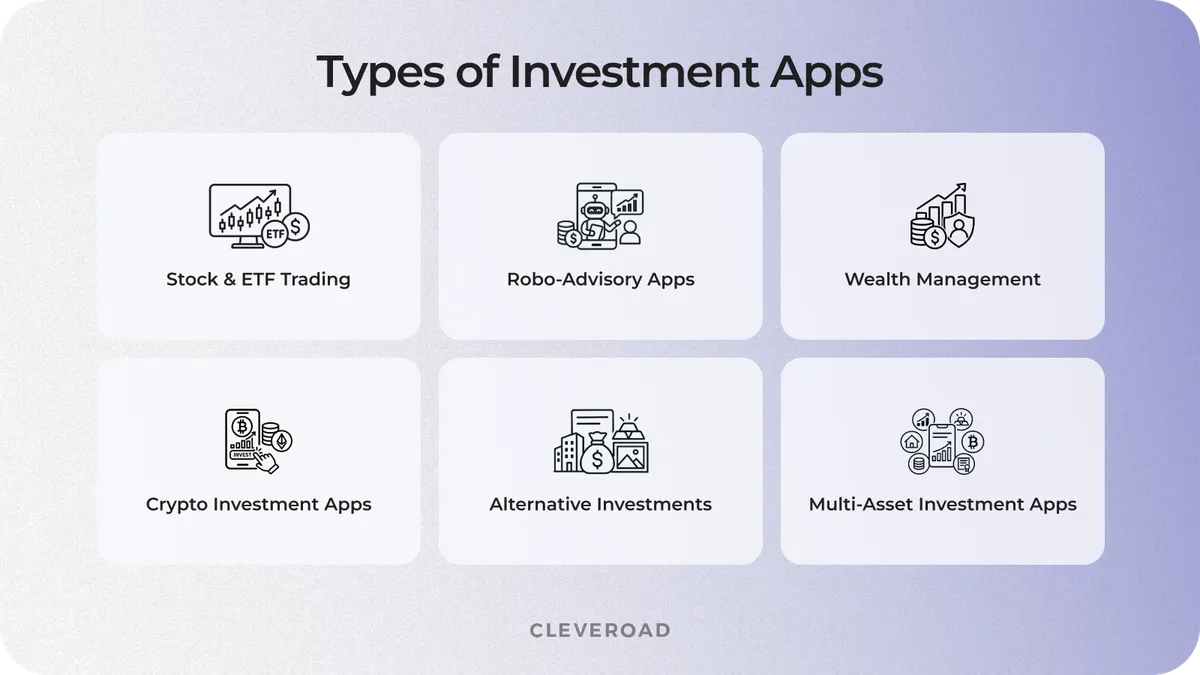
Types of investment apps
Stock and ETF trading apps
Self-directed platforms that enable users to trade public equities and ETFs with real-time data, advanced order execution, technical charting, and portfolio analytics. They suit active or semi-active investors who want direct market access and control over execution. To build one, you need an integration with a broker or clearing firm and a real-time market data feed, plus an order engine that supports several order types.
Robo-advisory apps
Automated investing platforms that build and rebalance portfolios based on user goals and risk tolerance. These solutions simplify long-term investing through algorithmic asset allocation, sometimes complemented by optional human advisory services.
Development focuses on a risk questionnaire and allocation engine that matches investors to model portfolios and automatically rebalances them when allocations drift.
Wealth management platforms
Comprehensive systems designed for high-net-worth individuals and professional investors. They support portfolio management, financial planning, tax optimization, and consolidated reporting across multiple accounts within a regulated framework.
Building one means pulling data from multiple accounts and custodians into a single view, with separate roles and permissions for advisors and clients.
Cleveroad's wealth management software development services can help you build a solution tailored to your business need
Alternative investment apps
Platforms offer fractional ownership of assets like real estate and art, with a focus on long-term growth and portfolio diversification.
Development requires a fractional ownership model and investor status checks, since some offerings are open only to accredited or professional investors. Every deal also needs its own document set that users review before they commit.
Hybrid multi-asset investment apps
Integrated platforms that let users manage multiple asset classes in a single interface, combining equities, funds, crypto, and selected alternatives. This unified model increases engagement and centralizes portfolio oversight.
The core development task here is a single portfolio model that tracks balances and performance across every asset class the app supports.
Cryptocurrency and digital asset apps
Platforms that enable users to trade and manage digital assets such as Bitcoin and Ethereum, often incorporating custody solutions, staking features, and regulatory compliance mechanisms. In regulated markets, integration with traditional finance infrastructure is increasingly common.
Development covers custody and wallet infrastructure, and every transfer needs transaction monitoring to meet anti-money laundering (AML) rules. If you plan a full trading venue rather than an investing app, look at our cryptocurrency exchange development services.
The table below compares the six types by target user, core functionality, and typical licensing.
| App type | Target user | Core functionality |
|---|---|---|
Stock and ETF trading | Active and self-directed investors | Real-time quotes, orders, charts |
Robo-advisory | Beginners, long-term savers | Goal-based portfolios, auto-rebalancing |
Wealth management | High-net-worth individuals, advisors | Multi-account reporting, planning |
Alternative investments | Diversification seekers | Fractional real estate, art, private deals |
Hybrid multi-asset | Mixed audiences | Several asset classes in one portfolio |
Crypto and digital assets | Crypto investors | Trading, custody, staking |
Steps to Create an Investment App
Building an investment product requires structured planning. If you are researching how to create an investing app that complies with financial regulations, you need a clear execution roadmap. Below is a practical framework that reflects how real FinTech platforms move from idea to launch.
Step 1. Run market research and define the product plan
Start by defining your target audience, as it directly affects feature depth and infrastructure load. Your target audience also determines which investment options your platform should support in the MVP, such as stocks, ETFs, crypto assets, or other instruments. For instance:
- Beginners expect automation and simple interfaces.
- Day traders demand advanced charts and complex order types.
- Long-term investors prioritize diversification and low fees.
Analyze direct competitors such as Robinhood, Acorns, eToro, or Betterment. Study their positioning, asset coverage, onboarding flow, and monetization structure. Your goal is not replication but differentiation. Combine competitor insights with emerging market trends to define your Unique Selling Proposition (USP).
You must also select a monetization model at this stage. The most common models include:
| Model | Description | Best for |
|---|---|---|
Commission per trade | Users pay a fixed or percentage-based fee for each executed transaction. | Active trading apps and brokerage platforms |
Subscription plans | Monthly or annual fee for access to trading tools or premium functionality. | Multi-asset platforms with advanced features |
Spread-based revenue | The platform earns on the price difference between buy and sell quotes. | Forex and crypto trading apps |
Payment for order flow | Revenue generated by routing trades to specific market makers. | US retail brokerage apps (banned in the EU, effectively prohibited in the UK) |
Asset management fees | Percentage fee charged based on assets under management (AUM). | Robo-advisory and automated investing apps |
Premium feature upgrades | Additional paid tools such as analytics, signals, or advanced reporting. | Hybrid and semi-professional trading apps |
Monetization impacts licensing requirements and even database architecture. For example, charging a fee on assets under management usually means you act as an investment adviser and need daily portfolio valuations to calculate that fee, while per-trade commissions and spreads are calculated inside the order flow.
Step 2. Handle compliance, licensing, and data protection
Your legal obligations depend on where you launch and which assets you offer. Above all, they depend on the role your company plays: a broker-dealer, an investment adviser, a crypto-asset service provider (CASP), or a technology provider. Many startups launch without their own brokerage license. They build the product on top of a licensed broker’s API (brokerage-as-a-service) and take responsibility only for the user-facing layer. The table below lists the key requirements in the US and the EU. Other markets run their own licensing regimes, for example, authorization by the Financial Conduct Authority (FCA) in the UK.
| Region | Requirement | Applies to |
|---|---|---|
US | Broker-dealer registration with the SEC and FINRA membership | Apps executing trades or holding client assets as broker-dealers |
US | Investment adviser registration (SEC or state) | Robo-advisory and advice-based apps |
US | Regulation S-P amendments (in force): incident response program, customer breach notice within 30 days | Broker-dealers, investment advisers, funding portals |
EU | MiFID II authorization | Brokerage, portfolio management, investment advice |
EU | MiCA CASP authorization (mandatory since July 1, 2026) | Crypto trading and custody apps |
EU | Any app processing EU users’ personal data |
Compliance planning must begin before development because it affects integrations, reporting logic, audit trails, and user data storage. If you are unsure how regulatory requirements affect your architecture, our IT consulting services can help you define the right compliance and security strategy before development begins.
Step 3. Select a FinTech development vendor
Choosing the right development partner reduces operational risk and accelerates delivery. Evaluate vendors based on four key factors:
- FinTech delivery experience: live investment or banking products in the vendor’s portfolio, ideally for your target market, with case pages you can check.
- Security and compliance expertise: certified information security management, such as ISO/IEC 27001:2022, and hands-on work with the rules of your markets, for example FINRA requirements in the US or MiFID II and GDPR in the EU.
- Integration experience with Know Your Customer (KYC), payment, and brokerage systems: the specific KYC vendors, payment gateways, brokerage APIs, and market data feeds the team has already connected.
- Transparency in estimation and roadmap planning: a feature-level estimate in hours and a roadmap with release milestones that you can track through regular demos.
Cleveroad has been delivering FinTech and investment solutions, including investment apps, for more than 15 years. Our clients range from startups and SMBs to enterprise businesses. We design secure architectures aligned with regulatory frameworks and implement platforms that handle high transaction volumes. Our clients consistently leave positive feedback about our collaboration, highlighting the team’s professionalism and strong dedication to achieving the best results.
One of our FinTech clients, Kirk Donohoe, CPO at Mangopay, shared their experience collaborating with us in this video testimonial:
Kirk Donohoe, CPO at Mangopay. Feedback about Cleveroad's FinTech Software Development Services
Step 4. Define the MVP feature set
Launching a focused Minimum Viable Product (MVP) reduces financial and regulatory risk. Core features of an investing app MVP typically include:
- User registration
- Identity verification through KYC
- Portfolio tracking dashboards
- Bank account linkage via providers such as Plaid
- Basic buy and sell flows with transaction history
Each feature must be documented as acceptance criteria that define expected behavior and edge cases. Advanced functionality such as social trading, derivatives support, tax optimization, or algorithmic trading tools should be scheduled for later releases. Clear prioritization protects the budget and accelerates time-to-market.
If you're unsure how to structure and validate your first release, explore our guide on how to build a minimum viable product to understand scope prioritization and launch strategy for regulated FinTech solutions.
Step 5. Choose the technology stack and plan integrations
When you develop an investment app, you need secure, scalable infrastructure. Select backend infrastructure that can handle low-latency transaction processing and ensure transactional consistency, and cloud infrastructure that supports high availability.
Integration planning is equally critical. Most platforms rely on third-party services such as KYC providers, payment processors, brokerage APIs, and real-time market data feeds. API reliability directly affects user trust, while integration pricing models influence long-term operational costs. Market data deserves special attention: for quotes and charts, work with licensed vendors such as Bloomberg or LSEG Data & Analytics, whose contracts cover display inside a commercial app. Exchanges also charge separate display fees for real-time quotes, so include them in your operating budget.
The licensing choice from Step 2 comes back here as a technical decision. For trade execution and asset custody, you can partner with a brokerage-as-a-service provider or build your own connection to a clearing firm. A brokerage API gets you to market faster and costs less at the start, because the partner already holds the licenses and clearing relationships. A direct clearing setup takes longer and needs its own licensing, and it lowers your per-trade costs only at high volumes.
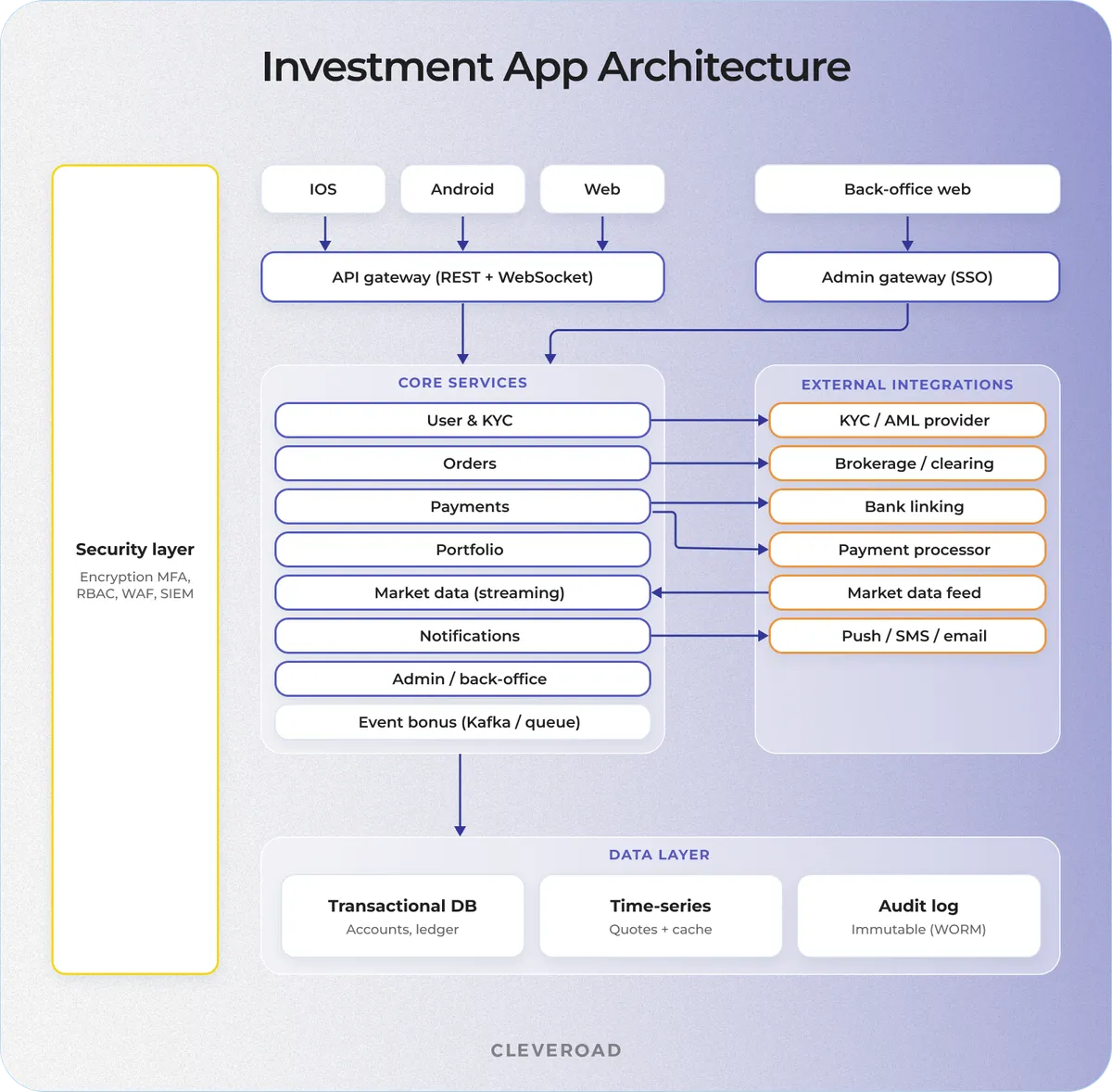
Investment app architecture.
Step 6. Develop the app and run security-focused testing
Development typically follows agile iterations with continuous QA involvement. Testing must include functional validation and load testing under peak trading conditions.
FinTech products require production-like staging environments before release. Final readiness checks should include security audits and penetration testing to ensure protection against unauthorized access and transaction manipulation.
Denis Chunikhin
Solution Architect at Cleveroad
"Most investment app MVPs we estimate start on a licensed broker’s API. Our clients reach the market months sooner, and moving to their own clearing setup becomes a business decision they make later, once trading volumes justify the licensing and integration effort."

Step 7. Launch, monitor performance, and maintain the product
App store release requires legal disclosures and operational readiness. After launch, teams must monitor transaction accuracy and user engagement to ensure operational stability.
Ongoing maintenance includes feature updates, regulatory adjustments, and regular security patches. Include maintenance planning in the initial budget, as investment platforms operate in dynamic financial and regulatory environments that demand continuous adaptation.
Essential Features to Make an Investment App
A competitive investment platform must balance usability, security, and regulatory compliance from the first release. The features below form the operational foundation of a reliable investing app.
User onboarding and identity verification
Secure registration with KYC and identity checks ensures regulatory compliance and reduces fraud risk from day one. This flow typically includes document verification, biometric validation, AML screening, and secure data storage aligned with regional legal standards.
Fast verification keeps users from dropping off before their first deposit. Combine the document check and the selfie check in one flow so users can finish in a single session, and save progress at every step so they can return later without starting over. Clear verification statuses, such as “in review” or “needs another document,” also reduce support requests.
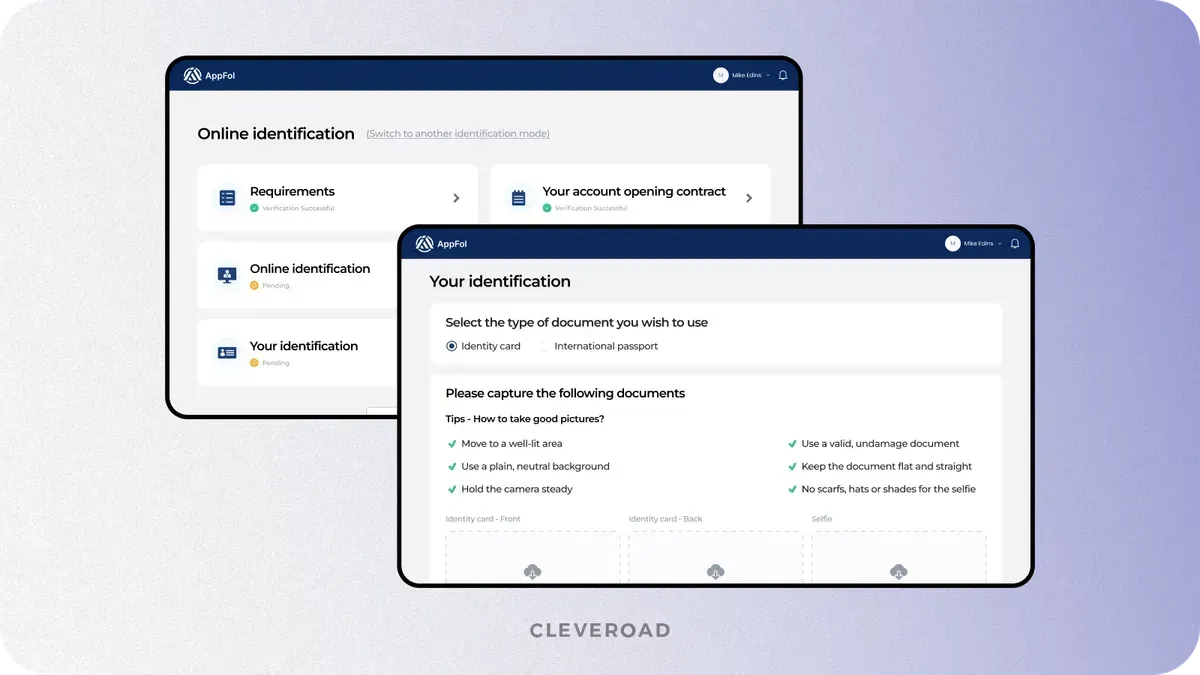
KYC check
Asset discovery and market data
Access to real-time or near-real-time quotes and basic analytics helps users explore investment opportunities before placing trades. Reliable data feeds and transparent price updates directly influence user confidence and engagement.
Search with filters by asset class or sector helps users narrow down thousands of instruments, and watchlists let them follow candidates before they buy. Label every quote as real-time or delayed, so users know how fresh a price is before they place an order.
Account and portfolio management
Users need a clear and structured overview of their assets, balances, historical performance, and transaction records across supported instruments. A well-designed dashboard improves trust and helps investors understand allocation, returns, and portfolio diversification at a glance within the app.
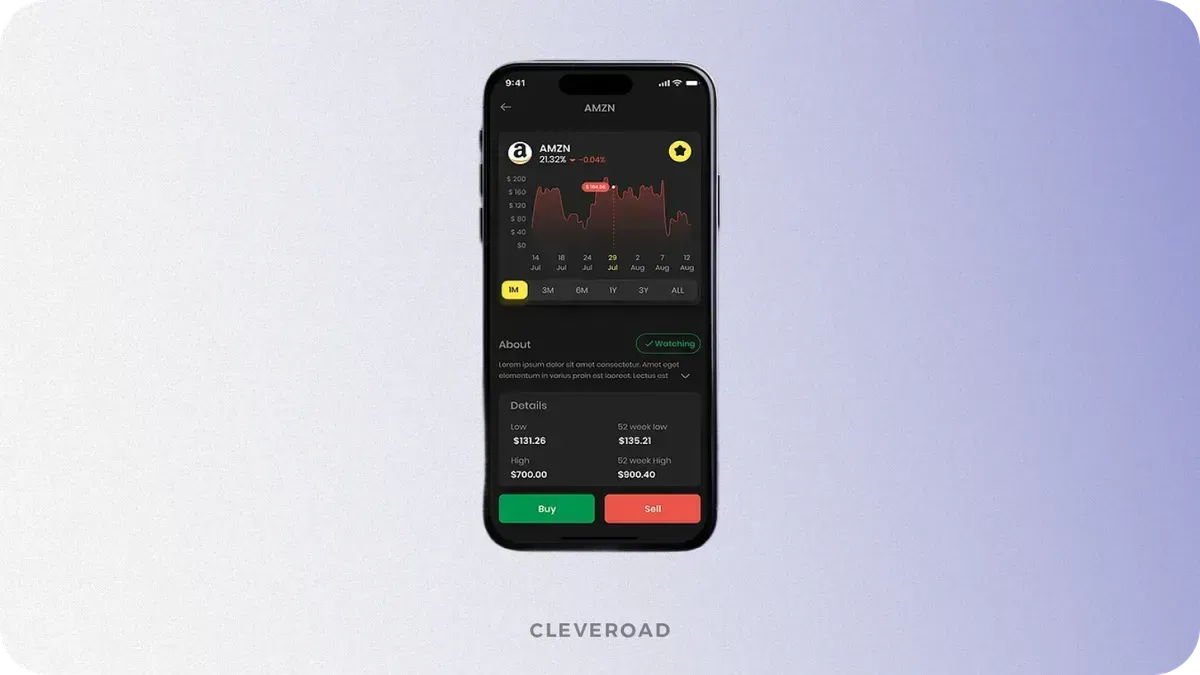
Auto Investing Portfolio Management
Trading and order execution
Core buy-and-sell functionality must support common order types, such as market and limit orders, with clear confirmations and real-time transaction status tracking. Fast and accurate execution is critical for both active traders and long-term investors.
Before an order goes out, show a confirmation screen with the estimated total, including fees. After that, the order status should update in real time from submitted to filled, and the app should notify users when an order fills only partially, so they know how many shares they actually hold.
Fractional shares and recurring investments
Fractional shares let users buy a stock for a set amount of money, for example $10 of a $400 share, instead of paying for a whole share. Recurring investments add automatic purchases on a weekly or monthly schedule from a linked bank account. Both features lower the entry barrier for beginners and help them build a habit of regular investing, which is why most retail-focused apps add them early.
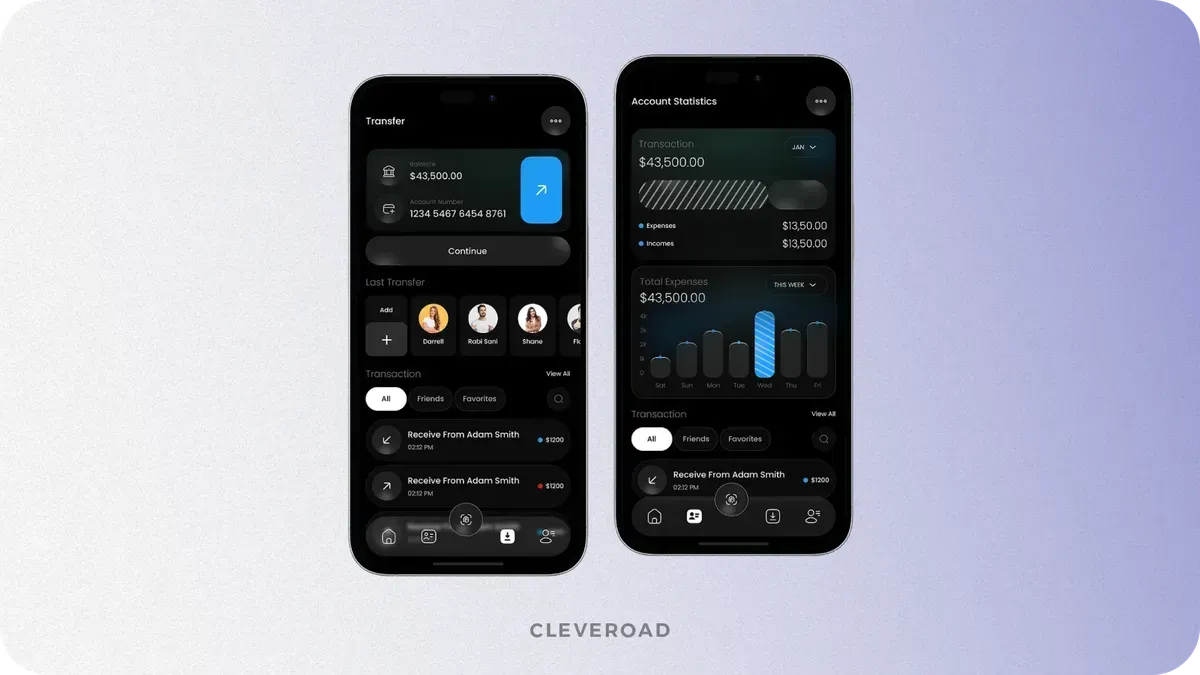
Payments and bank integration
Secure bank integration supports funding an investment account and internal transfers. Services such as Plaid are commonly used to simplify bank connectivity while maintaining security and regulatory alignment.
Funding an investment account
Security and access controls
Investment apps must implement strong encryption, secure authentication mechanisms, multi-factor verification, and role-based access controls. Continuous monitoring protects against unauthorized activity and suspicious transactions.
Compliance and reporting tools
Built-in regulatory reporting, audit logs, and automated document generation help businesses meet obligations imposed by financial authorities. Transparent reporting also improves credibility with users and partners.
Notifications and alerts
Timely push notifications and in-app alerts inform users about executed trades, portfolio changes, price movements, or compliance-related updates. Real-time communication increases engagement and prevents missed market events.
Admin and operations panel
An internal dashboard gives operational teams control over daily platform activities. Administrators can monitor transactions, manage user accounts, review payment histories, and resolve disputes. The dashboard also provides real-time alerts, reporting tools, and activity logs to help teams detect issues early, reduce manual tasks, and maintain smooth operations.
Scalability and performance monitoring
Trading traffic is uneven: order and quote volumes peak around the market open and on news-driven volatile days. Load-test the order flow well above your expected peak before launch, and set alerts on quote update delays and order submission times so your team sees slowdowns before users do.
These features cover a mobile investment app. If you plan a broader web product for several investor groups, our investment platform development guide covers that path in detail.
How Much Does It Cost to Build an Investing App?
Investment app development costs typically range from $90,000 to $300,000+, depending on complexity, regulatory scope, integrations, and security requirements. A simple stock-trading MVP with basic onboarding and portfolio tracking sits closer to the lower range. A multi-market platform with crypto or alternative assets and custom regulatory reporting falls into the upper range. The table below shows typical budgets and timelines by product scope.
| Product scope | What’s included | Budget ($) | Timeline (m) |
|---|---|---|---|
MVP | One asset class, one market, KYC onboarding, bank linking, portfolio dashboard, market and limit orders | $90,000–$160,000 | 4–8 months |
Multi-asset product | MVP + extra asset classes, fractional and recurring investing, advanced analytics or robo-advisory logic | $160,000–$220,000 | 8–12 months |
Multi-market platform | Several jurisdictions, crypto or alternative assets, custom regulatory reporting, high-load infrastructure | $220,000–$300,000+ | 12+ months |
Estimates are calculated at Cleveroad’s average rate of $50/h for a team of a business analyst, designer, mobile and backend developers, QA engineer, and project manager; they exclude licensing, legal support, and third-party service fees.
Beyond the build budget, plan for regular operating costs. You pay for every KYC check, a market data license, exchange fees for real-time quotes, commissions to your brokerage API provider, and cloud hosting. Keep these in a monthly budget separate from development, since they grow with your user base and trading volume.
To keep your first release within the MVP budget, our MVP development services team helps you cut the scope to the features that validate demand
Advanced features such as robo-advisory logic, social trading, AI-based recommendations, or multi-region regulatory support move your product into the higher tiers of the table above. For the base case, here is how an MVP estimate breaks down by component.
| Investment app development component | Development time (h) | Cost ($) |
|---|---|---|
User onboarding and KYC integration | 160 hours | $8,000 |
Account and portfolio management | 220 hours | $11,000 |
Asset discovery and market data integration | 200 hours | $10,000 |
Trading and order execution | 280 hours | $14,000 |
Payments and bank integration | 180 hours | $9,000 |
Security and access controls | 150 hours | $7,500 |
Compliance and reporting tools | 170 hours | $8,500 |
Notifications and alerts | 90 hours | $4,500 |
Admin and operations panel | 200 hours | $10,000 |
Scalability setup and performance monitoring | 120 hours | $6,000 |
Quality assurance and testing | 600 hours | $30,000 |
Total (MVP estimate) | 2,370 hours | $118,500 |
Cleveroad’s estimate at a rate of $50/h, based on average market effort for each component. The breakdown covers MVP functionality and development work only (engineering and QA); business analysis, UI/UX design, and project management are estimated separately and added to the total product budget.
Planning an MVP for your investment platform? Contact us to get a tailored investment app development cost estimate based on your product vision and business goals
How Cleveroad Can Help You Build an Investment App
Cleveroad is a FinTech software development company with 15+ years of experience delivering secure and scalable digital products. We build custom financial platforms for startups, SMBs, and enterprises. Our FinTech portfolio covers investment apps, digital banking systems, payment solutions, lending platforms, and crypto products. Depending on your scope and budget, we work as a traditional team or as an AI-assisted or AI-native team that adds delivery capacity without increasing the budget.
Here is what you get when you build your investment app with us:
- Investment domain expertise: we have delivered investment products for markets with strict regulators, including a SAMA-compliant micro-investment platform in Saudi Arabia and an FCA-regulated property investment platform in the UK.
- Compliance built into the architecture: we map the requirements of each target market during discovery, so KYC/AML flows, audit trails, reporting, and data storage rules are part of the design from day one.
- Certified security and quality processes: delivery follows our processes certified under ISO 9001 and ISO/IEC 27001:2022, and an engineer reviews every AI-generated change before it merges.
- Integration experience: our engineers have connected KYC providers, payment gateways, brokerage APIs over FIX, and real-time market data feeds.
- Flexible cooperation models: a dedicated team, IT staff augmentation, end-to-end development, or the AI-assisted and AI-native delivery models mentioned above, matched to your budget and in-house capacity.
- Transparent estimates and post-launch support: you get a feature-level estimate before signing the contract, and our team stays with the product after release for monitoring and regulatory updates.
Cleveroad’s Experience in Investment Software Development
Our team has hands-on experience in developing investment platforms for different markets and business models. Below, we share two projects delivered for clients in the Middle East and the UK. Each example highlights how Cleveroad addressed specific business requirements, implemented essential investment features, and built solutions tailored to the client's goals.
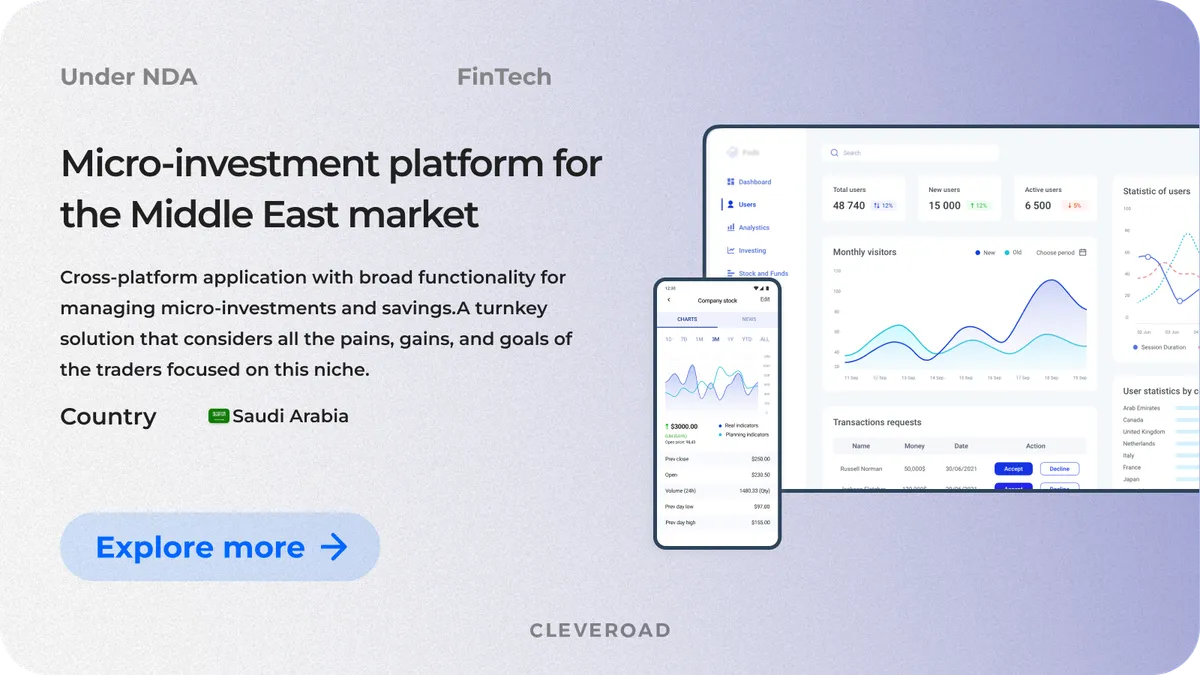
Micro-investment platform for the Middle East market
Our client is a Saudi Arabian investment company that has operated since 1988. In 2023, it decided to expand into micro-investing for retail users with small amounts of capital and partnered with Cleveroad to build a micro-investment platform from scratch. The client needed a technical partner to:
- build a scalable micro-investment platform from scratch
- meet the requirements of SAMA, the Saudi Central Bank, and the fintech rules of other Middle East markets it covers
- provide post-release maintenance and expert support for further growth
The Cleveroad team built a cross-platform Flutter app with multi-factor authentication, KYC verification with liveness detection, and automated KYC/AML checks. The platform also includes a payment gateway, real-time stock rates, push notifications, and a web back office for managing users, orders, and investment companies.
As a result, our client received a scalable, regulatory-compliant micro-investment solution that enables retail users to invest small amounts securely. The platform allowed the company to enter the micro-investing market, reach a new customer segment, automate investment operations, and establish a foundation for further growth.
Micro-investment platform
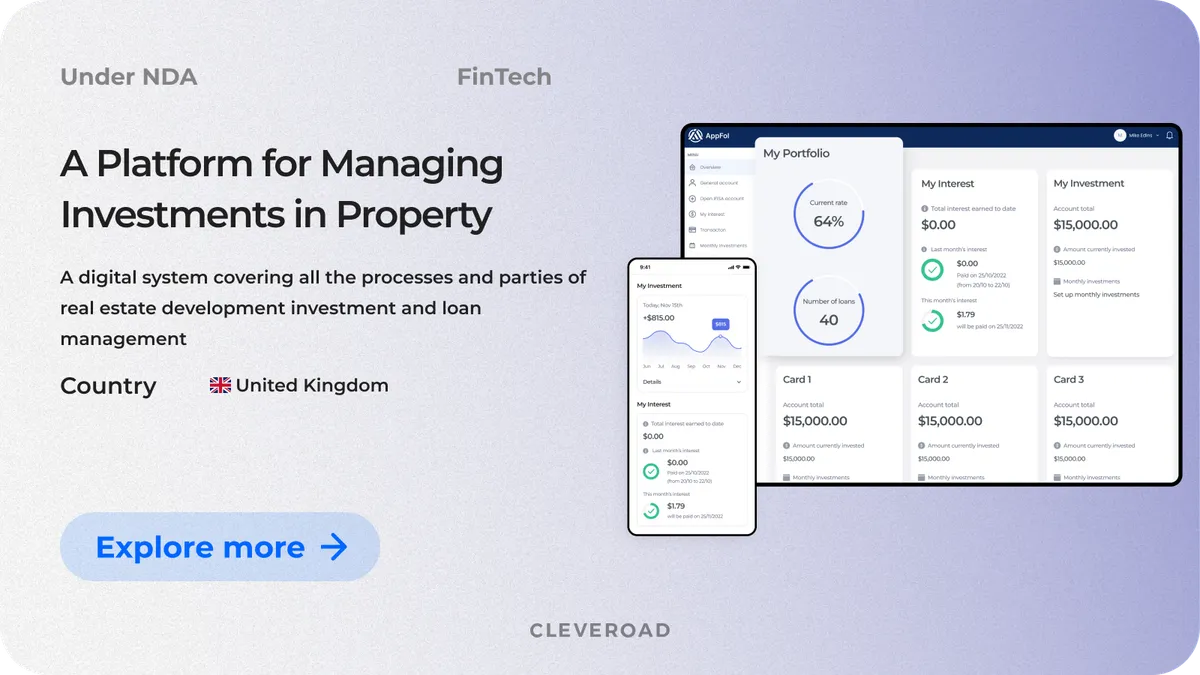
Property investment management platform in the UK
Our client is a UK conglomerate with 22 years of experience in property investment. To build a platform beyond the capacity of its in-house team, the company was looking for a partner to:
- build a digital ecosystem covering the entire property investment flow, from public offers to investor returns
- connect all parties: individual and institutional investors, their advisors, and property developers
- meet KYC/AML requirements and the rules of the FCA (#722801)
- extend the in-house team with industry experts under a dedicated team model
The Cleveroad dedicated team developed a comprehensive property investment management platform covering the entire investment lifecycle, from fundraising to investment and loan management. The solution includes iOS and Android apps for investors and advisors, a web-based Advisor portal, and an administrative back office. Key features include a custom KYC module with online and video-call verification, auto-invest settings, and an accounting module with bank reconciliation.
As a result, our client received a fully functional, industry-compliant investment ecosystem that connects all stakeholders, streamlines investment operations, and simplifies fund management. The platform helped the company attract investment activity and grow its earnings. At peak activity, users had invested £164.4m through the platform, while the company earned £7.6m in the first operational year and £9.3m in the second.
Property investment management platform
To create an investment app, follow a structured approach:
- Define your target audience and business model: A platform for beginner investors differs significantly from one designed for active traders or high-net-worth clients. Asset types, monetization logic, and geographic market must be selected first.
- Plan regulatory and compliance requirements: Financial apps must align with frameworks such as US SEC regulations or the GDPR in Europe. Compliance impacts onboarding flows, reporting mechanisms, and data architecture.
- Design UX and technical architecture: After clarifying legal and product scope, move to interface design, backend architecture, third-party integrations, and secure infrastructure planning.
Investment app development requires more than feature implementation. It requires building a compliant, scalable financial system that can operate in regulated markets.
An investment app MVP with one asset class, KYC onboarding, bank linking, and basic buy and sell flows costs $90,000–$160,000. A multi-asset product costs $160,000–$220,000, and a multi-market platform $220,000–$300,000+. On top of the build, plan monthly fees for third-party services such as KYC checks, market data licenses, brokerage API commissions, and cloud hosting.
The development timeline for an investment app MVP usually includes:
- 3–5 weeks for product discovery and compliance validation
- 4–8 weeks for UX/UI design and technical architecture planning
- 12–20 weeks for core development and integrations
- 4–6 weeks for testing, security validation, and release preparation
Because design and development partly overlap, most MVP versions take 4 to 8 months to complete. More complex platforms with multi-region licensing or advanced automation may require additional time.
An investment app must provide secure onboarding with identity verification, a clear portfolio dashboard, and reliable trading functionality. Users expect access to real-time market data, transparent transaction tracking, and smooth bank integrations for deposits and withdrawals.
Security mechanisms such as encryption, multi-factor authentication, and fraud monitoring are essential to protect financial operations. The platform must also include compliance and reporting tools to meet regulatory standards and maintain operational transparency.
It depends on the role your company plays in the investment flow:
- US: broker-dealer registration with FINRA membership if your app executes trades or holds client assets, or investment adviser registration if it gives advice.
- EU: authorization under MiFID II for brokerage or investment advice, and under MiCA for crypto trading and custody.
- Alternative: launch on a licensed broker’s API, so the partner holds the brokerage license while you run the user-facing app and protect user data.

Evgeniy Altynpara is a CTO and member of the Forbes Councils’ community of tech professionals. He is an expert in software development and technological entrepreneurship and has 10+years of experience in digital transformation consulting in Healthcare, FinTech, Supply Chain and Logistics
Give us your impressions about this article
Give us your impressions about this article
Comments
1 commentsthank you keep it up but cab get more videos thank you