STEM Program Management Platform
A custom platform for organizations managing STEM programs, designed to automate internal workflows, improve request visibility, and enable schools and partners to submit and process applications efficiently
Industry
Education
Team
9 members
Launched
2025
Country
USA
100%
submission success rate across 1,000+ schools
40%
faster request processing time across programs
3x
reduction in manual workload for administrators
About our Client
Betabox is a US-based education company that delivers hands-on STEM learning for K-12 students through mobile “Onsite Field Trip” labs, all-in-one project kits, teacher support, and its Classbox platform. The company focuses on making STEM programs easy to implement for schools while sustaining learning beyond a single event through a combination of physical experiences, ongoing digital engagement tools, and real-world exploration in the classroom.
Founded by Sean Newman Maroni, Betabox has reached over 500,000 students across 1,000+ schools and 150 districts. The company also builds partnerships with organizations such as Google, MITRE, or Red Hat, enabling up to 90% of programs to be delivered at no cost.
Client’s Business Goals
Betabox managed all requests manually, which led to missed submissions, document overload, inefficient coordination, and slow processing as demand from schools continued to grow. The team initially relied on Airtable to structure and manage these workflows, but as operations scaled, it could not support complex, multi-step processes and growing coordination needs. As a result, Betabox decided to build a centralized platform to efficiently manage requests and automate workflows. So, they needed a technology partner to:
Build a web-based platform to automate internal operations and simplify how educators explore STEM programs and submit applications, managing field trips across schools and districts.
Launch an MVP focused on Onsite Field Trips and Hands-On Projects to validate workflow efficiency and support early adoption through pilot programs.
Meet a strict 6-month MVP deadline to support onboarding and full rollout before the 2025–2026 academic year



Cooperation Process and Outcomes
Our collaboration with Betabox followed a structured, iterative approach focused on rapid validation and scalability. It started with an intensive Discovery phase to redefine the product concept and align it with business goals, followed by development iterations that delivered a platform to automate request processing and reduce manual coordination across STEM programs and partner workflows.
Planning Stage
During the Discovery Phase, Cleveroad’s PM, BA, SA, and Designer aligned the product vision and reduced uncertainty before development. Since the client revised the initial idea, we merged Solution Design and Discovery into a focused three-week process and rebuilt requirements from scratch. Regular communication via Slack, email, and Google Meet helped keep progress on track despite tight deadlines.
In the first two weeks, the team refined the concept, validated assumptions, aligned business and technical goals, defined core business logic and user flows, and prepared a prioritized Feature Breakdown List with the initial scope and dependencies.
In the final week, Cleveroad conducted a Quality Attributes Workshop to define scalability and performance requirements, while the designer created the product concept. All outputs were consolidated into a Software Architecture Document that guided дальнейшую development.
Key Discovery Phase deliverables included:
- Business Logic Diagram
- Feature Breakdown List
- Software Architecture Document
- Quality Attributes and Scenarios
- Design Concept
- Estimation for approved scope
- Project plan with Gantt chart


Development in Detail
The project evolved through two main iterations spanning 13 and 8 sprints, respectively. The first iteration focused on building the core platform for request automation and internal operations. The second iteration expanded the system with a dedicated partner portal, introducing a new user role and additional business logic.
1st Iteration – Building the core automation platform
- During the first iteration, our team developed a web-based automation platform centered around two core modules: the Educator App and the Admin Panel. The Educator App enabled educators to submit program requests, track request statuses, and approve Blueprints, while the Admin Panel centralized application reviews, funding allocation, operational task routing, and user management. The goal of this phase was to replace fragmented manual coordination with a unified digital workflow to simplify communication and improve operational visibility for both educators and administrators.
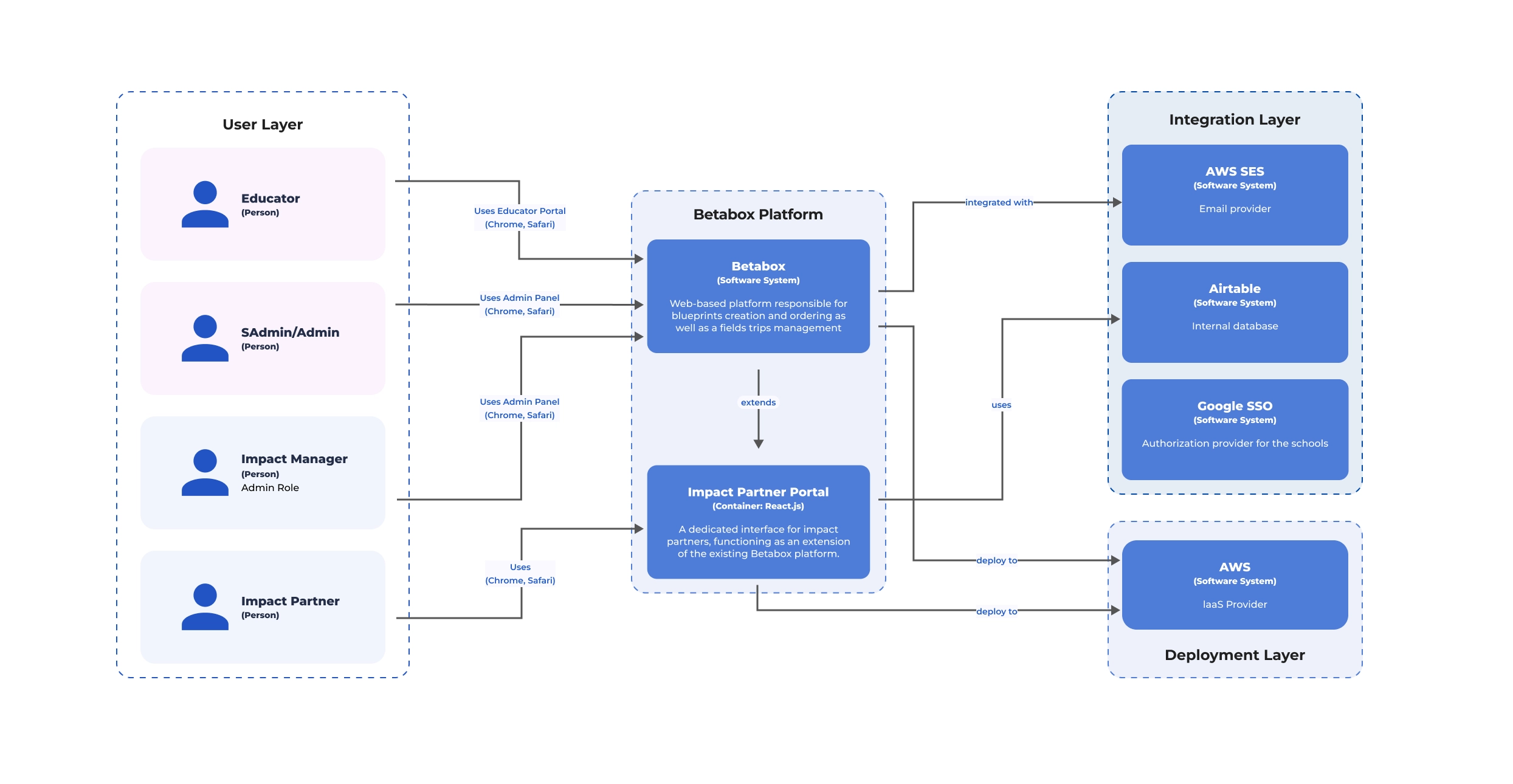
- The key engineering challenge was ensuring stable performance during seasonal spikes in request volume. To address this, our engineers implemented a serverless AWS architecture using .NET and React.js, allowing the system to scale dynamically without maintaining idle infrastructure. MySQL supported transactional consistency for multi-step request processing, while .NET handled workflow orchestration and integration-heavy business logic. Approved Blueprints automatically triggered task scheduling, resource delivery assignments, and status notifications.
- By the end of the first iteration, the team delivered the MVP within 6 months, ahead of the 2025–2026 academic year. The platform streamlined request handling, reduced operational bottlenecks, and improved turnaround time for schools and administrators. With validated core functionality, scalable AWS infrastructure, and a structured QA process including staging validation, regression testing, and rollback mechanisms, the system successfully supported concurrent submissions from more than 1,000 schools during peak periods without performance issues.
2nd Iteration – Expanding with partner portal functionality
- The second iteration focused on building a dedicated Partner Portal designed for corporate sponsors and impact partners. This module had to support program participation and impact tracking and enable structured collaboration within the Betabox ecosystem. To define scope and budget accurately, the Cleveroad team started with an additional two-week Discovery phase, following a structured process with regular sync sessions, brainstorming workshops, stakeholder alignment, and feature prioritization.
- The development phase centered on creating partner-specific workflows and interfaces. Our specialists implemented functionality that allowed partners to access program data, monitor impact metrics, and interact with ongoing initiatives. Implementing these partner-facing capabilities required extending the existing platform logic while maintaining consistency across user roles. Special attention was given to data visibility and role-based access to ensure that partners could operate independently without affecting internal workflows.
- The Partner Portal was built as an integrated module within the existing AWS-based serverless architecture from a technical perspective. The Cleveroad experts reused core system components while introducing new APIs and data structures to support partner interactions and data exchange. This approach accelerated development, reduced infrastructure overhead, and maintained consistency across all platform modules and user roles. Our engineers also ensured seamless integration with existing workflows.
Product Essentials
The Betabox platform is a centralized hub for STEM program requests and educator onboarding, as well as workflow automation. It connects schools and admins, enabling full visibility across districts.
Dashboard
Dashboard
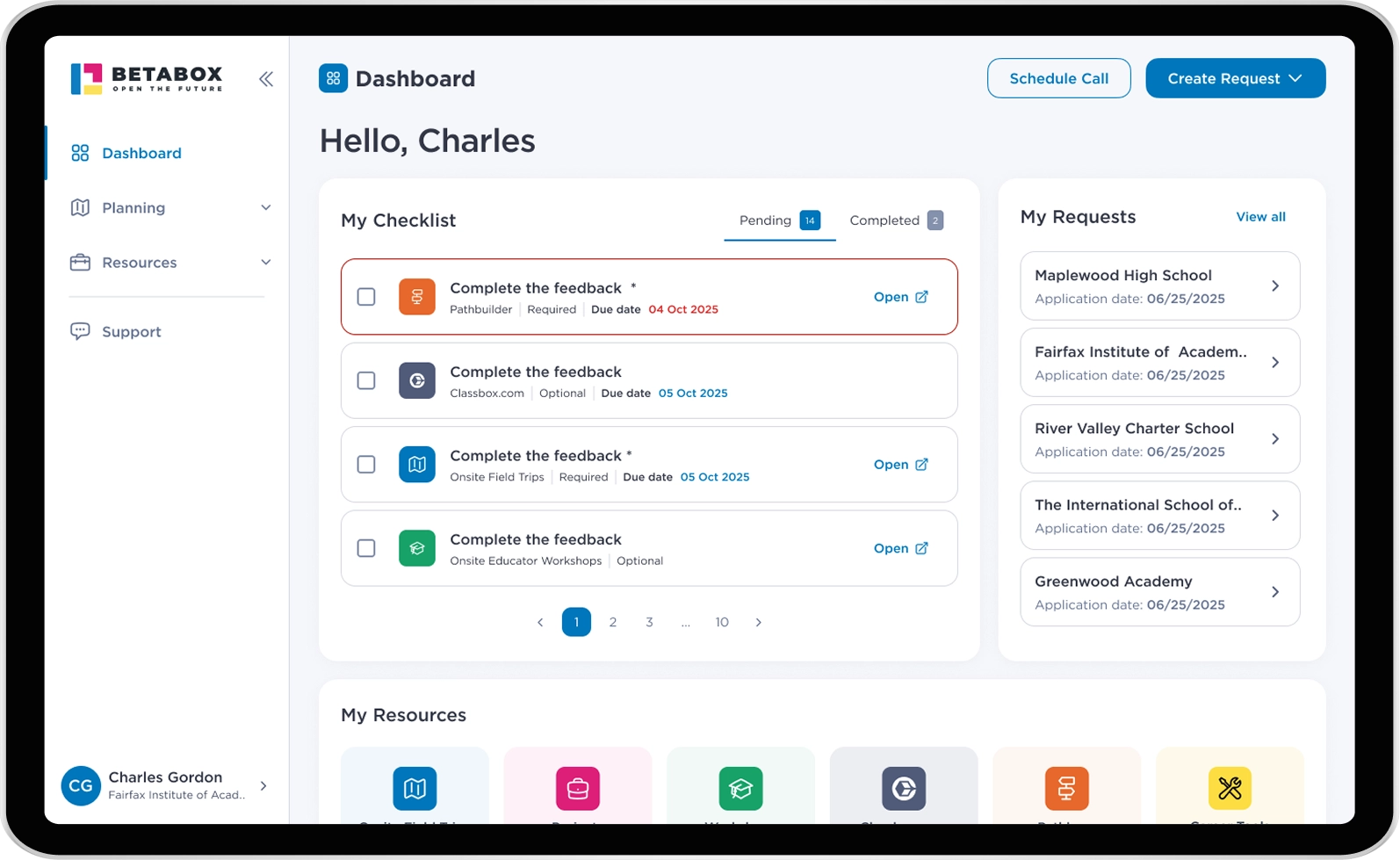
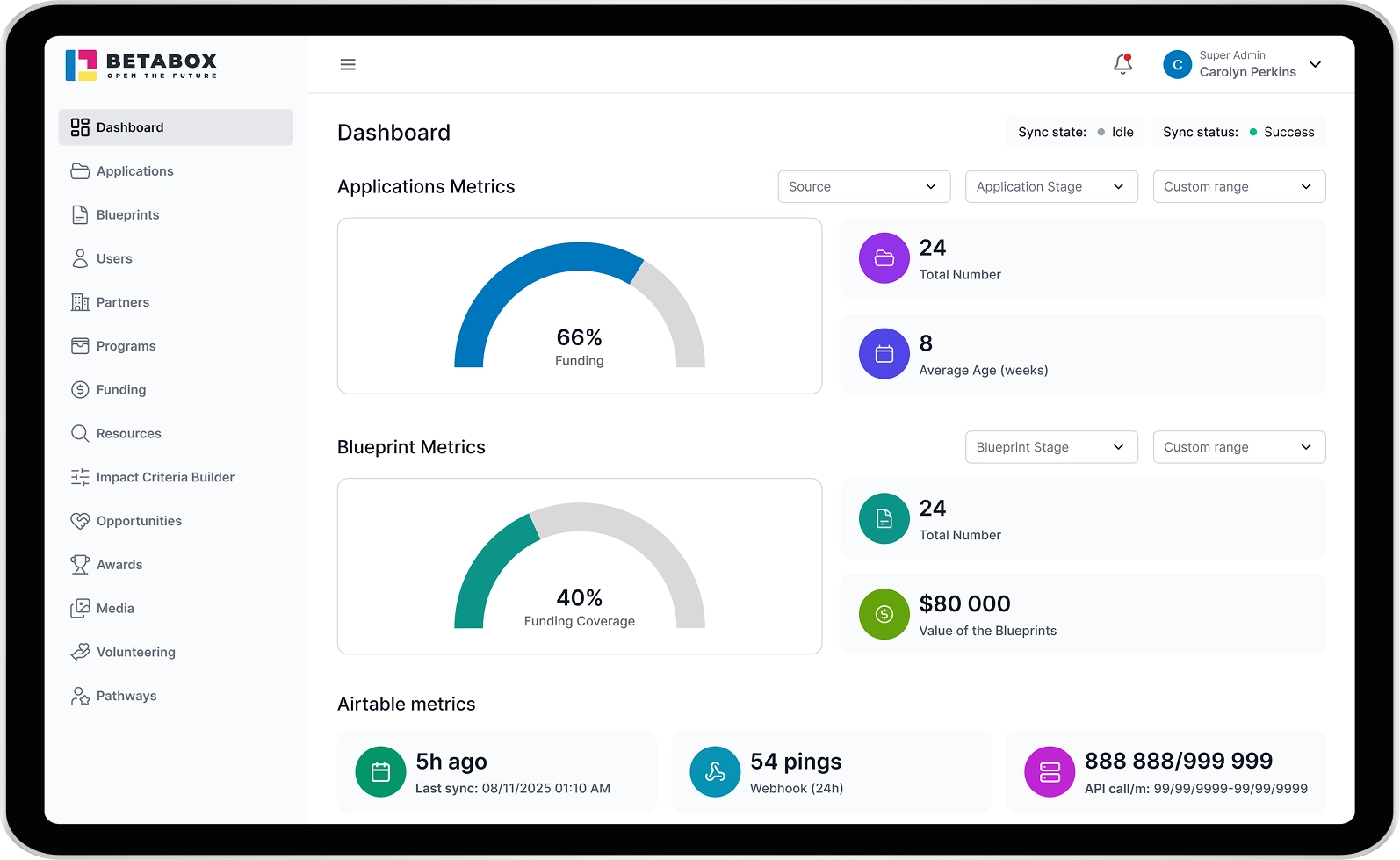
The Dashboard provides a centralized view of user activity and system status.
Users can track application progress and monitor tasks while accessing key updates, improving visibility and decision-making across all interactions with real-time insights into request status and operational performance.


Applications Management
Applications Management
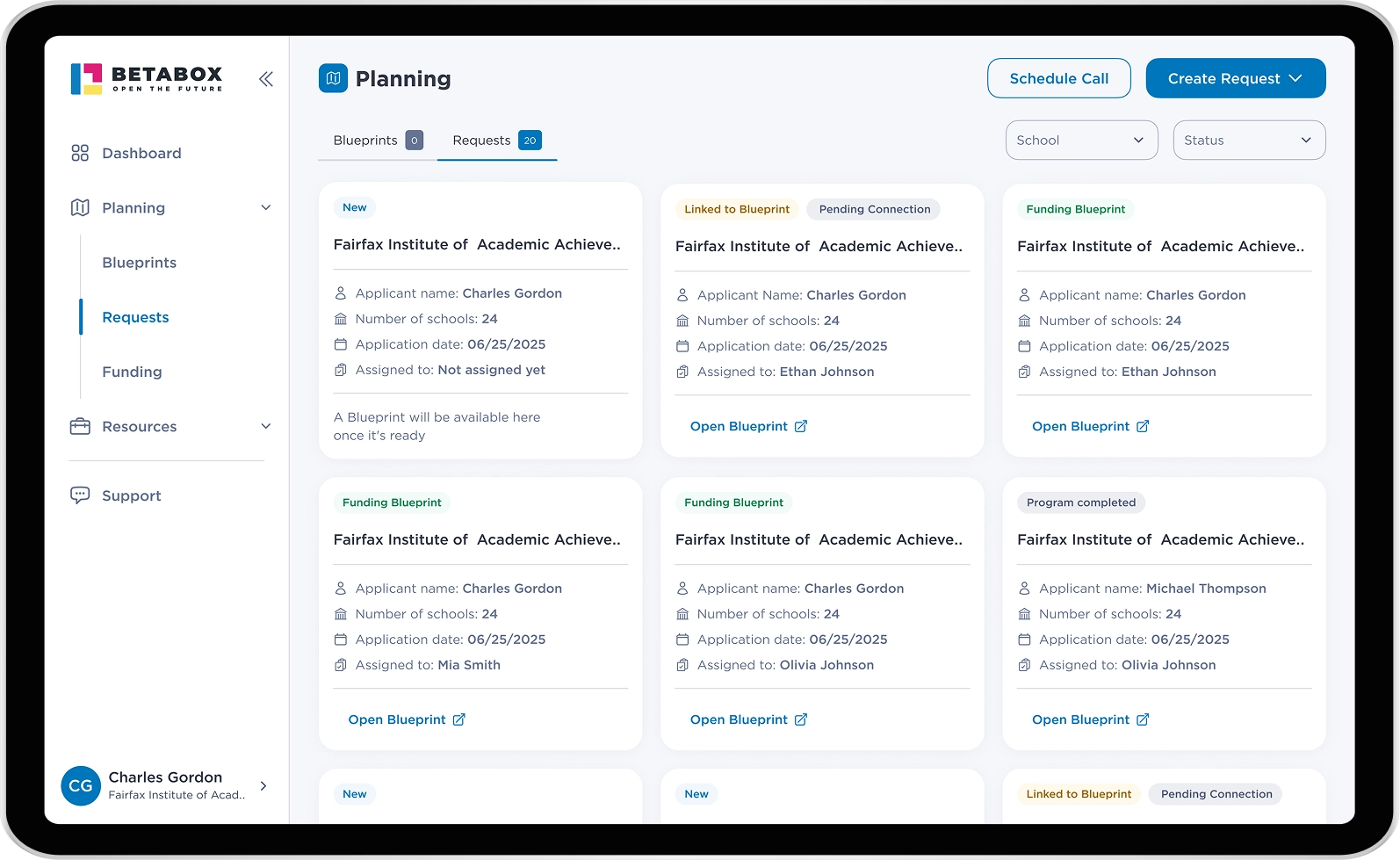
The management module handles the full lifecycle of STEM program requests. Educators submit applications through structured forms with prescreening questions.
Core capabilities:
- Submitting and managing applications
- Real-time status tracking
- Centralized request handling across multiple programs
Application management replaces manual intake, ensuring no requests are lost while supporting high volumes of concurrent submissions from different schools and districts.

Blueprint Management
Blueprint Management
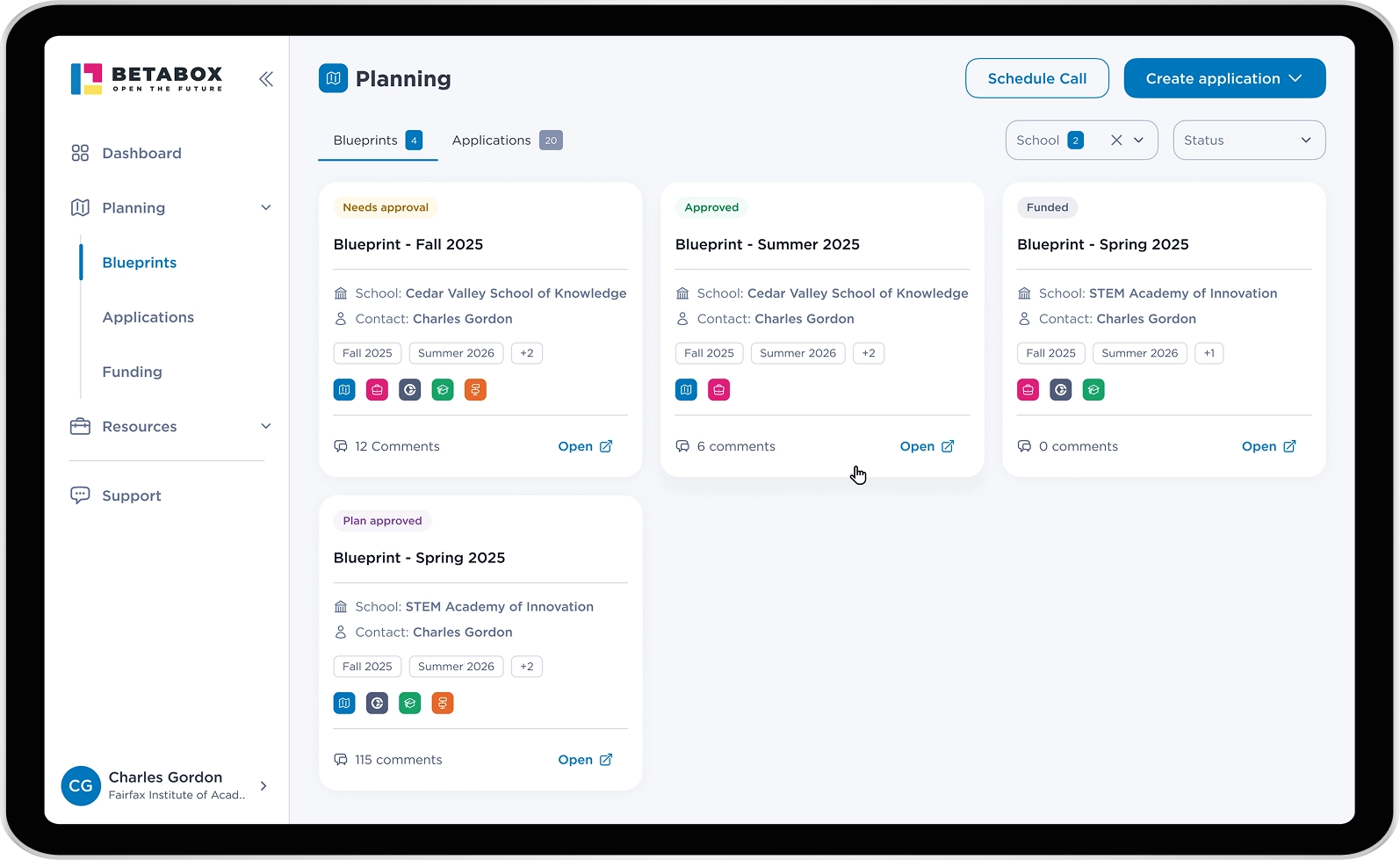
The Blueprint module supports structured planning and approval of STEM programs. Users can review, comment, collaborate with stakeholders, and approve blueprints within the platform.
Jira-like commenting enables collaboration between stakeholders, ensuring transparency and faster decision-making across distributed teams and multiple approval layers.

Tasks & Notifications
Tasks & Notifications
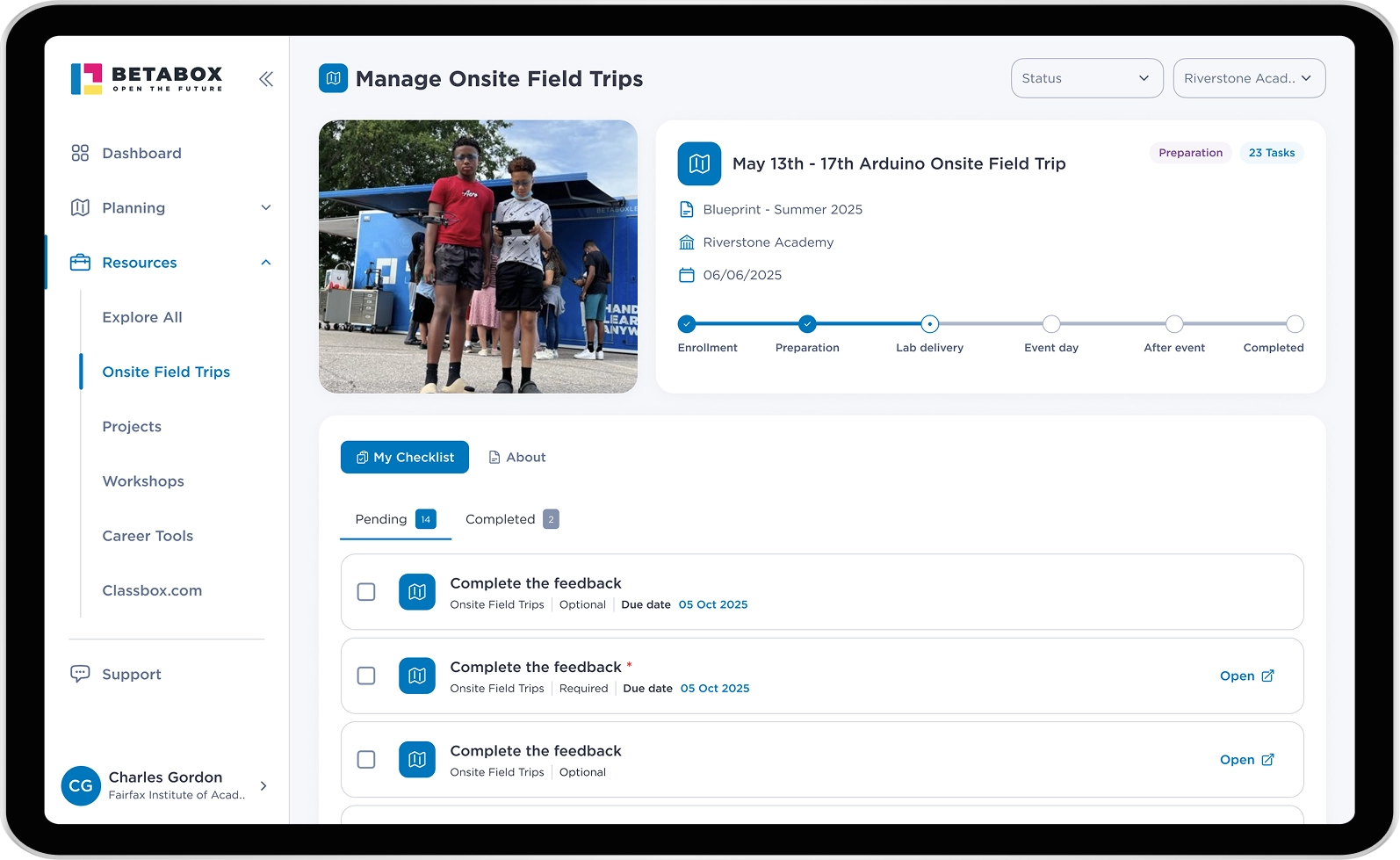
This module keeps users aligned with workflows and deadlines.
Core capabilities:
- Task assignment
- Completion tracking
- Automated email notifications for updates and field trips

Authorization & Access
Authorization & Access
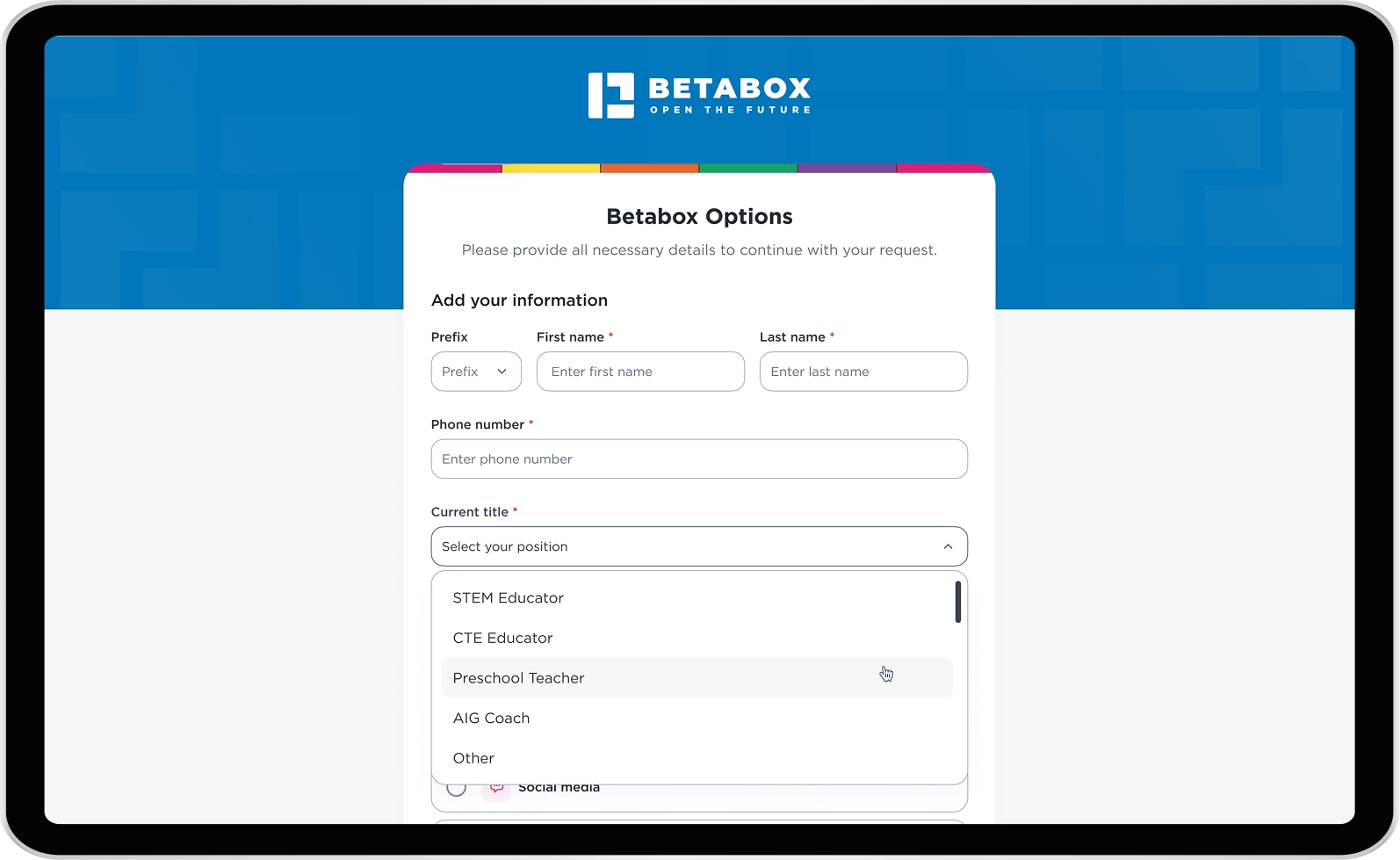
The platform provides secure access for educators and district representatives. Users can register via email with password recovery or use Google SSO.

Admin Panel
Admin Panel

Technology stack
We used a cloud-native, serverless technology stack to ensure scalability and reliable handling of complex workflows across multiple user roles.
Web Architecture
Frontend
React.js
Tailwind CSS
Backend
.NET
AWS lambda
AWS
Infrastructure layer
Amazon S3
Amazon CloudFront
MySQL
Integrations
Google SSO
Airtable
SES
Value for Our Client
MVP released on time for the academic year launch
The Betabox platform was delivered within 6 months, ahead of the launch of the 2025–2026 academic year. The system replaced fragmented manual workflows with a centralized digital solution, enabling an immediate operational rollout without delays or service disruption. This timely delivery allowed schools, educators, and administrators to begin program coordination before the peak season began.
Faster request processing enabled scalable delivery
Workflow automation reduced delays and improved response times, resulting in 40% faster request processing across the platform. During the peak autumn season, the system supported concurrent submissions from more than 1,000 schools with zero lost requests and stable performance under heavy load. The centralized workflow also improved coordination between all parties.
Reduced administrative workload
Workflow automation led to a 3x reduction in manual admin tasks. The team shifted its focus to strategic initiatives, supporting partnerships with organizations such as Google, MITRE, and Red Hat. The solution can be applied by STEM program operators, education nonprofits, EdTech providers, and corporate partners managing multi-school initiatives and partner-funded programs.
Our Clients Say

 USA
USAFounder & President of Betabox
“Cleveroad team enabled us to replace complex manual workflows with automated processes, creating a scalable digital office for our educators.”
More Cases



Blockbuster
Cross-device Video on Demand Platform