Hiring Dedicated Development Team in 2026: The Ultimate Guide
Updated 16 Dec 2025
14 Min
3907 Views
Big enterprises, such as Google, Microsoft, Uber, and Facebook, tend to hire dedicated development teams to access specialized skills, raise project scalability, and accelerate product development. Many IT vendors can offer to hire a dedicated development team from their staff. There’s no need for countless interviews and lengthy onboarding. Another reason to cooperate with a dedicated app development team is a low budget. There’s no need to pay for office rent, taxes, software, and hardware. Besides, you only pay when there are tasks to assign.
In this article, you’ll find step-by-step instructions on how to hire a dedicated team, where to search for dedicated developers, how much it costs, and what to keep in mind before choosing such a cooperation model. In short, the steps to hire a dedicated development team are:
- Define your project goals and skill gaps. Map your product scope and deadlines to understand who you need.
- Set a clear cooperation model. Decide on required roles, communication rules, workflows, and budget limits.
- Shortlist vendors with proven expertise. Review portfolios and client feedback to check domain fit.
- Assess technical and cultural alignment. Run interviews and evaluate communication quality.
- Choose the final team composition. Approve selected dedicated software engineers and agree on responsibilities.
- Sign the contract and kick off onboarding. Set up tools and launch the delivery process.
Next, we’ll discuss the hiring process in more detail.
What Is a Dedicated Development Team
A dedicated development team is a group of professionals that is dedicated to working exclusively for your project or for the completion of chosen tasks related to your project. This approach allows you to get fully focused and committed specialists who are dedicated to the success of your project.
A dedicated development team fits large, long-term projects with changing requirements. It offers high flexibility in scope, tasks, costs, and resources while keeping the team focused on delivery. The model increases speed and quality because specialists stay fully concentrated on your product, without the risks of context switching or team overload.
Basic dedicated team structure
What specialists can become your dedicated development team members? Here’s a list that can hint at your future dedicated development team structure:
- Frontend web developers. These specialists create a part of the software that your user interacts with, including the solution’s interactivity.
- Backend developers. Back-end developers are responsible for building and maintaining the server side of your software solution.
- Mobile developers. Mobile developers master applications for smartphones and tablets, consequently for iOS or Android mobile operating systems. Besides, usually, they are also qualified to provide cross-platform Flutter development services.
- UI/UX designers. UI/UX designers craft an appealing, user-friendly, and intuitive visual for your software solution.
- QA specialists. Specialists that provide quality assurance services test the software for quality and bug-free infrastructure.
- DevOps engineers. DevOps experts act as a bridge between software creation and IT operations and head all automated processes throughout software development.
- Other specialists. You can also hire other dedicated specialists like a project manager, business analyst, or solution architect, depending on your request and specific project requirements.
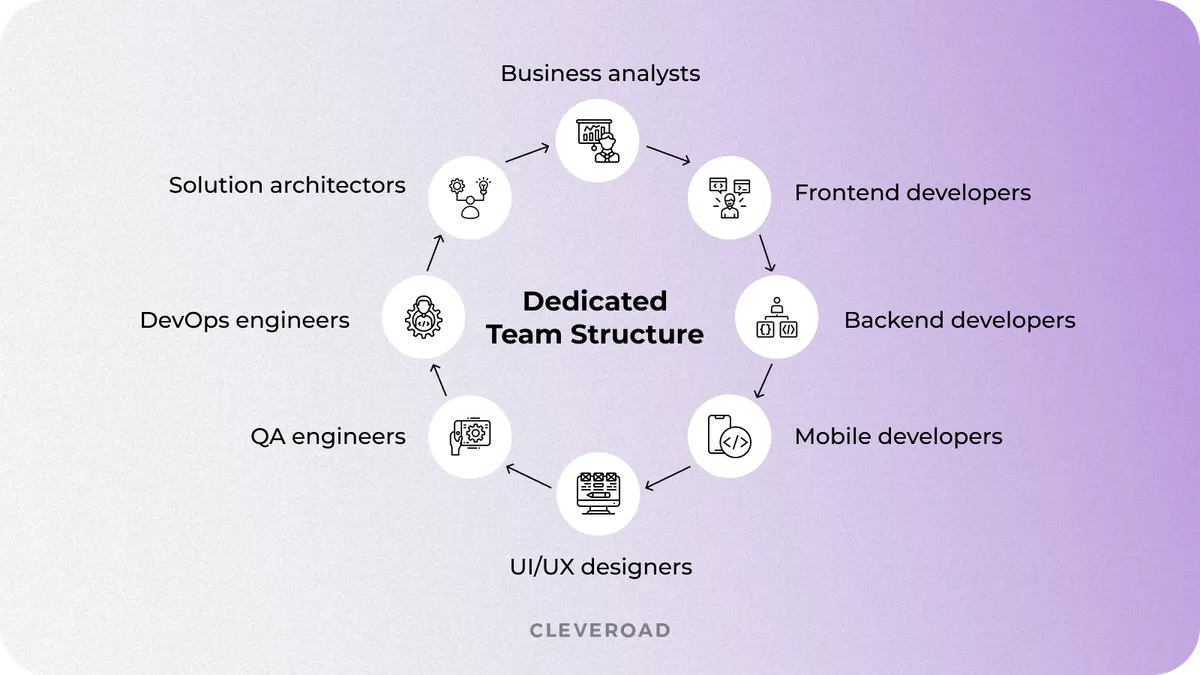
Basic dedicated team structure
Dedicated team vs. staff augmentation vs. project-based collaboration
Choosing the right engagement model shapes how your product evolves, how much control you retain, and how easily you can adapt to change. Dedicated teams, staff augmentation, and project-based collaboration each solve different business problems and suit different stages of growth. Understanding how these models differ helps you choose the approach that aligns with your goals, timelines, and internal capabilities.
Dedicated development team works as your remote engineering department. You get a full team of experts who work exclusively on your project from start to finish. This model fits complex, evolving projects where you need long-term commitment, deep product knowledge, and flexibility in team size.
Staff augmentation gives you individual developers who join your existing team to close skill gaps or increase capacity fast. It works well when you need extension of your in-house team with specific expertise without the cost and time of hiring full-time employees, but onboarding and integrating software developers into your workflows takes effort.
Project-based collaboration (often called an outcome-based model) centers on predefined deliverables, which is a good decision for a startup or a small business. You agree on the result, and the vendor takes responsibility for delivering it. This model fits projects with stable requirements and clear milestones, but it limits your control over day-to-day decisions and leaves less room for change.
In the table below, you’ll find a convenient comparison of dedicated team vs. staff augmentation vs. project-based collaboration:
| Model | Control | Flexibility | Best fits for |
|---|---|---|---|
Dedicated development team | High | High | Long-term, complex projects with changing requirements |
Staff augmentation | Medium | Medium | Short-term skill gaps, quick capacity boost |
Project-based collaboration | Low | Low | Fixed requirements, one-time projects, MVPs |
When to Hire a Dedicated Development Team?
Your decision to hire a dedicated development team can, for sure, positively impact your software development project. Let's discover when hiring a dedicated development team is the best option for your project's success.
When the internal team lacks bandwidth
Your in-house engineering team can handle only so much before delivery slows. New features stack up, blockers appear, and deadlines slip. A dedicated development team adds immediate capacity, so your core mobile or web development team can stay focused on priority work.
You avoid burnout, rushed releases, and quality drops. Dedicated software developers support feature delivery, manage routine tasks, and keep development stable. This structure helps you preserve momentum without overstretching internal resources.
When you need long-term development capacity
Long-term products need consistent speed and predictable team performance. A dedicated team stays with you throughout the entire lifecycle and builds deep knowledge of your software product. This creates continuity and reduces onboarding time with every new release.
You get a stable foundation for planning future updates and scaling your solution. The team understands your roadmap and supports long-term goals, which makes development more strategic and less reactive (Source: IEEE).
When the project requires specific expertise
Some projects demand skills that are difficult to find quickly. You may need AI engineers, senior mobile developers, or cloud architects to solve complex tasks. By hiring dedicated development team, you fill these gaps with specialists who already have the needed experience.
You remove the risk of hiring the wrong person or delaying development because the global talent pool is too wide. A remote team brings best practices and domain knowledge, which accelerates problem-solving and improves product quality.
When planning continuous delivery and product evolution
Continuous delivery requires predictable workflows, fast iterations, and strong ownership. A dedicated development team meets these needs because the specialists stay fully focused on your backlog. They support a stable pipeline and keep your releases on schedule.
As your product evolves, you can scale the team or add new skills without disrupting the process. The team adapts quickly to new priorities, which helps you introduce improvements faster and maintain product relevance.
When existing vendors fail or are too slow
Some vendors lack the capacity or expertise to support your roadmap. Missed deadlines, unclear communication, and inconsistent delivery slow you down. A dedicated team replaces this risk with a stable group that works only on your product.
You get predictable progress, transparent reporting, and higher accountability. The dedicated specialists aim to understand your goals, fix bottlenecks, and increase development speed so you don’t lose time or market opportunities.
Opt for our dedicated development team services to assemble remote professionals with a profound understanding of your project nuances
How to Hire a Dedicated Development Team
To extract the best outcomes out of a dedicated development team for hire, you’ll have to conduct certain preparations prior to. Below, you can find 5 steps to follow while planning to insert a dedicated development team into your project completion.
Step 1. Define your requirements for a dedicated team
You, as a business that seeks to hire a dedicated team of skilled developers, have to strictly outline your requirements, terms, and conditions of further cooperation. Here are the key points you should consider before hiring remore team:
- Scope. To make your dedicated team complete tasks correctly, it’s vital for you to primarily understand your own project requirements, functionalities, and desired timelines clearly
- Tech stack. Define the technologies your solution must use. This clarity helps the vendor select specialists with the right skills and ensures the team can support your long-term technical strategy.
- Product vision. Describe the purpose of your product, the users you target, and the outcomes you expect. A strong vision guides the team and keeps everyone aligned on business priorities.
- Timeline. Set realistic deadlines for key milestones and delivery phases. Establishing a clear timeline helps your vendor plan the development process and maintain predictable progress.
Step 2. Choose and vet potential vendors
At this stage, you need to search for IT companies that offer a dedicated team model and evaluate them carefully. Start with trusted sources such as Clutch, GoodFirms, vendor directories, tech communities, and referrals from your network. These channels help you shortlist reliable partners faster. Check each vendor’s technical and development experience and industry fit. Look for proven work in the technologies you plan to use and in domains similar to yours.
Once you build your shortlist, prepare a simple interview script. Ask vendors about their approach to delivery, team structure, communication habits, risk management, and typical timelines. This step will help you understand how well the vendor aligns with your expectations before you move to a deeper technical evaluation.
Many companies start cooperation with a Discovery Phase to evaluate a vendor’s expertise, communication, and approach before committing to full development. This step helps validate ideas, reduce risks, and understand how a team will work on a real project.
Betabox, our client, followed this approach and turned to us to run discovery phases with several vendors in parallel. Cleveroad stood out thanks to clear communication, detailed workshops, and a deep understanding of the product goals.
Here is what Sean Newman Maroni, CEO at Betabox, says about collaboration with Cleveroad:
Sean Newman Maroni, CEO at Betabox: Feedback on Cleveroad's EdTech Development Services
Step 3. Evaluate technical expertise and case studies
Once you shortlist vendors and make an interview script, you need to confirm that their technical skills match your project needs. Try focusing on the following actions:
- Check the portfolio for relevant technologies. Look at projects that use the same tech stack or architecture you plan to build. This helps you see if the vendor has hands-on experience, understands common pitfalls.
- Review case studies for complexity and outcomes. A good case study in vendor portfolio explains the challenge, the solution, and the measurable results. Focus on how the team approached technical decisions and solved bottlenecks (Source: PKP).
- Evaluate domain fit through problem patterns and solutions. Ask the dedicated development team company to explain common challenges in your industry and how they solved them in past projects.
- Verify team specialization for your product type. Ask whether the vendor assigns engineers who already work with similar product types, such as marketplaces, healthcare apps or fintech platforms.
Step 4. Review quality and security management
Before you hire a dedicated development team, confirm that the vendor follows strict quality and security standards. Strong processes protect your product from risks and create more predictable and faster development cycles.
The tips below will help you understand how the outsourcing company manages risks and keeps your data safe:
- Check their quality assurance workflow. Ask how a dedicated development team company tests features, tracks defects, and controls release stability. Look for structured QA processes, automated testing capabilities, clear acceptance criteria, and transparent reporting.
- Evaluate their security practices. Discuss how the vendor manages access control, data protection, and vulnerability prevention. They must follow secure coding standards, use reliable infrastructure, and document how they handle sensitive information.
- Confirm compliance with global standards. Choose vendors with proven certifications. At Cleveroad, we follow ISO 27001 for strong information security management and ISO 9001 for high-quality delivery processes.
- Review documentation and risk management. Ask for examples of project documentation, security policies, and risk mitigation plans. Clear documentation shows discipline and minimizes ambiguity.
Step 5. Determine communication channels
After you choose your vendor, turn your agreement into clear terms that everyone understands. Start by aligning on cost and the billing model. Decide whether the team works on hourly rates or a monthly fee, and confirm when payments happen. This step keeps the financial side simple and predictable.
Next, set expectations for how the team works. Add an SLA that covers delivery timelines, communication rules, and reporting frequency. Define a few KPIs to track progress, such as release velocity or response time. These details help you keep control without micromanagement.
Finally, protect your product with the right legal terms. Sign an NDA to secure your sensitive information and outline who owns the code and documentation. This gives you confidence that everything built for your project stays under your control.
Cleveroad's Approach to Dedicated Team Cooperation
While the previous step focuses on how you should prepare for cooperation, in this section, we’ll discuss how Cleveroad organizes and manages the dedicated development team model on our side. So, let’s review our structured working process that helps teams start fast and scale without friction.
1. Gathering requirements
We start with a series of focused meetings to understand your product vision, technical scope, timelines, and collaboration preferences. During this phase, we clarify required skills, seniority levels, communication routines, and delivery expectations.
Such preparation allows us to define clear success criteria and remove ambiguity before team assembly. As a result, both sides enter cooperation with aligned expectations, a shared understanding of priorities, and a clear delivery framework from the very start.
2. Assembling a team
Based on defined requirements, we select engineers and specialists with relevant technical expertise and experience in similar systems. We assess candidates not only by skills, but also by their ability to work in long-term, dedicated engagements.
You interview each shortlisted candidate and approve the final team composition. This step gives you full visibility and control, ensuring the team matches your technical and cultural expectations.
Discover how to find an app developer successfully in our comprehensive guide
3. Onboarding and development
After team approval, we run a structured onboarding process for the dedicated development. Developers study your documentation, architecture, and existing codebase, then align on workflows, tools, and delivery cadence.
Once onboarding is complete, the team transitions smoothly into active development. Regular communication and alignment checkpoints help maintain transparency and steady progress.
4. Scaling up and down
Your project needs can change over time, and the dedicated team model adapts with it. When workloads grow, we add specialists without disrupting ongoing development.
When the project stabilizes or moves closer to completion, you can reduce team size while preserving knowledge continuity. This flexibility helps you optimize costs without sacrificing delivery quality.
Want to hire a remote team?
Read our free book to know vital steps to hire and manage remote developers



The Cost of Hiring Dedicated Development Team
Estimating the cost of hiring a dedicated development team isn’t straightforward. Pricing depends on multiple variables, and each project requires a tailored calculation rather than a fixed rate. That’s why cost ranges can differ significantly even for similar products.
Several key factors influence the final price of a dedicated team:
- Team size. The number of developers, QA engineers, DevOps specialists, and other roles directly affects the budget. Larger teams increase delivery speed but also raise monthly costs.
- Developers’ location. Hourly rates vary widely by region. Teams in North America typically charge more than those in Europe or Asia, largely due to local salary levels and operating costs.
- Level of expertise and roles. Senior engineers, architects, and niche specialists command higher rates than mid-level or junior developers, but they also reduce risks and rework.
- Scope and duration of the project. Long-term engagements often allow for more predictable pricing, while short or highly dynamic projects may require additional flexibility and resources.
- Technology stack and domain complexity. Projects that involve complex architectures, legacy systems, or regulated domains require more experienced specialists, which impacts cost.
In practice, average hourly rates differ by country. US and Canadian developers usually have the highest rates, while Asian markets offer the lowest. Central and Eastern Europe sits in between, offering a balanced combination of cost efficiency, strong engineering education, and smooth communication thanks to high English proficiency and manageable time zone differences.
Below, you will find the dedicated team specialists' hourly rates depending on the region:
| IT specialist | CEE region | Western Europe | North America | Asia | South America |
|---|---|---|---|---|---|
Business Analyst (BA) | $45–$70 | $72–$133 | $90–$150 | $30–$42 | $45–$55 |
Solution Architect (SA) | $50–$77 | $129–$190 | $120–$200 | $35–$48 | $60–$72 |
UI/UX designer | $36–$56 | $51–$106 | $80–$140 | $25–$36 | $40–$50 |
Developer | $25–$70 | $68–$122 | $90–$160 | $18–$42 | $35–$61 |
Quality Assurance (QA) | $25–$63 | $50–$110 | $70–$130 | $15–$36 | $30–$50 |
Project Manager (PM) | $45–$70 | $86–$151 | $100–$160 | $35–$48 | $55–$66 |
At Cleveroad, we don’t apply one-size-fits-all pricing. Instead, we analyze your goals, technical scope, and timeline to assemble the right dedicated team and calculate a realistic hiring cost for your specific case. Contact us, and we’ll help you define the optimal team composition and provide a transparent cost estimate aligned with your business needs.
Why Choose Cleveroad for Hiring Dedicated Development Team
Cleveroad is an outsourcing software development company that has been providing dedicated development team services for more than 15 years. Our expertise applies to various industries, including Healthcare, FinTech, Logistics, Retail, Media, and more. We follow a proven multi-step assembling process to provide the best dedicated development team that meets our clients’ requirements.
Turning to Cleveroad, you get:
- Agile-oriented team of more than 200 highly qualified specialists, experienced in a broad spectrum of domains, like Healthcare, Fintech, Logistics, E-commerce, and E-learning, fitting in your project
- Cooperation with a team proficient in web technologies (AngularJS, JavaScript, React, etc.), mobile technologies (Kotlin, Swift, Objective-C, etc.), and more
- We provide a wide range of software services, including custom web and mobile software development, IT consulting, legacy software modernization, CRM, HRM, ERP development, etc.
- Deep knowledge and proven expertise in advanced technologies like IoT, AI, Big Data, Machine learning (ML), cloud computing, blockchain, etc.
- A cooperation with an IT partner with ISO/IEC 27001:2013 (security management) and ISO 9001:2015 (quality management) certifications
- A comprehensive Project Management Office to help you fully oversee your project requirements in order to complete it fast, timely, without overstepping a budget
Over the years, our dedicated teams have delivered 200+ software projects, supporting products through complex builds, strict compliance requirements, and long-term scaling. They took ownership of architecture, integrations, and product evolution.
To show how the dedicated team model works in practice, here are a few examples of solutions our engineers successfully delivered:
- Transportation Management System (Logistics). Our dedicated team of 13 engineers built a custom transportation management system with automated route planning, fleet control, driver mobile apps, and seamless integrations with WMS and CRM systems.
- Micro-Investment Platform (FinTech). Our team of 8 specialists developed a SAMA-compliant micro-investment platform from scratch, including KYC, multi-factor authentication, payment integrations, and a scalable Flutter-based mobile app.
- IoT-Based EKG Monitoring System (Healthcare).Our dedicated team of 18 experts delivered mobile apps and backend services for real-time EKG and blood oxygen monitoring, secure IoT data processing, HIPAA compliance, and FDA-ready architecture.
- Quality Management System for Medical Devices (Healthcare). Our team of 9 professionals built a web-based QMS to replace a legacy system, automating FDA and ISO compliance workflows, document control, role-based access, and audit-ready reporting.
All of our clients highly appreciated our work and left positive reviews on Clutch. Look what Breanne Butler, Client Liaison Officer at Prime Path Medtech, said about our work on their CMS:
Breanne Butler, Client Liaison Officer at Prime Path Medtech™
Hire a dedicated team at Cleveroad!
Contact us! We have 15+ years of experience, so we’re ready to assemble a team of dedicated tech talents based on your specific product requirements and onboard them to your project quickly
A dedicated development team is a group of professionals who work on your project exclusively or for the completion of chosen tasks tailored to your unique case.
To hire a dedicated software development team, go through the following stages:
- Step 1. Define your requirements for a dedicated team
- Step 2. Choose and vet potential vendors
- Step 3. Evaluate technical expertise and case studies
- Step 4. Review quality and security management
- Step 5. Formalize contracts and engagement terms
Cost to hire dedicated developers as a team typically is $6,000–$20,000+ per month per specialist, depending on location, seniority, and team composition. North America has the highest rates, while Central and Eastern Europe offer a strong balance of cost and expertise. The final price depends on your project scope, timeline, and required skills.
Benefit of a dedicated app development team includes the ability to get a project team with suitable expertise that can integrate into your existing workflows quickly. Besides, you should hire and manage the team of specialists who track and monitor the whole development process on its own, letting you focus on core business tasks.

Evgeniy Altynpara is a CTO and member of the Forbes Councils’ community of tech professionals. He is an expert in software development and technological entrepreneurship and has 10+years of experience in digital transformation consulting in Healthcare, FinTech, Supply Chain and Logistics
Give us your impressions about this article
Give us your impressions about this article
Comments
6 commentsThanks)
Thank you for sharing such a nice text. The topic is quite demanding these days. I want to create a social media app hiring a dedicated team. And you've answered all my questions.
I want to cooperate with a dedicated development team. Thanks for sharing article that covers all the possibilities of the cooperation. Liked your guide, it's full and structured)
Wow! Informative article
Good.
very nice article.