FinTech App Development Companies in USA: A Curated 2026 Shortlist for Founders, Banks, and Product Leaders
Updated 05 Oct 2026
15 Min
129 Views
When you choose a vendor for a FinTech product, a wrong pick costs more than a slipped release date. A weak partner can leave you unable to pass your partner bank's audit or obtain the license your product needs to go live. Directories make the choice harder, since every vendor there shows similar ratings and the same long list of services.
For 15+ years, we at Cleveroad have been building financial products, from neobanking and lending to payments, insurance, and trading platforms. Our editorial team assembled this shortlist using Clutch, DesignRush, GoodFirms, TechBehemoths, The Manifest, and each company's official website. Unlike a directory page, the list filters for verified FinTech delivery and compliance posture, and it presents every vendor in the same format so you can compare them like-for-like.
Key takeaways:
- Eight US-serving FinTech vendors, each validated across multiple B2B directories and official sources.
- Selection filters: verified FinTech delivery, US client base or presence, Clutch-verified reviews, compliance posture, and mobile and web depth.
- Rates in this shortlist run $50-$199/hr; US-only teams sit at the top of that band, US-headquartered vendors with offshore engineers at the bottom.
- The list is curated, not ranked. Filter it against your own regulatory shape and budget.
How We Built This Shortlist of US FinTech Development Companies
This shortlist works for different US FinTech buyer profiles. Early-stage founders sizing their first MVP will weigh one set of factors. Banks, credit unions, lenders, and insurers replatforming legacy systems will weigh another. The eight companies below cover both ends of that spectrum and most points in between, and the order does not signal ranking.
- ITechArt
- Praxent
- Cleveroad
- ArcTouch
- Itexus
- Topflight Apps
- Velvetech
- Saritasa
What we filtered for
To identify the most reliable FinTech app development companies in the USA in 2026, we evaluated each vendor against a consistent set of practical criteria. The goal was to shortlist companies that can deliver secure, compliant FinTech products that scale in real-world conditions, not just market themselves well. Here's what we assessed:
- Verified FinTech delivery experience across banking, lending, payments, insurance, wealth management, and blockchain.
- A US client base or US delivery presence. A vendor without US working relationships sits outside.
- Clutch verified reviews with strong ratings and meaningful review counts, not three reviews from anonymized accounts.
- Compliance experience and security posture, including ISO 27001 certifications, SOC 2 audits, and documented secure Software Development Life Cycle (SDLC) practices.
- Mobile and web engineering depth across iOS, Android, Flutter, React Native, and modern web stacks like React, Node.js, Python, and .NET.
- Transparent pricing ranges and a public portfolio that holds up to scrutiny.
Looking for a partner who knows how to build solutions for the financial domain? Opt for Cleveroad's FinTech software development services
Where we sourced candidates
We started with a candidate pool of roughly 60 to 80 firms identified across Clutch, DesignRush, GoodFirms, TechBehemoths, The Manifest, AWS Partner Network listings, and official company websites. From that pool, we narrowed to a validated shortlist of about 15 firms based on verified FinTech delivery, public US engagement, and meaningful client review volume. The final eight in this article passed every filter we applied.
The table below compares the eight firms side by side across industry expertise, Clutch reviews, and core services.
| Company | Industry expertise | Reviews | Services |
|---|---|---|---|
ITechArt | FinTech, Insurance, Healthcare, Retail | 100+ reviews on Clutch, avg. 4.8/5 | Custom software, mobile, QA, dedicated teams |
Praxent | FinTech, Banking, Lending, Insurance | 60+ reviews on Clutch, avg. 4.9/5 | FinTech UX, web app modernization, custom software, mobile |
Cleveroad | FinTech, Healthcare, Logistics, Education, Retail | 75+ reviews on Clutch, avg. 4.9/5 | Mobile, web, MVP development, dedicated team |
ArcTouch | FinTech, Media, Retail, Connected devices | 80+ reviews on Clutch, avg. 4.9/5 | Mobile, web, connected experiences, design |
Itexus | FinTech, Banking, Insurance, Lending | 30+ reviews on Clutch, avg. 4.9/5 | FinTech software, mobile, web, and AI integrations |
Topflight Apps | FinTech, Healthcare, Blockchain, EdTech | 30+ reviews on Clutch, avg. 4.9/5 | Mobile, FinTech apps, MVP, web |
Velvetech | FinTech, Insurance, Healthcare, Manufacturing | 30+ reviews on Clutch, avg. 5.0/5 | Custom software, FinTech apps, mobile, AI/ML |
Saritasa | FinTech, Healthcare, Real Estate, Manufacturing | 70+ reviews on Clutch, avg. 4.9/5 | Mobile, web, custom software, AR/VR |
Review counts and average ratings come from each vendor's Clutch profile at the time of the update; industries and services come from company websites.
Which FinTech App Development Companies Stand Out in the USA in 2026?
The eight companies below have all delivered FinTech apps for US clients and earned public client feedback that holds up to checking. Read each one against your own regulatory profile and budget.
ITechArt
- Founded: 2002
- Offices: New York, NY (US)
- Hourly rate: $50–$99/hr
- Industry expertise: FinTech, Insurance, Healthcare, Retail, SaaS
- Reviews: 100+ reviews on Clutch, average rating 4.8/5
- Services: Custom software development, mobile app development, QA and testing, dedicated development teams
ITechArt
ITechArt has spent more than two decades building software for US-headquartered tech companies, with a particular concentration in venture-backed Software-as-a-Service (SaaS) and FinTech. The firm operates a large engineering bench that lets clients quickly spin up dedicated teams, which is why it tends to fit growth-stage FinTech startups that need to add mobile (iOS and Android) or backend capacity within a quarter rather than a year.
Praxent
- Founded: 2000
- Offices: Austin, TX (US)
- Hourly rate: $150–$199/hr
- Industry expertise: FinTech, Banking, Lending, Insurance, Wealth Management
- Reviews: 60+ reviews on Clutch, average rating 4.9/5
- Services: FinTech UX design, web app modernization, custom software development, mobile app development
Praxent
Praxent is a US-only FinTech and financial services UX specialist headquartered in Austin, Texas. The firm focuses on credit unions, lenders, insurers, and wealth platforms, where regulated-industry UX research and strong onshore communication in a single time zone tend to matter more than the lowest hourly rate. Praxent fits buyers who want to modernize a legacy banking experience or rebuild a wealth management web app and want every conversation in English business hours.
Cleveroad
- Founded: 2011
- Offices: Claymont, Delaware (US)
- Hourly rate: $50–$99/hr
- Industry expertise: FinTech, Healthcare, Logistics, Education, Retail
- Reviews: 75+ reviews on Clutch, average rating 4.9/5
- Services: Mobile app development, web app development, MVP development, dedicated development team
Cleveroad
Cleveroad is a custom software development company with US headquarters in Claymont, Delaware. The team includes 280+ in-house engineers, supported by a 2,100-specialist external talent network for scaling specific skill sets. Pairing a US business presence with senior engineering talent abroad gives founders and product leaders a single accountable partner without paying full onshore rates. The company's FinTech work spans neobanking, lending, payment platforms, insurance, blockchain wallets, and trading tools.
For US FinTech buyers, the compliance posture matters most. Cleveroad follows a documented, secure SDLC, holds ISO 9001 and ISO 27001 certifications, and regularly works with PCI DSS, SOC 2, GLBA, and the General Data Protection Regulation (GDPR).
Cleveroad has delivered 200 projects, many of them in FinTech, and holds a 4.9/5 average rating across 75+ Clutch reviews. Clients most often point to delivery speed and attention to regulatory requirements. Penneo, a Denmark-based FinTech company, worked with Cleveroad on its cloud infrastructure and KYC implementation. In the video below, Hans Jørgen Skovgaard, Penneo's CTO, explains how the team kept delivery secure and compliant:
Hans Jørgen Skovgaard, CTO at Penneo: Feedback on Cleveroad's Cloud Infrastructure Services
ArcTouch
- Founded: 2009
- Offices: San Francisco, CA (US)
- Hourly rate: $100–$149/hr
- Industry expertise: FinTech, Media, Retail, Connected devices, Enterprise
- Reviews: 80+ reviews on Clutch, average rating 4.9/5
- Services: Mobile app development, web app development, connected experiences, product design
ArcTouch
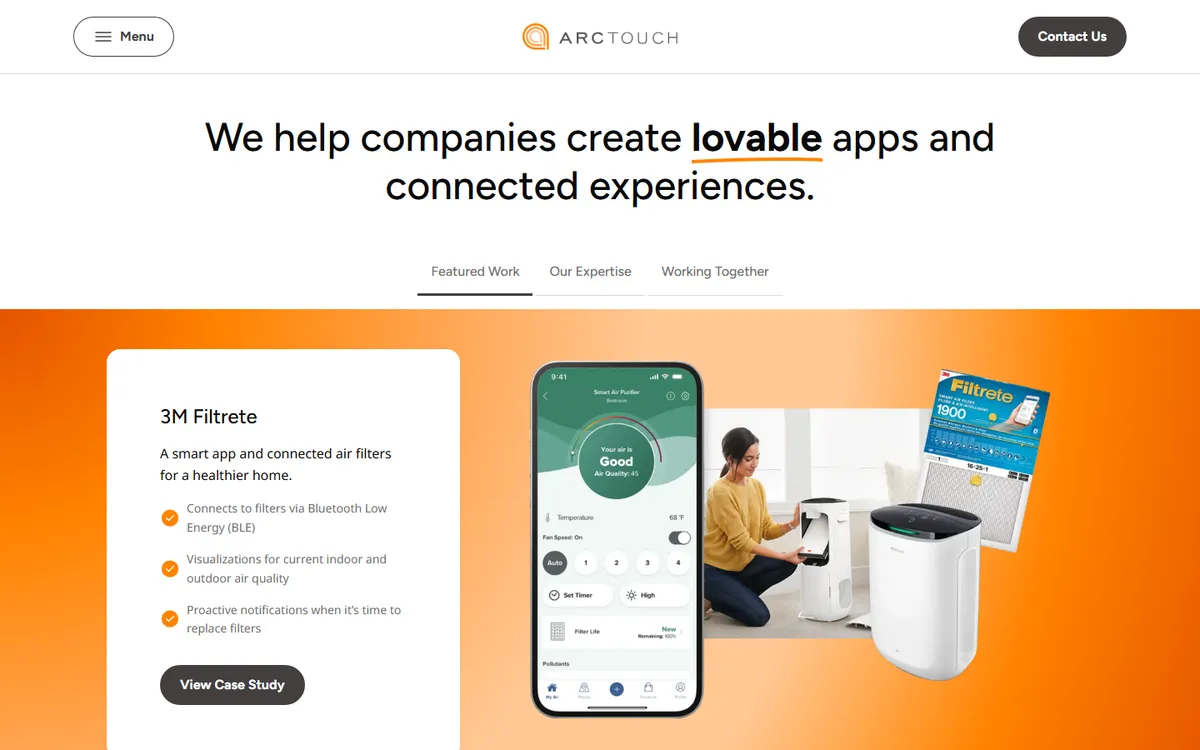
ArcTouch is a mobile-first product agency based in San Francisco with a long list of Fortune 500 clients spanning FinTech, media, retail, and consumer brands. The firm has a design-led engineering culture that suits buyers building consumer FinTech apps where motion design and a polished iOS or Android experience drive adoption. ArcTouch is a strong fit when the app is the product and the experience needs to compete with the best in the category on the App Store.
Itexus
- Founded: 2013
- Offices: New York, NY (US)
- Hourly rate: $50–$99/hr
- Industry expertise: FinTech, Banking, Insurance, Lending, AI
- Reviews: 30+ reviews on Clutch, average rating 4.9/5
- Services: FinTech software development, mobile development, web development, AI integrations
Itexus
Itexus is a FinTech-only software company with a US office in New York and a portfolio focused on neobanking, peer-to-peer lending, trading platforms, and insurance products. That narrow positioning is the appeal: every engineer and project manager the firm puts on a project has shipped FinTech before, which shortens onboarding and removes the cost of explaining why KYC and Anti-Money Laundering (AML) matter. Itexus fits early- to mid-stage US FinTech startups that want a vendor whose entire portfolio is within their domain.
Topflight Apps
- Founded: 2009
- Offices: Pittsburgh, PA (US)
- Hourly rate: $100–$149/hr
- Industry expertise: FinTech, Healthcare, Blockchain, EdTech
- Reviews: 30+ reviews on Clutch, average rating 4.9/5
- Services: Mobile app development, FinTech app development, MVP development, web development
Topflight Apps
Topflight Apps is a US-headquartered mobile and web development firm based in Pittsburgh, with a fully US delivery model. Its blockchain work centers on digital wallets, while its FinTech portfolio covers neobanking concepts and lending tools. The firm also runs a published MVP-to-scale framework aimed at venture-backed founders. Topflight fits early- and mid-stage US FinTech startups that want a smaller, dedicated US-based team rather than a large offshore bench.
Choose Cleveroad as your AI fintech platform development company to turn complex financial workflows into secure, AI-enabled digital products
Velvetech
- Founded: 2001
- Offices: Glenview, IL (US)
- Hourly rate: $50–$99/hr
- Industry expertise: FinTech, Insurance, Healthcare, Manufacturing
- Reviews: 30+ reviews on Clutch, average rating 5.0/5
- Services: Custom software development, FinTech apps, mobile development, AI/ML solutions
Velvetech
Velvetech has run for more than two decades from its US headquarters in the Chicago metro and has shipped trading and brokerage software, along with insurance systems, across that time. The firm fits buyers who want a stable, US-incorporated vendor with engineers who have spent years within the financial-services domain rather than rotating in from generic enterprise SaaS work.
Saritasa
- Founded: 2005
- Offices: Newport Beach, CA (US)
- Hourly rate: $100–$149/hr
- Industry expertise: FinTech, Healthcare, Real Estate, Manufacturing
- Reviews: 70+ reviews on Clutch, average rating 4.9/5
- Services: Mobile app development, web app development, custom software, AR/VR, and IoT
Saritasa
Saritasa is a US-headquartered firm in Newport Beach, California, with a two-decade track record across regulated industries. Its in-house team covers mobile and web development, as well as emerging technologies such as Augmented and Virtual Reality (AR/VR) and the Internet of Things (IoT). That last capability matters for FinTech products that touch hardware or in-branch experiences such as identity capture, where a vendor with both a FinTech track record and IoT engineers is uncommon.
How to Choose the Right FinTech App Development Partner in the USA
Use the seven criteria below to cut the eight profiles above down to two or three real candidates. They are ranked roughly by how often they decide the outcome.
Regulatory fit
A US FinTech vendor needs a working knowledge of the rules your product will be audited against: PCI DSS scope reduction, SOC 2 Type II controls, GLBA safeguards, Federal Financial Institutions Examination Council (FFIEC) guidance for products tied to chartered banks, and state money-transmitter licensing rules, where applicable. On the tooling side, look for hands-on experience with the AML and KYC providers the US market actually uses, such as Plaid, Alloy, Persona, and Sardine. Ask any vendor to walk you through how they would integrate one of those during an onboarding flow. If they cannot answer in detail, treat that as a flag.
Engagement model
Engagement model determines your cost, your level of control, and how much delivery risk you carry:
- Fixed-scope works for well-defined builds with locked requirements, such as a v1 MVP with a frozen feature list.
- Dedicated team works when the scope will shift over six to eighteen months, and you want the same engineers across the whole arc.
- Staff augmentation works when you have internal engineering leadership and just need to add capacity.
Most US FinTech projects start with one model and shift to another after launch, so pick a vendor that supports that shift without requiring a renegotiation from scratch. Ask candidate vendors how their team composition changes between MVP and post-launch phases.
Onshore vs. nearshore vs. offshore
Geography is a cost and risk tradeoff: Onshore vendors charge $100–$200+ per hour and offer same-day communication, easier contract enforcement, US-based data residency, and a single legal jurisdiction.
- Nearshore vendors in Latin America charge $50 to $100 per hour and offer time-zone overlap with US working hours.
- Offshore vendors in Eastern Europe or South Asia charge $25 to $80 per hour and offer the deepest engineering bench at the cost of time-zone friction.
For US-regulated workloads, check where engineers will physically work and where production data will sit before signing.
Looking to choose the right cooperation model for your FinTech product? Explore Cleveroad's detailed guide on outsourcing models to compare options and make an informed decision
Security posture
Security posture should be auditable. Ask the vendor whether they hold ISO 27001 certification and whether they themselves are SOC 2 audited as a service organization. Ask whether they run penetration tests on every release and sign Business Associate Agreements (BAAs) and Data Processing Agreements (DPAs) without renegotiation. Then request their secure SDLC documentation: it should cover code review, dependency scanning, secrets handling, and access management. A vendor that cannot send these artifacts on request is not ready for FinTech work.
The vendor's security posture also feeds into your own compliance. According to the Federal Trade Commission, the Safeguards Rule under GLBA requires covered financial institutions to select service providers that can maintain appropriate safeguards, spell out security expectations in the contract, monitor the provider's work, and reassess its suitability periodically.
Domain depth
Domain depth is where most buyers cut corners. A vendor listing "FinTech" as an industry on their website does not prove they have shipped FinTech. Ask for two references from named FinTech projects in the last 24 months. Read their Clutch-verified reviews and look for the phrase "financial services" or for specific FinTech subverticals. If their case studies are vague or every screenshot is from a healthcare or retail client, treat the FinTech claim as marketing rather than capability.
Contract red flags
Four contract issues come up over and over:
- No fixed milestones means no enforceable progress checkpoints.
- No Intellectual Property (IP) assignment clause means the vendor could later claim ownership of your codebase.
- A vague Quality Assurance (QA) scope means you will pay extra for every test cycle the contract did not name.
- No security obligations means a breach is your liability, not theirs.
Get all four addressed before signing.
Post-launch support
Post-launch support separates real product partners from agencies that ship and disappear. Ask whether the vendor offers Service Level Agreement (SLA)-backed maintenance, on-call rotations, observability setup, and a documented incident response process. For a regulated FinTech product, a six-hour outage during a banking partner audit window is a business-ending event. Make sure the contract reflects that.
Why US FinTech Buyers Choose Cleveroad
Here is how Cleveroad measures up against the criteria above. We are a custom software development company with a US office in Claymont, Delaware, and 15+ years on the market. We build banking platforms, lending and neobanking products, insurance systems, payment solutions, and blockchain solutions for FinTech startups and established financial institutions.
For example, our team built an eBanking software system for a Swiss investment bank, with digital account opening, KYC verification, an online banking portal, and trading tools that meet Financial Market Infrastructure Act (FMIA) requirements. After launch, user retention grew by 20–30%, and the bank now operates the platform under its own license.
Here is what you get when you work with us on a US FinTech product:
- 280+ in-house engineers. Our core team covers mobile, web, backend, QA, and DevOps, and a 2,100-specialist external talent network adds rare skill sets when your roadmap needs them.
- Certified processes. Cleveroad holds ISO 9001 and ISO 27001 certifications for quality management and information security.
- Documented secure SDLC. We build security checks into every stage, from architecture design to release, so you have documentation ready when your partner bank or auditor asks for it.
- Compliance experience. Our team regularly works with PCI DSS, SOC 2, GLBA, and GDPR, and integrates KYC and AML providers into onboarding flows.
- Flexible cooperation. You can start with a Dedicated Team, Staff Augmentation, or Time & Material model and adjust it as your product moves from MVP to post-launch growth.
- Transparent start. A free Solution Workshop maps your business challenges to a technical plan before you sign a contract, and we sign a Non-Disclosure Agreement (NDA) from day one.
- Post-launch support. Our engineers stay on for technical support and maintenance after release, so your product keeps pace with new regulations and user demand.
Tell us about your FinTech product
With 15+ years of experience in FinTech development, we build secure, compliant solutions tailored to your business goals, on time and within budget
Budget about $80,000 for a stripped-down MVP and $500,000 or more for a full regulated product. Geography and engineer seniority drive most of the difference in hourly rates:
- Onshore US team: $100 to $200+ per hour
- Nearshore Latin American team: $50 to $100 per hour
- Eastern European or South Asian offshore team: $25 to $80 per hour
- Vendors in this shortlist: $50 to $199 per hour
A standard FinTech MVP with KYC, payments, and basic dashboards typically costs $120,000 to $200,000 with a mid-priced offshore or nearshore partner. Expect compliance work (PCI DSS scope reduction, SOC 2 readiness, penetration testing, secure SDLC) to add 15 to 25 percent on top of the baseline development budget.
At a minimum, a US FinTech vendor should be familiar with PCI DSS for any product that handles cardholder data, SOC 2 Type II as the de facto enterprise security audit, and GLBA for products that touch consumer financial information. Bank-aligned products usually inherit FFIEC guidance from the chartered partner. Money movement products must comply with state money transmitter licensing rules. AML and KYC integrations with Plaid, Alloy, Persona, or Sardine are standard. The vendor should hold ISO 27001 itself, sign BAAs and DPAs without friction, and document a secure SDLC.
It depends on your budget and on whether you have an internal CTO to steer the build. Here is how the three options compare:
*** US-only vendor** (Praxent and Topflight Apps in this shortlist): $100 to $200+ per hour. Works best when there is no internal CTO and the product cannot tolerate any time-zone friction.
- Nearshore Latin American vendor: $50 to $100 per hour, with same-day overlap with US working hours.
- US-headquartered vendor with offshore engineers (Cleveroad, ITechArt, and Itexus in this shortlist): $50 to $99 per hour. Sits in the middle, offering US contract enforceability and a deeper engineer bench.
Most US FinTech MVPs ship in 4 to 6 months with a team of 5 to 8 engineers. The timeline depends on three factors: the complexity of the regulated workflow, the number of third-party integrations the product requires, and how much time you can spend reviewing demos. A neobanking MVP with KYC, account opening, and a basic ledger typically reaches the 5-month mark. A lending MVP with credit decisioning and underwriting integrations runs longer, often 6 to 8 months. A full production-grade FinTech product takes 9 to 14 months from kickoff through public launch.
Ask how the vendor handles compliance, integrations, IP, and post-launch support. Specifically:
- Which AML and KYC providers have you integrated into production?
- Are you ISO 27001-certified and SOC 2-audited as a service organization?
- Will you sign a BAA and DPA without renegotiation?
- Who owns the IP, and is a full assignment included in the master agreement?
- What is your post-launch SLA, on-call rotation, and incident response process?
A vendor that answers all five with documentation and specific project examples is worth shortlisting. A vendor that hedges on any of them is a risk in regulated US FinTech work.

Evgeniy Altynpara is a CTO and member of the Forbes Councils’ community of tech professionals. He is an expert in software development and technological entrepreneurship and has 10+years of experience in digital transformation consulting in Healthcare, FinTech, Supply Chain and Logistics
Give us your impressions about this article
Give us your impressions about this article