How to Create an Investing App in 2026: Must-Have Features and Cost
Updated 26 Feb 2026
13 Min
5415 Views
How to create an investment app? In today’s market, a successful application starts with understanding one simple shift: investing moved from brokers’ offices to a mobile app experience. Users expect instant onboarding, real-time portfolio tracking, fractional shares, and transparent fees. An online investment app must also support secure deposits and clear transaction status updates. What once required financial education and phone calls now happens in a few taps.
At Cleveroad, we design and develop secure FinTech products for startups and financial institutions for over 15 years. With 200+ delivered projects and hands-on experience in building complex digital platforms, we know how to combine compliance and user-first design in investment app development.
If you’re researching how to build an investment app, you need a clear execution plan. Below is a step-by-step guide to launching a competitive investing platform:
- Define your niche and target audience
- Validate regulatory requirements and licensing
- Design intuitive onboarding and portfolio UX
- Choose a scalable and secure tech stack
- Integrate brokerage, payment, and market data APIs
- Implement advanced security and fraud protection
- Define your monetization strategy early
Common 6 Types of Investment Apps
The investing market includes several distinct product models, each built around different user goals and asset classes. When planning investment app development, you need to define the segment you target, as licensing and feature sets vary significantly across these categories.
Below are examples of investment apps across the most common categories.
Stock and ETF trading apps
Investment app development requires preparations. It’s better to decide on the apSelf-directed platforms that enable users to trade public equities and ETFs with real-time data, advanced order execution, technical charting, and portfolio analytics. Designed for active or semi-active investors who require direct market access and execution control.
Example: Robinhood, ETRADE, Charles Schwab, Fidelity.
Robo-advisory apps
Automated investing platforms that build and rebalance portfolios based on user goals and risk tolerance. These solutions simplify long-term investing through algorithmic asset allocation, sometimes complemented by optional human advisory services.
Example: Betterment, Wealthfront, SoFi Invest, Nutmeg, Ellevest.
Wealth management platforms
Comprehensive systems designed for high-net-worth individuals and professional investors. They support portfolio management, financial planning, tax optimization, and consolidated reporting across multiple accounts within a regulated framework.
Example: Morgan Stanley Wealth Management, UBS Wealth Management, Goldman Sachs Private Wealth Management, JPMorgan Private Bank.
Cryptocurrency and digital asset apps
Platforms that enable users to trade and manage digital assets such as Bitcoin and Ethereum, often incorporating custody solutions, staking features, and regulatory compliance mechanisms. In regulated markets, integration with traditional finance infrastructure is increasingly common.
Example: Coinbase, Binance, Kraken, Gemini, Crypto.com.
Alternative investment apps
Platforms that provide retail access to non-traditional assets such as real estate or art through fractional ownership models. These apps focus on long-term growth and portfolio diversification.
Example: Fundrise, Yieldstreet, Masterworks, Republic, CrowdStreet.
Hybrid multi-asset investment apps
Integrated platforms that allow users to manage multiple asset classes within a single interface, combining equities, funds, crypto, and selected alternatives. This unified model increases engagement and centralizes portfolio oversight.
Example: eToro, Revolut, Public, Interactive Brokers, M1 Finance.
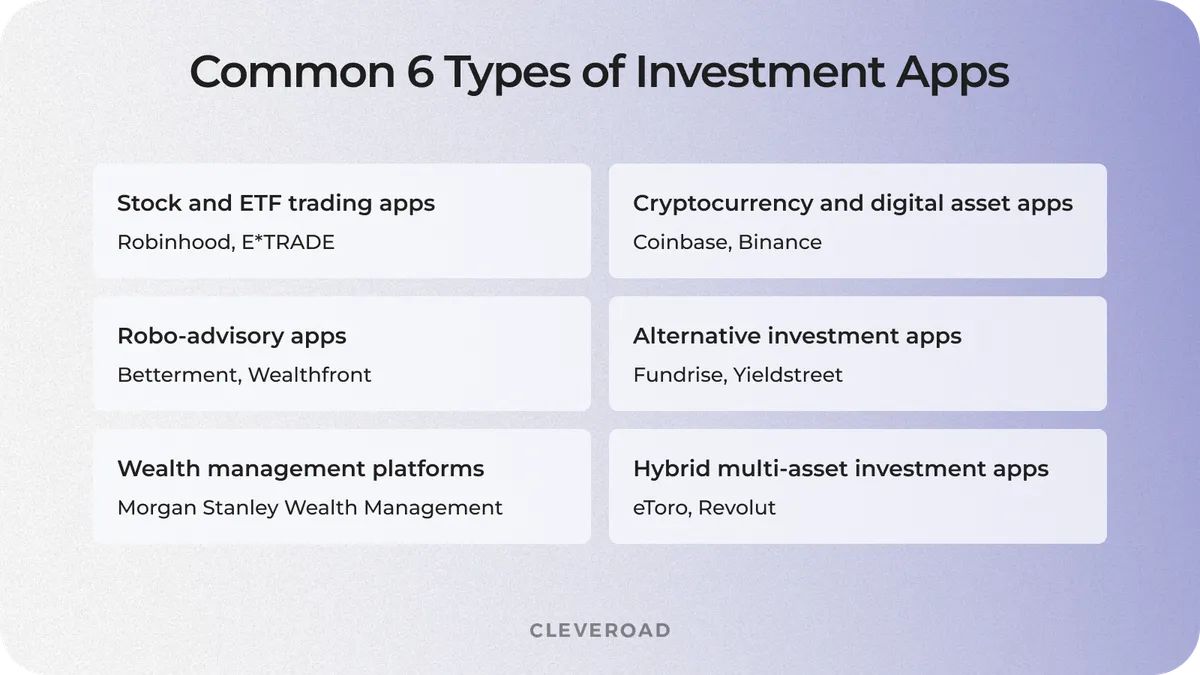
Common 6 Types of Investment Apps
Steps to Create an Investment App
Building an investment product requires structured planning. If you are researching how to create an investing app that complies with financial regulations, you need a clear execution roadmap. Below is a practical framework that reflects how real FinTech platforms move from idea to launch.
Step 1. Run market research and define the product plan
Start by defining your target audience, as it directly affects the depth of features and the infrastructure load. Your target audience also determines which investment options your platform should support in the MVP, such as stocks, ETFs, crypto assets, or other instruments. For instance:
- Beginners expect automation and simple interfaces.
- Day traders demand advanced charts and complex order types.
- Long-term investors prioritize diversification and low fees.
Analyze direct competitors such as Robinhood, Acorns, eToro, or Betterment. Study their positioning, asset coverage, onboarding flow, and monetization structure. Your goal is not replication but differentiation. Combine competitor insights with emerging market trends to define your Unique Selling Proposition (USP).
You must also select a monetization model at this stage. The most common models include:
| Model | Description | Best for |
Commission per trade | Users pay a fixed or percentage-based fee for each executed transaction. | Active trading apps and brokerage platforms |
Subscription plans | Monthly or annual fee for access to trading tools or premium functionality. | Multi-asset platforms with advanced features |
Spread-based revenue | The platform earns on the price difference between buy and sell quotes. | Forex and crypto trading apps |
Payment for order flow | Revenue generated by routing trades to specific market makers. | High-volume retail trading platforms |
Asset management fees | Percentage fee charged based on assets under management (AUM). | Robo-advisory and automated investing apps |
Premium feature upgrades | Additional paid tools such as analytics, signals, or advanced reporting. | Hybrid and semi-professional trading apps |
Monetization impacts licensing requirements and even database architecture. For example, robo-advisory apps often rely on AUM-based fees, while trading platforms may focus on spreads or subscription tiers.
Step 2. Handle compliance, licensing, and data protection
In the United States, investment apps operating as broker-dealers must register with the SEC and become members of FINRA. In the European Union, the GDPR governs the handling of personal data, while MiFID II may apply depending on the services offered. Cryptocurrency platforms often face additional AML, KYC, and custody regulations that vary by jurisdiction.
Your legal obligations depend on your target markets, the asset classes you offer, and whether you operate as a broker, intermediary, or technology provider. Compliance planning must begin before development because it affects integrations, reporting logic, audit trails, and user data storage.
If you are unsure how regulatory requirements affect your architecture, our IT consulting services can help you define the right compliance and security strategy before development begins.
Step 3. Select a FinTech development vendor
Choosing the right development partner reduces operational risk and accelerates delivery. Evaluate vendors based on five key factors:
- FinTech delivery experience
- Security and compliance expertise
- Integration capabilities with KYC
- Payment and brokerage systems
- Transparency in estimation and roadmap planning
Cleveroad has more than 15 years of experience delivering FinTech and investment solutions, including investment applications, for startups, SMBs, and enterprise businesses. We design secure architectures aligned with regulatory frameworks and implement platforms capable of handling high transaction volumes. Our clients consistently leave positive feedback about our collaboration, highlighting the team’s professionalism and strong dedication to achieving the best results.
One of our FinTech clients, Kirk Donohoe, CPO at Mangopay, shared their experience collaborating with us in this video testimonial:
Kirk Donohoe, CPO at Mangopay. Feedback about Cleveroad's FinTech Software Development Services
Step 4. Define the MVP feature set
Launching a focused Minimum Viable Product (MVP) reduces financial and regulatory risk. Core features of an investing app MVP typically include:
- User registration
- Identity verification through KYC
- Portfolio tracking dashboards
- Bank account linkage via providers such as Plaid
- Basic buy and sell flows with transaction history
Each feature must be documented as acceptance criteria that define expected behavior and edge cases. Advanced functionality such as social trading, derivatives support, tax optimization, or algorithmic trading tools should be scheduled for later releases. Clear prioritization protects the budget and accelerates time-to-market.
If you're unsure how to structure and validate your first release, explore our guide on how to build a minimum viable product to understand scope prioritization and launch strategy for regulated FinTech solutions.
Step 5. Choose the technology stack and plan integrations
When you develop an investment app, you need a secure and scalable infrastructure. Select backend infrastructure capable of handling low-latency transaction processing and ensuring transactional consistency, and cloud infrastructure that supports high availability.
Integration planning is equally critical. Most platforms rely on third-party services such as KYC providers, payment processors, brokerage APIs, and real-time market data feeds from providers like Bloomberg or Yahoo Finance. API reliability directly affects user trust, while integration pricing models influence long-term operational costs.
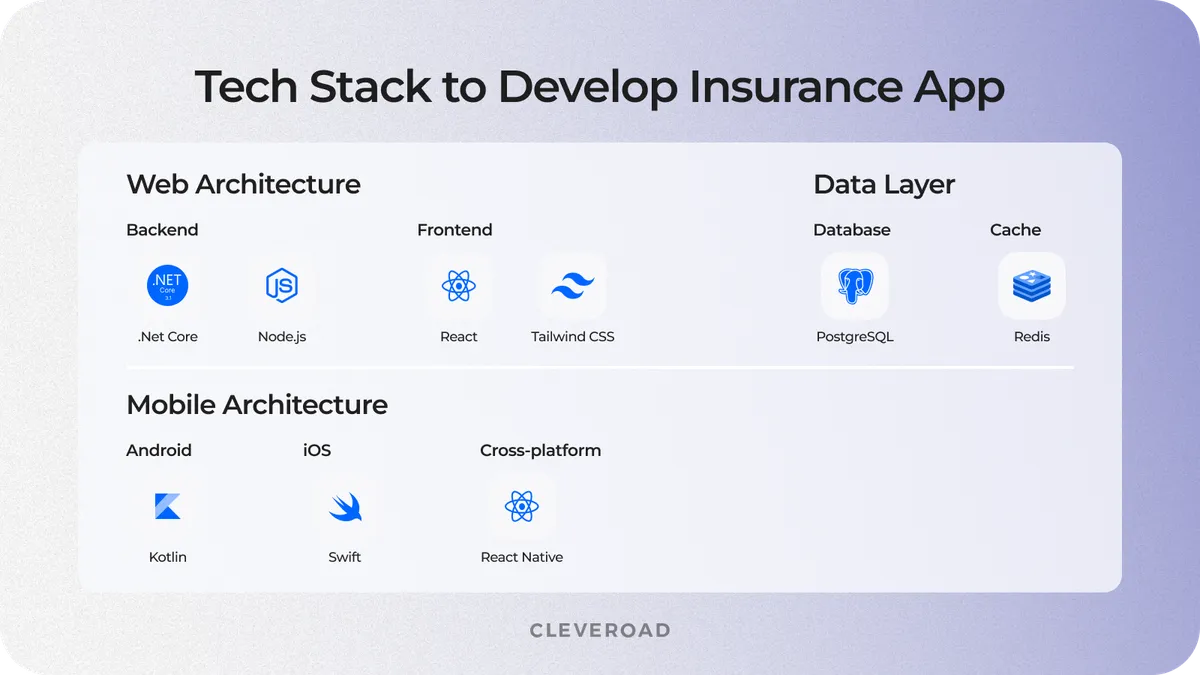
Tech Stack to Develop Insurance App
Step 6. Develop the app and run security-focused testing
Development typically follows agile iterations with continuous QA involvement. Testing must include functional validation, security verification, and load testing under peak trading conditions.
FinTech products require production-like staging environments before release. Final readiness checks should include security audits and penetration testing to ensure protection against unauthorized access and transaction manipulation.
Step 7. Launch, monitor performance, and maintain the product
App store release requires legal disclosures and operational readiness. After launch, teams must monitor transaction accuracy, API reliability, and user engagement to ensure operational stability.
Ongoing maintenance includes feature updates, regulatory adjustments, and regular security patches. Maintenance planning should be included in the initial budget, as investment platforms operate in dynamic financial and regulatory environments that demand continuous adaptation.
Need a secure investment app? Explore our FinTech software development services to build compliant, scalable financial platforms.
Essential Features to Make an Investment App
A competitive investment platform must balance usability, security, and regulatory compliance from the first release. The features below form the operational foundation of a reliable investing app.
User onboarding and identity verification
Secure registration with KYC and identity checks ensures compliance with financial regulations and reduces fraud risks from day one. This flow typically includes document verification, biometric validation, AML screening, and secure data storage aligned with regional legal standards.
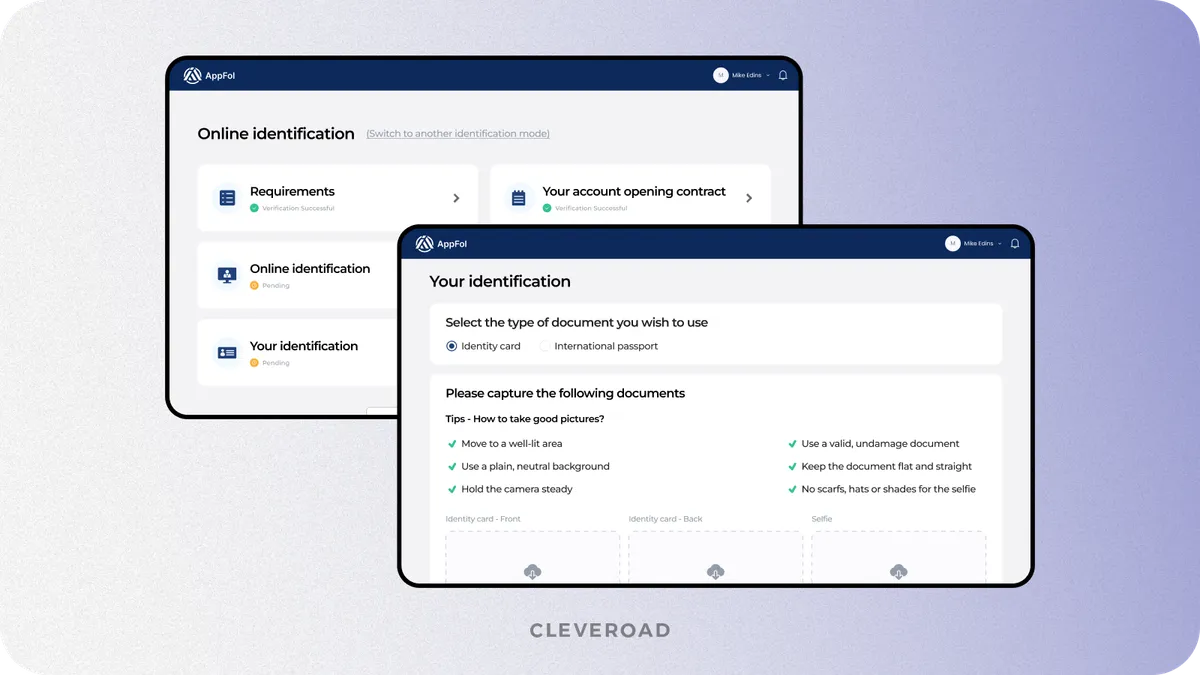
KYC Check
Asset discovery and market data
Access to real-time or near-real-time quotes and basic analytics helps users explore investment opportunities before placing trades. Reliable data feeds and transparent price updates directly influence user confidence and engagement.
Account and portfolio management
Users need a clear and structured overview of their assets, balances, historical performance, and transaction records across supported instruments. A well-designed dashboard improves trust and helps investors understand allocation, returns, and portfolio diversification at a glance within the app.
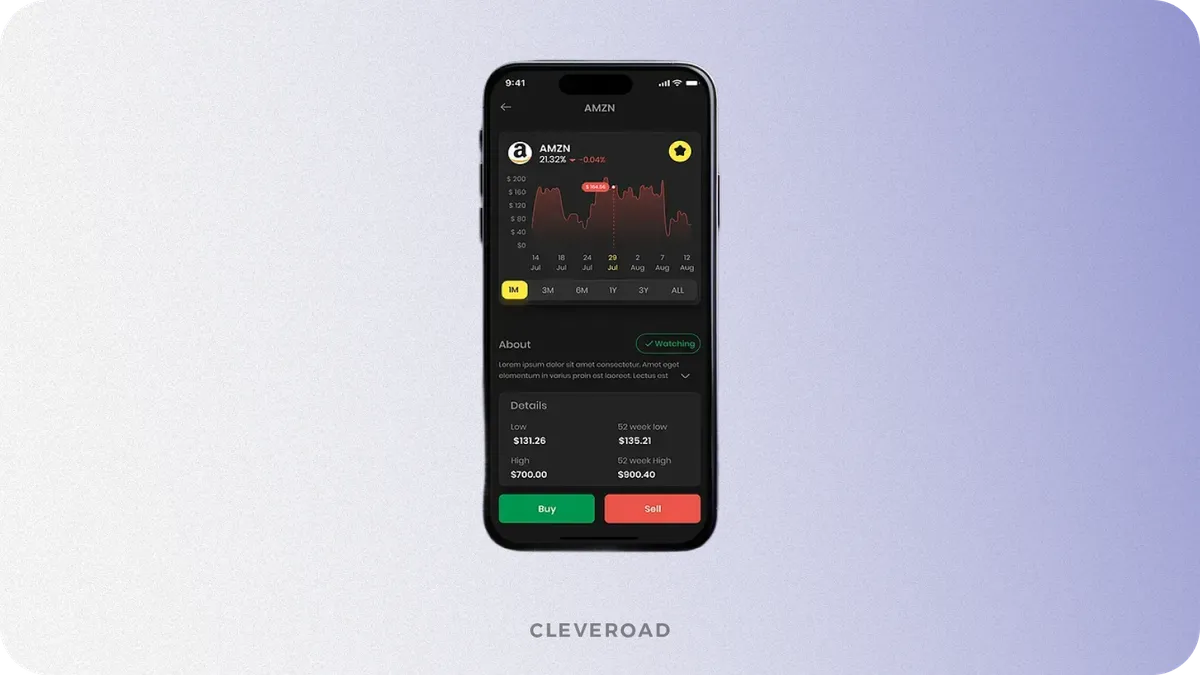
Auto Investing Portfolio Management
Trading and order execution
Core buy-and-sell functionality must support common order types, such as market and limit orders, with clear confirmations and real-time transaction status tracking. Fast and accurate execution is critical for both active traders and long-term investors.
Payments and bank integration
Secure integration with banks supports funding an investment account and internal transfers. Services such as Plaid are commonly used to simplify bank connectivity while maintaining security and regulatory alignment.
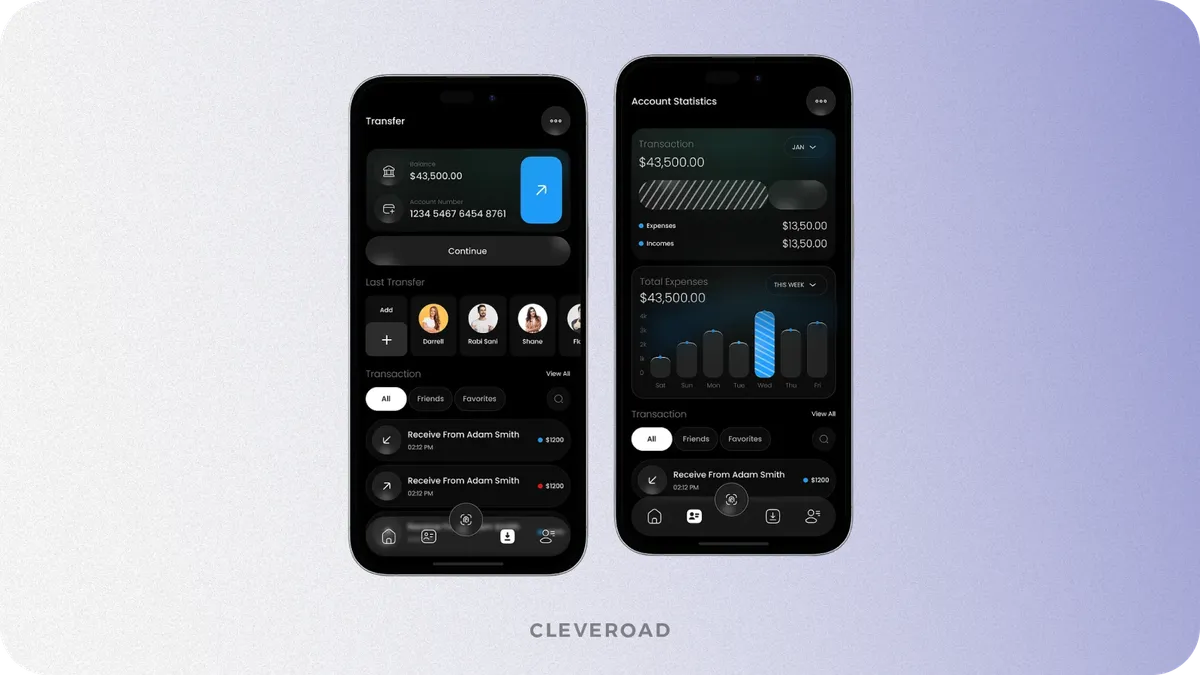
Mobile Finance App
Security and access controls
Investment apps must implement strong encryption, secure authentication mechanisms, multi-factor verification, and role-based access controls. Continuous monitoring protects against unauthorized activity and suspicious transactions. Academic research also emphasizes that cybersecurity frameworks and risk-based access control significantly improve trust in digital financial platforms (Source: Journal of Securities Operations & Custody).
Compliance and reporting tools
Built-in regulatory reporting, audit logs, and automated document generation help businesses meet obligations imposed by financial authorities. Transparent reporting also improves credibility with users and partners.
Notifications and alerts
Timely push notifications and in-app alerts inform users about executed trades, portfolio changes, price movements, or compliance-related updates. Real-time communication increases engagement and prevents missed market events.
Admin and operations panel
An internal dashboard allows operational teams to monitor transactions, manage user accounts, and resolve disputes. This layer supports daily operations and reduces manual workload.
Scalability and performance monitoring
Backend architecture must support peak trading activity and high data volumes without performance degradation. Continuous system health monitoring ensures uptime stability and protects user experience during market volatility.
How Much Does It Cost to Build an Investing App?
Investment app development costs typically range from $90,000 to $250,000+, depending on complexity, regulatory scope, integrations, and security requirements. A simple stock-trading MVP with basic onboarding and portfolio tracking sits closer to the lower range. A multi-asset platform with advanced analytics and robust compliance controls falls into the upper range.
Below is an approximate MVP cost breakdown based on core investment app features.
| Investment app development component | Approx development time (h) | Approx cost ($) |
User onboarding and KYC integration | 160 hours | $12,000 |
Account and portfolio management | 220 hours | $16,500 |
Asset discovery and market data integration | 200 hours | $18,000 |
Trading and order execution | 280 hours | $24,000 |
Payments and bank integration | 180 hours | $14,000 |
Security and access controls | 150 hours | $12,000 |
Compliance and reporting tools | 170 hours | $15,000 |
Notifications and alerts | 90 hours | $7,000 |
Admin and operations panel | 200 hours | $16,000 |
Scalability setup and performance monitoring | 120 hours | $9,500 |
Quality assurance and testing | 600 hours | $30,000 |
Total (MVP estimate) | 2,370 hours | $174,000 |
These numbers reflect an average blended development rate and assume a cross-functional team including backend and frontend engineers, QA specialists, and a project manager.
If you plan to add advanced features such as robo-advisory logic, social trading, AI-based recommendations, or multi-region regulatory support, the total investment increases accordingly.
Planning an MVP for your investment platform? Contact us to get a tailored investment app development cost estimate based on your product vision and business goals
How Cleveroad Can Help You with Investment App Development?
Cleveroad is a FinTech software development company with more than 15 years of experience delivering secure and scalable digital products. We build custom financial platforms for startups, SMBs, and enterprises, including investment apps, digital banking systems, payment solutions, lending platforms, and crypto products. Our teams support clients through the entire product lifecycle, covering business analysis, UI/UX design, backend engineering, DevOps, and compliance expertise to launch regulated FinTechfintech solutions across global markets.
Here what benefits you’ll receive by cooperating with Cleveroad:
- FinTech domain expertise with regulatory awareness: We understand how SEC-related obligations, GDPR, AML requirements, and financial reporting standards shape product architecture.
- Security-first development approach: Cleveroad operates under ISO-certified processes, including ISO 9001 and ISO 27001 standards, ensuring structured quality management and information security practices.
- End-to-end product delivery: From market research and MVP definition to scalable backend architecture and post-launch support, we provide full-cycle development services
- Reliable third-party integrations: Our engineers have hands-on experience integrating complex financial APIs while maintaining performance and cost control.
- Scalable architecture for growth: We design cloud-native systems that handle peak trading loads, high transaction volumes, and real-time data streams. Our DevOps teams ensure continuous monitoring, performance optimization, and secure infrastructure scaling.
- Transparent collaboration and predictable delivery: We provide structured estimations, clear documentation, and regular reporting throughout development. Clients receive full visibility into timelines, milestones, and budget allocation.
To demonstrate our expertise in investment software development, we’d like to show you one of our recent projects - a micro-investment platform for the Middle East market.
One of our clients, an investment company established in 1988, aimed to launch a micro-investment platform for retail users with limited capital. The company wanted to make investing accessible through small, automated contributions while ensuring regulatory compliance and secure financial operations. They approached Cleveroad to design and develop a scalable platform that would support fractional investments and integration with financial institutions.
To meet our customer’s business goals, we built a secure micro-investment platform with streamlined user registration and identity verification flows aligned with KYC requirements. Our team implemented automated portfolio allocation logic and integrations with banking and payment providers to enable seamless deposits and withdrawals. We designed an intuitive dashboard that allowed users to track their investments and transaction history in real time. The backend architecture was built to support secure transaction processing and future scalability.
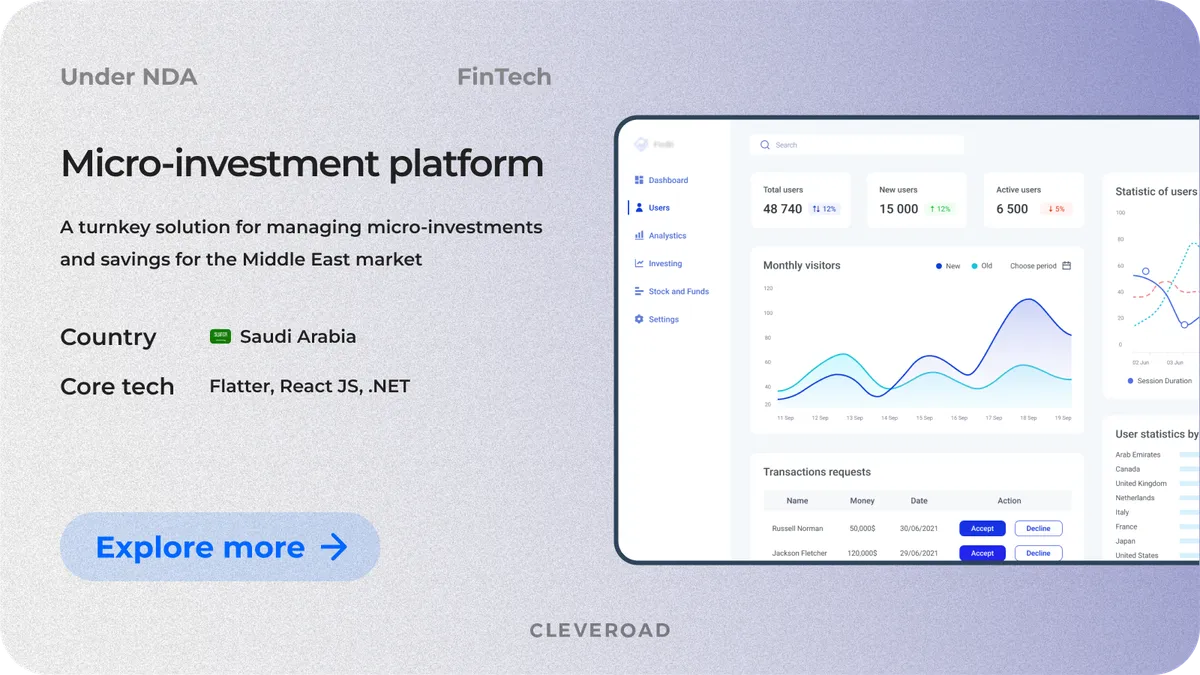
Micro investment platform
As a result, the client received a fully functional investment platform ready for market entry, with secure infrastructure and a clear path for scaling the user base. The solution enabled retail investors to start investing with small amounts, simplified portfolio management through automation, and provided the technical foundation necessary to expand features and enter new markets.
Ready to launch your investment app?
Our FinTech domain experts will help you validate your idea, define the right feature set, and develop a custom investing solution tailored to your business goals
To create an investment app, follow a structured approach:
- Define your target audience and business model — A platform for beginner investors differs significantly from one designed for active traders or high-net-worth clients. Asset types, monetization logic, and geographic market must be selected first.
- Plan regulatory and compliance requirements — Financial apps must align with frameworks such as US SEC regulations or the GDPR in Europe. Compliance impacts onboarding flows, reporting mechanisms, and data architecture.
- Design UX and technical architecture — After clarifying legal and product scope, move to interface design, backend architecture, third-party integrations, and secure infrastructure planning.
Investment app development requires more than feature implementation. It requires building a compliant, scalable financial system that can operate in regulated markets.
The cost to create an investing app depends on the scope and integrations. A realistic budget for an MVP with secure onboarding, KYC verification, portfolio tracking, basic buy-and-sell flows, and payment integration typically ranges from $90,000 to $160,000.
If you plan to support multiple asset classes, real-time market data from premium providers, advanced analytics, robo-advisory logic, or operate in several regulated markets, the investment often exceeds $200,000–$300,000+. Infrastructure scalability, security testing, licensing requirements, and ongoing compliance updates also influence the final cost.
In regulated fintech products, architecture and security standards drive the budget more than UI complexity. A well-planned MVP reduces risk and allows you to validate demand before committing to full-scale platform development.
The development timeline for an investment app MVP usually includes:
- 3–5 weeks for product discovery and compliance validation
- 4–8 weeks for UX/UI design and technical architecture planning
- 12–20 weeks for core development and integrations
- 4–6 weeks for testing, security validation, and release preparation
In total, most MVP versions take 4 to 8 months to complete. More complex platforms with multi-region licensing or advanced automation may require additional time.
An investment app must provide secure onboarding with identity verification, a clear portfolio dashboard, and reliable trading functionality. Users expect access to real-time market data, transparent transaction tracking, and smooth bank integrations for deposits and withdrawals.
Security mechanisms such as encryption, multi-factor authentication, and fraud monitoring are essential to protect financial operations. The platform must also include compliance and reporting tools to meet regulatory standards and maintain operational transparency.

Evgeniy Altynpara is a CTO and member of the Forbes Councils’ community of tech professionals. He is an expert in software development and technological entrepreneurship and has 10+years of experience in digital transformation consulting in Healthcare, FinTech, Supply Chain and Logistics
Give us your impressions about this article
Give us your impressions about this article
Comments
1 commentsthank you keep it up but cab get more videos thank you