How To Start a Streaming Service Like Netflix and How Much It Costs?
Updated 12 Mar 2026
15 Min
95682 Views
Today, streaming platforms have become the primary way people watch movies, series, sports events, and online video content. Services like Netflix, Disney+, Hulu, or TikTok have reshaped how audiences consume media globally, making streaming one of the fastest-growing segments of the modern digital entertainment industry.
Starting a streaming service requires more than just launching a video website. Companies must define a clear niche and build a content strategy, partnering with experienced developers who can design a reliable streaming platform that works smoothly across multiple devices.
Cleveroad’s software engineers design scalable digital media products for over 15 years. Among the projects we've delivered are cross-device video-on-demand platforms, social media apps for streaming and video content sharing, and other media solutions. Based on our experience building media platforms, we explain how to start a streaming service, what infrastructure is required to run it reliably, and how much it typically costs to build a Netflix-like platform in this guide.
Key takeaways:
- A basic streaming platform usually costs $60,000–$150,000+, depending on features
- Most services launch with web + iOS + Android apps and scalable video delivery infrastructure
- Successful platforms focus on niche content and regional audiences
Why Creating Your Own Streaming Service Is Beneficial?
A streaming service is an online platform that provides on-demand audio, video, or live content over the Internet. It uses adaptive bitrate streaming, cloud infrastructure, and Content Delivery Networks (CDN) to help users watch it smoothly on different kinds of devices. Modern Over-The-Top (OTT) platforms also rely on Digital Rights Management (DRM) protection, video encoding pipelines, recommendation algorithms, and analytics systems that help operators manage content delivery and track viewer engagement.
The demand for streaming platforms continues to grow worldwide. Today, viewers choose between popular streaming services such as Netflix, Prime Video, Disney+, and Hulu, which demonstrates how large and competitive the market has become. Launching such platforms usually starts with an Minimum Viable Product (MVP) that includes core streaming functionality, followed by feature expansion such as recommendation engines, monetization tools, multi-region scaling, and analytics systems for tracking viewer behavior.
Recent industry reports highlight the scale of the streaming market and audience engagement:
- According to Statista resource, the number of video streaming users worldwide is expected to exceed $1.7 billion by 2027
- YouTube is the most popular free video streaming app in the world with 2.4 billion users, considering Business of Apps 2026 report
- The global video streaming market is expected to surpass $416 billion by 2030, as to Grand View Research statistics
These figures demonstrate why launching a streaming platform has strong business potential. Companies that create a streaming service today often focus on niche audiences, regional markets, or industry-specific content to differentiate themselves from global platforms.
How does Netflix streaming work?
Netflix is a Subscription Video-on-Demand (SVOD) platform and one of the largest OTT services worldwide. Subscribers pay a monthly fee to watch TV shows and movies across devices, including Smart TVs, iOS, Android, and web platforms. The platform uses adaptive bitrate streaming, cloud microservices, and Netflix’s Open Connect Content Delivery Network (CDN), ensuring stable video playback worldwide.
Today, Netflix includes several core features that keep users engaged:
- A searchable library of movies, series, and Netflix original content
- AI-driven recommendation algorithms based on viewing behavior
- Up to five personalized profiles within one account
Cross-platform streaming across TVs, mobile apps, and browsers Together, these capabilities illustrate how Netflix streaming works in practice. The platform combines large-scale content libraries with personalization systems and a reliable delivery infrastructure that allows millions of users to stream video across devices without interruptions.
For companies exploring how to make a live streaming app, Netflix demonstrates the importance of scalable backend architecture, recommendation engines, CDN-based content delivery, and multi-device support. When aligned with a clear business model, these systems help streaming platforms maintain engagement while monetizing content through subscriptions or ads.
How to Start a Streaming Service Like Netflix, Disney+, or TikTok: Step-by-Step Guide
Launching a streaming platform requires more than technology. A successful online video platform combines a clear niche, a strong content strategy, a sustainable monetization model, and a scalable infrastructure that delivers video to users across devices.
Below are the key steps to follow when building a streaming platform similar to Netflix or Disney+.
1. Find your niche and target audience
Before you create streaming service, define the niche and the audience you want to reach. The video streaming industry is broad, so successful platforms usually focus on a specific category such as sports, education, entertainment, or regional media. A clearly defined niche helps position the streaming service’s value proposition and differentiate it from global competitors.
To identify the right audience and content strategy, analyze several key factors:
- Viewer preferences and the types of on-demand content they consume most often
- Audience demographics such as age groups, regions, or viewing habits
- Content formats that drive engagement, including series, live broadcasts, etc.
- Platforms and devices your audience uses to watch streaming content
Clear insights into audience behavior help shape both the content library and the overall user experience. Streaming platforms that focus on a well-defined audience segment typically achieve higher engagement levels and build more stable subscriber communities over time.
Content is the foundation of every streaming platform. When planning how to launch a service like Netflix, you should first develop a business plan that defines the content strategy, publishing schedule, content acquisition strategy, and monetization model. Some platforms release full seasons at once, while others publish episodes gradually to keep viewers engaged.
Streaming platforms use several monetization models depending on their content strategy and target audience. The table below explains the most common revenue models used by modern streaming services and shows how they differ.
| Monetization model | Description | Examples |
|---|---|---|
Subscription Video on Demand (SVOD) | Users pay a recurring subscription fee (monthly or annually) to access the entire content library without additional charges. This model provides stable and predictable revenue | Netflix, Disney+, Apple TV+ |
Transactional Video on Demand (TVOD) | Users pay for individual content such as a movie, episode, or live event. This model is commonly used for new releases or premium content | Apple TV Store, Amazon Prime Video rentals |
Advertising Video on Demand (AVOD) | Users can watch content for free, but the platform generates revenue through advertisements shown before or during video playback | YouTube, Pluto TV, Tubi |
Hybrid model | Combines multiple monetization approaches, such as subscriptions with advertising or pay-per-view options. This allows platforms to reach different audience segments | Hulu, Amazon Prime Video |
Licensing is another critical part of the strategy. Streaming platforms such as Netflix, Disney+, Prime Video, and regional OTT services typically obtain distribution rights through content distributors, sales agents, or directly from film studios and production companies that own the media rights.
Licensing agreements usually define the distribution model (SVOD, AVOD, or TVOD), the geographic territories where the content can be streamed, the duration of the licensing window, and the permitted distribution channels. In addition to licensed titles, many streaming services also invest in original productions to strengthen brand identity and attract long-term subscribers.
3. Design a unique user experience
If you want to create a streaming service that attracts and retains viewers, the design should make it easy for users to discover content, manage profiles, and watch on-demand content across different devices. Clear navigation, personalized recommendations, continue-watching features, and structured content libraries significantly improve user retention.
Instead of copying existing platforms, focus on creating a unique style and interaction model. Strong UI/UX design services from a qualified vendor help establish brand identity and make the platform memorable for viewers. Professional UI/UX designers typically design recommendation interfaces and layouts optimized for TVs, mobile devices, web applications, and other platforms.
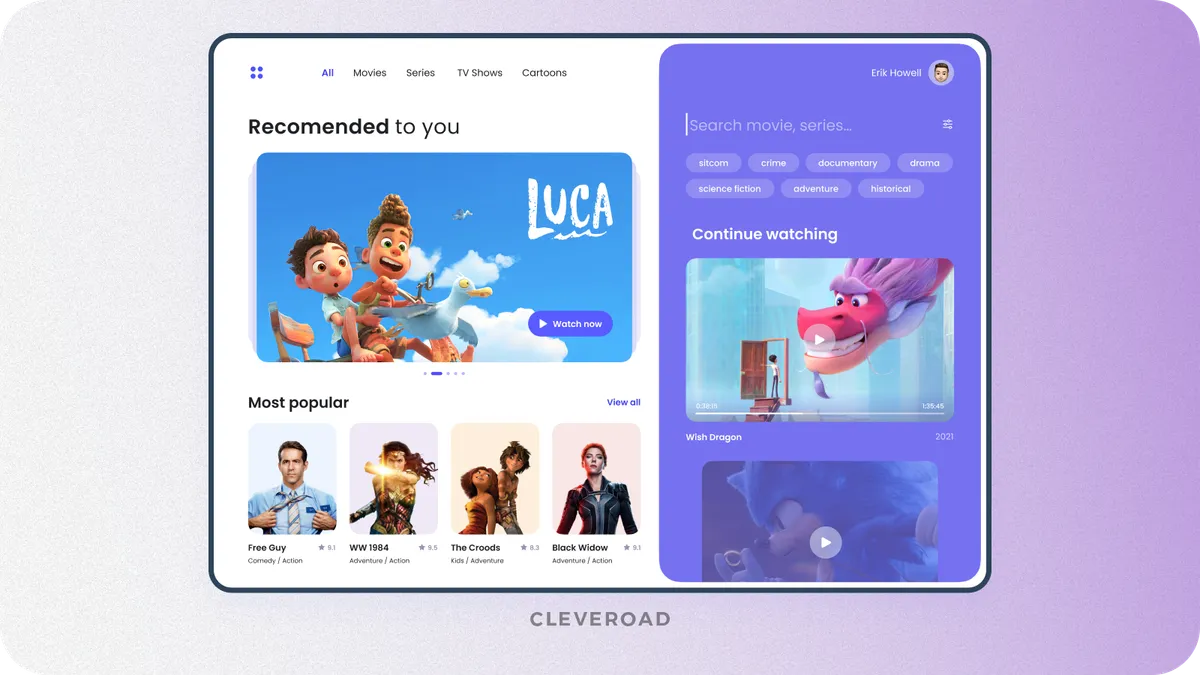
Streaming web platform by Cleveroad (Source: Dribbble)
4. Choose platform and architecture
Selecting the right platforms and architecture is essential for delivering stable video streaming. Most modern services support multiple devices, including Smart TVs, mobile apps, tablets, and web browsers. A cross-platform approach is critical when launching your streaming service, since viewers expect seamless access across screens.
From a technical perspective, video broadcasting platforms rely on adaptive bitrate streaming, cloud infrastructure, and CDN delivery networks. Video content is typically stored in cloud storage and distributed through CDNs that provide high bandwidth and reduce buffering during playback. If you're exploring how to create a live streaming website, understanding these core technologies is essential for ensuring reliable content delivery, scalability, and a smooth viewing experience across devices.
You should also select appropriate video streaming protocols such as HLS, WebRTC, or RTMP, which determine how video is delivered to users and affect latency, streaming quality, bandwidth efficiency, and device compatibility. Streaming platforms additionally implement security mechanisms such as token-based authentication, geo-restrictions, and DRM protection to prevent unauthorized access and content piracy.
Below is an example of a technology stack commonly used by Cleveroad’s streaming software development team to build scalable video broadcasting platforms:
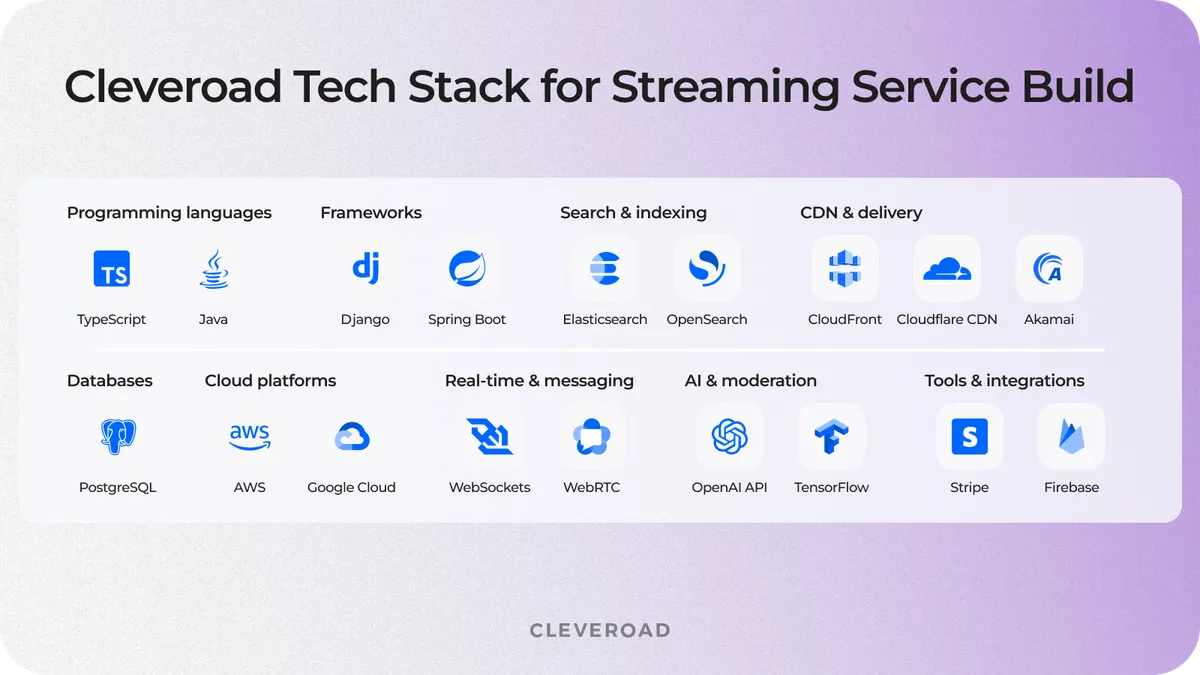
Cleveroad tech stack to develop video streaming resource
5. Develop the streaming platform
Building a streaming service requires experienced software engineers who understand media infrastructure and cloud architecture. A reliable development team will design the backend and integrate payment systems, implementing video hosting solutions that store and deliver media files efficiently. The backend handles core platform logic such as data processing, content management, streaming pipelines, and server infrastructure, while frontend developers build the interface that lets viewers browse content, watch videos across applications, etc.
During development, software engineers, QA specialists, designers, and project managers typically follow an iterative Agile process, delivering features in short development cycles called sprints. Engineers build core components such as content management systems, recommendation algorithms, or streaming pipelines, while QA engineers continuously test frontend and backend functionality in each iteration.
After development cycles are complete, regression and stress testing ensure the platform remains stable under heavy traffic and scales as the audience grows.
Discover our media software development services to build video platforms tailored to your business needs
6. Launch, analyze user feedback, and improve the service
Collecting user feedback after release becomes a key priority. Viewer behavior, analytics data, retention statistics, and engagement metrics (e.g., watch time, content completion rate, repeat visits) help identify how audiences interact with the platform and which features require improvement. Continuous optimization keeps the service competitive in the fast-growing streaming market.
Successful platforms evolve over time by expanding their content library, improving recommendation systems, and refining user experience. Regular updates ensure the platform keeps up with user expectations and continues to attract new subscribers.
Average Feature Set for Media Services like Netflix, Disney+, or TikTok
You should consider the following: the more features your streaming service has, the more expensive it is. So for the beginning, it is better to add the core features only into the first app version, to reduce its cost. Additional features can be added later when the app and website become popular.
Now let's discover the core and additional features to build a streaming service.
Core features for streaming service creation
If you are considering developing a streaming service, it is important to focus on the features that are truly necessary so you can roll out a complete product without going overboard. Starting with essentials will save costs and allow the platform architecture to scale gradually as user demand and traffic increase.
Payment gateway. If you intend to create a streaming website as well, we advise using a payment gateway like Stripe or Braintree. Each payment service shall have PCI-DSS compliance. And gateway providers such as Braintree, Stripe, and PayPal also offer native libraries for both Android and iOS.
User profile. Here, users can add their favorite movies or similar content. Also, you can add more people to your account so they can watch their own content on a Hulu- or Netflix-like streaming service.
Content search and discovery. Selection of genres, selection by user reviews. You can check what your friends watch and what films they like. More advanced platforms later integrate recommendation algorithms that analyze viewing behavior to suggest relevant content.
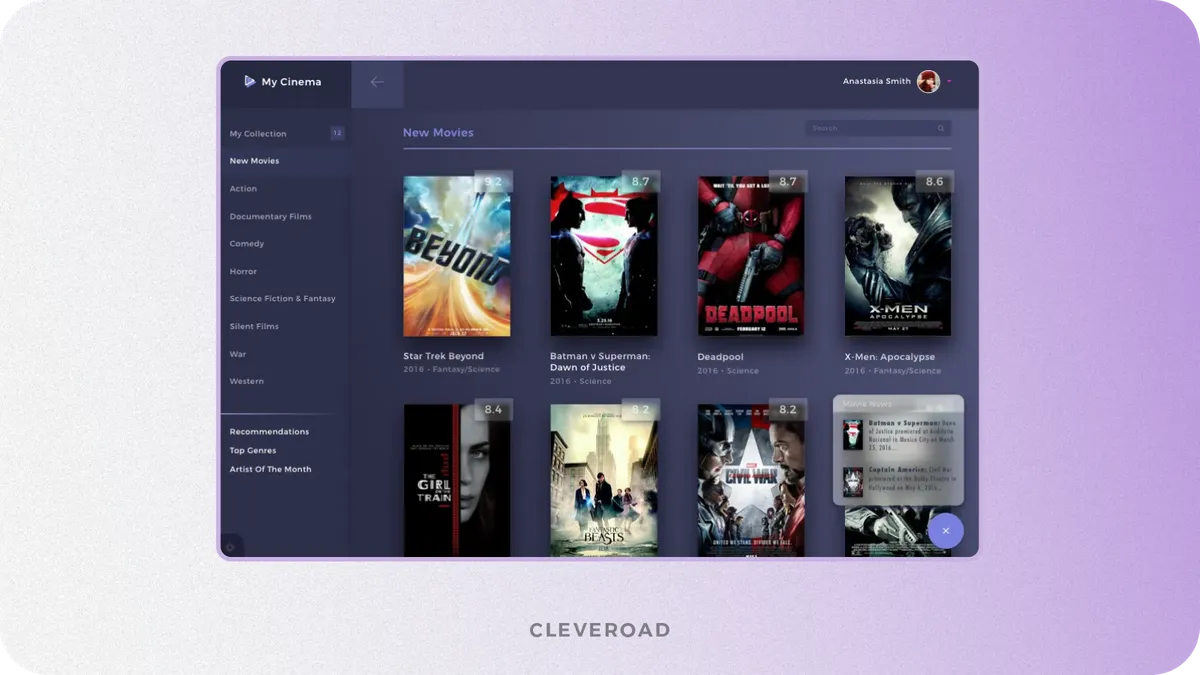
My Cinema Dashboard for streaming app designed by Cleveroad (Source: Dribbble)
Chat and comments. Give users the freedom to interact with one another and share impressions of movies and TV series they've watched. You can achieve this by implementing features such as chat and comment functionality.
Push notifications and settings. These notifications are an extremely useful feature to stay in touch with users. For example, you can notify them once a new TV series or show is released. The settings include selecting the audio track, enabling or disabling subtitles, playing/pausing, rewinding, volume control, etc.
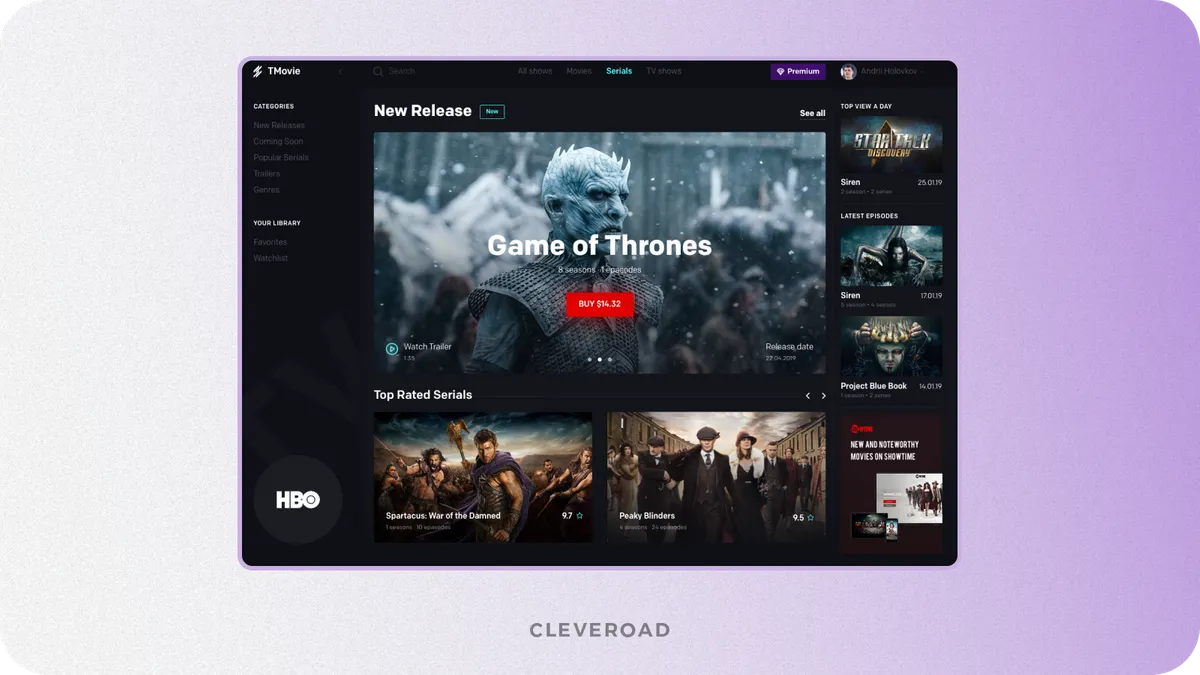
Service for watching movies from Cleveroad (Source: Dribbble)
Multiple language support. The user base is the key to success for this kind of online service. The more languages the Netflix-like app supports, the more users you have.
Geo-restrictions and regional content control. When you build a streaming service, your tech partner muse implement geo-filtering to control where specific titles are available. Licensing agreements often limit content distribution to certain countries or regions. Geo-restrictions ensure compliance with these agreements while also enabling region-specific catalogs, localized recommendations, targeted content licensing strategies, and language adaptations.
Admin panel. It should be available obligatorily since you, as an admin, will have access to all content to manage videos and users, edit videos, block users if necessary, and so on. Administrators also manage video catalogs, licensing windows, and metadata that power search and recommendation systems.
Additional possible features
Let's now look at possible features you could add to the product after launching the MVP of your streaming platform. These capabilities usually appear during later development phases when the service already has an initial audience and a validated business model.
- Social sign-in. Capability to share news and reviews via social media.
- Reviews and ratings. You can rate a television program or movie, forming your own rating based on your portal users' opinions.
- Live streaming video. Live broadcasting of specific TV programs, shows, sports events, etc.
- Content recommendation algorithm. Netflix uses the CineMatch system to provide users with content that is more interesting to them. You can integrate something similar into other services like Netflix, Disney+, or Hulu.
- Download feature. Users can save content on their tablets/smartphones/PC to watch it even when there is no Internet connection available.
- Video quality. Based on the client's requirements and the technical features of their device, they can choose a quality level.
Building a streaming platform like Netflix, Disney+, or TikTok requires a perfect mix of basic and premium features to win over and retain users. Let's now break down the total cost of developing a streaming service and identify what influences the overall budget.
| Feature | Cost range | Priority |
|---|---|---|
User profiles & watchlists | $3,000 – $8,000+ | MVP |
Content search and discovery | $5,000 – $12,000+ | MVP |
Payment gateway integration | $4,000 – $10,000+ | MVP |
Multi-language support | $3,000 – $7,000+ | MVP |
Geo-restrictions and licensing control | $4,000 – $9,000+ | MVP |
Admin panel for content management | $6,000 – $15,000+ | MVP |
Adaptive bitrate streaming | $8,000 – $20,000+ | MVP |
CDN-based video delivery | $10,000 – $25,000+ | MVP |
Social sign-in | $2,000 – $5,000+ | Post-launch |
Reviews and ratings | $2,000 – $6,000+ | Post-launch |
Recommendation algorithms (AI/ML) | $15,000 – $40,000+ | Growth stage |
Offline downloads with DRM | $12,000 – $30,000+ | Growth stage |
Live streaming functionality | $20,000 – $60,000+ | Advanced stage |
How Much Does It Cost to Create a Streaming Service?
Developing a streaming platform is expensive, but it can vary based on functionality and sophistication. The cost to create a video streaming application generally ranges from $30,000 to $200,000+.
Important note! Please note that all costs are approximate, and the final price of your streaming service may vary. Everything depends on your specific requirements. Moreover, to the indicated price, we also include meetings and code documentation processing.
The design should be both attractive and easy to use. It is a guarantee of success. So, for the development of a TV app like Netflix with the core functionality, the cost may be the following:
| Service | Time | Cost | What's included |
|---|---|---|---|
Netflix, Hulu, Disney+ | 1,300-1,500 h | $65,000-$75,000 | 1 server and 2 mobile apps |
Hangouts | 1,000-1,200 h | $50,000-$60,000 | 1 server and 1 mobile app (Android or iOS) |
Instagram Stories, TikTok | 1,100-1,300 h | $55,000-$65,000 | 1 server and 1 mobile app (Android or iOS) |
Thus, according to the information above, you can easily imagine how to start a video streaming service and how much it will cost. And it can become profitable if you follow the right marketing strategy and are willing to invest the required amount.
But for proper development of the app itself, you should trust the high-skilled development company that can implement your ideas accurately within your requirements and desires. So please get in touch with us anytime, we are always at your disposal!
Cleveroad Expertise in Media and Entertainment Software Development
Cleveroad has extensive expertise in creating streaming applications for various businesses. Recently our portfolio was replenished with a project digitizing the popular Video Streaming Platform.
Our customer is the TDC Group company, the largest Danish telecommunication service provider. In 2013, the enterprise acquired the rights for Blockbuster, an iconic US company known for video and game rentals, to launch a video streaming platform in the Nordics. The company wanted to transform the current business model and create a video-on-demand platform to deliver movies and TV series via the Internet on a paid basis. The client approached Cleveroad as an experienced media software development company to:
- Receive a comprehensive video-on-demand platform, localized for the Nordic region, that allows viewers to buy and rent video content within the TVOD (or pay-per-view) model.
- Replace the outdated Android and Android TV apps to recreate a core business process and satisfy end-users expectations about the new product solution.
- Get a responsive on-demand video platform ensuring consistency across devices and optimizing the media experience for everyone.
As a result, our client got a high-quality TVOD streaming platform that allowed the enterprise to digitize the traditional video rental business and offer on-demand video services online. The service has hundreds of thousands of subscribers in Denmark and is rapidly increasing a solid client base across Sweden, Finland, and Norway. Within six weeks, 10,000 people subscribed to the service.
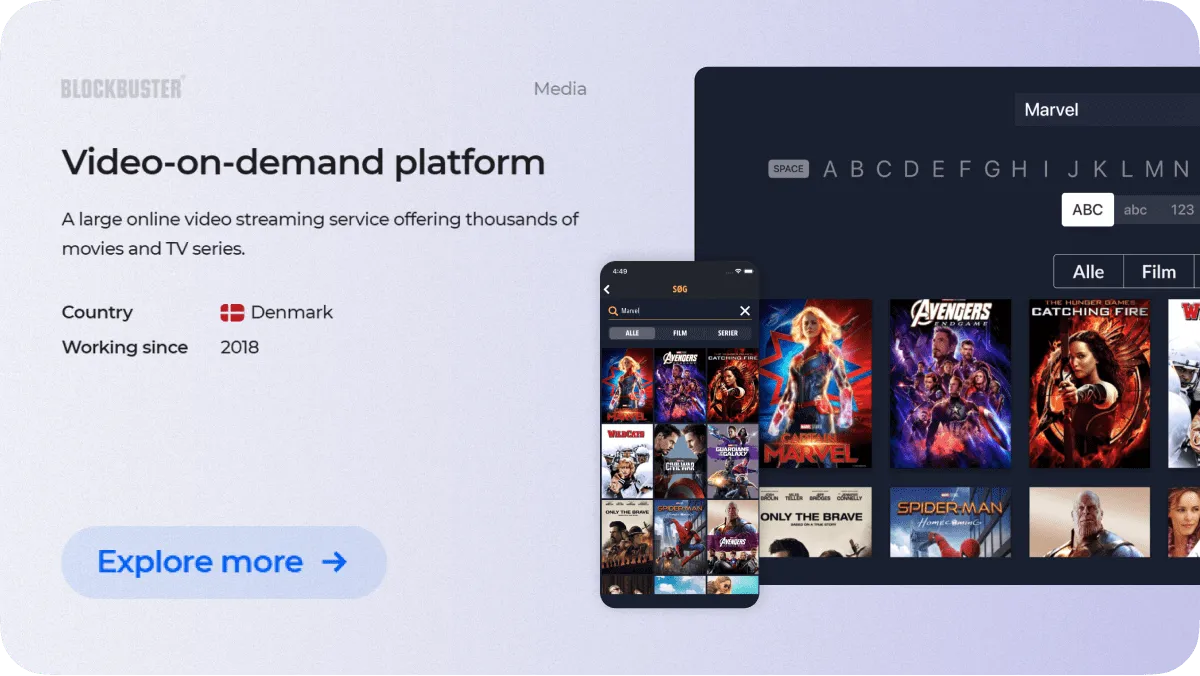
Video-on-demand platform designed by Cleveroad
Now let us introduce our company and tell you more about IT services we provide.
Cleveroad is a high-tier technical company specializing in developing various technical solutions for businesses of all industries. For more than ten years on the market, we have helped hundreds of companies find modern technologies and custom software to boost their performance.
By cooperating with us, you can get many benefits, such as :
- A team of specialists with extensive expertise in the media domain: media and entertainment software, Video-On-Demand, live streaming platforms, VR/AR-based apps, and more
- Practical expertise in implementing media streaming integrations, such as Vimeo, Agora, Twillio, and others, to offer a more comprehensive streaming experience to end-users
- Flexible cooperation with several models for you to choose from: IT staff augmentation services, dedicated development team services, project-based model, etc.
- Free Solution Design Workshop stage with our media domain specialists to help you in planning, implementation, and launch of your streaming service.
- Experienced developers and QA specialists able to provide robust, quality, and fault-tolerant media streaming service
If you want to create your own streaming platform and you're not sure where to start, contact us! Our experts will advise you on media streaming service building and help you to develop a solution for distributing your media content at low latency to viewers worldwide.
Henrik Loop, CTO of Blockbuster, TDC, gives feedback about cooperation with Cleveroad
Build a video streaming platform with our domain experts
Work with our team to transform your streaming idea into a reliable, scalable video platform tailored to your business goals
A streaming service is an online platform that delivers video, audio, or live content over the Internet without requiring users to download files. Users can watch content instantly through a streaming site on devices such as smartphones, laptops, smart TVs, and Apple TV. Modern platforms use cloud infrastructure, CDNs, and adaptive bitrate streaming to provide a smooth viewing experience across multiple devices.
To set up a streaming service, you should usually follow a structured process that combines business strategy and content planning, as well as technical development. Businesses typically start streaming with a minimum viable product and expand the platform as the audience grows.
Key steps to build streaming platform infrastructure include:
- Define your niche and audience. Analyze viewer preferences, demographics, and the types of content users consume most often. Understanding these factors helps position your platform and design the right viewing experience.
- Plan the content strategy and licensing model. Decide how to distribute content, whether through subscriptions, pay-per-view access, or hybrid models. Platforms also determine whether they will license media or produce original content.
- Design the user experience. To build your own streaming platform, you need intuitive navigation, recommendation systems, and profile management that allow viewers to easily discover and watch content across devices.
- Choose the platform architecture. Developers set up a streaming infrastructure using cloud hosting, CDNs, and adaptive bitrate streaming to ensure smooth playback on mobile devices, web browsers, and smart TVs.
- Develop and launch the platform. Engineers integrate video hosting and content management tools before releasing the product, then optimize it based on user feedback.
The cost to set up a streaming product depends on the platform complexity, supported devices, and infrastructure. A basic MVP may cost $30,000–$200,000+, while advanced platforms with recommendation systems and live streaming features require higher budgets.
Companies that want to build your streaming platform with a scalable architecture should also consider CDN delivery, encoding pipelines, and other components that affect the streaming platform’s overall performance and development cost.
To create a streaming service like Netflix, you need scalable infrastructure, a strong content catalog, and a clear monetization model. Most companies build your own streaming platform around a niche audience or specific content category instead of competing directly with global services such as Netflix or HBO Max.

Evgeniy Altynpara is a CTO and member of the Forbes Councils’ community of tech professionals. He is an expert in software development and technological entrepreneurship and has 10+years of experience in digital transformation consulting in Healthcare, FinTech, Supply Chain and Logistics
Give us your impressions about this article
Give us your impressions about this article
Comments
9 commentsVery useful article . Ready to launch
very informative, thank you . love the blog
Very well explained. If i am considering making some streaming TV services regionally wise would never start doing it, after reading this article. But definitely it will be the challenging step to against giant digital platform companies as there are major disruptors in the future TV and video market. In my opinion, the joint venture of Telco and IP operators in some area, would be the best fit, in order to ger customer feedback snd etc. concern of Regulators in TV and media/advertisements area should preserve local content and media companiies from global giants. Where this infudtry is gonna go , nobady knows but deffintely is a huge potential investing in streaming TV services.
i love this article great use

Very, very informative! Well Done!
Your blog writing and explanation way are awesome. I love your Blog
Very Much Detailed.
I love Netflix and I hope I get to be on it
Thank you found your article very useful