Why You Need to Modernize a Legacy Insurance System in 2026 [And How to Do It Safely at Scale]
08 Apr 2026
21 Min
115 Views
Insurance legacy system transformation has become a priority due to rising costs and slow product delivery. Outdated systems limit flexibility, making it harder to meet modern customer expectations. For example, updating core products such as auto or life insurance can take months due to monolithic architectures, delaying new launches. Modernization addresses these issues by enabling cloud migration, introducing AI-driven capabilities, and improving scalability while reducing risks.
Here are the key reasons why insurance companies invest in modernization:
- Legacy systems increase operational costs
- Lack of real-time data slows claims processing
- Limited integration blocks digital growth
- Monolithic architectures delay deployment
At Cleveroad, we have 15+ years of experience delivering scalable software solutions, including FinTech and Insurance platforms. We help clients modernize legacy systems using a phased approach with audits, API integrations, data migration, and gradual improvements to reduce risks and avoid downtime.
We explain why insurers are modernizing legacy systems in 2026 and the challenges they face. You will also learn how modernization works in practice, including key strategies, architecture choices, and steps to upgrade your system without downtime.
Here are the key reasons why insurance companies invest in modernization:
- Legacy systems increase operational costs
- Lack of real-time data slows claims processing
- Limited integration blocks digital growth
- Monolithic architectures delay deployment
At Cleveroad, we have 15+ years of experience delivering scalable software solutions, including FinTech and Insurance platforms. We help clients modernize legacy systems using a phased approach with audits, API integrations, data migration, and gradual improvements to reduce risks and avoid downtime.
We explain why insurers are modernizing legacy systems in 2026 and the challenges they face. You will also learn how modernization works in practice, including key strategies, architecture choices, and steps to upgrade your system without downtime.
What Are Legacy Insurance Systems and Why Do They Become a Problem
An insurance legacy system is outdated software that supports critical operations but lacks flexibility and integration capabilities. The core issue often lies in a rigid data architecture that blocks real-time access and interoperability.
Several types of insurance platforms are typically considered legacy applications:
- Monolithic policy administration systems, difficult to update or scale
- Claims management platforms with limited automation
- On-premise infrastructure is restricting cloud adoption and scalability
- Systems built on outdated programming languages such as COBOL
- Siloed databases are preventing unified data access across departments
These systems persist because replacement is complex and risky. They also limit the adoption of AI-driven features such as automated claims processing or predictive risk assessment. However, legacy systems’ limitations drive the need for legacy modernization in insurance. In most cases, modernization starts with restructuring data flows and adding integration layers.
Legacy systems continue to limit innovation and increase operational costs across the insurance industry. According to Insurance Business report, over 70% of insurers continue to operate on legacy platforms, which slows innovation and increases operational costs. At the same time, Insurance Business states that 54% of IT budgets in the insurance industry go toward maintaining existing systems instead of building new capabilities. This circumstance directly limits digital transformation initiatives and delays the launch of new products.
Several types of insurance platforms are typically considered legacy applications:
- Monolithic policy administration systems, difficult to update or scale
- Claims management platforms with limited automation
- On-premise infrastructure is restricting cloud adoption and scalability
- Systems built on outdated programming languages such as COBOL
- Siloed databases are preventing unified data access across departments
These systems persist because replacement is complex and risky. They also limit the adoption of AI-driven features such as automated claims processing or predictive risk assessment. However, legacy systems’ limitations drive the need for legacy modernization in insurance. In most cases, modernization starts with restructuring data flows and adding integration layers.
Legacy systems continue to limit innovation and increase operational costs across the insurance industry. According to Insurance Business report, over 70% of insurers continue to operate on legacy platforms, which slows innovation and increases operational costs. At the same time, Insurance Business states that 54% of IT budgets in the insurance industry go toward maintaining existing systems instead of building new capabilities. This circumstance directly limits digital transformation initiatives and delays the launch of new products.
What problems legacy systems create today
Despite their stability, legacy systems create serious operational limitations. The cost of maintaining outdated infrastructure continues to grow, while fragmented legacy data prevents real-time analytics and slows decision-making.
These limitations impact multiple areas of the business:
- Reduced system performance and slower processing times
- Limited integration, which complicates application modernization
- Inability to meet growing digital expectations
- Increased operational costs and inefficiencies
The above limitations make modernizing insurance legacy systems a priority. The shift drives broader modernization in the insurance industry and increases demand for structured innovation approaches.
These limitations impact multiple areas of the business:
- Reduced system performance and slower processing times
- Limited integration, which complicates application modernization
- Inability to meet growing digital expectations
- Increased operational costs and inefficiencies
The above limitations make modernizing insurance legacy systems a priority. The shift drives broader modernization in the insurance industry and increases demand for structured innovation approaches.
What Does Legacy Modernization in Insurance Actually Mean?
Legacy system modernization refers to upgrading outdated infrastructure, applications, data layers, and architectures to improve performance and scalability. In practice, this includes migrating from on-premise infrastructure to cloud-based environments, enabling better resilience and cost control. It also involves introducing new capabilities such as AI-driven automation, advanced analytics, or real-time decision-making to support modern insurance workflows.
Modernization does not always mean full system replacement. Technology partners help define the most suitable modernization approach based on system constraints and architectural dependencies. The right strategy allows platforms to evolve gradually while maintaining stability and compliance.
Modernization does not always mean full system replacement. Technology partners help define the most suitable modernization approach based on system constraints and architectural dependencies. The right strategy allows platforms to evolve gradually while maintaining stability and compliance.
Key components of modernization
Legacy system modernization includes several strategies that differ in complexity and business impact. These implementation models help insurers adapt their existing infrastructure to support modern requirements, such as integration, scalability, or advanced insurance technology capabilities.
Below is a comparison of the main modernization approaches:
Below is a comparison of the main modernization approaches:
| Approach | Risk | Typical cost range ($) | When to use |
Rehosting | Low | $20,000-$80,000+ | When quick cloud migration is needed without changing architecture |
Replatforming | Medium | $50,000-$150,000+ | When optimizing performance with minimal code changes |
Refactoring | Medium-High | $100,000-$300,000+ | When improving scalability and maintainability |
Rebuilding | High | $250,000-$1,000000+ | When the legacy system no longer meets business needs |
Aspects to consider in insurance legacy modernization
Insurance companies typically recognize the need for modernization when legacy systems begin to limit growth and operational efficiency. This limitation occurs when existing platforms cannot support digital services or integrate with external ecosystems.
Key signals that indicate the need for modernization include:
- Inability to launch new digital products or services
- Challenges with integrating partners and third-party APIs
- Rising maintenance costs of legacy systems
- Lack of real-time data access
At this stage, companies engage technology partners to assess risks and define a structured modernization strategy. Growing regulatory pressure and evolving customer expectations further increase the urgency to modernize. As modernization across the insurance industry accelerates, legacy systems become a direct barrier to innovation, delaying product launches and limiting data-driven decision-making.
Key signals that indicate the need for modernization include:
- Inability to launch new digital products or services
- Challenges with integrating partners and third-party APIs
- Rising maintenance costs of legacy systems
- Lack of real-time data access
At this stage, companies engage technology partners to assess risks and define a structured modernization strategy. Growing regulatory pressure and evolving customer expectations further increase the urgency to modernize. As modernization across the insurance industry accelerates, legacy systems become a direct barrier to innovation, delaying product launches and limiting data-driven decision-making.
When Should You Modernize a Legacy Insurance System for Your Company?
Legacy modernization should begin when existing systems start limiting product delivery and integration capabilities, not when failures occur. These constraints often appear early and signal the need for a structured transformation approach that starts with assessment and evolves through phased implementation.
Let’s find out why legacy modernization in insurance becomes a business necessity.
Let’s find out why legacy modernization in insurance becomes a business necessity.
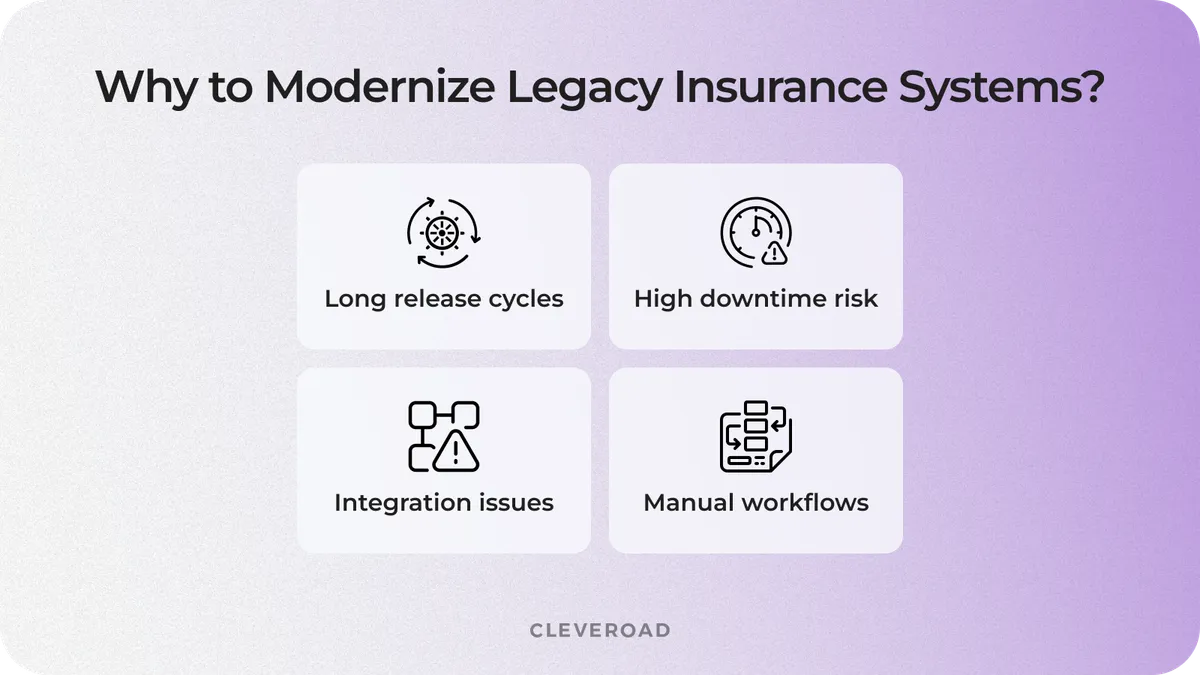
Key reasons to modernize insurance legacy systems
Long release cycles
When updates in policy administration or underwriting systems take months, core platforms are slowing delivery. This directly impacts quote-to-bind timelines and delays product launches.
As insurers adopt models such as usage-based insurance or dynamic pricing, slow releases reduce responsiveness. Technology partners help decouple components and enable faster delivery through API-driven architecture.
As insurers adopt models such as usage-based insurance or dynamic pricing, slow releases reduce responsiveness. Technology partners help decouple components and enable faster delivery through API-driven architecture.
Integration issues
Legacy platforms often struggle to connect with broker portals, insurtech APIs, and third-party data providers. This limits access to modern distribution channels and slows partner onboarding.
Poor connectivity leads to duplicate data and delayed processing, which affects the customer experience. API enablement and cloud-based integration layers delivered through insurance software development services by a technology partner allow insurers to support real-time data exchange and partner-driven ecosystems.
High downtime risk
Frequent outages in claims or billing systems signal fragile infrastructure. These disruptions delay processing, impact customer satisfaction, and increase operational costs.
During peak periods, downtime can significantly increase backlog and financial exposure. Modernization improves system resilience through modular architecture and cloud-based infrastructure, ensuring stable system performance and continuous availability.
During peak periods, downtime can significantly increase backlog and financial exposure. Modernization improves system resilience through modular architecture and cloud-based infrastructure, ensuring stable system performance and continuous availability.
Manual workflows
Manual processes in claims handling and policy servicing reduce efficiency and increase error rates. Many systems still depend on manual data entry and validation.
Reliance on manual processes creates operational bottlenecks and limits scalability. Modernization enables automation and reduces processing time through better system integration.
Reliance on manual processes creates operational bottlenecks and limits scalability. Modernization enables automation and reduces processing time through better system integration.
Security gaps
Legacy environments often fail to meet modern security and compliance standards. Outdated frameworks increase exposure to data breaches and regulatory risks.
As insurers expand digital channels, these vulnerabilities become more critical. An experienced technology partner strengthens security during modernization through updated architecture, cloud-native security models, improved access control, and continuous monitoring.
Constraints such as slow releases and integration limitations, along with operational instability and security risks, directly affect product delivery and competitiveness. Modernization is a strategic necessity, and working with an experienced technology partner helps insurers implement it in a controlled, predictable way.
As insurers expand digital channels, these vulnerabilities become more critical. An experienced technology partner strengthens security during modernization through updated architecture, cloud-native security models, improved access control, and continuous monitoring.
Constraints such as slow releases and integration limitations, along with operational instability and security risks, directly affect product delivery and competitiveness. Modernization is a strategic necessity, and working with an experienced technology partner helps insurers implement it in a controlled, predictable way.
How to Modernize a Legacy Insurance System Step by Step
Modernizing legacy insurance systems requires a structured approach that aligns business goals with technical execution. The main challenge is not the technology itself, but how to introduce changes without disrupting critical insurance operations across claims, underwriting, and policy administration. This process becomes critical for many carriers when systems begin to limit growth and innovation.
Step 1. Define modernization objectives
Modernization typically starts when insurers recognize that outdated legacy systems no longer meet business needs. The process may include slow product releases, high maintenance costs, limited integration capabilities, or poor customer experience.
These signals often appear in insurance legacy systems built years ago that cannot support modern requirements. Even though some benefits of legacy include stability, they no longer justify operational inefficiencies. At this stage, companies define goals for insurance modernization together with a technology partner, such as faster delivery and improved scalability, as well as better customer experience.
These signals often appear in insurance legacy systems built years ago that cannot support modern requirements. Even though some benefits of legacy include stability, they no longer justify operational inefficiencies. At this stage, companies define goals for insurance modernization together with a technology partner, such as faster delivery and improved scalability, as well as better customer experience.
Step 2. Conduct system audit and assess readiness
Once the need is clear, insurers engage a technology partner to validate assumptions and assess risks. A structured audit helps identify dependencies across aging insurance systems, including tightly coupled architecture and fragmented data flows.
This step is especially important in complex legacy environments where systems across core insurance domains are interconnected. The audit becomes the foundation of the entire modernization journey, helping define realistic priorities and timelines.
This step is especially important in complex legacy environments where systems across core insurance domains are interconnected. The audit becomes the foundation of the entire modernization journey, helping define realistic priorities and timelines.
See how structured code audit services help identify risks and define a clear modernization roadmap before starting implementation
Step 3. Choose the right modernization strategy
Based on the audit, a technology partner helps define the most suitable approach to modernize legacy systems, whether through replatforming, refactoring, or phased replacement. This decision directly affects the success of the overall modernization initiative.
A vendor also assists in balancing risk, cost, and system complexity when modernizing legacy applications, ensuring that stable components are preserved while high-change, business-critical areas are prioritized and transformed first.
A vendor also assists in balancing risk, cost, and system complexity when modernizing legacy applications, ensuring that stable components are preserved while high-change, business-critical areas are prioritized and transformed first.
Step 4. Prioritize high-impact workflows
A technology partner helps prioritize business-critical workflows that deliver immediate and measurable value. In many cases, this includes claims processing or customer-facing services that directly impact digital insurance capabilities and customer experience.
Focusing on these areas allows insurers to quickly realize the benefits of legacy modernization, such as faster processing times and improved customer experience. This approach is especially effective when many insurance organizations need to demonstrate ROI early in the process.
Focusing on these areas allows insurers to quickly realize the benefits of legacy modernization, such as faster processing times and improved customer experience. This approach is especially effective when many insurance organizations need to demonstrate ROI early in the process.
Step 5. Implement integration and enable a gradual transition
To avoid disruption, vendors introduce API layers that support transforming legacy systems without shutting them down. This implementation enables legacy and modern components to coexist during the transition.
Such integration is critical for companies that aim to modernize their legacy systems while maintaining operational continuity and system stability. This stage often includes migrating data to cloud-based storage and enabling real-time processing capabilities required for digital insurance platforms.
Such integration is critical for companies that aim to modernize their legacy systems while maintaining operational continuity and system stability. This stage often includes migrating data to cloud-based storage and enabling real-time processing capabilities required for digital insurance platforms.
Step 6. Manage change and scale modernization
Modernization is an organizational and operational shift. Vendors support insurers in scaling improvements, aligning specialists and processes, and continuously modernizing insurance legacy systems across multiple domains.
With vendor support, insurers move toward fully modernizing legacy apps, achieving long-term scalability, flexibility, as well as resilience, while enabling new capabilities such as AI-driven automation, predictive analytics, or intelligent workflows.
With vendor support, insurers move toward fully modernizing legacy apps, achieving long-term scalability, flexibility, as well as resilience, while enabling new capabilities such as AI-driven automation, predictive analytics, or intelligent workflows.
Discover Cleveroad's legacy software modernization services to help you modernize legacy systems and improve operational efficiency
What Are the Key Issues of Modernizing Legacy Insurance Systems and How to Avoid Them?
Most modernization failures occur when companies attempt to reduce infrastructure risk before isolating business-critical workflows. In insurance, claims and policy administration systems carry the highest operational load, so modernization must be scoped around these workflows first.
Below are the key challenges insurers face and how a workflow-based modernization strategy can address them.
Below are the key challenges insurers face and how a workflow-based modernization strategy can address them.
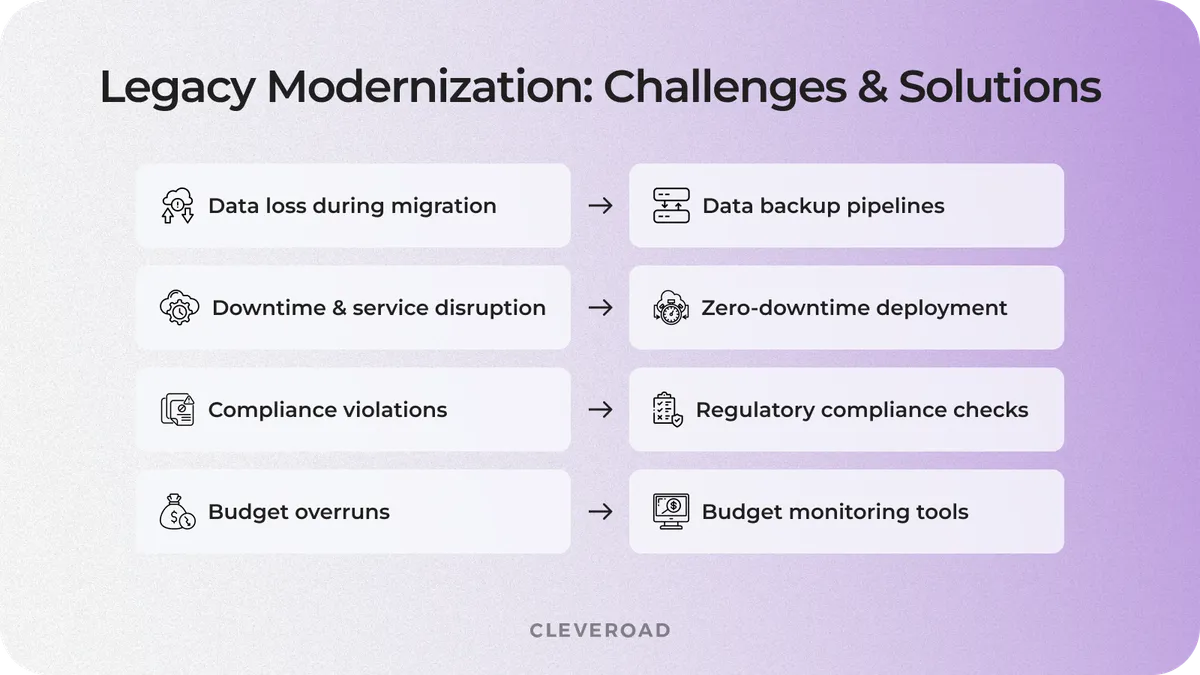
Major challenges of legacy modernization in insurance and their solutions
Data loss during migration
Problem: Migration risks increase when insurers attempt to move large datasets across multiple systems at once. In claims modernization, this often leads to inconsistencies between historical records and financial reserves, which can affect reporting and regulatory compliance.
Solution: Instead of full migration, data should be scoped per workflow, starting with domains such as claims. At Cleveroad, we prioritize reconciling legacy and new systems at each stage, ensuring data accuracy before proceeding. We also implement backup pipelines and rollback mechanisms to protect critical datasets. A key decision is whether to migrate full datasets or maintain synchronized data layers during transition.
Solution: Instead of full migration, data should be scoped per workflow, starting with domains such as claims. At Cleveroad, we prioritize reconciling legacy and new systems at each stage, ensuring data accuracy before proceeding. We also implement backup pipelines and rollback mechanisms to protect critical datasets. A key decision is whether to migrate full datasets or maintain synchronized data layers during transition.
Discover how we handle complex data migration in Healthcare to ensure data consistency and reduce risks before full-scale rollout
Downtime and service disruption
Problem: Downtime becomes critical when modernization affects systems handling live transactions. Legacy platforms often lack support for parallel processing, which increases the risk of service interruptions and impacts customer experience.
Solution: Legacy modernization in insurance should isolate workflows and use phased cutover strategies. For example, claims processing can be gradually routed between systems using traffic-splitting and zero-downtime deployment. A key trade-off is balancing rollout speed with operational stability.
Solution: Legacy modernization in insurance should isolate workflows and use phased cutover strategies. For example, claims processing can be gradually routed between systems using traffic-splitting and zero-downtime deployment. A key trade-off is balancing rollout speed with operational stability.
Compliance violations
Problem: Compliance risks increase when modernization affects regulated processes such as claims adjudication or reporting. Any inconsistency in audit data can lead to regulatory exposure, especially in multi-region environments.
Solution: Compliance must be validated at the workflow level rather than across the entire system. This includes maintaining consistent audit trails and reporting outputs throughout modernization. Cleveroad embeds compliance validation into each stage to ensure alignment with regulatory requirements. A key decision is whether to replicate legacy logic or redesign processes while preserving compliance equivalence.
Solution: Compliance must be validated at the workflow level rather than across the entire system. This includes maintaining consistent audit trails and reporting outputs throughout modernization. Cleveroad embeds compliance validation into each stage to ensure alignment with regulatory requirements. A key decision is whether to replicate legacy logic or redesign processes while preserving compliance equivalence.
Budget overruns
Problem: Budget overruns often occur when the scope of modernization is defined at the system level. Large-scale transformation of legacy platforms without clear priorities increases uncertainty. This makes upgrading legacy systems more expensive and difficult to control.
Solution: Modernization should be structured around incremental value delivery. For example, starting with claims workflow modernization allows insurers to reduce processing time and operational costs early. Focusing on this workflow first creates a measurable ROI before expanding the scope.
Solution: Modernization should be structured around incremental value delivery. For example, starting with claims workflow modernization allows insurers to reduce processing time and operational costs early. Focusing on this workflow first creates a measurable ROI before expanding the scope.
How Much Does It Cost to Modernize a Legacy Insurance System?
The cost of insurance legacy system transformation varies significantly depending on system architecture, business requirements, and technical scope. For most insurance providers, modernization projects start at $50,000–$150,000 for limited upgrades and can exceed $200,000–$1,000,000+ for a full-scale transformation of a core system.
The final cost depends on several key factors that shape overall modernization efforts:
- System complexity: tightly coupled architectures and monolithic core system components require more effort to modernize
- Data volume: large datasets stored in existing legacy environments increase migration complexity
- Integrations: connections across multiple insurance domains, such as claims, underwriting, or billing add implementation effort
- Compliance requirements: regulatory constraints require additional validation, security, as well as audit layers
- Infrastructure model: whether systems run on-premise or require migration to cloud environments significantly affects cost and complexity
To provide a clearer picture, below is an approximate breakdown of modernization efforts by typical components used in legacy systems in the insurance sector:
The final cost depends on several key factors that shape overall modernization efforts:
- System complexity: tightly coupled architectures and monolithic core system components require more effort to modernize
- Data volume: large datasets stored in existing legacy environments increase migration complexity
- Integrations: connections across multiple insurance domains, such as claims, underwriting, or billing add implementation effort
- Compliance requirements: regulatory constraints require additional validation, security, as well as audit layers
- Infrastructure model: whether systems run on-premise or require migration to cloud environments significantly affects cost and complexity
To provide a clearer picture, below is an approximate breakdown of modernization efforts by typical components used in legacy systems in the insurance sector:
| Modernization component | Approx time (hours) | Approx cost ($) |
System audit & architecture assessment | 80–120 h | $4,000-$6,000+ |
API layer development | 120–200 h | $6,000-$10,000+ |
Data migration & validation | 150–300 h | $7,500-$15,000+ |
Refactoring core components | 200–400 h | $10,000-$20,000+ |
Cloud migration | 120–250 h | $6,000-$12,500+ |
Integration with third-party systems | 100–200 h | $5,000-$10,000+ |
Security & compliance implementation | 80–160 h | $4,000-$8,000+ |
Total | 850–1630 h | $42,500-$81,500+ |
Please note that this estimate is approximate and based on typical project scenarios. It does not include costs for UI/UX redesign, advanced analytics, AI integration, or ongoing support and maintenance. Additional requirements may arise depending on how systems are used by internal software development teams, insurance agents, and external partners.
Modernization requires careful planning, especially when dealing with interconnected systems and high-risk operations. A detailed assessment helps define priorities, reduce risks, and ensure predictable outcomes for long-term system evolution.
Modernization requires careful planning, especially when dealing with interconnected systems and high-risk operations. A detailed assessment helps define priorities, reduce risks, and ensure predictable outcomes for long-term system evolution.
How Cleveroad Helps Insurance Companies Modernize Legacy Systems
Cleveroad is a software development company with 15+ years of experience delivering digital solutions for regulated industries, including FinTech and Insurance. We help insurance companies modernize legacy systems by focusing on risk-controlled transformation, system stability, operational continuity, and measurable business outcomes.
We provide measurable value for insurance modernization projects through proven expertise in regulated environments. We are an ISO-certified company, holding ISO 9001 and ISO 27001 certifications, which ensures strong quality management and data security practices across all stages of delivery.
Our team has hands-on experience building and modernizing insurance solutions, including policy management systems, claims processing platforms, underwriting systems, and customer-facing insurance applications. This deep domain expertise allows us to deliver modernization projects that align with real business needs, strict compliance requirements, and complex operational workflows across the insurance industry.
Here’s how we approach legacy software modernization in insurance:
- Start with business-critical workflows. We begin with areas such as claims or policy administration to deliver early impact and validate decisions before scaling
- Audit before transformation. Our specialists analyze system architecture, dependencies, and data flows to identify risks and define a clear modernization roadmap
- Decouple systems through APIs. Cleveroad introduces integration layers that allow legacy and new components to work together without disruption
- Apply phased migration. Instead of replacing systems at once, we modernize components step by step to maintain stability and control
- Embed compliance into delivery. We ensure every stage aligns with regulatory requirements, auditability, and data protection standards
- AI-driven enhancements. Our specialists integrate intelligent automation, predictive analytics, and decision-support tools into modernized systems
- Cloud-native architecture. We migrate legacy systems to scalable cloud environments to improve performance and resilience
We also help insurers introduce new digital features such as self-service portals, automated claims processing, and real-time analytics.
Handling insurance policies and sensitive data requires strict compliance controls at every stage. This is exactly the type of modernization we specialize in, ensuring system upgrades without disrupting critical operations or violating regulatory requirements.
For one of our clients, a US-based medical device manufacturer, we replaced an obsolete Quickbase-built QMS with a brand-new custom Quality Management System. The goal was to modernize fragmented workflows and improve compliance, ensuring system scalability without interrupting ongoing operations. The client needed to modernize fragmented workflows and replace disconnected processes with a centralized, compliant platform without disrupting ongoing operations.
We provide measurable value for insurance modernization projects through proven expertise in regulated environments. We are an ISO-certified company, holding ISO 9001 and ISO 27001 certifications, which ensures strong quality management and data security practices across all stages of delivery.
Our team has hands-on experience building and modernizing insurance solutions, including policy management systems, claims processing platforms, underwriting systems, and customer-facing insurance applications. This deep domain expertise allows us to deliver modernization projects that align with real business needs, strict compliance requirements, and complex operational workflows across the insurance industry.
Here’s how we approach legacy software modernization in insurance:
- Start with business-critical workflows. We begin with areas such as claims or policy administration to deliver early impact and validate decisions before scaling
- Audit before transformation. Our specialists analyze system architecture, dependencies, and data flows to identify risks and define a clear modernization roadmap
- Decouple systems through APIs. Cleveroad introduces integration layers that allow legacy and new components to work together without disruption
- Apply phased migration. Instead of replacing systems at once, we modernize components step by step to maintain stability and control
- Embed compliance into delivery. We ensure every stage aligns with regulatory requirements, auditability, and data protection standards
- AI-driven enhancements. Our specialists integrate intelligent automation, predictive analytics, and decision-support tools into modernized systems
- Cloud-native architecture. We migrate legacy systems to scalable cloud environments to improve performance and resilience
We also help insurers introduce new digital features such as self-service portals, automated claims processing, and real-time analytics.
Handling insurance policies and sensitive data requires strict compliance controls at every stage. This is exactly the type of modernization we specialize in, ensuring system upgrades without disrupting critical operations or violating regulatory requirements.
For one of our clients, a US-based medical device manufacturer, we replaced an obsolete Quickbase-built QMS with a brand-new custom Quality Management System. The goal was to modernize fragmented workflows and improve compliance, ensuring system scalability without interrupting ongoing operations. The client needed to modernize fragmented workflows and replace disconnected processes with a centralized, compliant platform without disrupting ongoing operations.
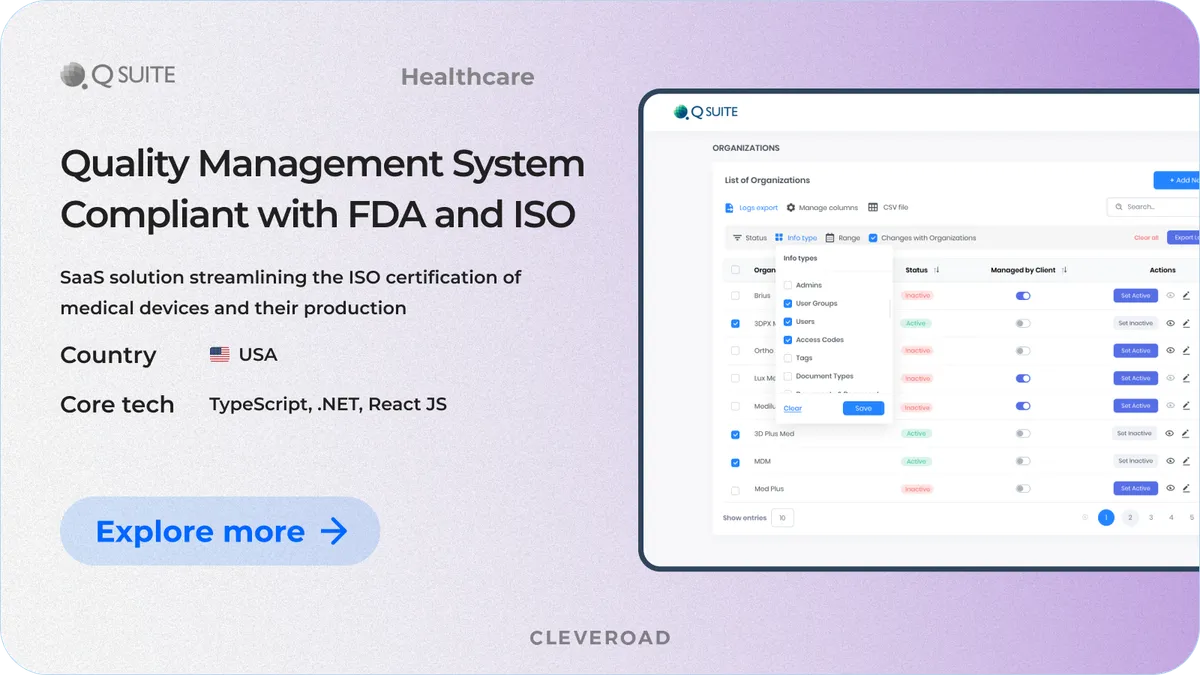
Quality Management System (QMS) developed by Cleveroad
We redesigned the system architecture, introduced role-based access control and audit trails, and automated key workflows while enabling real-time reporting. This modernization approach allowed the client to transition to a structured, scalable system with improved process control, reduced manual effort, enhanced data visibility, and a foundation for further integration and growth.
Our experience shows that wrapping legacy systems works best for stable components, while extraction is more effective for high-change areas such as claims workflows. This decision directly affects the benefits of core modernization, including scalability, delivery speed, system flexibility, and long-term cost efficiency.
Here’s how Breanne Butler describes working with Cleveroad on a complex Healthcare system transformation:
Our experience shows that wrapping legacy systems works best for stable components, while extraction is more effective for high-change areas such as claims workflows. This decision directly affects the benefits of core modernization, including scalability, delivery speed, system flexibility, and long-term cost efficiency.
Here’s how Breanne Butler describes working with Cleveroad on a complex Healthcare system transformation:
Breanne Butler, Client Liaison Officer at Prime Path Medtech™
Modernizing a legacy insurance system means upgrading outdated infrastructure, applications, and data architecture to improve performance, scalability, and integration capabilities. In many systems in the insurance industry, this process involves transitioning from monolithic platforms to API-driven, cloud-enabled environments. It also addresses limitations caused by aging legacy systems that restrict real-time data access and digital service delivery.
Legacy insurance system modernization follows a structured, phased approach. It starts with auditing existing architecture and identifying dependencies, including tightly coupled legacy code, then defining business and technical goals. Next, a technology partner helps define the strategy, implements API layers, manages data migration, and gradually replaces legacy components safely to reduce risks and avoid downtime.
Modernization improves system performance, reduces operational costs, and enables faster product delivery. It also allows insurers to integrate with external platforms, automate workflows, and enhance decision-making across complex domains such as life insurance and annuity.
Key benefits include:
- Faster release cycles and quicker time-to-market
- Improved integration with partners and third-party services
- Reduced manual work through workflow automation
- Better data visibility for analytics and reporting
The main challenges include data migration risks, system downtime, compliance requirements, and budget control. These modernization challenges are amplified by tightly coupled architectures and high dependency between systems. Without a structured modernization strategy, insurers may face data inconsistencies, service disruptions, or implementation delays.
Working with a reliable technology partner helps mitigate these risks by applying a phased approach, ensuring controlled data migration, maintaining system stability, and aligning each stage with compliance and business requirements.

Evgeniy Altynpara is a CTO and member of the Forbes Councils’ community of tech professionals. He is an expert in software development and technological entrepreneurship and has 10+years of experience in digital transformation consulting in Healthcare, FinTech, Supply Chain and Logistics
Give us your impressions about this article
Give us your impressions about this article