Machine Learning in Healthcare: Opportunities, Challenges, and Use Cases
Updated 09 Jul 2026
11 Min
862 Views
Healthcare organizations collect growing volumes of medical data from imaging systems, EHRs, or connected devices, making manual analysis increasingly difficult for clinical teams. Machine learning helps transform this data into actionable insights that support better clinical decisions and more personalized patient care. By detecting patterns across medical data, ML models can automate analysis tasks and assist clinicians during diagnosis and treatment planning.
Cleveroad has 15+ years of experience developing HealthTech solutions, including machine learning and computer vision systems that help healthcare organizations improve data analysis and clinical workflows. Our team builds secure healthcare platforms for processing sensitive medical data, with experience working in HIPAA-compliant environments and applying ISO 27001-certified security practices.
Read the article to learn how machine learning works in healthcare, which use cases deliver the most value today, what challenges organizations face, and how to build reliable ML-powered healthcare solutions.
Key takeaways:
- Healthcare ML models analyze complex medical data to predict outcomes and support clinical decisions.
- Common healthcare ML applications include medical image analysis, clinical decision support systems, and tools for detecting health risks at earlier stages.
- Successful healthcare ML solutions require high-quality data and careful model validation to ensure accurate and safe clinical use.
What Is Machine Learning in Healthcare?
Machine learning (ML) in healthcare is a branch of artificial intelligence that enables systems to learn from medical data and support decision-making without being explicitly programmed for every specific task. Unlike traditional software that follows predefined rules, ML models improve their performance by analyzing examples and learning relationships in the data.
Deep learning is a more advanced type of machine learning that uses neural networks to process complex data, such as medical images or clinical records. Generative AI is another AI approach that focuses on creating new content, such as clinical summaries or medical documentation, based on learned patterns.
Healthcare organizations use machine learning when they need to analyze large volumes of medical data and find insights that may be difficult to detect manually. ML models can support clinical decisions and improve diagnostic accuracy, helping create more personalized care approaches. As Atul Butte explained:
Atul Butte
Director of the Institute for Computational Health Sciences at UC San Francisco
Machine learning is the next layer of analysis, and it will revolutionize how we think about disease diagnosis and treatment.

The growing adoption of ML reflects the increasing demand for AI-powered healthcare solutions. As your organization collects more complex medical data, machine learning helps you identify patterns, support clinical decisions, and improve care delivery. To turn these capabilities into practical healthcare solutions, you need to understand how machine learning benefits clinical workflows.
What Are the Benefits of Machine Learning in Healthcare?
Machine learning helps your healthcare facility analyze data, automate workflows, and support clinical decisions. The main benefits include faster operations, personalized treatment approaches, lower costs, earlier disease detection, and improved patient safety.
Reducing manual healthcare workload
Automating repetitive processes allows healthcare teams to optimize daily operations and reduce manual workload. ML models can analyze medical information and support clinical documentation, improving resource allocation without adding extra workload for healthcare teams.
For example, AI automation in healthcare can help healthcare providers cut down on administrative tasks and improve workflow management. These capabilities allow your medical professionals to spend more time on patient care.
Enabling more personalized treatment plans
Machine learning improves personalized care by analyzing multimodal patient data. This method helps identify individual health patterns and supports more accurate treatment recommendations.
Your healthcare organization can use ML models to develop care strategies based on a patient’s unique medical history, current condition, and risk factors, rather than relying solely on standard treatment approaches.
Reducing costs through preventive care
Early risk identification and workflow automation help healthcare facilities lower costs and reduce unnecessary manual work. Predictive models flag patients at high risk of chronic conditions before symptoms escalate, where earlier intervention is consistently cheaper than late-stage treatment. If your facility runs on value-based reimbursement, this is usually where ML pays back first.
You should also consider the cost of implementing AI in healthcare before starting development. The final investment depends on solution complexity, data preparation requirements, security measures, and integration with existing healthcare systems.
Diagnosis support and early disease detection
Machine learning helps healthcare organizations identify potential health risks before conditions become more severe. Early detection allows medical teams to start treatment sooner, reduce the risk of complications, and improve patient outcomes.
Predictive ML models can help healthcare providers prioritize high-risk patients and support preventive care strategies. For healthcare facilities, this approach can also reduce the cost of late-stage interventions by addressing conditions earlier. Diagnosis and early detection are among the fastest-growing AI healthcare segments, with a CAGR of around 39.8% (Source: Polaris Market Research, 2026).
Strengthening patient safety
Identifying potential risks before they affect patients allows healthcare teams to improve safety and prevent avoidable complications. ML models used by a medical imaging software development company can support medication safety checks and predict possible complications, highlighting warning signs.
By adding data-driven analysis to clinical workflows, machine learning helps healthcare providers make safer decisions and improve the reliability of healthcare processes.
Top Machine Learning Use Cases in Healthcare
Healthcare organizations apply machine learning to improve diagnostics, support clinical decisions, and analyze complex medical data. The most common healthcare ML use cases include:
- Medical imaging and radiology for detecting abnormalities in scans
- Drug discovery for identifying potential treatments faster
- Predictive analytics for assessing patient risks
- Diagnosis and early disease detection
- NLP-powered clinical documentation
- Patient monitoring with wearable devices
Medical imaging and radiology
Medical imaging is one of the most mature areas for healthcare machine learning. ML models analyze X-rays, CT scans, MRIs, and other visual data to detect abnormalities and support radiologists in clinical decision-making.
Radiology remains the leading area for FDA-authorized AI medical devices, accounting for around 74% of approved solutions (Source: Nature, 2025). Common applications include automated image analysis for detecting tumors, fractures, or other signs of disease. Deep learning models can highlight suspicious areas in scans and help physicians review medical images faster.
Cleveroad also applies computer vision and machine learning expertise to visual data analysis solutions. For example, our team developed a Color Detection application that uses computer vision algorithms to recognize and analyze visual patterns. Similar ML approaches can support healthcare solutions for processing medical images and identifying clinically relevant features.
Opt for our custom computer vision development services to empower your healthcare with advanced medical imaging
Drug discovery
Machine learning helps pharmaceutical companies analyze biological and clinical data to identify potential drug candidates and predict patient responses to treatments. By finding patterns across large datasets, ML models help researchers prioritize promising compounds and reduce the time required for drug development.
For example, Tempus combines genomic sequencing data with clinical information from EHR systems to identify genetic mutations and support personalized cancer treatment decisions.
Predictive analytics
Predictive analytics uses machine learning models to identify health risks before they become critical. By analyzing patient data, ML systems can estimate the likelihood of complications or disease progression.
Healthcare organizations use predictive models to support proactive care. For example, ML algorithms can identify patients at higher risk of deterioration and help clinicians deliver earlier interventions.
Diagnosis support with multimodal healthcare data
Machine learning supports diagnosis by analyzing multiple sources of medical information and identifying patterns that can assist clinicians during decision-making. ML models can process medical images, laboratory results, EHR records, and patient history to detect abnormalities and provide additional clinical insights.
For example, Google Health has explored deep learning models that analyze medical scans and identify potential signs of disease. These systems can support clinicians by highlighting relevant findings and adding another layer of analysis to diagnostic workflows.
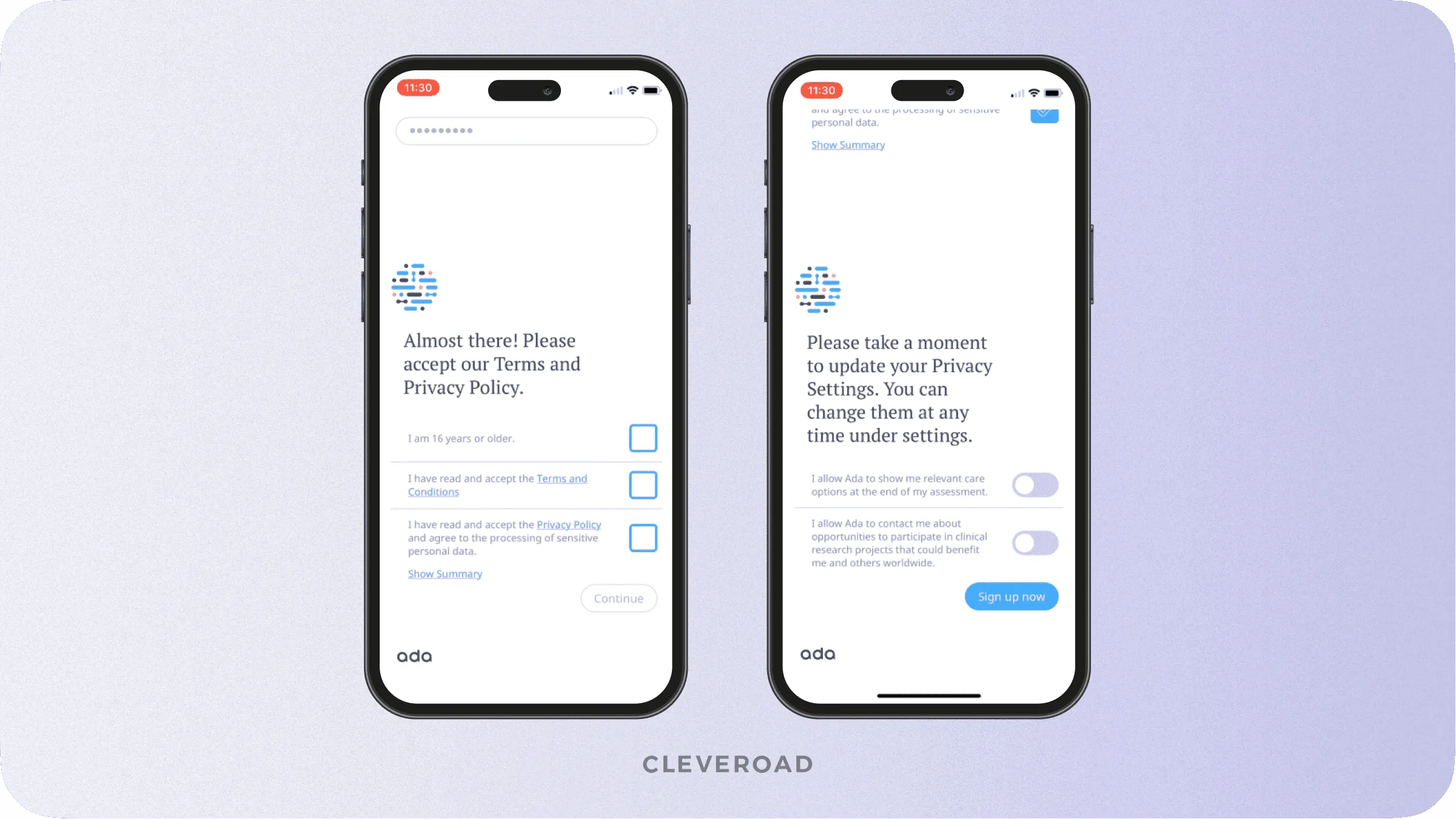
Example of ML-based healthcare app: Ada
Clinical documentation automation
Machine learning and natural language processing (NLP) help healthcare organizations extract valuable information from medical notes and automate documentation workflows. NLP models analyze clinical text, structure patient information, and reduce the time physicians spend on administrative tasks. Generative AI in healthcare expands these capabilities by creating summaries and assisting healthcare professionals with routine communication, allowing clinicians to spend more time on patient care.
When integrated with EHR systems, ML and NLP solutions can automatically extract relevant information from clinical notes, structure patient data, and improve the accuracy of electronic health records.
Discover the EHR software development services from Cleveroad to create secure, data-driven healthcare solutions ready for ML integration
What Are the Challenges and Limitations of ML in Healthcare?
Machine learning can improve healthcare workflows and support clinical decisions, but healthcare organizations must address several barriers before deploying ML solutions. Let’s find out the main challenges of machine learning in healthcare.
Safety and transparency of ML models
Before clinicians can rely on an ML model, it must produce reliable, explainable results and demonstrate consistent performance across different clinical scenarios. Explainability helps doctors understand why a model reached a specific conclusion, which is essential for trust and for validating AI-supported decisions.
Healthcare organizations must also consider regulatory requirements for AI-enabled medical devices. The FDA evaluates ML-based medical devices based on safety, effectiveness, and performance validation, making compliance a key part of healthcare ML development.
Data privacy and PHI protection
Machine learning in healthcare depends on access to patient data, but medical information such as protected health information (PHI) requires strict security controls. Healthcare organizations must balance the need for high-quality training data with privacy obligations defined by regulations such as HIPAA (Source: HHS HIPAA for Professionals, 2024).
That tension is exactly what we solved for Codex Labs. After two previous vendors, their teledermatology platform DECODE.ME required a technical partner who could stabilize the inherited codebase and prepare the product for further development.
The Cleveroad team performed a code review, fixed critical backend issues, and built HIPAA-compliant infrastructure with PHI stored on GCP FHIR. As a result, within five months, Cleveroad stabilized the inherited platform, prepared the HIPAA-compliant infrastructure, and helped Codex Labs deliver a working demo for the 2025 AAD Innovation Meeting.
See how Barbara Paldus, Founder and CEO of Codex Labs, describes our cooperation, and why she recommends Cleveroad as a reliable HealthTech software development partner.
Watch Barbara Paldus, Founder & CEO of Codex Labs, share her experience working with Cleveroad.
Rough or low-quality healthcare data
Reliable ML outcomes depend on accurate, structured data, but healthcare information often comes from many different systems and formats, making preparation and analysis harder. Facilities like yours need effective data processing to clean, structure, and standardize records before ML training or clinical use.
Patient consent and data usage regulations
Healthcare organizations must obtain proper patient consent before using medical data for machine learning purposes. Clear consent processes help patients understand how their information will be used and ensure compliance with privacy regulations.
Your organization should also apply data anonymization and access controls to reduce privacy risks throughout the ML development lifecycle.
Shortage of healthcare ML experts
Successful healthcare ML projects require specialists who understand both AI technologies and healthcare-specific requirements. The shortage of professionals with this combination of skills can slow development and make implementation more challenging.
Your medical facility can address this challenge through application development outsourcing, which allows them to access experienced ML engineers and healthcare technology specialists without building a large internal team.
Discover how Artificial Intelligence can change your business in our post
The Future of Machine Learning in Healthcare
Machine learning will play a larger role in healthcare as organizations move from standalone AI tools toward foundation models, multimodal systems, and AI assistants integrated into clinical workflows. These technologies can help healthcare providers analyze various types of medical data, assisting professionals in making faster, more informed decisions.
One of the key trends for 2026 is the adoption of foundation models in clinical environments. Unlike traditional ML models designed for one specific task, foundation models can process broader datasets and support multiple healthcare use cases. For example, Aidoc’s CARE™ foundation model powers FDA-cleared clinical AI solutions that combine multiple indications into a single workflow for healthcare providers.
Generative AI is also becoming more common in healthcare applications. Large language models can help medical professionals summarize clinical information, automate documentation, and provide conversational support. For instance, RecovryAI received FDA Breakthrough Device Designation for its AI-powered Virtual Care Assistants designed to support patients during post-operative recovery.
Another emerging direction is multimodal machine learning, which combines different data types such as medical images, EHR records, genomic information, and wearable device data. By analyzing multiple sources together, ML systems can provide more complete insights and support more personalized healthcare decisions.
The growing adoption of ML, foundation models, and generative AI shows that healthcare is moving toward more intelligent and connected solutions. Learn more about how organizations apply AI automation in healthcare to improve clinical and operational workflows.
Exploring where ML or foundation models fit your healthcare product? Our AI Strategy Advisor maps it to your use case
How Can Cleveroad Help With Machine Learning in Healthcare?
Cleveroad helps healthcare organizations build ML-powered solutions that turn medical data into actionable insights. With 15+ years of healthcare software development experience since 2011, our team delivers machine learning, computer vision, and data science solutions designed for secure clinical workflows. Our commitment to secure software development is confirmed by ISO 27001 certification, which validates our information security management processes and practices.
Our healthcare technology expertise includes:
- Developing ML models that analyze medical data and support predictive healthcare solutions
- Building computer vision systems for medical image analysis and visual data processing
- Creating data-driven healthcare platforms with secure integrations and scalable architectures
- Developing healthcare software that follows industry requirements, including HIPAA and GDPR
Cleveroad has hands-on experience with connected healthcare solutions that generate valuable medical data for analysis. For example, our team developed an IoT-based EKG monitoring system that collects and processes heart activity data through connected devices. The solution enables continuous patient monitoring and provides healthcare professionals with structured data that can support further analysis and clinical decision-making.
- Learn more about our IoT EKG monitoring case.
Our engineers also work with cloud technologies, Big Data solutions, and secure healthcare integrations to help organizations build reliable ML products. We provide NDA options to protect sensitive project information and ensure confidential collaboration.
Apply ML to your healthcare product
Talk to our ML and Healthcare experts to identify the right use cases, build a secure data strategy, and develop a reliable solution that meets healthcare requirements and standards
Machine learning in healthcare is a branch of artificial intelligence that enables systems to learn from medical data, identify patterns, and support clinical decisions without explicit programming for each task. Healthcare organizations use ML models to analyze information such as medical images, EHR data, and patient records.
The main healthcare machine learning use cases include medical imaging analysis, drug discovery, predictive analytics, early disease detection, clinical documentation automation, and patient monitoring. ML helps healthcare providers analyze complex data and support more personalized care strategies.
The biggest challenges of machine learning in healthcare include:
- Safety and transparency of ML models
- Data privacy and PHI protection
- Rough or low-quality healthcare data
- Patient consent and data usage regulations
- Shortage of healthcare ML experts
According to Grand View Research, the global AI in healthcare market is expected to reach $50.7 billion in 2026 and grow to $505.6 billion by 2033, with a CAGR of 38.9%.
Yes, generative AI is already used in healthcare settings for tasks such as clinical documentation, medical note summarization, patient communication, and workflow support. Healthcare organizations are also exploring foundation models and AI assistants that can process multimodal data and support more complex clinical workflows.

Kateryna is a Cleveroad business analyst striving to investigate innovations that improve people's lives. She loves to tell readers more about technologies of the modern world. She also enlightens tech topics as to business domains like Logistics and Supply Chain, Healthcare, Fintech, and others.
Give us your impressions about this article
Give us your impressions about this article