AI and Automation in Healthcare: Business Opportunities for 2026
Updated 28 Jul 2026
13 Min
111 Views
AI and automation help your clinical teams spend less time on paperwork and more time with patients. These technologies speed up clinical decisions, documentation, scheduling, and other workflows that can delay care.
Cleveroad is an AI healthcare software development company with 15+ years of experience in custom software development and extensive expertise in building AI-powered healthcare solutions. In this guide, you’ll learn how AI and automation are used across the healthcare industry and explore real-world implementation examples, discovering practical steps to adopt these technologies in your organization.
This article will tell you about how:
- AI supports patient assistance, personalized treatment, medical imaging analysis, clinical documentation, predictive risk scoring, and care plan adjustments.
- AI automation tools reduce documentation time, improving access to patient support, and speeding up clinical trial matching.
- Healthcare organizations must address data privacy, algorithmic bias, implementation costs, regulatory compliance, and excessive reliance on automated decisions.
What Is AI Automation in Healthcare?
AI automation uses machine learning, language models, and rule-based systems to handle repetitive clinical and administrative tasks. It can analyze patient data, prepare draft documentation, detect risks, and route cases to the right specialist. Your physician teams get more time for patient care, although medical experts must still review clinical outputs.
Healthcare AI automation statistics
Recent studies show how these technologies affect clinical accuracy, documentation speed, investment, and adoption:
- Cera uses an AI-powered care platform to detect early signs of patient deterioration. According to an NHS England report published in 2025, the technology has reduced hospitalizations by up to 70%. Cera also reports that its fall prevention tool predicts 83% of falls in advance and reduced their number by 20% during its initial rollout.
- A 2024 study by Cornell University on age-related macular degeneration (AMD) showed that using AI assistance improved diagnostic accuracy significantly. The F1-score rose by over 50% in some cases, while clinicians completed diagnoses up to 40% faster with AI support.
- According to the Financial Times, the smart hospital market, driven by AI and robotics, is expected to hit $148 billion by 2029, as more healthcare facilities adopt tech to improve patient care.
- Another study by Financial Times states that in 2024, $800 million was invested in AI-powered tools that summarize doctor-patient conversations and cut down clinician admin work. Companies like Microsoft, Amazon, and startups like Nabla are leading this charge.
- Agentic AI adoption has also gained momentum. According to Deloitte’s 2026 healthcare research, 61% of surveyed organizations already build or implement agentic AI initiatives or have secured budgets for them. These systems can complete multi-step tasks across clinical and administrative workflows with limited human input.
These results show where the technology can produce measurable value, from faster diagnostics to shorter documentation cycles. Your next step is to identify the workflow with the clearest clinical or financial outcome.
Improve clinical workflows with a tailored healthcare AI solution. Our AI development services help you build secure software for your practice
TOP Healthcare AI Automation Use Cases
The following use cases show how specific providers apply AI tools in clinical settings. Each example covers the organization, the technology, and the practical result across three areas:
- Patient experience
- Medical staff productivity
- Patient care process optimization
These examples show how AI already improves care delivery and coordination across healthcare organizations.
Patient experience
Healthcare is a deeply human interaction, where one person turns to another for help, often in vulnerable moments, expecting empathy and care. These tools can help your teams provide faster support while keeping clinicians involved in diagnosis and treatment.
AI-powered health assistants. Healthily, formerly known as Your.MD, offers Dot, an AI-powered virtual health assistant that provides medically verified guidance and symptom navigation. It helps users understand their health concerns, evaluate suitable next steps, and make more informed care decisions. The platform does not replace professional diagnosis.
Personalized treatment. K Health uses clinical data, including millions of anonymized records from Maccabi Healthcare Services, to identify patterns across symptoms, medical histories, and treatment outcomes. The company also works with Mayo Clinic Platform on AI models that support personalized treatment decisions for conditions such as hypertension and cardiovascular disease. Its AI Physician Mode helps clinicians automate patient intake and prepare structured charts before consultations.
Medical staff productivity
These systems can reduce the documentation and coordination work that takes your clinicians away from patients. The following examples show how medical teams use these tools to prepare notes, review images, and complete routine tasks faster.
Medical imaging interpretation. South Australia Medical Imaging (SAMI) started using an AI tool by Annalise.ai to help radiologists read chest X-rays. Think of it like a second pair of eyes that highlights anything unusual, making the process quicker and reducing the chance of missing something important.
EHR-integrated ambient AI. athenahealth introduced athenaAmbient, an ambient digital scribe built directly into the athenaOne EHR platform. It captures clinician-patient conversations and prepares draft notes, diagnoses, and prescriptions within the existing clinical workflow.
Real-time consulting scribe. Mass General Brigham has tested ambient AI scribes that record clinician-patient conversations and prepare draft notes for physician review. A 2025 study linked their use to a 21% reduction in burnout among surveyed Mass General Brigham clinicians. The tools reduce documentation pressure, although physicians must still review every note before it enters the medical record.
AI-assisted clinical documentation. Yale New Haven Health uses Abridge to generate draft clinical notes from patient conversations. Clinicians reportedly retain about 80% of the AI-generated draft on average before finalizing the note. The tool reduces manual documentation work, but clinicians remain responsible for reviewing the content for clinical and coding accuracy.
Patient care process optimization
Fragmented workflows and administrative delays can slow diagnoses, disrupt follow-up care, and frustrate patients. AI automation helps your teams detect risks earlier and coordinate interventions before a patient needs emergency treatment.
Automated care plan adjustments. UK-based Cera Care uses AI to analyze updates recorded by carers during home visits, including blood pressure, heart rate, temperature, and changes in a patient’s condition. The system flags signs of deterioration, infection, or fall risk so care teams can intervene before the patient needs emergency treatment. According to an NHS England report published in 2025, Cera’s technology processes data from more than 2 million home care visits per month and has reduced hospitalizations by up to 70% across participating care settings.
Predictive patient risk scoring. HN, formerly Health Navigator, combines AI-based risk screening with nurse-led clinical coaching. Its predictive models identify patients with chronic conditions who face a high risk of unplanned hospital care. Healthcare teams can then offer personalized support that helps patients manage symptoms and seek assistance before their condition requires emergency treatment.
Use our AI Strategy Advisor to identify the AI automation scenario with the highest potential return for your healthcare business case
Benefits of Implementing AI Automation within Your Healthcare Business
The cases above show how individual healthcare providers use AI in practice. At the business level, these tools can also reduce documentation time, expand access to patient support, accelerate trial recruitment, and improve hospital inventory management solutions.
Reduced clinical documentation time
AI automation can prepare draft notes, structure patient histories, and transfer consultation data into EHR fields. Your clinicians spend less time on manual documentation and can complete records closer to the point of care. AI healthcare solution developers can help design such systems to fit clinical workflows and data requirements. Faster documentation also reduces after-hours administrative work and helps your teams keep patient records current. Human review remains essential before any AI-generated content enters the medical record.
Smart clinical trial matching
Automated matching systems built through medical imaging software development services scan electronic health records, lab results, and genetic data to connect patients with suitable trials. It reduces manual screening and helps eligible patients find relevant studies faster. For research teams, AI can shorten recruitment cycles and expand the pool of suitable participants.
AI-driven supply chain forecasting
Managing inventory in hospitals is complex. Oversupply may lead to wasted resources, while shortages may cause compromised care. For example, generative AI in healthcare enables real-time monitoring of usage patterns and predicts future supply needs based on seasonal trends, appointment volumes, or local disease outbreaks.
Predictive reordering can reduce stockouts and expired inventory by aligning purchases with actual usage. Even a small reduction in waste can release recurring budget for medicines, equipment, and patient services.
We provide AI recommendation system development services to deliver personalized suggestions based on user behavior, preferences, and contextual data
24/7 access to patient support
AI assistants can provide symptom guidance, appointment support, medication reminders, and answers to routine questions outside clinic hours. This gives patients faster access to basic support without increasing the workload of your front-desk and nursing teams.
Healthcare providers can route urgent cases to clinicians while automated systems handle low-risk requests. This approach improves service availability across time zones and locations, although AI should not replace professional diagnosis.
Explore how RPA and AI in healthcare can reduce manual work across patient intake, documentation, billing, and compliance
How to Implement AI Automation in Healthcare
The following guide outlines the main implementation steps for your healthcare organization. It also includes insights from Cleveroad’s approach to AI solution planning, validation, development, and deployment.
Step 1. Find a healthcare IT partner
The first step is choosing a reliable healthcare IT partner. Look for a team that understands clinical workflows, patient data, and regulations like HIPAA and GDPR. Review case studies, check client feedback on platforms like Clutch and GoodFirms, and verify that the company has delivered similar healthcare projects.
At Cleveroad, we have 15+ years of experience delivering custom healthcare software. We offer flexible engagement models, from team augmentation to dedicated development teams and full-cycle delivery. Our specialists help healthcare organizations build secure, compliant AI solutions while keeping development transparent and focused on measurable business outcomes.
Codex Labs approached Cleveroad after two vendors failed to deliver its teledermatology platform, DECODE.ME. Our team rebuilt the backend, implemented HIPAA-ready infrastructure with Protected Health Information (PHI) stored in a Google Cloud Platform FHIR environment, and prepared a demo-ready version in five months for presentation at the 2025 AAD Innovation Meeting, where dozens of dermatologists joined the platform.
Watch Barbara Paldus, Founder & CEO of Codex Labs, share her experience working with Cleveroad.
Dr. Barbara Paldus, CEO at Codex Labs: Feedback on Cleveroad’s Telemedicine Development Services
Step 2. Pass AI design stage
We run a focused design sprint to identify the workflows with the strongest potential for automation, such as appointment scheduling, care pathway coordination, or diagnostic support. We assess the quality and availability of your data, determine tech feasibility, and shape a clear roadmap to build generative AI that will enhance patient outcomes, reduce admin overload, and support your business objectives.
Step 3. Develop a Proof of Concept (PoC)
Next, we build a working prototype to validate the concept in a real healthcare setting. This PoC is created within weeks and deployed on your infrastructure, whether it’s cloud, on-premises, or hybrid. We test one limited use case, such as claims processing, and gather data on how AI implementation will impact your business processes. This process ensures your investment is grounded in tested results, not assumptions of unnecessary fancy functionality.
At Cleveroad, we provide custom healthcare software development services, facilitating compliance with healthcare-specific data security and integrity regulations.
Step 4. Full-scale development and deployment
Once the PoC delivers positive outcomes, we expand it into a production-ready solution. Our engineers optimize performance, strengthen security, and ensure clean integration with your existing systems like EHRs, CRMs, or billing platforms. We follow a structured software development life cycle that emphasizes usability, compliance, and scalability. The AI system is then launched in your production environment to support daily operations.
Potential Drawbacks of Healthcare AI Automation
AI automation can introduce privacy, bias, cost, and patient-safety risks. You should address these issues during system design rather than after deployment. In this section, you’ll learn about the main risks of AI in healthcare and how Cleveroad helps reduce them through secure architecture, human oversight, compliance controls, and staged implementation.
Data privacy and security vulnerabilities
Medical AI automation processes massive amounts of sensitive patient data. Without strict protocols, this data can be exposed to breaches or misuse, putting organizations at legal and ethical risk. With the risk of frequent cyberattacks in healthcare, providers must comply with HIPAA, GDPR, and other regulatory standards to safeguard PHI (Protected Health Information) and maintain healthcare data security. Encryption, secure APIs, and role-based access are all must-haves, but implementing them right requires deep technical know-how. The 2025 HIPAA Security Rule NPRM also proposes mandatory multi-factor authentication and encryption of ePHI at rest and in transit.
Cleveroad’s solution: Cleveroad builds healthcare solutions in line with HIPAA, GDPR, FHIR, HL7, HITECH, PIPEDA, CDA, etc. Our engineers use end-to-end encryption, OAuth 2.0, PHI access controls, data residency and retention, and secure cloud environments like AWS and Azure to protect data both in transit and at rest. Cleveroad’s DevSecOps practices embed security at every stage of development, ensuring you can safely scale your AI systems without risking patient data.
Additionally, Cleveroad is an IT vendor certified with ISO/IEC 27001:2013, meaning that we provide medical software services in alignment with international information security management practices
Risk of algorithmic bias in patient care
AI systems can unintentionally reflect biases found in the training data, leading to unequal treatment recommendations based on race, gender, or geography. These biases impact diagnostic accuracy, treatment prioritization, and clinical decision-making, leading to disparities in care and outcomes.
Cleveroad’s solution: We test models across relevant patient groups and add audit tools that help teams detect inconsistent outputs. Explainable AI features also allow clinicians to review the factors behind each recommendation and override it when necessary.
How can machine learning in healthcare help you tune the workflows of your medical practice? Check out our guide to learn more
High implementation and maintenance costs
These solutions require upfront investment in infrastructure, integration, training, and model maintenance. Smaller clinics and hospitals may struggle with AI costs, especially after maintenance or updates.
Cleveroad’s solution: We start with an AI PoC development to test one high-value workflow before you fund a full rollout. Modular architecture, cloud infrastructure, and open-source frameworks can also reduce initial infrastructure and licensing costs.
Overdependence on automated decision-making
Even though AI tools improve speed and consistency, overreliance can lead clinicians to blindly trust machine-generated outputs. This undermines critical thinking and may compromise patient safety if the system fails or produces inaccurate results. A healthy balance between automation and human oversight is vital.
Cleveroad’s solution: We design human-in-the-loop workflows that require medical experts to review high-risk outputs. Explainable AI, override controls, and configurable rules keep clinicians responsible for final decisions.
How Cleveroad Implements AI Automation in Healthcare
Cleveroad is a healthcare software development company with 15+ years of experience. We build custom medical platforms, modernize legacy systems, and add AI capabilities to existing clinical products.
We build various medical software for different clinical needs: EHR/EMR, telemedicine platforms, e-prescription tools, medical billing, remote patient monitoring (RPM), and medical imaging systems. Each connects to the third-party services your workflow depends on, from EHRs like DrChrono to payments via Stripe and eligibility checks through Eligible.
Here’s what benefits you’ll obtain by collaborating with us:
- Certified partner. Cleveroad holds ISO/IEC 27001:2013 for information security and ISO 9001:2015 for quality management, key certifications for secure healthcare solutions.
- End-to-end development. We cover strategy, data assessment, model development, system integration, testing, and deployment.
- Expert healthcare-focused development team. You’ll access 280+ skilled in-house professionals. Our cross-functional team knows how to handle the complexity of healthcare apps, from medical APIs to EHR integrations.
- Flexible collaboration. You can choose the most suitable model for your healthcare organization: IT staff augmentation boosts your team with niche AI expertise, dedicated teams handle full-cycle development with domain focus, and project-based cooperation ensures end-to-end delivery under fixed scope.
To prove our experience in Healthcare software development, we’d like to represent our recent case, an IoT-based system for monitoring EKG and blood oxygen level.
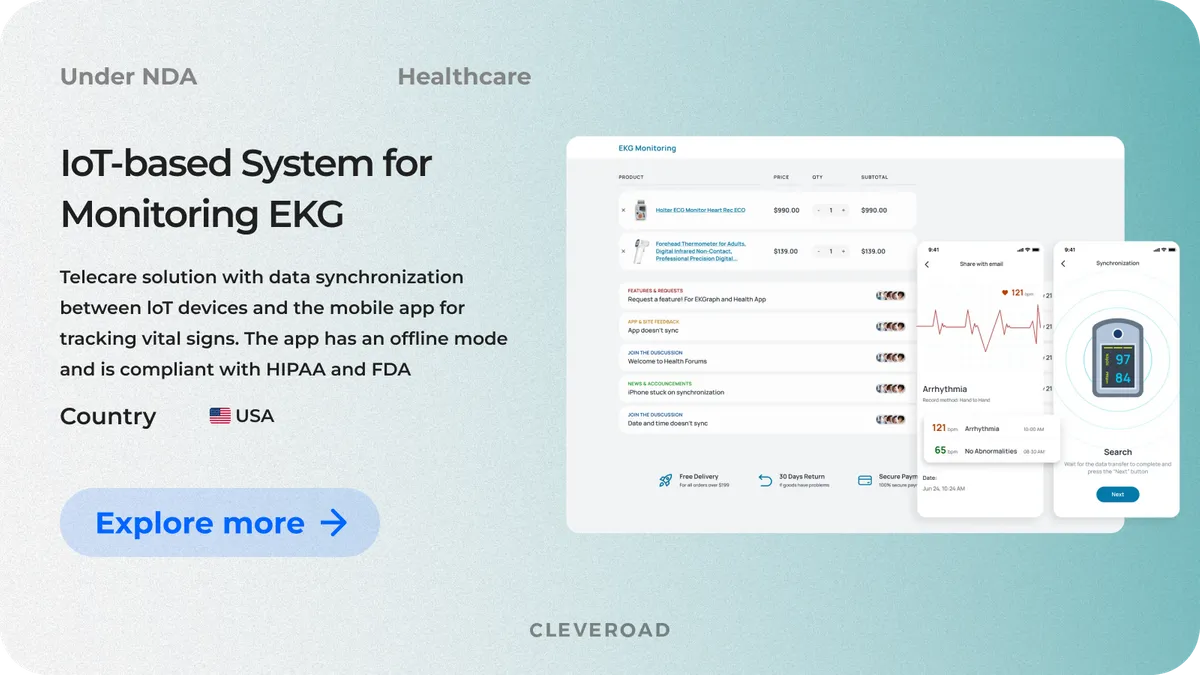
IoT-based system developed by Cleveroad
A US-based medical device manufacturer turned to Cleveroad to bring its IoT-powered ECG monitors and pulse oximeters into the digital space. The company aimed to build a mobile app that would let users track heart and oxygen levels in real-time and needed an e-commerce platform to sell devices directly to customers. Alongside this, they envisioned creating a professional community space for doctors and patients to connect.
Our team tackled the project by delivering mobile apps for iOS and Android, equipped to sync seamlessly with the company’s devices via Bluetooth. To meet strict US healthcare regulations, we embedded AES-256 encryption and HIPAA-compliant data storage protocols. Beyond the app, we developed an e-commerce module and launched a WordPress-based medical forum integrated with the mobile platforms, turning the solution into a full-service digital ecosystem.
As a result, the client received a compliant, scalable mobile solution that reliably connects to its ECG monitors and pulse oximeters. The app earned 4-5-star ratings in 95% of user reviews and also received positive feedback from doctors. The e-commerce module created a new online sales channel, while the medical forum helped the company grow its professional community and strengthen customer trust.
Start AI automation with experts
Our team with deep knowledge in eHealth and the medical regulatory landscape will help you automate routine clinical tasks with the extensive capabilities of Artificial Intelligence
AI automation in healthcare uses artificial intelligence to automate clinical and administrative tasks and improve operational efficiency. Common applications include clinical documentation, medical imaging analysis, patient triage, scheduling, billing, and remote patient monitoring.
AI automation helps healthcare organizations improve diagnostic accuracy, reducing administrative workload and enhancing patient engagement. It also supports better clinical decisions, lowers operational costs, and gives healthcare professionals more time for direct patient care.
You can use AI automation for radiology image analysis, clinical documentation, patient triage, appointment scheduling, billing, and remote monitoring.
It also supports:
- Supply chain forecasting
- Predictive maintenance for medical equipment
- Matching patients to clinical trials
These applications can reduce delays and manual work across your clinical and administrative workflows. Their value depends on data quality, integration with existing systems, and consistent human oversight.
The main challenges of AI automation include protecting patient data, preventing AI bias, meeting regulatory requirements and managing implementation costs. Healthcare organizations should combine strong governance, regulatory compliance, and experienced technology partners to deploy AI safely and effectively.

Evgeniy Altynpara is a CTO and member of the Forbes Councils’ community of tech professionals. He is an expert in software development and technological entrepreneurship and has 10+years of experience in digital transformation consulting in Healthcare, FinTech, Supply Chain and Logistics
Give us your impressions about this article
Give us your impressions about this article