The Cost of Implementing AI in Healthcare in 2026: Factors, Pricing, and ROI
Updated 15 Jul 2026
13 Min
123 Views
The cost of implementing AI in healthcare can range from $10,000 for a basic chatbot to $1,000,000+ for an enterprise-wide platform, depending on its clinical scope, security controls, regulatory obligations, and other factors.
With 15+ years of experience in healthcare software development, Cleveroad helps medical organizations evaluate AI initiatives before committing significant resources. In this guide, we explain what drives healthcare AI pricing, compare typical project costs, and show how to assess Return on Investment (ROI) before implementation.
Key takeaways:
- According to McKinsey’s 2024 analysis, administrative activities account for about 25% of more than $4 trillion in annual US healthcare spending.
- AI in healthcare typically costs $10,000-$50,000 for a chatbot, $50,000-$300,000+ for clinical documentation or workflow automation, and $1,000,000+ for hospital-wide integration.
- AI tools process large volumes of medical data faster than manual review, which supports earlier diagnosis and more informed clinical decisions.
Why Invest in Healthcare AI?
Your healthcare organization can invest in AI to reduce administrative costs, support clinical decisions, and identify patient risks earlier. According to the AI in healthcare market report by Grand View Research (2026), the global market will grow from approximately $50.7 billion in 2026 to $505.6 billion by 2033, with a Compound Annual Growth Rate (CAGR) of 38.9%. This rapid growth reflects broader investment in AI tools for clinical and administrative workflows.
Cost-effectiveness
AI can reduce the time healthcare teams in your facility spend on repetitive tasks such as appointment scheduling, claims review, or data entry. The technology also helps healthcare providers allocate staff, equipment, and clinical resources more effectively. When a provider automates high-volume workflows, medical personnel can dedicate more time to patient care while the organization reduces delays and avoidable expenses.
Personalized treatment plans
AI models can analyze patient histories, laboratory results, medication records, and previous treatment responses to support more personalized and evidence-based care plans. This approach enables your hospital clinicians to assess individual risks, reduce adverse reactions, and select treatments that closely match each patient’s condition.
Clinicians also expect AI to play a larger role in clinical decisions. According to AIPRM’s 2024 AI in healthcare statistics roundup, 64% of clinicians in South America believe AI will influence most of their decisions within the next ten years. This expectation shows why you can consider personalized care a key source of value from AI investment.
Improved diagnostic accuracy
AI algorithms can review medical images, laboratory reports, and Electronic Health Record (EHR) data at scale. They can highlight patterns for clinician review, support faster triage, and help care teams identify conditions at an earlier stage. Clinical specialists must still validate each result before they use it for diagnosis or treatment.
Cleveroad has applied computer vision principles in our ColorDetection project. The ColorDetection app tracked objects in a live camera feed and changed their colors while preserving natural shading and saturation. This project demonstrates computer vision skills relevant to medical image analysis, where healthcare products also require clinical validation, explainability, security, and regulatory controls.
Predictive analytics for preventive care
AI models can analyze patient histories, biomarkers, connected device data, and recent clinical events to identify elevated risks through real-time monitoring before a patient’s condition worsens. Care teams can then prioritize outreach, schedule additional tests, or adjust monitoring plans to support early clinical intervention before the case requires more expensive treatment.
Predictive analytics creates measurable value when the solution connects risk alerts to clear clinical workflows. A realistic AI development cost estimate should account for data preparation, model development, EHR integration, security, clinical validation, staff training, and post-launch monitoring.
Learn how you can cost-effectively create your AI-driven medical solution with our custom healthcare software development service!
Major Factors Affecting the Cost of Implementing AI in Healthcare
Budgeting for healthcare AI means accounting for several cost drivers. Startups and SMBs that skip this step risk underestimating the investment and missing long-term savings.
Below are the main pricing influencers and average cost ranges to set clear expectations.
Complexity and performance requirements
The more complex the AI solution, the more expensive it is to develop. High-performance models that use deep learning or natural language processing (NLP) cost more than simple rule-based systems. Projects that require real-time diagnosis, predictive analytics, or image recognition will increase computational requirements and a development timeline.
The type of the healthcare app also affects the cost of AI in healthcare: a chatbot vs. a complete diagnostic program are different in pricing. Ethical AI is complex and often requires deep testing and tuning to achieve clinically acceptable accuracy levels.
Let’s consider the average AI-based healthcare system cost according to its complexity:
| AI solution type | Use case example | Estimated cost range ($) |
|---|---|---|
Basic AI functionalities | Chatbots, symptom checkers | $20,000 - $50,000 |
Moderate complexity | Predictive risk modeling, triage | $50,000 - $150,000 |
High complexity | Diagnostic imaging, NLP assistants | $200,000+ |
Estimated ranges based on Cleveroad’s healthcare and AI delivery experience, 2024-2026. Final costs depend on model complexity, data readiness, clinical validation, and integration requirements.
Infrastructure capacities
The right infrastructure choice directly affects how well the AI performs within your healthcare application. Cloud services, servers, GPUs, and data storage shape both initial and recurring costs. The total budget also depends on whether you select an on-premises infrastructure model or a cloud platform such as AWS or Azure.
If the AI needs to pass through many data points or provide real-time replies, performance optimization comes at a cost too. Let’s find out the monthly basic expenditures for infrastructure, essential when you calculate the AI in healthcare cost:
- Cloud: $1,000 - $10,000+
- On-premises setup: $50,000 - $100,000+
- High-performance GPU services: $3,000 - $12,000+
Estimated ranges based on Cleveroad’s healthcare and AI delivery experience, 2024-2026. Final costs depend on model complexity, data readiness, clinical validation, and integration requirements.
Security and regulatory compliance
Depending on the product type and target market, healthcare AI may need to comply with the Health Insurance Portability and Accountability Act (HIPAA), the General Data Protection Regulation (GDPR), the Personal Information Protection and Electronic Documents Act (PIPEDA), Health Level Seven (HL7) interoperability standards, and requirements from the US Food and Drug Administration (FDA). These obligations increase costs for architecture design, legal review, clinical validation, encryption, documentation, and secure data storage.
You protect data integrity and build trustworthy AI products through adequate security measures. Failure to comply carries the risk of fines and reputational damage, making this an important cost to include. You also have to invest in regular audits, documentation, and certifications.
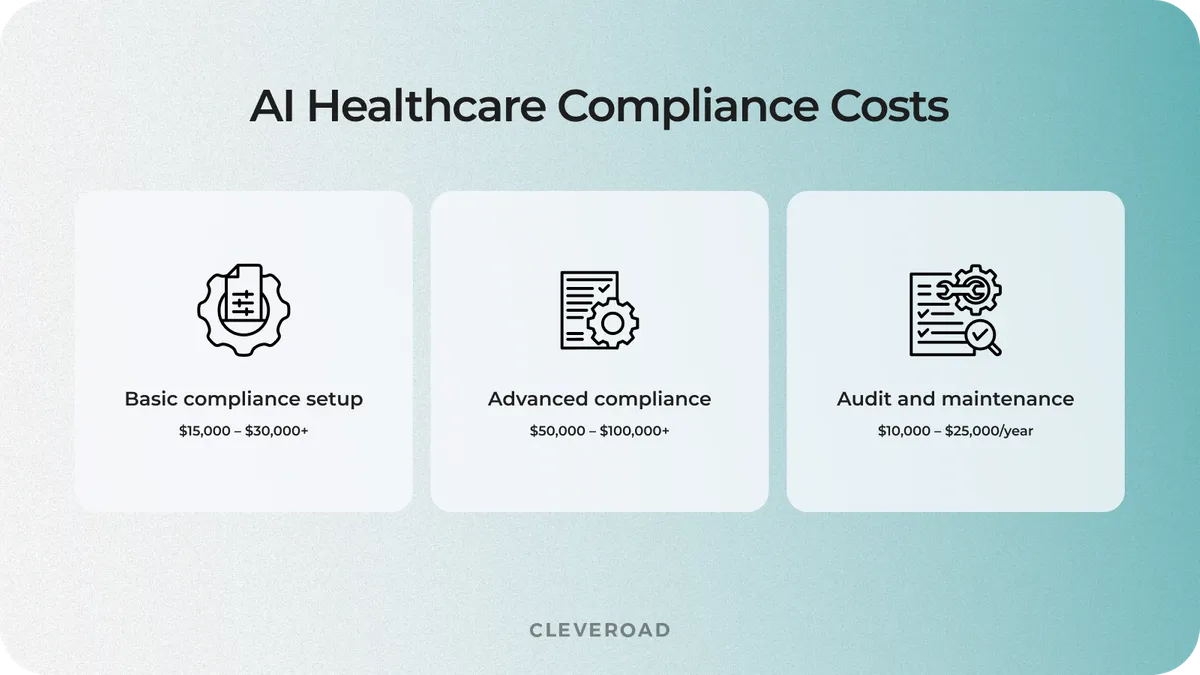
AI healthcare compliance costs
Cleveroad’s work on DECODE.ME shows how compliance requirements affect a real healthcare software budget. Codex Labs approached our team after two previous vendors had failed to deliver a stable demo of its teledermatology platform. Cleveroad reviewed the inherited codebase, fixed critical backend issues, improved performance, and built HIPAA-ready infrastructure for secure virtual consultations.
Our team configured storage based on Fast Healthcare Interoperability Resources (FHIR) on Google Cloud Platform (GCP), along with a protected development environment. This setup allowed developers to improve and test the product without direct access to patient data. Within five months, DECODE.ME reached a demo-ready state for the 2025 American Academy of Dermatology Innovation Meeting, where the platform attracted dozens of dermatologists. Cleveroad continues to support Codex Labs and expand the solution.
Find out how Barbara Paldus, Founder and CEO of Codex Labs, describes Cleveroad’s healthcare expertise, delivery approach, and work on DECODE.ME:
Dr. Barbara Paldus, CEO at Codex Labs: Feedback on Cleveroad’s Telemedicine Development Services
Integrations
Healthcare solutions must integrate AI with EHRs, billing systems, and third-party platforms. This often requires custom application programming interfaces (APIs) and middleware. Integration complexity varies across organizations and directly impacts development time and total EHR implementation cost.
Integration design also determines how quickly the system can deliver real-time insights and measurable value. The fewer manual steps a workflow requires, the higher user adoption and the greater the Return on Investment (ROI).
Now, we’ll explore the approximate integration costs for your AI-based healthcare system.
| Integration level | Description | Estimated cost range |
|---|---|---|
Basic API integration | 1-2 external services with limited data interaction | $5,000-$15,000+ |
Moderate system integration | EHRs and billing systems, including data transformation | $20,000-$50,000+ |
Enterprise-level integration | Full interoperability with multiple systems | $75,000+ |
Cleveroad reviewed the inherited codebase, fixed critical backend issues, improved performance, and built HIPAA-ready infrastructure for secure virtual consultations.
Team composition and expertise
Proper implementation of AI in healthcare requires a team consisting of data scientists, AI engineers, UI/UX designers, clinical consultants, etc. A skilled team helps ensure AI meets medical standards and patient needs. Healthcare domain knowledge is critical for accurate, contextual understanding.
Below are indicative monthly costs for different healthcare AI staffing models:
- In-house team: $40,000-$100,000+/month
- Outsourced development (project-based): $30,000-$200,000+/month
- Specialized consultants (e.g., clinical AI): $16,000-$48,000+/month
Estimated staffing ranges based on Cleveroad’s hiring and project delivery benchmarks, 2024-2026. Actual costs vary by team size, specialist seniority, location, and cooperation model.
Hiring an in-house team can be difficult and expensive. So when it comes to a tech as complex as AI, outsourcing the development of healthcare AI software is a more cost-efficient and scalable option. Engaging a seasoned outsourced team gives you access to end-to-end healthcare and AI expertise without the overhead of long-term staffing.
How Much Does AI in Healthcare Cost by Use Case?
The cost of implementing AI in healthcare ranges from about $10,000 for a basic chatbot or LLM fine-tuning project to $1,000,000+ or more for hospital-wide AI integration. The final budget depends on the use case, data volume, clinical risk, integrations, performance requirements, and compliance scope.
The table below gives healthcare providers a clearer 2026 cost benchmark by solution type.
| AI use case | Typical cost | Notes |
|---|---|---|
AI chatbot or virtual assistant | $10,000-$50,000+ | Usually the fastest option to deploy |
Clinical documentation AI | $50,000-$300,000+ | Often delivers ROI within 3-6 months |
Workflow and process automation | $50,000-$300,000+ | Covers revenue cycle management, scheduling, and triage |
Predictive analytics or medical imaging | $150,000-$800,000+ | Requires extensive data preparation and stronger HIPAA or FDA controls |
Full hospital AI integration | $1,000,000+ | Covers enterprise systems, multiple workflows, and complex integrations |
Fine-tuning an existing LLM | From $10,000+ | A custom model built from scratch can exceed $500,000 |
These estimates synthesize 2026 healthcare AI cost guides from Fulminous, Azilen, Emorphis, and Excellent WebWorld. The ranges are directional benchmarks and should be validated against the project’s data, deployment scope and so on. For a broader breakdown of model development, infrastructure, and other factors, review our general AI development cost guide.
A limited AI assistant can start with one workflow and a small data scope. A hospital-wide platform requires deeper EHR integration, stronger security controls, clinical validation, staff training, and long-term model monitoring.
Cleveroad helps healthcare providers define a realistic scope for AI before development starts. Our healthcare and AI specialists assess your workflows, data sources, compliance needs, and expected business results to prepare a project plan and cost estimate.
Contact us to discuss your AI use case and receive an estimate based on your clinical objectives, technical environment, and budget.
What ROI Can Healthcare AI Deliver?
According to a Microsoft-commissioned IDC study cited in 2024, healthcare organizations realize an average return of about $3.20 for every $1 invested in AI, with returns achieved within 14 months on average. Vendor benchmarks suggest that narrowly scoped administrative use cases, including clinical documentation and revenue cycle automation, may reach payback within 3 to 9 months, although actual results depend on implementation scope, data quality, and staff adoption.
These figures should serve as planning benchmarks rather than guaranteed results. A 2025 systematic review published in npj Digital Medicine found that clinical AI can improve cost-effectiveness by reducing unnecessary procedures and optimizing resource use. However, the authors also noted that infrastructure, indirect costs, and other implementation expenses were often underreported. The financial result varies by clinical setting and implementation model.
Healthcare providers should include the following ongoing expenses in their ROI calculations:
- Model support and retraining: around 25% to 45% of the initial project cost
- Staff training and adoption: around 5% to 15%
- Compliance updates and audits: around 10% to 20%
These cost ranges come from healthcare AI implementation benchmarks rather than standardized industry research. They show why an ROI model should cover at least three years and include model monitoring, infrastructure, compliance, integration support, and staff adoption alongside direct development costs.
The strongest ROI usually comes from a measurable use case. Healthcare providers can track documentation time saved, claims processed, denial rates, patient throughput, readmissions, diagnostic turnaround time, or avoided manual work to compare the financial gain with the total cost of ownership.
How to Optimize the Cost of AI in Healthcare
Healthcare providers can reduce AI implementation costs through a focused scope, phased delivery, existing infrastructure, and the right development model. The following four practices help control the initial budget and long-term ownership costs.
Choose scalable, modular AI solutions
Start with the functions that solve your most urgent clinical or administrative problem. A modular architecture lets you add new models, workflows, and integrations after the first release proves its value.
Reuse your current EHR, medical imaging software, cloud environment, and data pipelines where possible. This approach lowers infrastructure expenses and avoids a costly system replacement. Cleveroad designs modular healthcare AI products that connect with existing software through secure APIs. This architecture supports future expansion without a full product rebuild.
Use outsourcing in cost-efficient regions
Outsourcing gives you access to AI engineers, healthcare software developers, clinical consultants, and compliance specialists without the fixed costs of an internal department.
Healthcare organizations can select one of two common cooperation models:
- Dedicated development team services: A stable team handles complex products.
- IT staff augmentation: Individual specialists fill skill gaps within your existing team.
The vendor’s location also affects the project budget:
| Region | Average hourly rate | Notes |
|---|---|---|
Central and Northern Europe | $50-$90+ | Strong balance between cost and technical expertise |
North America | $100-$250+ | High rates and broad access to senior talent |
Western Europe | $80-$200+ | Strong engineering and regulatory expertise |
South Asia | $25-$60+ | Lower rates with wider differences in quality |
Latin America | $35-$75+ | Competitive rates and convenient overlap with US time zones |
Estimated hourly rates based on Cleveroad’s vendor-market benchmarks, 2024-2026. Actual rates vary by country, specialist seniority, healthcare expertise, and engagement model.
A healthcare-focused vendor from Central and Northern Europe can reduce development expenses while maintaining access to experienced AI and compliance specialists.
Use generative AI for high-ROI tasks
Prioritize use cases with clear financial and operational metrics. As the ROI section above explains, focused applications often reach break-even faster than broad enterprise programs.
Clinical documentation, patient communication, and appointment scheduling often deliver early value by reducing repetitive work. Providers typically see this value in less time spent on manual tasks and faster patient service.
Cleveroad helps medical organizations apply generative AI in healthcare to automate selected tasks without replacing entire clinical systems. A narrow first use case limits the budget and gives your team clear evidence before the next investment stage.
Start with a proof of concept
A proof of concept tests the technical feasibility and business value of an AI use case before full-scale development. It lets you validate data quality, model accuracy, system compatibility, compliance requirements, and user adoption with a limited budget.
Cleveroad’s AI proof of concept service helps healthcare providers test the core model and workflow in a controlled environment. The PoC results give stakeholders the evidence they need to approve, adjust, or stop the initiative before major expenses arise.
Our AI Strategy Advisor helps select the AI use case with the strongest ROI for your budget
Cleveroad as Your Partner for AI in Healthcare
Cleveroad is a healthcare software development company with 15+ years of experience since 2011. We work with medical startups, service providers, and HealthTech companies, helping them build custom AI solutions for clinical and telemedicine use cases.
Our team develops healthcare products from scratch and modernizes legacy systems by integrating AI into existing workflows. We also provide IT consulting and UI/UX design services.
This estimation process helps healthcare organizations plan AI implementation budgets and reduce the risk of unexpected expenses.
Rough estimate
A rough estimate outlines the preliminary project scope, expected development effort, and initial cost range. It helps you evaluate whether the proposed healthcare AI solution fits your budget before you invest in detailed planning.
Solution Design Workshop rough estimate
We prepare the initial estimate during the Solution Design Workshop, which is free as part of our first engagement. Our team defines the core business and clinical goals, evaluates the expected AI complexity, reviews potential integrations, and identifies technical or compliance constraints.
The result gives you an initial cost range and a clearer understanding of the resources required for your healthcare AI project.
Detailed estimate
A detailed estimate is the most precise project cost assessment and can reach almost 100% accuracy. The developers who will work on the healthcare AI solution take part in its preparation.
Cleveroad prepares it after the Discovery Phase, during development. The team uses approved requirements, architecture, wireframes, and specifications as the basis for further planning.
For each upcoming sprint or the next two sprints, a business analyst prepares user stories. A solution architect, technical lead, or responsible developer reviews each story and estimates its complexity, dependencies, and required effort.
The estimate covers:
- Development and non-development activities
- AI model work, integrations, testing, and deployment
- Documentation, specialist rates, work volume, and projected costs
The estimate also accounts for security, compliance, and infrastructure requirements. Cleveroad applies ISO-certified quality and information security management processes when developing healthcare AI solutions that must support HIPAA, GDPR, and other applicable requirements. As an AWS Select Tier Services Partner, Cleveroad can select suitable cloud services and infrastructure configurations to reduce setup time and avoid unnecessary resource costs.
Clients with a ready documentation package can receive a detailed estimate faster.
By taking this structured, quality-driven approach, you will accelerate the path from concept to implementation while optimizing impact and investment in the clinic.
Get your healthcare AI cost estimate
Share your use case with Cleveroad’s healthcare AI experts. We’ll assess scope, compliance requirements and other factors to prepare a rough project estimate during a Solution Design Workshop
Healthcare AI projects typically start at around $10,000 for a chatbot or LLM fine-tuning and can exceed $1,000,000 for a hospital-wide rollout. Most focused solutions, including clinical documentation and workflow automation tools, fall within the $50,000-$300,000+ range.
The main cost drivers include:
- AI model complexity and performance requirements
- Data preparation and model training
- Cloud infrastructure and computing resources
- HIPAA, FDA, and HL7 compliance
- EHR and third-party system integrations
- Team composition and healthcare expertise
- Post-launch support and model retraining
Projects that require real-time analysis, medical imaging, or clinical decision support usually cost more because they need stronger infrastructure and stricter security controls.
Vendor benchmarks often cite an average return of about $3.20 for every $1 invested, with a typical break-even period of 12 to 24 months. Focused use cases, such as clinical documentation or revenue cycle automation, may reach payback within 3 to 8 months.
Actual ROI depends on staff adoption, data quality, workflow fit, and ongoing costs. Healthcare providers should also account for model support, employee training, compliance audits, and infrastructure expenses when they calculate long-term value.
An AI chatbot or virtual assistant is usually the cheapest healthcare AI use case to launch, with costs from about $10,000 to $50,000+. It can automate appointment requests, answer common patient questions, and support basic triage without complex clinical integrations.
Start with one measurable use case, reuse your current infrastructure, and validate the idea through a proof of concept. You can also reduce costs through modular architecture, outsourced development, existing AI models, and phased implementation based on proven ROI. A clear implementation roadmap also helps prevent scope creep and unplanned expenses.

Kateryna is a Cleveroad business analyst striving to investigate innovations that improve people's lives. She loves to tell readers more about technologies of the modern world. She also enlightens tech topics as to business domains like Logistics and Supply Chain, Healthcare, Fintech, and others.
Give us your impressions about this article
Give us your impressions about this article