Monolith to Microservices Migration: A Modular Monolith Approach
07 Jul 2026
17 Min
134 Views
Moving from a monolithic application to microservices works best when the team first creates clear module boundaries inside the existing application. Without this step, migration can turn one large codebase into many tightly coupled services that are harder to deploy, test, and support.
Cleveroad is a custom software development company with 15+ years of experience modernizing legacy systems, building cloud-native platforms, and delivering scalable web and mobile products for startups, SMBs, and enterprises. Our team helps businesses restructure monolithic applications, improve delivery processes, and prepare platforms for low-risk service extraction through architecture assessment, code audit, DevOps setup, and application modernization.
In this article, you will learn what monolith to microservices migration actually means, when a modular monolith is the better intermediate step, which migration patterns reduce delivery risk, how to sequence the migration step by step, and how much a migration typically costs.
Key takeaways:
- Migration should be incremental, not a full rewrite. Extract one bounded context at a time while the application continues to run.
- A modular monolith provides the foundation for successful migration. Well-defined module boundaries reduce dependencies and make future service extraction faster and safer.
- Enterprise migrations require significant investment. Full migrations can take 6 to 24 months and cost approximately $300,000 to $3 million, depending on application size, business domain, integration complexity, and compliance requirements.
- Estimates are based on Cleveroad’s previous migration projects. We validate the timeline and budget for each product during the architecture assessment and discovery phase.
What Monolith to Microservices Migration Actually Means
Migration from monolith to microservices means breaking one deployable application into independently deployable services aligned with business capabilities. In practice, the safest path is rarely a direct jump from monolith to microservices. Most successful teams move through three stages: monolith → modular monolith → microservices.
The modular monolith stage is what makes the transition safe. It keeps one deployment unit, but introduces clear module boundaries, explicit ownership, and limited cross-domain dependencies. This gives the team a chance to remove coupling inside the codebase before taking on the overhead of distributed systems.
A true microservice is not just a smaller codebase. It should own:
- Deployment lifecycle
- Business logic
- Datastore (over time)
That independence lets the service change, scale, and release without forcing coordination across the whole platform. The opposite outcome is a distributed monolith. This happens when teams split code into separate services but keep a shared database, tight runtime dependencies, or coupled releases. In that model, the system gains more network calls, more failure points, and more observability overhead, but still lacks real service independence.
That is why moving from monolith to microservices should be treated as staged modernization, not as a rewrite. The practical sequence looks like this:
- Identify bounded contexts inside the existing application
- Turn them into stable modules with explicit interfaces
- Extract only selected modules into standalone services where independent deployment, scaling, or ownership creates clear business value
Recent academic research reinforces the need for a staged approach. A 2025 systematic mapping study on monolith-to-microservice migration found that migration remains complex and that available research still focuses heavily on decomposition rather than the full migration journey. A 2025 systematic literature review of ML-assisted migration also highlights limited tool support and unresolved challenges around migration automation.
The table below summarizes the practical differences between the main architectural states that teams encounter during migration.
| Architecture | Deployability | Data ownership | Typical outcome |
|---|---|---|---|
Monolith | Single deployable app | Shared | Fast to start, harder to scale and evolve later |
Modular monolith | Single deployable app with strict internal boundaries | Usually shared, but controlled by module rules | Best foundation for gradual extraction |
Microservices | Independent deploy per service | Each service owns its data | Higher flexibility, higher operational complexity |
Distributed monolith | Multiple deployables with shared data and tight dependencies | Shared or entangled | More complexity, limited independence |
The Modular Monolith: The Step Most Migrations Skip
A well-structured modular monolith is often the fastest and safest way to de-risk a migration from monolith to microservices. Once the application has clear domain boundaries, strict module interfaces, and controlled ownership of data and logic inside each module, service extraction becomes much easier to plan. At that point, migration becomes a targeted operational decision rather than a rescue mission for tangled architecture.
The main payoff of the modular-monolith step is lower migration risk. Fixing boundaries within a single deployment unit is faster and lower-risk than extracting services from tightly coupled code under production pressure. Instead of moving architectural chaos into a distributed system, the team first creates internal order, proves domain separation, and only then extracts the modules that truly need independent deployment or scaling.
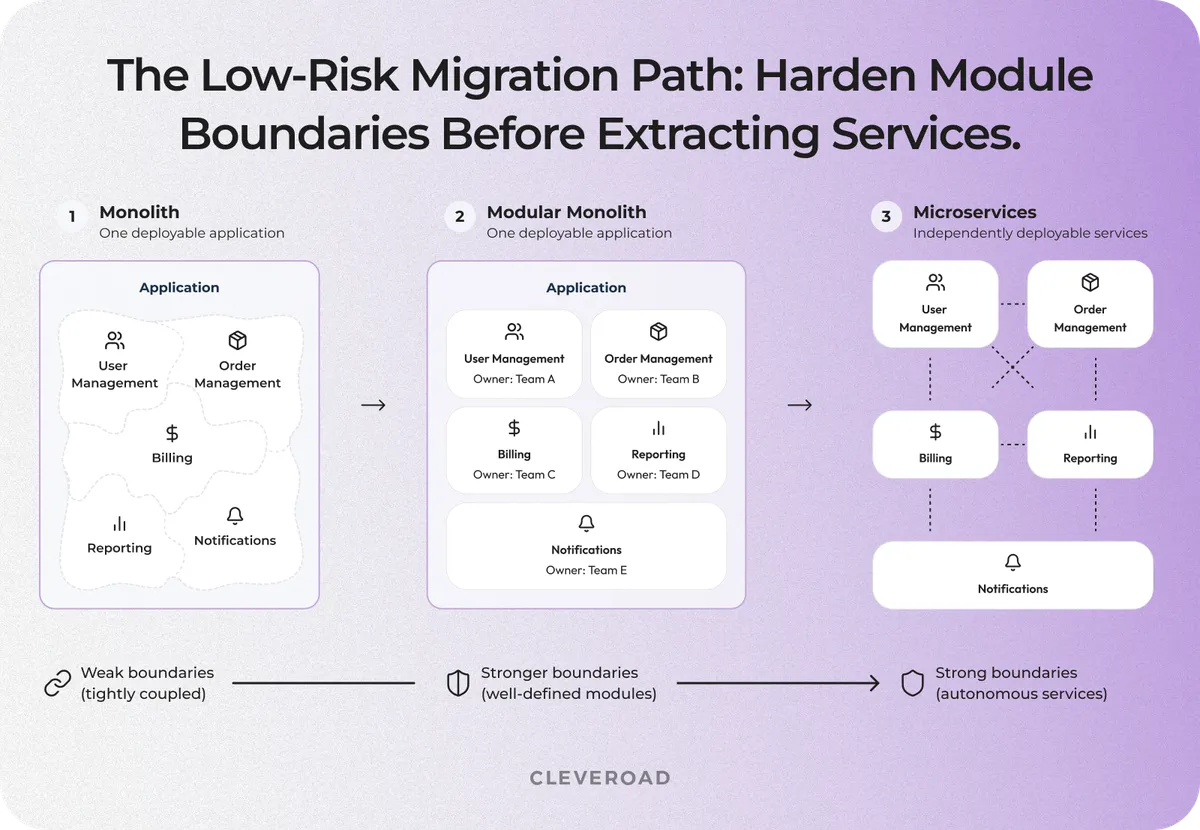
The low-risk migration path: harden module boundaries before extracting services
Define clean module boundaries
Clean module boundaries are the foundation of a modular monolith. Each module should own one business responsibility, so the boundary reflects a real business capability rather than a technical convenience. If those ownership rules are still unclear, extraction should wait because refactoring the monolith is safer than turning tangled code into tangled services.
This is where domain-driven design becomes practical. Bounded contexts help the team decide what belongs together and what should stay separate. A payments module, for example, should not quietly reach into order fulfillment or customer notifications through shared internals.
The goal is to reduce ambiguity inside the running system. Once each module has a clear responsibility and limited dependency surface, the team can test, change, and later extract that module with much lower risk.
Enforce data ownership per module
Module boundaries will not hold if every part of the application reads and writes the same tables. Each module should own its data and control how other parts of the system interact with it. That means no shared tables as a convenience layer and no direct cross-module database access.
The practical goal is logical schema isolation. A module may still live in the same physical database, but its tables, write rules, and data access paths should belong to that bounded context alone. Other modules should work through published interfaces, application services, or events instead of querying those tables directly.
This discipline matters later when the team starts database decomposition. If one module already owns its schema and other modules consume its data only through defined contracts, moving that data into a separate datastore becomes much safer. That is why data ownership should be enforced before converting a monolithic application to microservices.
Expose modules through clean internal APIs
Modules should communicate through defined internal APIs, not through direct calls into each other’s internals. One module exposes a clear contract, and other modules interact only through that contract. This makes later extraction much easier because the team replaces an in-process call with a network call instead of redesigning the interaction from scratch.
This approach improves the monolith long before any service split happens. Stable module interfaces help teams:
- Make dependencies visible
- Reduce side effects
- Prevent one module from reaching into another module’s private logic
Internal APIs also force architectural discipline around what a module is allowed to expose. A reporting module, for example, should request information through a defined order or billing interface, not by reading private classes or bypassing business rules embedded elsewhere in the codebase.
Modernizing an aging platform with shared data dependencies? Cleveroad’s cloud-migration guidance shows how to plan migration with less risk
When Should You Migrate, and When Is a Modular Monolith Enough?
You should migrate to microservices only when a specific module has outgrown what one deployable application can support, usually because it needs independent scaling or its own release cycle. Uneven load is the clearest case: a checkout, payment, or search function may absorb peak traffic while admin panels stay idle, yet one deployable monolith forces you to scale everything just to protect a few hot paths. When that waste becomes measurable, extracting the hot module starts to pay off. Chasing an architecture trend rarely does.
Signals you're ready to extract services
Continuous integration and continuous delivery (CI/CD) plus observability are prerequisites for migrating from monolithic to microservices, not goals to chase after the split. If the team still struggles to test changes reliably, deploy safely, trace failures across components, or monitor service behavior in production, service extraction will only multiply those problems.
Key readiness signals include:
- Independent scaling needs for a module such as payments or search
- Mature delivery discipline with automated builds, test coverage, deployment pipelines, and rollback procedures
- Production visibility through logs, metrics, tracing, and alerting
- Clean domain structure with stable ownership, enforced data rules, and intentional internal APIs
When these conditions are in place, service extraction becomes a controlled architectural step. Until then, the better move is usually to keep improving the modular monolith.
Signals that a modular monolith is the right stopping point
A monolithic to microservices migration is justified only when one deployment cadence no longer works and at least one module needs independent scaling. Until then, the better move is to keep strengthening boundaries inside the monolith and delay distribution. Splitting too early mostly adds network overhead, operational burden, and harder debugging without removing the real bottleneck. That caution is measurable: in the 2024 Cloud Native Computing Foundation (CNCF) annual survey, 46% of respondents said CNCF projects were too complex to understand or run in production, up 13% year over year. CNCF's cloud-native maturity model even describes a consolidation phase, where teams merge services back together as integration load starts to slow down delivery.
A modular monolith is often sufficient when a single team still owns most of the product, release coordination stays manageable, and traffic does not diverge sharply across domains. It gives you cleaner ownership and safer changes without the burden of service discovery, distributed tracing, and multi-service incident response, which is the core microservices vs. monolithic architecture trade-off many teams weigh in real projects.
How Cleveroad runs a migration-readiness assessment
Cleveroad assesses migration readiness before any service extraction starts. This work happens during the Discovery Phase of our application modernization process, where we clarify business workflows, identify outdated system parts, assess risks, and define the implementation scope.
In practice, our team audits the existing monolith, maps dependencies, and analyzes where coupling creates delivery or scaling risk. The core output is a structured recommendation supported by architectural documentation, dependency analysis, and an evolution roadmap.
Cleveroad's AI-assisted legacy modernization approach adds another layer to this work. We can build a plain-language business logic map, assign module-level risk ratings, and define the right starting sequence, whether that means modular-monolith refactoring, selective extraction, or full migration.
Not sure whether to extract services or keep a modular monolith? See how Cleveroad’s application modernization service helps assess the right path
Monolith to Microservices Migration Strategies and Patterns
Monolith to microservices migration patterns work better than full rewrites in most real systems because they reduce delivery risk and let the product keep running during modernization. The goal is not to move everything at once, but to choose the right extraction pattern for the right module at the right time.
This section explains which patterns teams use in practice, what problem each one solves, and how to sequence them without turning the migration into a stalled rewrite.
Strangler fig pattern
The strangler fig pattern is often the safest option for customer-facing systems that cannot go dark. Instead of replacing the monolith in a single release, the team adds an intercepting layer in front of the application. Some requests go to new microservices, while the rest still go to the monolith. Over time, more traffic moves to the new components, and less reaches the legacy core.
Why this pattern works:
- Users keep working on the same product
- Migration happens gradually, not all at once
- The team can replace functionality piece by piece
- Rollback is safer than with a full cutover
A checkout flow or customer account area can move first, while lower-priority or tightly coupled parts stay in the monolith until their turn comes. The main advantage is control. That is what makes the strangler fig pattern especially useful for live operations and revenue-critical workflows where downtime is unacceptable.
Branch by abstraction
Branch by abstraction works best when teams need to convert a monolith to microservices, but the code is too deeply embedded to be split through routing alone. Instead of intercepting traffic at the edge, the team adds an abstraction layer around the existing logic and switches consumers from the old implementation to the new one when the replacement is ready.
This pattern is useful when:
- The business logic is deeply embedded in the codebase
- External request routing will not help
- The team needs a safe seam for replacement inside the application
The main benefit is controlled replacement. The old and new implementations can coexist behind the same interface, which makes rollout safer and rollback cleaner if the new logic does not behave as expected. That makes branch-by-abstraction a strong option when the migration challenge lies within the code rather than at the request boundary.
Parallel run
Parallel run is the right pattern when correctness matters more than migration speed. The team sends the same input through both the monolith and the new service, compares the outputs, and cuts over only after the new implementation proves it matches the expected behavior.
This pattern is especially useful for:
- Billing
- Pricing
- Tax logic
- Settlements
- Other financial or compliance-sensitive flows
The main advantage is confidence. Instead of trusting the replacement from day one, the team validates it against real traffic and real business scenarios before making it the system of record. This reduces cutover risk and helps uncover edge cases that test environments often miss.
The trade-off is extra infrastructure and operational effort. The team has to run two implementations in parallel and needs a clear way to investigate mismatches and failure modes before cutover. Even so, that overhead is often cheaper than a bad release in a revenue-critical workflow.
How Do You Migrate a Monolith to Microservices Step by Step?
If you want to know how to migrate monolithic to microservices, the safest path is sequential. First, modularize the monolith. Then enforce boundaries around code and data. Next, extract one low-risk, high-value service, and only then expand the architecture one bounded context at a time.
This order matters because each later step depends on work completed earlier inside the modular monolith. When the team follows that sequence, migration stays controlled, reversible, and aligned with real product constraints.
Map components and bounded contexts the way Cleveroad does
At Cleveroad, this step starts with business and architecture discovery, not code extraction. Our team works with client stakeholders and engineers to map business processes, document how the system works today, identify outdated parts, assess risks, and define the modernization scope before implementation begins.
Next, we analyze coupling within the monolith through dependency mapping and code audit services. We map dependency chains, identify risky modules, detect unused paths, and build a plain-language business logic map. That helps us choose the first extraction candidate based on business value, ownership clarity, and technical risk.
Stand up CI/CD, containers, and observability first
CI/CD, containerization, and observability must be in place before the first service extraction begins. Without independent delivery pipelines, a new service still depends on the monolith’s release process. Without tracing, logs, and metrics, the team cannot see how requests move across service boundaries or diagnose failures once network calls replace in-process calls.
Containerization matters because each service needs a consistent deployment unit. Once services run in containers, the team can deploy, test, and scale them independently, while orchestration keeps them reliable across environments. These foundations are what make service extraction useful in practice. That is also why DevOps and CI/CD setup should be treated as part of the migration strategy, not as a side task.
Introduce an API gateway
During a monolith to microservices migration, an API gateway gives clients one stable entry point while the backend changes underneath. Clients keep using the same external interface, while routing rules decide whether a request goes to the monolith or to an extracted service.
The gateway also centralizes cross-cutting concerns such as:
- Security rules
- Request routing
- Rate limiting
- Traffic shaping
This matters most during the transition stage, when some capabilities still live in the monolith and others already run as standalone services. The API gateway keeps that split manageable and lets the team shift traffic gradually instead of forcing a hard cutover.
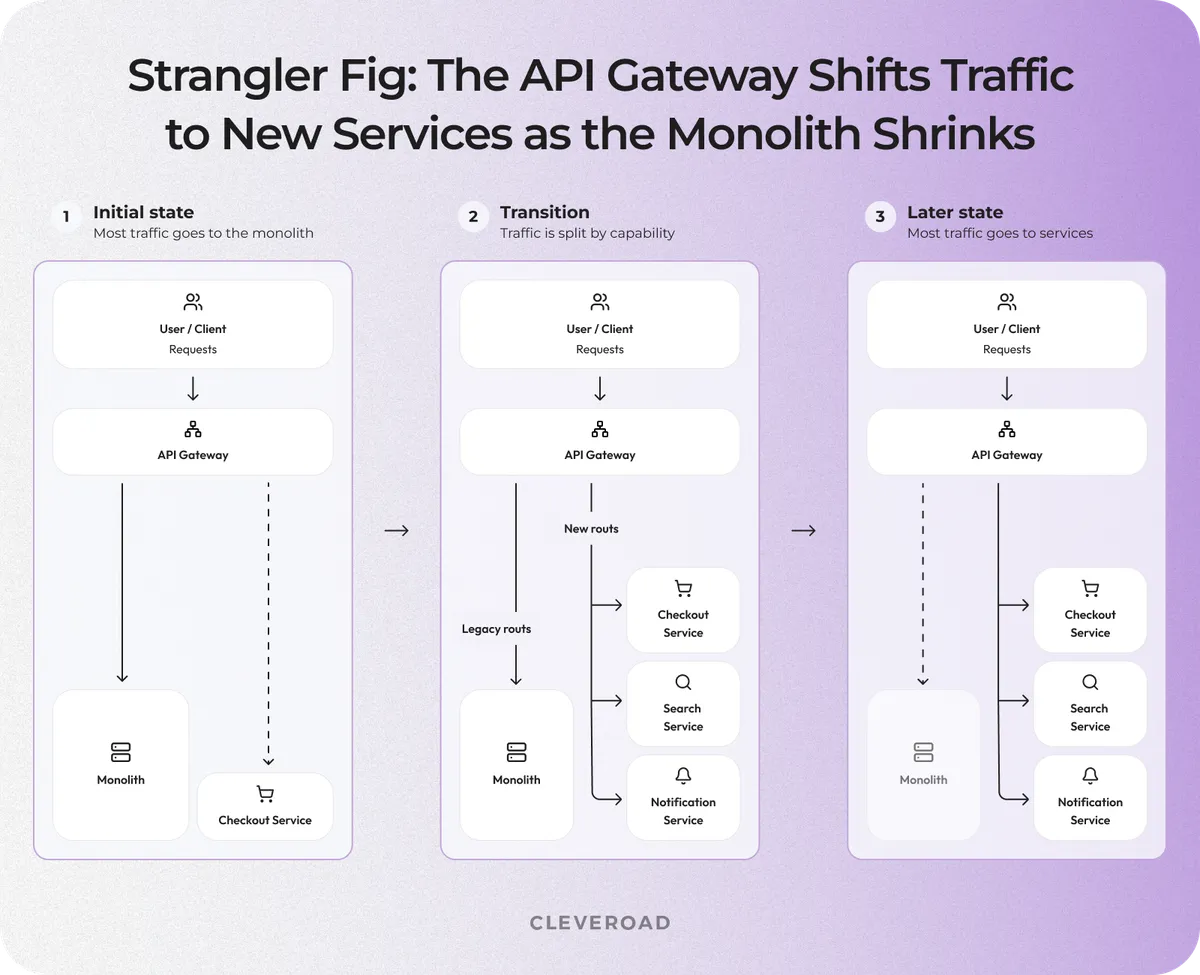
Strangler fig: the API gateway shifts traffic to new services as the monolith shrinks
Extract the first service
The first service should be small enough to control and important enough to matter. Pick a module with clear boundaries and limited dependencies so the transition from a monolithic system to microservices remains manageable. Then move its code and data into a new deployable unit, expose its functionality through a stable API, and remove direct in-process calls from the old system.
The team also needs to design for distributed behavior from the start. That includes:
- Retries
- Timeouts
- Idempotency
- Clear error handling
Data ownership matters just as much: the new service should own its data model and stop depending on shared tables. Treat this first extraction as a learning loop — it shows where boundaries are still weak and which resilience patterns should become standard before the next split.
Iterate context by context
After the first extraction, keep migrating from monolith to microservices one bounded context at a time, prioritizing by business value and technical feasibility. The monolith does not disappear overnight, so it still needs maintenance, security patches, and architectural discipline while more capabilities move out.
This step gets faster when the team turns each round into a reusable playbook. That includes:
- Routing rules
- API contracts
- Observability baselines
- Rollback procedures
Platform maturity matters most at this stage. At Cleveroad, we run containerized microservices on managed Kubernetes with CI/CD pipelines across AWS, Azure, and Google Cloud, so each extracted service ships and rolls back independently of the monolith.
How Much Does Monolith to Microservices Migration Cost?
Monolith to microservices migration costs vary widely because companies do not buy the same scope of change. One business may only need a pilot extraction to validate the target architecture. Another may need to separate several bounded contexts, rework shared data flows, and upgrade delivery infrastructure before the first service goes live.
In larger enterprises, the migration often includes platform engineering, database-per-service rollout, observability upgrades, and team model changes, which pushes both budget and timeline much higher. The most useful way to estimate migration cost is to group it by program scope. That shows what the business is actually paying for and why two “microservices migrations” can differ by hundreds of thousands of dollars.
| Scope | What it covers | Typical timeline | Indicative cost |
|---|---|---|---|
Pilot extraction | First service strangled out, gateway plus CI/CD stood up | 2 to 4 months | From ~$50K |
Mid-scope migration | Several bounded contexts extracted, partial database decomposition | 6 to 12 months | ~$150K to $500K |
Enterprise full migration | Most contexts extracted, database-per-service, organization changes | 12 to 24+ months | ~$500K to $3M+ |
These figures are planning estimates, not fixed prices. Final cost depends on codebase size, coupling level, data ownership complexity, compliance requirements, and delivery maturity.
A pilot extraction covers the minimum viable migration foundation. The team prepares CI/CD, introduces the routing layer, extracts one relatively low-coupling service, and proves that deployment, observability, and rollback work under real conditions. A mid-scope migration costs more because the team applies the pattern across multiple bounded contexts, maintains old and new paths during the transition, and often starts partial database decomposition.
An enterprise full migration is the most expensive tier because the hardest problems become unavoidable. Shared databases must be split more aggressively, service ownership must align with team structure, and release management must support multiple deployables rather than a single one. The biggest cost multipliers are usually due to database decomposition, the parallel operation of legacy and new systems, and refactoring required before extraction.
How Cleveroad Approaches Monolith to Microservices Migration
At Cleveroad, we approach monolithic to microservices migration services as a staged engineering program rather than a full rewrite. Since 2011, we've helped startups, SMBs, and enterprises modernize legacy software, improve delivery infrastructure, and prepare platforms for long-term growth. We do this through cloud-native architecture and microservices-based modernization.
To show how this expertise works in practice, let us look at one of Cleveroad’s relevant modernization cases. Blockbuster is a Danish transactional video-on-demand platform serving users across the Nordic market. The client needed to expand a traditional rental model into a scalable digital streaming product that could work across TV, web, and mobile devices while supporting a better user experience and broader market reach.
Cleveroad helped Blockbuster reengineer existing applications, build a scalable streaming platform, and redesign the product experience for cross-platform use. Our team developed a solution that supported digital movie rentals and purchases, improved usability across devices, and strengthened the platform's technical foundation for growth.
As a result, Blockbuster strengthened its digital presence and serves 500,000+ subscribers across Denmark, Sweden, Finland, and Norway. This case shows how Cleveroad supports platform modernization in products that need scale, multi-device delivery, and an architecture that can grow with the business.

Blockbuster streaming platform interface
The same staged approach guides our monolith modernization projects. Rather than recommending microservices by default, we help clients determine the right next step for their platform, whether that means strengthening a modular monolith, extracting selected services, modernizing cloud infrastructure, or rebuilding legacy components. This keeps business-critical systems running while the architecture evolves at a sustainable pace.
See how Blockbuster CTO Henrik Loop describes Cleveroad's technical contribution and delivery approach in the video below.
Henrik Loop, CTO Blockbuster, TDC, gives feedback about cooperation with Cleveroad
Monolith to microservices migration is the process of turning one deployable application into a set of smaller services aligned with business capabilities. In most enterprise projects, the safest path is:
- start with the monolith
- reshape it into a modular monolith
- extract selected services one bounded context at a time
That sequence lowers risk and makes each extraction easier to control.
You keep operations stable by changing the architecture in small steps. First, clean up module boundaries inside the monolith. Then add CI/CD, observability, containers, and an API gateway. After that, extract one low-coupling service, run old and new paths in parallel where needed, shift traffic gradually, and repeat.
Throughout the migration, users continue working in the same product while the backend evolves behind the scenes.
Choose a modular monolith when:
- one release cadence still works
- the team is still fairly compact
- modules do not need separate scaling very often
Choose microservices when:
- one bounded context needs independent scaling
- one team needs independent deployment
- one domain needs stronger isolation for resilience or ownership
For most teams, the right answer is not “microservices now.” It is “modular monolith first, then selective extraction.”
Typical timelines break down into three common scenarios:
- Pilot extraction: about 2 to 4 months
- Mid-scope migration: about 6 to 12 months
- Enterprise migration: about 12 to 24 months or more
Actual timelines depend on application size, architecture quality, integration complexity, and migration scope. The timeline grows when the system has shared databases, weak boundaries, limited automation, or many business-critical flows that need parallel run and rollback protection.
A distributed monolith is what you get when services are split physically but still behave like one tightly coupled system. Common signs include:
- services share the same database
- services call each other constantly
- deployments must still happen together
- one failure spreads across many domains
To avoid it, define business-aligned boundaries first, enforce per-service data ownership, keep APIs explicit, reduce synchronous dependencies, and extract services only when they can own their code, data, deployment, and operational lifecycle independently.

Evgeniy Altynpara is a CTO and member of the Forbes Councils’ community of tech professionals. He is an expert in software development and technological entrepreneurship and has 10+years of experience in digital transformation consulting in Healthcare, FinTech, Supply Chain and Logistics
Give us your impressions about this article
Give us your impressions about this article