Top 8 Web Development Companies in Australia for 2026
Updated 28 May 2026
15 Min
143 Views
Picking a web development partner in Australia comes down to choosing between three very different kinds of suppliers. Boutique studios in Sydney and Melbourne quote $180 to $260 per hour for senior work. Mid-market agencies in Brisbane and Adelaide fall within the $120-$180 range. Offshore-blended outfits push the floor down to $60-$90 when the build crosses the Pacific. The same brief gets priced at three different orders of magnitude, and the only way to compare quotes meaningfully is to know what kind of vendor you are talking to in the first place. This guide gives you a shortlist of eight Australian web development partners worth a conversation, plus the methodology, the comparison table, and the questions to ask before you sign.
In this guide, you'll find:
- A curated shortlist of 8 web development vendors with an Australian presence
- The screening methodology behind the selection
- A side-by-side comparison table covering offices, services, and industry expertise
- A buyer's checklist of questions to ask before signing
- Pricing and timeline expectations for Australian web projects
Top 8 Web Development Companies in Australia
The directories don't tell the full story. Clutch, GoodFirms, and DesignRush together surface around 100 firms claiming Australian presence for web development work, but a sizable share of those listings belong to offshore agencies that route every inbound through a Sydney mailbox. Filtering down to vendors with engineering benches actually working in Australian time zones, with at least two industries in their portfolio, and with verified Clutch reviews on the books drops the candidate pool to a manageable shortlist. The result is below.
Here are the top 8 web development companies in Australia:
- Appetiser Apps
- Cleveroad
- WebKey Digital
- Liquid Interactive
- Convert Digital
- WorkingMouse
- Polar Seven
- Pixel Force
Our analyst team narrowed the pool through directory cross-checks. Clutch, DesignRush, GoodFirms, TechBehemoths, and The Manifest were the primary sources, complemented by each firm's own portfolio pages and published client case studies. We cross-referenced directory listings against live corporate sites to confirm each firm was actively trading and to verify the office locations claimed in the listings.
From around 60 Australian and APAC web development firms reviewed, eight earned a spot on the final list. The narrowing followed a sequence: relevance to Australian buyers, depth of web development portfolio across multiple verticals, public client reviews, and named clients recognizable in the Australian market. Below are the criteria each shortlisted firm passed:
- Verified Australian office or major delivery hub on Australian soil
- Demonstrable web development portfolio across multiple industries
- Public reviews on Clutch or comparable platforms
- Engagement-model breadth (fixed-scope, dedicated team, or staff augmentation)
- Live corporate site with current operating status
- At least one named client is recognizable in the Australian market
The comparison table below gives a side-by-side view of where each firm sits, what they ship, and which verticals they cover.
| Company | Offices | Services | Industry Expertise |
|---|---|---|---|
Appetiser Apps | Melbourne, Australia; Manila, Philippines | Web development, MVP build, Mobile apps, UX/UI design | Startups, FinTech, Health |
Cleveroad | Brisbane, Australia; Claymont, Delaware (United States) | Web development, Custom software, API integration, QA | FinTech, Healthcare, Logistics, EdTech |
WebKey Digital | Brisbane, Australia | Web development, eCommerce, UX/UI design, Digital marketing | Retail, Tourism, Education |
Liquid Interactive | Brisbane, Australia | Web development, UX/UI design, Digital strategy, CMS implementation | Government, Tourism, Education |
Convert Digital | Melbourne, Australia | Web development, eCommerce, Shopify Plus, Magento | Retail, eCommerce, FMCG |
WorkingMouse | Brisbane, Australia | Web development, Custom software, Cloud apps | Government, Health, Logistics |
Polar Seven | Sydney, Australia | Web development, AWS cloud, DevOps, Integration | FinTech, Government, Enterprise |
Pixel Force | Adelaide, Australia | Web development, Mobile apps, Enterprise software | Government, Health, eCommerce |
What Are the Best Web Development Companies in Australia?
Each shortlisted firm below carries a short profile covering capability, buyer fit, and the kind of project that matches their delivery model. Cleveroad's profile runs longer because it covers credentials, compliance posture, and engagement-model breadth that buyers usually ask about on the first call.
Appetiser Apps
- Founded: 2014
- Offices: Melbourne, Australia; Manila, Philippines
- Hourly Rate: $100–$149/hr
- Industry Expertise: Startups, FinTech, Health
- Reviews: 60+ reviews on Clutch, average rating 4.9/5
- Services: Web development, MVP build, Mobile apps, UX/UI design

Appetiser Apps web development company
Appetiser Apps runs a blended Melbourne-Manila delivery model that targets Australian founders building their first web and mobile product. The studio is known for design-led MVP builds with a single discovery-to-launch engagement, and the firm publishes its hourly rate openly, which is a signal for buyers running comparison calls. Appetiser's portfolio leans heavily into early-stage product, with FinTech and health tech making up a sizable share of recent case studies. The cooperation model fits Australian founders who want senior product strategy paired with offshore engineering volume, at a mid-market rate that sits below boutique Sydney studios but above pure offshore shops. The studio is a strong fit if your build is pre-MVP and you want one vendor through the design and development phases.
Cleveroad
- Founded: 2011
- Offices: Brisbane, Australia; Claymont, Delaware (United States)
- Hourly Rate: $50–$99/hr
- Industry Expertise: FinTech, Healthcare, Logistics, EdTech, Retail
- Reviews: 75+ reviews on Clutch, average rating 4.9/5
- Services: Web development, Custom software, API integration, QA & testing
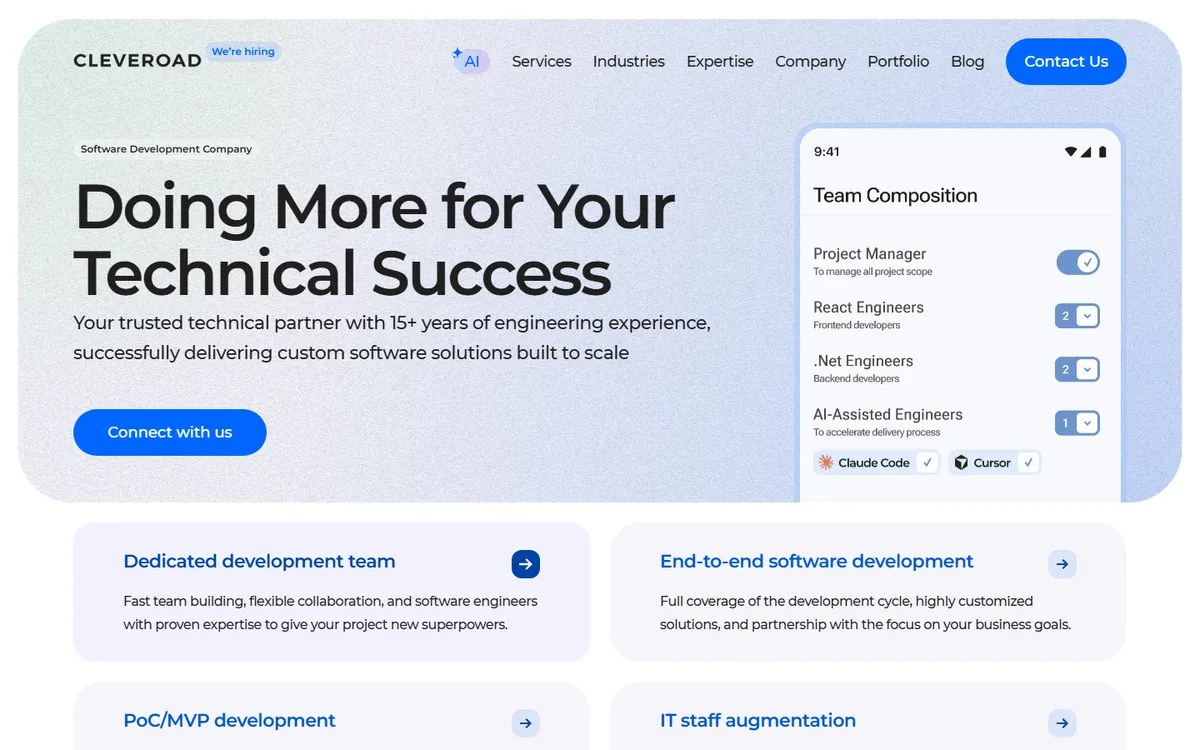
Cleveroad web development company in Australia
Cleveroad engineers deliver Australian web platforms using modern technologies, including React, Angular, and Vue on the front end, alongside Node.js, .NET, Java, and Python on the back end. The team has experience building microservice architectures, headless CMS solutions, and event-driven backend systems for companies in FinTech, healthcare, logistics, and EdTech. Cleveroad also handles API integrations with Australian payment systems, KYC providers, and government services when projects require local infrastructure connectivity. The company holds ISO 9001:2015 and ISO/IEC 27001:2013 certifications for quality management and information security management.
See how Cleveroad's web development services match your idea scope across architecture, integration, and delivery support
Cleveroad has delivered 200+ projects across mobile and web development for clients in healthcare, FinTech, logistics, education, retail, and connected fitness. Clients often highlight the company's engineering quality, transparent communication, multi-region delivery experience, and involvement of senior specialists throughout product development. Сleveroad ranks among Clutch Champion, Clutch Global Top 1000, Clutch Global Leader Fall 2025, and a Clutch Spring Global Honoree 2025.
One of Cleveroad's Australian clients, Row Nation, partnered with the company to build an MVP for a connected-fitness platform that combines indoor rowing machines with gamified mobile and web experiences. Cleveroad provided a dedicated development team responsible for Flutter-based application delivery, Concept2 PM5 monitor integration, and development of the web admin panel used to manage the platform ecosystem.
Watch what Georgia Beattie says about working with Cleveroad:
Georgia Beattie, Director at Australian Rowing Association, on Successful Partnership with Cleveroad
WebKey Digital
- Founded: 2002
- Offices: Brisbane, Australia
- Hourly Rate: $100–$149/hr
- Industry Expertise: Retail, Tourism, Education
- Reviews: 25+ reviews on Clutch, average rating 4.8/5
- Services: Web development, eCommerce, UX/UI design, Digital marketing

WebKey Digital web development company
WebKey Digital is a studio with two decades of trading history and a strong portfolio in retail, tourism, and education websites. The firm combines web development with digital marketing and SEO services, which gives buyers a single supplier for the build and the post-launch organic traffic work. WebKey's project mix sits at the content-driven and eCommerce end of the spectrum, with custom WordPress and Shopify builds making up most recent work. The studio is known for direct client communication and senior-led project teams, with no offshore handoffs in the delivery model. WebKey is a strong fit for Queensland and northern NSW retail brands, tourism operators, and education providers who want a single Australian agency for the website and the digital marketing that follows.
Liquid Interactive
- Founded: 2000
- Offices: Brisbane, Australia
- Hourly Rate: $150–$199/hr
- Industry Expertise: Government, Tourism, Education
- Reviews: 10+ reviews on Clutch, average rating 4.8/5
- Services: Web development, UX/UI design, Digital strategy, CMS implementation

Liquid Interactive web development company
Liquid Interactive has been delivering web platforms for Queensland government, tourism boards, and education providers since 2000, with a portfolio weighted toward CMS-led builds on Sitecore, Drupal, and Kentico. The firm runs structured UX research and discovery phases before development starts, a delivery cadence that suits public-sector buyers procuring against WCAG 2.2 AA accessibility requirements. Liquid's project sizes tend toward the upper-mid market, with multi-year engagements common across state government and tertiary education clients. The team works to government procurement standards and publishes case studies covering DTA Digital Marketplace and Queensland Government Information Technology Contracting work. Liquid Interactive is a strong fit for state government departments, tourism authorities, and universities procuring large CMS builds under accessibility-aligned frameworks.
Convert Digital
- Founded: 2008
- Offices: Melbourne, Australia
- Hourly Rate: $100–$149/hr
- Industry Expertise: Retail, eCommerce, FMCG
- Reviews: 15+ reviews on Clutch, average rating 4.9/5
- Services: Web development, eCommerce, Shopify Plus, Magento
Convert Digital web development company
Convert Digital is an eCommerce specialist focused on Shopify Plus and Magento builds for Australian retail and FMCG brands. The studio has shipped storefronts for several recognisable Australian consumer brands and runs replatform projects for clients migrating off legacy WooCommerce or in-house systems. Convert's delivery model pairs platform engineering with conversion-rate optimisation and post-launch growth work, which fits buyers who want the same supplier for the storefront and the marketing technology stack around it. The team is Shopify Plus certified and runs subscription, B2B wholesale, and multi-storefront configurations on the same platform. Convert Digital is a strong fit for Australian retail brands replatforming to Shopify Plus, FMCG companies launching direct-to-consumer storefronts, and B2B sellers consolidating multiple sales channels.
WorkingMouse
- Founded: 2010
- Offices: Brisbane, Australia
- Hourly Rate: $150–$199/hr
- Industry Expertise: Government, Health, Logistics
- Reviews: 15+ reviews on Clutch, average rating 4.8/5
- Services: Web development, Custom software, Cloud apps
WorkingMouse web development company
WorkingMouse is a custom software firm built on a fully onshore Australian delivery model, with no offshore handoffs anywhere in the pipeline. The firm uses a proprietary low-code platform called Codebots to accelerate web application development for government, health, and logistics clients, with a strong portfolio in state and federal department work. WorkingMouse's project sizes tend toward custom enterprise web applications rather than marketing websites, with discovery-led engagements that often sit in the $200K to $700K range for full builds. The team holds ISO 27001 certification and meets the procurement requirements that bar offshore delivery on certain government contracts. WorkingMouse is a strong fit for state government agencies, federal departments under sovereign-data procurement rules, and regulated industries that need their entire build chain inside Australia.
Polar Seven
- Founded: 2014
- Offices: Sydney, Australia
- Hourly Rate: $150–$199/hr
- Industry Expertise: FinTech, Government, Enterprise
- Reviews: 10+ reviews on Clutch, average rating 5.0/5
- Services: Web development, AWS cloud, DevOps, Integration

Polar Seven web development company
Polar Seven is an AWS Premier Tier services partner specialising in cloud-native web platforms for Sydney's enterprise and FinTech buyers. The firm's portfolio leans heavily on serverless architectures, including Lambda, API Gateway, and DynamoDB, built for clients replatforming monolithic web applications into event-driven systems. Polar Seven runs AWS Well-Architected reviews and FinTech-specific delivery for ASIC-regulated clients, with several published case studies covering banking and superannuation builds. The team is small but senior-loaded, with a delivery rate sitting at the higher end of the Sydney enterprise market. Polar Seven is a strong fit for enterprise buyers rebuilding legacy web stacks on AWS, FinTech companies needing AWS-native integration work, and government clients running cloud-first procurement.
Pixel Force
- Founded: 2007
- Offices: Adelaide, Australia
- Hourly Rate: $100–$149/hr
- Industry Expertise: Government, Health, eCommerce
- Reviews: 15+ reviews on Clutch, average rating 4.9/5
- Services: Web development, Mobile apps, Enterprise software
Pixel Force web development company
Pixel Force is an enterprise software developer with a portfolio weighted toward long-cycle government and health web platforms. The firm has shipped builds for federal agencies, state health services, and South Australian government departments, with engagements that often run multi-year through to post-launch support. Pixel Force's delivery model pairs web development with native iOS and Android development for clients building companion mobile apps off the same backend. The team holds ISO 9001 certification and follows the secure development practices that pass federal procurement security reviews. Pixel Force is a strong fit for South Australian and federal government buyers running long-cycle web platform builds, and health services organizations that need both web and mobile delivery from the same supplier.
Questions to Ask Before Signing With an Australian Web Development Partner
Once your shortlist is down to two or three firms, the next conversation does the rest of the screening work. The questions below pull the answers that separate a serious partner from a generalist agency taking another inbound. Walk through each one before you sign anything binding.
How do you size a project: fixed-bid, time-and-materials, or capped T&M?
A strong answer names the model the firm prefers, explains what triggers a scope or budget change, and walks through one or two recent projects where the model held under change. If the firm defaults to fixed-bid on every brief, ask how they handle scope shifts mid-build.
Who owns the code, design files, and infrastructure after launch?
The right answer is "you do, in full": source code, design files in their native format, cloud accounts, and CI/CD pipelines. Anything less is a renewal lock-in. Confirm the IP transfer clause and the infrastructure handover process before signing the MSA.
Where does the engineering team sit, and which hours overlap with our team?
The answer should name cities and time zones, with a clear standup cadence. Onshore-only delivery models name no offshore partner; blended models name the split and the daily handoff window. "Around the world" answers usually mean the project will run on overnight handoffs, for which the buyer carries the cost.
What does the handover look like at go-live?
A strong answer covers documentation, runbooks, infrastructure access transfer, and a transition period where the firm coaches your in-house team. "We hand over a Git repository" is not a handover. Ask for the handover artifact list from a recent project and check whether it includes operational documentation, not just source code.
How do you handle the Australian Privacy Act and Notifiable Data Breaches obligations during development?
The firm should name the controls (data classification, access logging, encryption at rest and in transit, breach response timelines) and describe how those controls survive into post-launch operations. Vague references to "best practice" without naming specific controls usually mean the firm has not faced a serious privacy review yet.
Do you run penetration testing in-house or contract a third party?
Either model can work. A strong answer says when penetration testing runs in the SDLC, who runs it, and what happens to findings before release. Independent third-party testing has more weight for regulated buyers; in-house testing has cost and turnaround advantages on iterative builds.
What does your senior-to-junior ratio look like on a project of this size?
Buyers want senior engineers carrying the architecture and middle engineers carrying the feature volume. A strong answer names the ratio and explains how it shifts across project phases. A team that's 80% junior at the MVP-build stage will deliver, but the architectural decisions made early will haunt the product later.
If those answers leave you wanting a sanity check on scope and pricing, Cleveroad's discovery phase turns a rough brief into a scoped roadmap with a fixed cost band before the build starts.
If those answers leave you wanting a sanity check on scope and pricing, Cleveroad's discovery phase turns a rough brief into a scoped roadmap with a fixed cost band before the build starts.
If those answers leave you wanting a sanity check on scope and pricing, Cleveroad's discovery phase turns a rough brief into a scoped roadmap with a fixed cost band before the build starts.
If those answers leave you wanting a sanity check on scope and pricing, Cleveroad's discovery phase turns a rough brief into a scoped roadmap with a fixed cost band before the build starts.
Making the Right Choice
The eight firms above clear the screening criteria that matter for Australian web development buyers in 2026: verified Australian presence, demonstrable portfolio depth, public reviews, and engagement-model breadth. The right partner for your project depends on three variables. Where you are in the product lifecycle, what engagement model your procurement allows, and which industry your build serves. A pre-MVP founder will pick differently than an enterprise replatform team or a state government agency.
Talk to two or three of the firms on the list. Hold them to the questions in the previous section and pay attention to which answers are concrete versus rehearsed. The firm you want is the one whose answers land specifically on your build, not on a generic web project pitch.
Talk to two or three of the firms on the list. Hold them to the questions in the previous section and pay attention to which answers are concrete versus rehearsed. The firm you want is the one whose answers land specifically on your build, not on a generic web project pitch.
Talk to two or three of the firms on the list. Hold them to the questions in the previous section and pay attention to which answers are concrete versus rehearsed. The firm you want is the one whose answers land specifically on your build, not on a generic web project pitch.
Talk to two or three of the firms on the list. Hold them to the questions in the previous section and pay attention to which answers are concrete versus rehearsed. The firm you want is the one whose answers land specifically on your build, not on a generic web project pitch.
Partner with Cleveroad on your Australian web build
Build your Australian web platform with a team that combines scalable engineering, transparent delivery, and long-term product support
Australian web development rates span a wide band. Boutique Sydney and Melbourne studios sit at $180 to $260 per hour for senior work. Mid-market Brisbane and Adelaide agencies sit at $120 to $180. Offshore-blended outfits push the floor down to $60 to $90 when delivery runs across the Pacific. A typical custom web application MVP costs between $80K and $300K, depending on scope and engagement model.
An onshore Australian agency runs the entire engineering pipeline inside Australia, with no offshore handoffs and Australian-based engineers on every part of the build. A blended partner pairs an Australian-based product or account team with offshore engineering volume in Manila, Ho Chi Minh City, or Eastern Europe. Onshore agencies cost more but meet sovereign-data procurement rules; blended agencies cost less but require the buyer to accept offshore engineering. Government and regulated work usually goes onshore; commercial builds often run blended.
Most custom web applications in Australia ship in four to seven months for an MVP scope, with full enterprise builds running nine to fourteen months. The biggest variables are integration count, regulatory review cycles, and how clean the requirements are at kickoff. Adding HIPAA-equivalent privacy controls, payment integrations, or multi-region hosting extends timelines.
The client owns the code, design files, and intellectual property in standard Australian web development contracts. Confirm the IP transfer clause in the MSA before signing, and check that the contract covers source code, design assets in their native format, infrastructure accounts, and any third-party licenses procured during the build. At Cleveroad, the client owns the full deliverable at project close.
A fixed-bid contract fits well-scoped MVPs and replatform projects where the scope is locked before kickoff. A dedicated team model fits multi-year product builds where scope shifts and the buyer wants engineering continuity. Staff augmentation fits enterprises with an existing engineering team that needs specific skills for a defined window. For most mid-market Australian web projects, a dedicated team or capped time-and-materials engagement carries the right balance of cost predictability and scope flexibility.

Evgeniy Altynpara is a CTO and member of the Forbes Councils’ community of tech professionals. He is an expert in software development and technological entrepreneurship and has 10+years of experience in digital transformation consulting in Healthcare, FinTech, Supply Chain and Logistics
Give us your impressions about this article
Give us your impressions about this article