Language Learning Platform with Generative AI
A web German-language learning platform MVP providing unique interest-based learning experiences for people moving to DACH countries.
Industry
EdTech
Team
9 specialists
Launched in
2022
Country
Germany
$100K+
funding raised after the investor pitch
600+
users joined the pre-launch waitlist
40%
waitlist conversion after launch
About Our Client
Our client is an early-stage EdTech startup based in Germany, founded by linguistics master’s graduates and certified German-language teachers with 10+ years of experience each. Before launching the platform, they wrote their own teaching materials, delivered German courses to hundreds of learners, and built a network of students, tutors, and partner schools that gave them a trusted base to validate and promote the product. Their first target market was German learners moving to DACH countries who need to function in daily life.
Client's Business Goals
Our customer aimed to create a German-language learning platform that provides personalized interest-based experiences using generative AI. They had a clear product vision and design concepts but no working software. The founders wanted to start with an MVP to prove the concept's value and give them something concrete to show investors, so they could raise funding for later releases. Two constraints shaped every decision: a limited timeline and budget.
They sought an experienced technology partner to:
Design and ship a language-learning web platform with personalized learning experiences powered by generative AI, covering learner and admin roles.
Deliver an MVP version of the solution within a tight timeline and limited budget, while keeping smooth, stable operation as the core quality standard.
Release the marketing landing page early, so the founders could start their marketing campaign before the product was ready.



Cooperation Process and Outcomes
Cleveroad structured the cooperation in clear stages. It began with discovery and planning to define scope and reduce risk, then moved into development, where the concept became a working MVP ready for investor demos and launch.
Planning Stage
The project opened with a Solution Stage that clarified which business needs to cover first and, from that, which specialists the project actually required. A three-week Discovery Phase then translated the vision into an execution plan: the team worked through user workflows, gathered requirements, and prepared the artifacts needed to start development.
There were 3 main stakeholders, the co-founders of the project, who approved all the decisions made during Discovery: CEO, Product Owner, and CMO. Moreover, the CMO owned the user interface designs, and the Cleveroad designer helped him get involved in the process according to the Scrum framework used in our company.
Key Planning Stage deliverables included:
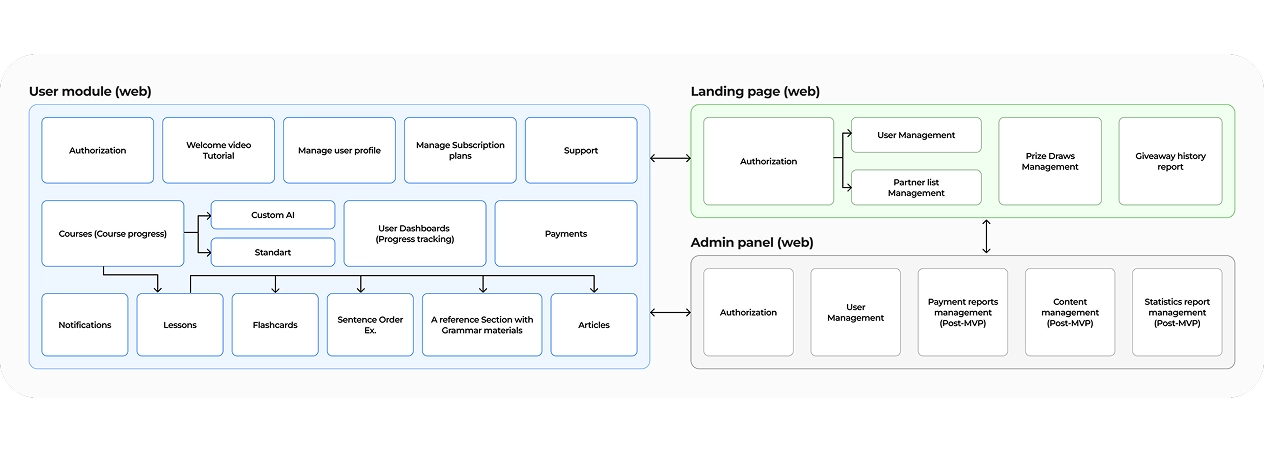
- Mind map and web flow
- Impact map
- UML dialog map diagrams
- Value stream map
- Feature breakdown list (FBL)
- Quality attributes and scenarios
- Software architecture document
- Landing page markup
- Infrastructure deployment diagrams
- Scope estimation based on the FBL


Development in Detail
Development focused on turning the validated concept into a working MVP quickly, without sacrificing stability. On our side, a dedicated team of 9 specialists was involved. During the development stage, all the stakeholders from the customer side were involved in communication according to the Scrum framework.
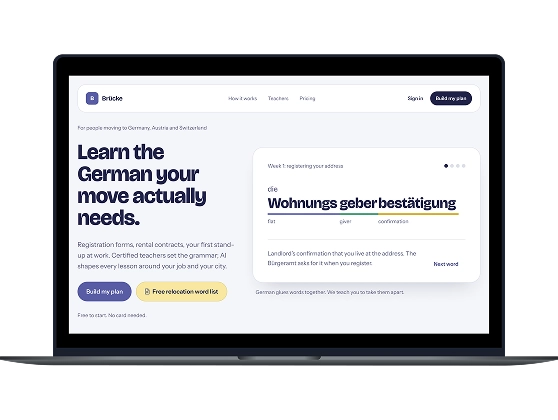
- The marketing landing page came first. The client needed a custom, marketing-ready page before the product existed, so the team delivered it at the start of development with lead magnets and conversion-focused forms. Stakeholders could launch campaigns, capture early demand, and build a waiting list while the platform was still in development.
- Next, the team delivered the MVP product. It included a learner web application and an admin panel, with German as the learning language and an English interface. Learners received standard lessons and custom learning materials tailored to their needs, while administrators could manage content and users and access payment and statistics reports.
- Team capacity stayed flexible throughout development. Specialists worked part-time or full-time depending on the workload at each phase. When more development capacity was needed, working hours increased; when demand dropped, specialists returned to part-time involvement, helping keep the overall development cost reasonable.
Product Essentials
The platform combines a standalone marketing landing page with connected learner and admin modules. The landing page drives acquisition, while the product modules deliver personalized German learning.
Standard and Custom Learning
Standard and Custom Learning
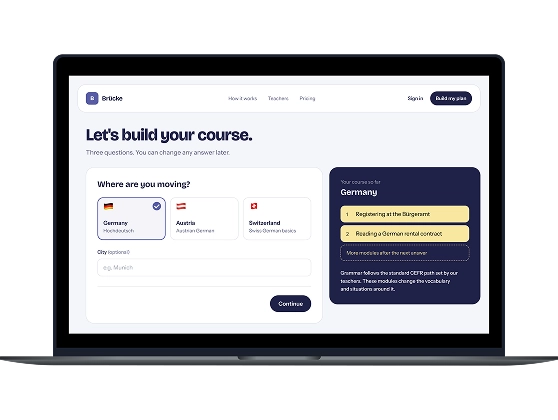
Learners work through a Standard track of general vocabulary useful to anyone, or a Custom track built for them individually.
The Standard track covers the base every learner needs regardless of background, so a new user starts studying immediately without any setup.
The Custom track is what makes the product different. To unlock it, learners complete a short questionnaire about themselves and their occupation, and Generative AI builds a course from those answers, so a logistics manager and a nurse get different vocabulary from day one. Both tracks run in parallel, and the words from each flow into the same personal vocabulary.


Lessons
Lessons
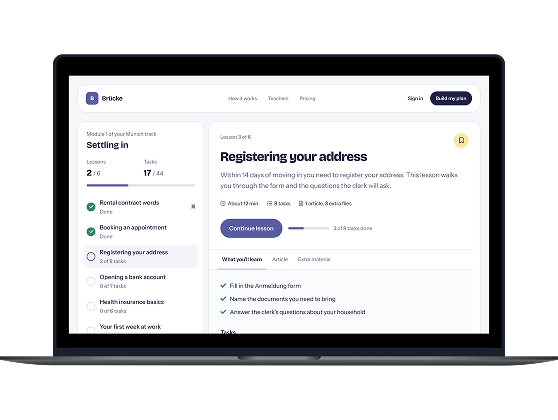
Each lesson opens with a short description so learners know what to expect before enrolling, and the module keeps them oriented once they start:
- Text articles and supplementary material alongside the main lesson content
- Progress across the lesson list, showing completed lessons and tasks out of the total
- Bookmarks for one-click return to any lesson from the sidebar

Practice Tools
Practice Tools
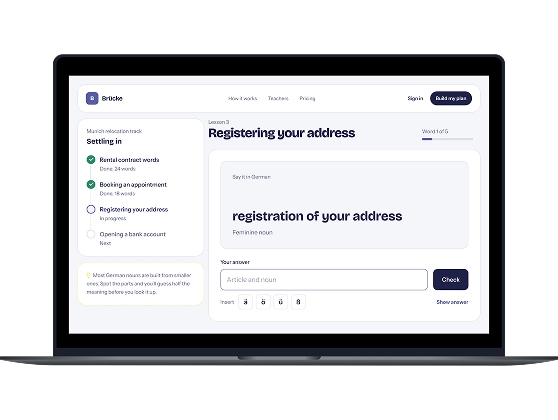
Vocabulary sticks through repetition in different forms, so practice runs on three exercise formats supported by a reference layer:
- Flashcards learners mark as learned or add to favorites
- Word translation tasks with a hint option that supplies the letters of the answer in random order
- Sentence composition exercises
- A grammar reference section in the sidebar for rules learners want to check mid-lesson

Vocabulary
Vocabulary
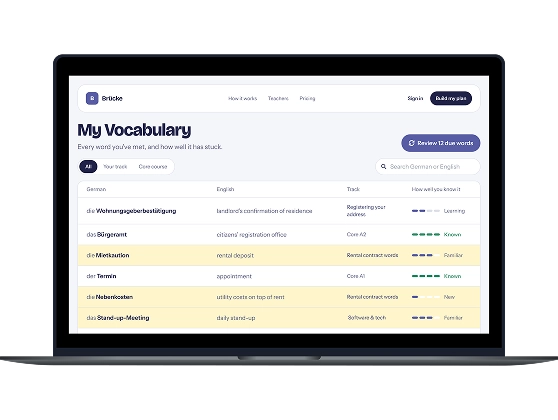
Every learner has an active vocabulary reachable from the sidebar at any point in the app, including mid-lesson. It combines words from both the Standard and Custom tracks, so everything a learner has met lives in one list instead of being scattered across lessons.
Each word has its own learning stage, so progress is tracked word by word rather than only lesson by lesson. A learner who finished a lesson but still struggles with four of its words sees exactly that, and those words keep coming back in practice until the stage advances.
Favorites sit in a separate list. Learners mark a word as favorite during flashcard practice and return to it later from the sidebar without searching through the full vocabulary.

Learner Experience
Learner Experience
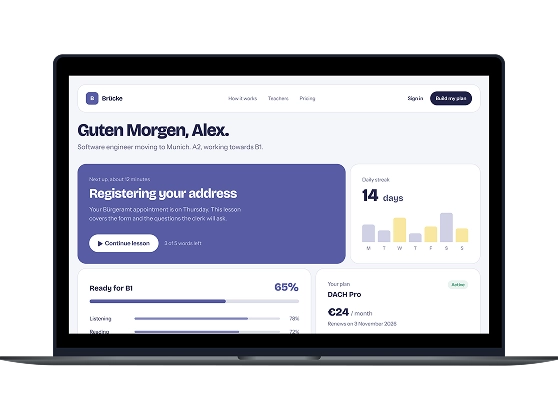
Around the lessons sits the everyday layer that gets a learner into the platform and shows them where they stand:
- Registration and sign-in through email and password, or through Google in a single click
- Profile management for updating personal information
- A progress dashboard reachable from the Home tab

Accessibility
Accessibility
The audience includes people learning a language under pressure of relocation, so the interface was built to stay usable across different needs and setups:
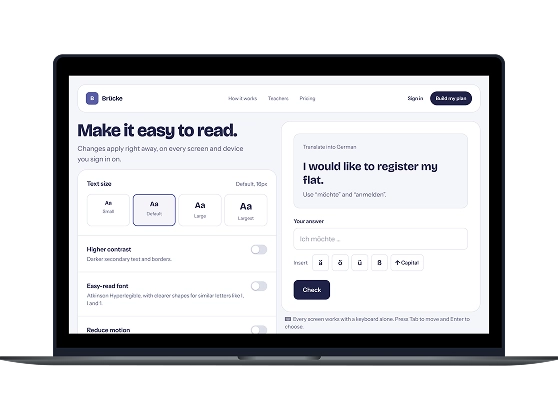
- Design and text styles built to accessibility practices
- Switchable text size to suit individual needs
- Clickable German characters shown on screen during translation tasks, so learners without a German keyboard layout are never blocked from answering

Subscriptions and Payments
Subscriptions and Payments
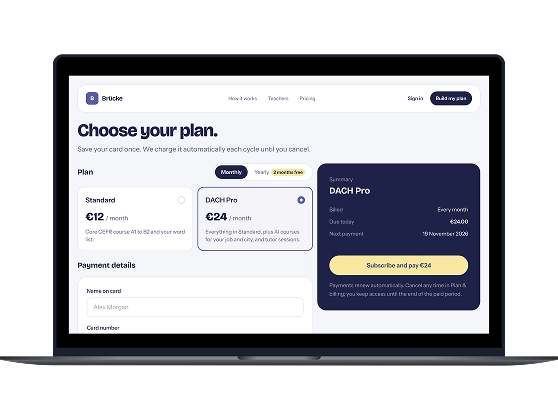
Learners choose a subscription plan and save payment details inside their account, after which payments run automatically on the defined cycle. Plan changes and payment methods are handled by learners themselves from the account page, with no support request and no separate billing portal.
For the client, this meant a working monetization path from day one of the MVP. The product went to market with recurring revenue already in place, so early user growth could be measured against actual subscriptions rather than against sign-ups alone.

Marketing Landing Page
Marketing Landing Page
The landing page serves as the main entry point for learners and brings together the core marketing elements needed to attract, inform, and convert potential users:
- Value proposition and course benefits
- Lead magnets for early engagement
- Contact and waitlist forms
- Trust-building content and social proof
- Conversion-focused CTAs
- Product and learning approach overview

Admin Panel
Admin Panel
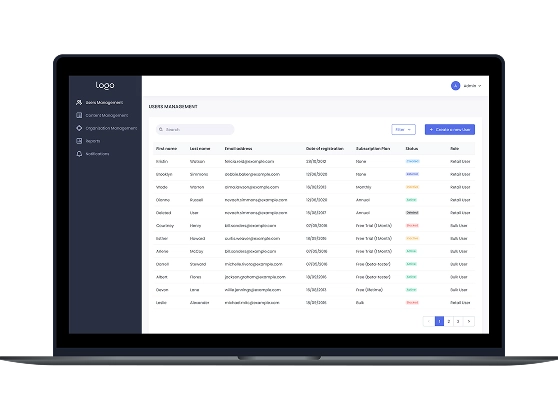
Administrators work through a dedicated web panel built around user oversight. The full user list is the entry point, and each record opens into individual user details, so support questions get answered from one place.
Core capabilities:
- Review the full user list
- Open individual user details
- Manage user accounts, including access state

Technology stack
We used a React and Node.js technology stack on AWS to deliver the learning platform functionality while maintaining stable, scalable cloud operations.
Web Architecture
Frontend
React.js
Backend
Node JS
Amazon Dynamo DB
AWS Infrastructure
Compute & orchestration
Lambda
API Gateway
Step Functions
Event Bridge
Data & delivery
RDS for MySQL
S3
Cloudfront
Cloud watch
External Services
3rd-party integrations
MailChimp
Stripe
Retention Engine
AI & Machine Learning
Generative AI
Amazon Bedrock
Amazon Open Search
Value for Our Client
4 months to launch the market-ready MVP
The team delivered the MVP in four months, 20% faster than initially estimated. Flexible staffing helped adjust team capacity across development phases and reduced overall development costs by 25%.
600+ learners joined the pre-launch waitlist
The landing page went live 8 weeks before the product release, allowing the founders to start marketing while development was still underway. More than 600 users joined the waitlist, with 40% converting after the platform launched.
$100,000+ raised after the investor pitch
The completed MVP gave the founders a working product to present to potential investors. Following the pitch, the company raised more than $100,000 in early-stage funding to support further development.