AI in Application Modernization: How It Works, What It Costs, and Where It Fails
30 Jun 2026
13 Min
137 Views
AI for application modernization helps companies reduce the time required to analyze, refactor, and migrate legacy systems. Engineering teams use AI to accelerate code analysis, documentation, testing, and migration planning while keeping architectural decisions under human control.
Cleveroad has spent 15+ years modernizing legacy systems across healthcare, FinTech, and logistics, pairing AI-assisted engineering with senior architectural review. This guide draws on that work to show where AI saves real time, what it costs, and where it still needs a human in the loop.
Key takeaways:
- AI capabilities can accelerate discovery, code transformation, testing, and migration planning, but architects still make decisions about system design and modernization strategy.
- The biggest time savings usually come from application discovery and code refactoring, where teams spend significant effort analyzing dependencies, documenting legacy logic, and updating outdated code.
- Most modernization failures stem from unclear migration strategies, insufficient modernization expertise, or weak governance, rather than from limitations in AI tooling.
- Cost depends on the modernization scope. A lift-and-shift migration often ranges from $40,000 to $150,000 per application. A full refactor or re-architecture can reach $250,000 to $1,000,000+, while modernization of large application portfolios may exceed $3,000,000.
What Is AI for Application Modernization?
AI for application modernization means using AI systems to analyze legacy application and database code, suggest refactoring, support migration planning, generate tests, and document existing logic, while engineers remain responsible for architectural decisions.
The main challenge of AI in application modernization is that greenfield and brownfield systems require different engineering approaches. In greenfield projects, software development teams build a new system from scratch. They usually work with cleaner architecture, current documentation, and fewer legacy constraints from old code, outdated integrations, and previous architectural decisions. Brownfield modernization is different. Engineering teams must work with existing code, outdated dependencies, hidden business logic, and years of technical decisions that may no longer support current business goals.
AI works best in brownfield modernization when engineers give it a clearly bounded task. It can summarize how a legacy module works, detect duplicate logic, suggest cleanups, generate tests, or prepare migration notes. These tasks save engineering time by reducing manual code reading and repetitive documentation work.
The main limitation of AI in application modernization appears at the system-architecture level. A language model may understand a function, class, or service, but it often misses the full architectural context of the application, including dependencies, data flows, integration logic, and failure paths. It may not know which workflows are business-critical, which integrations cannot fail, or which modernization path creates the lowest risk. That is why AI-powered application modernization works as acceleration, not autonomy. AI helps modernization teams move faster, but architects still decide what to keep, what to replace, what to rebuild, and how to modernize without disrupting the business.
Why Modernize Legacy Systems With AI Now?
Organizations face two connected challenges. Legacy systems consume a large share of engineering capacity, while most companies remain unprepared to deploy AI at scale. McKinsey cites a large financial institution that spent 70% of its IT capacity maintaining legacy systems, and Infosys reports that only 9% of organizations are AI-ready. These findings point to the same challenge: legacy systems limit delivery speed and AI readiness. When engineers spend most of their time maintaining outdated platforms, modernization becomes a prerequisite for AI adoption.
Modernizing has also become more affordable because AI now handles much of the manual work. Generative AI is already delivering in production across industries, from software engineering to supply chain, including generative AI in logistics. Specifically in modernization, McKinsey (2024) reports that generative AI can shorten timelines by 40% to 50% and cut costs by roughly 40% by reducing manual effort across discovery, code analysis, transformation, and migration. That makes modernization programs easier to justify and scale across larger application portfolios.
The payoff shows up in returns, not just lower migration costs. A 2022 Forrester Consulting study commissioned by Microsoft found that organizations modernizing applications on Azure PaaS achieved 228% ROI over three years, with a 15-month payback. The business case gets stronger: modernization improves scalability and frees capacity for new capabilities and future growth.
Ready to modernize with AI? Opt for Cleveroad's application modernization services
How AI Accelerates Each Modernization Phase
AI can accelerate every phase of modernization, from discovery to migration to testing. The biggest time savings usually land in discovery and refactoring, where your team spends the most effort reading legacy code, documenting how the system behaves, and preparing changes.
That is because AI assistants are good at making undocumented legacy code readable quickly. They can explain what a module does, flag repeated logic, suggest refactoring patterns, and generate tests for areas that would otherwise take weeks of manual review.
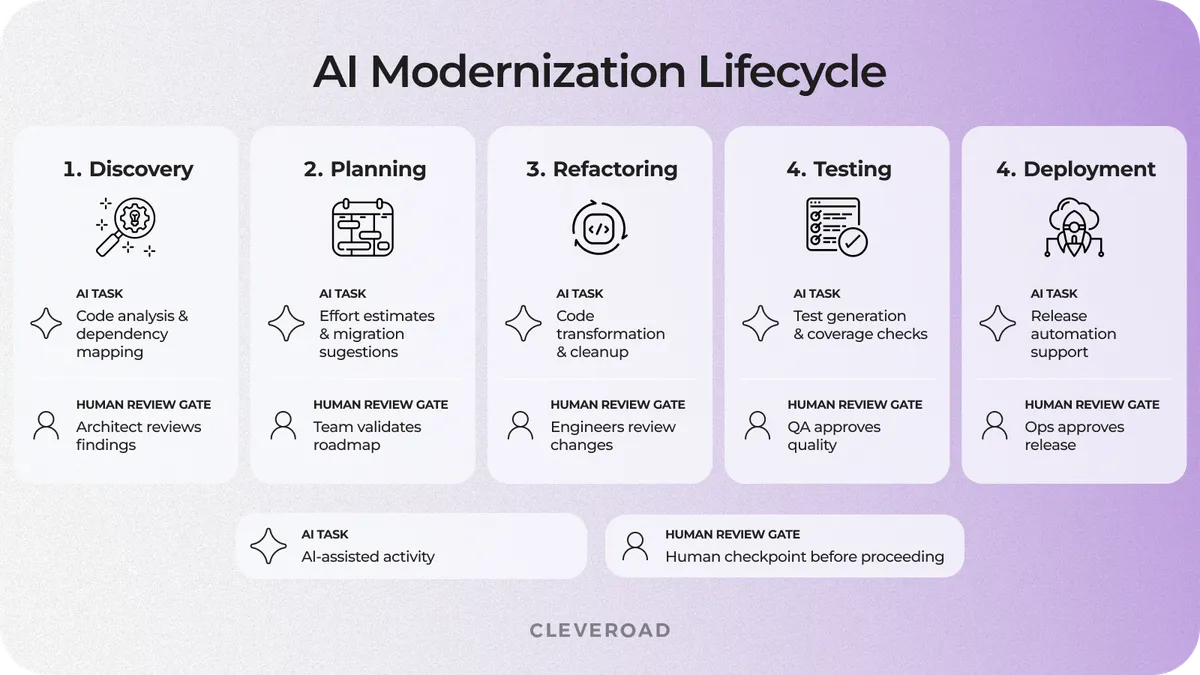
AI modernization lifecycle
Code discovery and dependency analysis
Generative AI in application modernization delivers some of the fastest modernization gains at the start of the project. It can help engineers map hidden dependencies, surface undocumented business logic, and understand how legacy modules interact much faster than manual code review alone.
That makes code audit a practical entry point for AI-driven modernization. Before teams plan a modernization journey, they need a clear view of what the application does, what it depends on, and where the highest-risk bottlenecks sit. If you need this baseline before changing your legacy system, start with a code audit.
Modernization roadmap and planning
Once an agentic AI tool has mapped dependencies, code complexity, and integration risks, it can help teams turn that data into a sequenced modernization roadmap. It can suggest which components can move together and which must follow a strict sequence because of shared services and fragile business-critical integrations. That gives teams a faster starting point for planning, but not a final answer. Architects still set priorities based on business value, delivery risk, budget, and the target architecture.
Automated refactoring and code migration
AI in app modernization accelerates refactoring and code migration by helping teams transform legacy applications into modern, cloud-ready architectures. Common use cases include converting legacy code into modern frameworks, restructuring tightly coupled applications into service-based architectures, and accelerating large-scale platform migrations.
The impact can be substantial. McKinsey reports that AI-powered application modernization can reduce migration effort by up to 40% and increase coding speed by more than 50%, particularly in refactoring-heavy projects where manual rewriting becomes a bottleneck. Organizations planning modernization initiatives can apply similar AI-assisted practices through Cleveroad's AI-assisted development services.
A practical example comes from Cleveroad's work with Proprio Cloud Solutions, a US SaaS company that turned to us to modernize its Orion platform. Our team used AI for several modernization activities, but its most measurable impact came from accelerating development and automating testing. During a 10-month engagement, our AI-assisted team increased development velocity by 35% across sprints and reduced the time to create Playwright test scripts from approximately 1 day to about 2 hours per scenario. These improvements helped maintain delivery speed while modernizing core platform components and expanding functionality across multiple environments.
Learn what Luke Abbott, CTO at Proprio Cloud Solutions, says on the collaboration and modernization results in this video testimonial:
Luke Abbott, CTO at Proprio Cloud Solutions: Feedback on Cleveroad AI-Assisted Development Services
Test generation and documentation
Generative AI app modernization can help stabilize modernization work by generating unit tests and reconstructing missing documentation around legacy. This matters during refactoring because teams must preserve behavioral equivalence between the old and new implementations.
By deriving tests from existing code paths, AI helps teams confirm that refactored components match the original system's expected behavior before deployment. It also fills documentation gaps by explaining code behavior and API workflows that were never properly documented.
This stage is where regression risk gets caught. Without automated test coverage and updated documentation, modernization efforts can introduce silent behavioral changes that surface only after release. AI reduces that risk by turning validation into a continuous layer.
Deployment and security validation
AI-powered app modernization accelerates the final stage of application modernization by generating infrastructure-as-code templates, CI/CD configurations, release checklists, and security review inputs that prepare systems for production. This can pull last-mile engineering work down from weeks to a much tighter release window, especially in cloud-native environments where deployment is complex.
According to IBM research, AI-assisted automation can shorten deployment cycles by speeding up configuration, environment setup, and release orchestration while improving consistency across environments. Still, engineers and security teams must own the security and compliance sign-off. They validate access controls, data protection rules, regulatory requirements, and production release conditions before the system goes live. This balance allows AI to increase delivery speed without weakening governance or introducing unmanaged security risks into production systems.
AI Tools and Platforms for Modernization
The right AI modernization tool depends on what your team needs to control. Some tools help developers move faster inside the codebase. Others help architects understand dependencies, manage risks, and keep modernization aligned with the target architecture.
In practice, organizations often need both layers. Coding assistants can speed up refactoring and code translation, but they do not provide full architectural context. Without that context, faster code changes can still create new technical debt. Architecture-aware platforms, such as vFunction, address this gap by analyzing dependencies and supporting safer modernization planning.
| Tool category | Examples | Best for | Limitation |
|---|---|---|---|
AI assistants coding tools | GitHub Copilot, Cursor, Amazon Q Developer | Speed up app modernization, refactoring, boilerplate, and language translation | No system-wide architectural context |
Architecture-aware platforms | vFunction | Mapping dependencies, refactoring complex monoliths | Specialized, added tooling cost |
Cloud-native AI agents | Azure, AWS, Google Cloud modernization agents | Governance, migration scripts, CI/CD setup | Tied to one cloud ecosystem |
Custom AI accelerators | Partner-built (e.g., Cleveroad) | Domain-specific migration with human review gates | Requires upfront context engineering |
For teams evaluating adjacent automation strategies, RPA for legacy systems is often used alongside modernization efforts to reduce manual load in legacy environments.
How Much Does AI-Driven Modernization Cost?
The cost of an AI-driven application modernization solution depends on the approach, application complexity, and portfolio size. Application modernization using generative AI can reduce execution effort in code analysis, refactoring, test generation, and documentation, but it does not remove the need for architectural discovery, system design, migration planning, and validation.
In most cases, AI shifts spending from manual engineering work to higher-value architecture and risk control, rather than eliminating costs entirely.
| Modernization approach | Typical cost | What drives it |
|---|---|---|
Rehost / lift-and-shift | $40,000-$150,000 per app | Minimal code change, cloud config |
Replatform | $150,000-$400,000 per app | Partial optimization, managed services |
Refactor / re-architecture | $250,000-$1,000,000+ per system | Monolith-to-microservices, deep logic rework |
Enterprise portfolio program | $1,000,000-$3,000,000 | 50+ apps: assessment, migration, optimization |
Ranges reflect typical Cleveroad project estimates by modernization approach; actual cost depends on system complexity, integration count, and compliance scope.
Where AI Falls Short in Modernization
AI improves modernization speed, but it can also accelerate the wrong decisions when teams use it without architectural oversight. An AI tool may suggest a technically valid code change that still conflicts with business logic, integration behavior, or the target architecture.
Without human validation, AI enables optimization of individual components while creating system-level inconsistencies, security gaps, dependency failures, and production risks. That is why architects and senior engineers must review AI-generated outputs before teams apply them to critical modernization workflows.
Architectural blind spots
Architectural context often matters as much as code quality because systems can fail at the interaction level. Research on AI-assisted decision systems in the 2026 Journal of Intelligent Robotics and Remote Systems Studies (JIRRS) shows that automated models often struggle with system-level reasoning across interconnected components, which reinforces the importance of architectural oversight in AI application modernization. A service may look clean and well-tested in isolation, yet still create instability once it starts interacting with the rest of the system.
This is where the integration paradox appears. A team optimizes a single service: response time improves and internal logic becomes easier to maintain. But those changes can shift load patterns, increase database pressure, or alter API call sequences in ways other services were not designed to handle. The result is system-level degradation that no isolated code review would predict.
Architectural blind spots arise when teams treat services as independent units rather than as parts of a connected runtime model. Without visibility into dependency chains, traffic flows, shared bottlenecks, and failure paths, optimization decisions solve local problems while creating distributed ones. Effective architecture work evaluates changes through system behavior, not service performance alone.
Hallucinated or insecurely generated code
Even strong AI for app modernization pilots show measurable accuracy limits. Infosys reported about 85% accuracy in a credit-card modernization pilot, which means a meaningful share of generated outputs still required correction or validation.
This matters because AI can confidently produce code that compiles but fails to match business logic, security rules, API contracts, or integration constraints. In some cases, AI-generated code may also introduce insecure patterns, such as improper authentication flows, weak input validation, unsafe assumptions about dependencies, and incomplete error handling.
For this reason, engineers must review every AI-generated output before applying it to modernization workflows. AI can accelerate delivery, but it cannot guarantee correctness or security without human and architectural validation.
Regulated data and IP constraints
In regulated industries such as healthcare, finance, insurance, and government, you must control how generative AI handles sensitive data and IP. You cannot freely expose production code, patient records, transaction data, proprietary business logic, or internal system documentation to external models without risking compliance violations or data leakage.
These constraints directly shape AI integration tooling choices in modernization workflows. Many organizations limit AI usage to private deployments, anonymized datasets, or on-premise models. They also keep critical systems and sensitive repositories isolated from external APIs.
In practice, AI acts as an assistive layer for pattern recognition, code transformation, and documentation support. It does not get full access to live environments or sensitive repositories.
As a result, modernization projects in regulated environments rely on hybrid setups. AI accelerates low-risk tasks, while engineers retain full control over work involving sensitive data, intellectual property, and production systems.
Not sure where AI fits in your modernization plan? Cleveroad's AI-Assisted Development Workshop can help you assess AI effectiveness for your case and prepare a clear modernization roadmap
The human-in-the-loop requirement
Deciding what to modernize and in what order remains a human judgment call, even in AI-accelerated environments. Infosys highlights that "people are still vital" in modernization programs because strategic decisions require business context, risk awareness, and system-wide understanding that AI cannot fully replicate. This human-in-the-loop layer separates controlled modernization from tool-driven execution. Without it, the work drifts toward whatever is easiest to automate, not what carries the most business value or risk.
With human oversight, you keep control over the direction of modernization: architects and senior engineers decide what to modernize, sequence the work by business risk, and make sure each change supports the target architecture instead of adding new technical debt.
Why Choose Cleveroad for AI Application Modernization
Cleveroad is a software engineering partner with 15+ years of experience modernizing complex legacy systems across healthcare, FinTech, logistics, and other industries, where application landscapes support critical operations and require scalable systems.
We pair AI-assisted modernization with senior architectural oversight to improve delivery speed without compromising system integrity. AI supports code analysis, documentation recovery, and test generation, while senior engineers own architectural consistency and safe release decisions.
By choosing Cleveroad for AI-assisted app modernization, you receive the following benefits:
- AI-assisted engineering for code analysis, refactoring support, documentation recovery, and test generation
- Senior architectural review to keep modernization decisions aligned with the target architecture
- AWS Select Tier Partner status, confirming Cleveroad's expertise in cloud migration and scalable AWS architecture
- ISO 9001 and ISO/IEC 27001 certified processes for quality and security management
- Full-cycle modernization support, from audit and architecture redesign to migration, QA automation, and long-term maintenance
- Flexible cooperation models, including dedicated teams, staff augmentation, and end-to-end delivery
We typically start with a pilot phase to validate modernization scope, measure AI impact, and define the level of human review required before scaling changes across the system. If you are planning a legacy app transformation, consider Cleveroad's legacy software modernization services.
DECODE.ME / Codex Labs case
Codex Labs is a Silicon Valley plant-biotech company founded by Barbara Paldus. The company, which develops microbiome-based skincare and dermatology solutions, needed to launch DECODE.ME, a HIPAA-compliant teledermatology platform for virtual skin consultations.
Before Cleveroad joined the project, previous vendors had failed to deliver a stable demo because of delays and technical issues. Cleveroad became the third engineering partner, ran a full system audit, fixed critical backend problems, and restructured the platform under a tight five-month deadline.
Within five months, Cleveroad assessed the inherited codebase, fixed critical backend issues, and stabilized the DECODE.ME teledermatology platform, and prepared it for a public demo release. The solution enabled patients to complete a health survey, submit skin photos, and receive virtual dermatology consultations via a secure, HIPAA-compliant workflow. We also configured GCP FHIR-based data handling and infrastructure to protect sensitive medical data.
As a result, the demo was ready for the American Academy of Dermatology Innovation Meeting as planned, where the platform attracted interest from dozens of leading dermatologists who later joined DECODE.ME as a platform user.
Barbara Paldus, CEO at Codex Labs, highlights Cleveroad's delivery speed, healthcare expertise, and strong communication in her video testimonial:
Dr. Barbara Paldus, CEO at Codex Labs: Feedback on Cleveroad's Telemedicine Development Services
Modernize your legacy software with Cleveroad
Cleveroad's architects and AI engineers are ready to identify the most efficient way to modernize your system using AI and rapidly enhance your software without disrupting core operations
Generative AI supports modernization by accelerating code understanding, refactoring, testing, and documentation recovery. It reduces manual effort in legacy analysis but still requires engineers to validate architecture and production changes.
Use generative AI as an assistive layer inside the modernization workflow:
- Analyze legacy code and dependencies
- Generate refactoring suggestions
- Create unit and regression tests
- Recover missing documentation
- Support migration planning
Engineers review AI-generated outputs before implementation and retain control over architectural decisions.
Healthcare, FinTech, insurance, logistics, and enterprise SaaS benefit the most. These industries rely on legacy systems with high compliance requirements, where AI helps reduce modernization time while maintaining strict security and regulatory control.
AI-driven modernization introduces several risks:
- Limited system-wide architectural context
- Inconsistent or incorrect code generation
- Hidden business logic in legacy systems
- Compliance and data security restrictions
Because of these risks, organizations typically combine AI-assisted workflows with architectural review, security validation, best practices, and controlled deployment processes.

Evgeniy Altynpara is a CTO and member of the Forbes Councils’ community of tech professionals. He is an expert in software development and technological entrepreneurship and has 10+years of experience in digital transformation consulting in Healthcare, FinTech, Supply Chain and Logistics
Give us your impressions about this article
Give us your impressions about this article