How to Choose a Software Development Company and Succeed
Updated 13 Feb 2026
12 Min
3162 Views
How to choose a software development company? This is a question you've probably asked yourself when planning to build a digital solution for your business or modernize legacy software. Choosing the best software development company is a critical decision that directly affects your product’s quality and success.
To help you with vendor selection, we’ve created this comprehensive guide, where you will learn:
- What criteria actually matter when choosing a software development company
- How to reduce delivery and budget risks
- What to check before signing a contract
- Why vendor choice affects long-term product success
These recommendations are based on interviews with business consultants and insights from Cleveroad clients who have gone through vendor selection. Keep on reading to learn more details.
How to Choose a Software Development Company?
Choosing a software development company is not about browsing ratings. It is a structured process that reduces risk and helps you find a long-term technology partner. Below is a practical step-by-step approach you can follow.
1. Define your project goals
Start with clarity. You can choose an ideal software development company for your needs only by clearly defining your project's development tasks and requirements. You should clarify business objectives, target users, core functionality, budget range, and timeline expectations.
Clear goals help you filter out vendors that do not align with your project scope or business priorities. For example, if your goal is to validate a startup idea, you may need a Minimum Viable Product (MVP) with only core features. If you plan to modernize an internal enterprise system, scalability and integration capabilities will matter more than speed alone.
2. Find potential candidates
If you are unsure how to find a software development company, one of the best ways is to look for ones with a proven track record, evidenced by verified customer reviews. At this stage, your goal is to create a long list of possible partners.
To find trusted software development companies, you can:
- Search on Clutch, GoodFirms, and similar B2B directories
- Review company blogs and case studies
- Ask for referrals from your network
- Check LinkedIn presence and team expertise
Focus on companies that clearly describe their development process and their technical stack. A reliable vendor does not hide behind generic claims. They show real projects and measurable results. This step is especially important if you are evaluating how to choose a software outsourcing company for nearshore or offshore software development
3. Shortlist companies based on relevant delivery experience
Once initial research is complete, narrow your list to a small group of companies that align with your technical and domain requirements. When evaluating a software development company, review their portfolio to understand both delivery capability and management maturity. Focus on similar project types, relevant industry expertise, matching technology stack, and demonstrated product outcomes.
Research published in IEEE confirms that structured vendor assessment based on technical competence and comparable project experience improves delivery predictability. In practical terms, the closer a vendor’s past projects are to your current challenge, the higher the likelihood of meeting timelines and budget expectations.
For example:
- If you want to build a mobile app, choose vendors with strong experience in iOS and Android development.
- If you plan to build a healthcare platform, look for companies with experience in HIPAA or GDPR compliance.
- If you need a SaaS product, prioritize vendors with expertise in cloud-native, scalable architecture.
Do not evaluate companies only by size or brand visibility. Evaluate them by delivery relevance. The closer their previous work is to your project goals, the lower your execution risk.
Below, we will explain in more detail what criteria define a reliable software development vendor.
4. Speak to them to assess expertise and dedication
Portfolio validation is only the first filter. Direct communication reveals whether a vendor can take responsibility for your product long term. Schedule discovery calls with shortlisted companies. Discuss your goals and expectations. Many professional vendors, with experienced project managers and skilled developers, offer a Discovery phase to clarify scope changes and align on the payment schedule. This stage helps you evaluate technical competence, business understanding, transparency in estimation, and responsiveness and communication style.
One of our clients followed this exact approach. Before choosing Cleveroad, the CEO of Betabox initiated Discovery discussions with several vendors. During these sessions, he compared how deeply each team understood his product idea, how structured their questions were, and how clearly they outlined risks and timelines. Based on that practical comparison, he selected our team as the most committed and prepared partner.
See what Sean Newman Maroni, CEO at Betabox, says about collaboration with Cleveroad in the video feedback below.
Sean Newman Maroni, CEO at Betabox: Feedback on Cleveroad's EdTech Development Services
Key Criteria for Choosing the Right Software Development Company
To choose the best custom software development company, you need clear evaluation criteria that will help you compare vendors objectively and reduce long-term risks.
We’ve compiled a list of key factors to consider when evaluating potential technical partners.
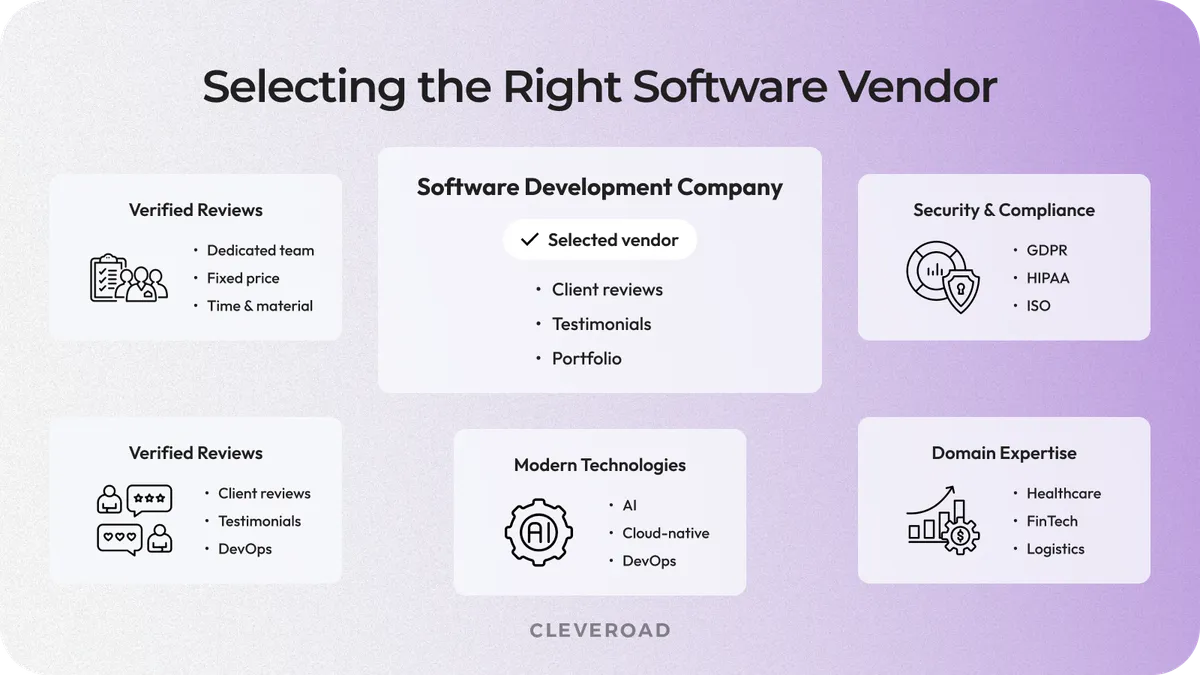
Selecting the Right Software Vendor
Cooperation models diversity
Tenured vendors typically provide several cooperation models. When you choose the best software development company, make sure you can work according to a model that suits you. For example, we at Cleveroad offer such cooperation models:
- IT staff augmentation: staff augmentation services involve temporarily provisioning specialists to augment your existing team to perform specific tasks. This model is also perfect when you don't need a full team, and allows easy scalability as your needs change. The vendor provides the necessary skills, while oversight and management remain in your hands.
- Dedicated development team: Dedicated development team services imply assembling a separate team to work exclusively on your project in this model. This provides greater flexibility and control over the process on your end.
- Project-Based (Fixed and Time & Material): The model is based on executing a specific project with a fixed budget (fixed) or paying for actual time spent (time & material). The former involves setting the project's price, and the latter involves paying for each hour of work.
Reliable approach to security
Ensuring data security is critical. Choosing the right software development company means clarifying which security measures the vendor has in place to protect your sensitive information. This may include encryption, application security practices, and data processing. There's never too much security, especially when handling sensitive information such as users' payment information or personal data.
A reliable IT vendor sets an official security policy to monitor all operations with the help of the following security handling instruments:
- Non-Disclosure Agreement (NDA) can be signed per your demand to protect the uniqueness of your app concept, and your company's confidential data
- Access to data for developers working on your project. They don't need access to the entire database; if you prefer, you can share an anonymized copy.
- Secure Socket Layer (SSL) certificates can be used to verify the identity of contracted developers you work with.
Cleveroad has successfully obtained ISO 27001:2013 certification, ensuring the secure management of information in our projects.
Verified client reviews
Independent customer reviews and testimonials provide insight into a potential software development partner’s ability to deliver a successful project.
Use B2B directories such as Clutch to evaluate vendors. Clutch verifies reviews through direct interviews with clients. This means feedback comes from real decision-makers who worked with the vendor. You can analyze project scope, budget range, client satisfaction, communication quality, and delivery timelines.
Explore our Clutch profile, where you will find 75+ verified client reviews describing real projects and outcomes
In addition to professional platforms, use Google search to check media mentions, industry publications, public case studies, and thought leadership contributions. This broader view helps you confirm the company’s credibility and market presence.
Referrals are equally important. Recommendations from trusted peers reduce uncertainty and speed up decision-making.
Many of our clients discovered Cleveroad through professional referrals. For example, Hans Jørgen Skovgaard, CTO at Penneo, was introduced to Cleveroad through a recommendation from a former colleague who had previously collaborated with our team and had a positive experience.
You can learn how Hans Jørgen Skovgaard, CTO at Penneo, assessed collaboration with Cleveroad in his video-review:
Hans Jørgen Skovgaard, CTO at Penneo: Feedback on Cleveroad's Cloud Infrastructure Services
Expertise in modern technologies
Technology evolves fast. A development partner must evolve with it. Expertise in emerging technologies indicates that the team actively develops its competencies. This directly affects the quality and scalability of the solutions they deliver.
To select the top software development company, you should find out whether the company deepens expertise in:
- Artificial intelligence and generative AI solution development for automation and decision support
- Machine learning model design and production-grade ML operations
- Cloud-native architecture built on microservices and managed cloud services
- DevOps automation with CI/CD pipelines and automated testing frameworks
- Advanced data analytics and business intelligence platforms for real-time reporting and forecasting
Explore our AI development services page to see how we help businesses implement practical, production-ready AI solutions
Experience in your business domain
A company with industry-specific experience understands business processes, compliance requirements, and integration complexity within that sector. For example, healthcare software development projects require compliance with HIPAA and strict data protection standards. Fintech products demand secure payment integrations and regulatory alignment. Logistics platforms require a deep understanding of operational flows and real-time data processing.
You can evaluate a vendor's tech expertise across industries by reviewing their portfolio and looking for case studies across specific sectors. At Cleveroad, we work with clients in Healthcare, FinTech, Logistics, Education, Retail, and other industries, applying domain-specific best practices to each project. You can review our recent projects in our portfolio.
How to Reduce Risks Before Signing a Contract?
Remember that selecting the right software development company is critical to your project's long-term success. Before you sign a contract with the chosen company, make sure they meet several critical requirements.
Transparent cost estimates to reduce overbudgeting
Budget overruns usually happen when estimates are made once and remain approximate. A single rough estimate at the beginning of the project cannot account for hidden complexities or changing requirements. As development progresses, the gap between assumptions and reality increases financial pressure. However, a phased estimation approach reduces these risks.
For example, at Cleveroad, we provide several estimation stages:
Solution workshop rough estimate. This is a high-level estimate prepared after an initial solution workshop. It is based on business goals and comparable project benchmarks. Accuracy is limited because the technical architecture and edge cases have not yet been validated, but it still helps define budget ranges and assess investment feasibility.
Discovery phase rough estimate. This estimate is created during the Discovery phase once requirements are structured and user flows are defined. It is significantly more accurate because the team analyzes system architecture and constraints. It allows stakeholders to reassess priorities before entering full-scale development.
Detailed estimate. The detailed estimate is prepared after Discovery validation, when technical specifications and backlog items are finalized. It provides the highest level of cost precision because it is grounded in documented scope and engineering calculations. At this stage, financial risks are minimized, and execution planning becomes predictable.
Clear delivery ownership to prevent delays
Unclear responsibility slows decision-making and affects timelines. When it is not obvious who approves scope changes or who communicates risks, projects lose momentum. Small issues escalate into schedule delays. A defined management structure prevents this.
At Cleveroad, projects are coordinated through a dedicated Project Management Office. The PMO oversees execution control and communication consistency. This centralized oversight keeps stakeholders aligned and ensures accountability at every stage.
Flexible team scaling to control costs
Another hidden risk is overpaying for a fixed team size that does not match the actual workload. Some project phases require more developers. Others demand fewer resources. If the contract locks you into a rigid structure, you pay for capacity you do not use.
At Cleveroad, the team scales according to the current project needs. You can increase capacity during intensive development phases and reduce it during stabilization or support stages. This approach prevents payment for idle resources and keeps spending aligned with progress.
Defined communication cadence to avoid surprises
Irregular communication creates blind spots. Research published by ACM on coordination in distributed software teams shows that insufficient communication structures significantly increase the likelihood of delivery delays and project failure. Without a structured reporting rhythm, issues surface too late. Misunderstandings accumulate. Stakeholders lose visibility into progress.
At Cleveroad, projects follow a two-week sprint cycle with regular reporting sessions. Clients receive structured updates and have access to a dedicated Slack channel for direct communication.
Consistent interaction ensures transparency and early risk detection. When you choose software company partners based on governance and transparency, long-term product success becomes predictable rather than accidental.
| Risk area | Red flag | Safe indicator |
|---|---|---|
Estimation | One rough quote without breakdown | Phased estimation with documented assumptions |
Scope management | Undefined deliverables | Clearly defined scope and documented changes in scope |
Ownership | No dedicated project manager | Dedicated PMO or responsible delivery lead |
Communication | Irregular updates and no reporting cadence | Sprint-based reporting with structured updates |
Team scaling | Fixed team size regardless of workload | Flexible scaling based on project phase |
Why Choose Cleveroad As Your Trustworthy Software Development Partner
Cleveroad is a software development company with R&D centers in Estonia, Poland, and Ukraine, and representative offices in the US and Norway. Since 2011, we've been helping startups and small, medium, and large-scale businesses automate processes, increase client engagement, and improve efficiency with robust software solutions.
Our team has experience in software development across industries such as Healthcare, FinTech, Logistics, Education, Retail, and Travel. The Cleveroad team has expertise in modern and emerging technologies, including cloud development, blockchain, smart contracts, Artificial Intelligence (AI), Machine Learning (ML), and the Internet of Things (IoT).
We have 280+ in-house software engineers on board, 64% of whom are senior and middle level experts. Since 2023, Cleveroad team has completed certifications for two international standards: ISO 9001:2015 (quality management) and ISO/IEC 27001:2013 (information security management). Additionally, we have achieved the status of Amazon Web Services (AWS) Select Tier Partner within the AWS Partner Network (APN).
We guarantee our clients transparency in projects and effective communication, ensuring openness and understanding of each stage of development. For this purpose, we stay in constant contact with the client, respond promptly to changes in the project, and hold scheduled meetings with the client to discuss the project's progress.
For the convenience of our clients, we offer flexible cooperation models depending on your needs:
- Staff Augmentation
- Dedicated Team
- Project-Based model
Hire a reliable software development vendor
Cleveroad’s experts are ready to provide you with high-quality software development services according to your business needs
Selecting a software development company requires a structured evaluation process that minimizes delivery risks and clarifies expectations from the start.
- Define clear business goals and project scope before contacting vendors.
- Review portfolio cases that closely match your industry and complexity level.
- Assess technical expertise and hands-on experience with relevant technologies.
- Verify client reviews on trusted B2B platforms such as Clutch or GoodFirms.
- Initiate a Discovery phase to validate architecture and delivery approach before signing a long-term contract.
The right software development company is the one that aligns with your strategic objectives and operational model, not just your feature list.
- Proven delivery experience in projects similar to yours
- Transparent estimation and clear cost breakdown
- Defined governance model and accountable project ownership
- Flexible cooperation formats, such as dedicated teams or time and material
- Structured communication practices with regular reporting cadence
The best software development company is not necessarily the biggest brand or the lowest bidder. It is the vendor that demonstrates process maturity and measurable accountability. You should evaluate, from the first call, how clearly the company structures project governance, how it manages risks, and how transparent its communication model is. Verified client testimonials and detailed case studies often reveal more about real performance than marketing claims. Strong security standards and experience with modern technologies such as AI solutions and cloud-native architectures indicate long-term scalability potential. A well-organized Discovery phase typically confirms whether the team understands your business model and can translate requirements into a viable technical strategy.
To reduce execution risks and avoid costly mistakes, apply practical validation steps before committing to a long-term partnership.
- Avoid accepting rough, high-level cost estimates without documented assumptions
- Review comparable project cases with measurable outcomes
- Speak directly with the proposed delivery team, not only sales representatives
- Validate governance structure and escalation processes
- Confirm compliance standards and security practices
- Start with a smaller pilot or Discovery engagement before scaling the contract

Evgeniy Altynpara is a CTO and member of the Forbes Councils’ community of tech professionals. He is an expert in software development and technological entrepreneurship and has 10+years of experience in digital transformation consulting in Healthcare, FinTech, Supply Chain and Logistics
Give us your impressions about this article
Give us your impressions about this article