COBOL to Java Migration: Approaches, Costs, and How to De-Risk It
17 Jul 2026
14 Min
120 Views
COBOL to Java migration requires you to preserve decades of business logic while changing the technical foundation around a critical system. For banks, insurers, and government organizations, the safest path is rarely a single automated rewrite. A successful program combines detailed code analysis with staged implementation. It also establishes functional-equivalence testing before the first production cutover.
At Cleveroad, we apply 15+ years of software engineering experience to evaluate legacy dependencies, production workloads, and the business rules that must remain unchanged after migration. This discovery-first approach helps us define a realistic scope before recommending a full migration budget. Keep reading to compare the main migration approaches, understand where project budgets go, and learn how to reduce the technical risks of moving a regulated core from COBOL to Java.
Key takeaways:
- Four migration paths dominate. Automated code conversion and AI-assisted modernization focus on transforming the application. Incremental refactoring and API enablement provide more gradual alternatives.
- A pilot or discovery engagement can range from $50,000 to $1 million. A mid-sized system may require $2 million to $5 million over 12 to 24 months. A large enterprise app often starts at $4 million and can run for two to four years.
- Based on Cleveroad's experience, AI-assisted programs may automate 70% to 85% of translation and shorten suitable modernization timelines by 40% to 60%.
Why Companies Migrate COBOL to Java
You migrate COBOL to Java because the specialist talent pool is shrinking while COBOL applications still support core operations. Java provides access to a broader hiring market and more flexible cloud deployment options.
The migration also makes it easier to connect legacy business logic with modern customer applications. However, the main board-level driver is often operational continuity rather than technology preference. COBOL still runs an estimated 220 billion lines of code and supports roughly $3 trillion in daily commercial transactions, according to IBM, so the pressure to replace it usually comes from staffing, not from the technology itself.
Deloitte’s Mainframe Market Pulse found that 79% of respondents viewed acquiring the right talent as their leading mainframe challenge. Another 71% said their teams were understaffed.
A technically stable system can therefore become an operational risk when only a small group of employees understands how it behaves. The longer you delay the migration, the more business knowledge becomes concentrated among specialists approaching retirement.
The shrinking COBOL talent pool
Recruitment markets usually contain far more Java engineers than COBOL specialists. Some organizations use a planning assumption that Java developers are 10 to 15 times more available, although the actual ratio depends on location and seniority.
The strategic effect is still clear. Each retirement can increase your maintenance costs when important business rules remain undocumented. If only one or two of your engineers understand unusual transaction scenarios, you carry key-person risk even when the application itself remains stable.
That pressure is why many teams move COBOL to Java before a staffing shortage forces an uncontrolled decision. Converting COBOL to Java earlier gives you time to document knowledge and validate the new architecture before migration becomes urgent.
Licensing cost and cloud agility
Moving suitable workloads away from a mainframe can reduce licensing and infrastructure expenses. The AWS Transform launch guide states that customers report operating-cost reductions of up to 70% after leaving costly legacy licenses. Results depend on workload utilization and the target architecture. In an AWS case study involving Meliá Hotels International, the organization reported a 60% reduction in compute costs after migration. Java also provides a clearer route to cloud-native scaling. Your product teams can release changes without relying on the same specialized mainframe workflow that previously constrained delivery.
When weighing modernization against the status quo, budget owners should also assess whether a technology partner can support business-critical infrastructure. In our DevOps staff augmentation case for Penneo, two Cleveroad senior DevOps engineers quickly joined the internal platform team and helped simplify AWS infrastructure management, keeping the platform stable as the customer base grew.
Penneo was satisfied with their performance and planned to continue the cooperation and expand the team. Here is what Hans J. Skovgaard says about working with Cleveroad:
Hans J. Skovgaard, Penneo: Video testimonial on working with Cleveroad
How to Convert COBOL to Java: Migration Approaches Compared
There is no universally correct way to convert COBOL to Java. The decision depends on codebase size and the acceptable level of operational risk. Documentation quality is another major factor. When business rules exist only in source code or operator knowledge, direct conversion becomes more difficult to validate.
A COBOL to Java converter can accelerate syntax translation, but the generated output does not define a safe migration by itself. You must first decide whether you want to replace the mainframe completely or gradually reduce your dependence on it.
Some businesses need a full COBOL to Java conversion solution. Others should expose stable functions through APIs while preparing a longer modernization roadmap. The table below compares the four dominant approaches by how they work, where they fit, and the main risk each carries.
| Approach | How it works | Best for | Main risk |
|---|---|---|---|
Automated code conversion | COBOL to Java migration tools translate the source into Java | Large and stable codebases | JOBOL, meaning Java that still reads like COBOL |
AI-assisted modernization | Large Language Models (LLMs) or agents analyze the application before generating Java | Poorly documented business logic | Silent logic errors without expert review |
Incremental refactoring | Teams convert bounded modules while the remaining system stays on the mainframe | Risk-averse mission-critical cores | A longer overall timeline |
API enablement | Teams wrap stable COBOL functions in Representational State Transfer (REST) APIs | Extending the system’s life rather than replacing it | The COBOL dependency remains |
- Automated COBOL to Java migration tools work best when the source is stable. Existing tests must also capture the behavior that the translated application needs to preserve.
- AI-assisted COBOL to Java transformation is more useful when code analysis creates the main bottleneck. It can help your engineers understand unfamiliar modules, but its output requires strong review controls.
- API enablement can be the right solution when immediate replacement is not economically justified. It improves access to legacy functions without removing the underlying dependency.
Do not evaluate a tool by asking only whether it can translate COBOL to Java. First determine whether the resulting application preserves transaction behavior. Then assess whether regular Java engineers can maintain it. A Java to COBOL conversion demonstration does not provide equivalent evidence. Reverse translation cannot prove that the forward conversion will preserve production behavior.
Why COBOL to Java refactoring lowers risk
Incremental refactoring converts one bounded module at a time while the rest of the core remains operational. You can compare outputs under production-like conditions before moving to the next migration wave.
This COBOL to Java migration approach creates a clear rollback boundary. When a migrated module produces unexpected results, traffic can be routed back to the original implementation while the team investigates the discrepancy.
Incremental delivery also lets you improve your process between modules. Findings from the first conversion can influence estimates and test planning for the next one. For regulated cores, phased application modernization is usually safer than a big-bang cutover. Each migrated capability can be validated before the old path is retired.
When AI-assisted COBOL to Java conversion earns its place
AI earns its place when it shortens the time required for code understanding and dependency analysis. It should not be treated as an autonomous production author.
When your teams use AI to transform COBOL to Java, every critical module still needs an approved behavioral baseline. Generated Java should remain a draft until senior engineers compare it with the original implementation.
The potential time reduction can be substantial. AWS reports that Itaú reduced discovery time by 96% and accelerated migration speed by 75% during its modernization work. These results demonstrate what is possible, but they do not define a universal baseline. You must prove the expected gains on your own applications.
For early planning, a target of 70% to 85% automated translation may be reasonable for a suitable codebase. The exact proportion should be established through a representative pilot. The remaining code is the hard part: it often contains unusual control flow or deeply embedded business rules, and this is where silent errors are most likely to survive a superficial review.
A 2025 arXiv semantic-equivalence study explains that generated Java cannot be trusted to reproduce the original COBOL correctly without validation. The researchers created a framework to compare the semantic behavior of the two implementations.
Use the Cleveroad AI Strategy Advisor to pressure-test whether AI-assisted conversion fits your codebase before committing the migration budget.
COBOL to Java Migration Cost, Timeline, and Where Budgets Actually Go
A practical COBOL to Java migration cost model starts with the scope. Estimates depend on system condition rather than language alone. A smaller application with undocumented behavior can be harder to migrate than a larger codebase with reliable tests.
On the savings side, a 60% to 75% cost reduction for AI-assisted work should be treated as an upside scenario rather than a default forecast. McKinsey reports a 40% reduction in technology debt costs when generative AI is applied effectively.
Cost by codebase scope
The table below maps typical cost and timeline ranges to codebase size, from a single-module pilot to a full enterprise estate.
| Scope | Codebase size | Typical cost | Timeline |
|---|---|---|---|
Pilot or discovery | A single module or technical assessment | $50K to $1M | 1 to 3 months |
Mid-sized system | 100K to 1M lines | $2M to $5M | 12 to 24 months |
Large enterprise | More than 1M lines | $4M+ | 2 to 4 years |
Ranges are Cleveroad preliminary scoping estimates based on codebase assessments and representative pilots, not published market prices. Actual cost depends on documentation quality, regulatory validation, and mainframe dependencies.
Lines of code influence the estimate, but they rarely explain the full spread. Undocumented business logic can have a larger effect because engineers must reconstruct the intended behavior before converting COBOL to Java.
Regulatory validation adds another cost layer. A system that processes financial records needs stronger evidence before the new implementation can replace the original.
Mainframe dependencies also affect scope. Job Control Language schedules may control processing outside the application code. Copybooks can define data relationships shared by many programs.
At Cleveroad, we begin with discovery before quoting a full COBOL to Java conversion solution. Our team inventories the application and maps its most important dependencies. We then select a representative pilot and define equivalence criteria. The full estimate is built from observed complexity rather than an assumed price per line.
Testing is the hidden budget line
Testing can consume 30% to 40% of the budget in a regulated migration. This is a planning range that should be adjusted after discovery. The time commitment can be even more significant. A 2025 AWS post on mainframe testing automation states that testing typically consumes more than 50% of a mainframe modernization project’s duration.
The reason is functional equivalence. A new application cannot be approved because it compiles or passes ordinary unit tests. You must prove that the Java implementation produces the same business outcomes as the COBOL system, across both normal transactions and unusual production scenarios.
Before committing to the full program, assess the codebase first. The audit should establish transaction baselines and expected batch results. It should also record error behavior and performance under production-like load. These baselines become the reference point for each migrated module.
The Technical Traps That Derail Automated COBOL to Java Conversion
Most failed migrations do not fail because a tool cannot produce Java syntax. They fail because the translated code behaves differently from the original system.
These behavioral gaps take a few recurring forms: numeric results that no longer match, copybook relationships that break during transformation, and output that becomes JOBOL — Java that preserves COBOL structure without becoming maintainable. Each is covered below. Testing is what exposes them, and a 2018 arXiv study, still widely cited, describes testing as the most difficult and underestimated part of a large automated conversion.
In that study, unexpected testing obstacles caused major delays even though the application eventually reached production. Newer research reaches a similar conclusion: automated transformation can produce useful output, but functional equivalence still requires deliberate validation.
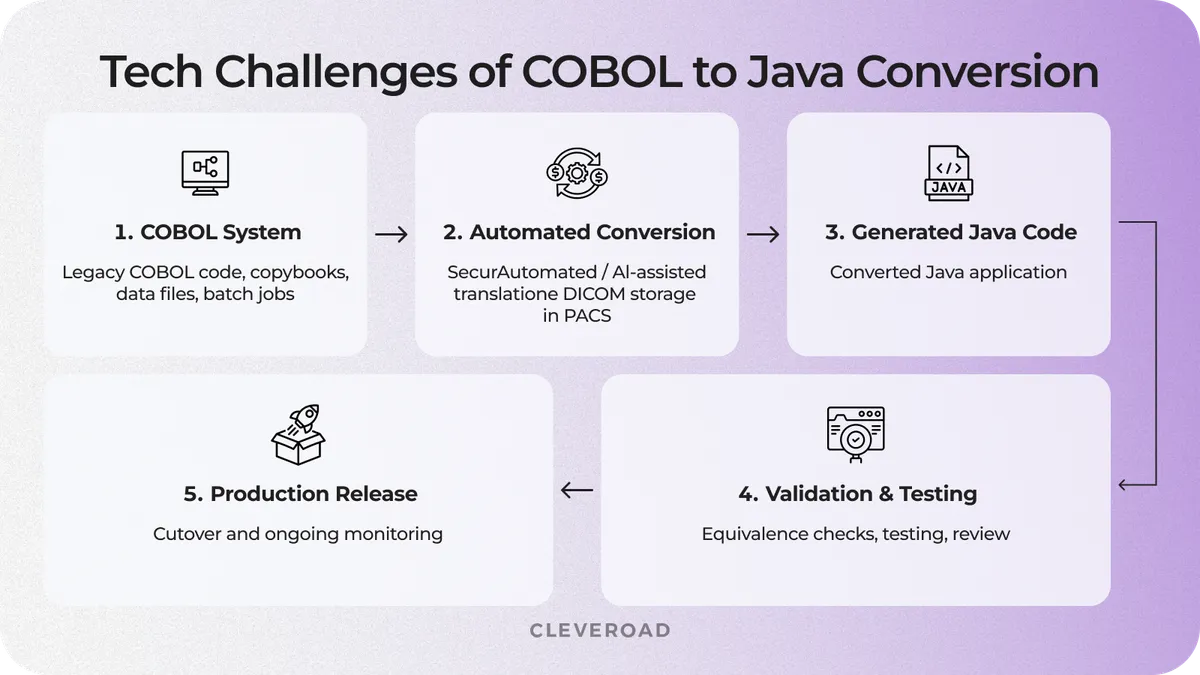
COBOL to Java Conversion Bottlenecks
Functional equivalence
COBOL numeric behavior does not map cleanly to Java. Packed-decimal arithmetic can produce different results when a value overflows or is rounded. Fixed-width fields create another risk. COBOL may truncate a result or raise an ON SIZE ERROR condition, while ordinary Java types behave differently.
Control flow also needs careful treatment. A conversion tool may restructure GO TO logic or complex PERFORM ranges in a way that changes when a business rule executes. A safe COBOL to Java conversion must reproduce the original semantics through support libraries or explicit Java logic. Tests must then prove that both implementations produce the same observable outcome.
This makes functional equivalence a business requirement rather than a final quality assurance check. As Alex Penzov, CTO at Cleveroad, explains, successful migration depends on proving that the new implementation preserves the rules embedded in the legacy core:
Alex Penzov
CTO at Cleveroad
Before cutover, every critical business rule must produce the same observable result in COBOL and Java. The migration is not complete when the code compiles. It is complete when the new system behaves exactly like the legacy core under real operating conditions.

Copybook and data structure flattening
Copybooks define hierarchical records that can be shared across many COBOL programs. They may also contain packed decimals and fixed-position layouts. These constructs affect how financial information is stored and interpreted.
An AI conversion can flatten those relationships into convenient Java objects, and the output may look cleaner while quietly changing how records behave. This is especially dangerous when several programs interpret the same physical data differently. A local change in one Java class can corrupt logic elsewhere in the migration.
The AWS Transform documentation treats COBOL programs and copybooks as separate project inputs. It also requires relevant data files because the transformation cannot be based on source code alone.
A recent IBM Research paper presented at ICSE 2026 shows why this distinction matters. The researchers combined static program analysis with LLM-based translation, rather than asking a standalone model to infer the entire design.
The hybrid pipeline achieved a median structural-quality score above 80%. Its functional score exceeded 75%, while variability between results also decreased.
These findings do not mean that the generated code is automatically ready for production. They show that program analysis and data structure design must be handled deliberately. Broader research on COBOL to Java migration reaches the same practical conclusion: translation quality and behavioral equivalence remain separate engineering problems.
JOBOL and long-term maintainability
JOBOL is Java that retains COBOL’s paragraph structure and procedural control flow. Generated helper classes may hide the original syntax, but the underlying design remains difficult for Java engineers to follow. The application may pass an initial test suite and still fail the modernization objective. You have changed languages without removing your dependence on legacy thinking.
Avoiding this outcome means identifying where application boundaries can be redesigned safely, so the target follows recognizable Java conventions once functional equivalence has been established. This distinction separates temporary output from sustainable COBOL to Java modernization.
Read our technology migration strategy guide to learn how to plan a phased COBOL-to-Java transition, and keep business-critical operations stable throughout modernization.
How Cleveroad Can Help With COBOL to Java Migration
Cleveroad is a software engineering partner with 15+ years of delivery experience. We work with regulated financial systems and align our security processes with core requirements such as GDPR and PCI DSS. Where a project calls for it, we also work to sector-specific frameworks like DORA or Swiss FINMA rules.
We treat COBOL to Java migration solutions as risk-managed engineering programs. The goal is to preserve business behavior while replacing the constraints that make the legacy core expensive and difficult to support. Raw Java output volume is not the measure of success.
Here are the benefits you’ll receive by cooperating with us:
- Discovery-first migration planning. Our code audit services help map out legacy logic and dependencies before defining the COBOL-to-Java migration approach. This gives you a realistic scope before committing the full budget.
- Human-reviewed AI modernization. We use AI to accelerate analysis, while senior engineers validate architecture. Our guide to legacy code modernization using AI explains how this process reduces JOBOL and silent logic errors.
- Certified cloud engineering. Cleveroad aligns its delivery with the requirements of ISO 9001:2015 and ISO/IEC 27001:2013 for quality and information security. As an AWS Select Tier Partner, we build scalable cloud foundations for COBOL to Java modernization.
These controls support several COBOL-to-Java conversion solutions. You may begin with one bounded module before expanding the program.
Another organization may need a staged core replacement. The right COBOL-to-Java migration solution depends on whether the old platform must be retired entirely or retained during a transition period.
Replacing a regulated banking core without losing operational continuity
Our client, a Swiss investment bank, needed to replace an inflexible legacy platform while preserving the ability to operate under its existing license.
Cleveroad organized three engineering teams to deliver the new platform. Each team included technical leadership and specialists responsible for implementation. The wider delivery model contained four coordinated service flows. Business Analysis worked alongside Engineering. QA Automation verified the delivered functionality, while Project Management coordinated the program.
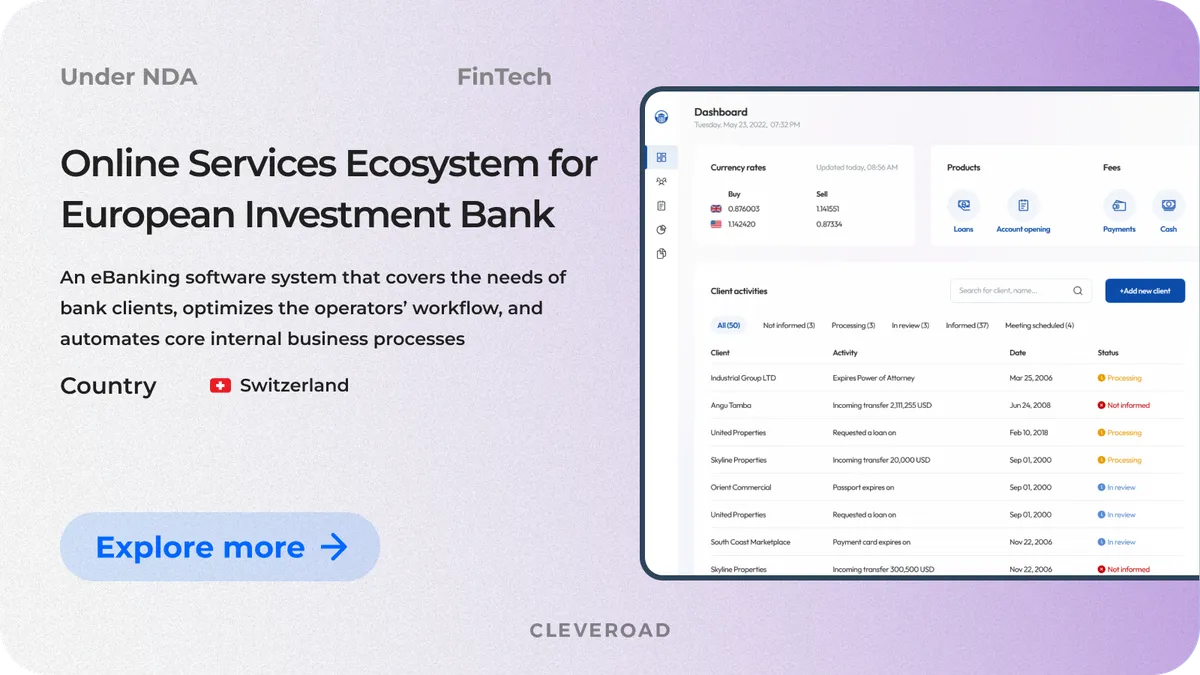
Swiss investment bank design by Cleveroad
The client also needed to comply with the Financial Market Infrastructure Act. The delivery process had to comply with the Swiss Financial Market Supervisory Authority’s requirements for outsourced work.
As a result, our client received a custom eBanking ecosystem that covers digital account opening and all necessary operations across B2B and B2C business models. The platform met the requirements of the Financial Market Infrastructure Act. It allowed the bank to continue operating under its existing license. The improved onboarding experience also improved user retention by 20% to 30%, according to the project results.
Move off COBOL with confidence
Share your legacy system requirements with us, and our experts will assess the codebase and create a risk-controlled COBOL to Java migration plan
Companies migrate because access to experienced COBOL developers is shrinking while legacy applications continue to support critical operations. Well-planned migration projects reduce key-person risk and give organizations access to a broader Java talent pool.
Java also provides more flexible cloud deployment options and easier integration with modern services. The business case still depends on the cost of maintaining the current mainframe and the operational risk of delaying modernization.
The migration process begins with discovery, where engineers document application behavior and identify dependencies that must remain stable after conversion.
- Analyze the COBOL source code and every connected COBOL file to identify shared records, batch rules, and the business logic hidden inside them.
- Map database interactions, including Structured Query Language (SQL) queries, then select a representative module for a controlled pilot.
Each migrated module should be tested against the original system before the legacy path is retired.
A focused pilot may take one to three months, while a mid-sized system often requires 12 to 24 months. A large regulated estate may need two to four years.
The schedule depends on the volume of COBOL code, the quality of existing tests, and the number of external dependencies. Undocumented business rules can extend the analysis phase before implementation begins.
The main challenge is proving that the new application behaves exactly like the legacy system under normal and exceptional conditions.
- Each COBOL data type must map correctly so the generated Java code preserves decimal precision, field length, and overflow behavior.
- The selected conversion toolkit must preserve record structures without creating JOBOL that regular Java engineers cannot maintain.
Functional equivalence should be validated with representative production data before cutover.
Look for a partner that begins with discovery rather than offering a flat quote based only on lines of source. The team should explain how it will convert COBOL to Java while preserving transaction behavior and operational continuity.
For regulated systems, confirm that the provider has experience with compliance-aware architecture and staged releases. Human review must remain part of the delivery model when automated conversion or AI is used.
No. AI can accelerate application analysis and prepare draft transformations, but it cannot safely approve its own output for production.
Silent logic errors may survive compilation and ordinary code review. Senior engineers must compare each migrated module with the legacy baseline and approve the result before production traffic is moved.

Evgeniy Altynpara is a CTO and member of the Forbes Councils’ community of tech professionals. He is an expert in software development and technological entrepreneurship and has 10+years of experience in digital transformation consulting in Healthcare, FinTech, Supply Chain and Logistics
Give us your impressions about this article
Give us your impressions about this article