How to Find an App Developer in 2026: All You Need to Consider
Updated 11 Feb 2026
16 Min
2570 Views
To find a programmer for an app in 2026 means more than matching a tech stack to a platform. Mobile products differ in delivery models, compliance requirements, and time-to-market pressure, so choosing developers who can support scaling is critical, whether you launch a native or hybrid app. Founders who want to create an app often assess candidates solely by skills, ignoring discovery maturity, backend dependencies, and growth constraints, which later lead to costly delivery risks.
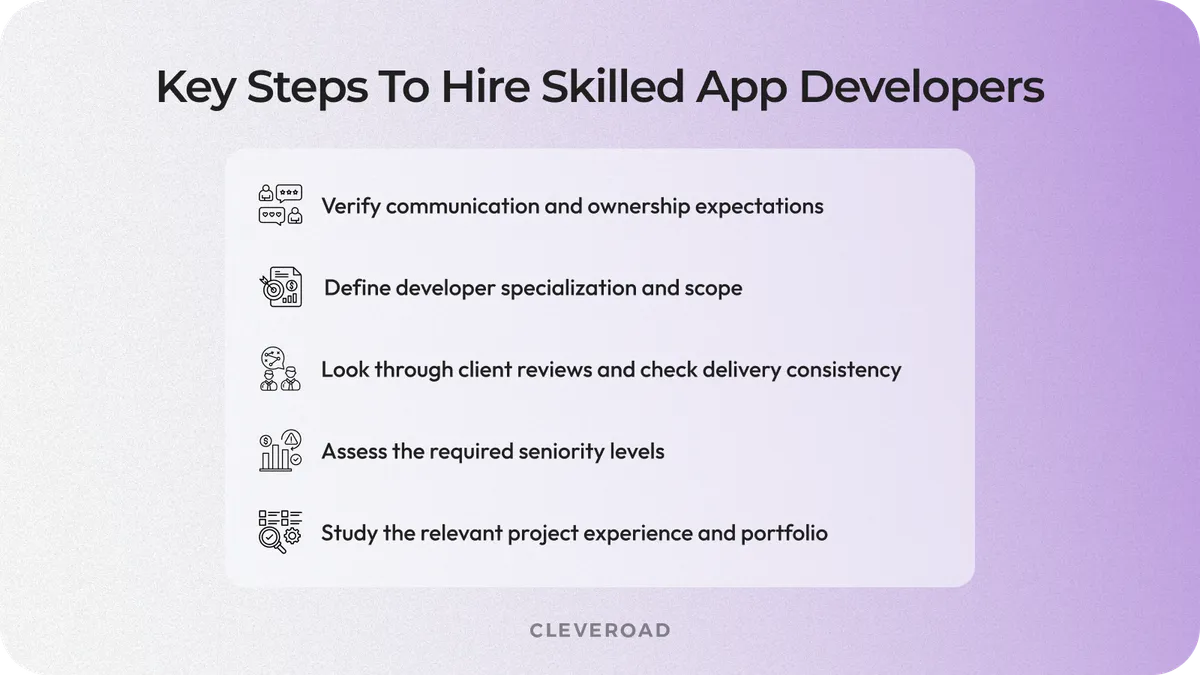
Here are the core steps to find app developers and reduce delivery risks:
- Define developer specialization and scope
- Assess the required seniority levels
- Study the relevant project experience and portfolio
- Look through client reviews and check delivery consistency
- Verify communication and ownership expectations
As an outsourcing software development vendor with 15+ years of experience, Cleveroad has a team of 250+ experienced app developers and a talent pool of 3,000+ software engineers. Based on our hands-on hiring experience, we've created this guide to show how to find app developers, the basic resources to find these experts, and practical tips for hiring software developers.
How to Find Mobile App Developers?
Finding mobile app developers is not just about reviewing resumes or comparing hourly rates. It requires evaluating technical fit, delivery ownership, and long-term scalability expectations. The steps below will help you assess candidates systematically and reduce risks before development begins.
1. Clarify the product idea and business context
Start by defining the core app idea from a business perspective. Clarify the user problem, expected value, and delivery constraints before discussing technical solutions. At this stage, business clarity matters more than technical detail, because these inputs guide every later decision and help you find programmers who understand the business context, not just the technology.
Before moving on to technical requirements or selecting a mobile app development service provider, make sure you can confidently answer the following questions:
- What user problem must the best mobile app solve from day one?
- Who will use the product across different mobile devices, and in what real-life scenarios?
- What business outcome defines success in the first release?
- What constraints exist around budget, timelines, or regulatory requirements?
- Which assumptions must be validated early to reduce risk when finding the right developer?
Answering these questions upfront ensures that later discussions with developers are grounded in business reality rather than abstract ideas.
2. Outline baseline technical requirements
Once the business context is clear, define the initial technical direction. An app developer may work on web, cross-platform, or mobile native solutions, so you should specify which environment you are targeting and for which platforms. You should also decide whether to start with an MVP, PoC, or move directly to a full-featured product.
Learn the differences between PoC vs prototype vs MVP and the value of these approaches for idea validation
3. Choose a cooperation model
Before you find a mobile developer, decide how you want to collaborate and where delivery responsibility should sit. In-house hiring means building and managing your own team, while outsourcing shifts part or all of the delivery responsibility to an external partner. Within outsourcing, clarify whether you will manage developers directly through outstaffing or delegate delivery to a dedicated team, especially if the product must be built as an app from scratch.
Cleveroad is an experienced mobile development company with over 15 years of hands-on delivery across consumer and enterprise products. We help businesses evaluate potential app developers and structure collaboration models that balance delivery risk and internal capabilities. Depending on your needs, we provide:
- Staff augmentation services to quickly extend your in-house team when you already have product ownership and technical leadership in place.
- Dedicated development team services when you need end-to-end responsibility for delivery, architecture, quality assurance, and long-term product evolution from a single vendor.
Choosing the right model helps you hire a developer or team that aligns with your product stage and avoids fragmented ownership. It also increases the likelihood of delivering an app with predictable quality and timelines, supported by dedicated developers rather than loosely coordinated contributors.
4. Define success metrics and KPIs
Clear metrics help you find the developer who aligns with your expectations. Define KPIs related to delivery speed, product quality, user adoption, or system stability. These metrics provide an objective baseline for evaluating progress during development.
The table below maps common KPIs to the aspects of delivery they help measure and validate:
| Metric category | What the metric shows | Why it matters |
|---|---|---|
Delivery speed | Meeting planned milestones | Shows planning accuracy and execution discipline |
Product quality | Defect rate, release stability | Reflects engineering and testing standards |
User adoption | Feature usage, retention | Indicates alignment with real user needs |
System stability | Crash rate, downtime, performance | Essential for production and scaling |
Change responsiveness | Handling scope or requirement changes | Demonstrates ownership and adaptability |
5. Set communication and project management expectations
Before you search for app developers, clarify how collaboration should work in practice. Define communication frequency, preferred tools, escalation paths, and decision-making responsibilities. This reduces friction once development starts and helps maintain transparency in delivery.
Modern app development requires structured communication across time zones and clear documentation of decisions, supported by tools such as Slack for day-to-day communication, Jira for delivery tracking, and Confluence for documentation. When defining how to find app developers, it is important to align communication practices with the type of app being built.
Cleveroad applies a structured communication model across time zones, which is especially relevant when working as an app developer for startup projects that require predictable reporting, documented decisions, and transparent delivery from early stages.
A practical example of this structured communication approach is our collaboration with AVFX, a US-based event technology company. Despite a significant time zone difference, communication remained consistent and transparent throughout the project. Our developers adjusted schedules to join late-night and weekend calls during key presentation milestones, ensuring uninterrupted coordination and reliable support during critical delivery stages.
This is how AVFX reviews their collaboration with our team:
AVFX & Cleveroad: A Successful Technology Partnership - Client Testimonial
6. Research the market and shortlist vendors
At this stage, focus on finding an app developer or vendor whose experience matches your domain and scale. Review portfolios, case studies, and client feedback to narrow the list to a manageable number of candidates who are worth interviewing.
Beyond surface-level experience, evaluate whether candidates have worked with systems of comparable complexity, including backend integrations, third-party APIs, data security requirements, and production deployment workflows.
Pay attention to how teams describe architectural decisions, technology trade-offs, and post-launch support, as these details indicate readiness for real-world delivery rather than demo-level development.
7. Interview candidates and make a selection
Interviews help confirm whether candidates can actually make an app under real constraints. Discuss previous delivery challenges, decision-making approaches, and ownership expectations. This final step turns preparation into a confident hiring decision rather than a guess.
While conducting interviews, focus the discussion on practical delivery signals:
- Delivery experience. Ask how candidates handled missed deadlines, changing requirements, or technical blockers in past projects.
- Decision-making approach. Explore how architectural and technology choices were made, including trade-offs between speed, quality, and scalability.
- Ownership scope. Clarify which responsibilities the developer or team takes beyond task execution, such as system design, risk identification, and release readiness.
- Collaboration style. Assess how candidates communicate issues, escalate risks, or work with product and business stakeholders.
- Post-launch involvement. Confirm experience with maintenance, updates, performance tuning, and long-term support after release.
Applying this structured approach helps reduce hiring risks and align development with business goals. Contact Cleveroad to discuss your project and get support in selecting and organizing app developers for predictable delivery.
How to Choose App Developers for Hire in 2026?
The app developer hiring process requires evaluating how well a candidate aligns with your product stage and technical scope. Hiring decisions made without this alignment often surface as delivery delays, architectural rework, or scaling issues later in the product lifecycle. If you plan to find talented app developer resources for real product creation, evaluation should focus on specialization, delivery experience, tech ownership and decision-making responsibility.
Let’s revise the key criteria that help you evaluate the specialists and hire application developer team for your product at each stage of development.
Steps to hire an app developer
Define developer specialization and expertise scope
Start by defining what type of mobile developer your product requires. A mobile developer may specialize in native iOS or Android development, cross-platform frameworks such as Flutter or React Native, or web-based approaches like Progressive Web Apps (PWAs), depending on performance expectations and platform strategy.
Many mobile app development companies offer mixed skill sets, so it is important to determine whether you need a focused mobile specialist or broader expertise spanning mobile, backend systems, and integrations.
This distinction becomes critical during scaling, when insufficient backend or integration expertise can create architectural bottlenecks and require costly refactoring.
Cleveroad can provide you with skilled native app developers for iOS and Android. We also offer cross-platform app development services to help you deliver a powerful, cost-effective Flutter-based mobile app, saving you time and budget.
Assess the required seniority level
Developer seniority determines the complexity and uncertainty of problems a specialist can handle. Junior developers work best with clearly defined tasks, while mid-level developers implement features within established architectures. Senior developers define architecture and technical direction, and take responsibility for complex decisions under uncertainty. Projects entering the Discovery or MVP phases without senior technical oversight risk accumulating architectural constraints that later limit scalability.
When you hire a professional app developer, clarify the level of responsibility required to determine appropriate seniority:
- Decision ownership: Senior developers define the architecture and technical direction while implementing tasks.
- Problem-solving scope: Junior and mid-level specialists typically solve clearly defined, known problems, while senior developers handle complex unknowns and architectural uncertainties.
- Impact radius: The more systems and experts a decision affects, the higher the required seniority is.
- Mentorship needs: When internal guidance is unavailable, senior developers become essential.
Study the relevant project experience and portfolio
Reviewing a vendor’s portfolio helps determine whether their experience matches the complexity and maturity of your product. When selecting developers, assess whether the outsourcing vendor has delivered solutions similar to yours, paying attention to domain experience, system complexity, integration requirements, and production readiness. If your app must operate in production with real users and data, developers who have only worked on demo projects may lack the architectural judgment and scaling experience required for long-term stability.
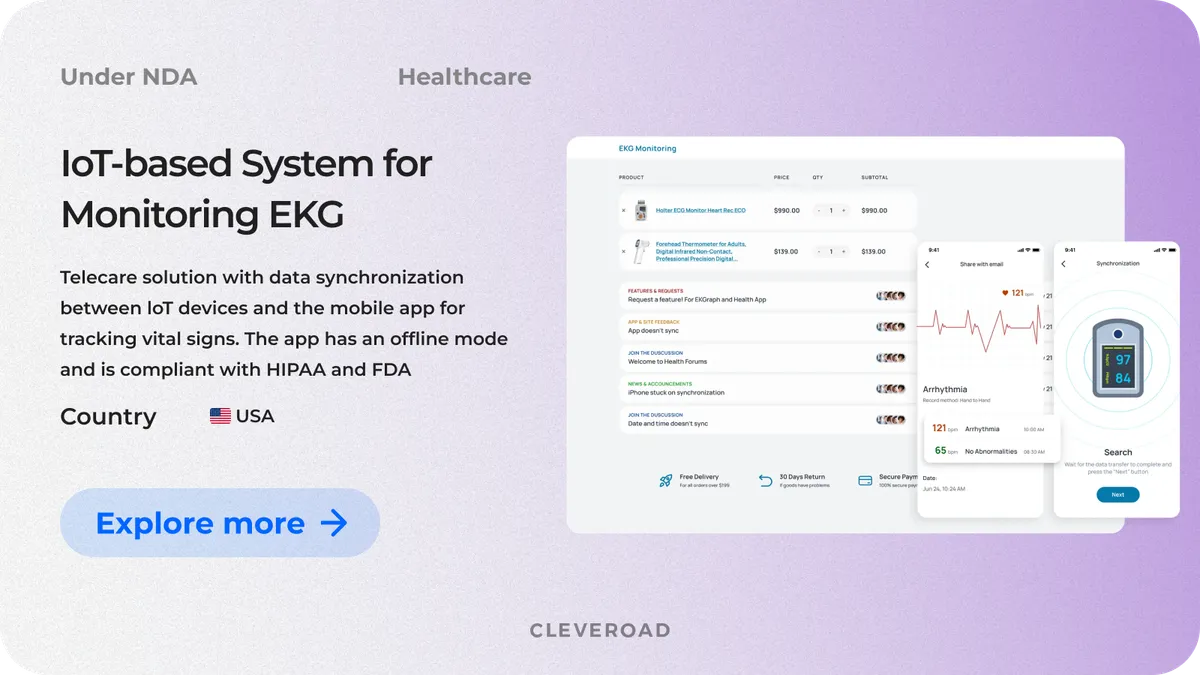
Cleveroad portfolio includes a wide variety of projects across diverse business domains and technology stacks. For instance, the Cleveroad team has recently designed an IoT-based system for monitoring EKG and blood oxygen levels. The solution’s core is iOS and Android mobile applications connected via IoT devices. As a result, our client received a mobile telecare app that meets US health regulators’ requirements and provides users with valuable opportunities to track vital signs.
IoT-based system for monitoring EKG by Cleveroad
Look through client reviews and check delivery consistency
Client reviews rarely describe individual contributors, but they reveal how reliably an app development team delivers under real constraints. Look for patterns in delivery predictability, communication clarity, and the consistency with which change requests are handled. Platforms like Clutch help validate this consistency by aggregating verified feedback across multiple projects and industries.
To assess delivery reliability more objectively, pay attention to the following signals in client reviews:
- Consistency across reviews. Repeated mentions of similar strengths or issues matter more than single comments.
- Delivery outcomes. References to meeting deadlines, handling scope changes, or stabilizing products post-launch.
- Communication quality. Clarity of updates, responsiveness, and transparency during difficult phases.
- Long-term collaboration. Evidence that clients continued working with the same team after the initial release.
Here is a short, verified Clutch review that can help illustrate what consistent delivery and communication look like in practice:

 Ireland


To explore more feedback from real clients and see recurring delivery patterns across projects, check additional reviews on our Clutch profile.
Verify communication and ownership expectations
Clear communication is one of the earliest indicators of engineering ownership. During initial discussions, evaluate how candidates explain technical trade-offs, clarify ambiguous requirements, and challenge assumptions instead of simply agreeing with them. The way a team communicates often reflects how it approaches responsibility.
Ownership goes beyond completing assigned tasks. A strong mobile app development team takes responsibility for delivery outcomes, including architectural decisions and long-term scalability. When ownership is present early, risks are identified and addressed before they turn into structural problems.
Cleveroad software development experts demonstrate this approach during the Discovery phase by surfacing architectural and integration risks upfront. This reduces the likelihood of costly corrections after launch and improves overall delivery predictability.
Where to Find App Developers in 2026?
Once you understand what type of developer you need and how to evaluate candidates, the next step is deciding where to find software engineers that match your product goals. In 2026, finding app developers is less about reviewing large volumes of candidates and more about selecting environments where expertise and technical credibility become visible before collaboration starts.
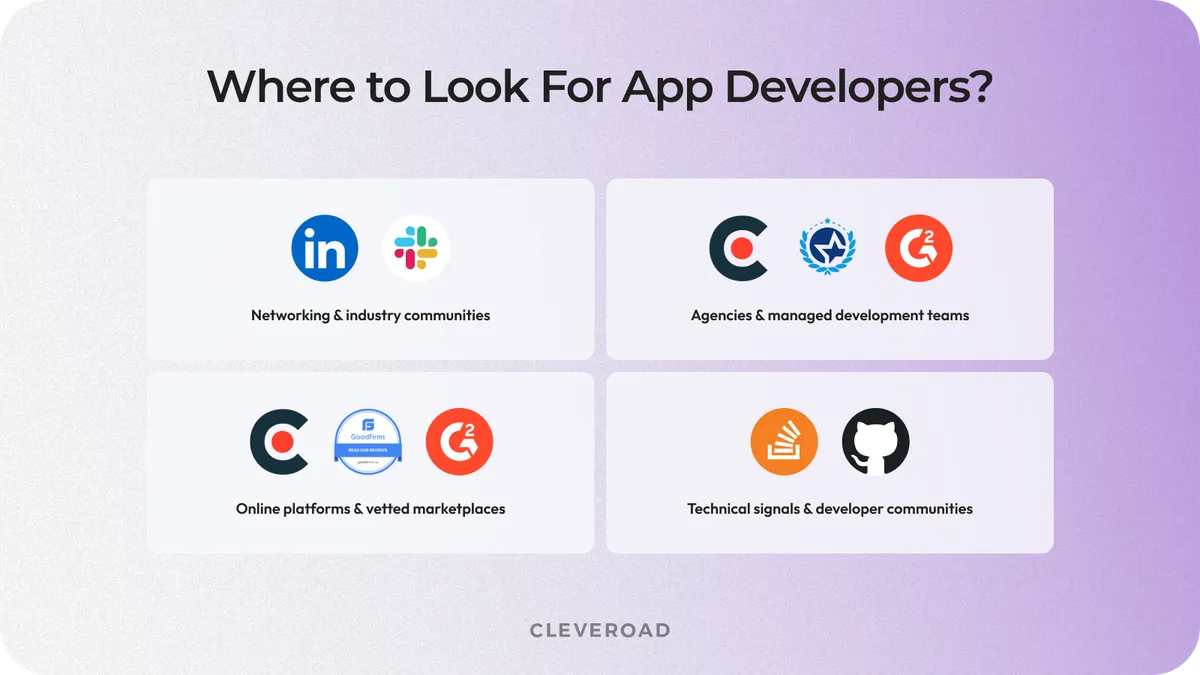
Below are the most reliable places to find a developer. Different sourcing channels support different levels of responsibility and execution scale. The right choice depends on whether you are validating an idea, building core functionality, or preparing for production deployment.
Where to find app developers?
Online platforms and vetted marketplaces
Professional platforms such as Clutch, GoodFirms, and G2 help you identify app development agencies with verified reviews, case studies, and delivery histories. These environments make it easier to compare providers by domain focus and technical capability without relying solely on individual CVs.
This approach is most effective when you need a coordinated app developer team with proven production experience. Agencies listed on vetted platforms typically operate with structured processes and defined ownership, which is important for complex or regulated products.
Developer communities and technical signals
Developer communities provide visibility into how engineers approach technical problems. Platforms such as GitHub reveal open-source contributions and architectural discussions, while Stack Overflow highlights depth of knowledge and reasoning quality.
Such channels are most useful when evaluating individual contributors for feature-level work or when searching for an app developer to build specific components inside an existing system. However, they offer limited visibility into delivery ownership, coordination, and long-term system responsibility, which become critical as products move beyond early development stages.
Networking and industry communities
Professional networks help assess how developers communicate and reason through ambiguity. In LinkedIn threads or Slack discussions, strong engineers often clarify assumptions and surface hidden constraints before suggesting solutions.
This method is useful during early concept exploration. However, it does not replace evidence of structured delivery capability once budgets, timelines, and dependencies become fixed.
Agencies and managed development teams
When projects require shared ownership and predictable execution, agencies and managed teams reduce delivery uncertainty compared to hiring individuals independently. This model emphasizes milestone-based execution with defined responsibility for architecture, integrations, quality assurance, and release management.
Agencies are typically selected once products move beyond experimentation and enter scaling or production phases. At this stage, coordinated teams help maintain architectural consistency and long-term system stability.
To simplify the decision, the table below maps sourcing channels to product stage, execution scope, and ownership expectations.
| Sourcing channel | Best suited stage | Delivery risk profile |
|---|---|---|
Online platforms & marketplaces | MVP, scaling, launch | Low to medium |
Developer communities & technical signals | Feature work, prototyping | Medium |
Networking & industry communities | Validation, discovery | Medium to high |
Agencies & managed teams | Scaling, production, support | Low |
Common Mistakes When Finding App Developers For Your Project
Hiring app developers requires structured evaluation because early hiring decisions influence architecture quality, scalability, and long-term product ownership. Teams that rush selection often underestimate the complexity of matching developer capability with real product demands. Below are common mistakes that undermine delivery outcomes and how they can be avoided.
Prioritizing price over delivery quality
Selecting developers primarily based on cost often leads to fragile architecture, unstable releases, and missed milestones. These problems typically surface when teams attempt to scale, optimize performance, or release updates to meet the high standards users expect from mobile apps.
A delivery-first evaluation reduces this risk. Working with experienced developers like the Cleveroad team helps balance speed, architecture, and maintainability early, preventing costly rework once the product gains traction. We support a delivery-first approach to your product by assigning senior technical oversight early, aligning architectural decisions with scaling needs, and reducing rework in later development stages.
Starting development with incomplete requirements
When decision-makers need a developer before clarifying business goals and user flows, development becomes reactive. Ambiguity at the start leads to scope creep, timeline shifts, and misaligned expectations once implementation begins.
A structured pre-development approach helps product owners define what it takes to build an app from the ground up. At Cleveroad, this is addressed through Solution Design Workshops and Discovery phase that formalize user roles, workflows, and system boundaries, enabling our software development experts to translate business intent into validated architecture and delivery-ready requirements.
Skipping portfolio validation and technical vetting
Hiring developers without production experience increases the likelihood of performance bottlenecks and scalability issues. Demo applications rarely reflect real-world constraints such as integrations, security, or post-launch maintenance.
Portfolio validation should focus on system complexity and lifecycle support. Cleveroad demonstrates production-grade mobile and backend projects with defined scope, integrations, and long-term evolution, allowing stakeholders to evaluate real delivery capability.
Check our portfolio section for case studies that show how we build and scale apps in practice
Ignoring long-term ownership and post-launch responsibilities
Many product owners focus on launch while underestimating maintenance, updates, and platform changes. This often results in stalled development once the initial release is live.
Companies that aim to find a mobile app developer for long-term success should prioritize an ownership mindset and delivery continuity. Working with dedicated app engineers and a consistent delivery team that supports the right mobile app development beyond launch helps keep the product stable, extensible, and aligned with business growth.
At Cleveroad, long-term ownership is built into the delivery model through stable team allocation, documented architecture decisions, and post-launch support plans that cover OS updates and controlled feature evolution.
Mobile App Developer Rates by Country
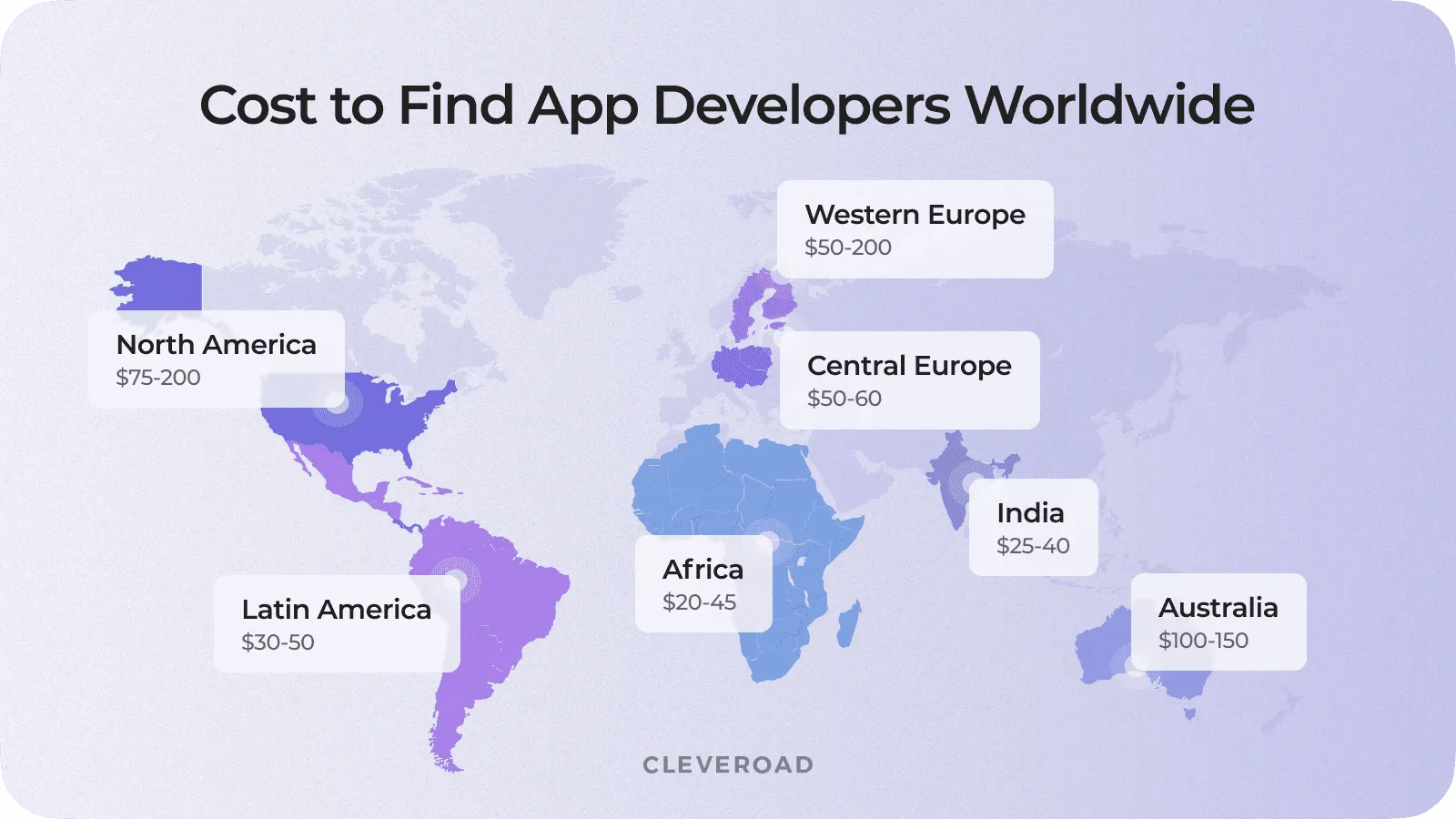
Mobile app developers’ rates can differ from country to country, ranging from $100-$250 per hour in the USA, Canada, and Western Europe to $20-$40 per hour in India and Pakistan. Central Europe seems to be a golden mean charging $50-$95 hourly while providing a high level of competency. If you want to outsource mobile development or find nearshore or offshore mobile app development, you should know popular regions that suit best for it.
We’ve analyzed rates of mobile app developers in different countries and highlighted the most popular tech hubs.
Cost to find app developers worldwide
Rate differences are driven by several structural factors, including local labor markets, tax systems, demand for engineering talent, and the maturity of development processes. Lower rates may indicate access to talented developers, but they can also reflect weaker delivery practices, higher turnover, or limited experience with complex products. At the same time, higher app developers hourly rate do not automatically guarantee better results if teams lack domain expertise or efficient workflows.
When you hire developers, it’s important to look beyond the hourly rate and evaluate how teams handle architecture decisions, quality assurance, communication, and long-term support. For example, a slightly higher rate in a region with strong process discipline and stable teams may reduce rework, delays, and maintenance costs over the product lifecycle.
Why Hire a Mobile Developer Team at Cleveroad
Cleveroad is an outsourcing software development company with more than 15 years of experience, during which we’ve successfully accomplished 200+ successful projects. 280+ in-house Cleveroad engineers are fluent in Swift, Kotlin, and Flutter app development services and are ready to help you build top-tier iOS, Android, and cross-platform apps.
You can find app developers for a startup or for expanding an already existing app with one of our three adjustable cooperation models:
IT staff augmentation services
We offer you to attract the necessary tech talents with the required skills to your project on a temporary basis. Additionally, IT staff augmentation services are ideal for situations in which a complete team is not required and enables simple expansion based on your requirements. The vendor supplies the required expertise, but you are still in charge of supervision and administration.
Dedicated development team services
This type of collaboration is perfect for high-volume or complex projects that require ongoing development and flexibility. We finalize the cooperation terms and engagement model, then assign highly skilled software developers who are 100% dedicated to your project.
All of this is managed by a project manager who oversees the entire development process and handles any communication issues to ensure everything runs smoothly. Thus, dedicated development team services let you focus on your core business activities while handing off the technical execution to professionals.
Project-based model
This collaboration model is predicated on either paying for actual time spent (time & material) or carrying out a specified project with a fixed budget (fixed). While the latter entails paying for each hour of labor, the former entails determining the project's pricing.
Don’t hesitate to cooperate on mobile app development projects with us, doing that in the most comfortable way for your business. You’re also welcome to look through our portfolio to see what projects we’ve developed before and find ideas for your business solution.
Hire qualified remote app developers now
Work with 280+ in-house engineers and access a vetted talent pool of 3,000+ specialists to reduce delivery risk, strengthen architecture decisions, and ensure stable post-launch support
You can use popular hiring platforms to find app developers depending on the cooperation models (freelance, in-house team, outsourcing companies).
There are several popular software outsourcing destinations: USA, Western Europe, Eastern Europe, Asia. Central Europe is golden mean charging $25-50 hourly while providing a high level of competency. For example, Estonian developers charge $40.
Before finding app developers, you need to make the following steps: define target audience, validate the problem, validate the solution, build MVP, measure (KPIs) and analyze.
It depends on the country, experience level, and stack of technologies that programmers work with. For instance, app developers in the USA charge $100/h compared to $50 in the Central Europe for the same price.

Evgeniy Altynpara is a CTO and member of the Forbes Councils’ community of tech professionals. He is an expert in software development and technological entrepreneurship and has 10+years of experience in digital transformation consulting in Healthcare, FinTech, Supply Chain and Logistics
Give us your impressions about this article
Give us your impressions about this article
Comments
3 commentsHi there, thanks for sharing such an awesome blog with us, It's really helpful to find the best mobile app and web development company.
First time I found such an open and informative paper. Would appriciate a copy in PDF to take and discuss with others.
This is a great inspiring article. I am pretty much pleased with your good work. You put really very helpful information. Keep it up. Keep blogging