Healthcare CRM Implementation in 2026: Features, Cost, and Best Practices
Updated 14 Jul 2026
17 Min
1479 Views
Healthcare organizations need more than traditional CRM tools to manage patient relationships. Healthcare CRM platforms help automate communication, protect PHI, integrate with medical systems, and support secure patient workflows.
With 15+ years of experience in custom software development, Cleveroad helps healthcare organizations build secure CRM solutions aligned with healthcare workflows and compliance requirements. In this article, you will learn how healthcare CRM software works, which features and integrations matter most, how much implementation may cost, and which best practices help create a secure and patient-focused solution.
Key takeaways:
- Healthcare CRM solutions help medical organizations organize patient interactions, automate communication, and deliver consistent care experiences.
- Healthcare CRM implementation requires secure handling of PHI, regulatory compliance, and integration with existing healthcare workflows.
- AI-powered healthcare CRM features help organizations automate patient communication and gain insights from interaction data.
- Successful CRM implementation starts with a clear strategy, compatible integrations, and workflows that match how teams deliver care.
What Is a Healthcare CRM and How Does It Differ From Others?
A healthcare CRM is a specialized customer relationship management system designed to help medical organizations manage patient communication, coordinate care, and maintain comprehensive records of patient interactions. By combining patient data, medical history, demographic details, and engagement insights into a single unified profile, healthcare teams can personalize outreach, monitor patient needs, and improve interactions across the patient journey. Healthcare CRMs also ensure regulatory compliance, such as HIPAA, and integrate with clinical workflows and electronic health records (EHRs).
Healthcare CRMs differ from general-purpose CRMs, which primarily focus on managing leads, sales activities, and customer relationships. Unlike standard CRM platforms, healthcare CRMs are built around patient-centered workflows, compliance, and integration with healthcare-specific systems. They support appointment scheduling, patient engagement tracking, secure handling of protected health information (PHI), and connections to telemedicine platforms.
The table below summarizes the main distinctions:
| Feature | Traditional CRM | Healthcare CRM |
|---|---|---|
Focus | Prospects, sales activities, and customer interactions | Patient journeys, appointments, communication history, and care activities |
Primary goal | Optimize sales conversion and customer retention | Improve patient engagement and continuity of care |
Data management | Standard customer information | PHI and healthcare-related patient records |
System integration | Marketing and support channels | EHRs, scheduling systems, and telemedicine platforms |
Security & compliance | General security practices | Healthcare-specific compliance controls (e.g., HIPAA) |
Healthcare CRM platforms serve hospitals, clinics, pharmacies, insurance providers, companies developing hospital management software, and research organizations. By unifying patient data, communication tools, analytics, and workflow automation on a single platform, they help organizations improve the patient experience, increase operational efficiency, and create a more connected healthcare ecosystem. According to Grand View Research (2026), the global healthcare CRM market is projected to grow from approximately $23.3 billion in 2026 to around $35.7 billion by 2033, driven by rising demand for personalized patient engagement and digital healthcare solutions.
How the medical CRM system operates: workflow example
When booking a new appointment, the CRM software automatically sends reminders to both patients and healthcare providers, with multilingual support. In practice, some clients’ consultations require a translator. In such circumstances, the doctor also receives a notification via email or text message (depending on settings). Each vital event (rebooking, cancellation, patient absence, and others) triggers the delivery of notifications to the corresponding parties.
After that, if customers have successfully completed the appointment at the physical medical establishment, they receive a post-consultation survey link via text message or email. Such an interview comprises questions concerning how convenient the appointment booking was. Besides, it asks about the quality of the facilities, satisfaction with consultations with the medical expert, etc. Patients who have missed the scheduled consultation receive a brief survey that includes questions about automated reminders, reasons for absence, and feedback on enhancing the customer experience.
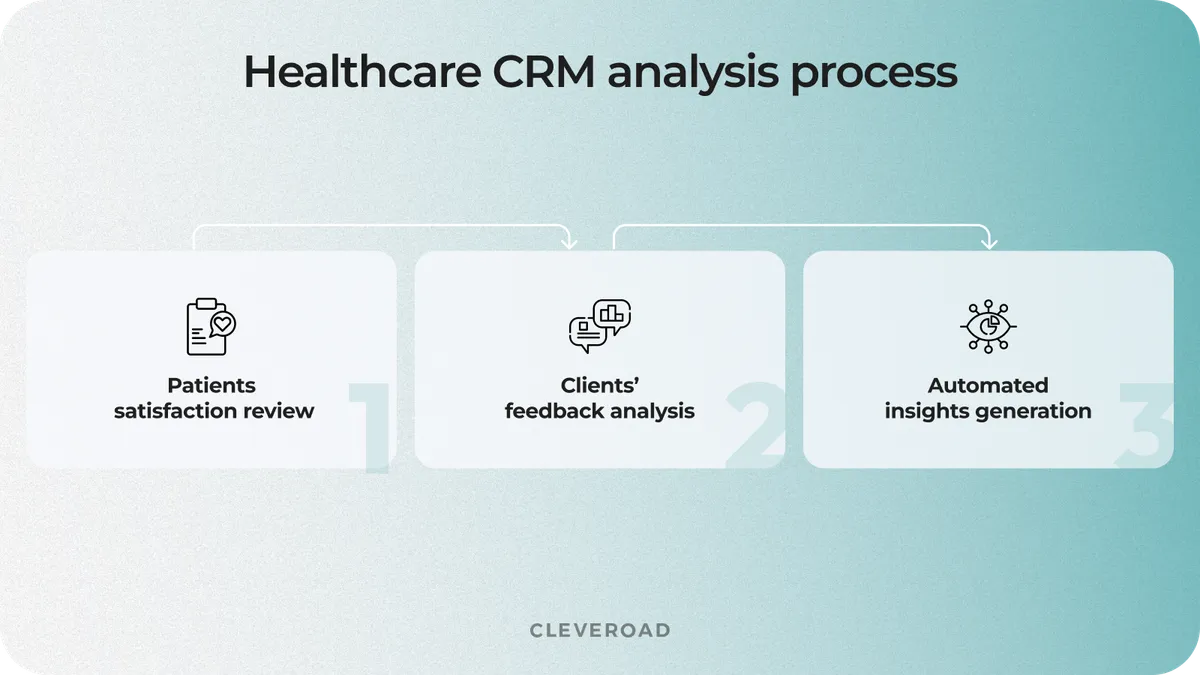
Healthcare CRM operation principle
What makes a healthcare CRM system profitable?
A healthcare CRM becomes profitable by helping organizations retain patients, reduce administrative workload, and improve decision-making through better use of patient data. By combining automation, analytics, AI, and integrations with healthcare systems, these platforms streamline workflows while enhancing patient engagement.
Key ways a healthcare CRM adds value:
- Patient retention: Identifies patients needing follow-ups, preventive screenings, or additional support.
- Automated communication: Sends reminders, notifications, and personalized messages to reduce missed appointments and improve engagement.
- AI-driven insights: Analyzes patient behavior and engagement patterns to guide proactive outreach and optimize workflows.
- Personalized patient interactions: Tailors communication based on care history, preferences, and engagement trends.
- Marketing and acquisition optimization: Tracks communication performance and patient responses to refine outreach strategies.
- System integration: Connects with EHRs, scheduling, telemedicine, and patient portals to provide a complete view of patient interactions.
By focusing on these core areas, a healthcare CRM helps organizations deliver better care, improve efficiency, and increase overall profitability.
Cleveroad’s CRM development services help healthcare organizations build custom CRM solutions with secure integrations, tailored workflows, and healthcare-specific requirements in mind
Common Approaches to Healthcare CRM Implementation
There are several options for CRM development and implementation. The most common approaches are custom, CRM module integration, and off-the-shelf.
Custom CRM architecture
Development from scratch is the most profitable option among those described. This approach enables the implementation of a healthcare CRM system that includes all required features in accordance with your company’s needs. The functionality will include only the necessary elements, with the option to add advanced tools as needed. A one-time financial investment in a healthcare CRM implementation will be quickly recouped, as such a product will help attract a larger audience and expand your business.
Custom software development is considered better than off-the-shelf solutions for a few reasons:
- Tailored fit: For multi-clinic scheduling, insurance-specific billing, or unique referral chains, a custom CRM eliminates workarounds that ready-made platforms force on your staff.
- Increased efficiency: Automating organization-specific processes, such as patient follow-ups or internal approvals, reduces manual work and speeds up operations.
- Competitive advantage: Unique features, like advanced analytics dashboards or specialized patient communication workflows, differentiate your services from competitors.
- Scalability: Custom systems can expand as the organization grows—adding new clinics, users, or services without forcing compromises.
- Flexibility: Workflows, reports, and integrations can evolve with your business, ensuring that the CRM continues to serve your changing needs.
Custom development does cost more and take longer than an off-the-shelf tool, and it needs ongoing support. Over time, though, it saves on costs, time-to-market, and effort, and it scales with the business.
CRM module integration
If you have a healthcare business product, you can increase its potential and usefulness by implementing a CRM module. That way, you don’t need to develop a standalone solution, which requires a solid financial and time investment. You get a module with the functionality that brings the above benefits.
Off-the-shelf software
Off-the-shelf healthcare CRM software allows organizations to quickly implement patient management, communication, scheduling, and reporting features without the time or cost of custom development. These solutions are suitable for standard workflows and rapid deployment but may have limitations for organizations with complex needs.
Limitations of off-the-shelf healthcare CRM:
- Lack of customization: May not fit unique organizational workflows
- Inadequate security: May not fully protect sensitive patient data
- Limited integration: Can be difficult to connect with existing systems
- Inflexible reporting and analytics: May not provide detailed performance insights
- Higher total cost of ownership: Hidden costs for customization, integration, or training
Organizations should carefully evaluate whether an off-the-shelf solution meets their workflow, integration, and compliance requirements before implementation.
Basic Healthcare CRM Functionality
Below, we’ve prepared an exemplary list of essential features you should take into account when developing healthcare CRM software from scratch.
Patient data management
The essential elements of client information operation and processing are patient record storing, modification, and tracking. For this, the medical CRM should comprise the two databases:
- Centralized patient database. This is a storage system that stores patient data, such as contact information, insurance details, clinical data, analysis results, and pharmaceutical treatments.
- Template documentation database. It provides an opportunity for healthcare vendors to deliver diverse forms to customers that can be completed quickly. The format of a template guarantees that no vital information is missing.
The patient’s personal details, insurance and billing information, and appointment history are all securely stored by healthcare CRM software. Staff can pull up and update a patient’s record from any device. Patients stop re-filling the same forms at every visit, and the record stays consistent across departments.
Interactions
This feature’s main aim is to enable quick, easy communication between the medical vendor and patients, as well as to use digital marketing tools.
- Call operation. The system robotizes the processing of incoming calls. In addition to showing relevant details about the client, available physicians, and their schedules during the communication session, the CRM software can deliver previously recorded voice messages and bots.
- Newsletters and mailing lists are sent. The product is able to conduct structured, automated, and personalized mailing list sending depending on the goal (individual offers, marketing, premium programs, etc).
- Patient segmentation. CRMs allow medical staff to group patients by behavior, demographics, treatment plans, examination results, and other criteria to deliver more personalized service and marketing.
- Rates and reviews assembling. A CRM solution may be embedded in your company’s web platform to collect customer feedback. This way, you may develop new strategies for enhancing the medical services your entity provides.
Task operation
This feature lets teams assign internal tasks and monitor their execution, making team management and progress tracking more straightforward. It also includes an integrated dashboard that pulls together customer information, updates, assignments, booked consultations, and other data related to medical workflows.
- Consultations’ booking. The medical customer relationship management software streamlines appointment reservations and allows easy-to-use schedule monitoring and modifications. The feature may include instruments for marking and grouping booked consultations using an implemented filtering system.
- Schedule and reminders. An integral function that assists healthcare employees in quickly and easily creating and modifying calendar events, setting automatic notifications to remind both parties about the upcoming consultation, and tracking calendar changes (if any).
- Performance observation. The essential element of every CRM solution is the feature that allows tracking staff productivity. This tool provides insights into employee efficiency, enabling you to set key performance indicators tailored to your company’s peculiarities. Therefore, it allows tracking the performance and demand of each medical specialist, as well as the need for a specific service type.
Automated reminders keep staff on track for upcoming appointments and recurring tasks. Teams can also raise internal tickets and route requests to the right department without leaving the CRM. To properly allocate the workload, managers can check their team’s status and schedule. A mobile CRM app enables secure and legal communication between professionals working in various locations.
Sales and marketing automation
Healthcare CRM systems can provide marketing teams with data for effective patient segmentation and promotional targeting. It makes gathering input easier, which aids in understanding correlations between patients’ demands. In doing so, firms can enhance their performance, identify high-risk patients, and reduce turnover by monitoring patient satisfaction. One of the key functions of medical CRM is lead management, which enables prompt follow-up on leads and identifies persistent lead-nurturing issues.
Customer service integration
Client service representatives have immediate access to pertinent patient data and staff schedules. As a result, they can efficiently respond to patient inquiries via any channel, including phone calls, text messages, social media posts, live chat, and email, and schedule appointments with the appropriate specialists and take other informed actions.
Referral management
All-round patient-journey data is contained in the CRM for doctors. With this knowledge, hospital staff may automatically set up a referral appointment, remind patients if they don’t show up, and follow up with them at the next stage. Such information can be safely shared across departments, healthcare facilities, and practitioners by simply exporting it from the hospital CRM.
Document management
In CRM, all patient management documentation may be safely kept and promptly made available upon request. Documents such as invoices and certificates can be created quickly and legally using a range of built-in templates. Your workers will be able to concentrate on patients and high-alert work while reducing operational costs by streamlining paperwork and automating record-keeping.
Check our article on how to build EHR software and how to integrate it with a healthcare CRM
Insights and analysis
CRM software for the medical industry may analyze data from customer service, marketing, and sales processes and provide key insights. It aids in measuring campaign outcomes and tracking marketing and sales performance. It also helps identify conversion-influencing elements. Analytical dashboards can provide a clear and comprehensive overview of leads, opportunities, patients already on the books, and those who have been recommended.
- Custom reports completion. The main purpose of a client relationship management solution is to generate custom insights tailored to your business requirements. To illustrate, the indicators and metrics analyzed by the CRM may include the number of clients at the healthcare establishment, the average time required for each medical session, or the most common health issue diagnosed by your experts.
- Analysis instruments. Such tools assist in preparing reports and precise analytics based on the set metrics. To illustrate, this feature allows for assessing and tracking one-time or regular outgoings related to the delivery of medical services and estimating budgets for the healthcare business’s promotional campaigns.
- Solid security. Sensitive patient medical data must be protected by a robust safety system to ensure health record security. To achieve this goal, you may implement features such as access management and two-factor authentication.
Last but not least, if you have other stand-alone medical solutions, such as an e-prescription or an EHR, your healthcare CRM system should integrate seamlessly with them to enable secure data sharing and processing. The range mentioned above doesn’t represent any advanced features, so the sophistication of your CRM isn’t limited. However, the list comprises key functionality that is implemented in each solid system of this type.
Cleveroad has practical experience in building healthcare solutions with patient data management, scheduling, and analytics capabilities. For example, we developed an Appointment Management System for a healthcare provider to simplify appointment scheduling and improve patient record management. Our team built a custom solution with patient profiles, appointment scheduling, and healthcare workflow management features. As a result, the client received a centralized platform that streamlined appointment processes, improved access to patient information, and supported more organized healthcare service delivery.
Discover how to find a CRM implementation partner in our guide
How Is AI Changing Healthcare CRM in 2026?
AI is transforming healthcare CRM systems by enabling organizations to personalize patient communication, predict patient behavior, and automate routine engagement tasks. Modern healthcare CRM platforms combine patient data and automation tools to support more proactive patient interactions.
AI-driven patient engagement and predictive analytics
AI-powered healthcare CRM features help providers improve patient engagement through predictive analytics, automation, and personalized communication. These tools help identify patients at risk of missing appointments, detect patterns of disengagement, and deliver timely outreach.
Common AI capabilities include:
- AI chatbots that handle routine patient questions and appointment requests.
- No-show prediction that identifies patients at risk of missing visits and triggers reminders.
- Patient retention analytics that detect disengagement risks and support proactive outreach.
- Automated communication workflows that deliver personalized follow-ups based on patient data.
For example, a healthcare provider can use AI analytics to identify inactive patients and automatically send personalized follow-up messages, helping maintain long-term engagement and support preventive care.
Growing investment in AI patient engagement technologies shows that healthcare organizations increasingly use automation and predictive analytics to improve patient experiences and optimize workflows.
Telemedicine and telecare integration
A modern healthcare CRM rarely works as a standalone system. It connects with telemedicine platforms and digital care tools that patients use for consultations, remote monitoring, and ongoing communication. These integrations help healthcare providers combine patient communication history with virtual care data, track appointments, follow up after consultations, and maintain a complete view of patient interactions.
Learn more about telemedicine software development and how compliant digital healthcare platforms support better patient experiences
Cleveroad has experience delivering compliant healthcare solutions that support digital patient care workflows. One example is DECODE.ME, a teledermatology platform developed for Codex Labs, a Silicon Valley plant-biotechnology company.
Codex Labs needed a reliable technology partner to stabilize and improve their teledermatology solution after previous vendors failed to deliver the required results. The main goals were to rebuild the backend, improve system performance, and create HIPAA-ready infrastructure for secure virtual doctor-patient consultations.
Cleveroad’s team rebuilt the backend, fixed critical issues, and implemented compliant infrastructure with PHI stored on GCP FHIR. Remarkably, the platform was fully ready in just five months, providing Codex Labs with a stable teledermatology solution ahead of schedule.
Watch Barbara Paldus, Founder and CEO of Codex Labs, describe the collaboration and why she recommends Cleveroad as a compliant healthcare software development partner.
Dr. Barbara Paldus, CEO at Codex Labs: Feedback on Cleveroad’s Telemedicine Development Services
How Much Does Healthcare CRM Implementation Cost?
Healthcare CRM implementation costs usually range from $40,000 to $400,000+. The final budget depends on whether you need a basic patient management system or an enterprise CRM with AI capabilities, advanced analytics, and complex healthcare integrations.
A basic MVP with patient profiles, scheduling, and simple automation requires a smaller investment. Enterprise healthcare CRM platforms require a larger budget because they involve deeper integrations, advanced security measures, and more complex workflows.
The main factors affecting healthcare CRM costs include:
- Feature complexity: Advanced automation, AI-powered engagement, and predictive analytics increase costs because they require additional development, testing, and data processing.
- Integration requirements: Connecting CRM software with EHRs, telemedicine platforms, billing systems, or legacy applications increases technical complexity.
- Security and compliance needs: Healthcare CRM systems require robust data protection measures and regulatory compliance, such as HIPAA.
- Customization level: Custom workflows, dashboards, and interfaces require more resources than standard CRM functionality.
The following estimates show how healthcare CRM costs increase as organizations move from basic patient management features to enterprise-level platforms.
| Scope | What it includes | Cost range |
|---|---|---|
Focused MVP | Patient data management, scheduling, and basic automation | $40,000-$80,000 |
Custom CRM | Marketing automation, referrals, analytics, and third-party integrations | $80,000-$200,000 |
Enterprise / multi-entity | Deep EHR and legacy system integration, AI engagement, and advanced analytics | $200,000-$400,000 |
Organizations planning AI-powered healthcare CRM features should also consider additional AI in healthcare costs. The budget depends on data preparation, model complexity, AI integration requirements, and ongoing optimization needs.
A detailed estimate begins with analyzing your business goals, existing systems and user workflows. Contact us for a free Solution Design Workshop, where we’ll define your required functionality and architecture, and provide a rough cost estimate for your healthcare CRM.
How to Implement CRM in Healthcare Avoiding Problems?
We’ve prepared a list of the most common challenges you may face in the architecture and ways to properly implement CRM in healthcare.
Lynda Peel
Program Manager, Data and Process, St. Luke’s Health Systems
Telehealth is not going away, and COVID has really brought that to the surface. Students should be learning about telehealth when they’re experiencing it in the clinical setting.

Medical environment cohesion
Healthcare CRM implementation is a pretty challenging task due to the complex basis of the medical market sector, as well as the issues that such software products are striving to overcome. When it comes to healthcare, it’s vital to understand that institutions in this domain adapt to patients, fully reflecting their particular requirements and problems.
The medical industry is a separate environment that constantly processes and exchanges medical data, so there are no standalone organizations that completely retain the client. This sector operates almost like a living organism, with specific elements such as a clinical center, support department, marketing hub, financial department, and many others. They all work together to deliver a seamless experience for the audience and provide a personalized medical journey for each customer.
Therefore, medical establishments need to eliminate fragmented data so that every team works from the same patient record. This approach fosters greater unity among the audience, medical vendors, and B2B organizations.
Discover more reasons to choose custom medical software architecture in our post
Proper healthcare team training
One more issue may be the medical staff and the solutions they should know how to work with. Healthcare employees should be aware of what the CRM system implementation can deliver, and may just stick to the previous workflow methodology without involving the software. To demonstrate the product’s capabilities and efficiency, you should conduct comprehensive team training and provide guidance to ensure each specialist knows how to execute their responsibilities correctly using the healthcare CRM.
Adhering to the right implementation pipeline
A proper project roadmap and gradual implementation are vital for CRM product quality. The main stages of the customer relationship management system implementation are as follows:
- Planning
- Analysis
- Design
- Implementation
- Maintenance
Before implementation starts, healthcare organizations should evaluate HIPAA requirements, data security risks, and migration challenges. This step helps identify how existing patient data will be transferred, validated, encrypted, and protected during the transition to the new CRM system.
Build Turnkey Custom Healthcare CRMs with Cleveroad
Building a healthcare CRM requires expertise in patient data management, healthcare integrations and compliance requirements. The right development partner helps organizations create a platform that fits their processes instead of forcing teams to adapt to generic software.
Cleveroad is a software development company with 15+ years of experience building custom digital products, including healthcare solutions. Our team develops healthcare software, including custom CRM systems, EHR/EMR platforms, eRx solutions, and other medical applications tailored to business goals and industry requirements.
We help hospitals, clinics, laboratories, pharmacies, and other healthcare organizations build turnkey CRM solutions that centralize patient information, automate communication workflows, and connect fragmented healthcare processes.
Cleveroad follows structured quality and security practices confirmed by ISO 9001 and ISO 27001 certifications. These standards support reliable development processes and help protect sensitive healthcare data throughout the software development lifecycle.
Our healthcare expertise includes developing solutions like the Clinic Management System, where Cleveroad created a centralized platform for managing patient records, scheduling, and clinical workflows. The project reflects key principles required for effective healthcare CRM development: connected data, streamlined processes, and improved workflow organization.
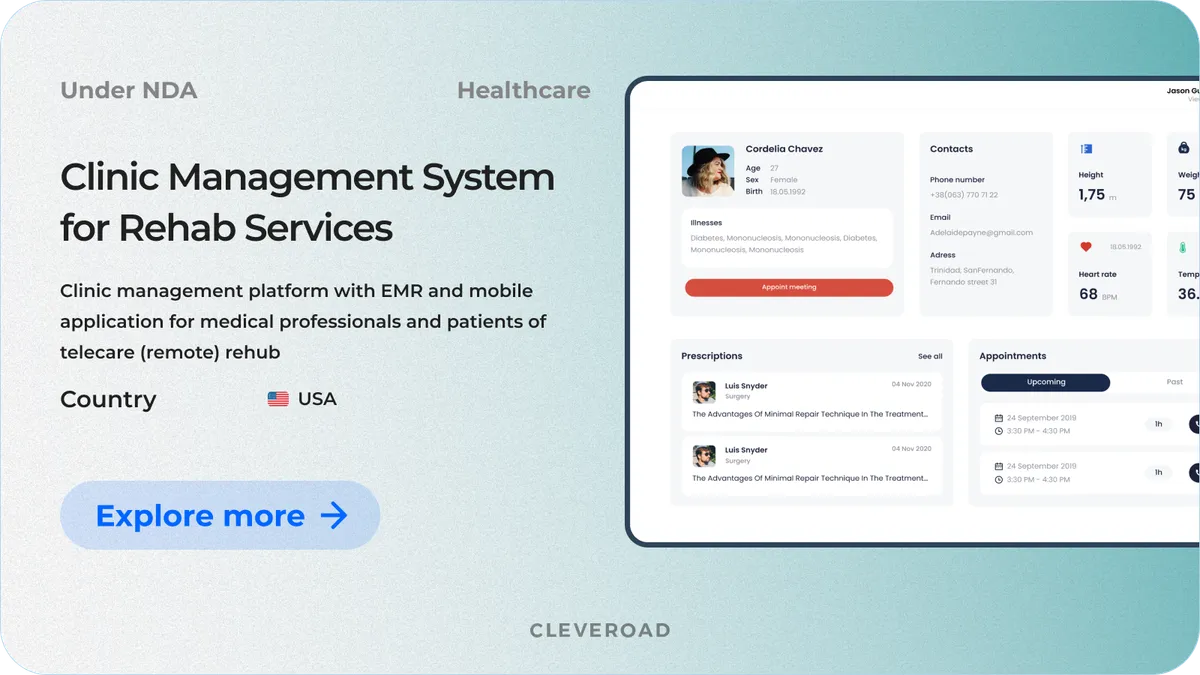
Clinic Management System interface
Our client is a healthcare organization in the United States. They needed a platform to manage appointments, patient information, and internal healthcare processes. Cleveroad developed a custom system with patient record management and tools to organize daily clinic operations.
As a result, the client received a unified healthcare platform that centralized patient information, organized workflows, and simplified daily clinic management, while reducing system maintenance costs by 30% and improving overall long-term profitability.
Build your custom healthcare CRM
Our team will design, develop, and integrate a compliant healthcare CRM tailored to your workflows, patient engagement needs, and regulatory requirements
A healthcare CRM is a specialized customer relationship management system designed for medical organizations. Unlike regular CRM software, it manages patient interactions, tracks medical workflows, ensures data privacy, and supports compliance with healthcare regulations such as HIPAA. Key features include patient profiles, appointment scheduling, communication tracking, and workflow automation.
Healthcare CRM costs vary depending on scope, integrations, and complexity:
- Focused MVP: $40,000-$80,000 - includes patient data, scheduling, and basic automation
- Custom CRM: $80,000-$200,000 - adds marketing automation, referrals, analytics, and integrations
- Enterprise / multi-entity: $200,000-$400,000+ - includes deep EHR/legacy integration, AI-powered engagement, and advanced analytics
Final costs depend on compliance requirements, AI features, cloud infrastructure, and the number of users.
Healthcare CRMs extend general CRM capabilities to meet medical-specific needs:
- Patient-focused: Tracks the full patient journey, not just sales leads
- Compliance-driven: Manages PHI and ensures HIPAA/GDPR adherence
- Integrated with medical systems: Connects with EHRs, telemedicine tools, and hospital workflows
- Enhanced communication: Supports personalized patient outreach via multiple channels
- Analytics: Provides insights on patient engagement, appointment no-shows, and retention trends
AI improves patient engagement and operational efficiency:
- Predictive patient engagement: Identifies no-show risks, churn patterns, and engagement opportunities
- Chatbots and virtual assistants: Automate routine patient queries and appointment scheduling
- Data-driven insights: Segment patients, personalize communication, and optimize workflows
- Forecasting: Predicts patient needs and resource allocation
AI helps providers maintain high-quality care while reducing manual administrative work.
- Custom solution: Best if you need tailored workflows, deep integration with existing systems such as EHRs or telemedicine platforms, or AI-powered features for predictive patient engagement.
- Off-the-shelf CRM: Suitable for faster deployment with standard features, workflows that fit ready-made templates, or when budget limits full custom development.
Custom healthcare CRMs offer flexibility and scalability, while off-the-shelf solutions can reduce initial investment and time to launch.

Evgeniy Altynpara is a CTO and member of the Forbes Councils’ community of tech professionals. He is an expert in software development and technological entrepreneurship and has 10+years of experience in digital transformation consulting in Healthcare, FinTech, Supply Chain and Logistics
Give us your impressions about this article
Give us your impressions about this article