Programming Outsourcing: Revealing Strengths and Weaknesses
Updated 26 Dec 2025
12 Min
3065 Views
Outsource programming is essential when a company needs additional engineering capacity, faster delivery, or specialized expertise without expanding its in-house team. It works well for startups, scale-ups, distributed teams, and enterprises with clear product ownership and scope.
When executed correctly, software development outsourcing enables predictable delivery across a defined tech stack. Results depend on selecting a capable outsourcing provider, setting clear boundaries, and managing risks early. Cleveroad has delivered 200+ projects through long-term outsourcing partnerships for enterprises and scaling products, supporting structured delivery, controlled growth, and stable quality across distributed teams.
This article explains where programming outsourcing creates value, where it introduces limitations, and how to approach it as an engineering process rather than an ad hoc decision. You will also find out:
- When outsourcing engineering is technically viable
- Where programming outsourcing introduces risk
- How to structure outsourcing for long-term delivery
What Is Programming Outsourcing?
Programming outsourcing is not just hiring external developers to write code. It is a delivery model where you extend or partially replace in-house software engineering capabilities. This setup works when speed, cost control, or access to specific expertise matters more than full internal ownership. Engaging external IT teams allows you to execute complex work faster while maintaining strategic control over product direction.
Unlike broad IT outsourcing, programming services engagement focuses specifically on building and maintaining production-ready software solutions such as mobile and web applications, or enterprise systems. Delivery responsibility with outsourced programming is assigned to a third-party IT partner providing skilled engineers, proven processes, and infrastructure aligned with project goals.
Companies typically consider outsourcing when they need to accelerate development, cover skill gaps, or scale delivery without expanding internal teams.
Development tasks you can outsource
Not all technical work carries the same level of risk when outsourced. A practical way to decide what to delegate is to evaluate how strongly each task affects the core software product, its architecture, and long-term ownership.
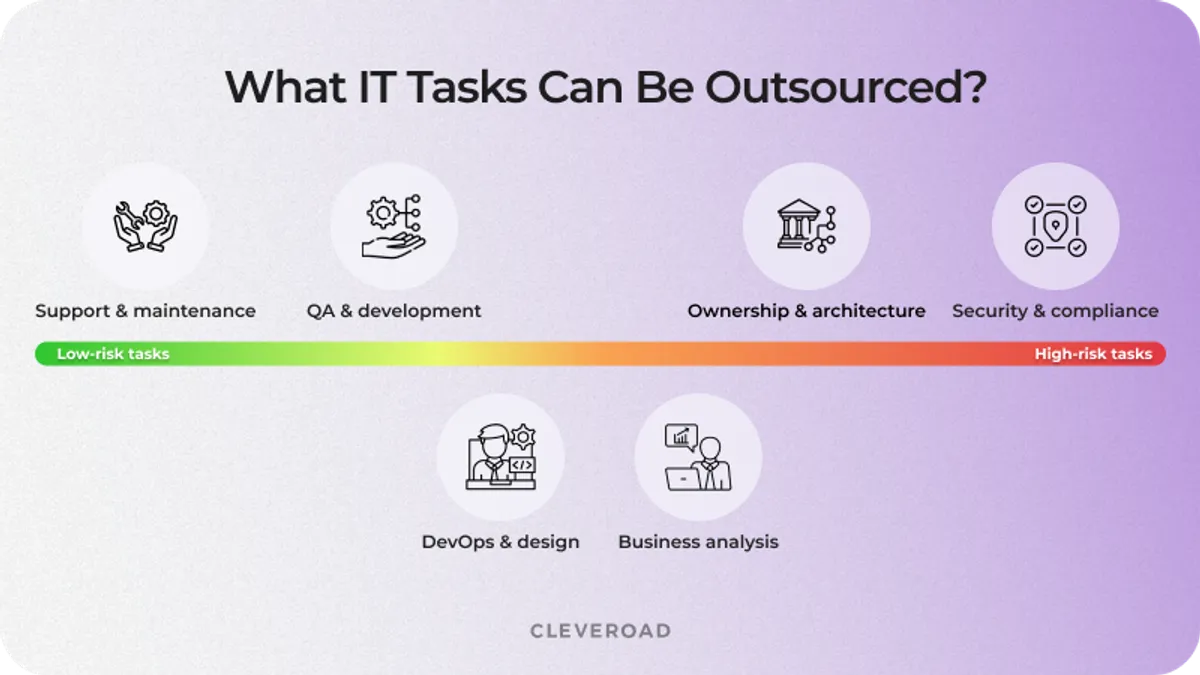
What tech tasks can be outsourced
Low-risk tasks (safe to outsource)
These activities have minimal impact on product direction and are easy to manage through defined processes and metrics:
- Support and maintenance, including bug fixes, monitoring, and incident response
- Software testing, both manual and automated, with clear test cases
- Development itself, such as frontend development without core business logic
Because these tasks have clear inputs and outputs, you can outsource software development in these areas with predictable results, even when working with a distributed outsourcing programmer or external team.
Medium-risk tasks (outsourcing with governance)
The following functions can be delegated successfully but require structured oversight and validation:
- DevOps and cloud operations, including CI/CD pipelines and infrastructure management
- UI/UX design, provided that product owners validate user flows and design decisions
- Business analysis, focused on requirements gathering, documentation, and backlog refinement
Such responsibilities are often mishandled when treated as plug-and-play outsourcing services. Clear governance and shared ownership help prevent misalignment and delivery gaps.
High-risk tasks (usually kept in-house)
Some programming outsourcing responsibilities are tightly coupled with long-term business and technical decisions and should remain internal:
- Product ownership and roadmap decisions
- Core system architecture and technical direction
- Security, compliance, and data governance decisions
Keeping these areas in-house allows companies to combine internal leadership with external execution and achieve the best outsourcing outcomes without losing control over critical decisions.
Most Common Outsourcing Models
Modern outsourcing offers multiple engagement models aligned with delivery speed, control, risk management and integration needs. Below are the three most common cooperation formats used to outsource programmers at different growth stages.
IT Staff Augmentation
IT staff augmentation is most effective when a company needs to temporarily increase internal engineering capacity by adding a specific software development role. During IT staff augmentation services, external engineers join an existing team and follow the client’s processes, tools, or technical leadership. It is often used to cover short-term skill gaps or accelerate delivery without changing internal ownership.
IT staff augmentation suits organizations with established workflows that require flexible capacity without long-term team commitments, and is commonly used for IT programmer outsourcing when internal resources are constrained.
Discover IT staff augmentation as a scalable cooperation model for addressing engineering capacity constraints
Dedicated development team
A dedicated development team is a long-term collaboration model where a vendor provides a stable, full-cycle team focused exclusively on one software product. The team typically includes developers, QA engineers, and a project manager who work as an extension of the client’s organization. This model suits companies that want to outsource software development while retaining strategic control and predictable delivery.
Dedicated teams are often used for continuous development, scaling, and product evolution. Such a cooperation model provides access to a skilled programming workforce without the overhead of internal hiring.
Custom software development
Custom software development services, also known as project-based engagement, are used when the scope, timeline, and deliverables of a development project are clearly defined upfront. Within this engagement structure, the vendor assumes full responsibility for delivery throughout the entire project lifecycle, based on agreed requirements.
It works well for MVP development, standalone platforms, or time-bound initiatives where outcomes matter more than team composition. You often choose this format when your company needs reliable programming outsourcing services with fixed milestones and costs. Project-based delivery is effective for launching or modernizing a product without building internal engineering capabilities.
Comparing these outsourcing models side by side, the table below highlights their key differences in control, scope, and real-world use cases.
| Model | Level of control | Typical scope | Key advantage | Best for |
|---|---|---|---|---|
IT staff augmentation | High | Specific roles or expertise added to an internal team | Fast access to engineers without changing processes | Covering skill gaps and scaling existing teams |
Dedicated development team | Medium to high | Ongoing development and product evolution | Stable team aligned with business goals | Long-term product development and scale |
Custom software development | Medium | Full delivery of a defined project | Predictable timelines and deliverables | Clearly defined, time-bound work |
Key Benefits of Programming Outsourcing
Modern outsourcing models support flexible engineering capacity and predictable delivery. Your company can outsource programming services to reduce execution risk and accelerate development without expanding internal teams.
Price optimization and scalability
A key advantage of outsourcing lies in cost control combined with flexible resource scaling. By working with external teams, companies avoid long-term hiring commitments and can adjust capacity based on the scope of a development project.
Outsourcing allows teams to increase resources during peak workloads and reduce them once key milestones are completed. Cost efficiency improves further when companies engage outsourcing programmers only for the duration and skill set required.
End-to-end execution and expertise
Outsourcing providers often deliver full-cycle support, covering analysis, design, implementation, and maintenance. This structure supports product development initiatives that require coordinated execution rather than isolated tasks.
Vendors offering mature software development services typically follow structured workflows that reduce handoffs and delays. As a result, the entire development process becomes more predictable and easier to manage.
Faster time-to-market
Speed is a critical factor for many digital products. Outsourcing enables companies to assemble ready-to-work outsource programmers teams without spending months on recruitment and onboarding.
Parallel development streams, established delivery practices, early risk mitigation, and prior domain experience help reduce release cycles and improve delivery predictability. This acceleration is especially valuable when your company is entering new markets or responding to competitive pressure.
Access to new technologies
Outsourcing also opens the door to skills that may be difficult or expensive to build internally. Many vendors maintain a skilled programming workforce with hands-on experience in emerging frameworks, cloud platforms, and AI-driven solutions. Such an access allows companies to adopt new technologies faster without investing heavily in internal training or experimentation.
These benefits are reflected in real client outcomes. One of our long-term outsourcing clients, AVFX, shares how structured delivery, technical expertise, and predictable collaboration translated into measurable results when working with Cleveroad:
AVFX & Cleveroad: A Successful Technology Partnership - Client Testimonial
How to Outsource Programming and Succeed?
Successful programming outsourcing is not about delegating tasks as quickly as possible. It is a structured process that starts with clear ownership and ends with predictable delivery. Companies that approach outsourcing systematically reduce execution risks, avoid rework, and keep control over product quality.
The steps outline how to outsource programming for long-term results, not short-term fixes.
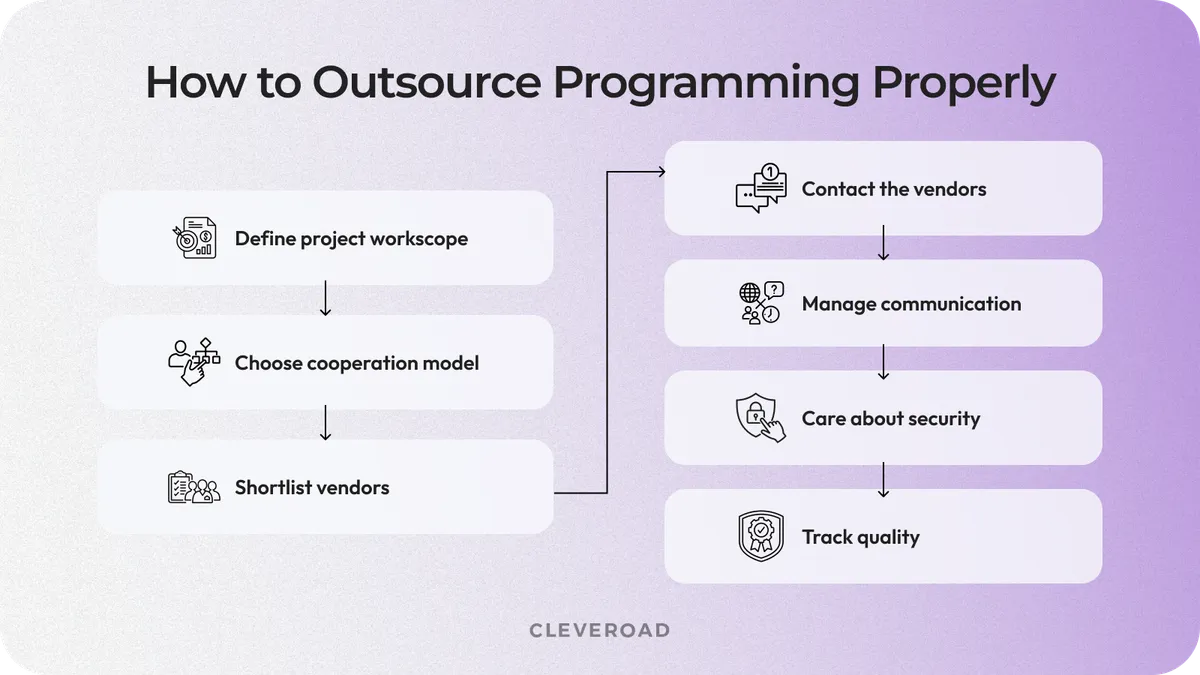
How to outsource programming properly
Step 1. Define project workscope
The first step is defining what exactly should be built and what falls outside the scope. This includes business goals, core features, constraints, expected outcomes, and success metrics. A clear workscope prevents scope creep and reduces misunderstandings once development starts.
At Cleveroad, engagement starts with a free Solution Design Workshop that helps transform high-level ideas into a clear project scope, validated requirements, and initial architecture decisions. During this workshop, teams analyze business goals, user flows, and technical constraints to align expectations and surface risks before development begins.
Step 2. Choose a cooperation model
Different projects require different engagement formats depending on control, timeline, internal capacity, and other essential points. Choosing the right cooperation model determines how responsibilities are shared and how decisions are made in programming outsourcing.
Cleveroad helps clients select between Staff Augmentation, Dedicated Team services, or project-based delivery based on project maturity and risk tolerance. This selection defines how the outsourcing partner integrates into existing workflows and governance structures. A poorly chosen model often leads to misaligned expectations or cost overruns. But the right setup creates predictability and scalability from the start.
Step 3. Shortlist vendors
Shortlisting vendors goes beyond comparing ratings and hourly rates. To build a meaningful shortlist, review company websites and portfolios to find projects similar in scope, industry, or technical complexity. Client feedback on B2B hiring platforms such as Clutch and GoodFirms also helps validate delivery reliability, communication quality, and long-term performance. Together, these sources provide a more complete picture of domain expertise, delivery history, and the depth of available tech talent.
Cleveroad’s portfolio demonstrates production-ready results across regulated and high-load environments, showing how complex challenges were addressed in real projects. This helps narrow down development companies that can realistically support your project’s complexity and reduces risk early in the selection process.
You can also check our Clutch page to review verified client feedback and validate delivery reliability
Step 4. Contact the vendors
Initial conversations with vendors often determine whether outsourcing will succeed or fail. Live discussions reveal far more than proposals or price estimates, helping you evaluate how clearly a team understands your goals and how confidently it can challenge assumptions.
At Cleveroad, we know from practice that this step is critical for making the right outsourcing decision. One of our clients, Betabox, approached vendor selection by requesting a Discovery phase from several shortlisted companies to compare their processes side by side. After completing a free Solution Design Workshop and a full Discovery phase with Cleveroad, the Betabox team was impressed by how clearly we captured their business logic, budget constraints, and quality expectations. Our deliverables proved to be the most structured, transparent, and aligned with their goals, which ultimately led them to choose cooperation with Cleveroad.
Learn more about the project and Sean Newman Maroni’s experience in the video testimonial below.
AVFX & Cleveroad: A Successful Technology Partnership: Client Testimonial
Step 5. Manage communication
Strong communication is what keeps programmer outsourcing predictable rather than stressful. When channels, routines, and responsibilities are unclear, even experienced outsourcing teams slow down.
Cleveroad establishes a clear communication structure from the start of cooperation. We align meeting schedules and sprint reviews in advance, selecting time slots that work for all stakeholders across time zones. A dedicated Slack channel is set up at the beginning of the project to handle ongoing questions, updates, and quick clarifications without delays.
Regular syncs, sprint demos, and transparent reporting ensure you always know who owns decisions and what the next steps are. This setup keeps progress visible, prevents issues from getting lost in message threads, and helps communication directly support delivery rather than create friction.
Step 6. Care about security
Security becomes a critical factor as soon as companies consider outsourcing programming, especially when development involves sensitive data, intellectual property, or regulated environments. Regardless of the type of programming outsourcing you choose, gaps in security planning often lead to compliance issues, access risks, or costly changes late in delivery.
Many teams underestimate this step when choosing to outsource programming, focusing on speed or cost instead of long-term protection. As a result, security problems surface only after development starts, when fixing them becomes significantly more expensive.
Cleveroad addresses security from the start of cooperation. Before development begins, we align access rules, IP ownership, data handling standards, and compliance requirements with the client. NDAs are available from the first contact, and role-based access applies across tools and infrastructure. With ISO/IEC 27001–certified processes, Cleveroad ensures predictable security management aligned with international standards.
Step 7. Track quality
Quality determines whether outsourcing feels predictable or risky. Without continuous control, issues surface late and create stress at release time, especially when working with distributed teams and complex software development outsourcing models. Ongoing quality tracking gives teams confidence that delivery stays stable as scope or priorities change.
At Cleveroad, quality management is built into delivery. QA activities run alongside development through regular testing, code reviews, and clear quality metrics. Our PM Office oversees delivery standards, sprint outcomes, and risk signals across projects, aligning engineering work with business expectations. This approach differentiates reliable software development companies and allows you to delegate software delivery while keeping full visibility and confidence in results.
Plan to outsource IT?
Learn how to manage scope, vendors, and risks with our free guide



Why Outsource Programming to Cleveroad?
Cleveroad is an experienced outsourcing vendor with more than 15 years of hands-on software development outsourcing experience. We support startups, mid-sized businesses, and enterprises in delivering reliable software development projects.
We provide IT services across Healthcare, Logistics, FinTech, Retail, and other business domains supporting custom software development and long-term product scaling. Our teams handle architecture, development, quality assurance, and ongoing support, allowing you to focus on business priorities while confidently outsourcing programming tasks.
As one of the trusted programming companies working from Central and Northern Europe, a well-established popular outsourcing destination, Cleveroad combines strong technical education, mature engineering practices, and high communication standards. We act as a long-term program outsourcing partner, adapting team structures and processes to client goals.
When you choose Cleveroad for programming outsourcing, you benefit from:
- Solution Design Workshop. We start with a free workshop that helps turn your idea into a clear project scope, validated requirements, and an initial delivery roadmap before development begins.
- Extensive talent pool. Cleveroad provides access to 280+ in-house engineers and a 3,000+ specialist internal talent base, allowing us to quickly assemble teams with the right skills and scale delivery without delays or hiring risks.
- Seamless integration with your environment. Cleveroad engineers work within your tech stack and workflows, integrating smoothly with internal teams, legacy systems, and third-party tools.
- R&D centers for innovation and experimentation. Cleveroad leverages dedicated R&D centers to explore new technologies, test architectures, and validate technical approaches before full-scale development, helping reduce implementation risks and accelerate informed decision-making.
- Quality and security by default. ISO 9001:2015 and ISO/IEC 27001:2013 certified processes ensure consistent quality, data protection, and compliance across every stage of cooperation.
Let us share some of the outsourcing projects we’ve recently delivered to our clients:
- Versatile Video-on-Demand Platform. A scalable video-on-demand platform designed to support content streaming, user management, and monetization features. The project involved a team of 8 IT experts, including frontend and backend developers, a QA engineer, a UI/UX designer, and a PM.
- Field service system for trading activity. A field service management system built to coordinate on-site operations, track tasks, and support real-time reporting for trading activities. The solution was delivered by 7 specialists, including backend and mobile developers, a business analyst, QA engineer, and a delivery manager.
- Micro-investment platform for EMEA region. A secure FinTech platform that enables micro-investments, user onboarding, transaction processing, and regulatory compliance across multiple EMEA markets. The outsourcing team consisted of 9 IT experts, including FinTech-focused backend developers, frontend engineers, QA specialists, and a product-oriented PM.
- IoT-based system for monitoring EKG. A healthcare IoT system designed to collect, process, and visualize ECG data from connected devices for remote patient monitoring. The project was implemented by 10 professionals, including IoT engineers, backend developers, mobile developers, QA engineers, and a healthcare-experienced solution architect.
Cooperate with a reliable IT partner
Strengthen delivery with experienced engineers and 15+ years of expertise, integrated into your workflows to help you ship faster without losing control.
Programming outsourcing is the delegation of software development tasks and responsibilities to third-party vendors that provide IT services and have all resources to deliver them.
There are several pros of programming outsourcing:
- Quick hiring
- No boundaries in the hiring process
- No extra expenses
- Step #1. Define all crucial info about your app (features, platforms, business goals and so on).
- Step #2. Choose the region where you'll outsource your app.
- Step #3. Conduct a company research
- Step #4. Make first contact with companies you like and discuss further options for cooperation.
- Step #5. Make a final decision.
There are a few nuances that may impact the overall decision on whether to outsource programming or not:
- Communication inconveniences
- Less control over the project
- Security risks

Evgeniy Altynpara is a CTO and member of the Forbes Councils’ community of tech professionals. He is an expert in software development and technological entrepreneurship and has 10+years of experience in digital transformation consulting in Healthcare, FinTech, Supply Chain and Logistics
Give us your impressions about this article
Give us your impressions about this article
Comments
4 commentsThis article convinced me to outsource my project. First, I wanted to organize my in-house team. But after your article, I like the idea of outsourcing the development of my project. Thanks a lot!
Thanks for the explanation, you did a great job!
Great article. Recently I outsourced my project. It took me a couple of months to choose a company. As for the communication troubles, it's partially true since I have a huge time-zone difference.

Nice article! It helped a lot!