Uber For Trucking App Development: Everything You Should Know in 2026
Updated 03 Mar 2026
16 Min
5732 Views
Truck app development in 2026 focuses on building digital freight platforms that connect shippers, carriers, brokers, and fleet operators in real time, reduce empty miles, automate load matching, and improve shipment visibility across the supply chain. Well-designed platforms can reduce empty miles, accelerate load assignment from hours to minutes, and improve on-time delivery rates through automated dispatching and tracking.
The other business reasons to start trucking app development include measurable operational gains, such as:
- Reduced empty miles and idle time
- Faster book-to-assign cycles
- Improved on-time performance
- Lower cost per shipment and cost per tender
Cleveroad brings hands-on experience in building logistics software solutions with high-load routing engines, custom load-matching algorithms, real-time telematics integrations, and integration-ready architectures designed for cross-border freight operations. We help transportation and supply chain companies design scalable digital platforms that automate dispatching and optimize fleet usage, as well as improve operational control while maintaining compliance and performance stability.
In this article, we’ll discuss key points of on demand trucking app development, including current market challenges, essential features, and monetization strategies.
Trucking App Development Basics: How Does The Uber For Trucks App Work?
Trucking application is a B2B transportation platform designed to streamline logistics operations by connecting shippers and verified carriers through automated load matching, real-time tracking, automated rate calculation, and structured settlement workflows. This logistics software centralizes load posting, rate confirmation, dispatching, and payment in a single integrated digital environment.
Depending on business objectives, such platforms can take different structural forms:
- A digital freight marketplace focuses on direct shipper–carrier matching, with automated pricing and dispatch logic.
- A load board platform aggregates available loads and carrier capacity, with limited control over execution.
- TMS-first solution integrates booking and tracking into a broader transportation management ecosystem.
- Broker-centric dispatch platform prioritizes full operational oversight, structured carrier vetting, margin control, and end-to-end compliance management.
Understanding which model fits your strategy is critical before starting development, as each type requires different levels of architectural complexity, integration depth, and compliance workflows.
To better understand how these models function in practice, let’s break down the core operating mechanism of trucking apps.
| Stage | Action | System logic | Business outcome |
|---|---|---|---|
Load creation | Shipper enters load details | Data validation & structuring | Standardized load submission |
Rate calculation | System auto-generates pricing | Pricing rules & lane data | Faster quoting |
Load matching | Platform suggests verified carriers | Compliance & score filtering | Better carrier selection |
Dispatch confirmation | Carrier confirms terms | Dispatch logged, rate locked | Clear booking terms |
Shipment tracking | GPS provides updates | Real-time status sync | Full shipment visibility |
Settlement | Payment released after POD | Automated settlement | Faster reconciliation |
Depending on business strategy, you may choose to develop a fully custom mobile app or adopt a white-label marketplace solution to reduce time to market. In both cases, partnering with an experienced app development company ensures that integrations and performance scalability are handled correctly from the start.
Reasons to Develop Your Own Uber-Like Trucking App
Digital freight platforms directly influence margin stability and asset utilization for the trucking industry. The value of an Uber-like trucking solution lies not in generic automation claims, but in measurable operational performance improvements across a modern logistics business.
Below are the core business drivers behind Uber for trucking app development.
Reduced empty miles and idle time
Empty miles are a major cost leak in trucking operations: ATRI reports that 15.4% of non-tanker mileage is deadhead, i.e., miles that don’t generate revenue and aren’t covered by fuel surcharges. A digital matching engine connects available capacity with nearby loads, reducing deadhead distance and idle time for each trucker on the road.
Faster book-to-assign cycles
Faster book-to-assign cycles help you secure reliable carriers before competitors react. Automated load matching within a scalable logistics app reduces the time between load posting and carrier confirmation from hours to minutes. Instant rate visibility and digital acceptance remove back-and-forth negotiations, enabling your dispatch team to lock capacity quickly and protect revenue opportunities.
Improved on-time performance
Reliable on-time delivery directly impacts customer retention, contract renewals, and long-term revenue stability. Real-time tracking and automated alerts give your company full shipment visibility, improving transparency and confidence in your service. Structured dispatch workflows minimize communication gaps and reduce the risk of delays caused by manual coordination errors. As a result, on-demand trucking app development becomes a strategic move to strengthen client relationships and consistently meet service-level commitments.
Lower cost per shipment and cost per tender
When you rely on manual brokerage workflows, you increase administrative expense with every additional shipment. According to McKinsey, logistics companies that digitize core workflows can reduce administrative and planning costs by up to 15–20%, while improving execution speed. Automated rate calculation, digital documentation, and streamlined settlement workflows significantly reduce handling effort and tender processing time.
A centralized platform allows you to lower the cost per shipment without increasing shipment volume, which protects margins through operational efficiency. Achieving this level of optimization requires a structured development process aligned with operational priorities.
Looking to try other Uber-like apps? Consider transportation app development to improve logistics operations
Core On-Demand Trucking App Development Features
A freight tracking application must be built around a clearly defined set of core capabilities to ensure accurate shipment visibility and operational control. Real-time location updates, automated milestone tracking, alert systems, and centralized monitoring are essential for maintaining delivery reliability and preventing service disruptions. These foundational features enable consistent coordination between carriers, shippers and other experts.
These are the essential components of a production-ready freight platform.
Trucking app functionality for shippers
The shipper interface is designed to simplify freight booking while giving businesses full control over their shipments. It allows users to create loads, compare rates, track deliveries in real time, manage documents, and communicate with carriers in one place. So let’s find out the major features for shippers in your trucking app:
- Load creation and structured tendering. Shippers create loads with detailed parameters and distribute them through contract or spot-based tender workflows.
- Automated rate calculation. The platform applies lane intelligence, historical pricing, and market data to generate dynamic quotes. So, the rate calculation feature ensures the platform operates as a comprehensive app solution.
- Carrier compliance and performance visibility. Only verified carriers meeting insurance, authority, and safety standards are eligible for load assignment. Performance dashboards display reliability metrics and service-level indicators.
- Real-time tracking and exception alerts. Shipment visibility is powered by telematics feeds and milestone tracking. Automated alerts notify your trucking experts before delays escalate into SLA violations.
- SLA monitoring and analytics. Aggregated delivery metrics provide insights into contract adherence.
- Digital documentation and approval workflows. Invoices, POD files, and billing
Trucking functionality for carriers
Core trucking functionality allows carriers to receive loads, follow optimized routes, update shipment statuses, and submit delivery documents within the platform. QA engineers validate the system before release through manual and automated testing to ensure stable performance and correct feature operation. The goal is to deliver a reliable solution that runs smoothly in production.
Core features for carriers app include:
- Load details and pricing transparency. Carriers access structured load data, including pickup and delivery windows, cargo specifications, etc. Integration with an API for shipping ensures standardized data exchange across marketplaces, TMS platforms, external systems, etc.
- Intelligent load recommendations. Rather than displaying a static list of loads, the platform prioritizes algorithm-driven suggestions based on lane history, equipment type, safety score, and availability.
- Accessorial and detention logging. Time-based shipment events such as detention or layovers are recorded automatically and attached to billing workflows.
- Navigation and telematics integration. Built-in route optimization integrates with GPS and ELD systems. Advanced routing and compliance synchronization can be powered through a dedicated Trucking API, enabling real-time route updates and hours-of-service awareness.
- Digital proof of delivery and document handling. Drivers upload POD files, bills of lading, shipment photos and other essential content directly through the application.
- Settlement visibility and payout options. Carriers can monitor payment status and access accelerated payout mechanisms where applicable.
Admin features for a trucking app
Admin features for a trucking app allow operations specialists to monitor active shipments and manage carrier compliance, controlling dispatch workflows from a centralized dashboard. They also provide visibility into performance metrics and financial activity, helping maintain operational transparency and strategic control.
Let’s discuss the features you need for the admin panel to ensure marketplace integrity and financial accuracy.
- Carrier onboarding and verification. Automated validation of authority, insurance, and safety ratings ensures regulatory compliance.
- Risk scoring and fraud detection. Behavioral monitoring detects duplicate payments, identity fraud, and suspicious billing patterns.
- Rate and pricing configuration. Admins manage lane strategies, pricing rules, and accessorial logic in one system.
- Revenue analytics and performance tracking. Dashboards show shipment profitability and carrier efficiency.
- Settlement automation and dispute handling. Structured workflows streamline claims resolution and payment approvals.
- Role-based access governance. Multi-level permissions ensure security across internal teams and partners.
Build a robust feature set for your truck app
We help you prioritize MVP functionality, while avoiding unnecessary complexity, and implementing a scalable freight platform for your logistics needs
Advanced competitive capabilities
These are the advanced features you can implement in your trucking software to remain competitive and extend beyond booking and tracking.
- AI-driven capacity forecasting
- Lane profitability analytics
- Exception management automation
- Multi-language support for cross-border freight
- Weather and traffic impact notifications
Some companies accelerate time to market using a white-label foundation and then extend it with custom modules. However, even in such cases, long-term scalability still depends on structured architecture and integration planning.
Before scaling advanced functionality, validate your scope and assumptions. You can explore guidance on how to develop an MVP before committing to full marketplace expansion
Basic Steps for Trucking App Development From Scratch
Planning to create trucking software, you may apply to a skilled outsourcing IT vendor for collaboration. Below, we’ll view how an Uber-like truck app is developed on the example of Cleveroad’s Software Development Lifecycle (SDLC).
1. Solution Workshop and Discovery Phase
At the Solution Workshop stage, we align your business objectives with the technical architecture of the future freight platform, whether you plan a custom solution or a white label truck booking app. Our Solution Team, including business analysts, solution architects, and designers, analyzes your operational model and capacity structure, as well as truck management workflows to define the optimal scope. The goal of our specialists is to translate business challenges into a structured technical proposal, including a team composition and a preliminary cost estimate.
During the Discovery phase services, we transform validated assumptions into a detailed execution plan tailored for logistics companies operating in competitive freight environments. At this stage, we refine the feature breakdown, confirm integrations, define non-functional requirements, and prepare architecture documentation. Our deliverables at this step typically include:
- High-level feature list
- Architecture and process diagrams
- Sprint-based estimation with timeline and budget projection
2. UI/UX design creation
For truck app development, our designers create structured UX maps, user flows, and interface concepts tailored to trucking operations. Each screen and module supports real freight workflows while maintaining usability standards.
During Uber-like trucking app development, we validate design decisions against real operational scenarios to reduce friction and improve task completion speed. Our QA engineers review interface elements to ensure accuracy, responsiveness, and cross-platform consistency before development begins.
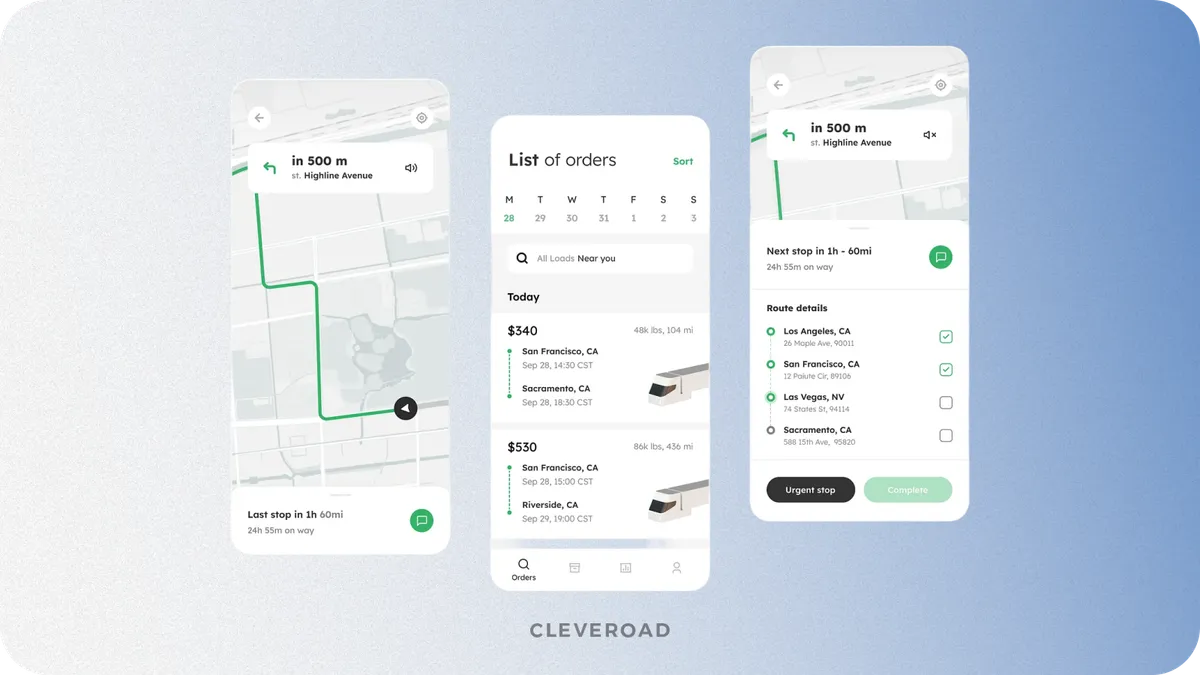
Delivery driver app for logistics company designed by Cleveroad
3. Product development & QA
After the UI/UX design is complete, it’s time for the trucking custom app developers to join the project. They bring the earlier-defined functionality to life, working in sprints — 2-3-week working periods, after which separate features or entire functionality are ready.
QA engineers validate the platform before release to ensure stable performance and correct functionality across all scenarios. They test overall system behavior and verify each feature, checking integrations under real-world conditions while using both manual and automated methods. The goal is to deliver a reliable solution that runs smoothly in production and supports uninterrupted operations.
4. Release and post-launch support
After completing testing, the team prepares your platform for production release across mobile marketplaces or a live web environment. Whether you deploy a custom platform or a white label trucking app solution, we ensure a stable launch aligned with your operational requirements in trucking and logistics. Once approved, you receive full project documentation, source code, system credentials, and deployment assets for complete ownership and transparency.
As needed, our work continues beyond release as your platform evolves into a scalable truck dispatch software ecosystem. We provide ongoing support, performance optimization, and feature expansion to strengthen your truck management systems demand grows. Continuous improvements help maintain stability, enhance efficiency, and support long-term revenue generation.
Explore Cleveroad logistics software development services and get intelligent domain platforms that streamline dispatch and optimize routes, while strengthening operational control
How to Monetize Uber Truck App
Monetization strategy plays a central role in Uber for trucking app development, since revenue logic must align with the marketplace structure and operational model. Sustainable digital freight platforms generate income by creating value for shippers and carriers rather than relying on consumer-style advertising models.
These are the most scalable monetization approaches used in modern freight ecosystems.
Take rate
If your platform operates as a broker, revenue is generated through a structured take-rate between shipper pricing and carrier payouts. This monetization model is common when companies aim to build an app like Uber for freight brokerage while maintaining control over pricing. The platform retains a brokerage margin per transaction while managing dispatch and settlement workflows.
Subscription model
Recurring subscriptions provide predictable revenue streams in a competitive freight environment. Shippers may pay for advanced analytics, lane intelligence, or priority access to capacity, while carriers can subscribe to premium load visibility and payout options. Subscription model is frequently considered during truck booking app development when long-term platform scalability is a goal.
SaaS fee for TMS modules
When the trucking solution includes transportation management capabilities, revenue can be generated through SaaS licensing of dispatch, compliance, and reporting modules. Investing in broader logistics app development, you often extend the freight platform beyond load booking to include operational control tools. It creates recurring B2B revenue rather than purely transactional income.
Transaction fees
Financial workflow monetization includes fees for payment processing, factoring services, insurance integrations, and accelerated settlements. An app like Uber Freight typically embeds these transaction layers directly into the settlement engine.
Value-added services
Advanced freight platforms increase revenue through additional operational services such as enhanced tracking, automated claims handling, and detention monitoring. These services become especially important when building a truck app like a full-scale freight marketplace. Companies that invest in structured mobile app development can integrate these services seamlessly within user workflows.
Successful monetization models combine brokerage margins, SaaS subscriptions, value-added service fees, and transaction-based revenue streams to ensure long-term sustainability. You can contact us for a consultation to define the right revenue model for your freight platform and align it with your development strategy.
How Much Does It Cost to Develop a Trucking App Like Uber for Trucks?
The cost of developing an Uber-like trucking platform typically ranges from $30,000 to $120,000+, depending on feature scope, integration complexity, and platform architecture. When estimating your project, consider that such a solution typically includes two core apps for drivers and shippers, plus an admin panel, which impacts both timeline and budget.
Below is a sample estimate covering basic functionality for iOS and Android mobile apps, as well as a web-based platform. The calculation is based on an average $50/hour development rate, which reflects common pricing across the Central and Northern Europe region.
| Type of work | Estimated hours | Estimated cost |
|---|---|---|
Driver app features | 300-400 h | $15,000-$20,000 |
Shipper app features | 300-420 h | $15,000-$21,000 |
Web admin panel | 120-180 h | $6,000-$9,000 |
API & integrations | 200-350 h | $10,000-$17,500 |
UI/UX design | 180-260 h | $9,000-$13,000 |
Quality assurance | 220-320 h | $11,000-$16,000 |
Project management | 120-180 h | $6,000-$9,000 |
Total | 1,440-2,110+ h | $30,000-$120,000+ |
Note: The given evaluation created on the basis of the core trucking app functionality is approximate. You can contact our experts to obtain a customized project estimate based on your demands.
Talking about on demand trucking app development cost, you should also pay attention to the team location. So, let's now look at average hourly rates by region. Given current market conditions, we may indicate that an excellent way to reduce development expenses while maintaining top-notch performance is to outsource to Central and Northern Europe.
Here are additional factors that make this region attractive for software development. It offers access to a vast pool of skilled engineering talent and strong cost efficiency compared to Western markets. The region benefits from trade openness and a high level of technical education, which supports consistent development quality. At the same time, competitive software developer rates allow companies to optimize budgets without compromising expertise.
Below are the average hourly development rates for truck apps by region in 2026:
- North America: $130–$170 per hour
- Western Europe: $90–$130 per hour
- Central & Northern Europe: $50–$80 per hour
- Australia: $110–$150 per hour
Trucking App Development From Cleveroad
Cleveroad is an outsourcing logistics software development company located in the Central and Northern Europe region that has provided a great diversity of IT-related services for over 15 years. Our custom-developed software products optimize workflow productiveness, solve business challenges of logistics and supply chain, and ensure competitive benefits for our clients from startups.
Cooperating with us, you’ll receive:
- End-to-end trucking app development, starting from marketplace architecture and dispatch automation to telematics integration and settlement workflows
- ISO-certified security and quality management, ensuring reliable handling of operational and financial data
- Advanced integration expertise with TMS systems, telematics providers, payment gateways, and ERP platforms
- Experienced in-house team of 280+ engineers (25% senior) with 200+ successfully delivered digital products
- Free solution workshop to validate your freight platform concept, define scope, and assess technical feasibility before development
Let us demonstrate our experience in truck app development through the latest portfolio cases.
Route planning and transport management system
Our client, a logistics company operating in the freight transportation sector, required a reliable technology partner to modernize its dispatch and route-planning operations. The goal was to replace fragmented manual workflows with a centralized Transportation Management System that optimizes route allocation, monitors fleet performance, and improves shipment visibility across the supply chain.
We assembled a dedicated development team with expertise in logistics and fleet management software. The team designed a robust TMS platform tailored to the client’s dispatch model and business processes. The solution was built with a strong focus on route optimization logic, real-time tracking integration, and performance analytics to support data-driven decision-making.
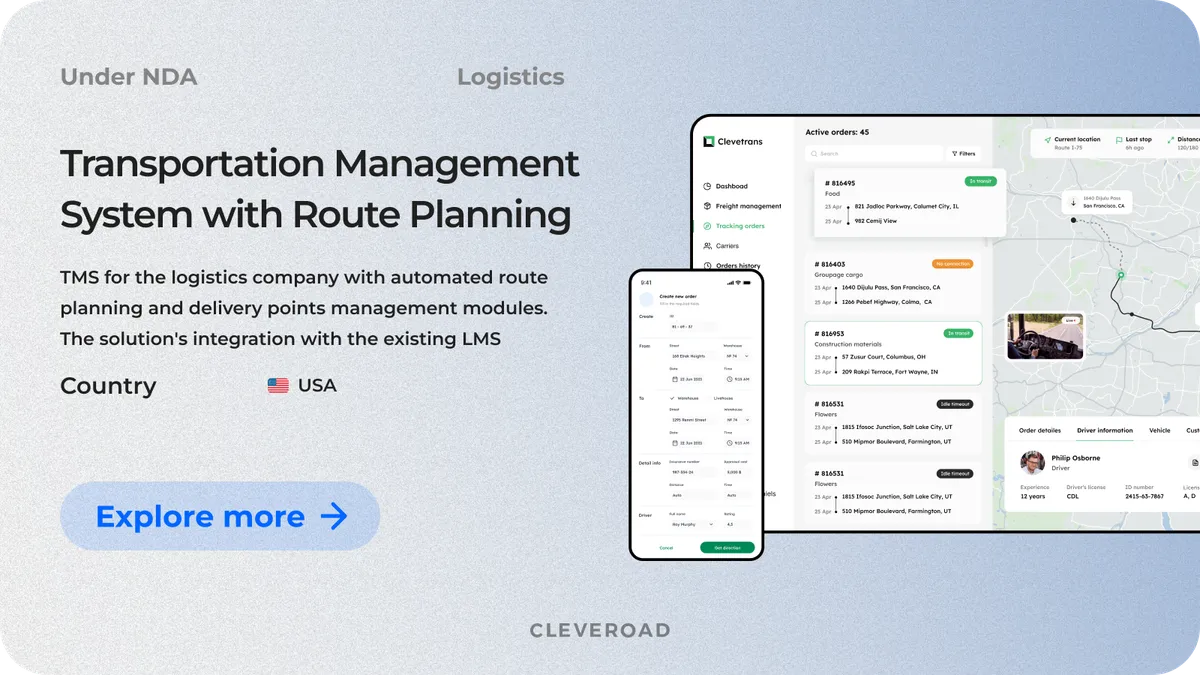
Transportation Management System developed by Cleveroad
As a result, the client received a comprehensive end-to-end truck management system that streamlined dispatching and reduced manual coordination efforts. The platform enabled automated shipment assignment, real-time monitoring of active deliveries, predictive route optimization, and centralized fleet control. By digitizing operational workflows and optimizing route planning, the company increased delivery reliability, enhanced asset utilization, reduced operational costs, and improved overall transportation efficiency.
P2P ridesharing solution
Our other client, a mobility-focused company, partnered with Cleveroad to develop a scalable P2P ridesharing platform that connects drivers and passengers in real time. The objective was to build a reliable digital ecosystem with transparent pricing and accurate geolocation, as well as seamless ride management to support efficient urban transportation.
After conducting discovery workshops and technical planning sessions, we assembled a dedicated team to design and implement a high-performance solution. The platform includes driver and passenger mobile apps along with an admin panel for dispatch control and payment management.
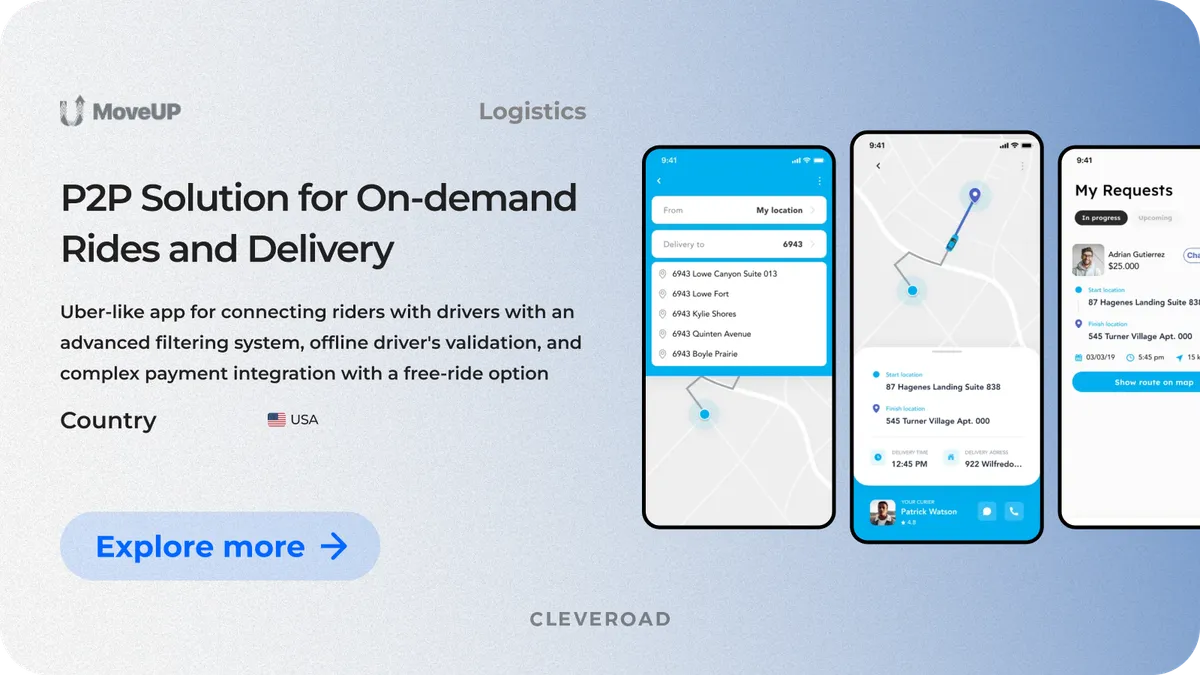
MoveUp mobility solution by Cleveroad
As a result, the client launched a fully operational ride-hailing system with real-time ride matching, route optimization, dynamic pricing, and secure payment processing. The solution provided a strong technical foundation for scaling operations and expanding into new markets.
This is what John Salmon, the founder of MoveUp, tells about cooperation with Cleveroad:
John Salmon, Founder at Unified Potential, Inc.dba MoveUP. Feedback about cooperation with Cleveroad
An Uber for trucking app operates as a digital freight marketplace that connects shippers with verified carriers through automated load matching and structured settlement workflows. Shippers post load details, the system calculates rates based on pricing logic or lane data, and the platform recommends loads to eligible carriers using algorithmic filtering.
Once a carrier accepts the load, real-time tracking via GPS and telematics provides shipment visibility until proof of delivery is confirmed. After delivery, automated settlement processes handle invoicing, accessorials, and payments according to agreed terms.
An Uber for trucks app delivers measurable operational improvements that directly impact margin stability and asset utilization across your logistics business. As a scalable mobile application, it replaces fragmented coordination with structured dispatch, tracking, and settlement logic. Whether you build a custom platform or deploy a white-label truck booking app, the core value lies in performance optimization rather than basic automation.
Key benefits of truck app development include:
- Reduced empty miles and idle time through algorithm-based capacity matching
- Faster book-to-assign cycles that secure carriers before competitors
- Improved on-time performance supported by real-time tracking and automated alerts
- Lower cost per shipment through integrated rate calculation and a secure payment gateway
When integrated into a broader truck management system, the platform strengthens fleet control and financial transparency. Achieving these results requires an experienced development team capable of aligning technical architecture with operational priorities.
The cost typically ranges from $30,000 to $120,000+, depending on scope and integration complexity. The final budget for such application development projects varies with the depth of the architecture and operational requirements.
An MVP with core marketplace features, tracking, and basic settlement logic may fall within the lower end of the range. A more advanced platform that includes telematics integration, compliance automation, predictive matching, and financial workflow management will move toward the upper range, especially in complex trucking and logistics app development scenarios.
If your solution includes mobile apps for drivers and shippers on multiple mobile devices, the development effort increases accordingly. Ultimately, the cost depends on feature depth, third-party integrations, security requirements, scalability expectations, and the maturity of your initial app idea.
Development usually takes 3 to 6 months for an MVP and 6 to 12+ months for a full-scale platform. The timeline depends on the complexity of your logistics app development process and the level of customization required.
Duration is influenced by integration scope, compliance requirements, pricing engine sophistication, and whether the solution includes both mobile applications and a web-based admin panel. A clearly defined development roadmap helps structure milestones and avoid delays, especially in projects involving advanced freight management workflows. With proper discovery and phased rollout planning, you can launch a scalable logistics app solution while maintaining platform stability and predictable time-to-market.

Evgeniy Altynpara is a CTO and member of the Forbes Councils’ community of tech professionals. He is an expert in software development and technological entrepreneurship and has 10+years of experience in digital transformation consulting in Healthcare, FinTech, Supply Chain and Logistics
Give us your impressions about this article
Give us your impressions about this article
Comments
1 commentsvery nice explaination