Why You Need a Code Audit in 2026 and How to Conduct It Successfully
10 Dec 2025
17 Min
102 Views
Every line of code in your software represents both risk and value. A single vulnerability can expose your customer data. That's where code auditing comes in. A thorough code audit examines your software's quality, security, and maintainability before small issues become expensive problems. Whether you're acquiring a company, preparing for a funding round, or simply want to ensure your codebase is healthy, a professional code audit gives you the clarity you need.
At Cleveroad, we've been conducting code audits for over 15 years for software across various industries like Healthcare, Fintech, Logistics, and others. We've reviewed everything from legacy monoliths to modern microservices architectures.
Based on our extensive experience auditing hundreds of applications, we've created this comprehensive guide to help you understand the code audit process, recognize when you need one, and know what to expect.
Key takeaways:
- A code audit uncovers issues your team overlooks when the product grows faster
- Performance slowdowns appear when your architecture carries hidden inefficiencies
- Security gaps emerge when outdated modules and third-party tools create weak points
- Vendor transitions become risky when new developers meet undocumented logic and legacy code
- Code audit costs rise when your codebase grows in size, complexity, and technology diversity
What Is a Source Code Audit?
A code audit is a thorough review of your software's source code. Throughout this process, specialists find security vulnerabilities, bugs and performance issues that slow down development. Unlike quick code reviews that happen daily, an audit examines your entire codebase from top to bottom.
The code audit’s goal is to answer critical questions: Is your code secure? Can it scale? Does it follow industry standards? Will new developers understand it?
During an audit, experienced engineers analyze your code structure, test for common security vulnerabilities, check compliance with regulations like HIPAA or GDPR, and verify that your architecture supports business growth. You receive a detailed report with prioritized fixes ranked by severity.
Code audit vs. code review vs. security assessment
Code audit, code review, and security assessment often get mixed up, but they serve different purposes at different stages of development.
Code review happens during active development. Your audit team checks new features or changes before they go live. The focus is on catching errors, enforcing coding standards, and making sure the code works as intended. It's a quick check, usually done by another developer on your team.
Code audit is a comprehensive examination of your entire codebase. It happens less frequently, typically before major releases, acquisitions, or funding rounds. The audit covers security vulnerabilities, compliance issues, performance bottlenecks, and technical debt.
Security assessment focuses exclusively on finding security vulnerabilities. Penetration testers try to break into your system, looking for exploitable weaknesses. This includes testing authentication, data encryption, and access controls. The outcome is a list of security risks ranked by severity.
Here's a comparison table for quick determination of what you need:
| Aspect | Code review | Code audit | Security assessment |
Purpose | A quick inspection of a specific feature | A deep, structured analysis of the entire codebase | A focused examination of security risks through targeted testing |
Best time to run | Before merging or releasing new functionality | Annually or before major product updates | Before launch or during regulatory and compliance checks |
Primary focus | Code correctness, readability, and adherence to standards | Reliability, performance, security gaps | Vulnerabilities, exploit risks, and penetration testing scenarios |
Outcome | Practical suggestions for improving code quality | A detailed report with required fixes | A security risk report that includes discovered threats |
What a code audit includes
A complete code auditing process examines five critical areas of your application. Each area reveals different types of problems that can affect your users, your team, or your business. Let’s look at areas of the code audit and how Cleveroad performs them.
Frontend code review
The frontend is what your users see and interact with. For instance, at Cleveroad, we check how fast pages load, whether the interface works on mobile devices, and if the code follows modern standards like React best practices or Vue.js style guides. We also look for accessibility issues that could exclude users with disabilities.
Backend code review
The backend handles your business logic and data processing. Cleveroad examines API endpoints and database queries. Also, we determine whether the code can handle increased traffic and whether the architecture supports future features.
Infrastructure and DevOps review
Your infrastructure determines how reliably your application runs. We review server configurations, deployment pipelines, and cloud resource usage. Moreover, Cleveroad will check if your CI/CD process includes automated tests and if your dependencies are up to date.
Security and compliance review
Security threats evolve constantly. We test for OWASP Top 10 vulnerabilities like SQL injection, cross-site scripting, and insecure authentication. We also verify compliance with regulations like HIPAA for healthcare apps or GDPR for European users.
Documentation and code maintainability
Good documentation helps new developers understand your code quickly. At Cleveroad, we check if functions have clear comments, if APIs are documented, and if the codebase follows consistent naming conventions. We also identify outdated libraries that need updates.
Opt for our code audit services to get a detailed analysis that will identify your software vulnerabilities and security gaps
When You Need a Software Code Audit
Code audits solve specific business problems. Whether you're scaling or seeing unexplained performance issues, a thorough code audit helps you maintain code quality and reduce business risk. Below are the most common scenarios that partnering with a code audit company can provide clarity and direction.
Current vendor’s code evaluation
If you’re working with an external development team and aren't sure about the quality of their work, a code audit delivers an objective assessment. A custom code audit verifies adherence to coding standards and identifies technical debt. It exposes security vulnerabilities, giving you the confidence to either stay with your current vendor or explore better-performing code review companies.
Performance bottlenecks
Slow-loading apps and unresponsive features often point to inefficient code. Code auditing digs into architecture, algorithms, and database interactions to identify root causes such as memory leaks or unoptimized queries. A professional code quality audit ensures your app scales efficiently without performance hiccups (Source: IEEE).
System updates and transitions
System updates or transitions to a new vendor require a clear understanding of your existing codebase, and in this situation, an in-depth audit gives you a clean view of current system health. It identifies unstable components and documents hidden dependencies, making transition planning smoother and reducing post-migration bugs.
Cleveroad audited the legacy code of a healthcare learning management platform for a US-based education provider and mapped every weak spot that held the product back.
Our team modernized the outdated solution with a responsive LMS that supports centralized training management and a modern UI. We also migrated users from the old WordPress system to the new custom platform without loss of data or adoption, and expanded functionality in line with the client’s revenue model. As a result, our customer obtained a scalable ans robust healthcare LMS that students trust and use on a daily basis.
Here is what Daniel Jones, CTO at NURSING, said about collaboration with Cleveroad:
Daniel Jones, CTO at NURSING. Feedback about Cleveroad's Dedicated Development Team Services
Security and compliance risks
When your system handles sensitive data, such as payment info, health records, or customer credentials, a regular software code audit is critical. It reveals insecure endpoints, outdated dependencies, improper encryption methods, and more. Also, audit code for regulatory compliance ensures you're in line with HIPAA (Healthcare), PCI-DSS (Fintech), SOC 2, or FERPA (Education), depending on your industry.
Cleveroad strengthens the entire audit process with a mature security framework supported by globally recognized standards. Our company holds ISO 27001 certification for information security and ISO 9001 for quality management, proving that we follow strict, audited practices in every project. We prevent common security flaws like SQL injection, cross-site scripting, insecure authentication, and broken access control, ensuring your code has no security gaps.
Moreover, as an AWS Partner, we apply cloud-native security controls and adhere to AWS Well-Architected principles, ensuring your infrastructure and permission models stay secure by design.
Technical debt management
Over time, quick patches and legacy logic can clog your codebase. A coding auditor helps you quantify technical debt and identify risky workarounds that could break with future updates. This approach keeps your engineering roadmap maintainable, especially for products with long lifespans.
Explore our application modernization services to reduce technical debt and strengthen your software system’s resilience
Strategic investment decisions
If you're not sure whether to rebuild from scratch or refactor existing code, a code audit gives you visibility into maintainability, performance potential, and scalability. You’ll get data-backed recommendations to guide smart investment decisions, saving you from over-engineering or unnecessary rewrites (Source: JOIS).
How to Audit Source Code: Step-by-Step Checklist
To answer how to audit source code, we will turn to our experience. At Cleveroad, we approach every software code audit as a structured, repeatable process led by senior engineers and security specialists. Our method surfaces performance risks and compliance gaps without disrupting your team’s work. Let's oversee our step-by-step code audit process:
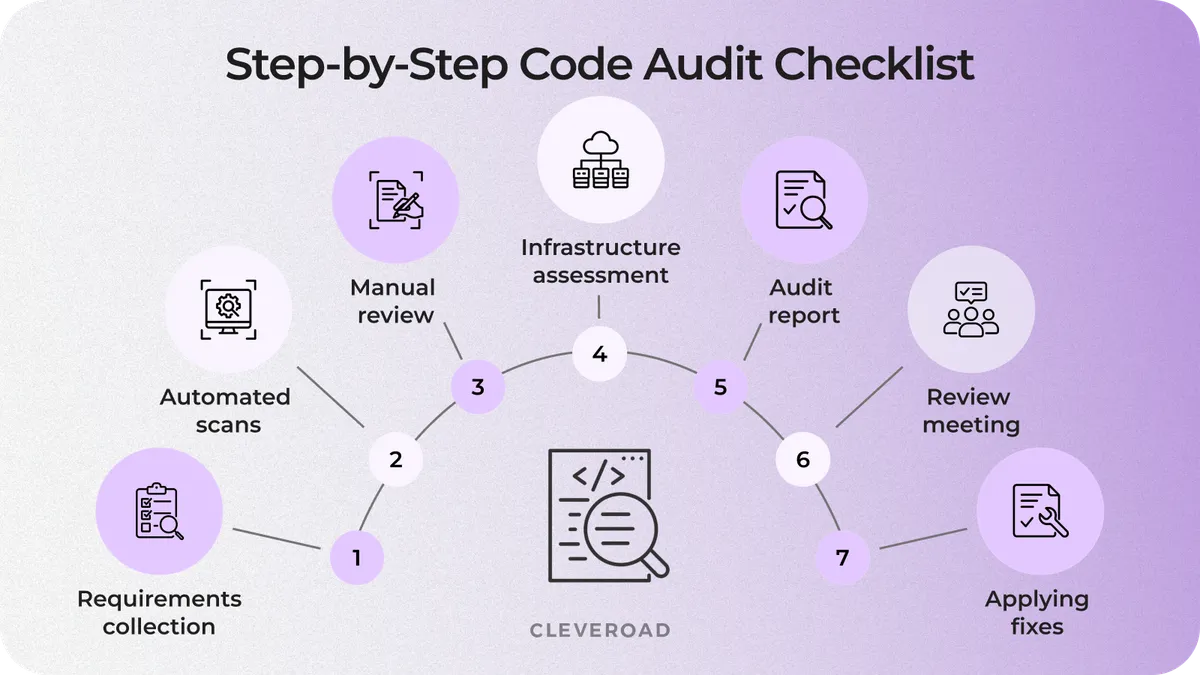
Step-by-step code audit checklist
1. Preparation and requirements collection
We start by collecting everything needed for a successful audit: repository access (GitHub, GitLab, Bitbucket), branch structure, API keys (if applicable), infrastructure maps, and project documentation. This setup phase also includes syncing with your tech lead to define focus areas for the audit. For example, performance issues, security, or readiness for scale.
This step lays the groundwork for a smooth and targeted code review process. Software development teams often skip documentation handoff, which makes audits longer and less effective. We make sure everything is in place from day one.
2. Running automated scans (static and dynamic)
Once access is confirmed, we launch automated scans to flag critical vulnerabilities early. For static analysis, we use tools like CodeQL and SonarQube to catch hardcoded credentials, memory leaks, or insecure functions.
For open-source dependency checks and container scans, we run Snyk or OWASP tools to detect known CVEs. Automated tooling is vital in any modern code review software development process, helping us cover more ground and reduce missed issues.
Explore what tech due diligence is and how to conduct it in our comprehensive guide
3. Manual deep-dive review by senior engineers
Next, our senior engineers manually audit your codebase. We look beyond syntax to detect architectural and security flaws, logic errors, poor abstractions, and code smells. This is where we assess readability, test coverage, separation of concerns, and how scalable or modular the design really is.
Knowing how to make good code review decisions here is what separates a surface-level check from a true audit. This step helps determine if your system is sustainable for future growth or is hiding big structural risks.
4. Infrastructure, dependencies, and CI/CD assessment
We go beyond the code. Our team inspects your CI/CD pipelines, deployment scripts, third-party integrations, and infrastructure-as-code. We look for hardcoded secrets, outdated libraries, broken environments, and unmonitored API endpoints, all of which can become critical attack vectors.
For teams wondering how to audit an application’s source code across the full stack, this is a key step. By analyzing both your runtime environment and package dependencies, we help future-proof your product against both downtime and security breaches.
5. Audit report preparation
We summarize audit results in a structured report with actionable insights. Our goal is to help your team understand their root causes and long-term impact. Our code audit deliverables include:
- Executive summary with key risks and recommendations
- Prioritized list of vulnerabilities and fixes
- Breakdown of architectural and logic-level issues
- Code quality metrics (maintainability, modularity, testability)
- Security checklist status
- CI/CD and infra review summary
- Code examples with inline comments for better context
6. Review meeting with your product team
Once the code audit report is ready, we host a handoff session with your engineering or product team. We walk through key issues and help prioritize which fixes should come first.
This step ensures full knowledge transfer and sets the stage for either immediate improvements or future roadmap planning. Knowing how to make a code review useful is about collaboration, not just handing off a PDF.
7. Follow-up: applying fixes
After the audit, you can choose to apply fixes internally or request implementation support from us. We can help you patch vulnerabilities, refactor modules, update dependencies, and rebuild your CI/CD process, or simply consult on best practices. Whether you choose hands-on help or handle fixes in-house, our software development code review process is built for flexibility and long-term value.
What Tools Are Used in Code Audit?
Effective code auditing relies on tools that speed up routine checks, highlight hidden flaws, and give engineers a clear picture of your system’s health. At Cleveroad, we combine automated scanners with expert manual code review to ensure no issues exist. Let’s review the code auditing tools we use:
Static code analysis tools
Static analysis inspects your source code without running it. These tools spot code smells, risky patterns, unused logic, and early-stage bugs that slow development later. They also help enforce coding standards automatically, making your codebase more maintainable and audit-ready over time.
Examples: SonarQube, ESLint, PMD
Dynamic analysis tools
Dynamic analysis evaluates how your application works in real conditions. Such tools reveal memory leaks and logic issues that often can’t be identified in static scans. They’re especially valuable for testing real user interactions and integration points under stress.
Examples: New Relic, SmartBear, AppDynamics
Dependency vulnerability scanners
Modern apps rely on many external libraries. Vulnerability scanners track those dependencies and alert you when a package introduces security risks or outdated components. They also help ensure compliance with security standards by licensing conflicts before they reach production.
Examples: OWASP Dependency-Check, Dependabot, Snyk Advisor
Performance profiling tools
Profilers pinpoint slow database queries, heavy functions, and inefficient resource usage that impact user experience. They help developers identify bottlenecks in CPU, memory, or I/O operations, enabling targeted optimizations that improve speed and scalability.
Examples: Datadog, Prefix, Chrome DevTools Performance
Security testing tools
Security scanners dig into authentication flaws, unsafe APIs, misconfigurations, and OWASP Top 10 vulnerabilities. They simulate attack scenarios to uncover hidden threats and help ensure your application meets industry-standard security benchmarks.
Examples: Snyk, Semgrep, Burp Suite
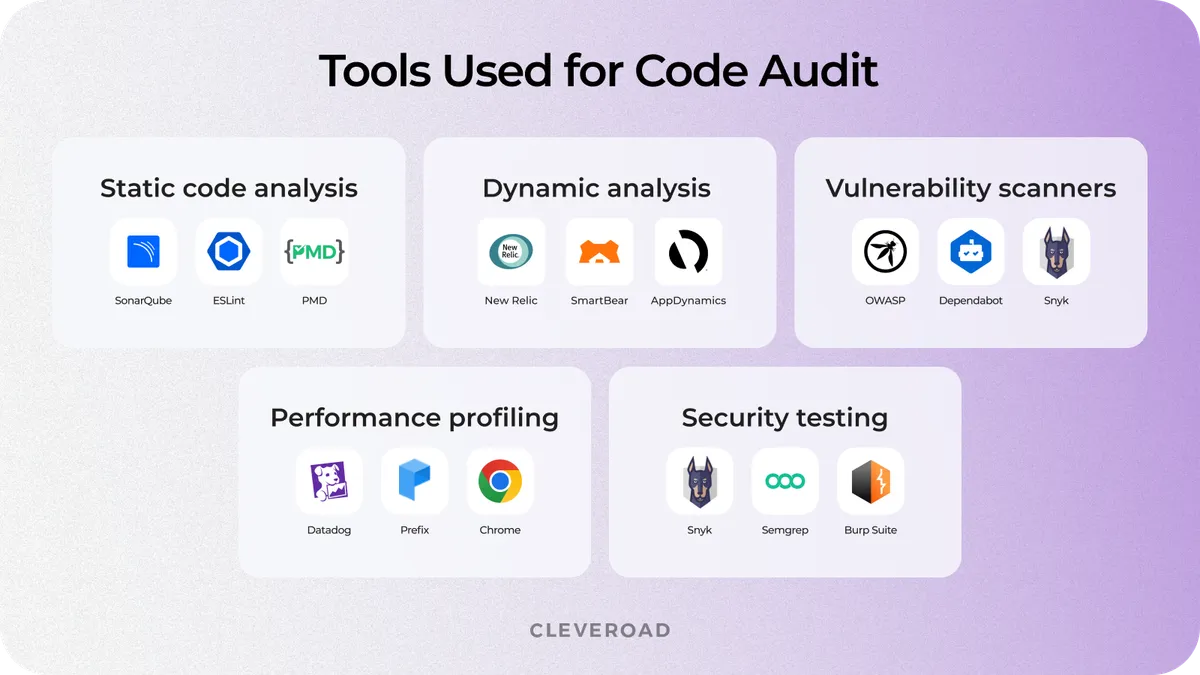
Tools used for code audit
Best Practices in Coding Audits
Strong coding audits follow a structured process, use the right mix of tools, and involve experts who can evaluate both technical quality and business impact. The practices below help teams run audits that produce reliable findings and support long-term product stability.
Use structured checklists for consistency
A structured checklist keeps the audit focused and repeatable. It ensures that every reviewer evaluates the same areas, such as architecture, security, performance, documentation, and dependencies, without skipping critical details. Teams gain consistency in how audits are performed, and the final report becomes easier to analyze and track over time.
At Cleveroad, we’ve refined our audit framework through years of working with startups, enterprises, and regulated industries. Our engineers bring deep tech expertise across industries and apply proven best practices to every codebase. This ensures your audit is both comprehensive and aligned with real-world engineering standards.
Combine automated and manual reviews
A strong code audit blends automation with expert analysis. Tools like CodeQL, SonarQube, and Snyk help surface obvious issues through static and dynamic analysis. Things like outdated packages, unhandled exceptions, or insecure functions. These scanners are excellent for identifying low-hanging risks across large codebases and accelerating the initial discovery phase.
But automation alone isn’t enough. It can’t evaluate architectural decisions, code readability, or business logic flaws. That’s where manual review comes in. Our senior engineers inspect core modules and assess whether your system is secure and easy to maintain. This hybrid approach ensures a thorough audit that goes beyond surface-level hygiene to deliver real technical value.
Alex Penzov
CTO at Cleveroad
“Automated scanners show you where the cracks begin, but only human expertise reveals how deep they go. A reliable audit requires both machines to map the surface and engineers to understand the structure beneath it.”

Hybrid approach mirrors a complete audit workflow:
- Planning the scope
- Gathering documentation
- Scanning the codebase with automated tools
- Manually reviewing critical paths
- Documenting audit findings
- Validating fixes during a follow-up audit
Such a step-by-step approach delivers accuracy and actionable insights for Cleveroad’s code audit.
Integrate audits into DevSecOps
Treat code auditing as part of the development lifecycle, not an afterthought. When audits run alongside CI/CD, security scanning, and continuous monitoring, issues appear earlier and cost less to fix. Adding code audit checks into pipelines also ensures that the code quality and security stay consistent as the product grows.
At Cleveroad, we help clients bake code review and auditing directly into their DevSecOps pipelines. We tailor quality gates that align with your team’s workflow, setting up automated code scanning tools and defining custom linting rules and review triggers.
Choose our cost-saving DevOps services to streamline delivery and bring new features to your product faster
Maintain documentation and enforce coding standards
Clear architecture diagrams, API references, and style guidelines make audits faster and more effective. Good documentation helps reviewers understand intent, while enforced coding standards prevent inconsistency and reduce the number of issues discovered during the audit.
Cleveroad follows strict internal code conventions and provides structured onboarding documentation for every project. Our teams document key decisions and integration points from day one, ensuring your codebase stays understandable and easy to scale, even as team members or vendors change.
Involve external auditors for unbiased results
Internal teams often miss issues because they know the system too well. External auditors bring a fresh perspective and specialized expertise that internal teams rarely have time to develop.
Cleveroad’s engineers apply experience gained from dissecting legacy architectures, scaling high-load systems, and restoring codebases with complex technical debt. We rely on structured audit frameworks and strong engineering discipline to uncover issues that stay hidden during development.
How Much Does a Source Code Audit Cost?
Code audit pricing varies significantly based on your project's scope and complexity. There's no one-size-fits-all answer, but understanding the factors that influence cost helps you budget accurately.
What affects code audit pricing:
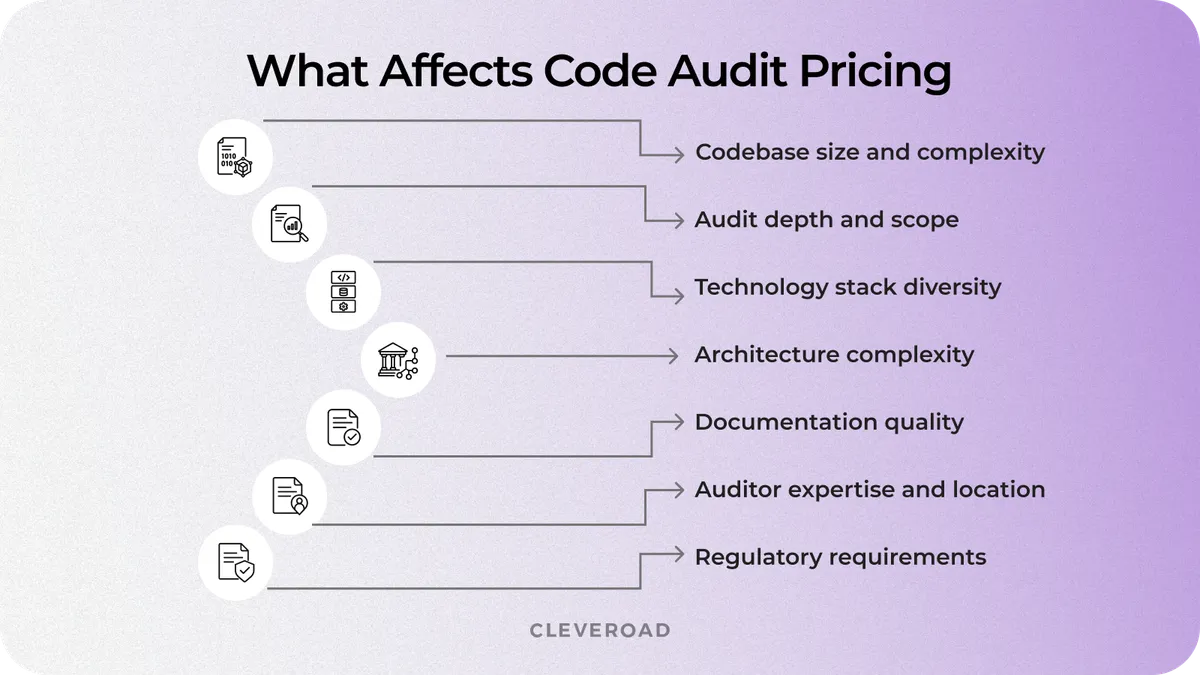
What affects code audit pricing
Codebase size and complexity. A 10,000-line mobile app takes less time to audit than a 500,000-line enterprise system with microservices architecture. More code means more time for both automated scanning and manual review.
Audit depth and scope. A basic security scan costs less than a comprehensive code audit covering security, performance, compliance, infrastructure, and documentation. If you need penetration testing or compliance verification for HIPAA or GDPR, expect higher costs.
Technology stack diversity. Applications built with multiple languages, frameworks, and third-party integrations require auditors with broader expertise. A React/Node.js stack is straightforward. A system mixing Java, Python, Ruby microservices with legacy COBOL modules requires specialists.
Architecture complexity. Monolithic applications are easier to audit than distributed systems with multiple databases, message queues, and cloud services. Serverless architectures, containerized deployments, and complex CI/CD pipelines add review time.
Documentation quality. Well-documented code with clear architecture diagrams speeds up the audit process. If auditors need to reverse-engineer undocumented systems to understand functionality, costs will increase.
Auditor expertise and location. Senior engineers with 10+ years of experience and specialized certifications charge premium rates but identify security issues junior auditors miss. Geographic location also matters, because auditors from the US typically charge more than teams, for example, in Eastern Europe, though quality doesn't always correlate with price.
Regulatory requirements. Apps need industry-specific compliance checks. Healthcare apps need HIPAA verification, financial platforms require SOC 2 or PCI-DSS adherence verification, and more. These specialized audits demand certified experts familiar with regulatory frameworks.
Here are the costs you should expect when investing in source code auditing:
| Project size | Codebase / scope | Typical duration | Cost range ($) |
Small | ~40,000–70,000 Lines Of Code (LOC), single platform, monolithic | 1–2 weeks | $4,000 – $12,000 |
Medium | 70,000–200,000 LOC, 1–2 platforms (web + mobile), 1–3 services | 2–5 weeks | $12,000 – $35,000 |
Large | 200,000–500,000 LOC, 3–10 services, integrations, APIs | 4–8 weeks | $35,000 – $90,000 |
Enterprise | 500,000–2,000,000+ LOC, distributed architecture, microservices, DevOps | 8–16 weeks | $90,000 – $220,000 |
Note: Remember that these estimates are approximate, and the final cost depends on various factors. To get an accurate estimate for your project with unique requirements and goals, contact us.
Cleveroad’s Experience in Code Audit Services
Cleveroad is a global software development company with 15+ years of experience helping startups, SMBs, and enterprise clients build and improve digital products. We support clients across Fintech, Healthcare, Logistics, Retail, and other industries, offering a range of tech services covering code auditing, custom software development, legacy system modernization, security testing, UI & mobile configuration audit, and more.
When you turn to Cleveroad for code auditing, you benefit from:
- Manual review by senior engineers: Beyond automated scans, our experts analyze logic flow, architecture, and scalability risks to deliver clear, actionable insights
- Full-stack system analysis: We evaluate your tech stack holistically to uncover hidden weak points in source code, infrastructure, and third-party dependencies
- Fast-track audits powered by AI tools: We accelerate issue discovery using advanced scanners like CodeQL, SonarQube, DeepSource, and Snyk, without sacrificing depth or accuracy
- ISO-certified processes: ISO 9001:2015 and ISO/IEC 27001:2013 compliance ensures quality, safeguards security, and builds trust at every stage of collaboration
To demonstrate our experience in code auditing, we’ll show you our recent case study - Transport Management System.
A US-based logistics company approached Cleveroad to enhance the functionality of its transportation management platform. However, before introducing any new features, we conducted a full code audit to assess the quality, performance, and scalability of the existing solution. This audit helped uncover architectural limitations, outdated dependencies, and integration challenges, all of which had to be addressed to move forward confidently.
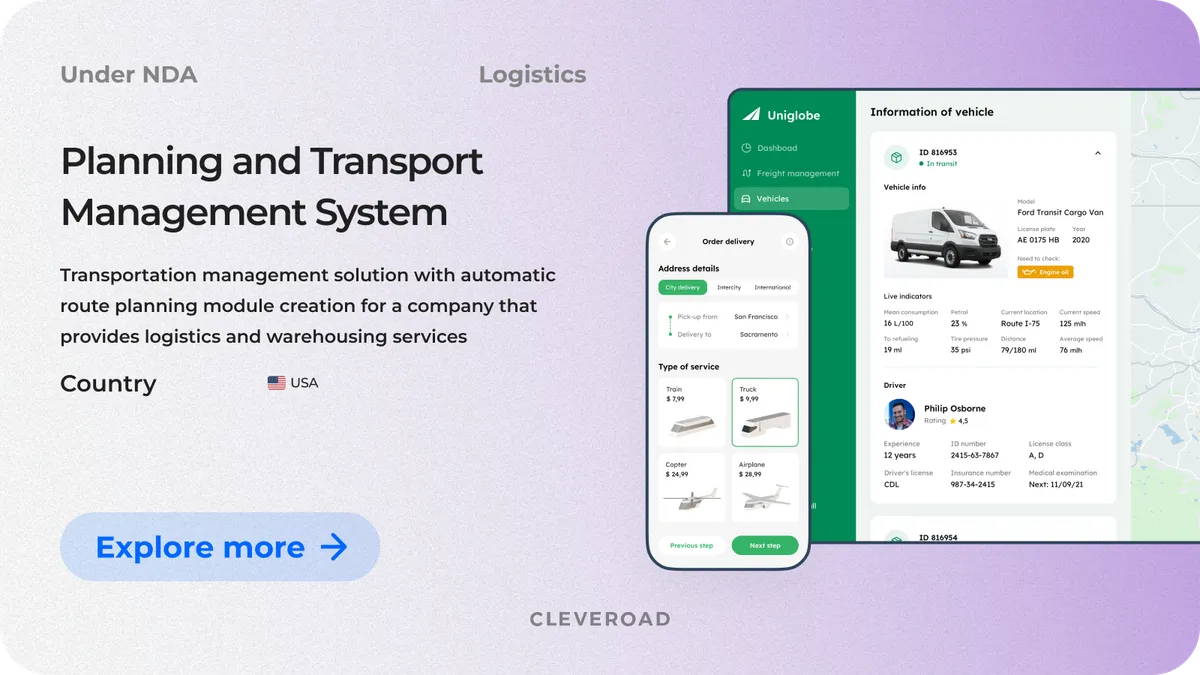
Transportation management system developed by the Cleveroad team
Based on our findings, we developed and integrated several new modules, including automated route planning, fleet management, and a “Jobs for delivery” system. These modules were seamlessly connected with the client’s existing logistics tech stack, including their warehouse and CRM systems. It enabled real-time data exchange, smarter dispatching, and greater control over deliveries.
As a result, our client obtained a robust transportation management system that reduced overhead, achieved faster delivery times, and fully streamlined logistics operations across their ecosystem.
Get a code review from a trusted IT partner
With 15+ years of experience in building and auditing software systems across various domains, Cleveroad is ready to help you assess code quality and reduce risks
A code audit is a thorough review of your software's source code. Throughout this process, specialists check code for security issues and vulnerabilities, bugs, performance issues, and technical debt that slow down development. Unlike quick code reviews that happen daily, an audit is a comprehensive analysis that examines your entire codebase from top to bottom.
A top code audit company ensures adherence to security best practices and also checks whether the code is consistent and scalable. So, the best code audit companies for 2026 are:
- Cleveroad
- NetSPI
- Toptal
- Codacy
- Snyk
- DeepSource
The tools to use for analyzing source code:
- Static code analysis tools: SonarQube, ESLint, PMD
- Dynamic analysis tools: New Relic, SmartBear, AppDynamics
- Dependency vulnerability scanners: OWASP Dependency-Check, Dependabot, Snyk Advisor
- Performance profiling tools: Datadog, Prefix, Chrome DevTools Performance
- Security testing tools: Snyk, Semgrep, Burp Suite
Online code review tools help distributed teams collaborate efficiently by integrating with version control systems like GitHub or GitLab. Developers can submit code changes, leave inline comments, perform a code security audit, and approve updates asynchronously, making reviews flexible across time zones. These tools often include automated checks, linting, and static analysis to enhance code quality, while CI/CD integration ensures issues are caught early in the development cycle.
A source security code audit typically includes:
- Static code analysis
- Authentication and authorization review
- Third-party code dependency scan
- Encryption and data handling checks
- Error and exception handling
- Configuration file inspection
- Compliance validation
- Security best practices audit

Evgeniy Altynpara is a CTO and member of the Forbes Councils’ community of tech professionals. He is an expert in software development and technological entrepreneurship and has 10+years of experience in digital transformation consulting in Healthcare, FinTech, Supply Chain and Logistics
Give us your impressions about this article
Give us your impressions about this article