How to Develop Custom Telemedicine Software in 2026
Updated 10 Jul 2026
19 Min
1695 Views
How to develop a telemedicine app? Telemedicine software creation involves a multi-stage process that ensures your platform is secure and ready for real-world medical workflows. The development path runs from defining product goals to building a scalable technical foundation. The steps below break it down.
We at Cleveroad have 15+ years of experience delivering top-notch eHealth solutions. Below, we’ve outlined the essential steps required for successful telemedicine software development. This process comes from our practical experience designing, engineering, and launching custom telehealth software for clinics, startups, and enterprise healthcare providers worldwide.
Here are the key steps for telemedicine software development:
- Step 1. Idea validation: Define your telemedicine product’s purpose, core features, and target users; ensure the concept is technically feasible and aligned with market needs.
- Step 2. Discovery phase: Analyze competitors, audience, and compliance requirements; create specifications, architecture plans, and an actionable development roadmap.
- Step 3. UI/UX design: Map user journeys for patients and doctors; build intuitive prototypes and interfaces that ensure smooth digital healthcare experiences.
- Step 4. Product development: Implement backend and core telemedicine features; build an MVP first to validate the concept and reduce development risks.
- Step 5. Testing: Perform functional and compliance testing to ensure stable performance and a smooth user experience.
- Step 6. Delivery and maintenance: Deploy the solution and provide ongoing updates and feature enhancements for long-term reliability.
Keep on reading our guide to learn about the main price drivers, functionality, and strategies to optimize your investment. Plus, we include a demo of a telemedicine platform developed by our team, giving you a firsthand look at its interface and functionality.
What Is Telemedicine and How Does It Work?
Telemedicine refers to the use of electronic communication technologies to monitor and treat patients instead of in-person visits. Simply put, telemedicine is the delivery of medical care to patients remotely. And there is telehealth software to provide it.
Telehealth software enables people to reach physicians from miles away, helping healthcare providers manage their resources effectively and attract new patients without high costs. Also, it provides on-demand access to different medical services for people while lowering doctors’ workload.
The demand for remote care continues to rise: according to the Grand View Research’s 2026 telehealth market report, the global telehealth market is projected to grow from $87.7 billion in 2026 to $187.5 billion by 2033, at a CAGR of 11.5%.
How telemedicine apps work
A telemedicine app connects patients and healthcare providers via a secure digital platform, enabling consultations, diagnoses, and follow-ups without in-person visits. These apps simplify scheduling and medical record management, making healthcare more accessible, convenient, and efficient. Patients can book appointments, share symptoms, and receive medical advice, while doctors can review patient history, provide treatment, and monitor progress, all within the app.
Here’s how a telemedicine app works step-by-step:
- User registration: Patients and doctors create accounts and verify identities.
- Profile and medical history setup: Patients input medical history; doctors set availability.
- Appointment booking: Patients browse available time slots and schedule consultations.
- Consultation: Video, audio, or chat sessions.
- Prescription and treatment: Doctors send instructions directly through the app.
- Payment processing: Secure in-app payment options handle fees or subscription plans.
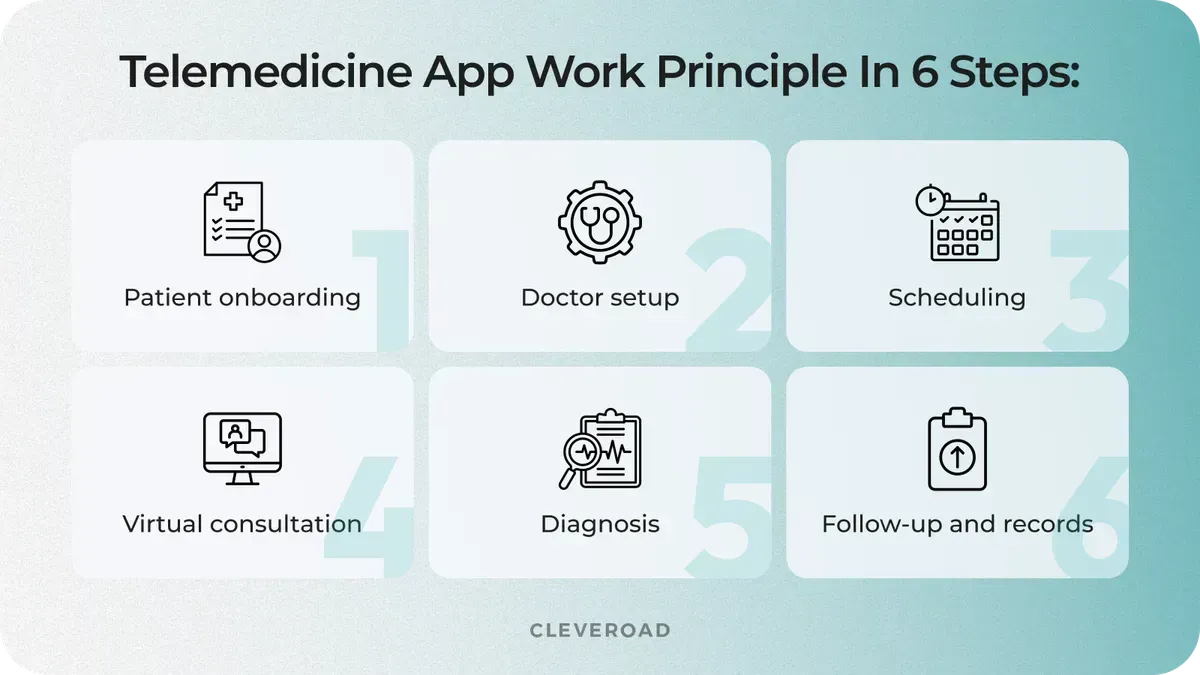
How does a telemedicine app work
Core Features of Telemedicine App and Their Cost
Regardless of the type of healthcare solutions you choose, all telehealth platforms include both the patient’s and the doctor’s sides. Below, you will find the required features based on the user’s role and their share of the telemedicine app’s cost.
Features for patients
Now, let’s explore the most essential features that let patients easily manage their healthcare needs and demands remotely.
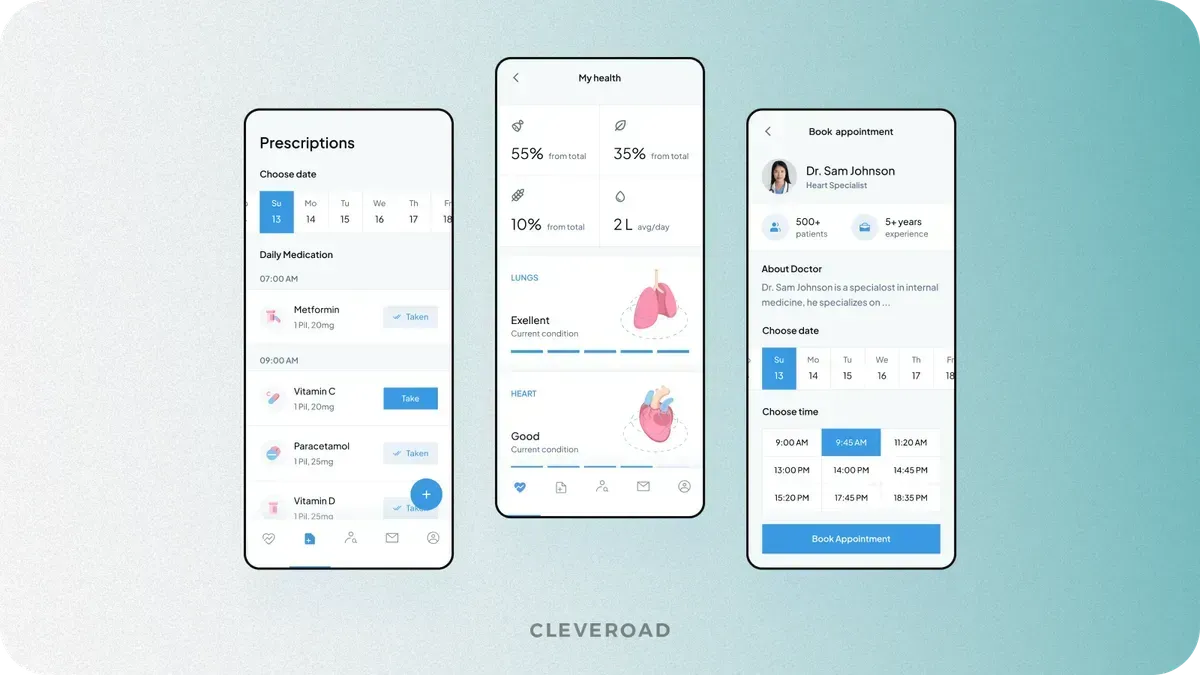
Telemedicine app features for patients
Easy registration
Since telemedicine applications store a large amount of sensitive information, the registration process should comply with EHR integration standards and support document uploads. To complete registration in 2 clicks, patients can register using email, mobile phone, or third-party services such as Facebook.
Video meeting
Video meeting is a key feature in telemedicine software development. Remember that video and audio should be transmitted in high quality so doctors can see the symptoms and make an accurate diagnosis. For this purpose, you can use protocols such as the Real-Time Messaging Protocol (RTMP) and Web Real-Time Communication (WebRTC).
Text messaging
Minor issues like a runny nose or cough don’t require a video call. Instead, patients can text a doctor for advice. This option will allow physicians to answer in their spare time without being distracted by other patients. Additionally, users should have the option to attach photos and files as visual cues.
Appointment management
When answering the question “How to build a telehealth app?”, appointment management is a critical feature to pay attention to. It will allow patients to track and manage doctor appointments. Users should be able to see the physician’s available time and planned meetings, and cancel their appointments.
Learn more about Cleveroad’s telemedicine software development services. We efficiently cover compliant and scalable platforms end-to-end, ensuring security and reliability.
Notifications
In addition to calendar notifications, users can receive personalized reminders for monthly check-ups, prescription renewals, and physician queries. These also let you inform customers about future updates.
Reviews
Patients should have the opportunity to leave a review of their doctor visits. Include a rating system that allows users to rate the doctor (for example, using a scale of 1 to 5) and leave a comment. Based on users’ feedback, physicians can monitor their performance and improve the quality of their service if needed.
Payment details
Payment functionality is vital in telemedicine software development. You can integrate payment methods such as PayPal, Stripe, and Braintree, create custom payment services, or use third-party services such as MasterCard or Visa. The main advantage of payment gateways over third parties is that they handle fast, secure transactions and are easy to implement.
| Patient app feature | Estimated development time (h) | Estimated cost ($) |
|---|---|---|
Easy registration | 40-80 hours | $2,000-$5,000 |
Video meeting | 160-240 hours | $10,000-$20,000 |
Text messaging | 80-120 hours | $3,000-$7,000 |
Appointment management | 80-120 hours | $4,000-$8,000 |
Notifications | 40-80 hours | $2,000-$5,000 |
Reviews | 40-80 hours | $1,500-$4,000 |
Payment details | 80-160 hours | $5,000-$10,000 |
Features for doctors
The doctor’s side also has some specific telemedicine app features. Some of them are similar to the patient’s side, while others are different. Let’s discuss them.
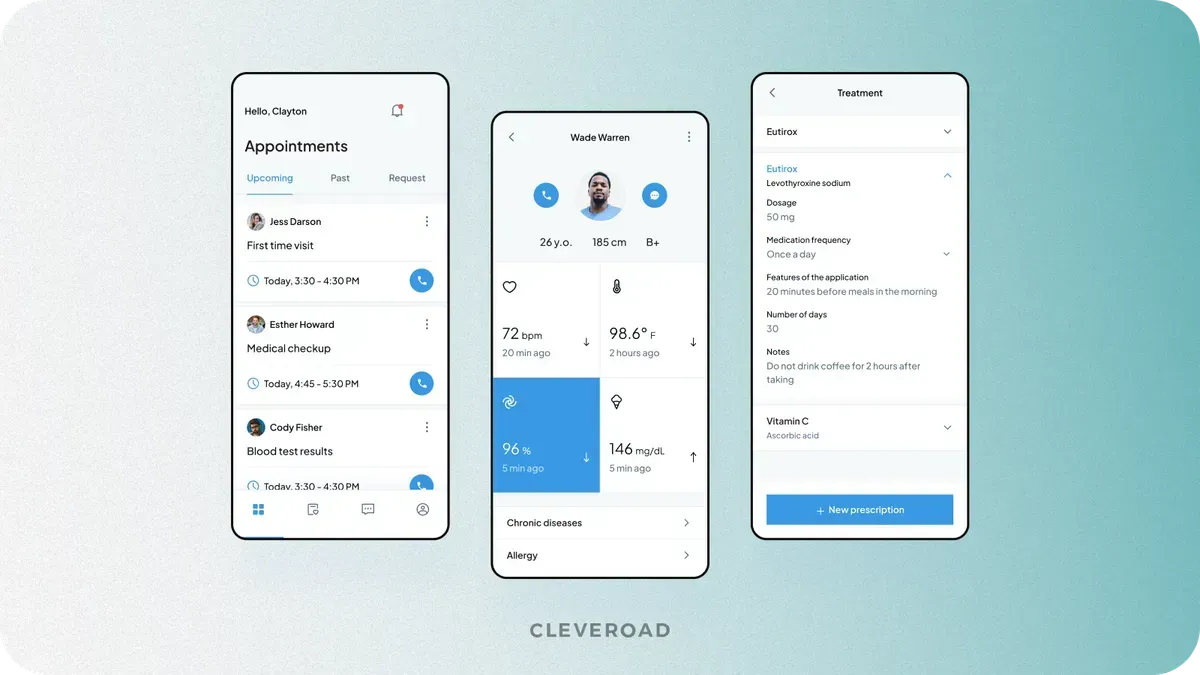
Telemedicine app by Cleveroad: Doctors’ experience
Dashboard with patient data
The patient dashboard is the primary screen displayed when physicians access a patient’s medical data and displays all personal and health-related details of each patient. It can cover the treatment history, prescriptions, and personal information.
Doctor profile
Physicians also need to set up their profiles by entering their specialization, qualifications, experience, and other relevant information. Client’s reviews should also be included in the profile. This information helps patients make informed decisions. A complete profile builds trust and attracts new clients.
Electronic Health Records
Before the meeting with the patients, the doctors need access to the patients’ EHR/EMR. Thus, to diagnose clients’ health conditions accurately, your app should integrate with an EMR. Ensure the physicians can’t download users’ medical files from your database.
Need custom EHR/EMR software? Check out our guide to learn how to create an EHR system.
Communication
Telehealth software development implies two-sided communication between patients and physicians. Doctors should also be able to text or call patients to ask about test results, the treatment process, or their state of well-being. If a planned physical examination is needed, the doctor should be authorized to schedule an appointment with the client.
Internal data exchange
The doctors may need to hand their patients to another specialist when, due to unforeseen circumstances, they cannot make an appointment. In this case, they should be able to exchange the clients’ information between departments. Your task is to provide smooth, secure, and reliable internal data exchange.
| Doctor app feature | Estimated development time (h) | Estimated cost ($) |
|---|---|---|
Dashboard with patient data | 80-120 hours | $4,000-$8,000 |
Doctor profile | 40-80 hours | $2,000-$5,000 |
Electronic Health Records (EHR/EMR) | 120-200 hours | $8,000-$15,000 |
Communication (text & calls) | 80-120 hours | $4,000-$8,000 |
Internal data exchange | 80-120 hours | $4,000-$8,000 |
These doctor-side features show how much it depends on the provider’s experience in telemedicine software development. If doctors cannot quickly access patient data, communicate securely, and manage consultations without friction, even a strong patient-side app may fail in real clinical use.
That is why the technical foundation behind a telemedicine platform matters as much as the visible feature set. The next example shows how Cleveroad helped bring a complex telemedicine product to a stable release after prior development attempts failed to deliver a working solution.
Codex Labs, a Silicon Valley plant biotechnology company, came to Cleveroad after two vendors failed to deliver a working version of DECODE.ME, their teledermatology platform for private doctor–patient consultations.
The client needed to stabilize the inherited product, prepare it for a public medical presentation, and establish a secure infrastructure to handle sensitive healthcare data. In five months, our team audited the existing codebase, fixed critical issues, optimized backend performance, and built HIPAA-compliant infrastructure for video consultations, with PHI stored on GCP FHIR.
As a result, our team brought DECODE.ME to a demo-ready state in five months, after two previous vendors had failed to deliver a working product. This timeline was critical because Codex Labs needed to present the teledermatology platform at the 2025 AAD Innovation Meeting, where dozens of dermatologists joined the platform during the presentation. Instead of showing another unfinished build, the client entered the event with a working product for the medical community. We continue to support the platform and expand its functionality.
Discover Barbara Paldus, Founder & CEO of Codex Labs, video feedback on the collaboration with Cleveroad, and why she recommends us as a telehealth software development partner:
Dr. Barbara Paldus, CEO at Codex Labs: Feedback on Cleveroad’s Telemedicine Development Services
6 Steps for Telemedicine Software Development
Creating telemedicine software demands careful preparation because it directly impacts people’s health. As a telehealth software development company with experience in healthcare, we’ll discuss the steps you should take to design a user-centric app while keeping an eye on telemedicine app development costs.
Step 1: Idea validation
At this stage, you define the purpose of your telemedicine solution and outline its main features. You may aim to build a video conferencing app for patient-doctor communication, a pharmacy management tool, or an all-in-one telehealth platform. Working with a qualified tech team ensures your concept is feasible and aligns with market needs.
- Estimated time: 1-2 weeks.
- Estimated cost: usually included in early consulting or discovery preparation.
Step 2: Discovery phase
The Discovery phase is crucial for aligning the client’s and developer’s visions. It involves competitor analysis, target audience research, regulatory compliance checks (e.g., HIPAA), integration planning, and preparation of project specifications detailing features and third-party integrations. This phase produces an accurate estimate of the telemedicine app’s cost and a clear roadmap for development.
- Estimated time: 2-6 weeks.
- Estimated cost: $4,000-$12,000, depending on product complexity, number of roles, compliance scope, and integrations.
Step 3: UI/UX design
Designers define core user scenarios, visualize app features, and plan smooth customer journeys for both patients and doctors. They create interactive prototypes and appealing user interface elements. The complexity of design impacts telemedicine development costs, especially when multiple platforms or advanced UX flows are required.
- Estimated time: 3-6 weeks.
- Estimated cost: $6,000-$12,000, depending on the number of screens, platforms, and user roles.
Step 4: Product development
This stage involves server-side development, API integration, and the conversion of the UI design into a working application. It’s recommended to start with an MVP to test the idea and reduce risk. For complex projects, a Proof of Concept (POC) may be created to validate feasibility. This is the main factor affecting how much it costs to develop a telemedicine app.
AI-assisted development can also support faster prototyping, cleaner documentation, test generation, and repetitive engineering tasks. Still, telemedicine software requires human architecture control, code review, security validation, and healthcare compliance checks before release.
- Estimated time: 3-8+ months.
- Estimated cost: $24,000-$64,000+, usually the largest part of the budget and depending on feature scope, integrations, and platform complexity.
We provide AI-assisted development services. Learn how we can help you to benefit from AI capabilities and optimize budget.
Step 5: Testing
QA engineers conduct comprehensive testing to verify functional requirements, security compliance, and bug fixes. They create detailed reports and ensure all app features work as expected. Testing is a critical step that ensures the platform meets user expectations and legal standards without unnecessarily inflating the telemedicine development costs.
- Estimated time: Continuous during development plus final stabilization.
- Estimated cost: $5,000-$20,000, depending on testing depth, security checks, compliance-related flows, and the number of supported platforms.
Step 6: Delivery and maintenance
After development and testing, the app is delivered for stakeholder review and feedback. Telemedicine platforms require ongoing support to implement new functionality and maintain security and compliance. Proper maintenance helps control the long-term costs of telemedicine app operations and keeps the solution reliable and up to date.
- Estimated time: Ongoing after release.
- Estimated cost: $2,000-$8,000+ per month, depending on the service-level agreement (SLA), infrastructure, monitoring, security updates, and the new feature roadmap.
How to Monetize Your Telemedicine App
Choosing the right monetization model for the eHealth app depends on your target audience and long-term growth plans. Often, combining multiple approaches is the best way to maximize revenue and user retention while covering telemedicine development costs.
Pay-per-consultation model
In the pay-per-consultation model, patients pay a fixed fee for each appointment, either directly to the doctor or via the platform, which may take a small percentage. This model is simple and transparent, ideal for users who only need occasional consultations. It works well for general healthcare advice or minor medical issues where patients do not require long-term treatment plans, helping manage cost of telemedicine app development efficiently.
Pay-per-consultation pros:
- Simple and easy to understand for users
- Scales directly with platform usage
Pay-per-consultation cons:
- Revenue can fluctuate with the number of consultations
- Less suitable for chronic care or recurring treatment plans
Subscription or membership plans
Subscription models allow users to pay a recurring monthly or yearly fee for a set number of consultations or premium features. This approach encourages long-term engagement and is particularly effective for chronic care, wellness programs, or preventive health services. Subscriptions provide predictable revenue and help platforms plan capacity, while keeping the telemedicine app cost predictable for users.
Subscription model pros:
- Provides stable, recurring income
- Encourages long-term engagement and loyalty
Subscription model cons:
- Higher upfront cost may discourage new users
- Requires consistent delivery of value to retain subscribers
Employer or insurance partnerships
Partnering with employers or insurance providers allows the platform to offer services to large groups of employees or insured patients. The organization typically covers part or all of the telemedicine costs. This approach helps expand the user base quickly and boosts retention, as users are incentivized to use covered services regularly.
Partnerships model pros:
- Access to a large, stable audience
- Accelerates adoption and retention
Partnership model cons:
- Revenue depends on contracts and negotiations
- Less control over pricing and individual user payments
Commission-based model
In the commission-based model, the telemedicine platform takes a percentage of each appointment or service booked through the app. This aligns revenue with platform usage and encourages providers to attract more patients. It is particularly effective for multi-provider platforms or marketplaces where doctors pay for leads and bookings rather than a fixed subscription.
Commission-based model pros:
- Revenue grows with usage
- Easy to scale with more providers
Commission-based model cons:
- Income can fluctuate based on appointments
- May reduce provider margins if commissions are high
In-app purchases or add-on services
This model allows users to pay for additional features or premium health services within the app. In-app purchases create a secondary revenue stream while keeping the core app accessible to all users, offering flexibility for personalized services without inflating overall telemedicine development costs.
In-app purchases pros:
- Adds extra revenue without increasing subscription costs
- Allows personalization and upselling
In-app purchases cons:
- Relies on user engagement for revenue
- Overuse can frustrate users if features feel mandatory
How Is Telemedicine Reimbursed Under Medicare in 2026?
In 2026, Medicare reimbursement remains a key factor to consider when building a telemedicine platform for the U.S. market. According to the official Health and Human Services (HHS) guidance on telehealth policy updates, many Medicare telehealth flexibilities have been extended through December 31, 2027, which means providers can continue delivering many non-behavioral telehealth services under broader access rules than before.
The main Medicare telehealth updates for 2026 include:
- Medicare patients can receive non-behavioral telehealth services from home through December 31, 2027.
- Geographic restrictions for originating sites are removed for Medicare non-behavioral telehealth services through December 31, 2027.
- Telehealth services can be provided by all eligible Medicare providers through December 31, 2027.
- Non-behavioral Medicare telehealth services can be delivered through audio-only communication platforms through December 31, 2027.
- Behavioral and mental health telehealth services have permanent support for home-based access, no geographic originating-site restrictions, and audio-only delivery.
The Centers for Medicare & Medicaid Services (CMS) also simplified how services are added to the Medicare Telehealth Services List for Calendar Year (CY) 2026. As stated in the CY 2026 Medicare Physician Fee Schedule final rule, the agency removed the distinction between provisional and permanent services.
Another important 2026 update concerns controlled substances. HHS and the Drug Enforcement Administration (DEA) extended telemedicine prescribing flexibilities from January 1, 2026, through December 31, 2026, allowing patients to receive prescriptions for controlled medications via telemedicine without a prior in-person visit while permanent rules are being finalized.
For product owners, these reimbursement and policy updates should be considered during discovery, not after launch. In practice, this affects core parts of the platform: audio-only workflows and provider eligibility all need to be configurable. The system also has to map services to Medicare rules and keep consent records, audit trails, and billing documentation aligned with current CMS policy.
How Much Does It Cost to Develop a Telemedicine App?
Costs rise with complexity: a basic app starts at $20,000-$40,000+, a medium-complexity product at $40,000-$80,000+, and a complex platform at $80,000-$150,000+. Enterprise-grade ecosystems, with multi-role dashboards, payer workflows, and deep integrations, exceed $150,000. The table below breaks this down.
If you decide to build a telemedicine app, there is no need to employ in-house specialists. There are many experienced telemedicine software development companies available. To give you a hint, we’ve estimated the cost of starting your own medical solution based on the solution’s complexity.
| Telemedicine app complexity | Key features | Estimated development time (m) | Estimated cost ($) |
|---|---|---|---|
Basic | User registration, appointment booking, chat consultation, simple notifications | 3-4 months | $20,000-$40,000+ |
Medium | Video consultations, payment integration, EHR/EMR integration, advanced notifications, basic analytics | 5-7 months | $40,000-$80,000+ |
Complex | AI-based symptom checker, multi-platform support, pharmacy integration, HIPAA/GDPR compliance | 8-12 months | $80,000-$150,000+ |
Enterprise | Multi-role dashboards, payer workflows, RPM, advanced AI, deep EHR/EMR integrations, custom infrastructure | 12+ months | $150,000+ |
The estimate is based on development rates in Central and Eastern Europe. The region has a solid reputation in this field. You can outsource healthcare software development to Central and Eastern European countries to get lower rates and highly qualified developers.
There are many reliable development companies that can deliver custom software solutions for approximately $50 to $80 per hour. Moreover, hiring globally opens access to a vast pool of talented experts skilled in various technologies, even rare ones.
How much does it cost to build a telemedicine app? Check our guide to learn about key pricing factors and ways to optimize your budget.
Future Opportunities of Telemedicine App Development
Telehealth and wellness apps stand to gain from several major growth vectors, such as smarter diagnostics and long-term chronic care management. Below we’ve listed some of the most promising opportunities ahead.
AI-driven diagnostics
AI-powered tools are now increasingly important in telemedicine because they can support preliminary triage and clinical decision support. The FDA’s public list of AI-enabled medical devices shows how quickly AI is entering regulated healthcare workflows, though the FDA notes that the list is not comprehensive and is based on AI-related terms in marketing authorization documents.
In 2026, agentic AI and GenAI will also create new opportunities for telemedicine platforms. They can summarize patient intake, draft visit notes, route patients to the appropriate specialist, and perform other administrative support tasks. Still, AI features connected to diagnosis, treatment, or patient risk scoring should be designed with medical validation, human oversight, and compliance review from the start.
Our AI Strategy Advisor helps map how AI can improve your telemedicine app depending on your care model.
Remote patient monitoring expansion
Remote patient monitoring (RPM) is one of the fastest-growing segments in digital health. According to Grand View Research, the global remote patient monitoring system market was valued at $26.0 billion in 2025 and is projected to grow from $30.9 billion in 2026 to $110.7 billion by 2033, at a compound annual growth rate (CAGR) of 20.0% from 2026 to 2033.
This reflects rising demand for long-term care, chronic disease management, and home-based health monitoring, which makes Remote Patient Monitoring (RPM) integration a major opportunity to transform a telemedicine app into a unified solution.
Integration with wearables and IoT
According to Grand View Research, the global wearable medical devices market was valued at $54.0 billion in 2025 and is projected to grow from $68.1 billion in 2026 to $330.5 billion by 2033, at a compound annual growth rate (CAGR) of 29.5% from 2026 to 2033. Besides, they note that more than 60% of adults use wearable devices for fitness tracking, preventive care, or health monitoring; many also rely on them for sleep and heart rate monitoring.
Many new wearables support medical-grade or near medical-grade tracking (vital signs, ECG, blood-oxygen, sleep, etc.), which expands app functionality far beyond consultations, enabling wellness tracking, early warning systems, and proactive health management. Such integration aligns well with the ongoing shift to digital health and appeals to users seeking connected, data-driven health tools.
At Cleveroad, we developed a mobile IoT-based solution for a US healthcare manufacturer, integrating EKG monitors and pulse oximeters with iOS and Android apps to track heart activity and blood oxygen levels. The platform ensures HIPAA compliance, meets FDA 510(k) requirements, and connects reliably with wearable devices via Bluetooth. Additionally, we created an e-commerce module and a professional medical forum, enabling the client to sell devices online and build a social community for practitioners.
- Explore the full IoT-based system case in more detail.
Growth of virtual chronic care management
A recent telehealth benchmark survey by TeledocHealth shows that among organizations already offering telehealth, 71% plan to expand virtual care, including chronic condition management and remote monitoring. While offering long-term care, regular check-ups, remote monitoring, and wellness coaching, telemedicine apps can also significantly evolve into essential tools for managing chronic conditions. This shift turns telehealth software into a continuous, preventive-care ecosystem.
Cleveroad: Your Reliable Partner for Telemedicine Software Development
Cleveroad is a skilled healthcare software development company with 15+ years of experience in the domain, located in Estonia, EU. We help businesses create software solutions of any scale across multiple domains, with Healthcare as a leading focus.
Our team has proven expertise in developing medical solutions such as EHR, EMR, ERX, mHealth apps, remote patient monitoring software, telehealth platforms, and other custom Healthcare solutions. We help hospitals, laboratories, and pharmacies deliver personalized care, reduce operational workload, and enhance the user experience.
By collaborating with us, you’ll benefit from:
- Custom telemedicine solutions built to scale, maintain regulatory compliance, and optimize patient-doctor workflows for long-term business impact.
- Free Solution Workshop with our solution architects to identify the optimal technical approach and tailor a telemedicine platform that meets your healthcare business needs.
- Seamless AI integration into telemedicine software, fully compliant with the Health Insurance Portability and Accountability Act (HIPAA), Health Level Seven (HL7), and Food and Drug Administration (FDA) 510(k) requirements.
- Cleveroad is ISO certified and aligns its delivery processes with ISO 9001:2015 for quality management and ISO/IEC 27001:2013 for information security.
Our team developed and released many healthcare software solutions. One recent project is the telemedicine appointment-scheduling system we built for a UK provider of NHS-trained GP consultations, offering 24/7 access to healthcare services, including video and audio consultations.
Telemedicine Management System With Appointment Scheduling
Our customer is a UK-based provider of healthcare consultations from NHS-trained general practitioners and clinicians, registered with the General Medical Council, Nursing and Midwifery Council, and Care Quality Commission.
They needed the telemedicine appointment scheduling system we built to automate their business processes and strengthen their position in the telemedicine niche.
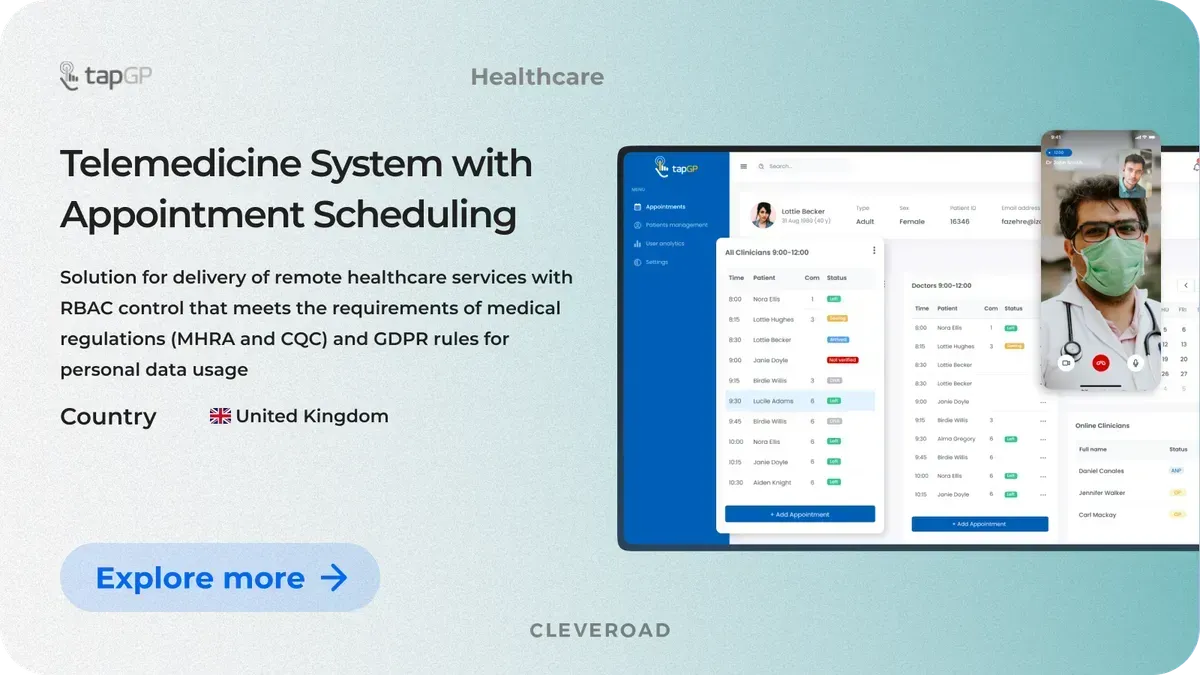
Telemedicine system with appointment scheduling
We’ve successfully delivered a turnkey system compliant with core healthcare regulations (namely, MHRA and CQC), including the following modules (but not limited to them):
- The appointment management module allows the administration to view and control the details of each Appointment, including appointments booked for children.
- The Patient KYC procedures module enables patients to register in the system by uploading identification documents and taking selfies. We have also added the selfie comparison mode to simplify the verification process.
- The patient management module contains detailed and secure patient data and allows patients to schedule/reschedule meetings with doctors and review their appointment history.
- The booking system helps patients book appointments with doctors, from selecting the required specialist to confirmation and payment.
- Online meeting functionality allows receiving consultation via voice and audio calls. To deliver high-quality processing, we’ve integrated a video conferencing API (Twilio).
As a result, the client received a custom telemedicine platform compliant with Medicines and Healthcare products Regulatory Agency (MHRA) and Care Quality Commission (CQC) requirements. The system automates two manual workflows end to end: appointment booking and Know Your Customer (KYC) patient verification, including document upload and selfie matching. Instead of checking identities and coordinating bookings by hand, admins now manage both flows in one digital system, which helped reduce paperwork by 20% and process patient requests faster.
Telemedicine Software Solution Demo
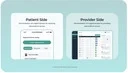
Below is a live demo of a telemedicine platform our team built. You can walk through both sides of the product: the patient app (registration, booking, video consultation, payment) and the provider dashboard (patient records, scheduling, EHR access). It shows how the features described above look in a shipped interface.


Telemedicine software is a digital platform that allows healthcare providers to deliver medical services remotely. It usually supports patient registration, appointment booking, video or audio consultations, secure messaging, EHR/EMR access, prescriptions, payments, and follow-up communication.
Building a telemedicine app takes six stages: idea validation, discovery, UI/UX design, MVP development, testing, and post-release maintenance. Each stage is broken down by timeline and cost in the 6 Steps for Telemedicine Software Development section above.
Telemedicine software usually uses video and audio communication APIs, secure messaging, cloud infrastructure, EHR/EMR integrations, payment gateways, analytics tools, and mobile or web development frameworks.
In 2026, telemedicine platforms will increasingly use AI/ML for triage, documentation support, patient routing, and workflow automation. FHIR and HL7 integrations are also important when the platform needs to exchange clinical data with healthcare systems.
Blockchain and AR can be used in specific cases, but they are not core technologies for most telemedicine products.
A telehealth app may cost from $20,000 to $150,000+, depending on complexity, integrations, compliance requirements, and infrastructure. See the detailed breakdown in the “How Much Does It Cost to Develop a Telemedicine App?” section above.
Yes. Many Medicare telehealth flexibilities have been extended through December 31, 2027, while telemedicine prescribing flexibilities for controlled medications are extended through December 31, 2026. See the full policy breakdown in the “How Is Telemedicine Reimbursed Under Medicare in 2026?” section above.

Evgeniy Altynpara is a CTO and member of the Forbes Councils’ community of tech professionals. He is an expert in software development and technological entrepreneurship and has 10+years of experience in digital transformation consulting in Healthcare, FinTech, Supply Chain and Logistics
Give us your impressions about this article
Give us your impressions about this article
Comments
2 commentsHi, Alina Rovnaya wonderful article! Thanks for taking your valuable time to share this with us. So far this is one of the best telemedicine software guides I've read on the internet. Keep up the good work with more informative and insightful content.
Since I have done a full research and in the process of developing the telemedicine system I find this article upto my satisfaction and in fact I find some useful information in it.