Vibe Coding Security Vulnerabilities: How to Find and Fix Them
09 Sep 2026
16 Min
118 Views
Your team shipped fast with Cursor, Claude Code, Lovable, Replit, or v0, and now that code runs in production, backed by your customers' data. The speed was real. So is the security debt, and it usually surfaces at the worst moment: right before an audit, an enterprise deal, or a compliance review.
As an IT provider with 15+ years of experience in secure software engineering, we at Cleveroad audit, harden, and rebuild applications assembled with AI coding agents. We have seen which flaws recur, which you can test for in an afternoon, and which mean the foundation has to be rebuilt before anything else. In this guide, we give you a named list of vibe coding vulnerabilities, a repeatable way to find them in your own repository, and a clear read on when in-house fixes are no longer enough.
Key takeaways
- Apiiro's 2025 analysis found AI-assisted pull requests produced 2.74× more security issues than human-authored ones.
- Vibe-coded applications commonly fail across eight recurring flaw classes, including exposed secrets, broken access control, unsafe deserialization, and hidden backdoors.
- Detecting these flaws requires layered checks, like secret scanning, SAST merge gates, dependency verification, and manual authorization testing.
- Refactor contained flaws; rebuild structural ones. Localized security defects can be fixed, while broken authorization or missing multi-tenancy usually require deeper architectural work.
What Are Vibe Coding Vulnerabilities?
Vibe coding vulnerabilities are security defects introduced when an AI agent, rather than a developer, makes an implementation decision. They matter because they cluster differently from human-written bugs, so the review habits that used to catch flaws walk right past them. If your product was assembled largely through prompts, this is the category your codebase most likely falls into.
The most common vulnerabilities in vibe-coded applications fall into the categories stated below.
1. Hardcoded secrets and exposed credentials
API keys, database passwords, JSON Web Token (JWT) secrets, and OAuth tokens are written directly into source code or returned in client-side responses. GitGuardian's State of Secrets Sprawl 2026 reports that exposed secrets on public GitHub rose 34% year over year, the largest single-year increase on record, with AI-assisted coding a primary driver. Detection is only half the problem: the same report found that 64% of validated leaked credentials were still live and unrevoked, so a secret sitting in your commit history is very likely still active.
Keeping secrets out of source is an architectural decision made before the first line of code, not a cleanup task afterward. In regulated markets, it is the difference between passing and failing an assessment.
When we at Cleveroad built a micro-investment and savings platform for a Saudi investment firm, we structured the Software Development Life Cycle (SDLC) so that customer and end-user credentials remained black-boxed from all participants. Multi-factor authentication and Know Your Customer (KYC) liveness detection sat at the authentication layer. The app passed SAMA Cybersecurity Framework assessment before release.
The screen below shows the platform's authentication and onboarding flow, where the credential controls described above are enforced.
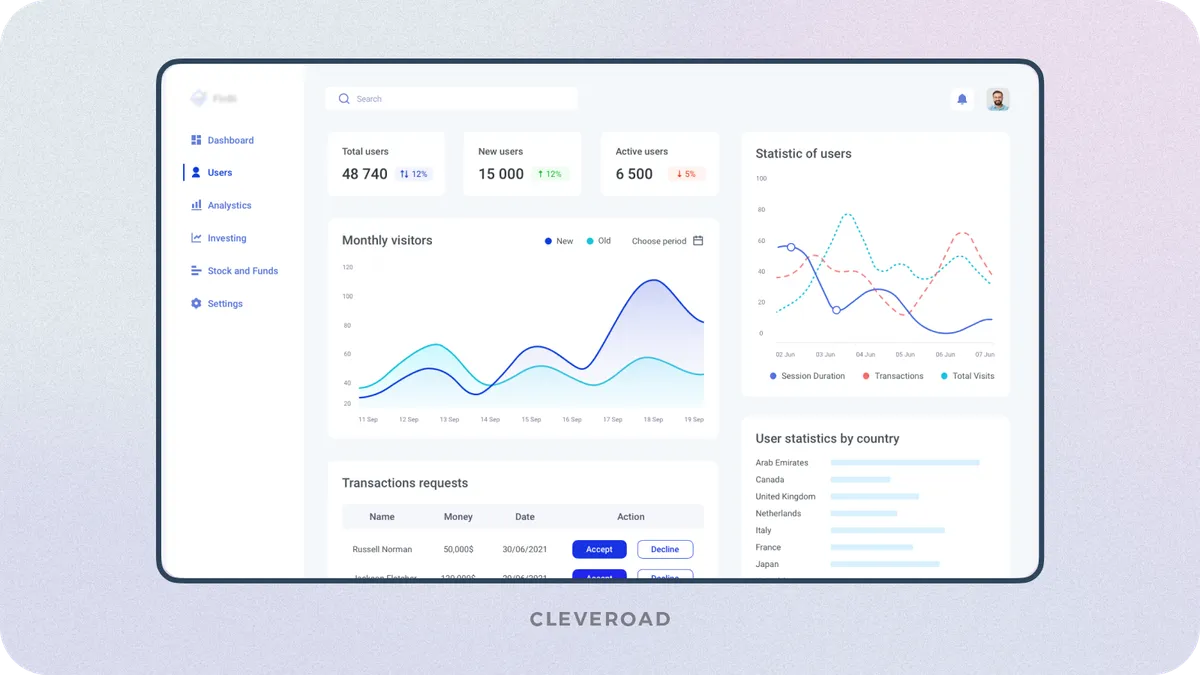
Micro-investment platform designed by Cleveroad
2. Broken authentication and access control
Iterative prompting quietly weakens authorization. Each refactor can drop an ownership check that an earlier prompt added, which produces Insecure Direct Object Reference (IDOR) flaws and missing row-level security, where changing an identifier in a request returns another tenant's data. The test for this is specific: send a valid session token and request another user's object identifier. If that record comes back, your access control is broken.
3. Injection through unsanitized input
SQL injection and cross-site scripting (XSS) show up most often, and command injection appears wherever the agent shells out to the operating system. All of them trace back to queries built by string interpolation instead of parameterized ones. The generated code passes functional tests with benign input, which is exactly why it survives to production. Veracode's testing found AI tools failed to defend against cross-site scripting in 86% of relevant code samples, so this is far from a rare edge case.
4. Hallucinated packages and slopsquatting
Models repeatedly invent the same non-existent package names. Attackers pre-register those names on public registries, and the vibe coder installs the malicious code on the next build. The industry calls this attack slopsquatting. Hallucination patterns shift with every model release, so a one-time allowlist goes stale fast and gives you false confidence.
5. Rules file backdoors
Attackers plant hidden Unicode instructions in shared agent configuration files, such as .cursorrules and CLAUDE.md, AGENTS.md, or Copilot instruction files. Every subsequent AI session inherits the poisoned instructions while the code review still looks clean. The compromised output stays invisible in a visual diff because the payload lives in characters the screen does not render.
Discover more about Cleveroad's vibe coding rescue services to learn ho wyou can turn your AI-built product into a secure, production-ready solution
6. Unsafe deserialization and memory corruption
According to Databricks' 2025 red team research, two clear examples of this appeared. Claude-generated network code serialized Python objects with pickle and deserialized them without validation, which opened the door to arbitrary remote code execution. A ChatGPT-generated GGUF parser carried an integer overflow that led to a heap buffer overflow. Both applications worked perfectly, and that is the whole problem: functional success hid a critical memory-safety hole.
7. Placeholder logic left in production paths
Stub functions that return hardcoded success values reach production unnoticed. The classic example is an isAuthorized() that always returns true, though a payment validator that never actually validates is just as damaging. A 2026 systematic study, Understanding the (In)Security of Vibe-Coded Applications, flagged placeholder logic as one of the patterns most distinctive to this kind of software, because a human author rarely leaves a security gate stubbed out by accident.
8. Exposed endpoints and missing rate limiting
Misconfigured Application Programming Interfaces (APIs) and admin routes sit reachable directly from public endpoints, with no throttling and no auth gate. As reported in Escape's 2025 security research, researchers disclosed more than 2,000 high-impact vulnerabilities across applications built on vibe coding platforms, and a large share of them were exactly this class of misconfiguration.
The table below maps each of the eight flaws to its OWASP Top 10 category, how it appears in generated code, and the primary way to detect it.
| Vulnerability | OWASP Top 10 category | How it shows up in generated code | Primary detection method |
|---|---|---|---|
Hardcoded secrets | A02 Cryptographic Failures | API keys and DB passwords inline in source or client responses | Secret scanning across full git history |
Broken access control | A01 Broken Access Control | Missing ownership checks, absent row-level security | Manual authorization test matrix |
Injection | A03 Injection | String-interpolated SQL and unescaped output | SAST plus DAST |
Hallucinated packages | A06 Vulnerable Components | Imports of packages that did not exist at generation time | Registry verification against manifest |
Rules file backdoor | No OWASP equivalent | Hidden Unicode in shared agent config files | Byte-level diff of rules files |
Unsafe deserialization | A08 Software and Data Integrity Failures | pickle, eval, unchecked buffer reads | SAST plus targeted code review |
Placeholder logic | No OWASP equivalent | Stub functions returning hardcoded success | Manual review of auth and payment paths |
Exposed endpoints | A05 Security Misconfiguration | Public admin routes, no rate limiting | External attack surface scan |
Mapping follows the OWASP Top 10:2025 categories; detection methods reflect Cleveroad's audit practice.
Notice that no single tool covers the whole table. Secret scanners, static analysis, and attack-surface scans each catch a slice, and the three flaws with no OWASP equivalent require a human to read the code. That split is why a purely automated pass can give false comfort, and it shapes the audit sequence later in this guide.
Why Do Vibe-Coded Apps Ship Insecure Code?
Vibe-coded apps ship insecure code for a structural reason: the vibe-coding loop removes the checkpoints that used to catch security defects. The models are often good at producing working code. The gap lies in what the workflow no longer does around them, and each mechanism below is supported by evidence.
Models optimize for correctness, not security
Benchmarks and training pipelines reward code that compiles and passes tests, so insecure-but-working output scores well and gets reinforced. Veracode's 2025 report found Java carried a 72% security failure rate across tasks, and newer models were no better at writing secure code than older ones. Capability alone does not close the gap.
Context loss across long prompt chains
An authorization check written in prompt 3 quietly disappears when prompt 14 refactors the same route. The same 2026 study traces this to agent memory loss and locally optimized objectives, in which the agent solves the immediate request without retaining a security decision made earlier in the session. The longer the chain, the more of these silent regressions accumulate.
Our LLM development services transform enterprise knowledge into AI systems that understand context and support complex business tasks.
Mega pull requests hide flaws from review
According to the Cursor Developer Habits Report (Spring 2026), average lines of code per pull request rose roughly 250% year over year, and pull requests touching 1,000 or more lines grew from 8% of all pull requests in January 2025 to 13.9% by May 2026. A reviewer skims a 1,200-line diff instead of reading it. Apiiro's data pairs the trend with its outcome: 4× delivery velocity and 10× the vulnerabilities.
Automation complacency in the review loop
When generated code has been correct ten times, the eleventh review gets skimmed. This is a behavioral failure rather than a knowledge gap, and it affects experienced engineers as much as non-technical builders. The habit of trusting the tool is precisely what the eleventh commit exploits.
Shadow deployments outside IT visibility
Non-engineers push working apps straight to production with live data attached, and your security team ends up defending assets it cannot inventory. In our own audits, private repositories tend to carry more hardcoded secrets than public ones, because the assumption of privacy quietly lowers the guard. You cannot protect what nobody has written down.
The diagram below shows where each of these five mechanisms injects risk as work moves from prompt to production.
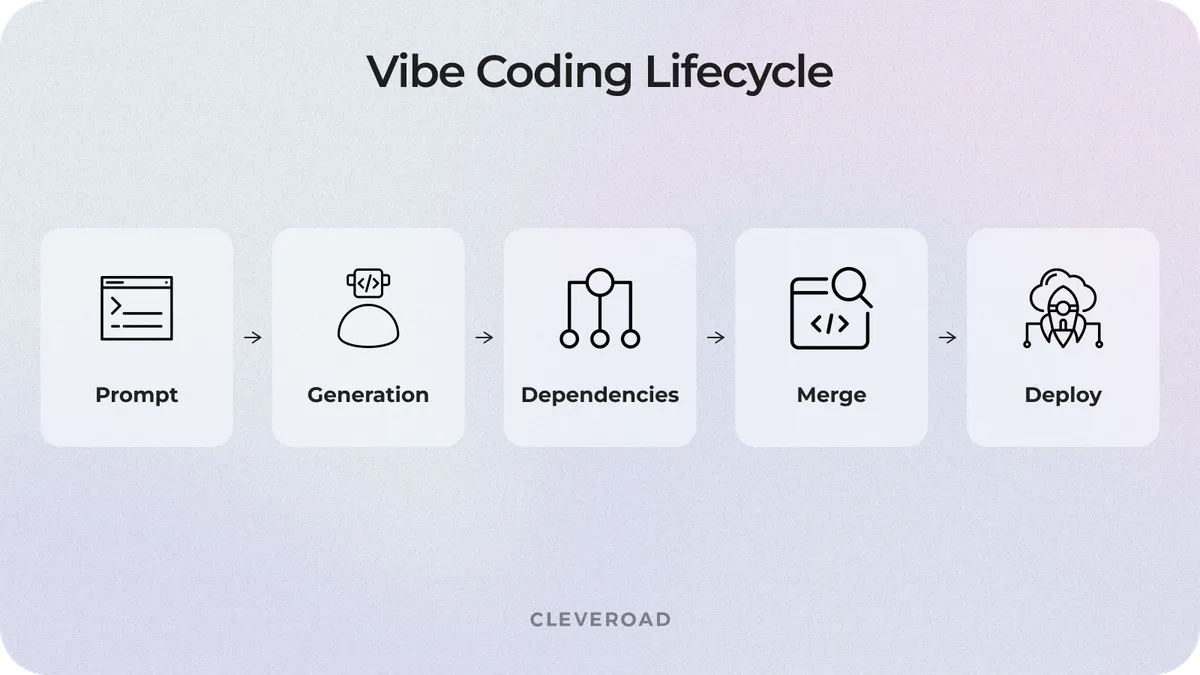
Vibe coding lifecycle
How Cleveroad Finds Vibe Coding Vulnerabilities
Here is the sequence we, at Cleveroad, run when a client brings us a vibe-coded application. We work outward from what can be inventoried, then inward to the logic only a human can judge. Each step produces a named artifact you keep, whether you continue with us afterward or take it back in-house.
Step 1. Inventorying every vibe-coded asset
We map applications built and deployed outside your sanctioned pipelines, including those shipped by non-engineers, and trace which data each one touches. The output is an asset register that lists every app, its owner, data connections, and exposure level. Until that register exists, every later step is working blind.
Step 2. Scanning the full git history for secrets
We scan history rather than only HEAD because a rotated-looking key still lives in the commit log and stays exploitable. Every finding is paired with a rotation task, since detection alone closes nothing. Most validated leaked credentials are never revoked, which is why we treat rotation, not discovery, as the point where the risk actually ends.
Step 3. Making SAST a mandatory merge gate
We treat AI-generated contributions as untrusted external input, so static application security testing (SAST) serves as a gate that each one must pass. Our QA and testing engineers wire these gates into Continuous Integration (CI) so that a failure blocks the merge, rather than generating a ticket that nobody picks up.
The same rule, generated code never approves itself, is how we ran AI-assisted delivery for Proprio Cloud Solutions, a US SaaS company developing AI-Assisted ERP for NetSuite SaaS Platform.
Our five-person team, working with AI coding tools, joined the client across two parallel workstreams: ongoing development of the Orion platform and delivery of a new Field Service mobile app. At the same time, our QA engineers replaced a manual regression process that previously took three working days per release with automated end-to-end testing across three client environments.
AI was used to accelerate code work, test generation, and documentation, but it was never allowed to approve its own output. Every AI-generated contribution still passed human review before release, while security-sensitive code paths required additional engineering control.
As a result, sprint output increased by 30-40% while defect rates remained at the client's previous baseline. The team also shipped four major Orion releases on schedule without increasing headcount.
Luke Abbott, CTO at Proprio Cloud Solutions, describes the balance between higher velocity and maintained code quality in his video feedback you can review below:
Luke Abbott, CTO at Proprio Cloud Solutions, on AI-assisted delivery holding code quality as velocity rose.
Step 4. Verifying and pinning every dependency
We check each import against the official registry, including package age and maintainer history, to catch squatted names before they install. Then we lock the result with version pinning and a minimum release age, so a freshly registered package cannot slip in. The stakes here are not theoretical. In the 2025 Shai-Hulud npm worm, according to Wiz's analysis, nearly 60% of compromised machines were continuous integration and delivery (CI/CD) runners rather than developer workstations, meaning a single poisoned dependency can directly expose your build secrets.
Step 5. Testing authorization by hand
Scanners cannot infer your business rules, so we build an explicit matrix of roles, resources, and expected outcomes, then test every forbidden combination. This is where IDOR and missing row-level security surface, because a machine sees a valid request while a human sees a tenant reading data that is not theirs.
We build that matrix into the architecture, not into a test plan alone. For a US medical device firm, we built the QSuite quality management system (QMS) with role-based access control across Super Admin, Admin, and User tiers. We configured AWS S3 so that no QMS document was reachable directly, only through the permission layer. All of this held up under scrutiny from FDA 21 CFR Part 11 and ISO 13485. That storage-level restriction is the control vibe-coded apps skip most often.
- Explore the Quality Management System case in more detail.
Step 6. Reviewing auth, payment, and data paths line by line
Authorization, payment, and data-handling paths are where placeholder logic does the most damage, so we read them manually rather than trust a scan. Our code audit sequences findings by business risk, not by severity score alone, so the fix that protects your revenue or your compliance status comes first, not the one that happens to score a higher number.
When in-house review capacity runs out, opt for our code audit services to get an external audit of the AI-generated portion of your codebase.
Step 7. Penetration testing before the app touches real users
We close with adversarial testing against the running application, because several of these flaws only appear at runtime. The output is a ranked remediation backlog your team can execute directly or hand back to us. By this point, you have moved from not knowing what is wrong to holding a prioritized, evidence-backed plan.
The diagram below shows the full sequence and the artifact each step hands you.
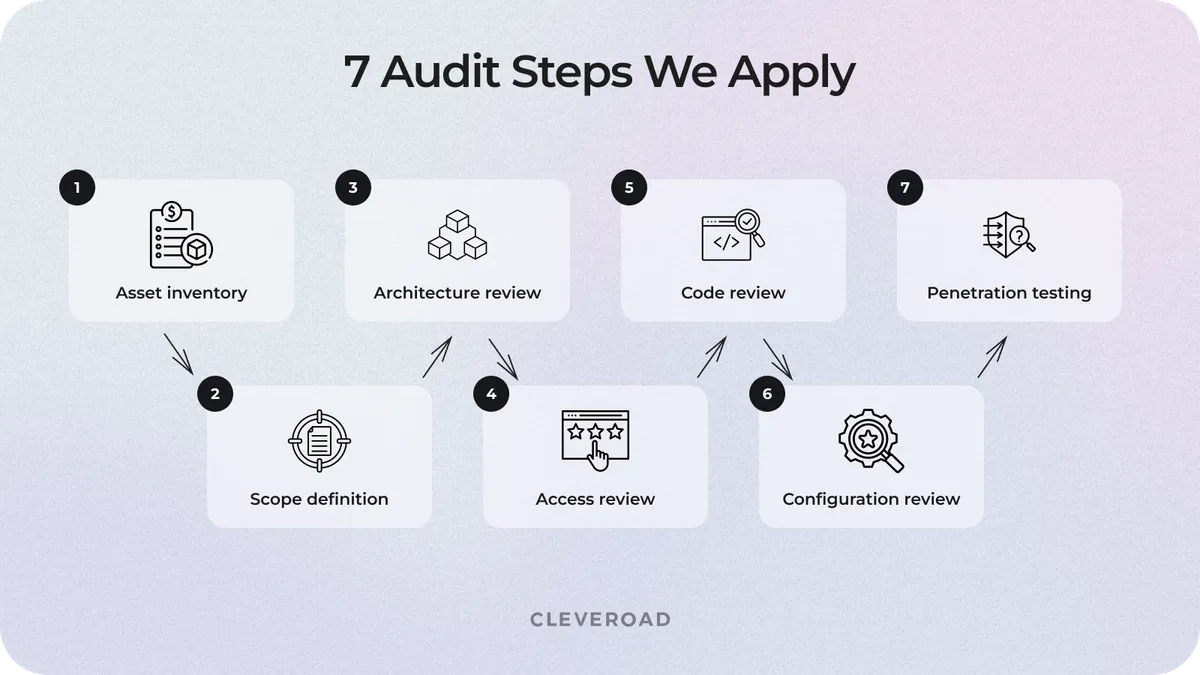
7 audit steps we apply to vibe coded apps
Four Practices That Keep Vibe Coding Vulnerabilities Out
Prevention means restoring the friction that vibe coding removed, at the cheapest point in the cycle. These four practices sit upstream of the audit. They change what reaches your codebase in the first place, so you fix far less later.
Cap pull request size
Set a hard threshold, for example, 400 lines of changed code per pull request, and enforce it in Continuous Integration. Review quality drops sharply once a pull request sprawls across services, and that is exactly where placeholder stubs stop being visible. With 1,000-line pull requests now at 13.9% of the total (Cursor's Spring 2026 data above), this single limit recovers most of the review coverage teams have lost.
Add security prompts and allowlist agent rules files
Add a self-review prompt to the agent's system instructions so it checks its own output for security issues before the code reaches review. In Databricks' 2025 red team research, this practice cut insecure code generation by roughly 48% for Claude 3.7 Sonnet in instruct mode. Language-specific prompts reduced it by 24% to 37%, while generic security prompts improved results by only 8% to 16%.
Then address the remaining risk by reviewing every shared rules file before use and diffing it at the byte level, because a malicious Unicode payload may be invisible on screen.
Treat generated code as untrusted input
This is how we structure AI-assisted development engagements: human architects own the design, and every generated change passes review before merge. In practice, that policy is documented as a clear boundary for AI use, defining which parts of the codebase it may modify, where human approval is mandatory, and which security-sensitive areas remain off-limits to autonomous changes throughout delivery.
Govern environments and the deployment pipeline
Use two controls together to keep AI-generated applications away from production by default. Give generated apps access only to non-production data, and require engineers to grant production access explicitly through the sanctioned deployment pipeline. The first control limits the blast radius if a vulnerability reaches a deployed environment. The second prevents shadow IT by ensuring the security team can see and govern every asset that reaches production.
Should You Refactor or Rebuild a Vibe-Coded App?
Once the audit is complete, the question is how deep the remediation has to go, and the answer depends on where the structural risk sits. The rule of thumb: patch when the architecture is sound and the flaws are localized, and rebuild when authorization, the data model, or tenancy assumptions are wrong at the foundation. The four outcomes below cover most audits we run:
- Refactor when secrets, injection points, and dependency issues make up the bulk of findings. These are contained fixes.
- Rebuild the security layer when authorization logic is scattered across routes with no central policy.
- Rebuild the data layer when multi-tenancy was never modeled and row-level security cannot be retrofitted.
- Full rewrite when nobody on the team can explain what the code does, which turns every future fix into a guess.
Both mistakes cost money: rewriting a system that could still be repaired, or keeping an architecture that will keep generating the same findings. Alex Penzov, CTO at Cleveroad, explains how we approach that decision when refining a vibe-coded solution:
Alex Penzov
CTO at Cleveroad
"The first thing I check is whether authorization can be expressed as one policy or is scattered across the request handlers. If a client can point me to a single place that decides who is allowed to do what, we can almost always refactor. When that logic is smeared across dozens of routes with no central owner, patching just moves the risk around, and that one answer usually decides rebuild versus refactor before I look at anything else."

A rebuild does not mean discarding the product. A working prototype is a validated specification, and it is often the fastest input to a proper implementation. The same principle drives AI-assisted legacy modernization, where a system that already proves the business logic becomes the blueprint for a secure rebuild rather than a throwaway.
How Cleveroad Secures Vibe-Coded Applications
Cleveroad is a custom software development company with 15+ years of experience in software delivery for various business domains. We have a track record of building secure, compliant software across FinTech, Healthcare, Logistics, and other regulated domains. We hold ISO 27001 certification for information security management and ISO 9001 for quality management, and we are an AWS Select Tier Partner. Our in-house security, QA, DevOps, and cloud engineers do the work described in this guide as a standard part of delivery, not as an add-on.
Behind our works sits a 280-engineer in-house core team plus a 2,100-specialist external talent network, so we can staff a fast code audit or a full rebuild without shuffling people between accounts. We match the engagement to where you are, rather than pushing a single service.
Several services for bringing your vibe-coded app to production:
- Vibe code audit identifies security and reliability issues and turns them into a risk-ranked remediation plan. Start with our code audit services.
- Full vibe code rescue fixes the issues uncovered during the audit and hardens the application for production.
- Launch support takes the rescued product through deployment and release, including rollback preparation and store submission where needed.
- Ongoing development gives you a dedicated development team to keep improving the hardened codebase after launch.
Rescue your vibe-coded application
Our engineers can audit your app, fix critical issues, harden the codebase, and prepare it for production. Start with a focused review or hand over the full rescue, from remediation to launch.
Vibe coding's biggest risks cluster into eight classes: hardcoded secrets, broken access control, injection, hallucinated packages, rules file backdoors, unsafe deserialization, placeholder logic, and exposed endpoints. The last three have no direct OWASP Top 10 equivalent, so standard security tools may not detect them reliably. The risk grows further when teams rely on AI coding tools without enough human oversight over generated changes.
The checkpoints that used to catch defects are often missing from the workflow. AI models and an LLM can generate code that passes functional tests while still introducing insecure behavior. Weak input validation is especially dangerous because working functionality can hide exploitable paths.
Context loss across long prompt chains makes the problem worse, particularly when large pull requests receive only superficial review. Without clear best practices for review and deployment, developers may push insecure-but-functional code toward production. Veracode's 45% vulnerability rate therefore becomes easier to understand.
A systematic study of deployed vibe-coded applications found recurring patterns such as placeholder authorization logic, insufficient filtering of user input, and exposed credentials.
Sensitive data can also enter source code through API keys, tokens, configuration values, or generated debugging logic. Exposed secrets alone rose 34% year over year on public GitHub in 2025, making secret handling one of the first areas teams should examine.
Dependency risk matters as well. Hallucinated or compromised packages can introduce weaknesses through the software supply chain, even when the generated application code itself appears correct.
Use layered security checks, because no single control catches every failure mode:
- Scan the full git history for secrets, not just HEAD.
- Make static application security testing (SAST) a mandatory merge gate.
- Verify and pin dependencies against their official registries to reduce supply chain risk.
- Test authorization manually with a role-resource-outcome matrix, since scanners cannot infer your business rules.
The goal is to make it difficult for generated code to bypass the controls that human-written code must already pass.
The central risk is that functionally correct code can still contain critical vulnerabilities. In one benchmark of 200 real-world tasks, 61% of agent-written solutions worked while only 10.5% were secure.
In production, that gap can surface as leaked customer data, cross-tenant access, or compromised build infrastructure. Before an audit, enterprise deal, or compliance review, insufficient controls around AI-generated code can therefore become a direct business risk rather than just a development concern.

Evgeniy Altynpara is a CTO and member of the Forbes Councils’ community of tech professionals. He is an expert in software development and technological entrepreneurship and has 10+years of experience in digital transformation consulting in Healthcare, FinTech, Supply Chain and Logistics
Give us your impressions about this article
Give us your impressions about this article