How to Create a Healthcare Learning Management System: Complete 2026 Guide
Updated 29 Sep 2026
15 Min
1639 Views
Clinical protocols and regulations change every year, and your staff has to keep up without stepping away from patient care. When training lives in spreadsheets and classroom sessions, completion gaps usually surface only during an inspection. A healthcare learning management system (LMS) gives you one place to deliver mandatory courses, run assessments, track certifications, and prove compliance when an auditor asks.
We at Cleveroad have combined healthcare and EdTech expertise for 15+ years to build secure, scalable software tailored to complex industry workflows and regulatory requirements. In this guide, we explain what a healthcare LMS includes, which features matter most, how development works, and what budget to plan. You will also find practical steps for picking a reliable vendor for your solution.
Key takeaways:
- A healthcare LMS should be built around compliance: role-based access, audit-ready reports, certification tracking, and support for e-learning standards like SCORM and xAPI.
- Healthcare LMS development typically costs from $40,000 for a basic solution for a single clinic to $250,000+ for an enterprise platform for a hospital network.
- Development usually takes 3–14 months, depending on platform scope, integrations, compliance requirements, and the number of facilities.
What Is an LMS in Healthcare?
A healthcare LMS is software that medical organizations use to run staff training and continuing education in one place. Clinics often need specialized learning solutions because employees in different roles must complete mandatory training, keep up with changing clinical and compliance requirements, and provide clear documented proof of successful course completion during audits.
How healthcare LMS differ from others
A healthcare LMS differs from a standard corporate learning platform because it must support regulated training, recurring certifications, and clinical staff work patterns.
- Compliance and training records. Healthcare organizations need reliable records of mandatory courses, completion dates, certificates, and recurring training. The LMS may also require strict access controls and data protection measures when it stores employee or patient-related information.
- Training built around clinical workflows. Medical staff often work shifts, which makes fixed classroom sessions impractical. A healthcare LMS lets them complete required training at a suitable time while keeping education aligned with clinical schedules and deadlines.
- Continuing education management. Healthcare professionals may need continuing education credits to maintain licenses or professional certifications. An LMS can track completed activities, credits, certificates, and renewal deadlines. In the US, organizations that provide accredited continuing medical education can also structure their programs around ACCME requirements.
These capabilities make a healthcare LMS suitable for organizations that must prove staff competency and keep training records current across clinical roles and locations. The diagram below shows how these requirements shape the LMS architecture, connecting user roles and client apps with training services, data storage, and HR and clinical system integrations.
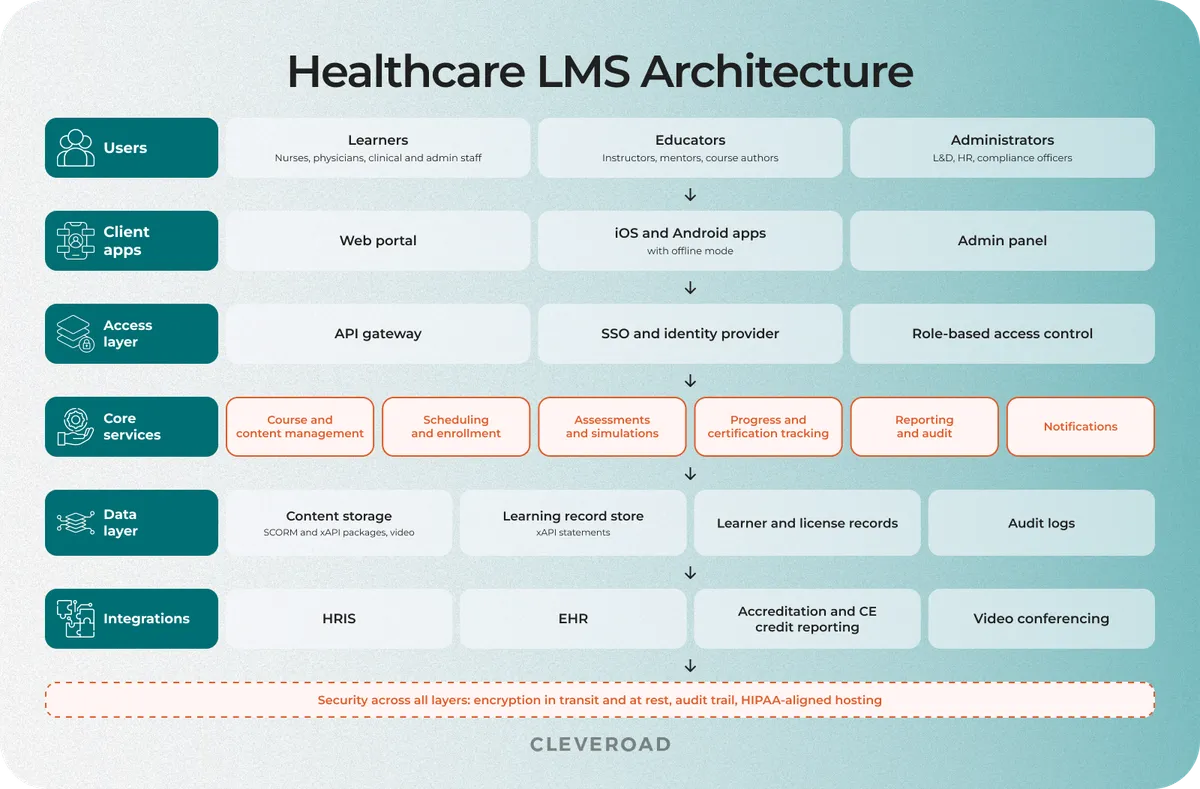
Healthcare LMS architecture: user roles, core services, data layer, and integrations
The market demand for LMSs
Demand for healthcare learning platforms keeps growing. A 2026 report by Grand View Research valued the global LMS market at $28.6 billion in 2025 and projects it to reach $123.8 billion by 2033, with a compound annual growth rate (CAGR) of 20.2% from 2026.
Healthcare adds to that demand. The U.S. Bureau of Labor Statistics projects about 1.9 million openings in healthcare occupations each year from 2025 to 2035, and every new hire completes onboarding and compliance courses before working with patients. On top of that, the Occupational Safety and Health Administration (OSHA) requires employers to train workers who face hazards on the job, which in hospitals covers recurring topics like bloodborne pathogens and hazardous chemicals.
Opt for our healthcare software development services to build a compliant training platform for your medical staff
What Healthcare Organizations Use an LMS Platform For
Healthcare organizations use an LMS to keep every employee trained and certified without disrupting patient care. Here is a quick overview of the 5 main ways a healthcare LMS pays off for a medical organization.
1. Fewer in-person training sessions
An LMS reduces your need for classroom education, saving the budget you spend on instructors, rooms, printed materials, and staff coverage. Theory moves online, so one course reaches your entire staff without extra instructor hours or booked rooms. Instructors then spend their classroom hours on hands-on skills that need a live session.
2. Training available anytime and anywhere
Physicians and nurses rarely fit a fixed class schedule into their shifts, so they need to set their own timetable. With an LMS, they study on a laptop or phone between rounds, alone or under a mentor's guidance. Course materials such as videos, podcasts, PDF files, and interactive cases stay in the cloud, so learners can return to any part of a course whenever they need it.
3. Courses that match current requirements
Clinical guidelines and regulations change often, and your staff has to learn new skills to keep giving patients safe care. An LMS lets you update a course once and push the new version to every learner, instead of reprinting materials or scheduling another round of classes. You can also adapt existing materials to your internal goals, so training reflects how your organization actually works.
4. Progress monitoring and audit-ready reporting
Dashboards show who completed which course, who is overdue, how each learner scored on assessments, and whose certificates expire next month. Based on these results, you can assign classes to specific employees and close knowledge gaps before they affect patient care. When an inspector asks for proof of training, you export a completion report in minutes instead of collecting paper certificates from each department.
5. In-house course authorship
Your organization already has protocols and instructional videos created by senior staff. Built-in authoring tools let you turn that content into structured courses with quizzes, so your internal expertise becomes reusable training. Support for the Sharable Content Object Reference Model (SCORM) and Experience API (xAPI) standards also lets you import ready-made courses from third-party providers.
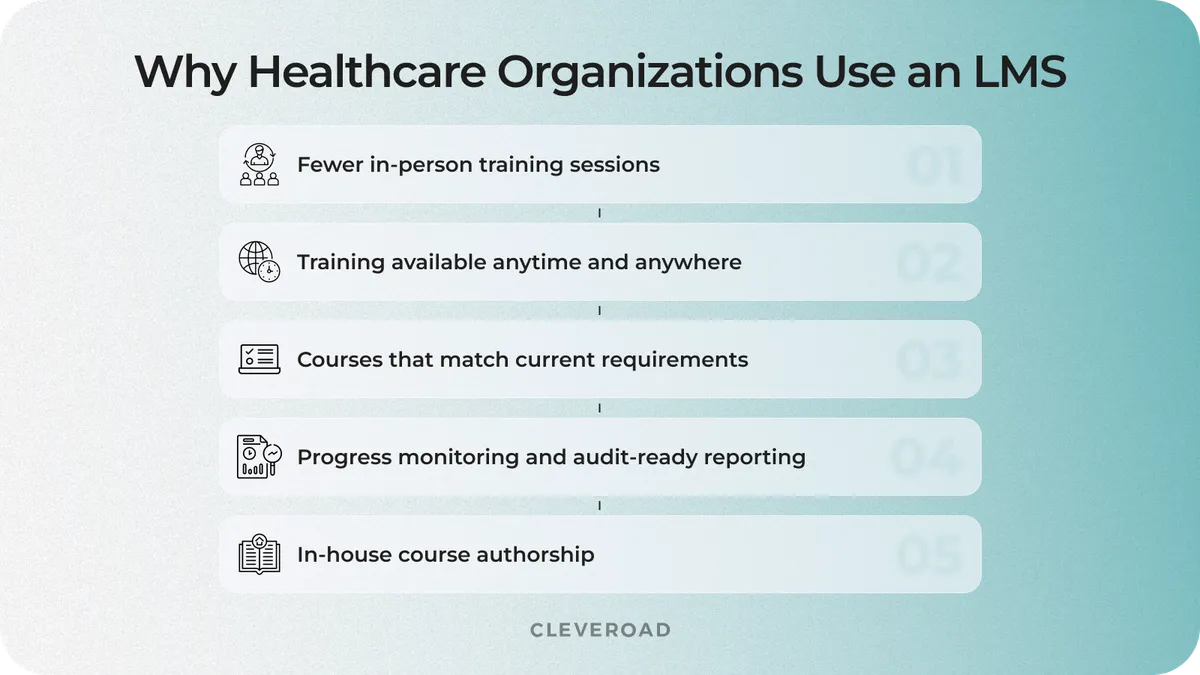
5 ways healthcare organizations use an LMS
Core Healthcare LMS Features for Training and Learning
A healthcare LMS's features determine whether staff complete training on time or postpone it until the deadline. Let's look at the functional blocks that make the platform useful for both learners and the people who manage their training.
Learning flows and materials management
This block covers how courses reach your staff. Educators group modules by role, department, and certification cycle, so each learner sees only the training that applies to them. Native iOS and Android apps add offline access: a nurse downloads a module at home, finishes it during a break, and the progress syncs once the device is back online.
Smart planning tools
A built-in training calendar lets educators schedule courses, live sessions, and simulations, while learners pick a convenient day and time. System notifications work alongside the calendar. They remind learners about upcoming sessions and approaching certification deadlines, so fewer licenses lapse unnoticed.
Social learning
Social learning tools let staff learn from each other inside the LMS. Learners share and comment on courses, rate content, and discuss cases in live chat. It helps a new nurse get answers from experienced colleagues without waiting for a scheduled session.
Evaluation and testing tools
Assessment tools let instructors grade quizzes, case tasks, and practical assignments quickly and give learners feedback on each one. Engagement and retention metrics then show how well each learner understands the material.
Test simulations are a good example. Staff take a practice version of a certification exam before the real one, which shows them their weak spots and builds confidence before an exam that affects their right to practice.
Security and access control
An LMS stores employees' personal data along with records of their clearances and licenses, so the same regulatory framework that governs clinical systems sets the requirements for its protection. In practice, this means HIPAA-aligned hosting, encryption in transit and at rest, access logging, and regular security testing. Role-based access control adds another layer: it decides who can edit courses and who can only view them.
We at Cleveroad design healthcare LMS infrastructure with built-in compliance controls. Codex Labs, a skincare and dermatology science company, came to us with its DECODE.ME teledermatology platform, an unfinished product that had already passed through several development vendors. We analyzed the legacy code and removed backend bottlenecks.
Then we set up HIPAA-compliant infrastructure and optimized it so medical data exchange stays predictable under load. Our team delivered the demo in five months, allowing the client to present the product at the American Academy of Dermatology (AAD) 2025 Innovation Meeting, where dozens of dermatologists joined the presentation. Today, we continue to expand the product’s functionality.
This is what Barbara Paldus, founder & CEO of Codex Labs, says about her cooperation with Cleveroad:
Barbara Paldus, Founder & CEO at Codex Labs: Feedback on Cleveroad
Training administration and management
A healthcare LMS should give administrators full control over how staff training is assigned, tracked, and documented. Admins can create learning paths for different roles, enroll employees in mandatory courses, set deadlines, monitor completion status, and review assessment results from one place.
For healthcare organizations, these capabilities also simplify compliance management. Administrators can quickly see who completed required training, identify overdue courses, and keep records ready for internal reviews or regulatory audits. The exact feature set depends on your staff structure and compliance scope, so it pays to involve a solution architect before you fix the requirements.
How to Create an LMS That Perfectly Fits Your Business
Building a healthcare LMS requires careful preparation before development starts. Before you contact a vendor, define the following aspects:
- A type of your future LMS depending on your goals (e.g., staff development, training, etc.)
- A portrait of your prospective learners (their age, education, and other essential data)
- Necessary third-party integrations
- Ways of user interaction with LMS
- Type of courses you need to develop
- Configuration to choose (e.g., a separate system integrated into the existing internal company platform)
Once you have answers to these points, you can contact a development partner, discuss the project details, and sign an NDA if needed.
The scheme below shows the five stages our team goes through to build a healthcare LMS, along with the specialists involved at each stage.
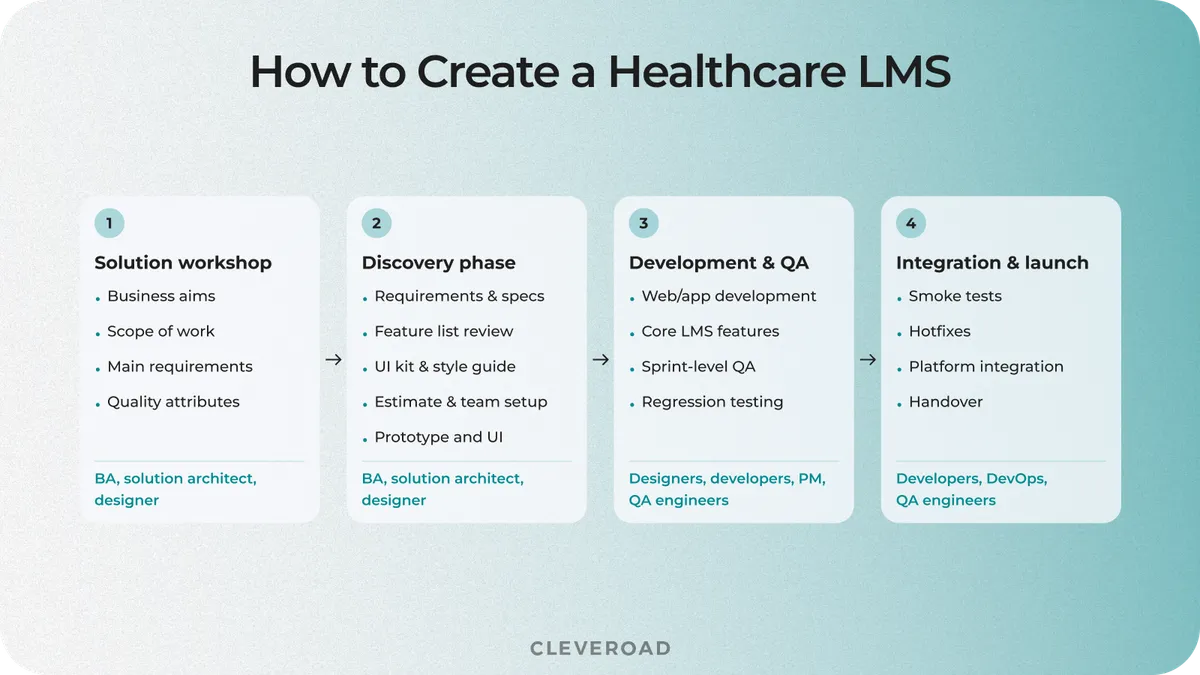
Five stages of healthcare LMS development at Cleveroad
Solution design workshop
After you send a request, the Solution Design team, which includes business analysts, a solution architect, and a designer, reviews the preliminary information. The team then contacts you to answer initial questions, identify the major goals, and schedule a workshop.
During this stage, the following points are defined by the team:
- Business aims
- A scope of future work
- Main concerns
- Basic quality attributes
Discovery phase
During the discovery phase, Business Analysts, a Solution Architect, UI/UX designers, and other technical specialists turn the initial LMS requirements into a detailed development plan.
The key deliverables include a detailed feature list, business process diagrams, defined non-functional requirements, a design concept with a UX map, and an updated Software Architecture Document. Based on these materials, the team also prepares the project timeline, team composition, and a more accurate development cost estimate.
LMS development and quality assurance
Cleveroad develops healthcare LMS solutions iteratively in two-week Scrum sprints. At the start of each sprint, the Project Manager defines the backlog, while developers implement the agreed functionality across web, iOS, Android, and backend components depending on the project scope.
QA engineers test new functionality during every sprint, covering both frontend and backend, and report issues for developers to fix. After all planned features are complete, the QA team runs regression testing across the system and can also perform stress testing on request to check how the LMS handles heavy loads.
Release and support
After regression testing and bug fixes, QA engineers run smoke tests to confirm that the healthcare LMS is stable for release. Our team then deploys the web solution to the live server or assists with publishing mobile apps to the App Store and Google Play, depending on the platforms included in the project.
Once the release is complete, Cleveroad hands over the project materials, including the specification, source code, design files, test documentation, system credentials, and other relevant deliverables. If required, our team can continue to support the LMS after launch. This may include bug fixes and further product updates based on user feedback.
Apply to our custom LMS development services to effectively cover every stage from the first workshop to deployment
How Much a Healthcare LMS Costs
A custom healthcare LMS typically costs between $40,000+ and $250,000+ and takes 3 to 14 months to build, depending on project scope. The table below breaks down cost and timeline across three typical scopes.
| Scope | Best suited for | What it includes | Cost |
|---|---|---|---|
Basic healthcare LMS | Single clinic or medical practice | Course delivery, enrollment, progress tracking, certificates, and role-based access | $40,000–$70,000+ |
Advanced healthcare LMS | Hospital or multi-site healthcare group | Everything above plus course authoring, assessments and simulations, audit reporting, SCORM and xAPI support, and mobile access | $70,000–$150,000+ |
Enterprise healthcare LMS | Hospital network or health system | Everything above plus HR and EHR integrations, multi-facility and multilingual support, accreditation credit tracking, and offline access | $150,000–$250,000+ |
Ranges reflect Cleveroad estimates for LMS and healthcare products of comparable scope, calculated at CEE engineer rates. The final figure depends on the feature list confirmed during the Discovery phase.
Several factors can push healthcare LMS development to the upper end of the range:
- Number of integrations. The more HR, EHR, and other internal systems the LMS must connect with, the more complex and costly the development becomes.
- Compliance reporting requirements. Advanced audit reports, detailed certification histories, and long-term data retention increase backend complexity and development time.
- Number of facilities. Multi-site deployments require more complex access rules and separate learning configurations for different locations.
- Multilingual support. Each additional language increases the amount of work required to adapt and validate the LMS.
- Interactive learning content. Clinical simulations and scenario-based assessments take more time to build than standard courses and tests.
To keep the first release affordable, you can start with the MVP scope, launch it for one department, and add authoring tools and integrations in later phases. During the Discovery phase, our team prepares a detailed estimate for your feature list, so you know the budget for each release before development starts.
How to Choose an LMS Software Development Vendor
Medical LMS development is complex because it requires a solid knowledge base and an understanding of its unique requirements. You can try it yourself, or simplify the process and entrust it to an outsourcing software development vendor with deep expertise in building digital healthcare products.
1. Analyze hiring platforms and check client feedback
Start with platforms that list and rate outsourcing companies, such as Clutch, GoodFirms, and ITFirms. These sites show basic company data like location, founding year, team size, service focus, and approximate hourly rates, while client reviews help you assess delivery experience and reputation.
The same platforms publish verified reviews from a vendor's previous clients. Read them closely, paying attention to reviews from healthcare and education companies and to how clients describe communication and deadlines. Recurring comments across several reviews tell you more than a single five-star rating.
See what our clients say about working with Cleveroad in verified reviews on Clutch and GoodFirms.
2. Study portfolios
Visit each vendor's website and review its portfolio section. Look for delivered LMS platforms and other compliance-heavy healthcare products, such as solutions built during healthcare web development, to check whether the vendor's experience matches your needs.
3. Make a shortlist
Instead of stopping at one company, prepare a shortlist of 3-5 healthcare LMS vendors. Compare what you know about each of them and plan the questions you want to ask, splitting them into technical and business parts.
4. Conduct interviews
Contact the companies on your shortlist and give priority to those that offer a meeting with their experts, which at Cleveroad is called a solution design workshop. Ask about similar LMS platforms they have built, how they handle HIPAA requirements, which team they would assign, and how they plan support after launch. A reliable vendor answers with specifics and offers a rough estimate after the first calls.
During the interviews, check that the vendor can offer:
- Technical support that helps you launch the platform and keep improving its performance after release
- Capacity to build both a basic version and an advanced one, which matters if your educational goals for learners keep growing
- Experience with learner analytics and rich course content, such as video tasks, webinars, and interactive onboarding flows
How Cleveroad Can Help You Build a Healthcare LMS
Cleveroad is a software development company headquartered in Estonia, Northern Europe. Since 2011, we have been building custom software for healthcare and education businesses, and our processes are certified under ISO 9001 for quality management and ISO 27001 for information security.
Our healthcare engineers have experience delivering LMS platforms, telemedicine systems, clinic management software, and remote patient monitoring solutions. Here is what you get when you work with us:
- We develop healthcare software in line with standards and regulations such as HIPAA, GDPR, PIPEDA, ISO 13485, and IEC 62304.
- Full-cycle development from the solution design workshop and Discovery phase to release and post-launch support.
- Flexible cooperation models, including a dedicated team, AI-assisted development team, and staff augmentation, with a team that scales as your requirements change.
- Multi-level QA process that covers functionality, integrations, performance, and security at every stage.
- Upfront cost estimation with no hidden fees and an NDA signed on request.
- Cleveroad has 280+ in-house engineers, 75% of whom are middle and senior specialists. We also have access to an external network of 2,100+ tech professionals when additional expertise or faster team scaling is required.
To demonstrate our experience in healthcare LMS development, let us present one of our healthcare development case studies.
Our client is a US-based nursing education company that offers online educational and training programs for future nurses. Their legacy WordPress web app had become too inflexible for a growing user base, so the company needed a responsive platform with centralized training management and a modern user interface (UI) and UX. The new Healthcare Learning Management System also had to take over every existing user and come with ongoing technical support.
Our dedicated team built a healthcare LMS with three modules. The student module on web and mobile covers goal setting, study plans, video courses, and quiz tracking. The educator module gives instructors progress statistics, visual reports, study plan assignment, and access to educational materials. A web admin panel manages users, courses, subscription plans, and tests.
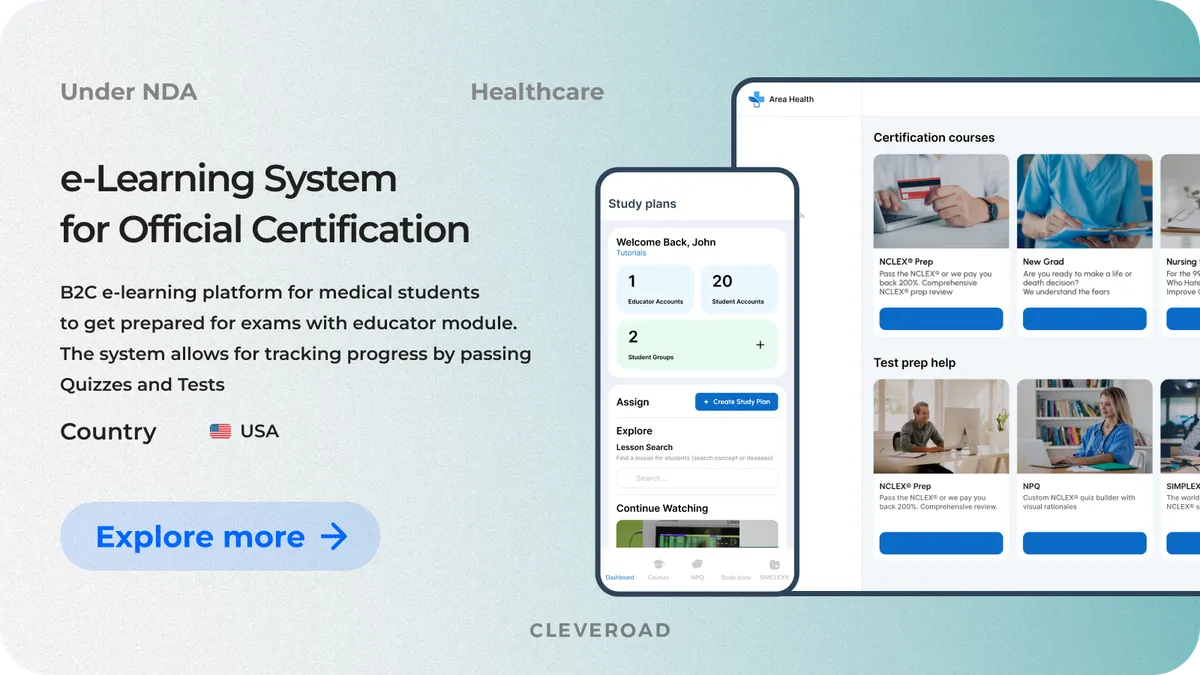
Healthcare Learning Management System by Cleveroad
As a result, the client replaced its legacy app with a modern healthcare LMS and migrated 100% of its users without service interruptions. The platform now serves 350,000+ future nurses and runs on a subscription model that gives the company steady income, while our team keeps adding new features.
Here is what Daniel Jones, CTO at NURSING, said about cooperation with Cleveroad:

 USA
USA


Healthcare LMS is a training platform that hospitals and clinics use to deliver mandatory courses and continuing education to medical staff, with records that hold up during an audit. Compared with a generic corporate LMS, it also tracks license and certification expiry dates and protects learner data at the level HIPAA requires.
The main benefits of a healthcare LMS for your business are:
- Fewer in-person sessions and less disruption to shift schedules
- 24/7 access to courses on web and mobile
- Courses updated as soon as protocols change
- Audit-ready reports on completion and certifications
- Internal protocols turned into SCORM-compliant courses
Start with verified reviews on Clutch and GoodFirms, then shortlist three to five vendors with delivered LMS or HIPAA-compliant products in their portfolios. On calls, ask each vendor to walk you through a similar case, explain how they handle HIPAA, name the team they would assign, and give a rough estimate after a workshop. Give priority to vendors with a delivered healthcare case, since compliance work is expensive to learn on your budget.
The healthcare LMS development costs averagely from $40,000 to $250,000+. A basic healthcare LMS for a single clinic or medical practice costs $40,000–$70,000 and takes around 3–4 months to develop, while an enterprise healthcare LMS for a hospital network or health system can reach $150,000–$250,000 with a 9–14 month timeline.
It depends on your headcount and how specific your workflows are.
- Buy a subscription platform if you train a few hundred employees with standard compliance courses and need to launch within weeks.
- Build a custom healthcare LMS if you train thousands of staff across several facilities, need EHR or HRIS integration, plan to sell courses, or report to an accreditor in a custom format, since per-user fees at that scale usually exceed the cost of your own platform over several years.

Evgeniy Altynpara is a CTO and member of the Forbes Councils’ community of tech professionals. He is an expert in software development and technological entrepreneurship and has 10+years of experience in digital transformation consulting in Healthcare, FinTech, Supply Chain and Logistics
Give us your impressions about this article
Give us your impressions about this article