5 Benefits of Medical Device Integration with Healthcare Systems
Updated 30 Sep 2026
15 Min
365 Views
Every reading a device takes, whether a blood pressure value or an ECG strip, helps a clinician only once it reaches the patient's record. Medical device integration moves that data into your Electronic Health Record (EHR) or telehealth system automatically, so your doctors make decisions based on current numbers rather than retyped ones.
For 15+ years, we at Cleveroad have been building healthcare software, including remote monitoring systems that connect EKG monitors and hydration sensors to mobile apps and clinical platforms. In this guide, we cover what integration gives you, which devices clinics connect first, how the process works, and which requirements you need to address before you talk to a vendor. Along the way, we add lessons from our own device integration builds.
Key takeaways
- Core benefits of medical device integration include more accurate and secure data, a complete patient view for clinicians, remote monitoring, less manual work for staff, and stronger patient involvement in care.
- Wearables, bedside and remote patient monitors, imaging equipment, telehealth carts, and lab analyzers are among the most commonly integrated devices in healthcare software.
- A typical medical device integration process starts with clear integration goals and vendor selection, followed by middleware development to convert device data, then testing under peak loads and unstable network conditions.
- Key technical and regulatory requirements include HIPAA, FDA and EU MDR compliance, HL7 and FHIR interoperability, data normalization across multiple device vendors, and a suitable connection method for each device type.
What Is Medical Device Integration
Medical device integration is the process of connecting medical devices to healthcare information systems, such as EHR and Electronic Medical Record (EMR) systems, Laboratory Information Systems (LIS), Picture Archiving and Communication Systems (PACS), and telehealth platforms, so that readings flow between them automatically. The goal is to remove manual data entry from clinical workflows and give clinicians a complete, current view of each patient's condition.
Here is the list of the most common devices medical providers use for health data extraction:
- Patient monitoring devices: heart monitors, pulse oximeters, blood pressure monitors
- Imaging devices: X-ray machines, CT (Computed Tomography), MRI (Magnetic Resonance Imaging)
- Diagnostic equipment: ultrasound machines, endoscopy equipment, spirometers
- Telemedicine devices: telemedicine carts, telemedicine platforms
- Wearables: smartwatches, fitness trackers
- Point-of-care testing devices: glucose meters, coagulation analyzers, etc.
Learn about all the peculiarities of software development for medical device integration and discover how to build such a solution and integrate it with your healthcare devices
Benefits of Medical Device Integration Software
Integration pays off wherever your staff currently copy numbers by hand or wait for data from another department. Below are the five benefits clinics usually see first.
Enhanced data security and accuracy
Medical device software integration makes sure medical data is captured and transmitted accurately. To keep transmission accurate and secure, developers implement the following safety approaches:
- Automated data transfer. The software automates the data transfer from devices to medical systems, minimizing the reliance on manual input and reducing the possibility of human errors.
- Data verification and validation. Implementation of strong validation mechanisms (e.g., timestamp verification, checksums, hash functions, automated checks, etc.) helps medical providers ensure only reliable data gets into the system.
- Encryption and security measures. The software encrypts all patient information in transit and at rest to keep it confidential and intact.
Complete patient condition overview
Most likely, you're reading this article with a smartwatch on your wrist, or you've owned one at some point. According to Rock Health’s 2025 Consumer Adoption of Digital Health Survey, 46% of U.S. adults owned a wearable device in 2025, while 59% of wearable owners had already discussed data from their devices with a healthcare provider. Below, you can see the parameters smart device users track most often:
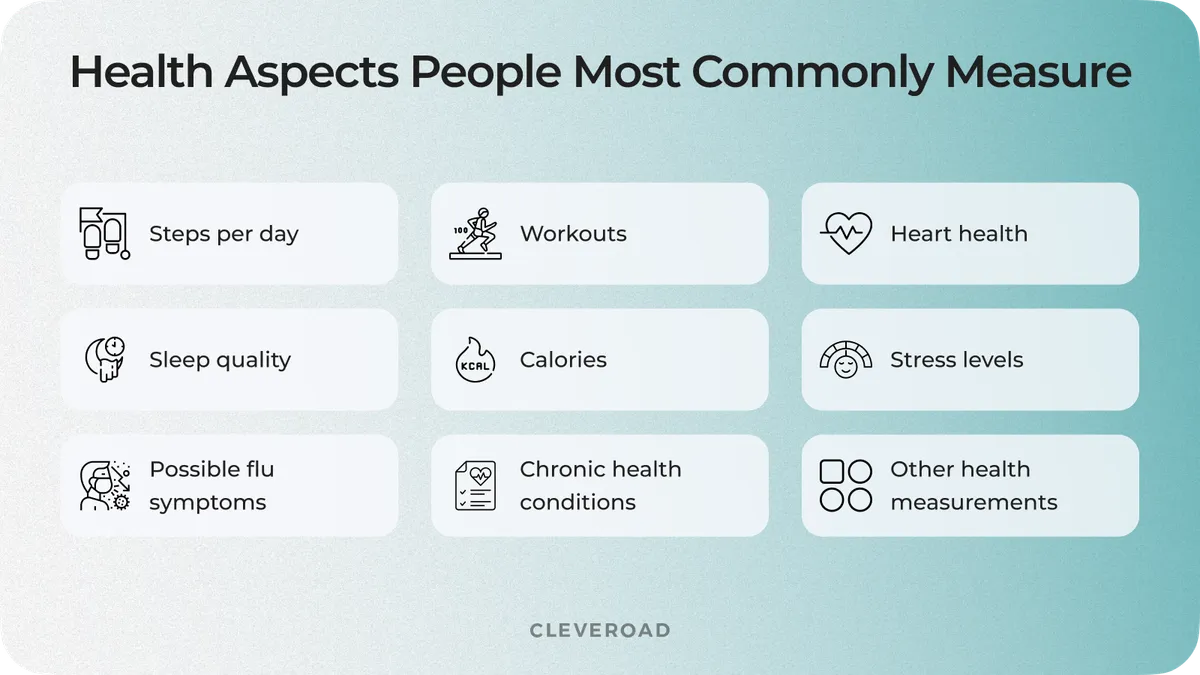
Commonly measured health aspects
The Journal of Medical Internet Research study highlights a clear integration gap: 78.4% of wearable users were willing to share their data with healthcare providers, but only 26.5% had actually done so within the previous 12 months. Integration closes that gap by sending readings to clinical systems directly. Continuous readings then fill the gaps between visits and feed clinical decision support tools, while pooled data helps you study disease patterns and measure how well public health programs work.
Remote monitoring and telehealth
Medical device integration makes remote monitoring possible by pulling readings from home sensors into the same system your clinicians already use. With that data in place, you can offer telehealth consultations built around current vitals rather than patient recollection.
For patients, this means care that works from home. For your practitioners, it means they can watch trends in real time and step in when a reading crosses a threshold they set.
Workflow optimization
Once readings arrive on their own, your nurses stop copying numbers from monitors into charts, and that time goes back to patient care. Documentation errors drop for the same reason. With healthcare device integration, medical care is also reinforced by automated alerts that enable medical professionals to track patients' physiological changes, device malfunctions, treatment milestones, and much more.
Patient-focused approach
When device data reaches a patient portal or app, patients see their own readings and trends, which makes them more active in managing their health. Clinicians can then discuss concrete numbers with them, and two-way communication between visits becomes part of care instead of an exception.
Medical Device Integration Examples
Now that you know the benefits, let's look at where integration happens in practice. Here are 5 categories of devices healthcare providers most often connect to their information systems:
Advanced wearable health tech
It's hard to imagine the modern tech world without smartwatches, especially something like the Apple Watch. Indeed, these devices can provide valuable health insights, thanks to ECG (Electrocardiogram) monitoring, blood oxygen measurement, fall detection, etc. However, more advanced technologies like BioStamp also exist. This wearable biosensor sticks to the skin and records muscle activity and movement along with heart activity. These devices provide valuable health insights, thanks to ECG (Electrocardiogram) monitoring, blood oxygen measurement, fall detection, etc.
Integrating such wearables with EHRs or Remote Patient Monitoring software enables continuous data transmission for personalized health monitoring.
Patient monitoring systems
High-risk patients need 24/7 observation. Integrating wearable heart rate monitors, bedside monitors, pulse oximeters, and continuous glucose monitors with health systems delivers vital signs to clinicians in real time, so they can watch patients remotely and respond to changes before they turn into emergencies.
Our team built an IoT-based system for monitoring EKG and blood oxygen level, a telehealth solution that synchronizes pulse oximeter and EKG monitor data with a mobile app.
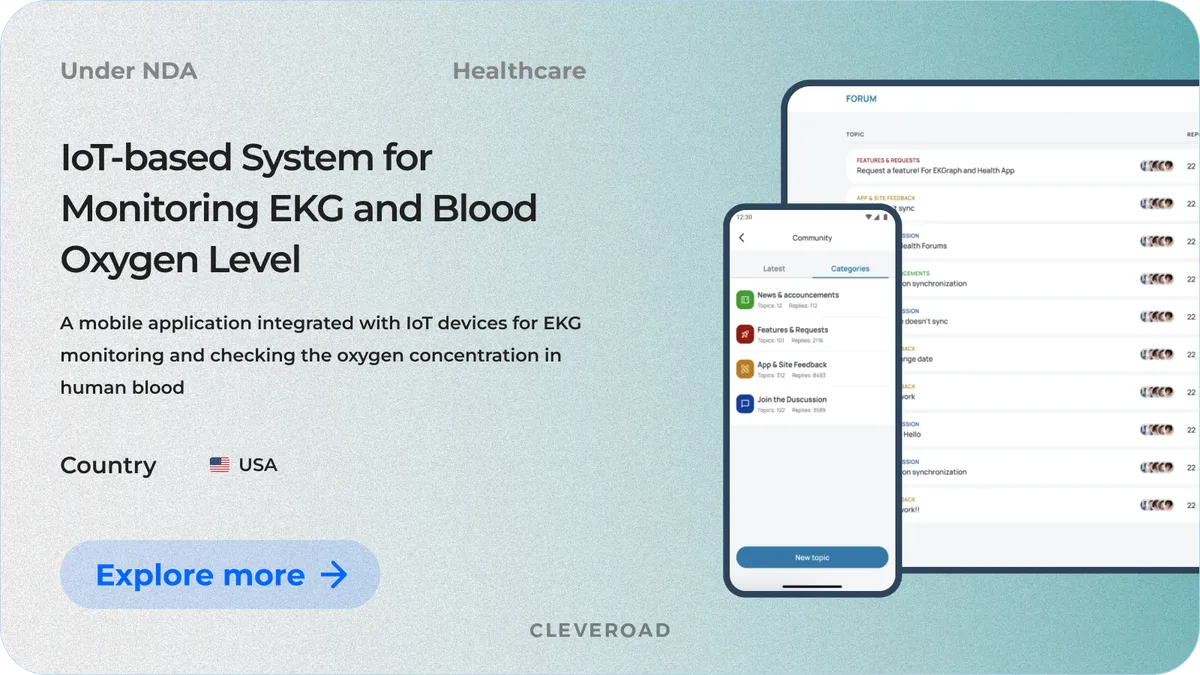
Telehealth mobile app interface showing EKG and blood oxygen
Its iOS and Android apps connect to the devices over Bluetooth, and we brought the solution in line with the 510(k) FDA registration and HIPAA requirements. After launch, 95% of user reviews rate the app at 4–5 stars.
Our team builds remote patient monitoring systems that integrate wearables and bedside monitors for continuous vital sign tracking.
Digital imaging devices
Imaging remains a primary source of diagnostic information in medical practice. When you connect X-ray machines, CT and MRI scanners to your systems, images travel in Digital Imaging and Communications in Medicine (DICOM) format to a PACS. The radiologist's report then links to the patient's EHR. Healthcare device integration within medical imaging software development gives clinicians quick access to diagnostic images and makes it easier for departments to work on the same case.
Telehealth platforms
Telehealth apps and telemedicine carts equipped with audiovisual and diagnostic tools let clinicians consult patients remotely while collecting vitals during the call.
When you integrate a telehealth platform with your healthcare systems, readings from connected stethoscopes, otoscopes or blood pressure cuffs land in the patient's record during the video visit. That way, a remote consultation produces the same documented data as an in-person one. Know more about telemedicine software development in our extensive guide.
Laboratory instruments
Laboratory instruments such as blood chemistry analyzers, hematology analyzers, microscopes, and spectrophotometers analyze patient samples and provide the data behind diagnoses and treatment plans.
Integration connects these instruments to your EHR and LIS, usually over the ASTM or HL7 interfaces most analyzers support. Results then appear in the patient's record without manual transcription, so clinicians see them as soon as the analyzer finishes.
Steps to Integrate Medical Device with Healthcare Systems
A clear strategy helps you avoid surprises and lower integration risks such as data security gaps or interoperability issues. We've split the process into 4 steps:
1. Assess the integration goals
Start by defining exactly what the integration must do, so the team stays focused on core tasks and skips features nobody needs. List the specific data and functions your medical devices and healthcare systems must exchange, then decide on the outcomes you expect, for example:
- Enhanced patient care. Personalized treatment plans and faster intervention in emergencies.
- Faster clinical workflows. Automated data transfer between devices and systems.
- Higher data quality and accuracy. More reliable records through direct integration of devices with EHRs and other healthcare databases.
- Cost-effectiveness. Lower costs through less manual work and better use of staff time.
- Research and analytics support. Data for population health studies and outcomes research.
2. Choose an experienced IT vendor
An experienced tech partner has a direct effect on how well your medical device integration works. Whoever builds it, check the team's healthcare experience first, since the domain comes with many standards and regulations. Start by deciding which kind of team you need. There are two main options:
- Build an in-house team. This model gives you full control over development, communication, and long-term product decisions. However, it usually requires a higher budget, and finding specialists with narrow expertise in healthcare integration, such as HL7, FHIR, medical device connectivity, or regulatory documentation, can be difficult.
- Work with an outsourcing partner. Outsourcing gives you access to healthcare and integration specialists worldwide while helping you optimize costs through flexible cooperation models. Depending on your needs, you can engage a dedicated development team or use IT staff augmentation to add specific experts to your existing team.
At Cleveroad, we also offer AI-assisted and AI-native development teams to help accelerate delivery and optimize development costs. Our specialists use AI tools to automate routine tasks across the software development lifecycle while keeping every stage under human oversight, from architecture and coding to testing and quality control.
3. Implement integration middleware
Middleware sits between the medical device and your healthcare system, whether that's an EHR or a telehealth platform. It validates device data and transmits it securely to the right destination. It also translates protocols: devices speak different languages, from vendor-specific formats to the IEEE 11073 family of standards, and the middleware converts them into Health Level Seven (HL7) messages your systems understand.
In practice, these functions are split across several parts that work one after another:
- Data intake. Receives readings from the device or its gateway over the connection the device supports and checks each reading for completeness and valid ranges.
- Buffering. Stores readings locally when the connection drops, so measurements taken offline reach the system once the link is back.
- Format conversion. Translates raw device output into the format your target system accepts, for example an HL7 message for the EHR.
- Send queue. Lines up converted messages and delivers them to the receiving system in the right order.
- Retry on failure. Resends any message the receiving system rejected or failed to confirm, and logs each attempt for troubleshooting.
Some teams deploy a ready-made integration engine instead of building their own layer, and that choice comes down to your budget and launch deadline.
4. Conduct thorough testing and validation
Test the new integration with every connected system to confirm it is reliable and performs well. Check that all essential data arrives complete and accurate. Then confirm the system's resilience by testing it under normal operation, peak load, varying data volumes, security stress, network interruptions and error scenarios.
Cleveroad’s healthcare software development services cover medical device integration with a wide range of healthcare systems
Requirements to Consider During Medical Device Integration
Successful medical device integration depends on seven core requirements that help the system pass compliance checks, exchange data reliably, and scale as you connect more devices. Here is what to cover.
Data privacy and security
Patient data needs protection both in transit and in storage. Based on our experience with healthcare software, we use the following measures to protect medical device data throughout integration:
- Data encryption: TLS 1.2 or higher for data in transit and AES-256 for stored data
- User authentication: multi-factor authentication that confirms each user is who they claim to be before granting access to sensitive medical data and system functions
- Access controls: role-based permissions that limit each user to the data their job requires
Regulatory compliance requirements
Regulatory compliance confirms that your integration meets legal and security standards, and it's a prerequisite for selling in regulated markets. When we integrate medical devices with healthcare software, we account for both applicable regulations and the data standards required for secure, interoperable exchange:
- HIPAA (Health Insurance Portability and Accountability Act). HIPAA ensures the security of patient-related data and establishes safeguards to protect the confidentiality and integrity.
- FDA (Food and Drug Administration). This US agency regulates device software functions, including mobile medical apps that connect to or control medical devices.
- DICOM (Digital Imaging and Communication in Medicine). This is a standard for transmitting, storing, and sharing medical images.
- Cybersecurity frameworks (e.g., NIST CSF). The National Institute of Standards and Technology (NIST) Cybersecurity Framework gives you a structured way to identify, protect against, detect, respond to and recover from security risks.
- EU Medical Device Regulation (MDR). This is a regulatory framework in the European Union ensuring the safety and efficacy of medical devices.
- Health Information Exchange (HIE) standards. Guidelines that enable secure data sharing among different healthcare systems.
Interoperability standards
To make medical device data usable across healthcare systems, we rely on recognized standards that define how connected solutions exchange and interpret information:
- HL7 (Health Level Seven). HL7 integration is essential for communication between healthcare management systems, ensuring standardized data exchange.
- FHIR (Fast Healthcare Interoperability Resources). A newer HL7 standard that exchanges healthcare data through web APIs, which makes it the usual choice for mobile apps.
Data normalization across manufacturers
Devices from different manufacturers often report the same measurement in different ways. One blood pressure cuff sends systolic pressure in mmHg under a field called "sys", while another model sends it in kPa as "systolic_bp" and batches readings every 15 minutes instead of sending each one as it’s taken.
That's why you need a normalization layer between the device and the medical system. It relies on a mapping dictionary that links each vendor's field names and units to one internal data model, often coded with LOINC (Logical Observation Identifiers Names and Codes). The same layer aligns readings sent at different intervals to a shared timeline, so the EHR shows one consistent record per patient.
In our experience, these mismatches rarely show up at the demo stage, when a single device model is connected. They surface with the second and third connected devices, so plan the mapping dictionary from the start and keep it as a separate component you can extend for new vendors.
Healthcare system compatibility
Before development starts, we assess how the medical devices will fit into your existing healthcare IT infrastructure, including EHR, LIS, and other connected systems. We check current architecture, data flows, APIs, and technical dependencies to identify compatibility issues before they affect the integration or disrupt clinical workflows.
Cleveroad can run a code audit to check whether your existing healthcare software is ready for the medical devices you plan to integrate and identify compatibility issues
Device connectivity
We choose the connection type based on where the device operates and how much data it needs to transfer. For example, we typically use wireless connections for battery-powered wearables, while imaging systems and lab analyzers often require wired connections.
The table below breaks down the main connection options, from Bluetooth Low Energy to Message Queuing Telemetry Transport (MQTT), and shows when each one fits your devices.
| Connection | Typical devices | When it fits | What to watch |
|---|---|---|---|
Bluetooth Low Energy | Wearables, glucose meters, pulse oximeters, blood pressure cuffs | Battery-powered devices sending small readings | Background sync reliability on the patient's phone |
Wi-Fi | Bedside monitors, infusion pumps, ultrasound | Devices inside a facility network with steady power | Network segmentation and access control on the clinical VLAN |
Wired USB or Ethernet | Imaging systems, laboratory analyzers | High data volume, fixed installation | Physical access to the device and driver support |
MQTT over the network | Remote monitoring hubs and gateways | Many devices reporting to one backend | Message ordering and delivery guarantees |
RFID and NFC | Asset tracking, device and consumable identification | Identifying equipment rather than moving measurements | Read range and tag placement |
Most products combine several of these options. A remote monitoring solution, for example, often uses Bluetooth Low Energy between the sensor and the patient's phone and MQTT between the phone or hub and your backend.
Settle on the connection types while you assess the integration goals, since each one shapes the middleware design and the testing plan. Adding a new protocol after launch usually means reworking the data intake part of the integration layer.
How Cleveroad Can Help You with Medical Device Integration
Cleveroad is a healthcare software development company with 15+ years of experience in the domain. Our clients include clinics, hospitals, and other healthcare organizations from the US, the UK, Australia, the Nordic region, Saudi Arabia, and France. Our team builds EHR/EMR systems, telehealth solutions, patient monitoring systems, and medical device software.
Our software engineers build to industry regulations and standards, including HIPAA, the General Data Protection Regulation (GDPR), HL7, the Health Information Technology for Economic and Clinical Health Act (HITECH), and Clinical Document Architecture (CDA). As an ISO 27001 (information security) and ISO 9001 (quality) certified company, we follow international practices for data security and software quality.
IoT-based system for hydration monitoring
Our team has practical experience in integrating patient monitoring devices, particularly wearables, with telehealth platforms. One example is our IoT-based system for hydration monitoring in real time.
Our client is a US-based scientific and commercial company that offers an IoT-based telecare solution for tracking human hydration levels. The company asked us to develop a platform that lets users monitor hydration indicators from their mobile devices.
Our health software engineers designed and built a custom telecare platform connected to an IoT hydration sensor. The application is integrated with the customer's Product-as-a-Service (PaaS) platform. The system synchronizes and stores all sensor data for later use. The solution meets the 510(k) FDA Medical Device Registration requirements so it can legally operate within the framework of US medical legislation.
As a result, the customer got an IoT-based system that lets users track hydration levels from their phones. Mobile access helped the company double its user audience.
The screens below show the mobile app users rely on to track their hydration readings.
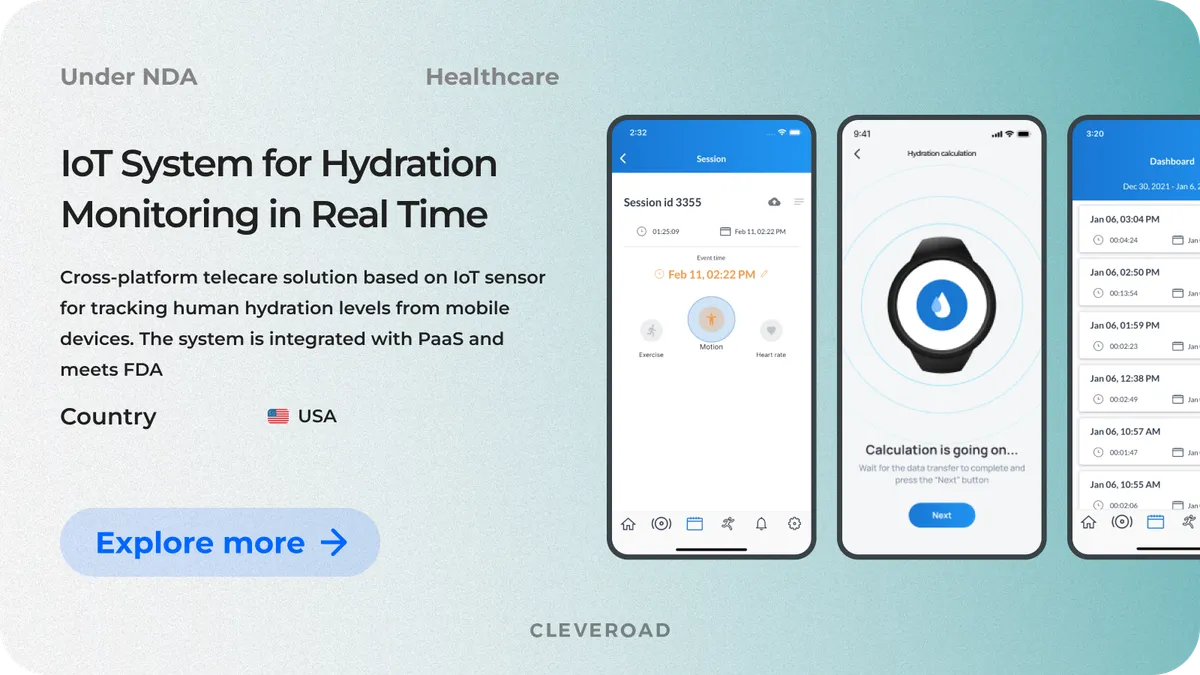
IoT-based system for hydration monitoring developed by Cleveroad
DECODE.ME platform for Codex Labs
We also work with Codex Labs on DECODE.ME, a platform where patients and dermatologists exchange medical data. The product came to us from a previous development team, so we started by analyzing how medical data exchange worked inside it. Our engineers removed backend bottlenecks and set up HIPAA-compliant infrastructure, so data exchange between patients and doctors stays predictable under load.
The demo was ready in just 5 months, in time for the American Academy of Dermatology (AAD) 2025 Innovation Meeting, where dozens of dermatologists joined the presentation. Since then, we have continued expanding the platform’s functionality.
Here is what Barbara Paldus, Founder & CEO of Codex Labs, says about our cooperation.
Dr. Barbara Paldus, CEO at Codex Labs: Feedback on Cleveroad's Telemedicine Development Services
It's the process of connecting medical devices to healthcare IT systems, such as EHR/EMR, PACS, LIS and telehealth platforms, so readings move between them automatically and clinicians get a full view of each patient's condition.
Yes. Once a medical device shares data with an application over a network, it becomes part of the Internet of Medical Things (IoMT), the healthcare branch of the Internet of Things (IoT). A Bluetooth glucose meter syncing with a mobile app is a typical example.
Medical device integration supports hospital operations by providing the following:
- Enhanced data security and privacy for Protected Health Information (PHI) and electronic PHI (e-PHI)
- Complete patient condition overview
- Remote monitoring of patients' health
- Hospital workflow optimization
- Patient-focused approach to care delivery
Through a normalization layer that sits between the devices and your medical system. It uses a mapping dictionary to link each vendor's field names to one internal data model, often coded with LOINC, and converts units to a single standard, such as kPa to mmHg for blood pressure. The layer also aligns readings sent at different intervals to a common timeline before they reach the EHR. Keep the dictionary as a separate, versioned component, so adding a new device model means adding new mappings rather than changing the integration itself.
Look for a healthcare custom software development company that checks three boxes:
- A shipped case of medical device integration with EHR/EMR systems
- Working knowledge of HL7 and FHIR, plus HIPAA and FDA requirements
- A plan for mapping data to each EMR's format when you connect several of them
At Cleveroad, we base our healthcare device integration work on 15+ years of practical experience in the healthcare domain.

Evgeniy Altynpara is a CTO and member of the Forbes Councils’ community of tech professionals. He is an expert in software development and technological entrepreneurship and has 10+years of experience in digital transformation consulting in Healthcare, FinTech, Supply Chain and Logistics
Give us your impressions about this article
Give us your impressions about this article