Healthcare APIs: Categories, Integration Options, and Real Examples
Updated 29 Sep 2026
11 Min
3309 Views
Patient data usually sits outside the healthcare product that needs it. An Electronic Health Record (EHR) system stores the patient record, a laboratory system holds test results, a connected device captures health metrics, and a payer keeps coverage data. For this reason, much of healthcare software development depends on reliable data exchange between separate systems.
Cleveroad has 15+ years of experience in healthcare software development. Our teams have connected EHR systems with two-way data synchronization, integrated e-prescribing services, linked medical Internet of Things (IoT) devices via Bluetooth, and added video communication and payment services. Below, we break down the main API categories with real services in each and show when direct EHR integration makes more sense than an aggregator.
Key takeaways:
- A healthcare API connects a product to a system that already holds the data, such as a provider, payer, device vendor, or patient smartphone.
- Most new integrations use Fast Healthcare Interoperability Resources (FHIR) over REST. In the U.S., certified EHRs must support a standardized FHIR R4 API. Older data formats usually reach the product through an integration layer.
- Healthcare APIs fall into several categories, including EHR, aggregators, terminology, e-prescribing, claims, device data, and imaging.
- Direct integration often costs less when you need one or two known EHR systems. An aggregator becomes more practical when the list of systems is long or unknown.
What Is a Healthcare API?
A healthcare API is an interface to a system that already owns medical data and defines what another application can read, write, and under which conditions. The source may belong to a healthcare provider, payer, pharmacy network, device manufacturer, or the patient through a smartphone or wearable. The diagram below shows the main systems a healthcare product usually connects to.
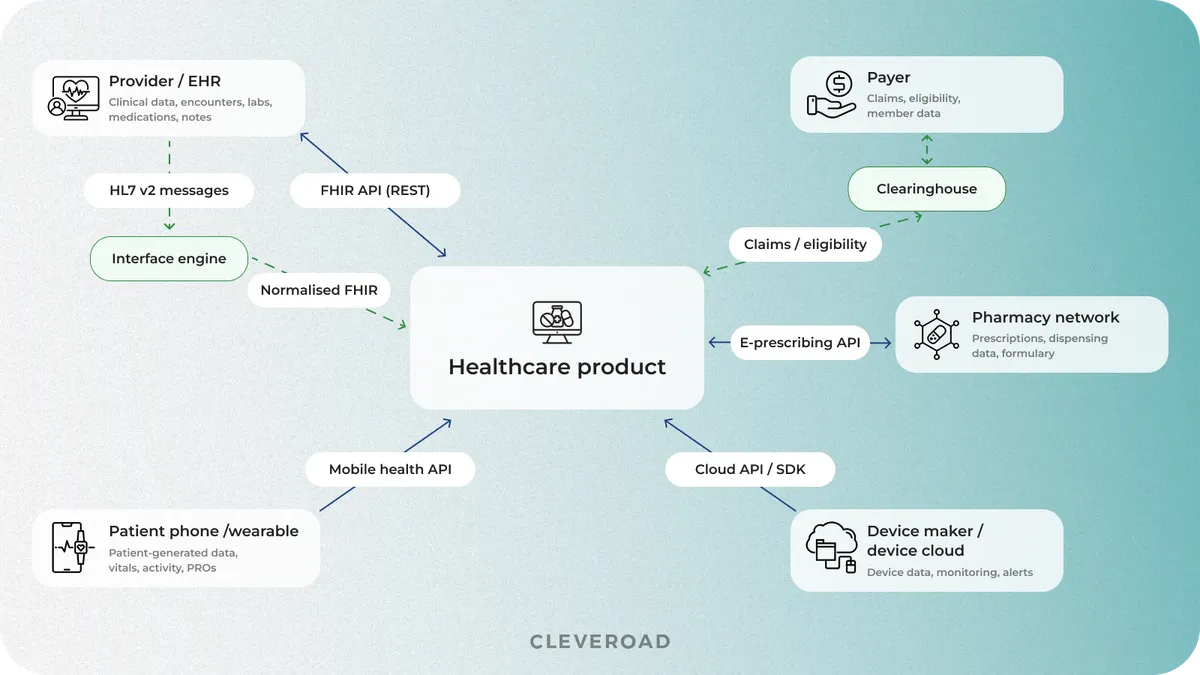
What a healthcare product connects to
Today, the main API surface for new healthcare integrations is FHIR over REST. In the U.S., certified EHRs must expose a standardized FHIR R4 API with US Core data profiles and SMART App Launch authorization, so most EHRs your product meets already support it. Health Level Seven (HL7) v2 follows a different exchange model: systems send messages through an interface engine that can route, map, and validate them. Payer transactions often follow another path and pass through a clearinghouse. These differences matter when you estimate an integration.
Some data sources support a direct connection through application code, while others require an interface engine, clearinghouse, or another intermediary. Each model brings its own share of architecture, mapping, and testing work. Our guide to HL7 integration explains how message-based exchange and interface layers work in more detail.
Cleveroad builds integration layers as standalone services with dedicated access controls and monitoring through our API development services
Healthcare APIs by Category
Healthcare APIs fall into several categories, each designed for a specific type of data exchange and integration task. EHR access, data aggregation, terminology, e-prescribing, claims, device data, and imaging solve different integration tasks, so the right starting point is the data source your product needs to reach. In healthcare application development, this order defines the integration scope before you commit to a vendor. The sections below explain what each category provides, which APIs belong to it, and what to check before choosing one. The diagram below groups the categories by the data each one carries.
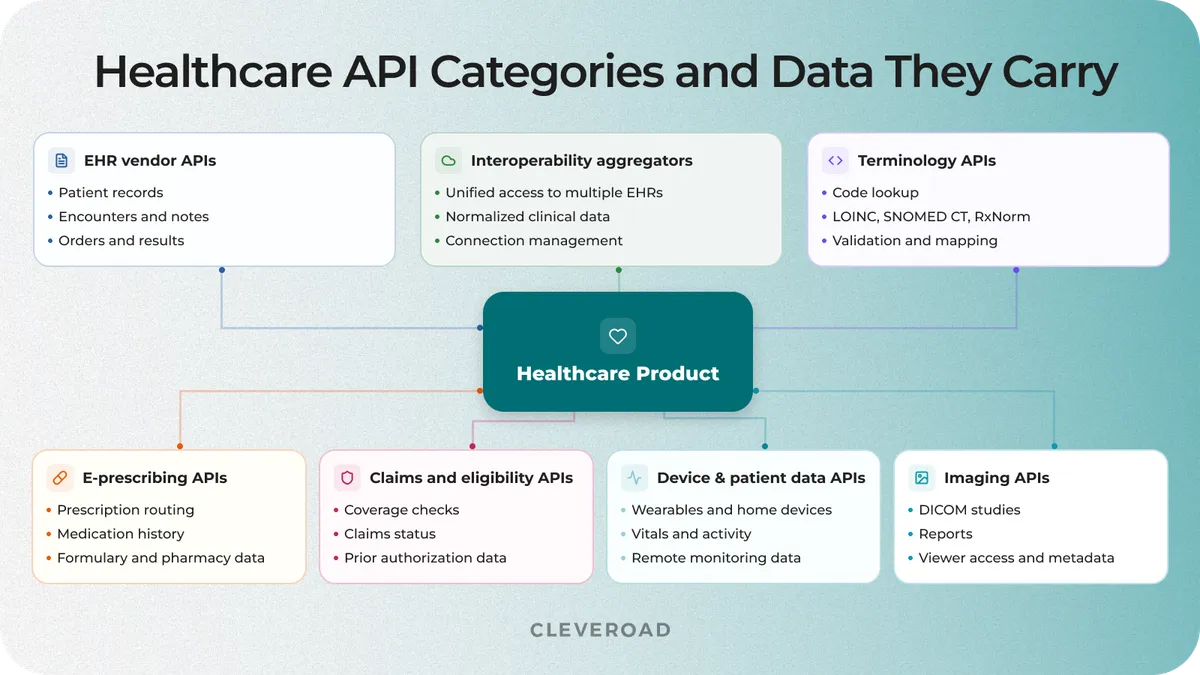
Categories of healthcare API and the data each one carries
EHR vendor APIs
EHR vendor APIs provide access to records, schedules, orders, and other data within one vendor’s installed base. Common examples include Epic, Oracle Health, athenahealth, MEDITECH, and eClinicalWorks. When you compare vendors, check whether the API supports write operations or only read access. Also review the app approval process, since vendor review can affect the integration timeline.
Data aggregators and networks
Data aggregators provide normalized clinical records from multiple providers through one interface. Common examples include Redox, Health Gorilla, 1upHealth, Particle Health, and Metriport. When you compare options, check which data sources are connected today rather than only listed as planned coverage. Also review how pricing changes as transaction volume and the number of connected organizations grow.
Terminology and coding services
Terminology APIs provide reference data for drugs, diagnoses, and procedures and help map codes across systems. Free public sources include RxNorm and RxNav from the National Library of Medicine, openFDA, and DailyMed, and they may be enough for reference and lookup use cases. Drug interaction checks usually require a commercial service such as First Databank, Medi-Span, or Lexicomp, often licensed annually.
E-prescribing networks
E-prescribing APIs send prescriptions to pharmacies and support medication checks before submission. Common examples include Surescripts, DoseSpot, DrFirst, and NewCrop. When you compare services, check pharmacy network coverage in the regions where your product will operate. If your product will prescribe controlled substances in the U.S., also confirm support for Electronic Prescribing of Controlled Substances (EPCS), which requires DEA-compliant identity proofing and two-factor authentication.
Claims and eligibility
Claims and eligibility APIs let healthcare products verify coverage, submit claims, and receive payer responses. Common examples include Availity, Waystar, Stedi, and Claim.MD. Most payer transactions still travel as X12 EDI files, such as 270/271 for eligibility and 837 for claims. When you compare services, check the supported payer list and clearinghouse fees. Also check whether the API accepts JSON and converts it to X12 on its side.
Payer connectivity requirements are also changing. Under the Centers for Medicare & Medicaid Services interoperability rule, impacted U.S. payers must support Patient Access, Provider Access, Payer-to-Payer, and Prior Authorization FHIR APIs. Compliance dates for these APIs generally start on January 1, 2027, so if your product works with U.S. payers, check whether your claims vendor already supports them.
Device and wearable data
Device APIs bring health metrics from wearables and medical hardware into healthcare products. Common options include Apple HealthKit, Dexcom, Withings, and Fitbit Web API. When you compare them, check how reliably the patient’s phone syncs data in the background and whether the source provides consumer-grade or medical-grade measurements.
Some medical devices send data straight to the app over Bluetooth rather than through a vendor API. For a U.S. medical IoT manufacturer, Cleveroad connected iOS and Android apps to electrocardiogram (ECG) and pulse oximetry devices this way. The solution was aligned with U.S. Food and Drug Administration (FDA) 510(k) and Health Insurance Portability and Accountability Act (HIPAA) requirements. The IoT-based monitoring system received 4–5-star ratings in 95% of user reviews.
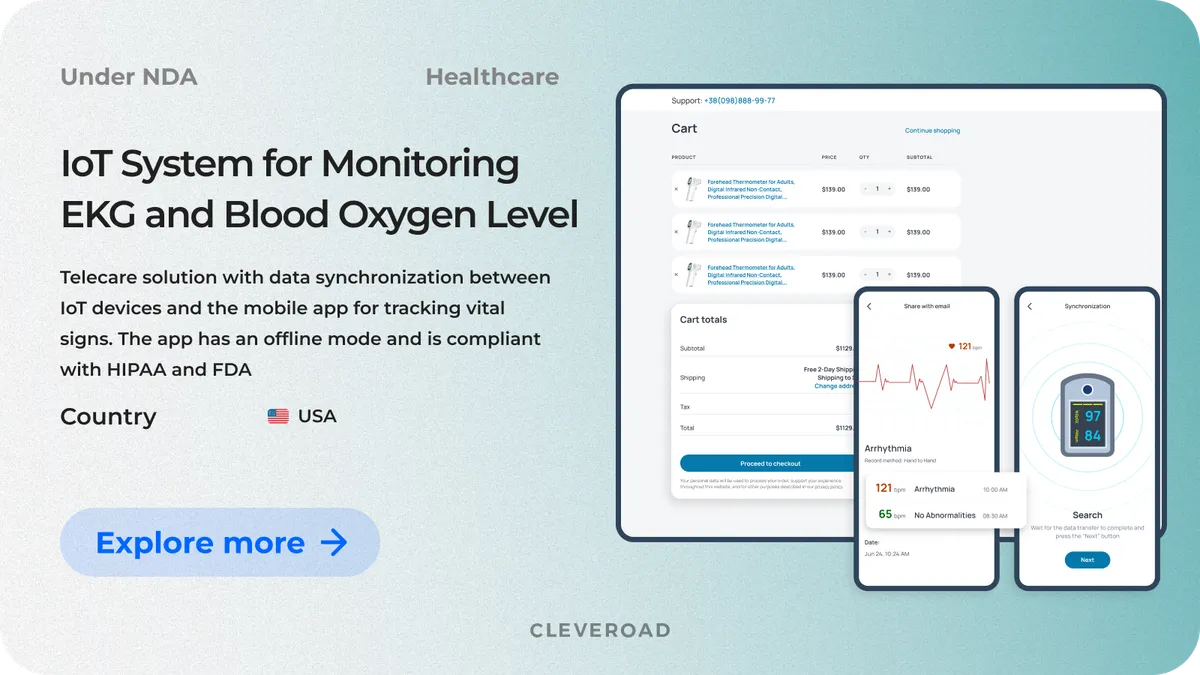
Mobile app screen showing live ECG and pulse oximetry readings from a Bluetooth-connected device
Imaging
Imaging APIs provide access to studies and reports through DICOMweb, the web version of the Digital Imaging and Communications in Medicine (DICOM) standard. Its core services cover search (QIDO-RS), retrieval (WADO-RS), and upload (STOW-RS). Common implementations include Google Cloud Healthcare API, Azure Health Data Services, Orthanc, and dcm4che. When you compare options, check whether the product needs its own image viewer and how studies will be delivered to mobile devices.
Direct EHR APIs vs Aggregators
If you need to connect one or two known EHR systems, direct integration usually makes more economic sense. If your product must work with many EHRs an aggregator can reduce the number of separate integrations you need to build.
The table below compares both approaches by fit, time to the first production call, data coverage, cost, and failure ownership.
| Parameter | Direct EHR API | Aggregator |
|---|---|---|
Reasonable when | One or two known EHR systems | Many EHRs, or the list is unknown upfront |
Time to first production call | Weeks to months per vendor, driven by production access and review | Days to weeks for the first connection |
Data coverage | Everything the vendor exposes | Data the aggregator normalizes across its sources |
Cost shape | Higher engineering effort upfront, lower running cost | Lower upfront effort, transaction fees that grow with volume |
Failure ownership | Yours, end to end | Shared; you may still need to debug the source EHR |
Production access often sets the schedule. OAuth 2.0 and SMART on FHIR provide a standard authorization flow, but the application still has to register with the EHR and receive the required production access. Plan the integration timeline from the vendor submission date rather than from the point when developers start the authorization code.
Direct integration also gives your team full responsibility for vendor-specific behavior. You need your own error handling, monitoring, data mapping, and compatibility controls when the EHR changes its interface. These tasks add to the technical scope described in our guide on how to build an EHR system.
Cleveroad dealt with this kind of vendor-specific behavior when we connected a telehealth platform for a U.S. mental healthcare provider directly to Kareo. Kareo had no mechanism to push updates to the external platform. Our 22-person team built two-way synchronization on our side, based on periodic polling and change processing. The synchronization keeps appointments and patient records consistent across both systems.
- See the online therapy services ecosystem case.
An aggregator moves part of that work into a common integration layer, but it does not remove the source system from the chain. When data fails to arrive or arrives in an unexpected format, your team may still need to trace the issue back to the underlying EHR.
In practice, the architecture can combine both approaches: connect the few EHR systems critical to your product directly and use an aggregator for the long tail of additional vendors.
Cleveroad treats EHR connectivity as its own development scope, from vendor registration to two-way synchronization. Learn more about our EHR/EMR and patient portal development
How Cleveroad Integrates Healthcare APIs
Cleveroad is a healthcare software development company with 15+ years of experience in HealthTech, and most of the API categories above have come up in our projects, from EHR and e-prescribing to insurance data exchange.
Since production access often sets the schedule, we put external integrations into the first sprint whenever possible. Submitting to the vendor early keeps a third-party review from delaying the release.
Custom clinic management platform for a U.S. rehab provider
A U.S. rehabilitation clinic relied on a third-party SaaS Electronic Medical Record (EMR) system where nearly 40% of the functionality was unnecessary. Staff also had to work across several disconnected systems, which increased costs and made clinical workflows harder to manage.
The Cleveroad team built a custom clinic management platform and migrated medical data from the previous system. We deployed the solution on AWS and protected sensitive data with AES-256 encryption and role-based access control.
The integration scope included DoseSpot for e-prescriptions. The module supports pharmacy selection, secure prescription transfer, insurer data, medication alternatives, and safety checks. We also added a telemedicine layer through Vonage for remote consultations.
As a result, the clinic received a single system for appointments, scheduling, billing, payments, prescriptions, and clinical data, rather than several separate services. Real-time scheduling removed appointment conflicts, and replacing the SaaS subscription with a custom platform cut long-term maintenance costs.
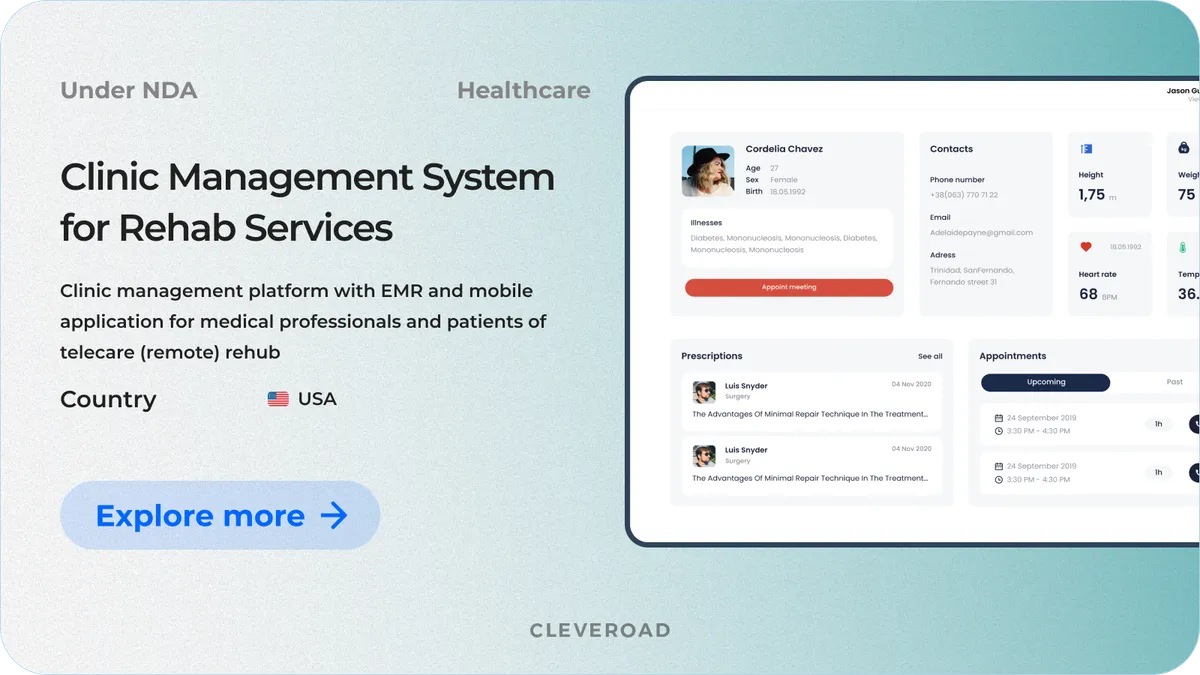
Custom clinic management platform built by Cleveroad
Stabilizing healthcare data exchange for Codex Labs
Codex Labs is a U.S. healthcare company behind DECODE.ME, a teledermatology platform that connects patients with dermatologists. The product came to Cleveroad after work by previous development teams, with backend bottlenecks and infrastructure issues that affected reliable medical data exchange.
We started by reviewing the existing codebase and data flows. Cleveroad’s backend and DevOps specialists removed backend bottlenecks and prepared HIPAA-compliant infrastructure on Google Cloud Platform (GCP), using FHIR-based medical data storage, so patient and physician data could move predictably under load.
Within five months, the platform was ready for the American Academy of Dermatology (AAD) 2025 Innovation Meeting, where dozens of dermatologists interacted with the product. Cleveroad continues to support further product development.
Barbara Paldus, Founder and CEO of Codex Labs, shares her experience working with the Cleveroad team on DECODE.ME and preparing the platform for its next development stage.
Dr. Barbara Paldus, CEO at Codex Labs: Feedback on Cleveroad's Telemedicine Development Services
Why Choose Cleveroad for Healthcare APIs Development and Integration
Cleveroad handles healthcare API integration end-to-end, from selecting the connection approach and mapping data flows to production deployment and monitoring. We connect healthcare products to EHR/EMR platforms, e-prescribing services, payer systems, medical devices, video services, and payment providers while accounting for security, data formats, and vendor-specific requirements.
Here is what you get when you work with Cleveroad:
- Healthcare integration expertise. Our teams have implemented two-way EHR synchronization, e-prescribing, insurance data exchange, medical IoT connections, and telemedicine integrations in real healthcare products.
- Direct and aggregator-based connections. We can integrate directly with selected EHR vendors or build an integration layer around aggregators when your product must support a broader system landscape.
- ISO-certified security processes. Cleveroad holds ISO/IEC 27001 certification, so our development, access control, and data-handling processes follow internationally recognized information security practices.
- Proven healthcare integrations. We work with EHR and healthcare platforms such as Kareo, athenahealth, and Health Gorilla, plus e-prescribing and medication services like DoseSpot, Truepill, and DrugBank.
- Telehealth, payment, and insurance APIs. Our integration stack includes Twilio and Vonage for communication, Stripe for payments, and Eligible for insurance workflows.
- Healthcare compliance expertise. We build healthcare software aligned with standards and regulations such as HIPAA, GDPR, PIPEDA, ISO 13485, and IEC 62304.
Integrate your clinic systems with Cleveroad
We will connect your healthcare product to the EHRs, payer platforms, pharmacy networks, medical devices, and other APIs already used across your clinical workflows.
A healthcare API is an interface that lets one system read or write healthcare data stored in another system. What sets it apart from a general-purpose API is the set of healthcare standards around it: FHIR for clinical records, HL7 v2 for hospital messages, X12 for claims, and DICOM for imaging.
An app typically gets EHR access in three steps:
- Register the application with the EHR vendor or hospital.
- Receive authorization for specific data and operations.
- Connect through FHIR APIs or another supported integration layer.
OAuth 2.0 and SMART on FHIR commonly control authentication and authorization.
Direct integration: best suited to one or two known EHR systems and usually has lower recurring costs. Aggregator: better suited to products that must support many EHR vendors or cannot predict the systems future customers will use.
An EHR connection commonly takes several weeks to a few months. The code itself may take days or weeks, while application review, sandbox access, testing, and production approval often set the final timeline.
Take a remote monitoring app that a clinic rolls out to its patients and that writes readings into the clinic's EHR. The app vendor handles protected health information (PHI) on behalf of a HIPAA-covered entity, so it needs a BAA with the clinic, and the same applies to any aggregator or cloud host in that data flow. If a patient connects an app on their own through a patient access API, the app usually works outside that relationship and no BAA is required. In that case, FTC health privacy rules may still apply.

Evgeniy Altynpara is a CTO and member of the Forbes Councils’ community of tech professionals. He is an expert in software development and technological entrepreneurship and has 10+years of experience in digital transformation consulting in Healthcare, FinTech, Supply Chain and Logistics
Give us your impressions about this article
Give us your impressions about this article