RPA in Banking Sector: Benefits, Use Cases and Step-By-Step Implementation Guide
05 Oct 2026
17 Min
138 Views
Robotic process automation in banking has become essential today because banks are under pressure to cut costs and speed up operations and customer service. Manual processes are too slow and too expensive. Robotic process automation is a software solution that takes over repetitive, rule-based tasks across large volumes of operational data. It frees your employees to focus on decision-making, improving customer satisfaction and overall business performance.
We at Cleveroad, as an IT company with 15+ years of experience in Banking software development, have prepared a comprehensive overview of robotic process automation in banking.
In this guide, you'll find:
- RPA in banking use cases that improve client onboarding, loan processing, and compliance checks
- A step-by-step implementation plan that helps you choose the right vendor, identify automation opportunities, build a Proof of Concept (PoC), and scale efficiently
- RPA benefits that reduce operational costs, boost staff productivity, and enhance service delivery
- Trends and best practices of RPA that leading banks follow to stay competitive, including intelligent automation and scalable architectures
What is Robotic Process Automation in Banking?
Robotic Process Automation (RPA) in banking uses software “robots,” or bots, that interact with banking applications, reporting tools, and other systems to automate repetitive, rule-based tasks traditionally performed by humans in banking operations. These tasks can range from data entry, transaction processing, compliance checks, customer onboarding, and report generation to fraud detection and account reconciliation.
RPA adoption keeps growing fast across industries, and banking is one of the sectors driving it. Precedence Research reports in its 2026 market update that the global RPA market will reach $35.27 billion by the end of 2026 and grow to approximately $247.34 billion by 2035, which reflects a compound annual growth rate (CAGR) of 24.20% during this period.
The U.S. market alone is expected to rise from $9.76 billion in 2025 to $74.94 billion by 2035, and North America accounts for 38.92% of global market revenue. For a U.S. or Canadian bank, that concentration means a mature vendor market and a large pool of engineers with hands-on RPA experience.
How RPA Benefits Banking Institutions
RPA pays off in banking because most back-office work follows written rules and repeats thousands of times a day. Here are the main benefits of RPA for banking entities and what each one changes in daily operations.
Cost-effectiveness
Manual processes drain time and resources. RPA use cases in banking often reduce operational costs by automating routine, rule-based tasks such as data entry and loan processing. According to Verified Market Reports, banks using RPA have reduced processing time by up to 70% while achieving substantial cost savings and improved productivity across various functions.
Personalized customer experience
Customers expect fast, personal service. Robotic process automation in banking tracks customer data in real time and automatically provides tailored responses to each user. For example, RPA can offer products based on recent transactions or route queries to the right agent. It helps banks boost customer satisfaction without adding more staff.
Fewer manual errors at volume
RPA reduces delays and errors caused by human input. Banks can process thousands of transactions daily with near-perfect accuracy because a bot applies the same rule to the ten-thousandth record of the day as to the first. Typos, skipped fields, wrong account codes, and copy-paste mismatches between systems drop out of the process, so your staff spends less time on rework and reconciliation.
Faster implementation
Banks often delay automation initiatives because of long IT timelines. One of RPA's main benefits for legacy systems in banking is fast deployment. You can integrate bots into existing systems and workflows efficiently, which automates tasks like credit card approvals or transaction alerts without disrupting core infrastructure.
Round-the-clock processing
Customers expect service anytime, not just during business hours. Bots run without breaks, and their workday follows your processing schedule rather than office hours. With robotic process automation and banking systems working together, institutions handle transactions, monitor fraud, and send confirmations around the clock. Research from Politecnico di Milano shows that RPA systems run 24/7 without fatigue, so overnight batches and weekend queues move at the same pace as weekday work.
Risk and compliance reporting
Compliance errors cost money and trust. Robotic process automation for banking automatically compiles audit trails, validates transactions, and ensures policy adherence. Banks use RPA to create real-time compliance dashboards and submit accurate regulatory reports with far less manual effort.
Improved scalability
As customer volume grows, systems must keep up. With RPA, you scale by adding bot licenses rather than hiring, so a spike in loan applications or a new branch requires a larger license pool instead of a larger back office. This supports growth across multiple banking branches without human resource constraints (Source: Journal of Intelligent Systems and Control).
The infographic below sums up the main benefits of RPA implementation for banks.
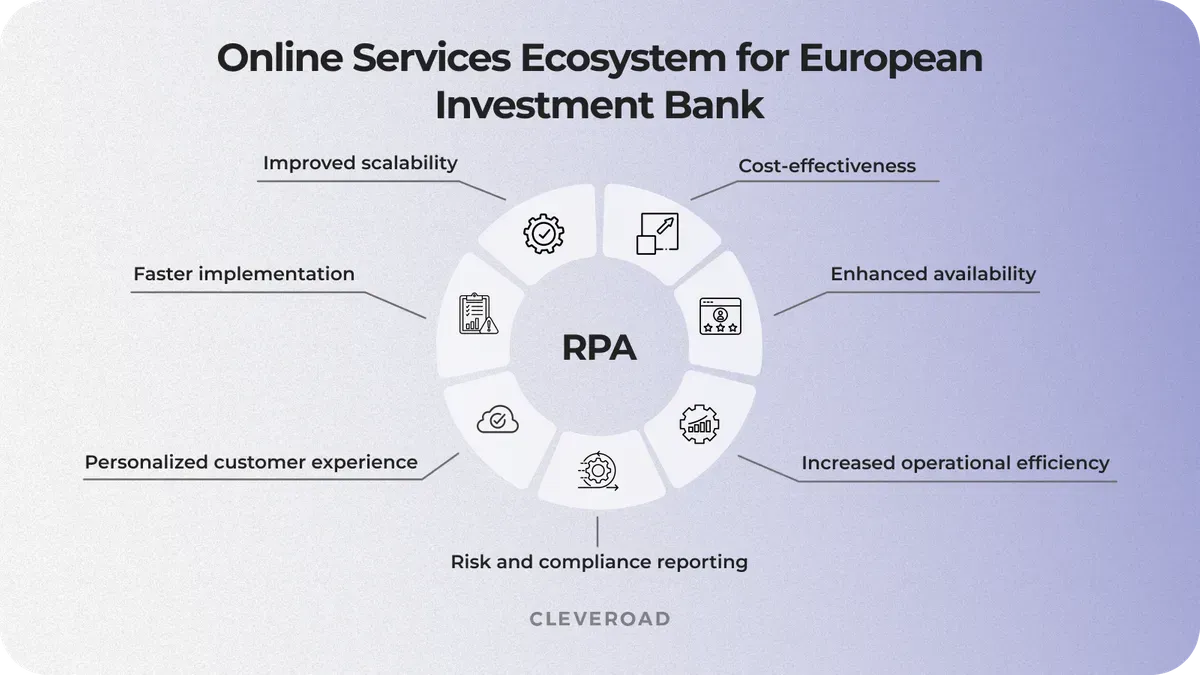
Main benefits of RPA implementation for banks
The Most Impactful RPA Use Cases in Banking
To get real value from robotic process automation in banking operations, focus on where RPA creates tangible improvements. Whether you’re trying to enhance the customer experience, free your team from repetitive tasks, or improve end-to-end processes, RPA can deliver results fast. Let’s break it down into the three areas where RPA matters most.
Boosting client experience
Robotic process automation banking efforts directly impacts your customer-facing financial services. RPA removes delays, cuts complexity, and keeps clients happy without adding pressure to your team. Here’s how you can use RPA to deliver faster and more personalized customer experiences:
- Digital onboarding
Customers expect instant service. With RPA, you can automate ID verification, biometric checks, Know Your Customer (KYC) documentation, and account creation. Instead of waiting days for manual processing, clients can complete onboarding in a single online session, with no branch visit required.
- 24/7 customer support
Chatbots powered by RPA handle everything from password resets to transaction updates. They integrate with your systems to deliver accurate answers instantly and escalate to a real person only when needed. This split keeps wait times low and frees your support agents for the cases that need judgment.
- Real-time loan status tracking
Instead of fielding constant informational emails, use RPA to notify customers whenever a loan moves to a new stage. The system pulls updates directly from your backend and sends personalized messages, giving clients transparency and a sense of control.
Increasing staff efficiency
In most banks, employees spend hours every day on low-value work. That’s where RPA in banking sector tasks can have the biggest internal impact. Free up time, reduce burnout, and improve accuracy across the board. Look at the use cases where RPA clears out routine tasks, so your team can focus on what matters.
- Smart document handling
Whether it’s processing mortgage applications or regulatory disclosures, RPA bots can extract key data, validate it, and file it into the correct systems. Instead of staff spending 10–20 minutes on each document, the process takes seconds, with far fewer entry errors.
- Automated credit and loan intake
When clients apply for loans or credit cards, RPA can verify income, check credit scores, pull the applicant’s history, and pre-fill approval forms. Staff jumps in only when something doesn’t meet the rules. This shortens response times and improves decision consistency.
- Faster compliance reviews
RPA can also screen every transaction against Anti-Money Laundering (AML) rules and auto-generate compliance reports from the results. Instead of sampling random cases, teams get full coverage without increasing headcount.
The table below shows five banking processes RPA automates, comparing the manual reality, the work bots take over, and the metric your bank can use to check whether automation worked.
| Process | Manual reality | What bots take over | What the bank measures |
|---|---|---|---|
Customer onboarding | Days of document checks across branches and back office | ID verification, KYC document collection, account creation | Time from application to active account |
Loan and credit intake | Staff re-key income and credit data into several systems | Income verification, credit score pull, pre-filled approval forms | Applications processed per underwriter |
Compliance review | Analysts sample a fraction of transactions | Full-population rule matching, audit trail assembly, report generation | Share of transactions reviewed |
Fraud response | Alerts queue until an analyst opens them | Account freeze, verification request, case creation | Time from anomaly to first action |
Customer data updates | Same change entered in CRM, core banking, and support tools | Sync across systems from a single change event | Data mismatches per month |
Making end-to-end workflows faster
Robotic process automation for banking drives change across entire workflows. When bots pass work from one system to the next without waiting for a person to pick it up, the gains add up across every step a request goes through.
Here are the RPA use cases that bring speed and control to your larger banking processes.
- Automated issue assignment
Automation also speeds up the bank’s internal IT support. IsBank, Turkey’s largest private bank, routes internal issue reports to development teams automatically.
According to an industrial case study by Softtech engineers, still one of the few published accounts from a bank’s own IT unit, the bank’s technology subsidiary receives an average of 350 issue reports a day, and a machine learning model assigns each one to the right team. Pairing a model like this with RPA lets the bot open the ticket with logs attached and notify the assigned team in one flow.
- Real-time fraud handling
Combine RPA with Artificial Intelligence (AI) tools to detect anomalies, like sudden withdrawals, login spikes, new-device sign-ins, or unusual transfers. When the model flags a case, the bot can freeze the account, send the client a verification request, open an investigation case, and alert the fraud team before damage is done.
- Unified customer data management
When client details change (like address, phone number, email, or employment info), RPA bots sync updates across your CRM, core banking system, and support tools. You get fewer data mismatches and a single version of each client record that every team works from.
Also, if you want to automate your own CRM, we offer custom banking CRM development services.
How to Implement RPA in Banking Sector
Implementing robotic process automation in banking means moving from vendor selection to production bots in four stages, each with its own exit criteria. Following them in order keeps a promising pilot from turning into a set of bots nobody can maintain. Here is our step-by-step guide to implementing RPA.
Step 1. Find a reliable vendor
Every successful RPA implementation starts with the right IT services provider. Look for a vendor with strong Banking software development experience and a proven track record in this industry. They must understand your regulatory environment and your back office's operational priorities. To narrow your options, ask for real-world case studies and look at their portfolio. Also, check client reviews on platforms like Clutch. This will clearly show the vendor’s service quality and how they interact with customers.
For a bank, choosing an automation vendor is also a supervised decision. The Office of the Comptroller of the Currency treats it as a third-party relationship, with separate expectations for due diligence, contract negotiation, ongoing monitoring, and provider termination.
At Cleveroad, we have deep experience in Banking software development. Recently, we provided IT staff augmentation services to Mangopay, an Ireland-based financial company that builds modular payment infrastructure for over 2,500 European platforms, including Vinted, Rakuten, and Wallapop.
Mangopay partnered with Cleveroad to upgrade its platform and launch a new global money-movement product that combines multi-currency pricing, multi-currency e-wallets, treasury management, and global payouts with built-in KYC and AML compliance. Our team also helped shape the product strategy and regulatory alignment, and the product launched ahead of schedule, which grew into a long-term partnership.
Here is what Kirk Donohoe, CPO at Mangopay, says about cooperation with Cleveroad:
Kirk Donohoe, CPO at Mangopay. Feedback about Cleveroad's FinTech Software Development Services
Step 2. RPA solution design
Once you’ve selected a partner, shift focus to understanding your workflows. Your IT partner and their RPA developers should collaborate with you to analyze daily operations and pinpoint where RPA in banking can reduce manual effort or increase speed. Your vendor maps each process end to end and marks where manual handoffs slow it down. Together, you then tie every automation goal to a business outcome. Look past speed alone: the strongest candidates also lift service quality and shorten the time it takes your team to make a decision.
Step 3. Proof of Concept (PoC) stage
Next, work with your Banking software development partner to build a PoC. It is a limited implementation of your RPA idea, designed to see how it performs under real conditions. The goal is to understand whether the solution makes sense in practice and delivers measurable business value. Agree on the success metric before the PoC starts, for example, cases processed per hour or the share of cases that fall into an exception queue, so the go/no-go decision rests on numbers.
For instance, evaluating intelligent document automation use cases at this stage can reveal how effectively the system processes financial data, extracts key information, and reduces manual effort. This approach helps clarify whether the solution warrants a broader rollout.
Step 4. Development and deployment
Your vendor’s team will make refinements based on the PoC data to ensure stable and scalable performance. They must integrate the system into your existing infrastructure with minimal disruption. Plan the move from concept to production in phases, starting with one team or one branch, so issues surface while the blast radius is small.
Once deployed, track bot throughput and exception rates weekly during the first month. A structured rollout plan and continuous performance monitoring keep your solution aligned with business goals as processes and regulations change.
Discover how our Banking development services can support your bank’s internal operations and bring RPA into them
Why RPA Projects Stall in Banks
An RPA initiative stalls when bots that worked in the pilot cannot hold up under production conditions. In banks, this usually happens after the first wave rather than during it, once bots meet real exception volumes, interface updates, audit requests, and staff pushback. The five obstacles below come up most often, and each one has a fix you can build into the plan before rollout.
Choosing the wrong process first
Bots break on processes full of exceptions and non-standard inputs. A scanned form with a handwritten correction or a loan application with a missing field sends the bot into an error queue, and your staff ends up handling the same case twice.
Start with high-volume operations whose rules rarely change and whose inputs arrive in a fixed, structured format. A quick test helps: read the work instruction your employees follow today. If it contains a line like “if unclear, ask your supervisor,” the process is not ready for a bot yet, so standardize the inputs first or keep that step with a person and automate the steps around it.
Brittleness on legacy screens
A bot that clicks through the user interface of an old core banking system depends on every field and button staying exactly where it was. After a vendor patch moves a field or renames a screen, the bot fails, sometimes silently, until someone notices the growing backlog.
Wherever the system exposes an Application Programming Interface (API) or a database connection, integrate through it instead of screen scraping, because those interfaces change far less often than the screens built on top of them. This is an architecture decision, so settle it during solution design before you count licenses. In our banking builds, we at Cleveroad map the available integration points during the Discovery Phase and reserve UI automation for systems where the screen is the only way in.
Bot sprawl without ownership
After the first successful pilots, departments start building their own bots. Within a year, a bank can end up running dozens of automations with unclear owners, and when a process changes or the original developer leaves, an orphaned bot keeps applying old logic to new rules.
Keep a single bot registry from day one. For each bot, record the business process owner, the technical owner, the systems it touches, and a review date. Add a decommissioning procedure so that bots whose process has changed or disappeared get retired on schedule.
Audit traceability gaps
When a regulator asks who approved a payment or froze an account, the record must show the answer. Many bot logs only confirm that a task ran, which leaves the bank unable to reconstruct how the decision was made.
Configure every bot action to write the bot identifier, the timestamp, the rule version it applied, and the input data it used to an immutable log. Expectations here are also moving: the Federal Deposit Insurance Corporation and other federal banking agencies proposed revised interagency third-party risk management guidance in September 2026, which affects what you will need to show about outsourced, vendor-built automation. Build the audit trail to a standard you can defend under both the current and the revised framework.
Staff resistance to bot handover
Operators who are unsure what happens to their role after automation tend to slow the handover. They keep parallel manual records or route work around the bot, and the expected time savings never show up in the numbers.
Treat operator training and an explicit plan for the freed-up hours as deliverables of the automation initiative itself, owned by the delivery team rather than handed to HR as a side task. Tell people which tasks move to the bot and what new work, such as exception handling or bot supervision, fills the time they get back.
Trends and Best Practices of Robotic Process Automation in Banking
Banks that already run RPA in production are extending bots from back-office tasks to decisions that directly affect customers. Here are the RPA trends and what exactly they bring to financial entities, with a practical takeaway for each.
Hyperpersonalization
RPA in finance and accounting helps banks collect and act on customer behavior data. For example, when a user hits a certain savings threshold, the system can trigger a personalized product offer. You can use bots to monitor account usage and flag spending patterns that signal a fit for a specific product.
Triggers like these only work on clean data. Before you define them, use RPA in banking and finance to merge customer records from core banking, cards, the CRM, and the mobile app into one profile, so every offer reflects the client’s full relationship with the bank.
Hyperautomation
RPA in banking drives hyperautomation, which combines RPA with AI models and analytics to automate complex tasks. With hyperautomation, banks can use AI to extract and analyze unstructured data, like income verification documents, while RPA pushes the application through backend systems.
We explain how AI in Fintech can deliver real value for your banking institution. Read our article to learn more
Automated compliance monitoring
Manual compliance checks drain time and create bottlenecks. With RPA, banks automatically gather transaction logs, apply predefined rules, and generate audit-ready reports. To stay ahead of regulations, build automated workflows that flag anomalies as they appear and route each one to the right analyst. RPA in banking compliance frees analysts to focus on critical review rather than data wrangling.
Automated control works best when you design it into the architecture from the start. We applied this approach to a micro-investment platform for a client from Saudi Arabia: a team of 8 specialists released the app in 7 months, with KYC verification using liveness detection and multi-factor authentication. We designed the architecture around the Saudi Central Bank (SAMA) Cybersecurity Framework, and the app passed the regulator’s assessment after launch.
Real-time fraud prevention
Banks now use RPA bots to monitor high-risk transactions in real time, and the practice that separates useful setups from noisy ones is alert tuning. Bots that flag every failed login flood analysts with false positives, so review alert thresholds on a fixed schedule, for example monthly, and let the bot close low-risk alerts after the client passes a verification step. You can use RPA in banking to integrate alerts across fraud management systems. Prioritize use cases where speed and consistency matter most, especially in high-volume digital channels.
Discover the best automation opportunities for your banking workflows with our AI strategy advisor
How Cleveroad Can Help You With Banking Robotic Process Automation
Cleveroad is a banking software development company headquartered in Estonia, Northern Europe. For over 15 years, we’ve delivered a range of IT services for the Banking industry, including custom banking software development, legacy system modernization, third-party integrations, IT consulting, AI development, and more. Through these services, we provide tailored solutions, including core banking systems, mobile and online banking platforms, AI-powered data analytics, real-time currency tracking, and integrations with SAP, Salesforce, and FIS Global.
Choosing Cleveroad for banking RPA implementation, you’ll get:
- AI Solution Design Workshop aligns business goals with technical feasibility and delivers a scalable implementation roadmap for confident execution.
- Flexible cooperation models: Dedicated Team, IT Staff Augmentation, Time & Material, AI-assisted and AI-native teams for faster development
- A high level of expertise and proficiency in providing cloud services, which is assured by Amazon Web Services (AWS) Select Tier Partner status within the AWS Partner Network.
- Partnership with an ISO-certified company that strictly adheres to ISO 27001 security standards and implements ISO 9001 quality management systems
- All guarantees for your business information security and signing a Non-Disclosure Agreement (NDA) per your request
Cleveroad has deep experience in banking software development. To demonstrate our expertise, we would like to present one of our recent case studies, the Online Services Ecosystem for the European Investment Bank.
Our client is a Swiss bank that offers online investment, loan lending, and trading services to clients from the B2B and B2C sectors. They had an outdated banking system that wasn’t supporting business scaling. So, our customer needed a reliable technical partner to build a new, flexible system that would expand the reach of their banking services and increase the number of clients. And Cleveroad became such a partner.
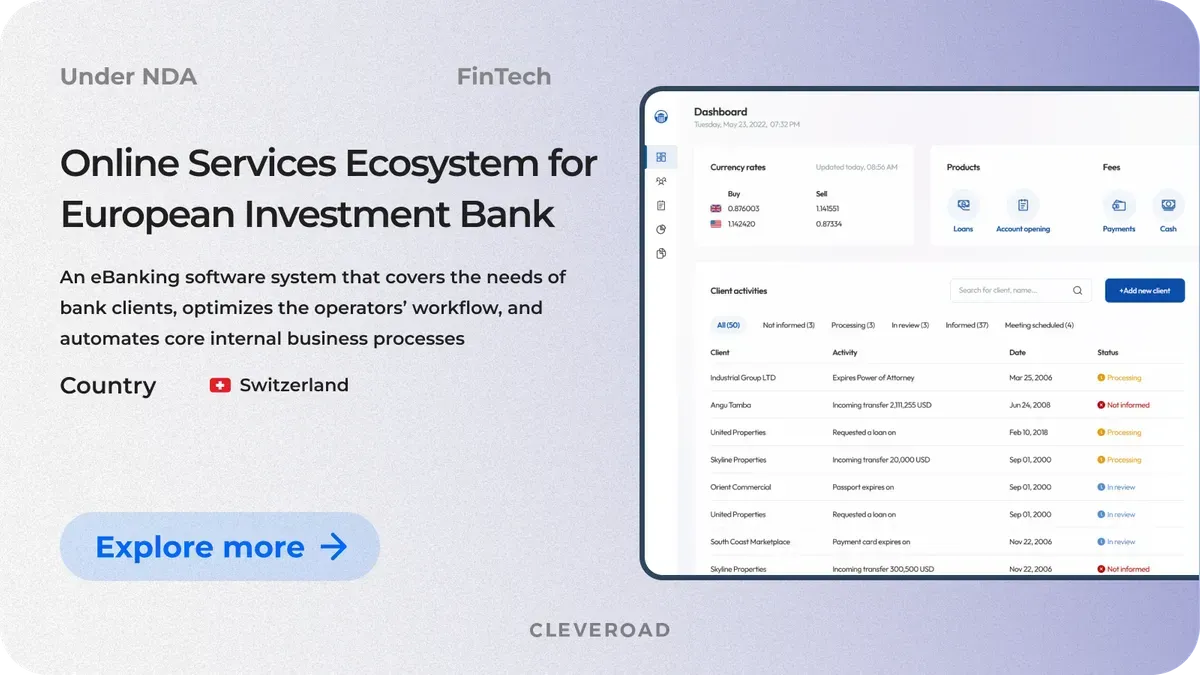
An eBanking software system designed by the Cleveroad team
To meet our clients’ business needs, we’ve created a new custom eBanking software that preserves and enhances existing banking capabilities. We developed an e-banking web platform with easy sign-up, a KYC-compliant digital account-opening system, and a web portal for trading and investing. Our solution also integrates with the bank’s internal DAO & Customer tool, which we enhanced to improve performance, stability, efficiency, and compatibility with the new platform.
To optimize internal operations, we automated tasks for bank operators, including RPA-based onboarding document processing, which accelerated verification and reduced manual workload. We also applied tailored tools and approaches aligned with Swiss banking regulations (namely FINMA), including Role-Based Access Control (RBAC) and need-to-know access control.
As a result of cooperation with Cleveroad, our client received a new eBanking system. The new user experience (UX) simplified account opening and sped up onboarding, increasing customer attraction and retention by 20–30%. The solution ensured full compliance with the Financial Market Infrastructure Act (FMIA), enabling secure operations under the customer’s existing license.
Implement RPA in your banking system with domain experts
With 15+ years in banking software development, we’ll identify key processes and implement RPA to automate them across your operations safely
RPA in banking is software that runs rule-based back-office tasks, such as data entry, KYC checks, account reconciliation, and regulatory report generation, by working through the same applications your staff use. Banks usually start with onboarding and compliance reporting, where volumes are high and rules rarely change.
The best candidates for RPA run at high volume and follow rules you can write down without judgment calls. In banking, that usually points to customer onboarding and KYC document checks, loan and credit intake, AML transaction screening, and syncing customer data between CRM and core banking. Processes fed by unstructured input, such as handwritten forms or free-text emails, need Intelligent Document Processing (IDP) in front of the bot before automation pays off. Pick the first process by the number of identical cases it handles per day, since that figure drives the return.
Introducing RPA into finance and banking requires a clear strategy and the right RPA software. Here are the steps to implement RPA software in the banking process:
- Step 1. Find a reliable banking and financial services provider
- Step 2. RPA solution design
- Step 3. Proof of Concept (PoC) stage
- Step 4. Development and deployment
Banks measure the effect of RPA through a few hard numbers:
- Processing time per case, measured from application to decision. Verified Market Reports puts the reduction at up to 70% for banks using RPA.
- Error rate, tracked through rework tickets or reconciliation mismatches per 1,000 transactions before and after go-live.
- Review coverage, the share of transactions checked against AML rules, which moves from a sample to the full population once bots run the screening.

Evgeniy Altynpara is a CTO and member of the Forbes Councils’ community of tech professionals. He is an expert in software development and technological entrepreneurship and has 10+years of experience in digital transformation consulting in Healthcare, FinTech, Supply Chain and Logistics
Give us your impressions about this article
Give us your impressions about this article