How Much Does It Cost to Develop a Telemedicine App: a Breakdown for 2026
Updated 30 May 2026
18 Min
6945 Views
How much does it cost to develop a telemedicine app? The cost of creating a telemedicine application often includes many factors that can significantly affect the final pricing: features, tech stack, design, integrations, developers' hourly rates, and more. Without knowing these details, it's impossible to define the exact price.
Still, it's possible to estimate the average cost of telemedicine software development to plan the budget. As experts in telemedicine software creation with 15+ years of experience, we’ll tell you more about the cost-forming factors for telemedicine applications, approximate costs, the ways to estimate telehealth app costs, and so on.
Below, you can examine the brief telemedicine app development price range by the app’s complexity:
- Basic telehealth app (MVP): $40,000-$70,000. Covers essential telemedicine app features, including user profiles, appointment scheduling, and basic video consultations.
- Medium-complexity telemedicine app: $70,000-$100,000. Expands core features with prescription management, secure payments, and enhanced user workflows.
- Advanced or enterprise-level platform: $100,000-$300,000+. Designed for large-scale use, including AI-powered chatbots, EHR integrations, remote patient monitoring, and advanced analytics.
Telemedicine App Development Cost Breakdown
As you’ve already learnt, the cost of telemedicine app development is not that easy to figure out initially. It strongly depends on the wide range of factors like features and their complexity, integrations, design considerations and more.
Anyway, one of the most popular ways to penetrate the telemedicine niche is to create an MVP version or Minimal Viable Product. This is a basic telemedicine app with functionality that is enough to test the telemedicine app in real-world conditions.
It takes less time and financial resources to develop and helps you to avoid particular risks using the trial and error method. If a fully completed telemedicine software requires 1200h-2400h at least, an MVP will take you approximately 1400h. MVP version of your telemedicine app will cost approximately from $40,000 to $70,000+.
We will try to answer the question of how much does it cost to develop a telemedicine app based on the example of the MVP version.
Cost by telemedicine app сomplexity
The overall cost of a telemedicine app depends heavily on its functional complexity. As the platform evolves from a basic solution to an enterprise-grade system, development effort increases due to added features, deeper integrations, higher security requirements, and stricter compliance standards. Each level of complexity introduces new technical challenges that directly affect time, team size, and budget.
A basic telemedicine app focuses on validating the idea and delivering core functionality. This level includes patient and doctor profiles, appointment scheduling, and standard video consultations. Development remains relatively straightforward because workflows are limited, integrations are minimal, and infrastructure requirements are moderate. Such apps work well as MVPs but offer limited scalability and automation.
A medium-complexity telemedicine app expands beyond consultations. Features like prescription management, secure payments, and more advanced user flows require stronger backend logic, payment compliance, and improved data protection. At this stage, the app must handle more sensitive medical and financial data, which increases development effort and testing scope.
An advanced or enterprise-level telemedicine platform supports large-scale healthcare operations. AI-driven tools, EHR integrations, remote patient monitoring, and analytics demand complex architecture, high availability, interoperability with third-party systems, and rigorous regulatory compliance. These factors significantly increase development cost but enable long-term scalability and operational efficiency.
| Telemedicine app complexity | Typical scope | Estimated cost range ($) |
|---|---|---|
Basic telemedicine app | User profiles, appointment scheduling, basic video consultations | $40,000-$70,000 |
Medium-complexity app | Prescriptions, secure payments, extended workflows, higher data security | $70,000-$100,000 |
Advanced platform | AI features, EHR integrations, remote monitoring, analytics, large-scale usage | $100,000-$300,000+ |
Cost by telemedicine app type
Initially, telemedicine apps can be classified into three types: synchronous telemedicine apps, asynchronous apps, and remote monitoring apps.
Synchronous telemedicine apps. These apps (e.g., Amwell, Doctor on Demand, Teladoc) facilitate real-time communication between patients and physicians through video consultations, phone calls, and secure messaging channels. The approximate synchronous telemedicine app development cost is $70,000-$150,000+.
Asynchronous telemedicine solutions. They enable patients to communicate with healthcare providers at their convenience, with no need for simultaneous interaction. The cost of such an app (like 98point6, Maple, HeyDoctor) ranges from $70,000 to $120,000+.
Remote monitoring apps. These solutions (e.g., Livongo, Omada Health, MyChart) allow patients track and monitor their health parameters, like vital signs, chronic conditions, adherence to medication intake, and lifestyle habits, from their smartphones or other smart health devices. Remote patient monitoring software development services cost ranges from $90,000 to $200,000+.
At Cleveroad, we provide cost-effective telemedicine software development services with flexible engagement models that will align with your timeline and budget requirements
What Factors Influence the Cost of Telemedicine Mobile App Development?
Telemedicine software in healthcare has significant potential and is already making care more accessible and stress-free for patients and more cost-effective for over 53% of healthcare organizations. However, the cost of a telemedicine app requires attention to avoid budget constraints in the future.
Let’s see 8 main price-affecting factors below.
Development team location and structure
When developing an app, the development team's location and structure significantly influence the overall cost. If you decide to hire offshore developers, you may receive lower rates, while local teams make communication easier. A typical team for mobile app development includes a project manager, a UI/UX designer, frontend and backend developers, QA engineers, and DevOps specialists. Team size and expertise in custom telemedicine solutions directly impact efficiency, timeline, and budget.
Below, you can examine the development rates for the telemedicine app in the most popular outsourcing regions worldwide:
| Telemedicine app experts | North America | Latin America | Central Europe | Western Europe | Asia | Africa |
|---|---|---|---|---|---|---|
Developers | $80-$100 | $35-$70 | $25-$50 | $30-$65 | $20-$45 | $25-$45 |
UI/UX designer | $70-$80 | $40-$60 | $35-$45 | $30-$50 | $20-$30 | $20-$30 |
Project Manager | $70-$80 | $40-$60 | $50-$70 | $30-$50 | $20-$30 | $25-$35 |
Business Analyst | $60-$75 | $35-$60 | $25-$35 | $25-$45 | $15-$25 | $20-$30 |
QA Specialist | $60-$75 | $35-$60 | $25-$40 | $25-$45 | $15-$25 | $20-$30 |
DevOps | $80-$100 | $35-$70 | $30-$50 | $30-$65 | $20-$45 | $25-$45 |
Web team lead | $85-$110 | $45-$80 | $45-$55 | $45-$65 | $35-$45 | $30-$45 |
Platform compatibility
Beyond overall functionality and usability, the cost of telemedicine app development largely depends on seamless interoperability across platforms, including mobile (iOS, Android) and web. Here, you can create a native app for each platform or leverage cross platform app development services.
The choice of platform directly affects the cost of developing a telemedicine app. Building a native app for one platform is always cheaper, roughly 2 times more affordable than creating and maintaining apps for both iOS and Android. Below is a breakdown to help estimate your development budget:
- One mobile platform (iOS or Android). A native telemedicine app that includes authentication, profiles, chat, video calls, and basic EHR integrations typically requires 800-1,200 hours of development. With an average hourly rate of $40-60, the cost ranges from $32,000 to $72,000.
- Two mobile platforms (iOS and Android). Building two native apps means duplicating most front-end development efforts. Timelines increase, reaching 1,600-2,400 hours, with a budget from $64,000 to $144,000+.
- Web version. A browser-based telemedicine platform accessible from both mobile and desktop usually takes 600-900 hours and costs $24,000-$54,000. It also requires hosting and infrastructure expenses that may add $200-$500/month depending on traffic and storage.
If you want to develop an app for two platforms but still reduce costs and speed up the release, we recommend a cross-platform approach. Tools like Flutter allow building a single codebase for both iOS and Android, significantly shortening time-to-market while ensuring consistent UI and performance across devices.
Learn more about Flutter app development services we provide at Cleveroad to help you create robust apps faster and on a budget
One of our recent HealthTech cases illustrates this approach well. Codex Labs, a Silicon Valley plant-biotechnology company, partnered with us to stabilize and enhance their teledermatology platform, DECODE.ME, which enables secure virtual consultations between doctors and patients. The client needed a reliable technology partner to improve system stability, fix existing technical issues, and ensure full compliance with healthcare security standards while maintaining uninterrupted service for end users.
We began with a comprehensive audit of the inherited codebase and system architecture to identify performance bottlenecks, security gaps, and scalability limitations. Based on this analysis, our engineers fixed critical bugs, optimized backend performance, and implemented HIPAA-compliant infrastructure to support secure and reliable medical data exchange during remote consultations. This approach ensured that the platform could operate consistently under increasing user load while maintaining strict healthcare compliance requirements.
As a result, the client received a significantly more stable and secure teledermatology platform that supports efficient virtual doctor–patient interactions and improved system performance for ongoing operations.
Here’s what Barbara Paldus, Founder and CEO of Codex Labs, says about the collaboration with Cleveroad:
Dr. Barbara Paldus, CEO at Codex Labs: Feedback on Cleveroad's Telemedicine Development Services
Features and functionality
The telehealth app functionality, its complexity, and breadth can take first place here. To start, let’s divide it into two categories: patient-side functionality and doctor-side functionality.
Patient app functionality is designed to make the patient experience convenient and intuitive. Patient features enable users to easily schedule appointments and access medical care remotely. This is especially important for patients with mobility issues, transportation challenges, or busy schedules.
Let’s take a closer look at each feature, time to develop it and its cost below:
| Telehealth patient app feature | Development time (h) | Cost ($) |
|---|---|---|
Registration | 10 hours | $500 |
Profile management | 15 hours | $750 |
Unified patient interface | 60 hours | $3,000 |
Video conferencing | 70 hours | $3,500 |
Text chat | 40 hours | $2,000 |
Scheduling and alerts | 35 hours | $1,750 |
Payment details | 20 hours | $1,000 |
Prescription and medical history | 30 hours | $1,500 |
Overall | 280 hours | $14,000 |
Doctor app functionality simplifies your medical organization’s physicians' work, assisting them in patient records and appointment management. Doctors can efficiently allocate their time, review patient information, and communicate with patients, enabling them to focus more on delivering high-quality care.
Here is the main physician-side functionality as well as time and cost to develop it:
| Doctor telemedicine app feature | Development time (h) | Cost ($) |
|---|---|---|
Physician dashboard (profile + calendar) | 90 hours | $4,500 |
Patient interaction suite (EHRs + communication) | 150 hours | $7,500 |
Overall | 240 hours | $12,000 |
Cost by cooperation model
The choice of cooperation model can also be a significant cost-affecting factor for telemedicine app development. Let’s take a look at the most commonly utilized cooperation models to implement telemedicine technology:
- In-house team. Setting up an in-house development team implies hiring full-time developers, designers, and other software professionals to design and build a telemedicine app. The typical salaries for in-house team members in the US range from $60,000 to $150,000 per year, depending on qualifications and skill set. Additionally, you’ll need to invest into office space, equipment, and overhead expenses.
- Outsourcing. Outsourcing healthcare software development for telemedicine app development to a third-party company, receiving cost-savings and well-tailored telehealth expertise. Hourly rates for outsourced specialists range from $50 to $200 per hour, based on the team location. So, in the US, software developers' rates are $60-$150+, in Estonia $40-$100+, and in the UK $50-$120+.
UI/UX design
The design of your telemedicine platform is the first thing the patient will see and decide if it is worth utilizing in the future. So, UI/UX design is definitely not worth cutting costs, as it has to be highly convenient, intuitive for an average user, and simple and eye-appealing. Considering creating a custom design highly tailored to your brand identity is definitely worth the effort; however, it’s more expensive, resulting in $20,000 to $50,000+. Anyway, you can still start simple, and the cost of telemedicine app development, including basic UI/UX design, may range from $10,000 to $20,000+.
Let’s consider a real-world example of a clinic management system’s UI/UX design created by Cleveroad to examine how thoughtful design choices affect usability and patient experience in general.
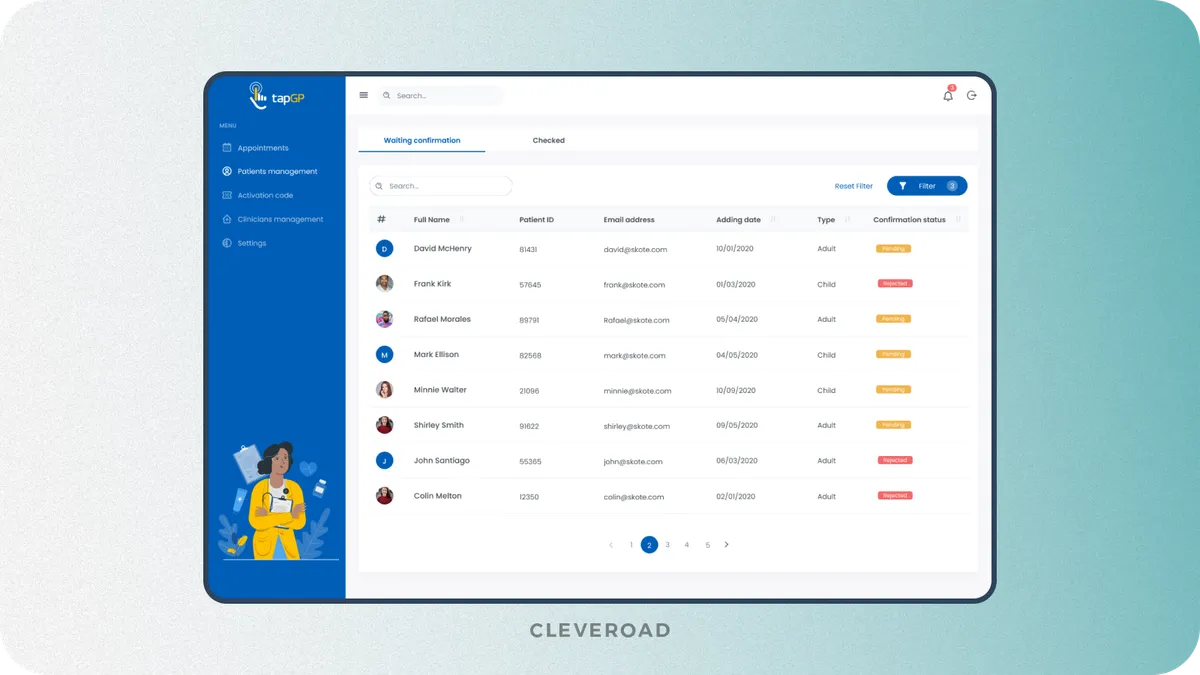
Telemedicine app interface designed by Cleveroad
Security and compliance
Healthcare is an industry where a high level of certification, regulatory compliance, and patient data security is required. Here is an exemplary list of regulations you may need to follow:
- HIPAA: Sets standards for the protection of sensitive patient health information or PHI
- GDPR: Applies to telemedicine apps operating within the European Union and sets guidelines for personal data collection, storage, and processing
- FDA: This regulation applies to telemedicine solutions that provide medical device support and diagnostic functionality
- PCI DSS: Safeguards cardholders’ data during transactions
- Regional laws: Make sure to research country-specific licensure laws that state norms for physician licensing, patient-provider relationships, etc.
This list is not a final selection of regulations. It may differ depending on the region you plan to launch your telemedicine application.
To illustrate how compliance-driven systems work in practice, it helps to look at real healthcare software built under strict regulatory constraints. Cleveroad has delivered regulated healthcare platforms, including a telemedicine-adjacent quality management system designed to meet FDA 21 CFR Part 820, FDA 21 CFR Part 11, and ISO 13485 requirements, supporting validated workflows and secure documentation handling. This experience shows how healthcare and telemedicine software can automate critical processes while remaining audit-ready and compliant.

 USA
USA


You still have to thoroughly assess security features that will protect your patient data. Here is the list of security measures for telehealth solutions development you can take into consideration:
- End-to-end encryption
- Two-factor authentication
- Biometric authentication
- Role-based access
- Secure data transmission (protocols like TLS or SSL)
- Secure cloud storage
Alignment with regulation and implementation of security features will result in a telehealth app cost of $10,000 to $30,000+.
Learn more about healthcare data security and how to provide top-notch security within your your eHealth environment
Tech stack
The tech stack affects the costs of developing a telemedicine mobile app significantly. Expert app development companies choose technologies that provide scalability, security, and seamless performance. The backend, frontend, and third-party services you use can determine the time it will take for your product to hit the app store and how well you are positioned to succeed in the telemedicine industry.
However, a more complicated stack can increase the overall telemedicine app cost; the tech stack can increase your development budget from $10,000 to $70,000+, depending on the complexity. Moreover, if your medical ecosystem requires rare or obsolete technologies, it will be harder for you to find a proper specialist, so that the overall cost will increase. A suitable tech stack is a must for creating a customized telemedicine solution and getting an accurate cost estimate.
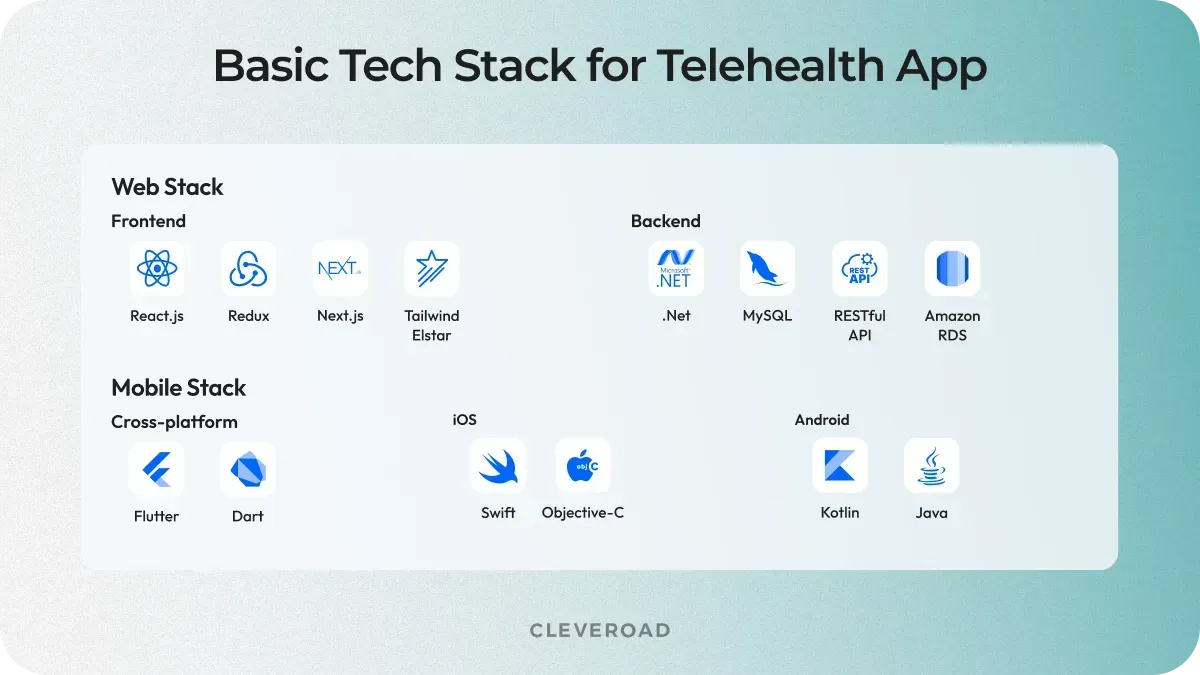
Telemedicine app technology stack
AI and ML capabilities
These advanced capabilities are more valuable as the telemedicine market grows more competitive. The addition of Artificial Intelligence (AI) or Machine Learning (ML) can greatly increase the total cost of a telemedicine app (adding from $15,000 to $70,000+ to it), especially with custom telemedicine solutions designed to fit specific clinical workflows.
An experienced mobile application development firm will advise you on how to navigate the complexities of AI integration to create a solution that is in line with the trends of the global telemedicine market. Whether you are involved in app development at the application stage or starting with an MVP, any AI/ML implementation will look compelling, and the product can stand out with a stronger differentiation than other products.
Note: At Cleveroad, we provide an extensive range of AI development services you can utilize to make an advanced and user-friendly telemedicine app.
Why You Need a Telemedicine App: Top 5 Benefits
As patient expectations shift toward remote access and healthcare systems face ongoing capacity and staffing challenges, telemedicine software helps organizations deliver care more efficiently without compromising quality or compliance. Below are the key benefits that explain why investing in a telemedicine app creates measurable value for both providers and patients.
Expanded access to healthcare
Telemedicine dramatically improves access to medical services, especially for patients in rural or underserved areas who otherwise face barriers to care. DiabeticStudies indicate that up to 85% of users report improved access to healthcare services with telemedicine platforms, highlighting its transformative impact on equity and availability.
Cost savings for patients and providers
Even though telemedicine development costs may seem high at first, they deliver measurable financial and operational benefits for healthcare providers. Telemedicine platforms help clinics reduce overhead expenses, optimize physician workloads, minimize missed appointments, and decrease reliance on costly in-person and emergency visits, resulting in more predictable and scalable operations.
Patients benefit as well, as telemedicine eliminates travel time and costs, improves access to care, reduces waiting times, and enables faster follow-ups and continuity of treatment from any location. MHealth shows that proper use of telemedicine can yield net savings of $19-$121 per session by avoiding in-person visits and related expenses.
Continuity of care
Remote healthcare enhances patient communication and follow-up, fostering better ongoing care. In surveys conducted by DiabeticStudies, over 80% of participants reported improved follow-up and communication through telemedicine, which supports long-term treatment adherence and stronger patient-provider relationships.
Better clinical efficiency
Telemedicine platforms help clinics and providers reduce waiting times and increase appointment availability. For instance, a recent industry analysis by MoldStud found that 75% of patients reported a positive experience, with telemedicine enabling more efficient care delivery and improved satisfaction.
Reduced hospitalizations
Telemedicine applications can also improve health outcomes. PubMed research indicates that telemedicine adoption is associated with significant reductions in hospital stays and mortality rates, stating its potential to enhance preventive care and patient health.
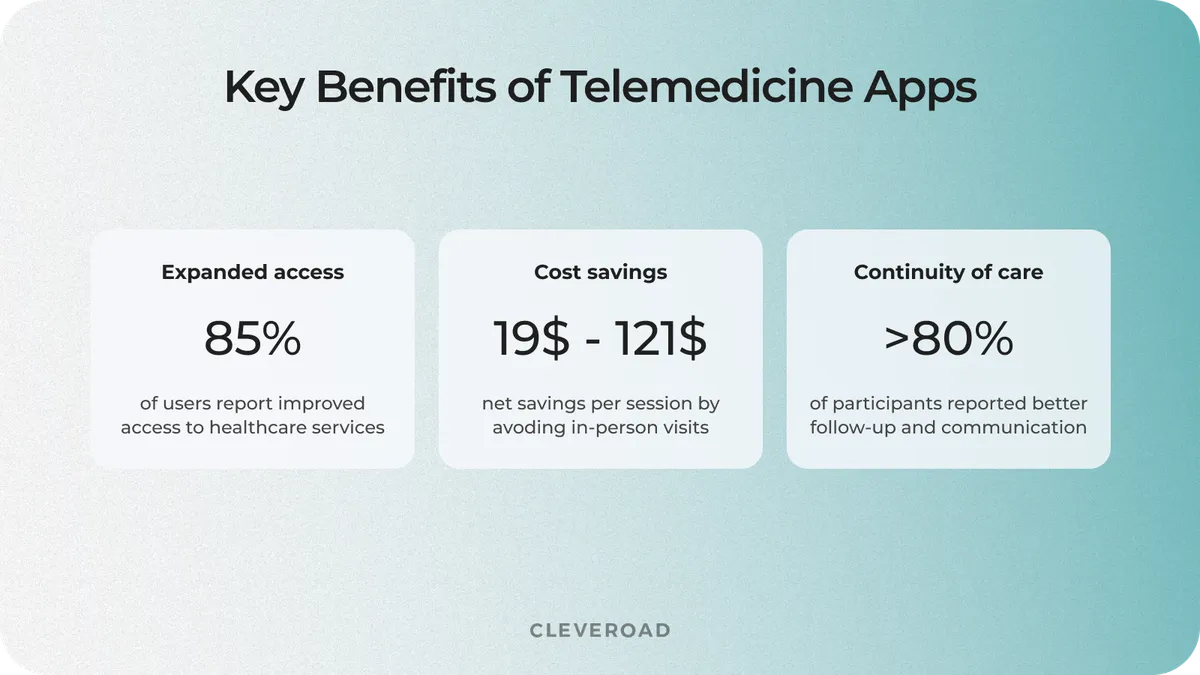
Telemedicine application benefits
Reasons for Telemedicine App Budget Overruns and How to Avoid Them
Developing a telemedicine app is inherently complex, and the cost of telemedicine app can quickly escalate without careful planning. Budget overruns usually stem from unclear or unrealistically high project expectations and poor planning. Identifying potential risks early and applying expert strategies helps you manage expenses while delivering a robust, scalable, and fully compliant telehealth solution.
Unclear or evolving requirements
When project requirements aren’t clearly defined, your developers may spend extra time revising features, redesigning workflows, or addressing misaligned expectations. Mid-project changes often lead to delays, rework, and increased expenses, particularly in regulated healthcare environments.
Cleveroad’s approach: At Cleveroad, we start software projects with a structured Product Discovery phase. We collaborate closely with you to define functional, technical, and regulatory requirements, create detailed product documentation, and validate workflows before development begins, reducing costly iterations.
Here are the key actions we take to avoid telemedicine app requirements confusion:
- We conduct stakeholder interviews to capture business and clinical requirements
- Develop user journey and workflow diagrams for clear feature mapping
- Produce detailed technical specifications and acceptance criteria
- Validate requirements through mockups, prototypes, and iterative feedback
Technical challenges and compliance hurdles
Telemedicine apps must comply with strict healthcare regulations such as HIPAA and GDPR. Technical hurdles, like secure data integration, infrastructure scaling, or EHR interoperability, can delay and increase the cost of telemedicine app development if not to address or tech hurdles on time.
Cleveroad’s approach: Our senior QA engineers, DevOps specialists, and security architects will manage technical and compliance challenges. Every stage is optimized for security and regulatory compliance.
Here’s what we do to minimize any compliance and technical unpredictabilities:
- Secure system architecture with encryption and role-based access
- Automated and manual QA testing aligned with healthcare standards
- Cloud infrastructure optimization for scalability and reliability
- Continuous monitoring and post-launch support for compliance
Cleveroad is an AWS Select Tier and Service Delivery Partner. You can rely on us to implement secure cloud solutions with a history of measurable results
Feature creep and over-engineering
Even if you’re being extra tempted, adding features beyond the original plan or overcomplicating workflows can inflate telemedicine development costs. Excessive functionality extends QA cycles, integration time, and testing, especially for applications that manage sensitive patient data.
Cleveroad’s approach: We apply a phased development strategy, starting with an MVP (Minimum Viable Product). During MVP development, we prioritize core functionality and plan optional enhancements for future releases, ensuring cost-effective delivery without compromising quality or compliance.
Here’s how we at Cleveroad solve feature creep even before full scale telemedicine app development:
- We define the MVP scope aligned with the key business goals
- Use agile sprints and backlog prioritization to control scope
- Provide iterative feature review to prevent unnecessary complexity
- Evaluate technical dependencies before adding new modules
- Ensure all features meet regulatory standards
Cost to Develop a Telemedicine App: Final Estimate
It's time to determine the total cost of telemedicine app development. Our estimate includes MVP features and is based on the average hourly rate of $50/hour in Central Europe, Estonia.
Remember: this price is approximate. It varies according to your business needs and features. First, take a look at the approximate cost of telehealth app development for basic features.
| Telemedicine app feature | Approx. development time (hours) | Estimated cost range ($) |
|---|---|---|
User authentication | $4,800-$8,400 | |
Profile management | $8,000-$14,000 | |
Doctor discovery & filtering | $8,000-$14,000 | |
Appointment management | $12,000-$21,000 | |
Real-time communication suite (video, chat, voice) | $16,800-$29,400 | |
Notifications & reminders | $3,200-$5,600 | |
EHR integration | $4,000-$7,000 | |
Admin panel | $8,000-$14,000 | |
Total | $64,800-$113,400 | |
It’s important to note that building a telemedicine app goes far beyond hiring software developers alone. Telehealth solutions are complex, regulated products that require cross-functional expertise to ensure usability, security, scalability, and compliance with healthcare standards.
A well-structured telemedicine development team typically includes:
- Front-end developer
- Back-end developer
- UI/UX designer
- Business Analyst
- Project Manager
- QA engineer
- DevOps engineer
- Team Lead / Technical Lead
Each role contributes to reducing delivery risks and ensuring the product meets both clinical and business requirements. For example, business analysts help avoid costly rework by defining precise workflows early, while QA and DevOps engineers ensure system stability and uninterrupted service after launch.
Considering the scope of work, and long-term maintenance needs, the cost of telemedicine app development usually ranges from $100,000 to $250,000+, depending on feature complexity, integrations, and scalability goals.
To receive a tailored cost estimate aligned with your business model and compliance requirements, contact our healthcare business engineering team for a personalized telehealth project assessment.
Telemedicine App Development Cost Estimate at Cleveroad
Cleveroad is a healthcare software development company located in Estonia, Central and Eastern Europe. Since 2011, we have provided technical assistance to healthcare businesses of various scales in the creation of healthcare and telemedicine software solutions that improve patient care, optimize workflow in medical facilities, and increase the performance of businesses by automating different labor-intensive processes and optimize them.
We help our clients develop a lot of eHealth solutions, including:
- EHR/EMR
- Telemedicine software
- AI-enriched medical software environments
- E-prescribing software
- Medical billing software
- RPM with wearable devices
- Hospital Management Software (HMS)
- Health insurance software
- Healthcare CRMs
- Health tracking apps, etc.
We thoroughly work on delivering healthcare solutions compliant with different regulations such as HIPAA, HITECH, HL7, CDA, TX-HB300, CCD, CCHIT, etc.
How do we estimate telemedicine app costs? We provide rough and detailed estimates.
Rough estimate
The main purpose of the rough estimate is to orient a client on the approximate budget to count on and primarily outline the structure of the whole telemedicine app development process.
We create 2 rough estimates to get to the closest pricing accuracy tier by tier:
- The first one was created after the Solution Design Workshop
- The second one after the product Discovery Phase
The Solution Design Workshop estimate is preliminary and based on an initial review of your telemedicine project. Based on prior experience with similar software delivery, the solution team defines your software project goals, complexity, scope of work, and potential constraints.
We offer a client three estimate options: optimistic, realistic, and pessimistic. This enables us to figure out the strategy and the number of features to include in the estimate while staying within a budget and meeting the perfect quality level of non-functional requirements (data privacy, security, and risk-mitigating strategies, etc.).
The Discovery Phase rough estimate implies that we analyze business process specifications, create a more detailed feature list, and define non-functional requirements and architectural solutions.
Based on a more detailed software image, this estimate corrects the inaccuracies of the previous one and outlines the telemedicine software requirements in more detail.
This estimate includes:
- The general section that describes the preparatory work
- Development that directly addresses the coding
- Integration of frameworks and libraries that enable us to speed up feature implementation
- Non-development aspects touching on the creation of well-structured tech documentation
- Suggestions section that contains improving proposals
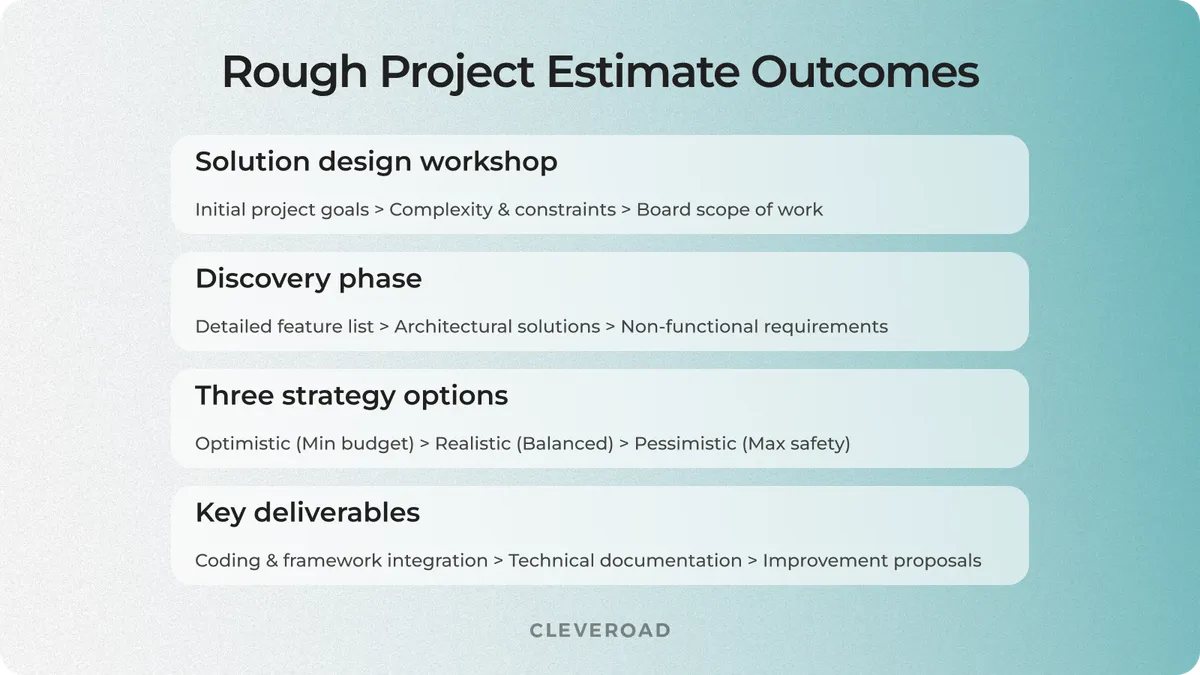
Telemedicine app rough estimate outcomes
Detailed estimate
Detailed estimate has nearly 100% of accuracy and is conducted along with developers who are directly involved into your telemedicine app creation. Prior gathering discovery phase requirements serve as a cortex that helps to define detailed requirements.
This is an iterative process divided by sprints. For each sprint or 2 sprints ahead, our business analyst prepares a list of detailed requirements or user stories. Depending on your project's complexity and requirements, each user story is reviewed by the technical team lead, the solution architect, and the responsible developer. By evaluating each sprint step by step, it is possible to assemble a detailed cost estimate for the entire telehealth app project.
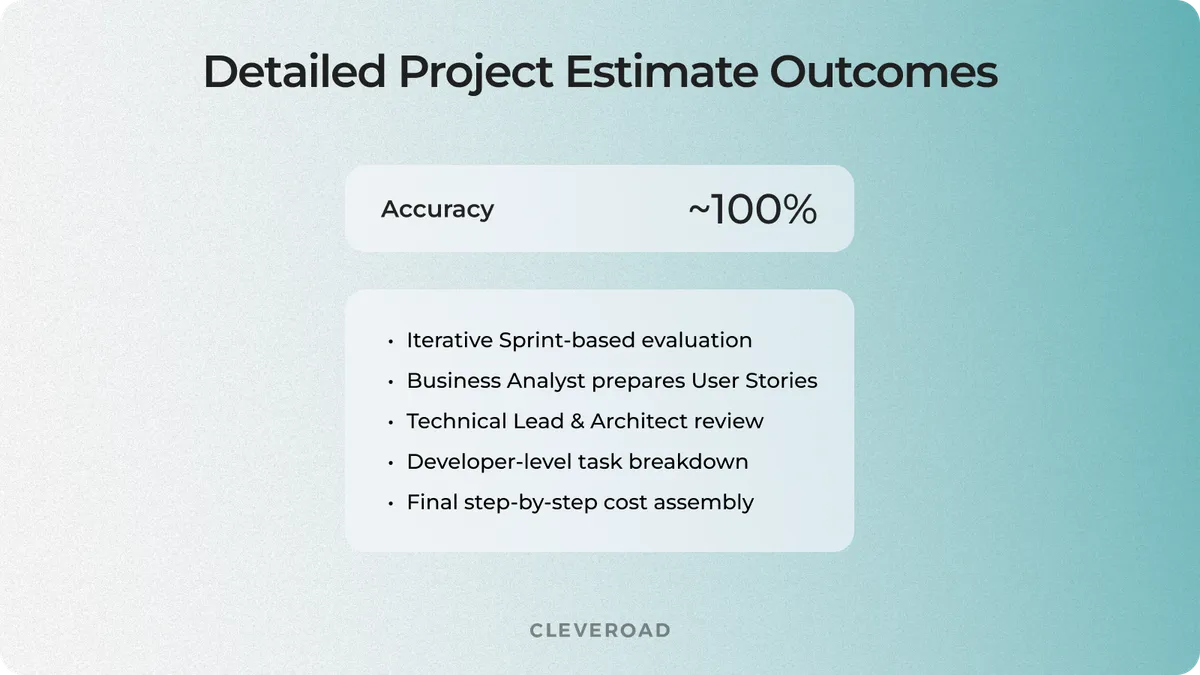
Telemedicine app detailed estimate outcomes
You can feel free to check out our portfolio and past clients reviews on Clutch to see the real feedback and work outcomes by your own eyes.
Learn the cost of your telemedicine app
Leave it to our healthcare tech experts! Contact us now and get a rough cost estimation of your telemedicine application
The average cost to build a telemedicine healthcare app is approximately $100,000-$250,000+, depending on scope and complexity. In practice, a telemedicine app can range across different price tiers based on functionality and target users, including:
- Basic telehealth app (MVP): $40,000-$70,000. Covers essential telemedicine app features, including user profiles, appointment scheduling, and basic video consultations.
- Medium-complexity telemedicine app: $70,000-$100,000. Expands core features with prescription management, secure payments, and enhanced user workflows.
- Advanced or enterprise-level platform: $100,000-$300,000+. Designed for large-scale use, including AI-powered chatbots, EHR integrations, remote patient monitoring, and advanced analytics.
These estimates reflect overall telemedicine app development, including compliance, scalability, and long-term viability.
The cost of a telemedicine app built from scratch typically starts at $40,000-$70,000 for initial development. However, the final price depends on the feature set required for your MVP, supported telemedicine services, and whether cross-platform development is needed. In addition, regulatory and security requirements in medical app development significantly influence total costs.
It’s difficult to determine upfront how much does telemedicine app development require, as the cost depends on multiple variables. These include platform choice, design complexity, integrations with third-party systems, team location, and compliance standards. Taking all factors into account, healthcare app development costs typically fall within the $100,000-$250,000+ range.
Patient- and doctor-facing features directly impact complexity, which increases overall telemedicine app development expenses. Advanced workflows, personalization, and secure data exchange add effort and development time. Since telemedicine platforms must comply with healthcare regulations, additional validation and testing may cost more, but they are essential for delivering a reliable and scalable solution.

Evgeniy Altynpara is a CTO and member of the Forbes Councils’ community of tech professionals. He is an expert in software development and technological entrepreneurship and has 10+years of experience in digital transformation consulting in Healthcare, FinTech, Supply Chain and Logistics
Give us your impressions about this article
Give us your impressions about this article
Comments
5 commentsVery good article and provides a good framework for business to budget.
Hello! thanks for sharing an informative post. It's worth reading. I have been using a couple of telemedicine apps and found Prescribery. It is HIPPA compliant and super easy to access. I would suggest you to give it a try and review if found useful!
Every single word is on point. Truly informative. Expert advises. Superb content in n out. Rating it 6/5
Wow This is fantastic the training is really good and superb

Superb content Most comprehensive blog about telemedicine I have ever read