Transportation Management System Development: Features, Costs, and More
Updated 24 Feb 2026
17 Min
1682 Views
Transportation management system development is no longer a generic IT upgrade. For mid-sized 3PL providers and freight brokers handling 300 to 2,000 shipments per month, TMS development is a margin protection strategy.
A custom TMS replaces fragmented spreadsheets and manual dispatch with a centralized cloud control layer, improving operational visibility and cost predictability. By automating coordination and invoice validation, the system reduces billing errors and accelerates operational decision-making. An effective TMS centers on the following capabilities:
- Automated carrier selection with dynamic rate comparison
- Route optimization with real-time ETA monitoring
- Load planning and shipment consolidation to improve asset utilization
- Freight audit and billing automation to reduce revenue leakage
- API integration with ERP and WMS systems, as well as telematics providers
With over 15 years of experience delivering custom logistics solutions, Cleveroad designs scalable, integration-ready TMS platforms tailored to operational workflows and compliance requirements. In this article, we’ll share our experience and explain how to design such a system, starting with defining the MVP scope and integration layers, and progressing to advanced modules and cost drivers.
What Is a Transportation Management System?
Transportation management software (TMS) is a multifunctional digital tool that helps logistics and transportation businesses streamline shipping operations and optimize the overall flow. Incorporating this solution allows you to avoid potential cargo delivery delays and establish reliable logistics management throughout the supply chain.
Logistics processes automated by TMS
A modern TMS is not just a collection of features. It is an operational architecture built on API-first integrations, event-driven data processing, and algorithmic optimization. Below are the core processes that create measurable performance impact.
| Process | How it works | Business impact |
|---|---|---|
Order orchestration | Ingests ERP/WMS orders via APIs and triggers workflows | Cuts manual work and planning time 20–30% |
Route optimization | Uses algorithms and real-time data for rerouting | Reduces transportation costs 8–15% |
Carrier selection | Compares contract and spot rates via APIs | Protects margins and improves rate accuracy |
Real-time tracking | Streams telematics data and predicts ETA | Improves on-time delivery and visibility |
Load optimization | Applies constraint-based capacity planning logic | Increases asset utilization and reduces empty space |
Freight audit | Matches invoices with shipment data automatically | Achieves 95–98% billing accuracy |
Analytics | Aggregates KPIs like cost per mile and SLA | Enables margin control and performance insights |
API integrations | Connects ERP, WMS, CRM, telematics via microservices | Ensures scalability and system flexibility |
By automating and optimizing these critical logistics operations, a TMS effectively improves efficiency, reduces costs, and enhances customer satisfaction. Such architecture is built in enterprise implementations to support tens of thousands of shipment events per day with near-zero latency, ensuring stable performance even during seasonal demand spikes.
Here is what Michael Baumann, an expert with 30+ years of working experience in transportation management, says about utilizing a transportation management solution:
Michael Baumann
Vice President at DHL Subolv Chain
Essentially, they create a transportation control tower that gives you real-time visibility of freight flows across all your operations.

Major types of transportation management systems
If you are planning transportation management system development, evaluate deployment models based on regulatory exposure, shipment volume, integration density, and long-term cost structure. Below are five structural models commonly considered in 2026 procurement.
On-premise TMS. Deployed on internal servers, this model provides full ownership of data governance and customization. It is typically selected by enterprises subject to strict regulatory or data-residency requirements. However, infrastructure management and hardware investment, as well as upgrade cycles, increase operational responsibility.
Cloud-based TMS. Cloud-based transportation systems, delivered via SaaS or public cloud, reduce upfront capital expenditures and accelerate deployment timelines. Infrastructure scaling and system maintenance are handled externally. But in highly regulated freight environments, cloud deployments may require additional compliance layers and data segmentation controls, which should be evaluated early in the RFP process.
3PL-Focused TMS. Designed for logistics providers managing transportation for multiple shippers, 3PL TMS prioritizes multi-tenant architecture and client-specific rate management. These platforms are built to protect margins and increase pricing accuracy across accounts, making them highly specialized transport management solutions for service-based logistics providers.
Enterprise TMS. Enterprise-grade systems for transportation support complex, multi-modal networks and high shipment volumes. They emphasize deep ERP or WMS integrations, analytics layers, and cross-border compliance logic. In large-scale implementations, the enterprise TMS becomes a central integration hub within the broader digital ecosystem.
Modular TMS. Modular transportation management platforms allow organizations to deploy specific components first, such as route optimization or freight audit, and expand functionality gradually. The modular TMS structure is often used within a staged digital transformation roadmap, especially when a development project requires phased investment and incremental ROI realization.
The selection process should align with operational maturity, compliance needs, integration requirements, and scalability goals. The chosen architecture ultimately determines how effectively your TMS supports cost control, depth of automation, and long-term growth. Because architectural choices directly affect implementation scope and integration depth, development costs vary significantly across these models.
To better visualize these differences, we’ll outline cost ranges and key complexity drivers for each TMS type on the image below:
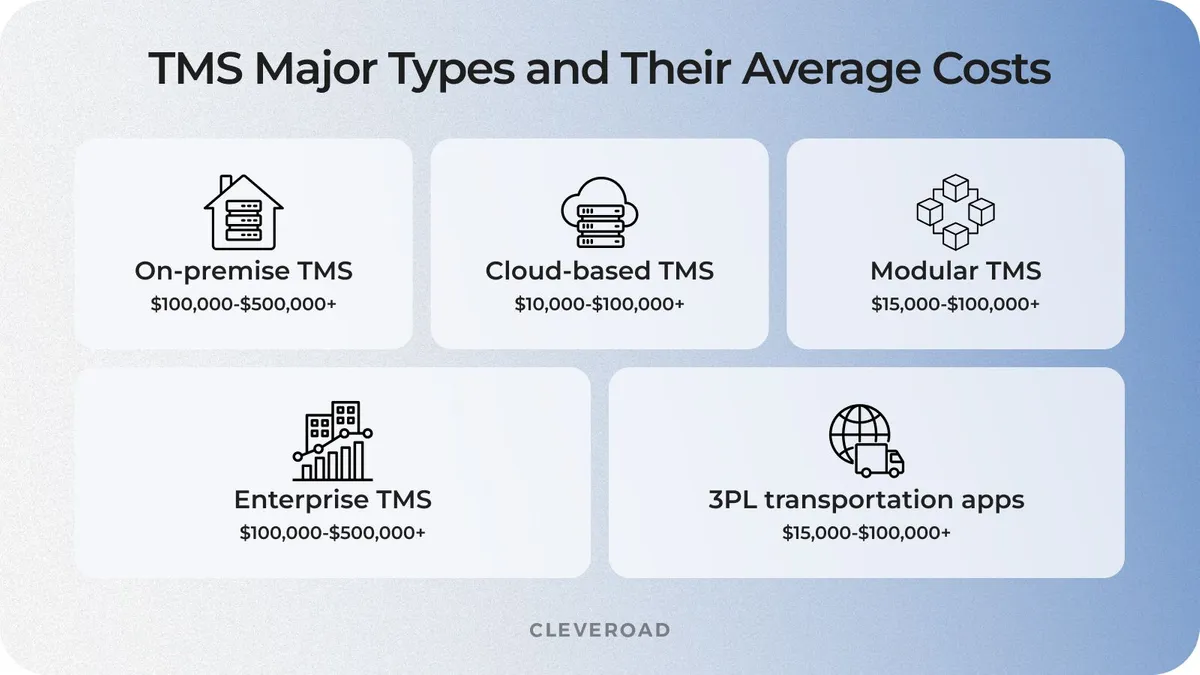
TMS major types and their average development costs
What Are the Must-Have Features For TMS Software Development?
Modern TMS platforms are structured around three core user environments: customers, drivers, and administrators. Each panel supports a specific operational workflow and reduces manual coordination across transportation and logistics processes.
1. Customer panel features
The customer panel is designed for shippers and freight owners who need visibility and control without direct operational involvement. In today’s transportation management systems development, this layer reduces manual coordination and increases process transparency.
Key capabilities of the customer panel include:
- Self-service shipment booking and order submission. Customers create shipments by selecting service parameters and required transportation modes, while validation rules ensure structured and accurate input.
- Real-time tracking with live ETA and map visualization. The client panel displays geolocation data from telematics integrations and provides predictive ETA based on real-time transportation data.
- Access to invoices, contracts, and Proof-of-Delivery (POD). Users access digital documents from automated billing workflows, ensuring traceability across core processes.
- Rate visibility and shipment cost estimation. Dynamic rate calculation logic improves transparency and supports structured carrier management decisions.
- SLA performance dashboards and shipment history. Dashboards aggregate shipment metrics, allowing customers to monitor SLA adherence and historical performance.
A well-designed client panel functionality reduces support workload and increases transparency. Such panels in scalable transportation software development rely on API-first synchronization with backend systems. Within broader custom TMS, an API-driven architecture guarantees real-time consistency between customer interfaces and operational workflows.
2. Driver panel features
The driver panel is typically delivered as a mobile application that connects field operations with dispatch systems in real time. The driver interface in custom transportation management software development is designed to synchronize instantly with dispatch logic and operational dashboards, ensuring continuous data consistency between field activity and backend operations.
Core functionality for a driver panel includes:
- Load assignment and task sequencing. Drivers receive structured job queues with priority logic, reducing manual coordination and helping to streamline logistics execution in the field.
- Integrated navigation and route guidance. Built-in navigation uses optimized routing data across various transportation scenarios, ensuring drivers follow planned routes with minimal deviation.
- ELD integration for Hours-of-Service compliance. Direct ELD connectivity supports automated compliance tracking and ensures adherence to regulatory driving limits within a custom transport management software environment.
- Real-time status updates and geolocation tracking. Live GPS tracking feeds operational dashboards, and the system helps dispatch logistics companies respond quickly to delays or route changes.
- Digital proof of delivery with photo upload. The mobile interface allows instant POD submission, and the software offers secure document synchronization with backend billing workflows.
- Incident and delay reporting. Drivers can submit structured exception reports with media attachments, and the system accelerates issue resolution without dispatcher intervention.
Driver applications reduce manual reporting errors and eliminate constant dispatcher-driver calls. Status updates flow directly into the system, improving tracking accuracy and response speed.
We implemented similar driver-side functionality in the MoveUp transportation solution, where the mobile driver module synchronized trip data, real-time tracking, and status updates directly with dispatcher dashboards. The app included structured task management and in-app communication, reducing manual coordination and improving operational visibility.
Here’s what John Salmon, the founder of MoveUp, said about working with our team:
John Salmon, Founder at Unified Potential, Inc.dba MoveUP. Feedback about cooperation with Cleveroad
3. Admin panel features
The admin panel acts as the operational control center, used by dispatchers, planners, operational managers, and finance experts. It centralizes planning, execution, financial oversight, and integrations within a single interface. At an enterprise level, the admin panel determines whether the TMS functions merely as a monitoring dashboard or as a true margin control system governing profitability.
The admin panel typically includes the following features:
- Manual route optimization and carrier selection, enabling more efficient load planning across various transportation networks
- Real-time dispatch board with SLA monitoring and automated exception alerts
- Freight audit, invoice reconciliation, and margin tracking per shipment
- ERP/WMS integrations, telematics connectivity, payment system synchronization
When properly architected, custom transportation management software turns the admin panel into a transportation control tower. Such development helps unify operational logic with a fleet management system, creating a centralized environment for shipment-level profitability governance, real-time visibility, and scalable operational control.
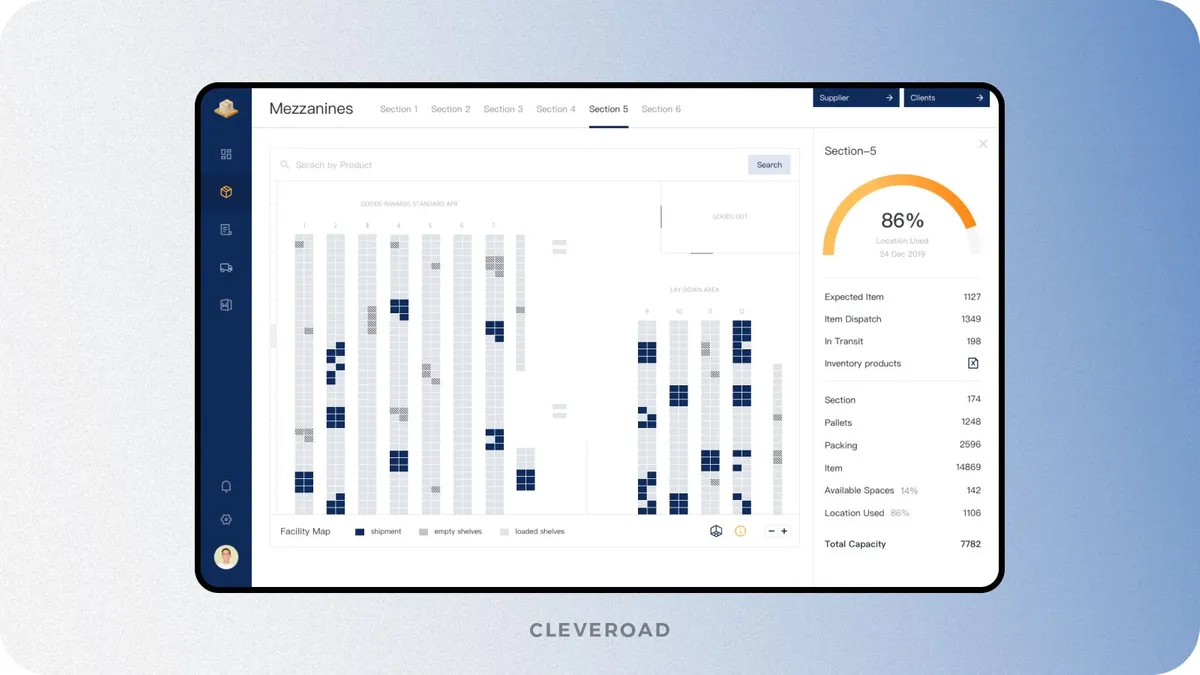
Admin panel for logistics designed by Cleveroad (source: Dribbble)
Transportation Management System Development in 6 Steps
Successful transportation management system development starts with a structured technical roadmap and a logistics-experienced technology partner. Study the provider’s portfolio and confirm their ability to support long-term product growth before starting the project.
Let’s review the fundamental steps for building a TMS system and achieving strong outcomes.
Step 1. Define key requirements
The primary thing to do is to outline what goals you want to achieve by TMS creation and which method you’ll need to use to accomplish this. The following questions will help you achieve this goal:
- What does the TMS that will suit you, your unique needs, and your demands look like?
- What features do you plan to implement?
- How will it impact your business? Will it be necessary to redesign the entire distribution network?
- Will this solution meet the expectations of your target users? etc.
At this stage, it is also critical to identify core user roles, such as brokers, dispatchers, and drivers, and clearly map their daily workflows. Understanding who interacts with the system and how they execute tasks (e.g., load assignment, communication, tracking, reporting) ensures that requirements are grounded in real operational processes rather than abstract feature lists.
Step 2. Pass Discovery and Design stages
After defining key requirements, the next step is a structured Discovery phase. At Cleveroad, Discovery Stage services clarify business goals, refine requirements, and align the future platform with real transportation operations. It also defines system architecture and integrations required for effective transportation management system development, including connections with a warehouse management system and an ERP system. The result is a structured roadmap with a defined scope and realistic delivery estimates, reducing execution risk.
The Design stage then translates workflows into UX prototypes for brokers, dispatchers, drivers, and administrators. The designers create clickable prototypes to validate usability before coding starts, ensuring alignment between operational logic and technical implementation.
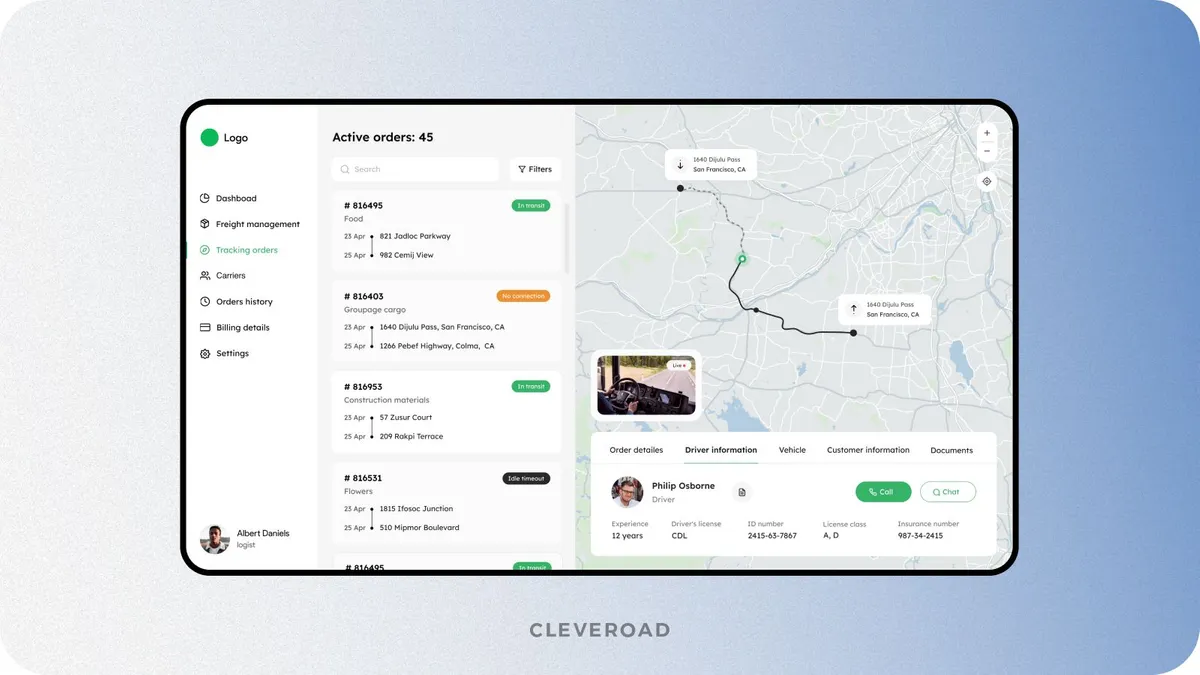
Transportation management system created by Cleveroad
3. Choose a relevant tech stack & develop core modules
At this stage, the logistics software development experts carefully define the technical foundation of your TMS. Selecting the right tech stack is critical because it directly determines scalability, performance under high shipment volumes, and long-term maintenance efficiency for custom transportation management software. The architecture typically includes cloud infrastructure, backend transaction-processing frameworks, database solutions for high-volume transportation data, and secure API layers for secure external integrations.
Here is an example of the tech stack we use for TMS development:
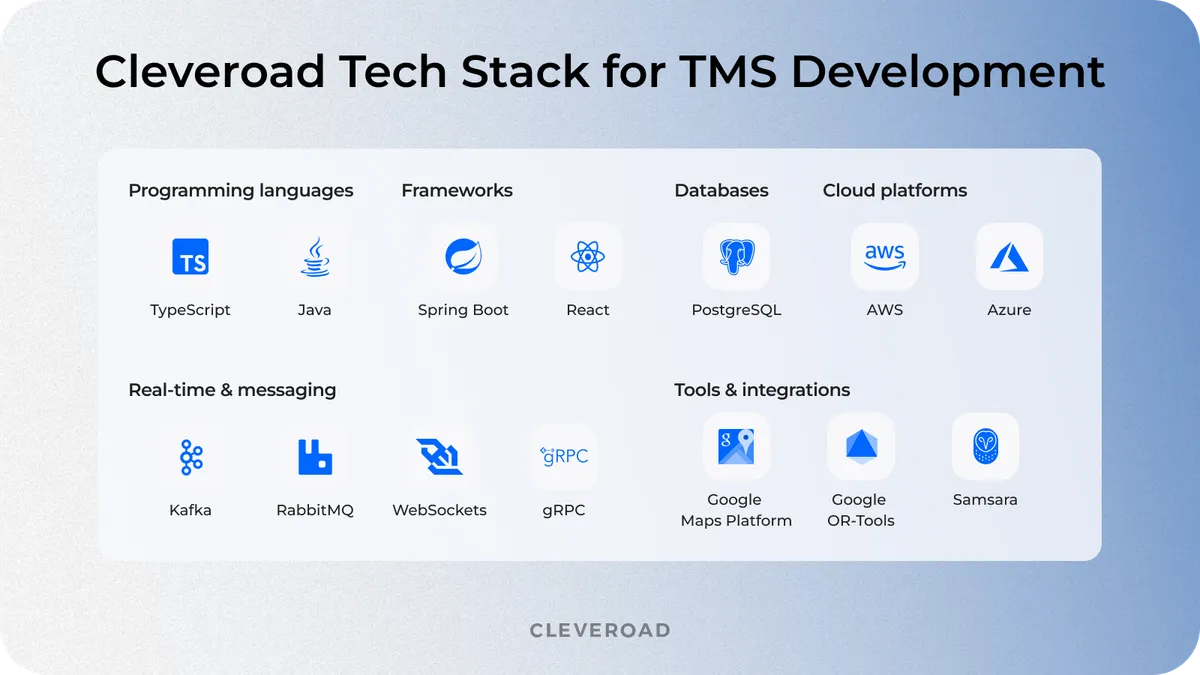
The Cleveroad tech stack for TMS development
Once the stack is approved, the team moves into the core software development project phase, building modules for transportation planning and execution, dispatch management, carrier coordination, tracking, financial control, and analytics. These software solutions components are designed to support real-time visibility and structured transportation planning and execution across the supply chain.
If the initiative replaces a legacy platform, data migration is handled alongside development. Historical shipment data, carrier records, contracts, and financial information are transferred carefully to maintain data integrity and avoid operational disruption.
Step 4. Integrate third-party tools in your TMS
External integrations transform your TMS into a centralized operational hub. Typical integrations for custom transport management software include:
- Telematics providers for real-time vehicle tracking, driver behavior monitoring, fuel usage control, and accurate ETA calculations
- Mapping services for route optimization and geospatial analytics
- Carrier APIs for automated load booking, rate synchronization, and shipment status updates
- Payment gateways for secure freight payments, carrier settlements, invoice processing, and transaction reconciliation
- Accounting platforms for automated freight audit, invoice reconciliation, cost allocation, and financial reporting
- Fleet management systems for asset monitoring, maintenance scheduling, and utilization tracking
- ERP and WMS systems for synchronized order data and end-to-end supply chain coordination
At Cleveroad, we design TMS architectures with a scalability-first approach, ensuring stable performance under peak shipment loads and seamless integration across operational, financial, and fleet ecosystems.
Step 5. Test and deploy your TMS
Before launch, your project should undergo comprehensive functional, integration, performance, and security testing to ensure the custom transportation management system operates reliably under real operational load. This stage of the development process validates workflows, data accuracy, API integrations, and user roles to eliminate critical risks before production release.
If the platform includes modules built during fleet management software development, telematics synchronization, and driver tracking accuracy must be tested in live conditions. Once validated, you can confidently deploy and develop a transportation management environment that supports stable operations from day one.
Step 6. Support and scalability
How to build a TMS system and make it highly adaptable and reliable? An efficient support system is a powerful tool for addressing questions or complexities that arise with TMS software. Also, the ongoing support and maintenance services will include the gradual modernization of the system through the implementation of new functionality, architectural upgrades, and bug fixes.
Last but not least, as the business grows, there is an increasing need to operate larger data volumes and better accommodate growing user demands. Scalability implies designing a TMS software architecture capable of handling larger workloads without sacrificing quality or performance.
How Cleveroad Helped Logistics Businesses Build TMS System
To prove our expertise in Logistics software development, we’d like to present you with our recent case.
Our customer is a US-based warehousing and cargo long-distance delivery company. Their primary goal was to obtain a convenient solution for automated route planning, increase performance efficiency, streamline shipment delivery, and reduce manual labor. Moreover, the new TMS software had to be integrated with existing systems.
We’ve managed to build a customized, flexible, full-fledged solution that facilitated automated route planning with a manual adjusting option. Additionally, our team has created a driver’s app for smooth navigation through custom routes.
Within the transportation management system development, we implemented the following core modules:
- Route planning module. This component helps logistics companies plan the quickest, most convenient route for more efficient deliveries, reduced costs, and increased customer satisfaction.
- Fleet management module. This tool enabled the company to accurately manage its fleets by structuring vehicle groups and modifying them when business process flows changed.
- Delivery points management module. Here, users can track fleets' locations in real time.
- An access system for company staff. It provides access-level management via Role-Based Access Control (RBAC).
- Jobs for delivery module. Each delivery process consists of a sequence of tasks. Jobs for delivery module allows companies to assign, track, optimize, and manage delivery tasks more efficiently.
As a result, the custom transportation management system enabled our client to minimize occasional shipment losses and optimize the delivery time. Also, operating within a single TMS environment, it became possible to cover all requirements for less time, resources, and financial investments, facilitating the gross profit increase.
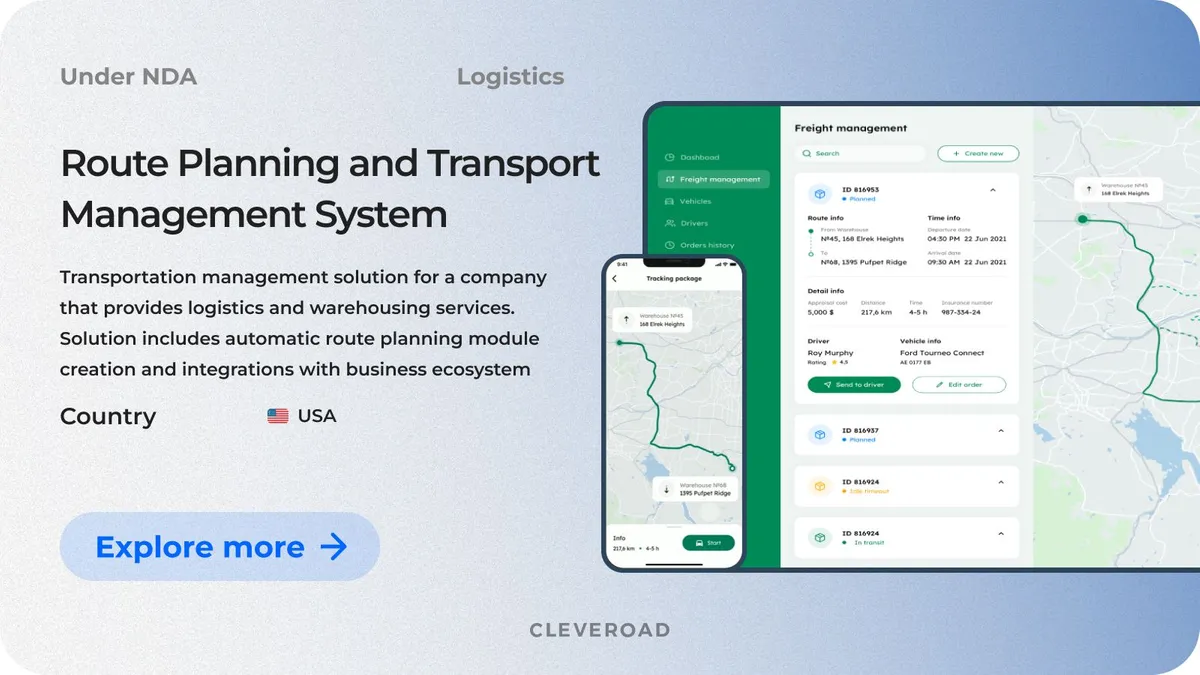
Transportation management system created by Cleveroad
What Are The Benefits of Custom Transport Management System Development?
Transport management system development streamlines and optimizes logistics operations, enhancing efficiency, reducing costs, and improving customer satisfaction.
Sure enough, there are different approaches to transportation management system development. You can rely on a pre-made application or go with a custom one. However, ready-made options may lack customization and require additional financial investment in the future. Unlike customized solutions, they seem more expensive but offer significant benefits for transportation organizations.
Now, we’ll talk more about the major advantages of TMS implementation in your business.
Cost savings in the long run
Developing a custom TMS through transportation management app development enables you to invest only in the functionality your company operations truly require, avoiding unnecessary features and hidden licensing or upgrade fees common in off-the-shelf solutions.
A custom-built architecture supports logistics and supply chain management by aligning system capabilities with real operational workflows. That’s why TMS development helps your logistics experts improve efficiency, ensure long-term cost predictability, and increase ROI by reducing overall service delivery expenses.
Tailored to specific needs
A custom transportation management system is designed around your specific operational needs, integrating seamlessly into existing workflows where standard solutions fall short. It improves transportation planning, scalability, as well as user experience while reducing errors and unnecessary reinvestment. With optional mobile capabilities, a tailored TMS supports flexible logistics management and long-term growth.
How to benefit from transportation app development? Read our article and know more!
Robust security
The integration of a custom transportation management system with an advanced transportation telematics system enables tailored security measures to address your business’s unique requirements and vulnerabilities. While the readymade option can only offer a set of standard measures, going custom means all security protocols are designed to provide full-scale protection, avoiding data breaches, cyberattacks, and other potential threats.
Smooth integration with existing systems
Integrating a bespoke TMS after transportation management application development with the logistics systems like WMS or ERP reduces the need for double data entry by automatically filling the necessary fields in other systems.
It can also help logistic enterprises like yours simplify data exchange and maintain superior data accuracy due to real-time updates. Moreover, the reduction of manual labor also facilitates the decrease of human errors, positively impacting efficiency.
Adaptation to the regulatory landscape
Going custom allows your logistics business to be more precise in terms of compliance with necessary regulations. Generally, well-tailored TMS software facilitates the automated compliance process, systematically checking if everything is up to new changes.
Also, when your company uses a transportation management system, you receive real-time alerts and notifications if a shipment compliance status changes or new regulatory requirements affect your operations.
We’ve got 15+ years of experience in rendering custom logistics software development services – click and discover more about it!
How Much Does It Cost to Build a Transportation Management System in 2026?
The cost of custom transportation management software ranges from $15,000 for a simple solution to $500,000+ for a complex system with advanced functionality. But that’s a pretty big range, right? The fact is that it’s difficult to calculate the software cost precisely, as the final price varies due to the following cost-forming aspects:
| Cost factor | What increases budget | Approximate budget impact |
|---|---|---|
Scope of features | AI routing, predictive analytics, multi-tenant logic, complex reporting, automation layers, advanced dashboards | $40,000 – $200,000+ |
Integrations | ERP, WMS, telematics, carrier APIs, payment systems, third-party connectors, legacy synchronization | $20,000 – $120,000+ |
Architecture complexity | High-load processing, microservices, real-time streaming, distributed databases, event-driven pipelines | $50,000 – $150,000+ |
Team composition | Solution architect, BA, DevOps, data engineer, QA specialists, UI designers | $30,000 – $100,000+ |
UI/UX customization | Role-based dashboards, custom workflows, interactive analytics, user permissions | $15,000 – $60,000+ |
Data migration (if required) | Legacy data cleanup and transfer, schema mapping, validation procedures | $10,000 – $50,000+ |
These factors collectively determine the total cost of TMS development, making it essential to plan and prioritize features that align with business goals and budget.
To simplify calculating TMS costs, we’ve analyzed software development rates across the most popular outsourcing destinations. Here, you can examine the rates of the most demanded destinations, including the Central and Northern Europe region:
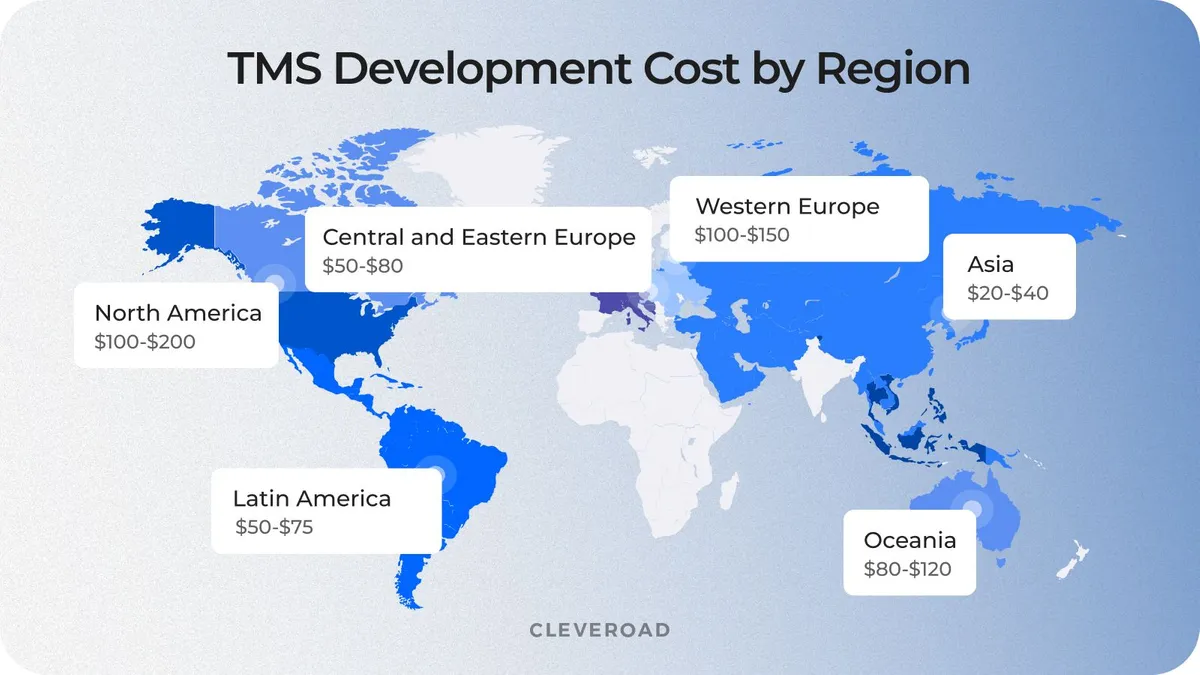
TMS Development Cost by Region
As shown, the numbers vary significantly. When considering TMS software development, the Central and Northern Europe region offers undeniable advantages, with a strong pool of highly skilled professionals and competitive rates compared to other markets. Estonia, in particular, stands out due to its robust tech ecosystem, high level of English proficiency, and focus on digital innovation.
By choosing developers in Central and Northern Europe region, you gain access to a talented workforce with expertise in logistics and transportation software, making it an ideal destination for quality-driven, cost-effective solutions. Contact us today for a customized estimate to see how we can bring your TMS vision to life.
Why Select Cleveroad for Transportation Management System Development
Cleveroad is a professional logistics software development company based in Estonia, Central and Northern Europe. Since 2011, our experts have been assisting startups and organizations of all kinds in acquiring cutting-edge software that helps with supply chain optimization.
Our experts focus on providing a wide range of logistics software development services, from custom app development and UI/UX design to legacy system modernization and third-party integrations. Our digital solutions for the logistics domain improve workflow efficiency, address business issues, and help acquire a competitive advantage.
So, what can you directly achieve, and how can you benefit while collaborating with us?
- With years of hands-on experience in the logistics sector, our team brings deep expertise in developing solutions tailored specifically for the transportation industry: fleet management software, supply chain management systems, transport management software, warehouse management applications, etc.
- We are a trustworthy logistics technology partner with certifications in both ISO 9001:2015 for quality management and ISO/IEC 27001:2013 for security of information
- 280+ in-house domain engineers ensuring constant cooperation throughout your project and removing the need for expert replacements and ensuring smooth project continuity
- Signing a Non-Disclosure Agreement (NDA) by your request to protect the uniqueness of your modern transportation management system
- Free Solution Workshop to link your business requirements for advanced TMS software to our tech implementation
Build a reliable TMS with skilled vendor
Our software engineering team with 15+ years of experience in logistics software creation is ready to help you design and deliver custom TMS solutions aligned with your operational workflows
A transport management system (TMS) is a digital platform used to plan, execute, and monitor the entire transportation process within logistics operations. It centralizes order management, carrier coordination, route planning, and real-time tracking to optimize transportation efficiency and cost control. Companies often implement custom TMS software to align workflows, integrations, and reporting with their specific operational model.
There are the following steps to pass for a successful TMS building:
- Define business goals, map user workflows, and complete structured Discovery and UX design to align the transportation management system software with real transportation operations.
- Build scalable core modules and connect external systems through secure application programming interfaces, ensuring seamless integration with ERP, WMS, telematics, and financial platforms.
- Perform comprehensive testing, deploy the solution, and provide ongoing support to streamline and optimize transportation while maintaining scalability and performance.
The cost to develop a TMS typically ranges from $15,000 for a basic solution to $500,000+ for an advanced platform, depending on architecture complexity, integrations, and feature scope. The final budget varies because the software development process must account for AI-driven optimization, ERP and WMS integrations, and scalable infrastructure that supports constantly changing transportation demands.
Ultimately, the investment reflects the level of automation, visibility, and control the TMS software offers throughout the transportation lifecycle, from planning and execution to financial reconciliation.
To optimize TMS development cost, start by defining a clear MVP scope aligned with your operational priorities, since transportation management system development usually becomes expensive when feature creep and undefined integrations expand the architecture. Build a strong case for custom transportation solutions only where they deliver measurable value, and rely on modular logistics management software components to avoid unnecessary complexity in your transportation and supply chain ecosystem.
Finally, treat the platform as a strategic role in transportation management rather than just a tracking tool, and approach it as targeted custom software development aimed at achieving the best transportation management outcomes with controlled long-term investment.

Evgeniy Altynpara is a CTO and member of the Forbes Councils’ community of tech professionals. He is an expert in software development and technological entrepreneurship and has 10+years of experience in digital transformation consulting in Healthcare, FinTech, Supply Chain and Logistics
Give us your impressions about this article
Give us your impressions about this article