

Ship your product 2.5x faster.Explore AI-assisted development

Our Insurance Claims Management Software Development Services

We deliver claims software services aligning platform architecture and capabilities with your operating model

Custom claims software development

We build claims platforms around your operating model, giving clients faster case handling and clearer control over decisions throughout the entire process

Claims system integration services

Connected claims systems reduce data gaps between platforms, helping adjusters work with current information and move cases forward faster

Legacy software modernization

We modernize legacy claims software around current business and technical requirements, preserving active operations while improving maintainability and future scalability

AI integration for claims management

AI integration strengthens claims review and decision consistency, helping adjusters process cases faster while keeping automated outcomes traceable and controlled

Insurance Claims Management Software Modules We Build

We build configurable claims modules that support every processing stage, from first notice through settlement and post-claim oversight

Claims intake and FNOL capture


  • Omnichannel FNOL submission

    Policyholders and agents report losses through guided, policy-aware forms, creating complete claim records from the first interaction

  • Policy data prefill

    Connected policy systems prefill insured details and coverage data, which cuts manual entry before claim registration and assignment

  • Loss detail validation

    Configurable rules verify required fields, incident dates, location data, and policy status before the claim enters downstream workflows

  • Automatic case creation

    Validated submissions become structured claim cases and move directly to the appropriate handling queue without manual setup

Claims adjudication and workflow automation


  • Rules-based adjudication

    Coverage rules compare claim facts with policy terms and flag exceptions for adjuster review before making a decision on approval or denial

  • Dynamic task routing

    Configurable workflows assign cases by claim type, complexity, location, adjuster capacity, and service-level targets for balanced workloads

  • Decision support rules

    Embedded checklists present required evidence and next actions at each stage, helping handlers apply consistent claim decisions

  • Escalation management

    Timers detect overdue tasks and route priority cases to supervisors before service commitments or regulatory deadlines are missed

Document and case management


  • Central claim workspace

    Handlers work from a unified claim record that centralizes case information and applies role-based access throughout the review process

  • Document classification

    Automated classification tags incoming files by document type and claim stage, then files them in the correct case folder without manual sorting

  • Version and audit history

    Every edit records the user, timestamp, previous value, and reason, supporting transparent case review and faster dispute handling across teams

  • Secure correspondence tracking

    All claim-related communications stay linked to the case, giving reviewers a complete and traceable interaction history from first contact to resolution

Financial management and payouts


  • Reserve management

    Reserve management keeps financial exposure current throughout each claim, supporting controlled adjustments and accurate forecasting by coverage line

  • Payment calculation rules

    Configurable logic calculates deductibles, limits, depreciation, taxes, and approved settlement amounts in accordance with policy terms

  • Payout approval workflows

    Multi-level approvals verify payment amounts and recipient details before funds move through connected banking or payment systems

  • Recovery and subrogation

    Financial workflows track recoveries, salvage proceeds, reimbursements, and subrogation balances against the original claim exposure

Fraud detection and risk scoring


  • Real-time risk scoring

    Risk engines score new claims against historical and real-time indicators, helping investigators identify suspicious cases earlier and prioritize their workload

  • Suspicious pattern detection

    Models and configurable rules flag duplicate submissions, unusual timing, inflated estimates, and linked claimant behavior for review

  • Investigation case routing

    High-risk claims move to specialist queues with sufficient case context to support faster investigation and more consistent assessment across complex cases

  • Investigation outcome feedback

    Confirmed outcomes return to scoring models and rules, so future detection improves without replacing investigator judgment or documented review

Analytics and reporting dashboards


  • Operational claims dashboards

    Dashboards give managers a clear view of claims performance, helping them identify delays and monitor settlement progress across business units

  • Loss and reserve trends

    Trend views compare incurred losses, paid amounts, reserve movements, and recovery values over configurable periods for financial oversight

  • Performance benchmark views

    Managers compare handlers, claim types, service levels, and resolution outcomes using consistent metrics and configurable reporting filters

  • Regulatory report generation

    Scheduled reports organize required regulatory data into submission-ready formats while preserving traceability to the original claim records

Self-service portals for policyholders and agents


  • Digital claim submission

    Policyholders and agents submit claims, upload evidence, review entered details, and receive confirmation without contacting a service desk

  • Claim status tracking

    A secure role-based dashboard keeps users informed about claim progress and the next required step throughout the entire process lifecycle

  • Secure document exchange

    Portal users upload requested files and receive settlement documents through encrypted channels linked directly to the active claim

  • Agent portfolio visibility

    Agents track claim activity across managed policies from one view, helping them respond before service commitments or renewal deadlines are missed

Key Benefits of Insurance Claims Management Software

Claims software earns its cost in four places: cycle time, leakage, decision quality, and the service policyholders feel

Faster claims cycle time

Straight-through processing clears simple claims automatically, while rules route complex cases to the right adjuster. Manual queue handoffs disappear

Higher decision accuracy

One claim record keeps policy terms, prior claims, evidence, and correspondence together, so adjusters work from the same facts. Disputed cases reopen with a full audit trail

Lower administrative and leakage costs

Claims leakage reaches 6% of payments. Configurable checks catch overpayments and duplicate claims before settlement, protecting margins manual review misses

Better policyholder experience

Nearly 20% of customers use multiple channels to ask one question, reducing satisfaction by over 100 points. Clear portal updates keep communication in one place
Share your claims software requirements and receive a tailored project estimate based on your processing model and delivery priorities
Price your insurance claims software

Insurance Claims Software We've Delivered

See how our insurance software team rebuilt a US auto insurer's legacy claims and policy system into connected web and mobile products

Online Services Ecosystem for Managing Auto Insurance
Under NDA

USA

Insurance

Challenges solved during the creation of auto insurance platform:

  • Replacing a legacy system that blocked scaling, rebuilt as React and .NET web, plus a Flutter app on AWS
  • Adding KYC identity checks through ID Analyzer and Adobe Sign e-signatures before claimants reach protected policy workflows
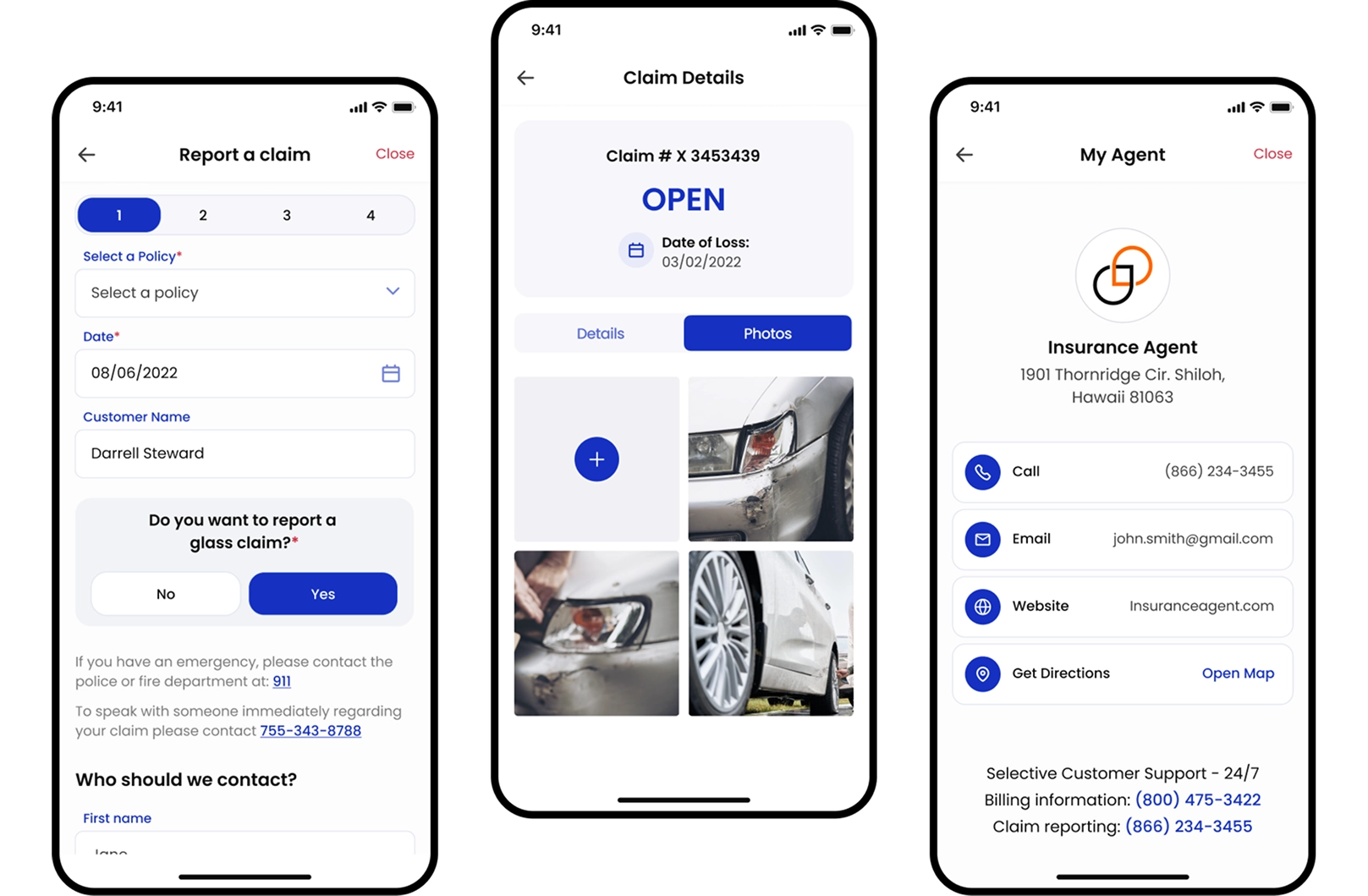
  • Wiring claims reporting to map-based incident capture and syncing customer data with the insurer's existing CRM

Learn about Cleveroad’s expertise in Projects Portfolio

in Projects Portfolio

Show more

Our Clients Say About Us

Client photo...
DK flagDenmark
FinTech

CTPO of Penneo A/S

"Cleveroad proved to be a reliable partner in helping augment our internal team with skilled technical specialists in cloud infrastructure."

AI Capabilities for Advanced Insurance Claims Management

AI strengthens claims operations with earlier risk signals and better-supported decisions from intake through settlement

Fraud detection and anomaly screening

AI models compare claim data with known fraud patterns to flag suspicious cases for review
  • Cross-claim pattern matching across connected policy records

  • Duplicate submission and identity mismatch detection

  • Risk scores with transparent review reason codes

Automated damage assessment

Computer vision extracts damage evidence and speeds estimate validation
  • Vehicle damage recognition from uploaded photos

  • Document data extraction for repair estimate checks

  • Human review thresholds for uncertain assessments

Claims triage and segmentation

AI classifies claims by complexity and urgency before routing them to suitable workflows
  • Severity scoring based on claim context

  • Automatic routing by workload and expertise

  • Priority queues for time-sensitive or high-value cases

Intelligent assistants for adjusters

Claims assistants surface case context and guide adjusters through policy-aware review steps
  • Policy clause retrieval during case review

  • Suggested next actions with supporting evidence

  • Claim summaries generated from case records

Predictive analytics and forecasting

Predictive models forecast claim volumes and financial exposure using portfolio data
  • Claim volume forecasts by product line

  • Reserve projections based on portfolio patterns

  • Processing demand estimates for workload planning

Conversational AI for claimant self-service

Virtual assistants handle first notice of loss and status questions in plain language
  • Guided first notice of loss intake through chat

  • Real-time claim status answers in natural language

  • Automatic escalation to a human for complex cases

Book a call with our AI engineers to define how AI can improve your insurance claims processing within your existing operating model
Discuss AI for claims management

Choose Delivery Model that Fits Your Project

We offer flexible engagement options from a classic human team to AI-native squad. Pick the model that matches your scope and budget

Traditional team

Iterative

The dependable, human-led baseline suited to any kind of project.

Base

Development budget

Team composition

  • Project Manager
  • Business Analyst
  • UI/UX Designer
  • QA Engineer
  • Backend Engineer
  • Solution Architect
  • Frontend Engineer
  • DevOps Engineer

Iterative delivery

Spec evolves during delivery

Write a sprint scope, deliver it, try it, then revise the spec or functionality.

Best for

Flexible-scope projects where each iteration reshapes the plan as you go

AI-assisted team

Iterative + AI

Your familiar full-stack squad, accelerated with AI support in every role.

30% less

Development budget

Team composition

  • Project Manager
  • Business Analyst
  • UI/UX Designer
  • QA Engineer
  • Backend Engineer
  • Solution Architect
  • Frontend Engineer
  • DevOps Engineer
+

Iterative delivery

Spec evolves during delivery

The same write-deliver-review sprint repeats, just accelerated with AI.

Best for

Brownfield projects that need fast iteration without locking scope too early

AI-native team

Spec-first

A minimal lean team with maximum AI leverage and strict human oversight.

50% less

Development budget

Team composition

AI Solution Architect. Owns the approved spec and the architecture the build follows

Prompt Engineer. Turns the spec into precise prompts and guardrails for AI code generation

AI Product Owner. Owns milestones and acceptance against the fixed spec

+

Milestone delivery

Spec locked before delivery

Approve once upfront. The spec becomes the source of truth for milestones.

Best for

MVPs and greenfield projects with fixed scope and milestone-driven delivery

Tech Stack We Use for Claims Software

Cleveroad engineers map each technology choice to your claims workflows, connected insurance systems, security model, and expected transaction load

Core claims platforms

Guidewire ClaimCenter

Duck Creek Claims

Majesco Claims

Sapiens IDITSuite

Snapsheet Claims

Customer relationship systems

Salesforce

Microsoft Dynamics 365

HubSpot

Zendesk

Document and e-signature services

DocuSign

Adobe Acrobat Sign

Box

Microsoft SharePoint

Dropbox Sign

Payment and payout services

One Inc

Paymentus

Stripe

Adyen

PayPal

Identity verification and KYC

Jumio

Trulioo

Socure

Persona

Fraud and risk intelligence

TransUnion

LexisNexis Risk Solutions

FRISS

Shift Technology

Front-end

React.js

Angular

Vue.js

Next.js

TypeScript

Back-end

Node.js

NestJS

.NET Core

Java

Python

Databases

PostgreSQL

MySQL

MongoDB

Redis

Elasticsearch

iOS

Swift

SwiftUI

Android

Kotlin

Java

Cross-platform

Flutter

React Native

Machine learning frameworks

TensorFlow

PyTorch

Scikit-learn

XGBoost

Computer vision

OpenCV

AWS Rekognition

Google Cloud Vision

Azure AI Vision

Generative AI and LLM APIs

OpenAI API

Azure OpenAI Service

Anthropic API

Natural language processing

spaCy

Hugging Face Transformers

Amazon Comprehend

Azure AI Language

MLOps and model management

MLflow

Kubeflow

Vertex AI

Azure Machine Learning

Amazon SageMaker

Cloud platforms

AWS

Microsoft Azure

Google Cloud

Containers and orchestration

Docker

Kubernetes

CI/CD

GitHub Actions

GitLab CI/CD

Jenkins

Azure DevOps

Monitoring and observability

Prometheus

Grafana

Sentry

Datadog

OpenTelemetry

Certifications

We keep deepening our expertise to meet your highest expectations and build business innovative products

ISO 27001

ISO 27001

Information Security Management System

ISO 9001

ISO 9001

Quality Management Systems

AWS

AWS

Select Partner Tier

AWS

AWS

Solutions Architect, Associate

Scrum Alliance

Scrum Alliance

Advanced Certified Scrum Product Owner

AWS

AWS

SysOps Administrator, Associate

Our Expertise with Insurance Regulations

Cleveroad maps each build to the security and insurance regulations of your target markets, so audits start from documented controls

Security regulations

  • NIST CSF 2.0flag
  • SOC 2 Type IIflag
  • PCI DSSflag
  • ISO/IEC 27001flag

Privacy and data protection

  • GDPRflag
  • GLBA Privacy Ruleflag
  • CCPA / CPRAflag
  • PIPEDAflag

Insurance and financial compliance

  • NAIC Model Lawflag
  • IDDflag
  • Solvency IIflag
  • IFRS 17flag

Healthcare claims standards

  • HIPAAflag
  • ASC X12N 276 / 277flag
  • ASC X12N 837flag
  • ICD-10flag
  • ASC X12N 835flag
  • CPT / HCPCSflag

Industry Contribution Awards

Leading rating & review platforms rank Cleveroad among top software development companies due to our tech assistance in clients' digital transformation.

70 clutch reviews

4.9

Award

Award

Clutch 1000 Service Providers, 2024 Global

Award

Award

Clutch Spring Award, 2025 Global

Ranking

Ranking

Top AI Company,
2025 Award

Ranking

Ranking

Top Software Developers, 2025 Award

Ranking

Ranking

Top Web Developers, 2025 Award

Ranking

Ranking

Top Staff Augmentation Company in USA, 2025 Award

Validate your claims software compliance plan
Review your insurance claims software concept with our specialists and define the regulatory path for your chosen market

Why Choose Cleveroad as Your InsurTech Partner

We combine insurance delivery experience with compliance-led engineering to build claims platforms that fit regulated operations and connected ecosystems

member

Oleksandr Riabushko

Engagement Director

  • Proven insurance delivery record

    Since 2011, Cleveroad has shipped 200+ products. One is a US auto insurer's claims and policy platform, with KYC through ID Analyzer and CRM sync built on a React, .NET, Flutter, and AWS stack. Your project starts from patterns run in production.

  • Compliance built in from discovery

    Our insurance app development team runs ISO 9001 and ISO 27001-certified processes, with data protection and audit trails designed into the architecture from discovery. GDPR and US state privacy rules shape decisions early, shortening your vendor risk review.

  • One team from discovery to support

    A 280-engineer in-house team covers discovery, delivery, QA, and support under one contract, so you keep technical ownership as claim volumes and integrations grow. A free Solution Workshop turns requirements into a phased plan with cost assumptions before you commit.

  • Expertise integrating complex insurance ecosystems

    Our engineers connect claims platforms to core systems like Guidewire and Duck Creek, and to identity, e-signature, payment, and CRM providers, so data stays current across web and mobile. The auto insurance build proved it with live CRM and ID Analyzer integrations.

Questions You May Have
Clear answers about claims software scope, value, timelines, and cost
What is insurance claims management software?
Insurance claims management software is a digital management platform for coordinating claim activity in one connected system. It centralizes claim information so authorized users can review current case context without switching between disconnected tools. Insurers use it to handle claims consistently from first notice through settlement. The software offers configurable workflows and traceable records that support controlled decisions across daily operations.
How long does it take to build a claims management system?
A focused first release usually takes four to six months, while a large enterprise system may require nine to eighteen months. The schedule depends on scope, integration depth, migration volume, compliance requirements, and approval logic. Cleveroad confirms the timeline after discovery and solution planning.
What are the benefits of insurance claims management software?
The main benefits affect speed, cost control, decision quality, and service visibility:
  • Faster claims handling moves straightforward cases forward with fewer manual handoffs.
  • Automated controls reduce claim leakage by flagging inconsistencies before payment.
  • Shared workflows support efficient claims decisions across adjusters and supervisors.
  • Centralized document management keeps evidence accessible throughout review and settlement.
How much does insurance claims management software cost?
Costs vary with scope, architecture, integration complexity, data migration, and compliance requirements. A focused first release costs less than an enterprise system supporting the entire claims lifecycle across multiple business units.

The final estimate also reflects the delivery model and post-launch support. Cleveroad defines the budget after a solution workshop, where requirements become a phased plan with clear cost assumptions.

Latest Insights

Start growing your business with us
By sending this form I confirm that I have read and accept the Privacy Policy