Generative AI in FinTech: Use Cases, Implementation Pipeline, and Useful Tips
07 Oct 2026
16 Min
125 Views
Generative AI in FinTech is already taking over document processing, audits, customer support, and the paperwork that eats into financial advisors’ days. Yet finance is the domain where a model error costs more than anywhere else, because a confident but wrong output can end up in a client’s credit decision or in a report a regulator reads.
For 15+ years, we at Cleveroad have been building FinTech software for banks, payment providers, lending platforms, and wealth apps. Today, our team also runs generative AI features in production for these financial clients.
Key takeaways
- GenAI works best where teams lose time, not control: document-heavy workflows, support, advisor assistance, and pattern detection offer the value.
- High-stakes decisions still need human oversight: AI can recommend or flag actions, but transactions and compliance decisions should remain controlled.
- A narrow first use case beats a broad AI rollout: starting with one measurable problem makes it easier to prove value, manage risk, and scale what works.
- Compliance depends on the use case, not AI alone: the more directly a system affects customers or regulated decisions, the stronger its governance has to be.
How Does Generative AI in FinTech Work?
Generative AI in FinTech uses advanced machine learning models, mainly large language models (LLMs), to understand, generate, and analyze human-like text from massive financial datasets. In simple terms, it “reads” and “writes” financial information automatically.
In practice, FinTech Gen AI can instantly generate reports, summarize customer interactions, draft compliance documents, and even answer client questions like a seasoned advisor. Its output is language, and that sets it apart from classic machine learning in FinTech: generative models produce text and documents, while classic ML models calculate probabilities and scores.
In a typical product, the two work together. A scoring model flags a risky loan application, and the generative layer drafts the explanation your underwriter reads, grounded in your own data such as past transactions and loan histories.
FinTech gen AI statistics
Gen AI capabilities are already moving from pilots into real products. Generative AI now runs across internal operations and customer-facing services, and more FinTech companies adopt it to automate workflows and improve their financial offerings. Here are the numbers that show how fast this is happening:
- In a 2024 report, PYMNTS notes that Visa's implementation of generative AI in its fraud detection systems has reduced false positives by 85%, significantly improving the accuracy of identifying fraudulent transactions.
- Grand View Research estimates the global generative AI in financial services market at $4.0 billion in 2026 and projects it to reach $15.4 billion by 2033, at a compound annual growth rate (CAGR) of 30.3%.
- Treat any single figure with care, because estimates vary widely. For 2026, forecasts for generative AI in financial services range from about $2.5 billion (Research and Markets) to $4.0 billion.
- Reports that cover AI in FinTech as a whole put the same year at $23–37 billion (The Business Research Company, Mordor Intelligence). The two categories measure different markets, so a figure from one cannot stand in for the other.
- In a 2024 survey of 118 UK financial firms, the Bank of England and the Financial Conduct Authority (FCA) found that 75% of firms already use AI and another 10% plan to adopt it within three years. Foundation models, the model class behind generative AI, already account for 17% of all reported AI use cases.
Our generative AI development services help integrate the right AI capabilities into your product and workflows
Generative AI Use Cases in FinTech
To help you start building a generative AI model for FinTech, here are some use cases with examples from real-world companies and enterprises. For better navigation, we prepared a breakdown by 3 main AI use case categories:
- Personalized customer journeys
- Financial teams & advisor workflow optimization
- Back-office and document workflows
The table below compares six use cases across four dimensions: the use case itself, what the model generates, a real-world example, and the guardrail it requires in production. After the table, we walk through the same six examples grouped into the three categories above.
Where generative AI fits in a FinTech product, and what has to sit around it
| Use case | What the model generates |
|---|---|
Portfolio recommendations | Plain-language strategy explanations tied to goals and risk profile |
Customer-facing assistants | Answers to account and product questions in natural language |
Advisor copilots | Meeting summaries, research digests, draft client communications |
Internal search and drafting | Answers assembled across Slack, wikis, repos, and drives |
Document processing | Structured fields extracted from unstructured statements and contracts |
Fraud pattern analysis | Descriptions of anomalous behavior and case summaries |
Personalized customer journeys
Finance is personal. Whether someone is applying for a loan, managing their savings, or seeking investment advice, they expect clarity, intuitiveness, trust, and personalized support. Let’s explore how Gen AI in FinTech helps you connect with customers and deliver human-centered experiences.
- AI-managed portfolios
Wealthfront, a prominent robo-advisory platform, builds portfolios around each client's financial goals, risk tolerance, and market conditions. In this setup, the investment engine handles allocation, and generative AI adds value by explaining each recommendation in plain language.
If you want to improve your own wealth app with AI or build it from scratch, Cleveroad, as a wealth management app development company, is here to help!
- Around-the-clock AI chatbots
Bank of America's virtual assistant, Erica, uses natural language processing (NLP) to handle customer inquiries 24/7. It handles a wide range of banking needs, from transaction questions to financial advice, improving customer service efficiency and satisfaction.
We provide NLP development services to create intelligent systems that analyze language, identify intent, and structure unstructured text.
Financial teams & advisor workflow optimization
It’s just as important to support your financial teams and advisors as it is to serve your clients. The right tools help reduce burnout and boost performance across the team. A study published by ACM, Digital finance generative AI, reviews where financial services already apply generative models, and internal team support is a practical place to start.
- AI copilots for advisors & agents
Morgan Stanley introduced AI-powered assistants like Debrief, which process vast amounts of financial data and market trends. These tools provide real-time insights and recommendations, helping advisors make data-driven investment decisions efficiently.
- AI-powered email and report drafting tools
Super.com, a travel-FinTech platform, has integrated AI-powered tools to speed up internal reporting and knowledge sharing. By partnering with AI startup Glean, Super.com implemented an enterprise search tool that centralizes information from platforms like Slack, Confluence, GitLab, and Google Drive. This integration has saved employees over 1,500 hours monthly and reduced onboarding time by 20%. The AI tools assist in task prioritization and email drafting, significantly improving productivity and efficiency.
The same drafting capability works for customer-facing content too: Cleveroad can help you implement genAI for media creation so your internal staff produce that content faster.
Back-office and document workflows
When workflows are scattered and manual processes pile up, you get slower service and frustration on both sides, for you and your customer. Here’s how leading financial institutions use generative AI to take document-heavy work off their teams and serve clients faster.
- Intelligent Document Processing (IDP)
Canoe Intelligence reports that it employs Generative AI to process over 5 million documents, extracting data with 99.9% accuracy. This automation reduces operational costs and accelerates investment decision-making for its clients.
Among the most impactful intelligent document processing use cases in FinTech are document checks for loan applications, identity verification, compliance checks, and statement reconciliation. In each of them, the model extracts and structures the data, and a person or a rules engine makes the final decision, so you cut manual review without handing approvals to the model.
- Fraud detection with GenAI pattern recognition
PayPal integrates Generative AI into its fraud detection algorithms to analyze behavioral patterns and discrepancies in user actions. This approach improves fraud identification and prevention, helping ensure secure transactions.
Steps to Implement FinTech Gen AI
As a software development company with deep experience in FinTech software delivery and generative AI technology, we’d like to outline Cleveroad’s approach for Gen AI FinTech development and implementation to help you better understand what awaits you at each step.
Step 1. Find a credible Gen AI FinTech vendor
Before jumping into the tech, the first step is choosing a partner who understands financial services at its core, not just how to code. You need a team experienced in banking, payments, and lending, and familiar with the compliance-heavy environment that comes with it, including the Payment Card Industry Data Security Standard (PCI DSS), SOC 2, the General Data Protection Regulation (GDPR), and anti-money laundering (AML) rules. Review their portfolio, ask for measurable outcomes from previous projects, and verify that they’ve built scalable Gen AI products in the FinTech space.
At Cleveroad, we help digital banks, FinTech startups, and financial service providers launch innovative products and optimize operations. We develop AI-powered, blockchain-based, and regulation-compliant FinTech solutions that are secure, scalable, and built for fast market delivery.
Recently, we delivered a FinTech application for one of our clients – Mangopay – a modular and programmable payment solution designed for marketplaces and platforms. It offers built-in features for know your customer (KYC) and AML compliance, split payments, digital wallets, and escrow services. Our team helped tailor and integrate Mangopay into a complex FinTech ecosystem, ensuring regulatory alignment and a faster go-to-market path.
Here’s what Kirk Donohoe, CPO at Mangopay, says about collaboration with us:
Kirk Donohoe, CPO at Mangopay — feedback about Cleveroad’s FinTech software development services
Step 2. Go through AI design stage
Once the partnership is in place, our next move is to run an AI design sprint. Here, our team collaborates closely with you to define what you want to achieve by adopting FinTech gen AI. It may be cutting fraud losses, improving underwriting, automating customer support, or anything else you might have in mind. We map out existing workflows, identify the opportunities for automation or intelligence, and make sure your data is structured and accessible enough to support a Gen AI solution.
The outcome is a practical roadmap with your FinTech use cases prioritized by impact and feasibility. The same sprint format works in adjacent financial domains too, as our breakdown of gen AI use cases in the insurance industry shows.
Step 3. Start from FinTech GenAI Proof-of-Concept (PoC)
With the goals set, we develop a lean AI Proof of Concept (PoC) focused on one high-value use case, such as real-time fraud alerts or hyper-personalized investment recommendations. The PoC is designed to test real-world business value, not just technical performance.
We use your infrastructure preferences (cloud, on-premises, hybrid), real or synthetic data, and feedback loops to evaluate how the Gen AI model fits your operations. We also estimate the AI development cost to help you plan your investment effectively. This step helps you avoid overbuilding and instead invest only in solutions that are proven to work.
Step 4. Develop and deploy FinTech GenAI
If the PoC delivers solid results, it’s time to scale. We expand the solution to support full production use, focusing on data privacy, model accuracy, and security. Apart from this, we facilitate deep integration with your current stack, whether it’s customer relationship management (CRM) systems, payment systems, core banking platforms, or risk engines. We follow a secure and transparent software development life cycle with Agile principles, enabling iterative improvements and faster time to market. The final product is built for scale, compliance, and real business impact.
Check out our AI FinTech app development company expertise to build smart financial applications for banking, payments, lending, and investing
Benefits of Gen AI in FinTech
The use cases above show where generative AI sits in a product. This section looks at the same capabilities from the business side: what each one changes in your numbers and where its limits are.
Hyper-personalized financial services
Generative AI for FinTech lets you offer hyper-personalized products and services by analyzing large datasets in real time. It reads user behavior, such as spending patterns and financial goals, and tailors offerings like investment advice, budgeting tools, or insurance plans accordingly. This kind of personalization lifts customer satisfaction and engagement and opens new revenue through targeted upselling and cross-selling.
The production-safe pattern mirrors the Wealthfront example above: a deterministic engine picks the product or allocation, and the model explains it in terms the client understands.
This approach boosts customer satisfaction, increases engagement, and opens up new revenue opportunities through targeted upselling and cross-selling.
Real-time fraud detection and prevention
Generative AI speeds up the part of fraud work where rules fall short: explaining what looks wrong. Detection models and rule engines score each transaction in real time, and the generative layer turns flagged activity into case summaries that describe the anomaly in transaction patterns, geolocation, and behavioral cues. Your analysts review high-risk cases faster because they start from a written summary rather than raw logs, while blocking decisions stay rule-based and auditable. Shorter review time means fewer losses from alerts that sit in the queue.
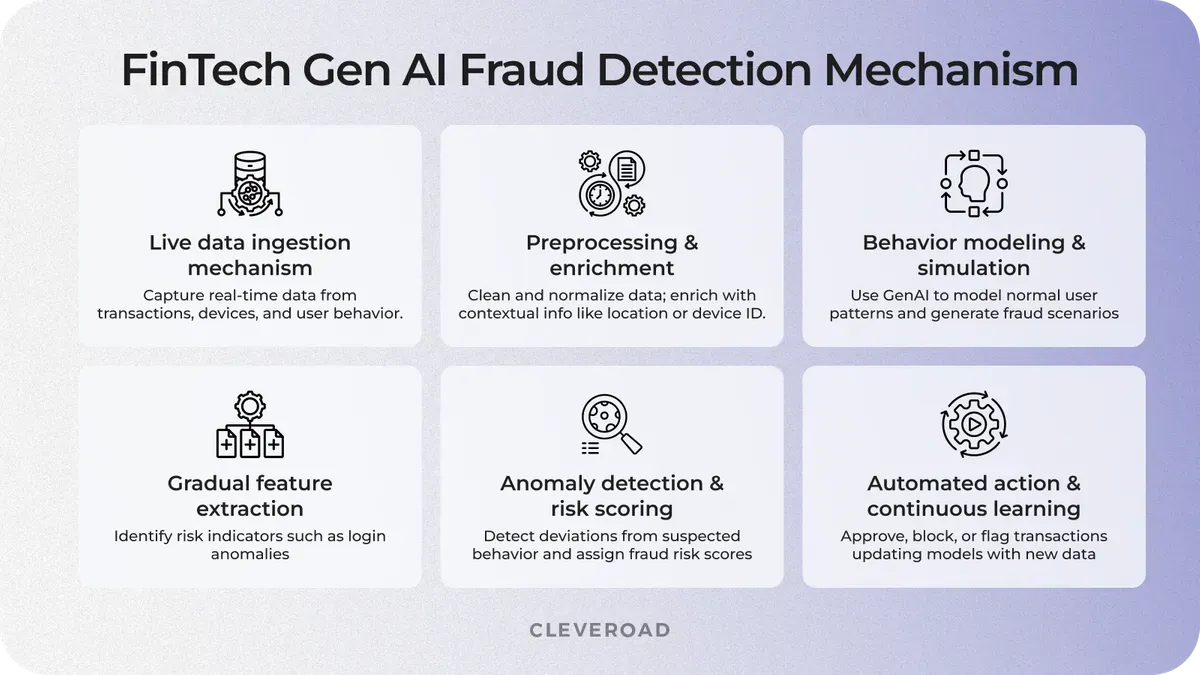
Generative AI fraud detection in FinTech
Intelligent customer support automation
Gen AI transforms customer service by enabling chatbots and virtual assistants that actually understand context and intent. These tools can handle routine inquiries, guide users through complex processes, and even resolve issues without human intervention. This simplification reduces response times and support costs, while freeing up your human agents to focus on high-value support tasks. Customers benefit from 24/7 availability, and you benefit from scalable service delivery.
We at Cleveroad built this kind of assistant for a US-based FinTech company. Our team delivered an LLM-powered knowledge assistant with vector search over the client’s CRM and knowledge base, serving customers and internal teams in 20+ languages across chat and email. Internal search relevance grew by 35%, and average query resolution time dropped by 28%.
Support is exactly the scenario where a generative layer pays for itself with minimal risk to transactions. The assistant answers questions and retrieves documents, while every money movement stays inside deterministic systems.
Smarter credit risk and loan assessments
Traditional credit scoring can overlook valuable data or give an incomplete picture. Gen AI widens the picture by summarizing a broader range of inputs, like transaction history and non-traditional data sources, into a structured view your scoring model and underwriters can use.
The score itself still comes from a validated model, and the final call stays with the lender. With that split, you can make better-informed decisions, reduce defaults, and extend credit to applicants that thin-file scoring misses. This benefit also carries the heaviest compliance load of the four, because the EU AI Act classifies creditworthiness evaluation as high-risk.
We are an experienced FinTech solutions development company you can work with to improve finance experience for your clients
Pitfalls of Gen AI in FinTech and Mitigation Tips
Generative AI and FinTech can work hand in hand to deliver powerful improvements. But integrating GenAI into financial systems isn’t always straightforward. The technology’s complexity, combined with strict industry regulations and the high stakes of financial decision-making, can quickly make things challenging. Let’s take a closer look at the key issues that can arise and how we at Cleveroad tackle them with proven solutions.
Data privacy concerns
In FinTech, generative AI systems need access to highly sensitive information, including personal identities, payment data, geolocation, behavioral patterns, and device fingerprints. Without strict data governance, this information can be unintentionally exposed during model training or inference, leading to violations of GDPR, PCI DSS, or local data residency laws. Even anonymized datasets may carry re-identification risks if not properly managed, making privacy breaches a real concern for AI-powered FinTech systems.
Cleveroad expert tip: We implement federated learning to keep user data local while training models securely. Differential privacy techniques ensure no personal data can be reverse-engineered. Combined with AES-256 encryption, tokenization, and strict access control policies, our pipelines form a privacy-first, audit-ready infrastructure that aligns with global data protection standards.
Cleveroad is certified with ISO/IEC 27001, proving our security management aligns with leading international practices. Check out our article to learn more.
Probability of AI hallucinations
FinTech Gen AI models, especially large language models, can sometimes generate outputs that seem factually accurate but are entirely fabricated or misleading. This is a phenomenon known as hallucination. In FinTech, such errors can have serious consequences: false fraud alerts, inaccurate risk assessments, or unreliable customer communication. These mistakes undermine business credibility and can trigger regulatory or legal scrutiny when decisions rely on incorrect AI-generated data.
Cleveroad expert tip: We use a hybrid AI architecture, where GenAI handles insight generation while deterministic systems manage critical actions like transaction approvals. Post-processing validators check outputs, and domain-specific fine-tuning using financial ontologies like the Financial Industry Business Ontology (FIBO) refines them. Confidence scoring and human-in-the-loop feedback ensure only validated, high-quality outputs influence real-world decisions.
Regulatory uncertainty
The FinTech sector operates across a fragmented regulatory landscape where AI requirements vary by jurisdiction. Depending on the market, companies may need to comply with data protection laws, financial regulator guidance, consumer protection rules, model risk requirements, and emerging AI-specific regulation.
In practice, the compliance burden depends less on the technology itself and more on how AI is used. Systems that influence lending, customer eligibility, transactions, or other high-impact financial decisions typically require stronger controls around explainability, auditability, data governance, and human oversight, while lower-risk use cases such as support or document processing generally face fewer restrictions.
Cleveroad expert tip: We follow a compliance-by-design approach, embedding model governance into every stage of development. Our solutions include explainability layers (LIME, SHAP), bias detection workflows, and sandbox validation to simulate real-world edge cases. With CI/CD pipelines built around policy enforcement, version control, and legal update monitoring, our AI systems are future-proof and regulator-ready.
The most effective way to address these challenges is to partner with a reliable IT vendor experienced in Gen AI solutions for the FinTech industry from the start.
Cleveroad – Your Credible IT Vendor for FinTech Gen AI Implementation
Cleveroad is a FinTech software development company with 15+ years of experience delivering secure, scalable FinTech solutions. We help financial institutions, neobanks, and FinTech startups adopt AI and GenAI technologies without compromising compliance, performance, or user trust.
We create FinTech solutions in full alignment with PCI DSS, GDPR, PSD2, Open Banking, AML/CFT, and other financial regulations. Any AI-powered feature you integrate, from automated KYC to fraud detection or recommendation engines, passes compliance review before it reaches production.
Our in-house engineers, 75% of whom are senior and mid-level specialists, provide end-to-end FinTech software development, combining traditional systems with modern AI capabilities. We build tailored solutions and integrate them with core banking platforms, payment gateways, credit bureaus, and third-party services like Stripe, Plaid, Experian, and Finicity.
Benefits you’ll receive from collaborating with Cleveroad:
- Partner with a vendor certified to ISO/IEC 27001:2013 for information security and ISO 9001:2015 for quality management, ensuring your FinTech platform is built to strict protocols.
- End-to-end Gen AI integration services covering the full AI adoption lifecycle from business analysis and model training to real-time integration and post-release support.
- An expert FinTech engineering team of cross-functional specialists who understand the specifics of financial data security, APIs, and mission-critical system performance.
- Flexible engagement models that adapt to your business needs and resource plans, including IT staff augmentation, dedicated teams, or project-based delivery.
- Advanced integrations that enable you to connect with leading FinTech and payment providers (e.g., Plaid, Stripe, Finicity, TrueLayer, etc.) to enhance your solution’s functionality.
To show how we deliver in a regulated FinTech environment, here is one of our recent cases, where compliance with EU market rules and a fast route to MVP mattered equally.
Broker research platform
A US-based financial analytics provider partnered with Cleveroad to build a SaaS-based broker research platform that enables asset managers, hedge funds, and brokers to evaluate brokerage services, track performance, and launch structured feedback loops. The client lacked in-house resources to execute the project and needed a compliant solution tailored for the European Union financial market.
Cleveroad’s team developed a MiFID II-compliant web platform, delivering a functional minimum viable product (MVP) to speed up time to market. The system included key modules such as a Voting web app, Commission Manager, Event Tracker, and Service Provider Portal, integrated into a unified SaaS ecosystem.
As a result, the client successfully launched a compliant SaaS product without scaling their internal team. The solution now powers efficient broker evaluations, generates new revenue streams, and remains adaptable through Cleveroad’s ongoing technical support.
The screen below shows the platform interface that asset managers use to evaluate broker services.
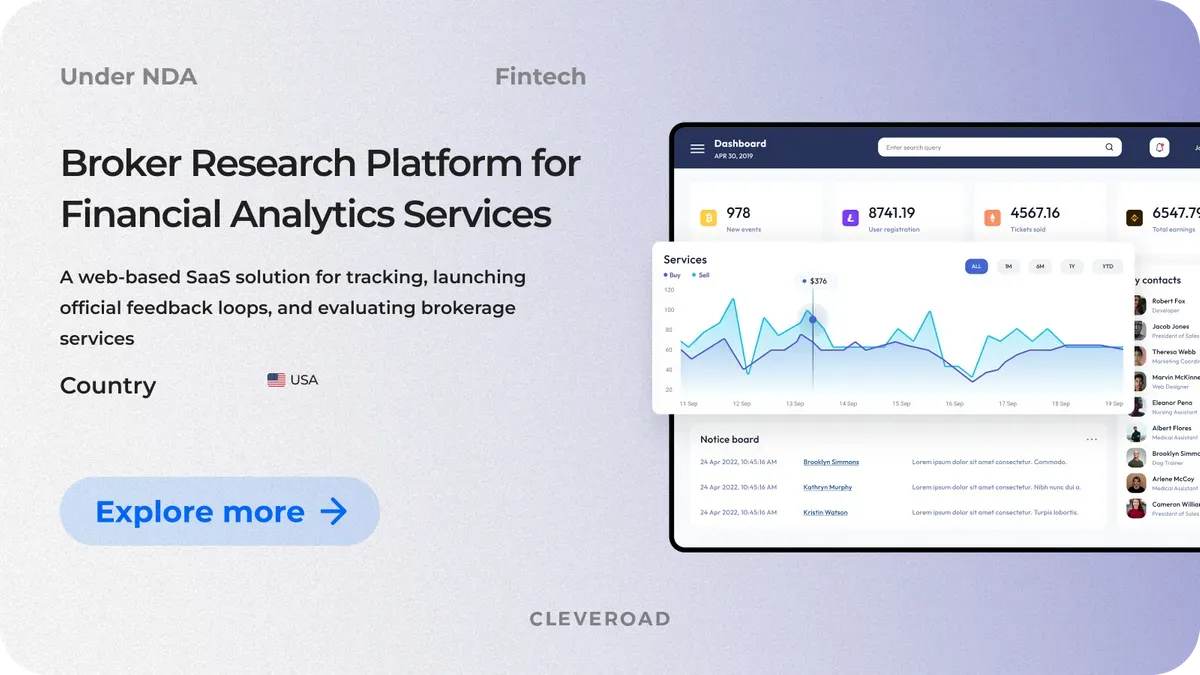
Broker research platform dashboard with broker voting, commission tracking, and event modules for asset managers
Implement FinTech Gen AI with Cleveroad
Our AI experts will map where generative AI pays off in your product and what controls it needs to pass a compliance review.
Of the six use cases covered above, four already run at scale, and each is defined by what the model actually produces:
- Advisor copilots: meeting summaries and draft client emails, as in Morgan Stanley’s Debrief
- Customer assistants: natural-language answers to account questions, like Bank of America’s Erica
- Document processing: structured fields extracted from statements and contracts
- Fraud case analysis: plain-language descriptions of anomalous behavior for investigators
In each scenario, a deterministic system or a human still makes the final call.
Super.com reports that its Glean-based enterprise search saves employees over 1,500 hours a month, and time saved on documents, research, and support is the main benefit you can expect. Generative AI also makes personalized financial services affordable at scale and speeds up fraud investigations. Starting with a single-use-case PoC keeps the cost of AI development under control while you validate the payoff.
To implement Gen AI in FinTech, follow these steps:
- Step 1: Find a credible GenAI FinTech vendor
- Step 2: Go through AI design stage
- Step 3: Start from FinTech GenAI Proof-of-Concept (PoC)
- Step 4: Develop and deploy FinTech GenAI
Expect a shift from pilots to production systems with built-in verification. The clearest checkpoint is 2 December 2027, when EU AI Act obligations for Annex III high-risk systems, including credit scoring, start to apply. From that date, any generative component inside a credit decision flow needs documented risk management, data governance, logging, and human oversight, so FinTech teams are designing human-in-the-loop review and audit trails into their GenAI features from the first release.

Evgeniy Altynpara is a CTO and member of the Forbes Councils’ community of tech professionals. He is an expert in software development and technological entrepreneurship and has 10+years of experience in digital transformation consulting in Healthcare, FinTech, Supply Chain and Logistics
Give us your impressions about this article
Give us your impressions about this article