HEOR in Pharma: Definition and Real-World Use Cases
03 Nov 2026
12 Min
131 Views
Regulatory approval used to be the finish line for a new therapy. Today it opens a second round of questions, and payers ask them first: what does the treatment deliver in everyday clinical practice, and how much will it cost the health system over the years? Health Economics and Outcomes Research (HEOR) exists to answer exactly that.
With 15+ years of experience in healthcare software development, we at Cleveroad build regulated healthcare data platforms with the audit trails and record integrity that evidence work depends on. In this guide, we'll help you understand what pharma HEOR is and how it differs from traditional clinical research. You'll also learn where HEOR applies across the drug lifecycle and how to implement it within your pharma business.
Key takeaways:
- HEOR in pharma combines clinical trial results with real-world data from EHRs, claims databases, registries, and patient-reported outcomes, then adds cost data to show a therapy's value beyond a trial.
- Pharma companies use HEOR evidence to set prices, secure reimbursement, negotiate market access with payers and HTA bodies, and design trials with endpoints that payers will accept.
- Traditional clinical research tests safety and efficacy under controlled conditions before launch, while HEOR measures a therapy's real-world value and cost from the patient and payer perspective, both before and after launch.
What Is HEOR in Pharma and How It Works
HEOR (Health Economics and Outcomes Research) helps pharmaceutical companies understand a therapy's value beyond clinical efficacy, including its economic impact, real-world performance, and effect on patients’ quality of life.
In practice, HEOR draws on data collected across medical software ecosystems, such as Electronic Health Record (EHR) systems, clinical trial platforms, patient engagement apps, and evidence analytics tools. These systems continuously gather outcomes data, and HEOR teams convert it into evidence that supports smarter development decisions and pricing strategies throughout a drug’s lifecycle.
Data sources used in HEOR
HEOR in pharma relies on data from both controlled research and routine care, from trial databases to the EHR and EMR systems (electronic health and medical records) hospitals and clinics use every day. These inputs let pharmaceutical HEOR teams assess outcomes across patient populations and healthcare systems.
Here are key HEOR data sources:
- Clinical trial data (efficacy, safety, comparators)
- Real-world evidence (EHRs, claims databases, registries)
- Patient-reported outcomes (quality of life, symptom burden, satisfaction)
- Health economics data (costs, resource utilization, budget impact)
- Epidemiological and population health data
- Payer and reimbursement datasets
In most pharma companies, these sources sit in separate systems owned by different teams and vendors, each with its own format and access rules. So the main work at this stage is getting technical access to the data rather than choosing it: you need healthcare APIs and agreed data standards to bring records into one place where analysts can work with them.
HEOR vs. traditional clinical research
Traditional clinical research evaluates treatment outcomes under controlled conditions to establish safety and efficacy. However, these trials are not designed to fully assess cost-effectiveness, real-world access, or how therapies perform across diverse patient populations and healthcare settings.
HEOR evaluates how well a therapy works in real-world settings and whether it delivers value to patients. The HEOR approach allows pharma companies to move beyond regulatory approval and build a compelling, evidence-based case for real-world adoption and reimbursement.
The table below compares HEOR and traditional clinical research across six aspects: primary focus, data sources, patient perspective, cost analysis, use case, and timeline.
| Aspect | HEOR | Traditional clinical research |
|---|---|---|
Primary focus | Value, outcomes, and economics | Safety and clinical efficacy |
Data sources | Real-world data, PROs, economic models | Randomized controlled trials |
Patient perspective | Central (quality of life, satisfaction) | Limited or secondary |
Cost analysis | Core component | Usually not included |
Use case | Pricing, reimbursement, market access | Regulatory approval |
What HEOR Does Across the Pharmaceutical Lifecycle: Real-World Use Cases
HEOR connects clinical, economic, and patient-centered evidence to real-world healthcare decisions. It helps pharma teams demonstrate value, control costs, improve outcomes, and secure market access in increasingly data-driven and payer-focused environments.
Below, we cover seven ways pharma teams apply HEOR, from budget impact models to post-launch monitoring. Where a company has published its own work, we add a real-world example with a link to the primary source.
Measuring treatment value
HEOR frameworks support treatment value by combining clinical outcomes with economic and humanistic data. They look beyond efficacy to quality of life and long-term outcomes, as well as the hospital stays and clinic visits a therapy adds or saves. This broader view helps you show payers and providers what a therapy delivers under real-world conditions.
Budget impact analysis
Budget impact analysis estimates how a new therapy will affect healthcare budgets over time. HEOR teams model costs related to treatment adoption, patient populations, and resource use, helping payers and providers understand financial implications before making reimbursement decisions.
Real-world use case: Researchers at Pfizer, together with consultants from Pharmerit, published a 2021 budget impact model for adding the bevacizumab biosimilar bevacizumab-bvzr to a US health plan formulary. The model forecast savings for the first year and over five years from two perspectives, a commercial payer and Medicare, with more than half of the savings coming from patients with metastatic colorectal cancer.
Improving patient-centered outcomes
HEOR uses patient-reported outcomes to measure quality of life, symptom burden, treatment adherence, and satisfaction. These insights help your team refine therapies and support value-based care models. They also give regulators and payers evidence of the patient-centered benefits they weigh when evaluating a drug.
Real-world use case: In its position paper on access to and use of real-world data, adopted in January 2019 and revised in November 2022, Roche describes using real-world data to generate additional evidence for payers and HTA bodies and working with these stakeholders on methods that reduce bias in such data. The paper notes that data quality requirements may vary by setting and lists outcomes-based pricing and reimbursement among those settings.
At Cleveroad, we provide patient monitoring software development services designed to support HEOR data collection
Supporting pricing and reimbursement decisions
HEOR provides evidence needed to justify pricing by linking treatment outcomes to economic value. It helps your health economists run cost-effectiveness analyses and comparative value assessments for negotiations with payers and HTA bodies.
Real-world use case: Published appraisal papers from the National Institute for Health and Care Excellence (NICE) in England record the evidence submission Sanofi made for caplacizumab, a treatment for acquired thrombotic thrombocytopenic purpura. The dossier combined results from the HERCULES randomized trial with a cost-effectiveness model, which the NICE committee reviewed before recommending caplacizumab alongside plasma exchange and immunosuppression.
Drug development and trial design
HEOR insights are increasingly applied early in drug development to design trials that capture outcomes relevant to payers and regulators. This includes selecting endpoints tied to quality of life, real-world effectiveness, and economic value, not just clinical efficacy.
Monitoring of drug performance
After launch, HEOR supports continuous monitoring of real-world performance across diverse populations. Using real-world evidence, pharma companies can validate effectiveness, identify care gaps, and refine market access or clinical strategies over time.
Real-world use case: In a 2024 ISPOR article, five epidemiology and real-world data specialists from Johnson & Johnson described how the company generates regulatory-grade real-world evidence. In one case, the FDA approved a label expansion for a J&J cardiac ablation catheter in persistent atrial fibrillation based on a comparative study that used only electronic health record databases.
The authors also describe countries that were underrepresented in the original trials. There, local real-world data confirmed that trial results applied to local patients, which supported a move from conditional to full approval and, together with trial extrapolation, extended indications to children.
New therapies vs. existing standards of care comparison
HEOR compares new treatments against existing standards of care by evaluating outcomes, costs, and patient impact. These comparisons help decision-makers understand whether innovation delivers meaningful improvement over current options.
Real-world use case: Health economics and outcomes research specialists at Bristol Myers Squibb, together with academic oncologists, published a 2021 matching-adjusted indirect comparison of nivolumab plus ipilimumab with BRAF/MEK inhibitor combinations in BRAF-mutant advanced melanoma. With no head-to-head trial available, the analysis reweighted patient-level trial data to compare survival outcomes, and the benefit of the immunotherapy combination became significant after the first year of treatment.
Enable HEOR workflows through your software ecosystem
With 15+ years in healthcare software development, we’re ready to build a HealthTech system that brings HEOR insights into your teams’ daily work. Schedule a meeting with our experts to choose the right tech foundation for your evidence workflows.
4 Main Benefits of HEOR in Pharma
HEOR gives you evidence that holds up outside the trial setting, and that evidence carries weight with the people who decide on coverage. Demand keeps growing: Mordor Intelligence values the HEOR services market at USD 1.98 billion in 2026 and expects it to reach USD 3.68 billion by 2031.
Here is what HEOR gives your business:
- Proves actual treatment value with real-world effectiveness and cost data, such as hospital admissions avoided, that trials rarely capture.
- Supports pricing and reimbursement with the figures payers and HTA bodies ask for, such as cost per quality-adjusted life year (QALY) and budget impact.
- Strengthens market access negotiations with indirect comparisons against the current standard of care when no head-to-head trial exists.
- Improves patient outcomes by using patient-reported data to show which interventions change patients' daily lives.
The chart below shows how the evidence picture changes when HEOR data is added to clinical efficacy results.
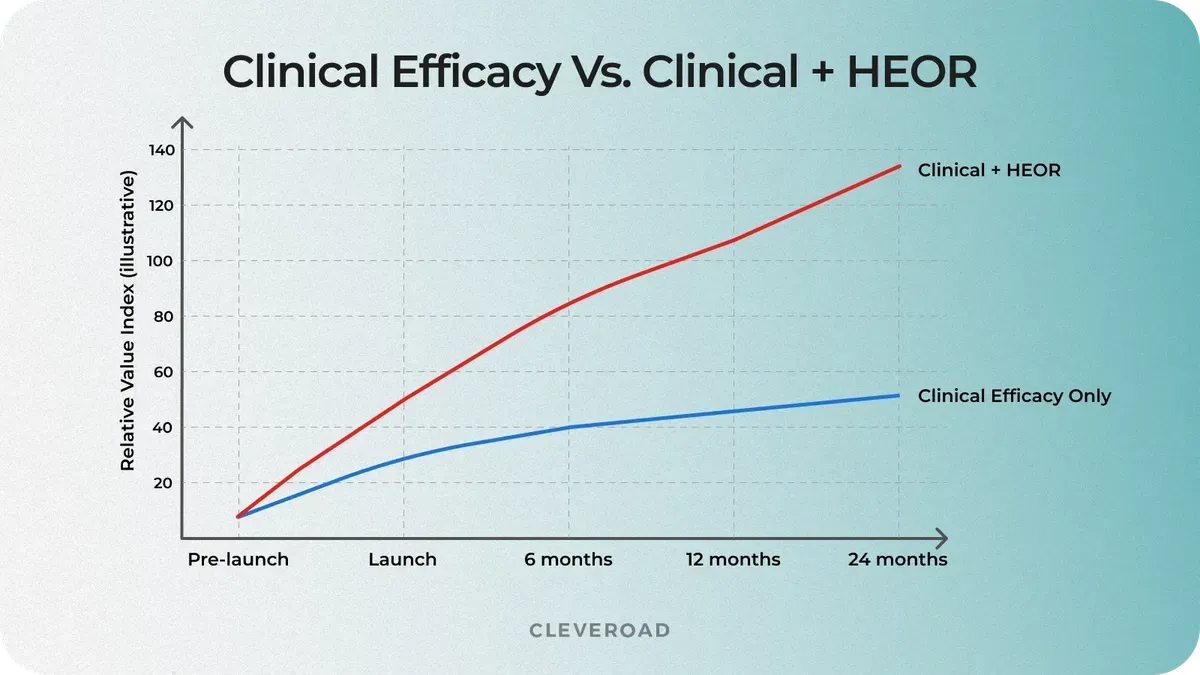
Clinical efficiency vs. Clinical + HEOR. Illustration by Cleveroad
Steps to Implement HEOR Within Your Pharma Business
Implementing HEOR is a multi-stage process that connects strategic objectives with real-world evidence generation, digital infrastructure, and post-launch value optimization. Below is a step-by-step overview of how HEOR is implemented in practice, and how we at Cleveroad support you at every stage of this process.
Step 1. Define HEOR goals
Pharma HEOR implementation begins with establishing clear, outcome-driven objectives aligned with your product strategy, target markets, and stakeholder needs. This includes defining which value questions must be answered (e.g., clinical effectiveness, economic impact, quality of life), identifying target payer and regulatory requirements, and determining success metrics across the product lifecycle.
Clear goal definition ensures HEOR efforts directly support pricing, reimbursement, market access, and patient outcome strategies. Cleveroad’s healthcare domain experts support this step by collaborating with clinical, market access, and commercial teams to translate strategic priorities into actionable HEOR use cases, KPIs, and technical requirements that underpin scalable implementation.
Step 2. Select data sources
Once you define key objectives, focus on identifying and validating the data needed to support them. This typically involves combining clinical trial data with real-world data sources, including electronic health records, claims data, patient registries, patient-reported outcomes, and digital health or remote monitoring data.
Selecting the right data sources is critical to ensuring relevance, data quality, regulatory compliance, and geographic applicability. Through our data engineering and data science services, we assess data availability and interoperability across your sources, then design data architectures that consolidate fragmented datasets into a unified HEOR data foundation.
Step 3. Integrate HEOR into workflows
To generate sustained value, HEOR must be operationalized within existing pharma workflows rather than treated as a standalone analytical function. This step embeds HEOR insights into clinical development, evidence generation, market access preparation, and post-launch operations, so the right stakeholders receive them at the right time.
Cleveroad enables this integration by building digital platforms and interfaces that connect HEOR data and analytics with your internal systems. With standards-based HL7 integration, your clinical and commercial teams can access and act on HEOR insights in the tools they already use every day.
In practice, integration work usually starts with a map of who uses HEOR outputs and where, since medical affairs and market access teams need different views of the same evidence. Agreeing on shared data definitions early saves rework later, when models need updating with new real-world data.
Need a pharmaceutical solution? Check out our guide about pharmaceutical software development
Step 4. Build economic and RWE models
With integrated data and workflows in place, HEOR insights are translated into analytical outputs such as cost-effectiveness models, budget impact analyses, comparative effectiveness studies, and real-world evidence (RWE) models. These models feed payer submissions and health technology assessments and guide pricing decisions in each market.
Cleveroad supports this phase by implementing digital platforms and analytical environments for HEOR modeling and scenario analysis. Through our business intelligence consulting, we help you customize models for specific markets and update them continuously as new data becomes available.
Step 5. Apply insights post-launch
Post-launch HEOR focuses on continuous evidence generation and value validation in real-world settings. This includes monitoring long-term outcomes, treatment adherence, healthcare resource utilization, and patient quality of life to refine value propositions and support lifecycle management.
Cleveroad enables ongoing post-launch HEOR with remote patient monitoring systems and reporting tools built on real-time analytics. With them, your team can respond to payer evidence requests faster and consistently demonstrate treatment value as healthcare conditions change.
Cleveroad – Your Technology Partner for HEOR Solutions
Cleveroad is an experienced healthcare software development partner with deep expertise in regulated, data-intensive healthcare platforms that maintain full audit trails and integrate with EHR and clinical systems. We design and build secure, compliant software products that help pharmaceutical and life sciences companies collect, integrate, and analyze clinical, economic, and patient-reported data across the product lifecycle.
For 15+ years, we have supported healthcare organizations, pharma companies, and MedTech providers in delivering data-driven solutions that enable evidence generation, support pricing and reimbursement activities, and improve patient-centric outcomes. Our focus is on building technology foundations that allow HEOR teams to work with reliable, structured, and audit-ready data.
By embedding HEOR-supporting capabilities into healthcare workflows, we help clients turn fragmented datasets into actionable insights that support decisions from clinical development through post-launch monitoring.
By partnering with Cleveroad, you gain the following benefits:
- HEOR and RWE strategy workshops: We help identify priority HEOR use cases and define a technology implementation roadmap aligned with regulatory, payer, and market requirements.
- Healthcare-compliant solution architecture: We design digital platforms that support HEOR analytics and evidence workflows in compliance with HIPAA, GDPR, HL7/FHIR standards, PIPEDA, and other applicable regulations.
- End-to-end system integration: Our team integrates HEOR-supporting solutions with EHR systems, clinical trial platforms, analytics environments, and enterprise healthcare software to ensure data continuity and interoperability.
- HEOR-focused PoC and MVP development: We build proofs-of-concept and MVPs to validate real-world data capture, outcome tracking, and value-based evidence workflows before scaling across regions or portfolios.
- ISO-certified delivery processes: Our delivery is backed by ISO 9001:2015 and ISO/IEC 27001:2022 certifications, which cover quality management and information security throughout the development lifecycle.
Over the years, our team has built regulated healthcare systems where audit trails and record integrity decide whether a product passes inspection, the same foundation HEOR evidence depends on. Here is one of them: a quality management platform we built for a US company that serves medical device manufacturers.
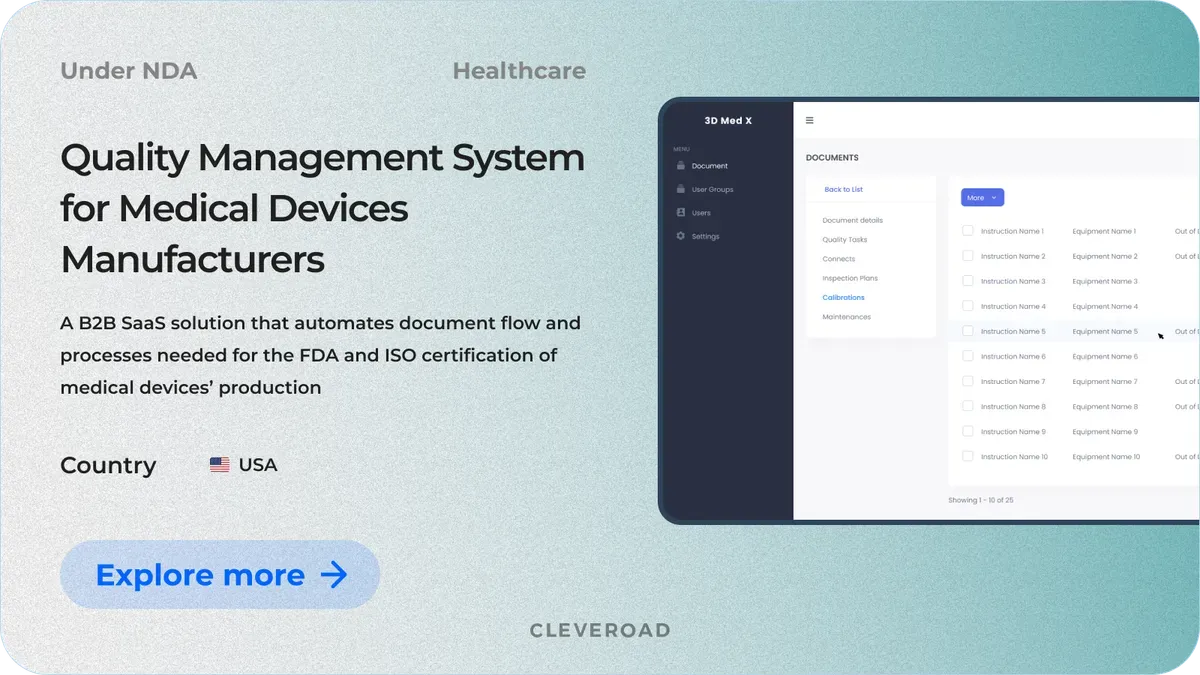
Quality Management System for medical device manufacturer designed by Cleveroad
Prime Path Medtech™, a US provider of total quality assurance services for medical device manufacturers, relied on an outdated Quickbase-based system that had grown too rigid for its B2B model. The company asked us to build a fully automated SaaS Quality Management System (QMS) that supports compliance with FDA 21 CFR 820 and 21 CFR 11 and conforms to ISO 13485.
Our team built QSuite, a web-based QMS with role-based access that mirrors each client's organizational hierarchy, including holding companies with several subsidiaries. The platform automatically creates tasks for document approvals and training assignments, and it maintains exportable audit logs of every data change.
As a result, Prime Path Medtech cut its gross expenditures by 20% after moving off Quickbase, allowing it to offer its SaaS to end clients at a lower price.
Here’s what Breanne Butler, project manager at Prime Path Medtech™, says about our collaboration on the project:
Breanne Butler, Project Manager at Prime Path Medtech™: Feedback on Cleveroad's Healthcare Software Development Services
Whether you start with a single data pipeline or a full evidence platform, our healthcare experts can map your HEOR goals to a delivery plan during a free Solution Workshop.
Operationalize HEOR across your digital ecosystem
We help you turn fragmented clinical and real-world data into HEOR-ready digital platforms. Talk to our experts to define the right technology foundation for evidence generation and market access.
When pharma companies seek reimbursement, they submit these findings to payers and HTA bodies, such as NICE in England or the Federal Joint Committee (G-BA) in Germany, which commissions IQWiG to assess the dossier.
For a pharma company, the main benefit is a stronger position in pricing and reimbursement talks. HEOR turns trial and real-world results into the measures payers compare directly, such as cost per QALY and budget impact over a one- to five-year horizon. It also shows which interventions improve patients' daily lives, so your team can focus resources where outcomes improve most.
HEOR plays a critical role in connecting clinical evidence with commercial and healthcare decision-makers. Its methodology combines clinical, economic, and patient-reported data to demonstrate real-world health outcomes, supporting both regulatory and payer submissions. HEOR informs drug pricing and value-based strategies, guides formulary placement, and enables post-launch evidence generation. In the biopharma industry, HEOR ensures therapies are evaluated not only for clinical performance but also for economic impact and improvements in patient quality of life.
HEOR collects and analyzes data from multiple sources, including clinical trials, real-world data, claims databases, patient registries, and digital health tools. These data inform economic models, comparative effectiveness studies, and outcomes analyses that guide pricing, reimbursement, market access, and post-launch strategy throughout a product’s lifecycle.

Evgeniy Altynpara is a CTO and member of the Forbes Councils’ community of tech professionals. He is an expert in software development and technological entrepreneurship and has 10+years of experience in digital transformation consulting in Healthcare, FinTech, Supply Chain and Logistics
Give us your impressions about this article
Give us your impressions about this article