How to Develop a FinTech App: Types, Requirements, and Development Stages
Updated 13 Mar 2026
22 Min
2443 Views
Building a FinTech app can drastically change your approach to entering the digital finance niche. There is no longer an obligation to rely on physical banking or insurance branches, empowering users with efficient digital finance tools. Developing digital finance apps enables you to deliver innovative financial solutions that meet customer expectations for speed and simplicity.
As a FinTech app development company with 15+ years of experience in the domain, we at Cleveroad are here to share our expertise and help you understand how to build a FinTech app, empowering you with the knowledge to develop your own platform and start profiting.
Below, you can preview the 7-step FinTech app development guide:
- Step 1. Choose your FinTech niche
- Step 2. Select an experienced IT partner
- Step 3. Pass the planning phase
- Step 4. Decide on the platform and feature set
- Step 5. Ensure robust security
- Step 6. Go through development and QA
- Step 7. Launch and gather user feedback
What is a FinTech App and Why Build One?
A FinTech app is a digital solution that delivers financial services through mobile or web platforms. It lets you manage money, make payments, invest, or access lending services without relying on traditional banks. In this way, as a user, you can make faster, more informed financial decisions. Generally, the apps consolidate multiple financial functions into a single convenient interface.
For your business, a FinTech app can significantly contribute to manual processes. The app enables you to access improved customer services, offering 24/7 access to features like instant payments and loan applications. Personalized notifications and analytics boost your clientele engagement and transparency. Overall, it just makes financial management simpler.
Common FinTech app use cases include:
- Digital banking: manage accounts and payments from a mobile device
- Online lending: request and manage loans without visiting a bank
- Investment platforms: track financial assets operations digitally
- Payment and wallet apps: send, receive, and store money securely
- Insurance platforms: manage policies and claims online
Why build a FinTech app?
First, consider building a FinTech app to modernize your services and stay competitive. A well-designed solution will make your services more accessible and way more engaging for your clients. Below are the key reasons businesses decide to build their custom FinTech apps:
Expand customer reach
Digital platforms make financial services accessible anytime, anywhere, removing the need for physical branches. This allows businesses to attract more users.
Improve user experience
Intuitive apps simplify complex financial operations through clear interfaces and guided workflows. Users can manage transactions and financial tools more quickly and conveniently.
Increase efficiency
Automation reduces manual processes and helps businesses manage transactions and customer data more effectively.
Create new revenue streams
When you create a FinTech app, you can introduce new products such as subscription variations or premium financial services.
FinTech Industry Overview
To establish why it’s profitable to create a FinTech app, let’s take a brief glance at the overall FinTech solutions market and the most vibrant trends you may want to incorporate within your own FinTech solution.
FinTech market view
We provided several interesting stats to represent the high demands and potential of FinTech software development:
- Expert Market Research states that the global FinTech market is projected to reach $324 billion by 2028, indicating a compound annual growth rate (CAGR) of around 9.2%
- According to Statista, the digital payments segment is expected to continue its expansion, with the number of users projected to reach 4.8 billion by 2028
- Exploding Topics claims that FinTech app revenue is booming, with the digital payments sector alone projected to generate over $10 trillion in global transaction value by 2027, fueled by growing eCommerce and mobile adoption
FinTech market promising trends
Let’s outline key FinTech industry trends that are currently shaping the digital finance vector:
- Embedded finance. Embedded finance integrates financial services into non-financial platforms, such as healthcare. It enables seamless operation directly within existing apps.
- Artificial intelligence in FinTech. AI application development services help automate processes and analyze financial data in FinTech platforms. It improves fraud detection and personalization.
- Decentralized Finance (DeFi). DeFi uses blockchain to provide services without banks or intermediaries. It enables decentralized lending and global access to financial tools.
How to build a DeFi app? Read our guide to learn about the DeFi mobile app development process to seamlessly integrate this knowledge within your own FinTech app
Types of FinTech Apps
Fintech is a compilation of technologies and financial services, such as blockchain, banking platforms, and budgeting apps. With recent expansion, this sector has made the business more customer-oriented. If you want your team or the IT company you've chosen to build a FinTech app to validate your idea, you need to determine your product's value to consumers.
Let's find out what types of fintech apps are and take a look at the most popular ones.
Insurance apps
This type of FinTech app is suitable for the insurance industry to speed up claims processing and policy administration, and to reduce the likelihood of insurance fraud. Besides, it may be as basic an insurance website as a complex CRM.
Insurance app development should include main features such as payment processing, claim filing, quotes, policy details, and the ability to search for policies by selected parameters.
If you want to create an insurance app, check out the good examples:
- Geico Mobile. It's one of the best auto insurance apps, with key features such as digital ID cards for accessing insurance policies, a virtual assistant that quickly answers questions about policy coverage and billing, and a parking locator that helps users find parking and make reservations in advance.
- Lemonade. This app is designed to provide policies to homeowners and renters. Its unique feature is that it charges a flat maximum fee to run a business, and any premiums over that amount are distributed among charities during the year.
Investment apps
It may be more preferable for you to choose this FinTech app type if you want to start working in the stock market. This app will allow you not only to research and invest in financial assets but also to improve the efficiency of your investments.
If you decide to create an investment platform, don’t forget about such main features as currency, savings, and credit management, product comparison, real-time alerts, and client support.
Here are some ideas for investment apps:
- Robinhood. Robinhood is a good solution for smooth trading. Its main advantages are quick access to the stock page and trading, a quick start with instant delivery of the first $1,000 of any funds deposited into the account, and a channel with stories from news and investment sites, so you can stay up to date.
- Wealthbase. Wealthbase is the best stock market games app. The app combines stock picking and social media, so you can see a feed of stocks that your friends or colleagues are choosing.
By the way, we at Cleveroad have created an investment application for the Middle East market.
We helped a Saudi investment company launch a scalable micro-investment platform from scratch, fully compliant with SAMA regulations. Cleveroad handled the full development cycle, including UI/UX design, Flutter mobile apps, back-end integrations, multi-factor authentication, and KYC/AML verification.
The solution allows users to manage micro-investments and savings seamlessly, while admins control accounts and monitor transactions, ensuring security and regulatory compliance. The turnkey platform enabled the client to attract a new audience, automate processes, and quickly monetize their micro-investing services.
Read our Micro-Investment Platform with SAMA-Compliance case study to learn more about our experience in FinTech solutions development.
Lending apps
Lending apps make the processing of loan requests and the interaction between borrowers and lenders faster and more efficient. It’s a good way to improve businesses for both independent digital lenders and traditional financial institutions.
While assessing how to create a money lending app, keep in mind that it may include features such as credit scoring, a loan application form, billing, and payments. You can also let users make loan repayments directly from the app.
Examples of popular lending apps are:
- Earnin. It’s the leader among fintech apps that provide low fees. This app stands out because it doesn't charge fees when you borrow money.
- PaySense. This platform provides short-term personal loans to salaried professionals within 5 hours of applying, with affordable, convenient EMIs and interest rates. It provides loans even to those with a low credit rating.
Consumer finance
Consumer finance apps don’t usually offer payment processing services. They are designed to help users plan and manage their expenses, save money, and forecast future account balances to avoid overspending.
Building a FinTech app of this type should include features such as financial goal setting, expense and bill tracking, investment analysis, payment categorization, and fraud and identity alerts.
Here are fintech apps that you can consider to understand how they work:
- Mint. It's a free app that allows users to budget, track payments, and enroll. Mint can be synchronized with various credit cards, bank accounts, and PayPal.
- Money Patrol. With this app, you can oversee and manage your transactions and savings, make effective financial decisions, access the data the app provides, reveal fraudulent transactions, and face penalties for late payments.
Banking apps
Banking apps are designed to allow users to manage their bank accounts and conduct financial transactions independently and quickly.
Many traditional banks are assessing mobile application development to become more competitive. This is because all services are becoming mobile, and financial transactions are carried out faster and more conveniently.
Creating a banking app, you can integrate it with payment systems like Google/Apple Pay or PayPal, as the UK financial company Monese did in its app.
Here is an example of several banking apps:
- Starling. The app allows customers to quickly open a free account without documents, manage overdrafts and savings, create a budget, and safely transfer funds to bank accounts in 38 countries.
- Monese. This app is specially designed for expats who have moved to the UK. You can open an account anywhere in continental Europe and the UK, even if you don't have a UK address, credit history, or fixed income.
Discover more about how to create mobile banking app regarding key functionalities, development steps, cost, potential challenges, and their resolution by reading our guide
Neobanks
Neobanks are digital banking services that allow you to access banking services without visiting physical branches. They operate and provide services exclusively digitally through mobile applications or online platforms. The main focus of neobanks is to provide customers with convenient, innovative, and personalized financial services.
The core functions of neobanks include account opening and management, investments, lending and borrowing, and financial planning and transfers.
Some of the most popular examples of neobanks include:
- Monobank. Monobank is a Ukrainian neobank that provides financial services entirely online. This application allows users to create and manage accounts and investments.
- Chime. Chime is an American financial company providing mobile banking services. The app allows users to open accounts and manage debit, credit cards, and savings.
Learn about how to create a neobank, learning from comprehensive real-world examples in our detailed guide
What are the Steps to Build a FinTech App?
During financial app development, you’ll need to leverage a lot of technical knowledge. To understand how to create a FinTech app, look at the main steps that we've outlined for you.
Step 1. Choose your FinTech niche
Choosing a niche is a crucial step in creating a successful fintech app. Firstly, you should analyze the target market. Then, choose whether you want to create your own fintech app or improve an existing one (reduce the number of clicks for operations, add social network integration, etc.).
If you want to be competitive, it would be good to build a fintech mobile app with complex features to engage more users. There are too many simple FinTech apps like budgeting apps, so you have to be unique. After you’ve chosen a niche, you can move on to finding app developers experienced in the fintech sector who can help you build an app tailored to your goals.
For instance, expert teams in mobile banking app development can craft innovative, user-centric features to enhance your app's appeal.
Step 2. Select an experienced IT partner
Your next step is to find and hire an experienced tech partner to help you build a FinTech app. Here are the specialists who are usually part of the FinTech app development team:
- Back-end developer
- Front-end developer
- Business analyst
- Project manager
- Designer
- Product manager
- QA specialist
If you choose a financial software development company, pay attention to the company's experience, hourly wages, and specialists' training level. Also consider client feedback on platforms like Clutch or GoodFirms, as well as the vendor's portfolio of previously completed projects. Another important factor is choosing the appropriate cooperation model.
Additionally, when choosing a vendor for FinTech software development, it’s important to assess technical expertise, as well as the team's approach to communication and solution architecture. A reliable partner should be able to translate complex financial requirements into a secure and scalable digital product.
At Cleveroad, we bring over 15 years of experience in building FinTech applications, helping companies launch compliant, high-performance platforms for modern financial services.
For instance, we supported Mangopay, an Irish FinTech company that powers payments for more than 2,500 European platforms, including Vinted and Rakuten. Working within an IT staff augmentation model, our engineers helped enhance Mangopay’s payment infrastructure and develop a new FinTech product that aligned with strict regulatory requirements, including KYC and AML. The result was a unified payment ecosystem supporting multi-currency pricing, digital wallets, treasury tools, and global payout capabilities, enabling secure and efficient financial operations across multiple marketplaces.
See what Kirk Donohoe says about cooperation with Cleveroad experts:
Kirk Donohoe provides feedback about cooperation with Cleveroad
Step 3. Pass the planning phase
The next important step is to engage in the planning phase with your software vendor. This step includes important processes such as:
- Market analysis. Your partner will provide data and analytics on the current state of the FinTech applications market, helping to identify the best market opportunities.
- Target audience identification. The vendor will also help define and understand your target audience by providing analytics and statistics on user behavior and preferences.
- Selecting a monetization model. Identifying the desired monetization model is equally important, as your developers will build a FinTech app with it in mind. Vendors can offer monetization models based on experience with other FinTech apps.
Step 4. Decide on platform and feature set
The next phase of building mobile apps for FinTech is the . This stage aims to detail all the product’s requirements and create a clear development plan. This phase includes:
- Platform selection. In this phase, developers determine the key requirements for developing a solution for your chosen platforms or help you decide which platform is best suited to your needs for FinTech app development, such as mobile devices (iOS and Android), web apps, or cross-platform frameworks.
- Choosing the features. An important step is to determine your FinTech app's functionality and features. Your vendor will select functional elements based on the type of solution you want to create. Design concept. Design teams develop a design concept considering the user interface (UI) and user experience (UX).
We at Cleveroad have been providing FinTech development services for over 15 years. Learn more about our expertise and flexible cooperation models we offer to create your own FinTech app from scratch
Step 5. Ensure robust security
Your development team also focuses on security and compliance with financial industry regulations and standards (e.g., PCI DSS, GDPR, KYC, MiFIR). During app development for FinTech specialists take measures to protect user data and ensure compliance with legislation on economic activity. This includes implementing robust encryption protocols, conducting regular security audits, and integrating advanced fraud detection systems.
Moreover, the team tracks global and regional compliance requirements, implements DORA and other mandatory regulations, and enables businesses to expand into new markets without legal hurdles. Keep in mind that in digital finance, data security and regulatory compliance must be the number-one priority, as they enable you to build trust and credibility with users.
Read our guide to learn how to become PCI compliant in order to deliver a reliable and robustly safeguarded FinTech app
Step 6. Go through the development and QA
The team can begin FinTech application development once they complete all preparatory steps. It is a good idea to start by building a Minimum Viable Product (MVP). Creating an MVP is an excellent way to test your app idea before launching a full-fledged fintech product. With the MVP, you can launch an app without extra costs and save money on product development.
A minimum viable app includes enough features that users can try out at first and review your app. Building an MVP will help you attract investors more easily, gather feedback, and minimize the risk that your idea won't pay off.
After launching your MVP app, the development process doesn't stop. You need to conduct an A/B testing stage to evaluate customer reviews, based on which you can add new features or improve existing ones (design, functionality).
Step 7. Launch and gather user feedback
Upon completion of the FinTech app development, your software vendor will launch it on the selected platforms and provide you with all the required documents. After establishing an app, you should collect feedback from target users and improve the solution through regular updates based on it. Improvements may include bug fixes or extensions of the app’s functionality. Maintaining communication with users and making the application more convenient, safer, and more functional are important.
Essential Features for a FinTech App
While FinTech applications vary in types and features, now we will look at the must-have features that every FinTech app should have.
Secure authorization and authentication
To keep your customers' data as safe as possible, you must provide secure user authorization functionality. Use two-factor authentication to protect accounts from unauthorized access.
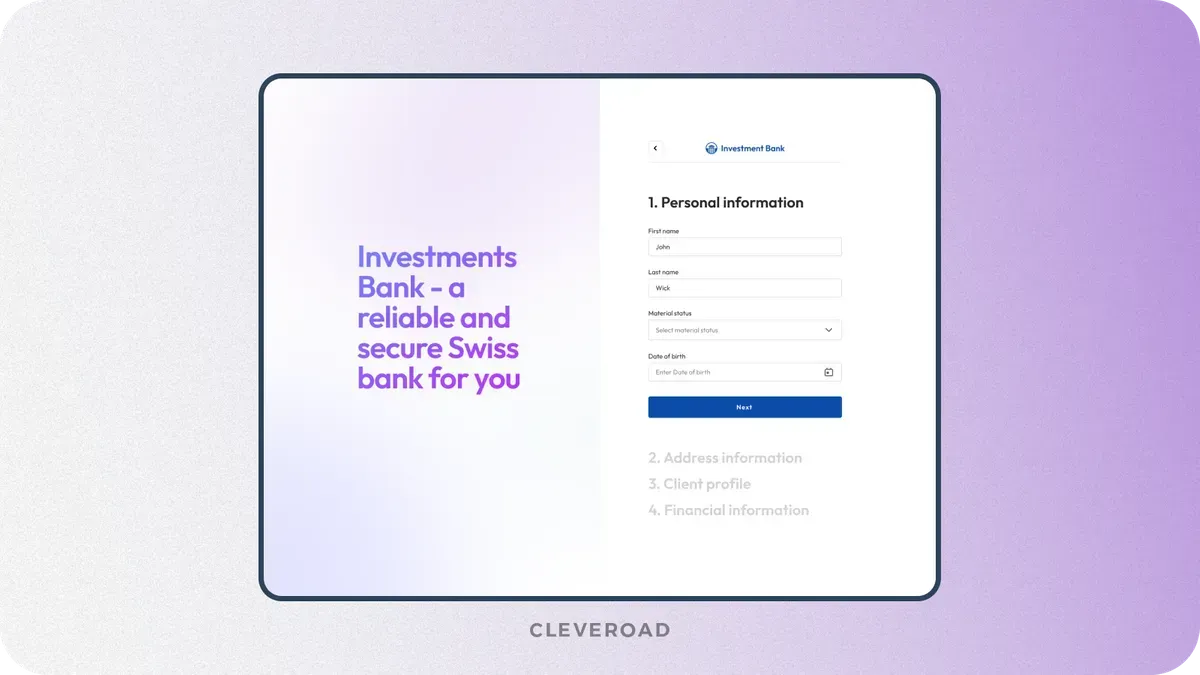
Authorization feature for FinTech app
Account aggregation
This feature enables users to consolidate and view information about their bank accounts, investments, and loans from various financial institutions in one centralized location, so an app offers unparalleled convenience, enhanced financial control, and a streamlined approach to managing their personal finances efficiently.
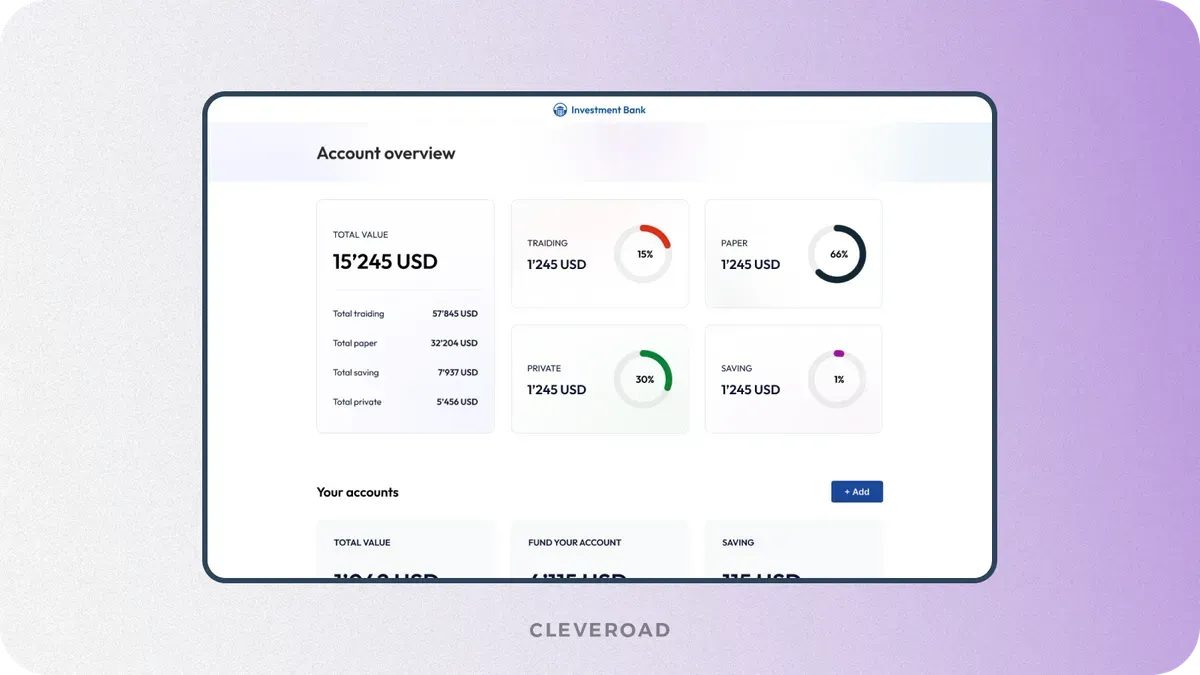
FinTech app account aggregation
Budgeting and savings tracking
Here, users will find a comprehensive suite of tools for setting budgets, analyzing expenses, and tracking savings. These features empower users to take control of their financial health, plan effectively, and achieve their savings goals with ease and confidence.
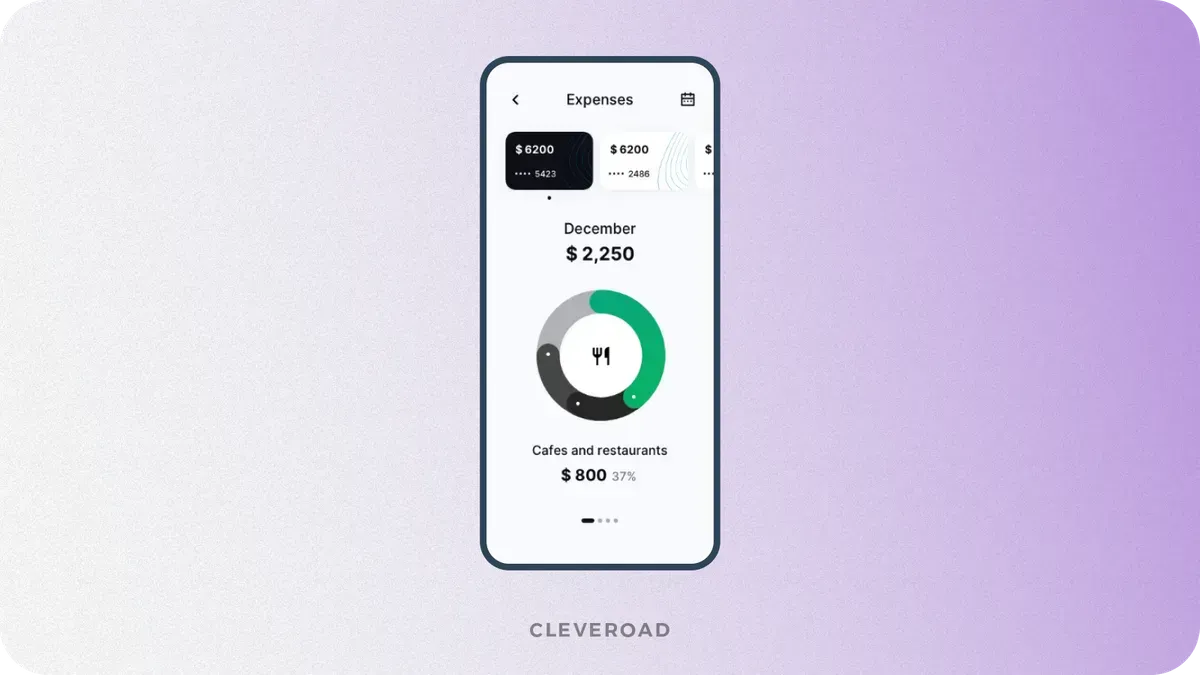
FinTech app budgeting feature
Payments and transfers
These features will empower users to make payments or money transfers with just a few clicks, enhancing convenience and saving time. By streamlining financial transactions, your app can offer a seamless and user-friendly experience that meets modern expectations.
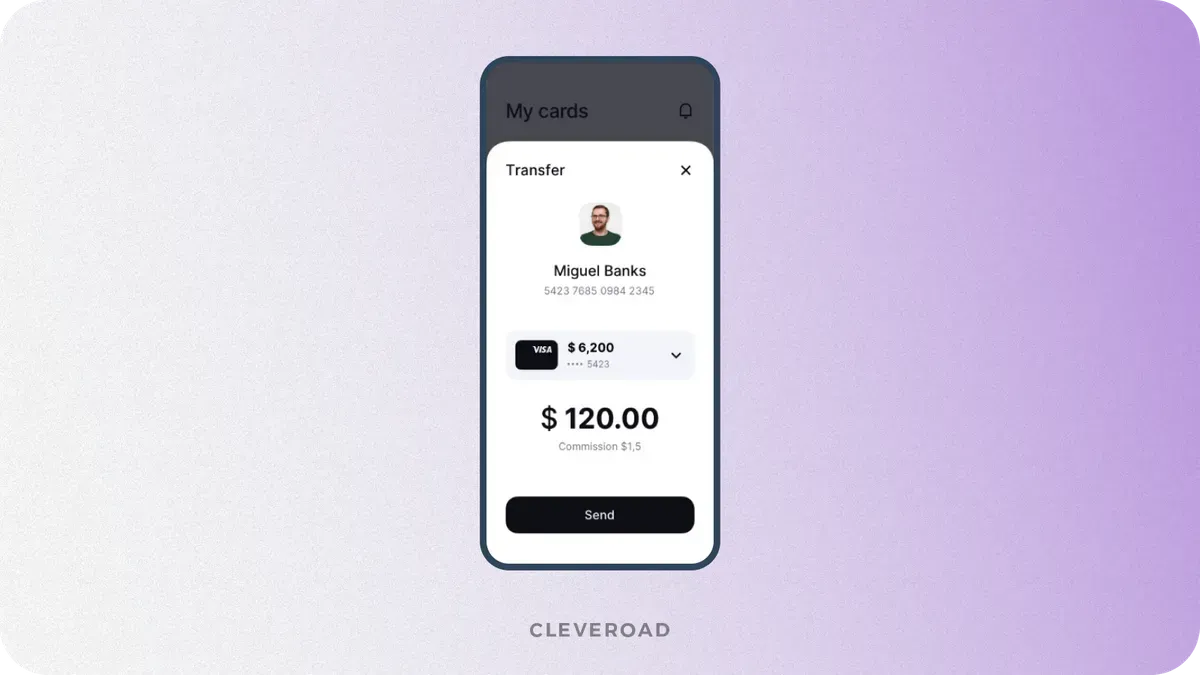
Payment feature for FinTech app
Card and account management
Provide comprehensive account management features, including locking and unlocking cards, setting and modifying spending limits, viewing detailed transaction histories, and managing personal identification settings, ensuring a secure, user-friendly experience for seamless financial control.
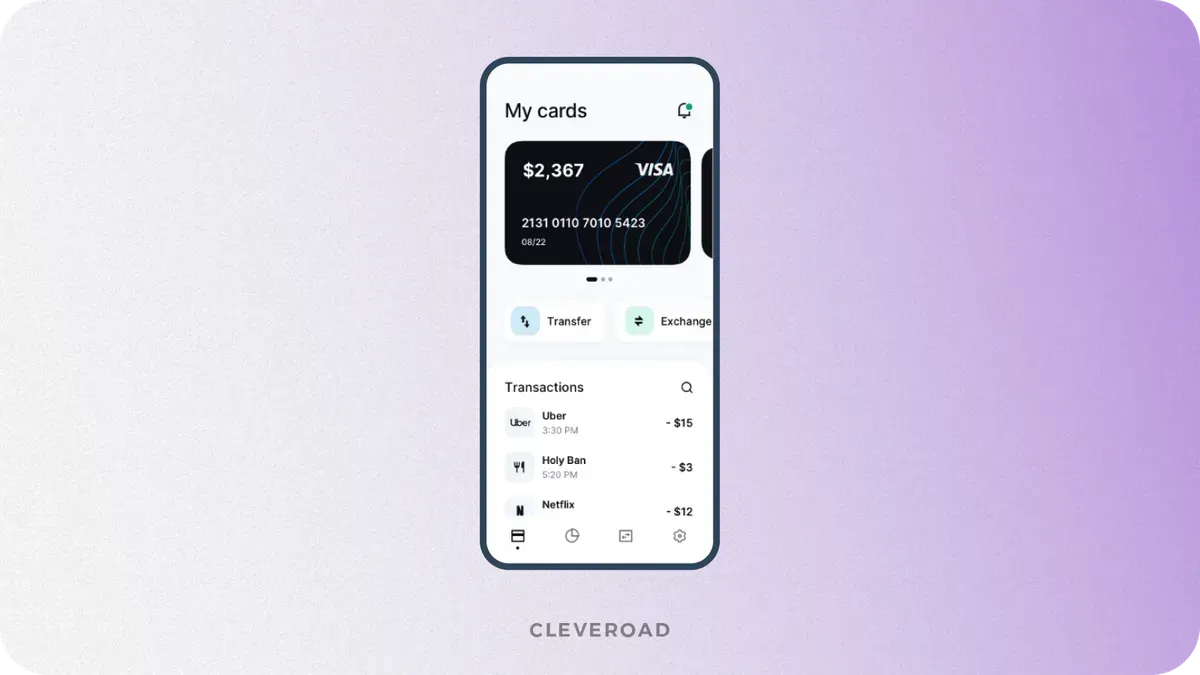
Card and account management feature of a FinTech app
Custom notifications
Allow users to tailor notifications to their specific needs, such as receiving alerts for in-app updates, account transactions, investment status, promotional offers, or reminders. This personalization enhances user engagement and ensures they stay informed about relevant activities within the app.

Custom notifications of a FinTech app
Integration with payment gateways
You need reliable payment gateways to ensure safe and secure payments within the app. We have covered the basic features required to build a FinTech app. This list can be supplemented based on the selected solution type and its characteristics.
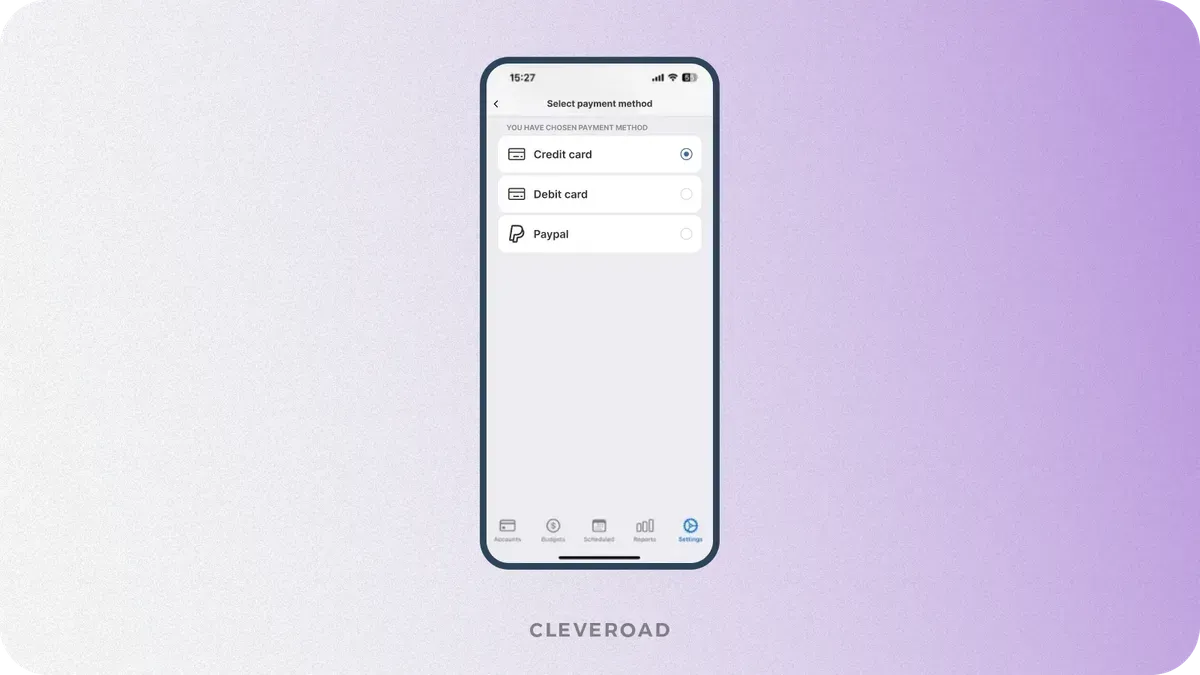
Payment integration for a FinTech app
Customer support
In FinTech app development, customer support is important because users may have questions or difficulties at any time. You can provide round-the-clock customer support with generative AI in FinTech using chatbots to advise customers and answer their questions.
How to Monetize Your FinTech App?
Monetizing a FinTech app requires selecting revenue models that align with your product’s functionality and user behavior. When planning app development for FinTech, it is important to consider monetization early so the business model supports long-term growth and sustainability. Let’s review the key available options below.
Transaction fees
Transaction fees are among the most widely used monetization models on financial platforms. In this model, the app charges a small percentage or fixed fee for operations such as transfers, payments, currency exchange, or investment transactions.
This strategy works well for products with frequent user activity because even small charges generate consistent revenue over time. PayPal earns a large portion of its income by charging a percentage fee on transactions processed through its payment infrastructure.
Subscription plans
Subscription-based monetization allows users to access additional functionality by paying a recurring fee. Typically, core services remain free, while advanced features such as analytics, premium financial tools, or higher transaction limits are included in paid tiers.
This model creates predictable revenue and encourages long-term engagement with the product. A common example is Revolut, which offers several paid plans that unlock additional financial tools and benefits for users.
Commission on financial services
Another effective strategy is charging commissions on financial products offered through the platform. FinTech applications may earn a percentage from loans, investment operations, or insurance policies provided through partnerships with financial institutions.
This approach works particularly well when the platform acts as an intermediary between users and service providers. For instance, Robinhood generates revenue through brokerage services and financial partnerships integrated into its ecosystem.
Freemium model
The freemium model offers essential features at no cost while charging for advanced capabilities. This approach helps platforms quickly grow their user base and later convert part of that audience into paying customers.
Premium functionality may include automated investing, detailed financial insights, or expanded portfolio management tools. Platforms such as Acorns successfully use this approach to provide subscription-based investment services.
Partner integrations and marketplaces
Another option is integrating third-party financial services into your platform. In this model, the app earns revenue through referral commissions or shared profits when users access partner products such as lending, insurance, or payment tools.
This approach expands the platform’s capabilities while strengthening its ecosystem. For example, Stripe allows businesses to integrate payments and financial services while generating revenue through service usage. These strategies are often considered when companies make a FinTech app and evaluate scalable monetization opportunities.
Note: In practice, combining several revenue streams usually produces the best results. Cleveroad’s business analysts can help you choose the most suitable monetization model for your FinTech app, considering your target audience and long-term business goals.
How Much Does FinTech App Development Cost?
So, what is FinTech app development cost? If you plan to create a FinTech app with basic features, development can cost you anywhere from $40,000 to $300,000+. These numbers are indicative and depend on your requirements, required features, development time, and more. However, here are other key aspects that may raise the FinTech app price tag:
- Development platform: native apps are more expensive than cross-platform ones
- UI/UX design: A complex and multi-layered design will cost more
- Third-party integrations: Their quantity and complexity impact the price
- Deployment: It’s usually required to pay fees for app deployment to the app store
- Team size, expertise, and location: Developers’ rates vary by region and level of expertise
The pricing of FinTech app development is a complex matter that is influenced by multiple factors. For example, your digital finance app MVP will be significantly lower-priced than a full-size, complex app incorporating technologies like blockchain or advanced AI algorithms. It will significantly impact the complexity of the FinTech app and will require extra effort from your development team, adding to the overall development timeline.
If we take fintech app development with basic features (MVP) as an example, the average time to build such a solution is 750-1500 hours. However, it is difficult to provide exact numbers without knowing your product requirements. Feel free to share your idea with our experts to get a detailed FinTech app development estimate.
Cleveroad’s Experience in Developing FinTech Applications
Cleveroad is a FinTech software development company with more than 15 years of experience. We develop a wide variety of digital solutions for startups and businesses. Among our services, we create financial software that facilitates online payments, financial analytics, and banking, ensuring security, legal compliance, and data protection.
Choosing us for FinTech app development, you will get:
- Practical expertise in custom Fintech app development to enhance finance and banking (e.g., trading platforms, digital wallets, financial management apps, etc.)
- Experience building FinTech software solutions compliant with GDPR, ePrivacy, MiFID II, KYC, etc.
- Experience in integrating FinTech software with a wide range of third-party services such as PayPal, Braintree, financial APIs, etc.
- Full consultation with our FinTech subject matter experts on FinTech app engineering
- Signing a Non-Disclosure Agreement (NDA) during the initial stages, upon your request, to preserve your project idea
- Flexible cooperation models depending on your needs: IT staff augmentation, Dedicated Development team services, and Project-Based Cooperation
To demonstrate our domain expertise, we want to introduce our featured FinTech project:
eBanking software system
Our client is a Swiss bank offering online investment, lending, and trading services. They turned to the Cleveroad team to help us create a flexible system that could expand their business and attract new customers. To accomplish the task at hand, we:
- Replaced a legacy software MVP and created a holistic system that would support the needs of B2B/B2C clients and operations teams, automate key internal workflows, and enable the bank to build new global business opportunities.
- Improved the user experience (UX) for registration, digital account opening, and e-banking portal so that users complete the registration process and become and remain customers of the bank, increasing retention rates.
- We created the software in accordance with all regulatory requirements for investment bank software. Namely, the new system and operational processes must be FMIA-compliant, and the development team must adhere to operating and data-processing rules under a "need-to-know" access-control framework.
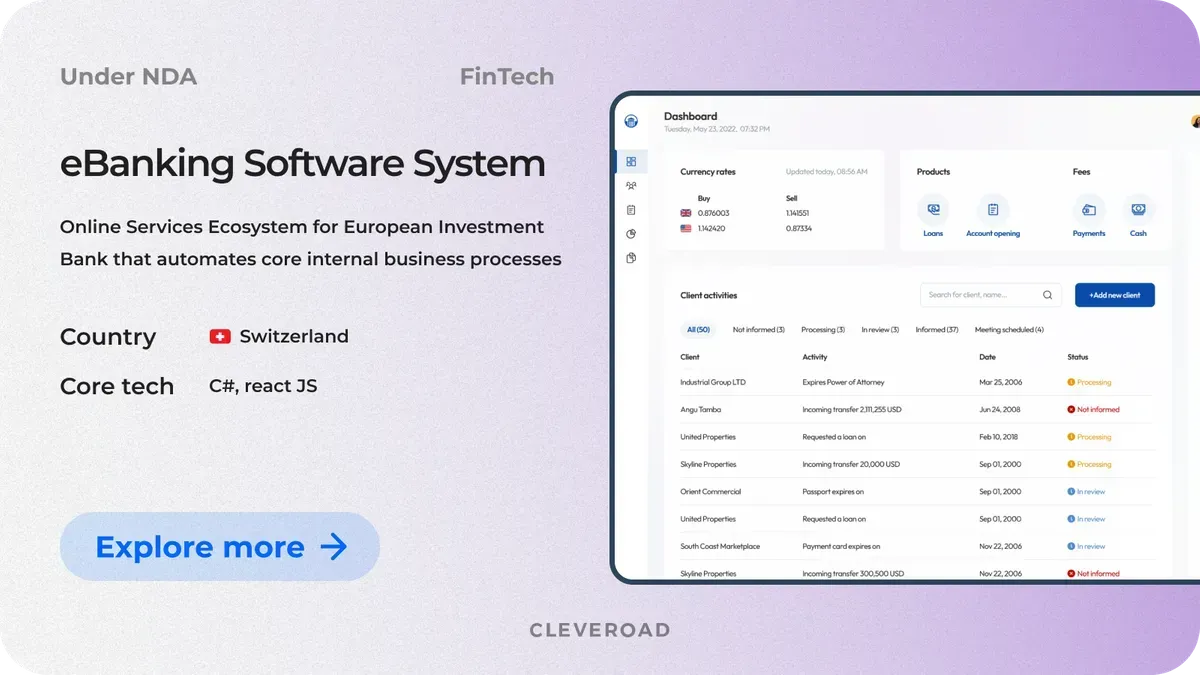
eBanking software system designed by Cleveroad
As a result, the client received a new eBanking system that helped achieve a 20-30% increase in client acquisition and retention rates through improved UX. Moreover, thanks to continued practical cooperation, the customer achieved business process improvements, accelerated operators' work, and freed up tech staff.
Create a FinTech app with our experts
With over 15 years of experience in the FinTech domain, our digital finance experts are ready to provide you with full-fledged FinTech development services to improve your financial services provision
A FinTech app is a digital solution that delivers financial services via mobile or web platforms. It lets you manage money, make payments, invest, or access lending services without relying on traditional banks. Using a FinTech mobile app development approach, you can make faster, smarter financial decisions while consolidating multiple functions in a single interface.
For businesses, a FinTech app can reduce manual processes, enhance customer service, and provide 24/7 access to features like instant payments, loan applications, and analytics. Personalized notifications improve engagement, while streamlined operations enhance transparency and client satisfaction. This guide to FinTech demonstrates how such apps simplify financial management while meeting market demand for FinTech solutions.
Here are the must-have features your app must include:
- Secure authorization and authentication: Protect user accounts with login credentials and two-factor authentication.
- Account aggregation: Consolidate bank accounts, loans, and investments into a single interface.
- Budgeting and savings tracking: Tools for managing expenses, setting budgets, and monitoring goals.
- Payments and transfers: Seamless money transfers and payment processing within a payment app.
- Card and account management: Manage cards, set limits, view transactions, and update personal settings.
- Custom notifications: Personalized alerts for transactions, investments, and offers.
- Integration with payment gateways: Secure and reliable payment processing.
- Customer support: 24/7 assistance via AI chatbots or live support.
Creating a scalable FinTech app requires a structured approach:
- Choose your FinTech niche: define the type of app and its primary audience.
- Select a mobile app development company: the partner has to ensure your app is developed with security in mind.
- Planning phase: work with business analysts to design a FinTech app roadmap.
- Decide on the platform and feature set: iOS, Android, or web; include all essential features.
- Ensure robust security: integrate secure authorization and data protection.
- Development and QA: focus on scalable FinTech architecture, proper testing, and high-quality design and development.
- Launch your FinTech app: gather user feedback, optimize, and iteratively improve the solution.
If you’re wondering how to create a FinTech app, our experts at Cleveroad can guide you through the application development for FinTech, from idea to launch.
The cost to build a FinTech app varies based on features, platform, and complexity. On average, basic FinTech apps start around $40,000, while complex, feature-rich apps can exceed $300,000. Factors that influence pricing include design and development efforts, security integration, and scalability.
Before starting, define your app type, required functionality, and long-term goals. With expert guidance from a mobile app development company, you can ensure your app meets market demand in FinTech, launches smoothly, and grows efficiently over time. Now, it’s time to start building apps that deliver secure, scalable, and user-friendly financial experiences.

Evgeniy Altynpara is a CTO and member of the Forbes Councils’ community of tech professionals. He is an expert in software development and technological entrepreneurship and has 10+years of experience in digital transformation consulting in Healthcare, FinTech, Supply Chain and Logistics
Give us your impressions about this article
Give us your impressions about this article