Load Planning Software Development in 2026: Essentials, Benefits, and Features
Updated 17 Mar 2026
16 Min
1742 Views
Truck load planning software is a system that automatically calculates the most efficient way to place cargo in trucks, trailers, or shipping containers. It analyzes cargo dimensions, weight limits, stacking rules, and delivery sequences to maximize trailer utilization, reduce transportation costs, and ensure regulatory compliance.
Why logistics companies should implement truck load planning software:
- Lower transportation costs. Ship more cargo per trip.
- Higher trailer and container utilization. Maximize available cargo space.
- Faster warehouse loading decisions. Reduce manual load planning.
- Better compliance and cargo safety. Ensure correct weight distribution.
- More reliable multi-stop deliveries. Follow the correct unloading order.
- Fewer planning errors. Automate load building decisions.
At Cleveroad, we bring 15+ years of logistics software engineering experience and 200+ delivered digital products across transportation and warehouse management. Our experts design and build solutions such as TMS platforms, route-planning engines, and cargo optimization systems for high-volume freight environments. Based on our expertise, we explain how truckload planning platforms work, which features logistics companies should prioritize, and how to implement a solution that aligns with real-world supply chain workflows in this guide.
What is Load Planning Software, and Why Logistics Businesses Need It?
Load planning, also known as load optimization, consolidates shipments to use trucks, railcars, pallets, and containers as efficiently as possible. The goal is to reduce transportation costs by maximizing vehicle capacity and minimizing trips across a logistics operation. Proper load planning also helps prevent cargo damage and improve delivery reliability.
When building load plan software, you must support different trailer and container configurations. Most logistics networks rely on specific types of equipment, so the system should adapt to the configurations used in each container or truck.
Load planners must evaluate several operational constraints, including:
- Cargo dimensions and pallet orientation
- Stacking rules and handling restrictions
- Trailer capacity and axle weight limits
- Delivery sequence constraints
Because these factors interact, manual load building quickly becomes complex, especially when shipments include mixed or irregular cargo. It is also important to distinguish load planning from other logistics optimization tasks. A load planning tool focuses on how cargo is physically arranged inside a truck and container to maximize space and maintain safe weight distribution. Route planning determines the most efficient path between delivery points, while warehouse slotting optimization defines where goods should be stored to speed up picking and packing.
To address these constraints, companies adopt an automated optimization tool for cargo placement. Modern trailer loading software uses advanced algorithms and 3D visualization to simulate cargo placement before loading begins. The system evaluates pallet dimensions and weight distribution, as well as delivery sequences, to generate a feasible loading plan and improve overall cargo utilization.
Which logistics operations benefit from load planning software?
Cargo load planning software is most valuable for logistics environments where load characteristics and delivery routes, as well as shipment volumes, change frequently. In these cases, automated load planning improves trailer utilization and reduces planning time, preventing loading errors.
The table below shows where load planning tools provide the highest operational value.
| Business scenario | Why load planning software is valuable |
3PLs handling mixed freight | Different pallet sizes, cargo types, and destinations require automated load optimization to use trailer space efficiently |
Carriers with multi-stop routes | The system optimizes loading sequences so cargo for earlier stops remains accessible during unloading |
Warehouses with pallet shipments | Automated planning improves pallet placement, reduces manual load building, and speeds up dispatch preparation |
Manufacturers shipping variable SKUs | The software evaluates product dimensions and stacking rules to prevent inefficient space usage in trailers |
Load planning software becomes less critical in operations where shipments are highly standardized and cargo configurations rarely change. When loads follow predictable patterns with fixed pallet dimensions, consistent SKU sizes, and stable trailer layouts, manual planning or simple rule-based templates can often provide sufficient efficiency without requiring advanced optimization algorithms.
Let’s examine the business scenarios where load planning software delivers limited operational value so you can determine whether this solution fits your logistics workflow:
| Business scenario | Why load planning app may be less critical |
Small logistics operations with fixed loads | Cargo layouts rarely change, so manual planning stays manageable |
Low-SKU shipments with consistent packaging | Predictable cargo sizes reduce the need for advanced optimization tools |
Key operational benefits of load planning software
Freight planning systems automate cargo arrangement inside trailers and containers, replacing manual calculations with optimized placement algorithms that improve load efficiency. In truckload and 3PL operations, these systems are typically integrated with TMS or WMS platforms. Companies often start with a pilot rollout in one warehouse or freight lane before expanding the system across multiple facilities and distribution locations.
Let’s discuss other benefits of freight loading software for your business.
- Lower transportation costs
Load planning software reduces the number of partially filled trailers by optimizing cargo placement and improving load density. Higher trailer utilization directly lowers transportation cost per shipment.
- Higher trailer and container utilization
Advanced trailer loading software optimizes pallet placement during container and truck loading, enabling planners to fit more freight into each shipment while maintaining safe stacking and unloading logic. When deployed across consolidated freight lanes, this optimization improves trailer space utilization and helps carriers increase payload capacity without adding vehicles.
- Faster warehouse loading decisions
Warehouse specialists receive clear load diagrams showing cargo placement and unloading sequence before dispatch. Pre-generated loading plans reduce loading time during outbound operations and help dispatchers prepare shipments faster.
- Fewer compliance and safety issues
Automated validation ensures correct weight distribution and continuously monitors axle load constraints before loading begins. This validation helps prevent regulatory violations and significantly reduces the risk of unsafe cargo placement.
- Less planning errors in complex shipments
Constraint-based load planning software for truckload carriers evaluates cargo dimensions, stacking restrictions, and delivery sequence logic to support multi-stop deliveries. As a result, planners reduce manual planning errors and improve operational accuracy. When integrated with TMS routing data, these systems can also account for delivery sequencing rules, making them particularly valuable for multi-stop freight and consolidated shipments.
By combining cargo optimization, compliance validation, and warehouse-execution visibility into a single workflow, load planning software can deliver measurable operational improvements for logistics providers managing complex shipment structures.
Discover more about how you can benefit from load software development with our freight management system development services!
What Business Scenarios Should Your Load Plan Software Support?
Modern logistics operations require load plan software capable of handling diverse shipment structures, delivery routes, and cargo constraints. Depending on the scenario, planners must optimize space utilization and maintain safe load distribution to ensure efficient unloading during deliveries. These systems are typically deployed alongside TMS or WMS platforms, where rule configuration and constraint modeling define how freight should be arranged across different shipment types.
Below are the key operational scenarios that logistics teams should consider when implementing cargo planning systems.
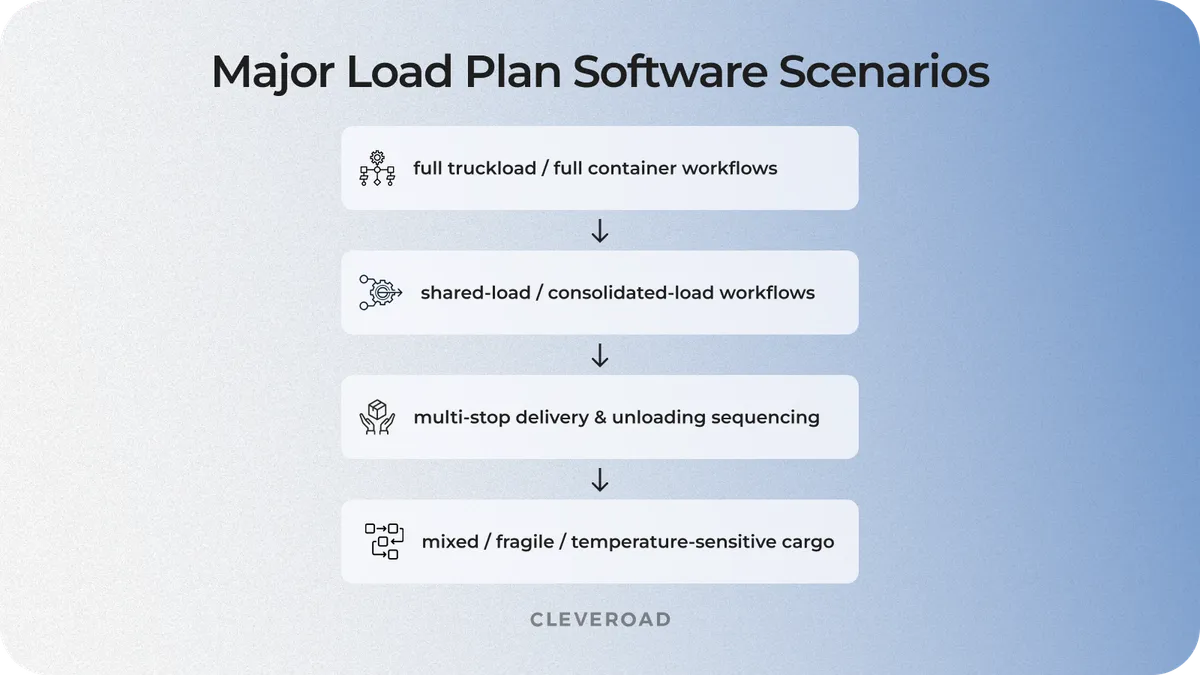
Major load planning software scenarios
Full truckload and full container workflows
In Full Truckload (FTL) or Full Container Load (FCL) shipments, a single shipper occupies the entire trailer or container. Even in this scenario, effective load planning is essential to maximize vehicle capacity and maintain stable cargo placement.
Companies often ship multiple SKUs with different pallet dimensions, packaging formats, and container types, which creates additional challenges when arranging freight inside the trailer. Cargo planning software helps determine the optimal load configuration by analyzing pallet size, weight limits, and stacking constraints.
Shared-load and consolidated-load workflows
Less-than-Truckload (LTL) and Less-than-Container-Load (LCL) shipments involve consolidating cargo from multiple shippers into a single vehicle or container. This way, shippers must coordinate multiple cargo restrictions such as fragility, stackability, weight distribution, and delivery order.
Advanced load-building software enables planners to combine shipments efficiently and generate optimized load plans for consolidated freight. These systems help ensure that freight from different shippers can be safely arranged while maintaining operational efficiency.
Multi-stop delivery and unloading sequencing
Many logistics operations require trucks to serve several delivery points in a single route. In such cases, cargo must be arranged inside the trailer in the order of unloading to avoid unnecessary handling.
Planning tools generate structured loading instructions that support supply chain planning and allow drivers to unload goods in the correct order. Proper sequencing improves operational efficiency and reduces handling time at each delivery location.
Mixed, fragile, or temperature-sensitive cargo
Certain logistics operations involve freight with strict handling requirements such as fragile goods, hazardous materials, or temperature-sensitive products. In these situations, cargo placement must follow specific stacking rules and compatibility restrictions.
Specialized systems support effective load planning by analyzing cargo characteristics and weight limits before generating loading instructions. However, software won’t eliminate every operational challenge, which is why human supervision remains essential when handling sensitive shipments.
Supporting multiple loading scenarios is essential for maintaining operational efficiency and delivery reliability. If your operations involve mixed cargo, consolidated shipments, or multi-stop deliveries, investing in tailored load planning solutions offers a strategic advantage.
What Features Should Be Included in the Load Planning System?
It’s time to consider the functionality needed to build load planning software for truckload carriers. We’ve put together core functionality for a Minimum Viable Product (MVP) and advanced features to make this section more useful for you.
MVP features to build load planning system
The main idea behind the core (MVP) feature set is to create a truck load platform with enough functionality to satisfy basic business needs, considering all the security matters. MVP development service will allow you to get a working product without investing a lot of money in creating a full-fledged software solution. Once you've ensured product viability, you can add more sophisticated product features.
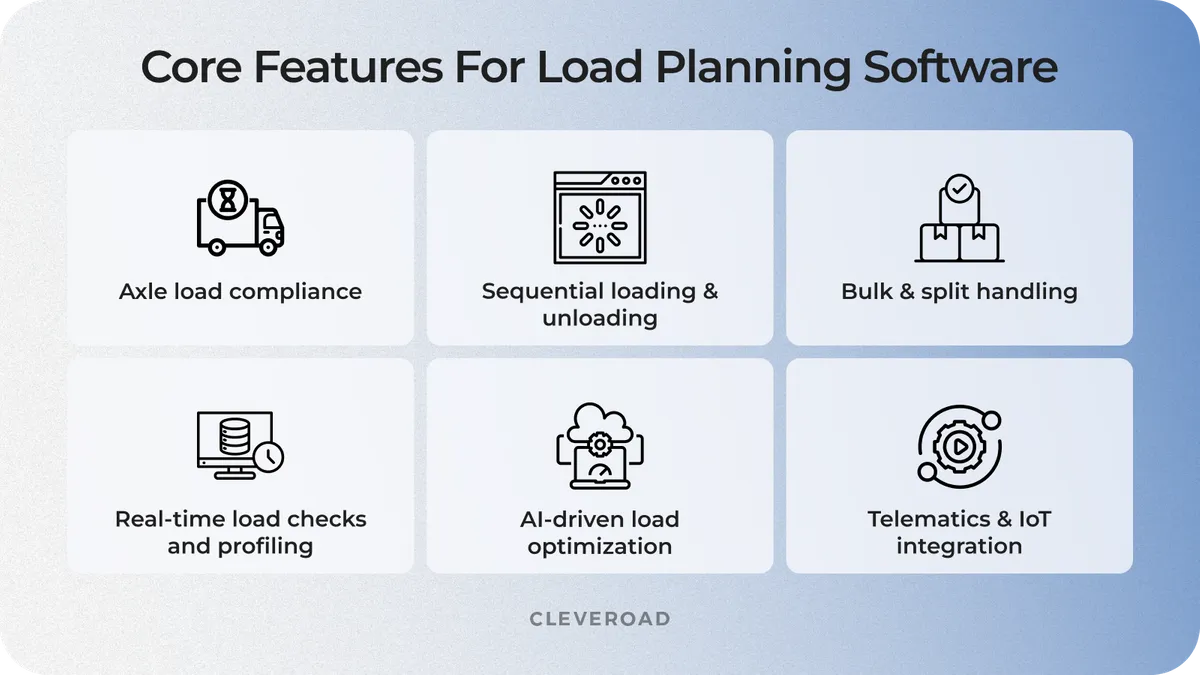
Key load planning system features
Axle compliance and load stability
These features enable proper weight distribution across axles and optimize double-stacking positions for maximizing trailer utilization while remaining compliant with regulations. They automatically adjust loading strategies based on weight limits and truck-trailer configurations to avoid fines.
Pick and unload in sequences
This functionality optimizes the picking order in warehouses to reduce travel time and ensures the pack cycle aligns with goods that need to be loaded in sequence at the stop. Providing a multi-dimensional, three-dimensional view of the cargo and the truck's cargo-container volume and weight streamlines unloading and eliminates unnecessary cargo handling at delivery points, enabling the person responsible for loading to work more efficiently.
Bulk and split item handling
It determines whether products should be loaded in bulk for efficiency; however, it groups products that should go together into one delivery. So, bulk and split item handling enhances warehouse processing and enables pallet load operations to be tuned for easier handling and transport.
Real-time load validation
Real-time load validation delivers real-time insights while loading, verifying weight compliance, axle balance, and trailer space limitations. This feature eliminates misloading errors and regulatory compliance problems, and eliminates manual recalculation. It has also integrated 3D load visualization, enabling correct load placement.
AI-powered load optimization
This feature generates the most space-saving and cost-fueling load planning and optimization algorithms using machine learning and historical shipment data. By dynamically responding to different types of cargo constraints in load planning software, it eliminates empty space and optimizes routes per load.
Integration with telematics and IoT
You can integrate your load planning software with telematics and IoT sensors to track cargo conditions, vehicle status, and load integrity in real time. It significantly improves supply chain visibility and allows for both planning and optimization in real time. The system also makes it easier for forwarders to manage their fleets by dynamically altering routes and load capacities.
Advanced functionality for load planning system
Such advanced truck and container loading software also uses sophisticated features to optimize not only stacking but also weight distribution, improving efficiency and precision.
Here are several of those features that help you make the most of trailer capacity, enhance sequencing, and ensure compliance with customer and regulatory requirements.
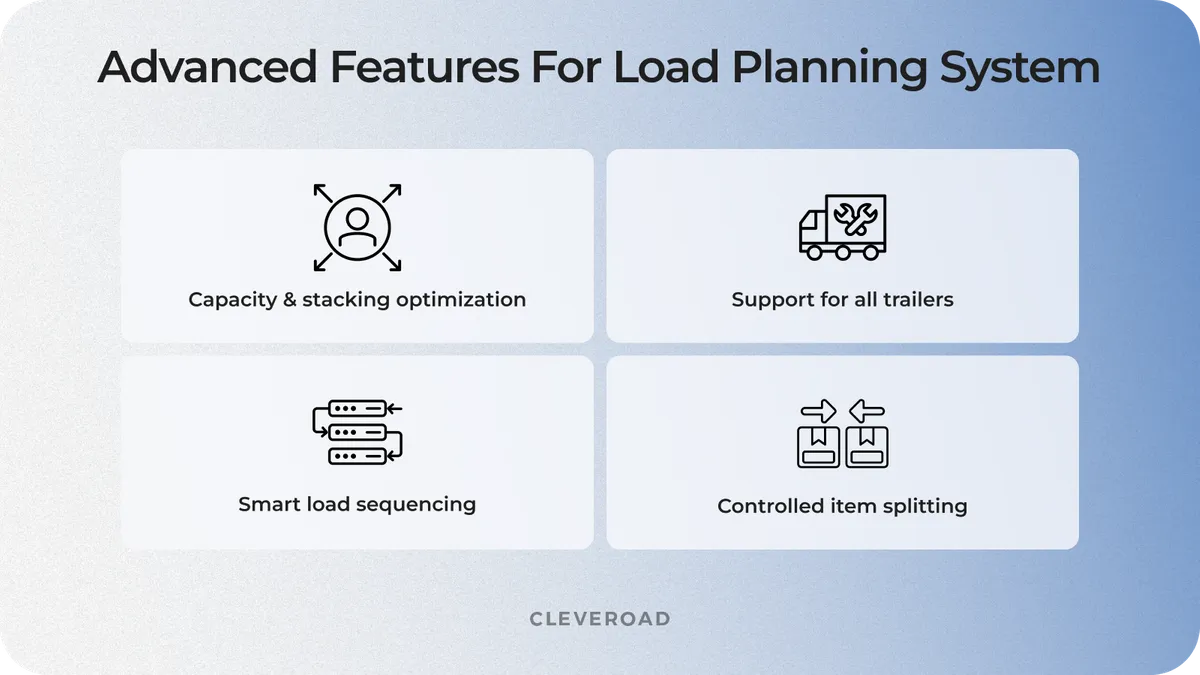
Advanced features to implement in load planning software
Advanced capacity and stacking optimization
These features also automatically double-stack and select the quick-max capacity to utilize each trailer step. Because of them, the cargo loading software determines whether the load will fit in a given area and adjusts how it is stacked. It also enables logistics managers to accelerate cargo density optimization while meeting safety and regulatory requirements.
Unlimited trailer types
This is critical for enabling multimodal logistics to support multiple trailer and container types. Users can input various equipment specifications, including axle capacity, compartment, pinwheel configuration, and door locations. The flexibility allows for a seamless connection between the different classes of transport, maximizing competence in specific transport and minimizing changeover cost.
Flexible load and unload sequencing
The software also optimizes the sequencing of stops, helping position goods in the trailer for removal at each stop as slowly as possible. For both truck and container loading for shipment, arrangements are made to minimize unnecessary handling. It also includes customer-defined overrides for prioritized unloading and other business-specific needs.
Split item control
As a result of re-ordering pallets, the system controls which items are co-packed within the pallets to reduce travel time and ensure efficient fulfillment of orders. Integrated palletizing logic keeps items bound for the same location together unless absolutely necessary. This shortens sorting time at warehouses, minimizes errors during shipments, and increases accuracy across logistics.
Partnering with experts in Logistics software development services ensures your system handles complex cargo constraints and scales with your supply chain
How to Integrate the Truck Load Optimization Software With Your Workflow?
Load planning software development and implementation can be performed in many directions. We’ll describe the standard approach to logistics product creation, but the number of stages may vary depending on your business needs and requirements.
Step 1. Define the integration needs of the load planning app
First, you should understand your business goals and challenges before integrating truck-loading software. Whether you’re looking to boost payload capabilities or optimize route planning, clear objectives will allow developers to deliver a customized solution. Review cargo placement rules, including stacking, weight distribution, and order sequencing, to maximize efficiency. By doing so, you will be able to optimize your loading process efficiently.
Step 2. Decide between off-the-shelf and custom load planning software
Before choosing a development partner, logistics companies should determine whether an off-the-shelf solution is sufficient or whether a custom system is required. Ready-made trailer loading software can be deployed quickly and usually includes basic planning capabilities, such as pallet arrangement, space visualization, or automated load calculations. However, companies managing complex freight operations often require more flexibility, deeper integrations, and support for company-specific cargo constraints and loading rules.
Typical differences between off-the-shelf and custom load planning software include:
- Off-the-shelf solutions. Faster deployment and lower upfront cost, but limited customization and restricted ability to generate optimized load plans for complex shipment structures.
- Custom solutions. Tailored to company workflows, allowing logistics teams to model constraints more precisely and build the optimal load for multi-stop deliveries and mixed cargo, as well as consolidated freight.
If your logistics operations require custom load-planning logic, working with an experienced logistics software vendor is essential. A reliable partner should demonstrate domain expertise, experience integrating logistics platforms, and the ability to design scalable solutions that align with real-world supply chain workflows.
Step 3. Solution Workshop and Discovery Phase
Solution Design phase includes identifying and analysis of your business requirements and challenges to draft a high-level feature list and solution architecture for future cargo planning software. Considering your goals and constraints, the software vendor estimates project costs and proposes tailored solutions within about two weeks.
- Solution Design Phase is free of charge at Cleveroad to align your business requirements with a proper tech implementation.
Following this step, the Discovery Phase services offered by the software vendor streamline project requirements into a comprehensive plan, expediting load plan software development. Your logistics software experts develop a detailed feature list, analyze business processes, and facilitate a quality attributes workshop. They develop a design concept and UX map, provide cost estimates, conduct a competitive analysis, and assemble a dedicated team to build your logistics solution. Upon agreement, they sign a development contract to ensure transparent collaboration.
Step 4. Development and integration
You can choose between the two options of load planning and scheduling software development:
- Standalone solution development: Creating a unique load planning software product that fully meets your needs and objectives.
- Integration with existing systems (TMS): Align the new load plan solution with your current traffic management systems (TMS), to ensure interoperability and complementarity.
Like any other IT solution, truck load planning software is typically developed during sprints, which are two-week intervals for certain functionality fulfillment and integration of various tools, e.g. trucking APIs. Each sprint starts with a planning session and ends with the delivery of a working product or feature. All teams are led by PMI-certified project managers who can clearly communicate requirements and coordinate workflows and communication among stakeholders and the team.
Combining multiple software applications into a single system will allow you to centralize and integrate all your supply chain features and tools. Such a combination of logistics apps will improve workflow efficiency and prevent disruptions to the supply chain management system, ultimately reducing freight costs.
Step 5. Support and maintenance
Cargo planning software solutions are complex, interconnected systems that may require multi-tier technical support options and maintenance services. This work may include support for the deployed software, version upgrades, adding new functionality, code optimization, etc.
Implementing load planning software requires deep expertise in logistics workflows, cargo optimization algorithms, and integration with systems such as TMS, WMS, and ERP platforms. At Cleveroad, we have over 15 years of experience developing logistics solutions, helping transportation companies, warehouses, and 3PL providers build scalable planning systems tailored to their needs.
This is how John Salmon, the owner of MoveUp transportation solution, responds about cooperation with Cleveroad:
John Salmon, Founder at Unified Potential, Inc.dba MoveUP. Feedback about cooperation with Cleveroad
Cleveroad as Your Reliable Partner in Load Planning Digitalization
Cleveroad is a logistics software development company from Estonia helping businesses create any-scale software solutions, including WMS, TMS, Load Planning Software, Freight Rate Management System, etc. With over 15 years of software development experience, we have built expertise across multiple domains, with Logistics taking a leading role.
Our team has proven expertise in developing logistics solutions, including TMS, WMS, SCM, ERP, and custom solutions, that help transportation companies reduce operational costs, optimize inventory usage, shorten delivery times, and improve business efficiency. We begin our cooperation with an in-depth business analysis to ensure you achieve concrete business value and high-quality outcomes.
By collaborating with us, you’ll receive a row of benefits such as:
- Practical experience in logistics software development: load planning software, warehouse management systems, transportation management systems, electronic resource planning, etc.
- Collaboration with an ISO-certified partner integrating ISO 27001 security management and ISO 9001 quality management standards
- Consultation on the development and integration of your load planning solution with our logistics subject matter experts
- Full-cycle logistics software development services, including custom load planning system development, Discovery Phase, UI/UX design
- On-demand IT services: cloud logistics solutions development, legacy software modernization services, IT consulting, managed IT services, etc.
- Signing of non-disclosure agreements (NDAs) upon your request at the first contact
- Flexible cooperation models based on your needs: Staff Augmentation, Dedicated Development Team, Project-Based model
Recently, we’ve delivered one of the logistics management solutions, namely, the Transportation Management System (TMS). The platform has a built-in automated route-planning module to reduce planning costs, optimize fuel management, and create an organic, coordinated logistics ecosystem.
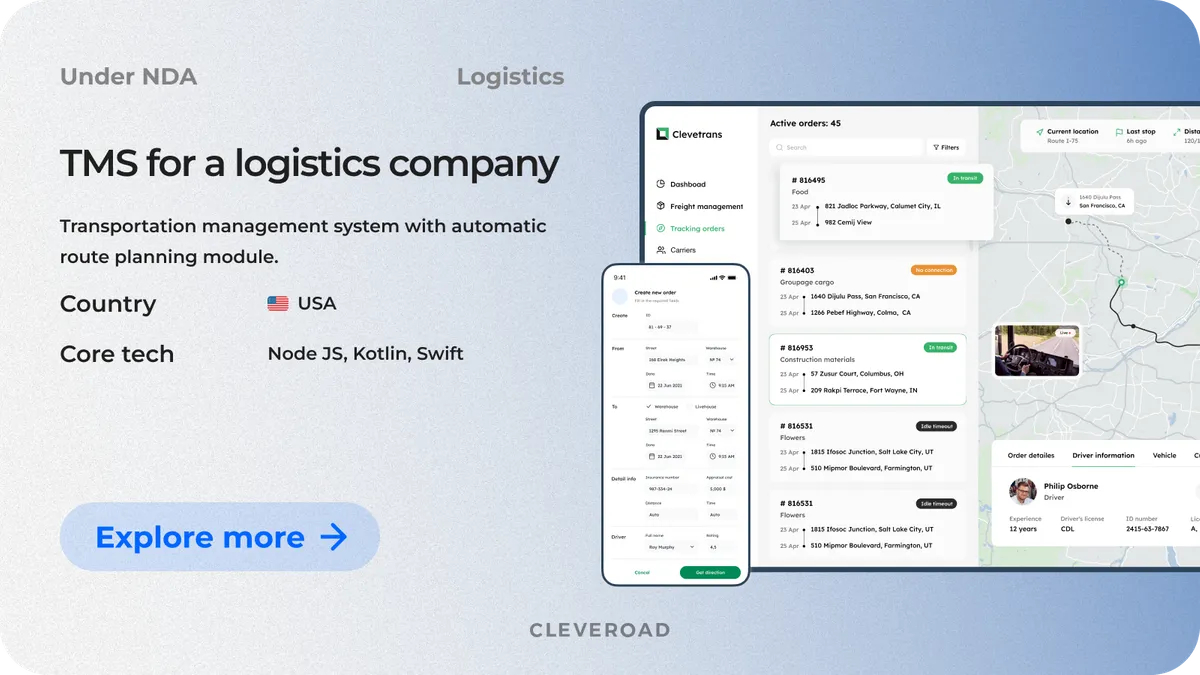
Transportation Management System designed by Cleveroad
We’ve successfully delivered end-to-end TMS, including the following modules:
- A Fleet management module helps the company track and manage fleets. For example, fleet managers can create a group of vehicles utilized in transportation flow and modify it due to changing business processes.
- Delivery points management module allows TMS users to determine everyday work location and track data changes in real-time.
- An Access system for company staff enables access level management according to the employees’ role RBAC approach.
- “Jobs for delivery” module that allowed integration with existing WMS and CRM systems for smooth data transmission.
As a result, the company reduced route planning time by up to 30% while improving fleet utilization through automated route optimization and centralized delivery management.
Logistics is a complex industry requiring a severe approach to implementing industry-specific software. Our team is prepared to help you architect a top-notch custom software solution for load planning and other parts of the supply chain. We’ll also take care of the entire software development life cycle: from the Discovery phase to maintenance for the long term. Let's cooperate and develop a powerful logistics solution in tune with your time, budget, and expectations.
Develop load optimization software with domain specialists
Get the robust load planning software solution for seamless logistics in your business, optimized efficiency, and smarter resource management
Load planning software is a logistics tool that automates the planning process of arranging freight inside trailers or containers. It helps logistics teams optimize pallet and cargo loading by calculating optimal placement based on dimensions, weight, and stacking constraints, while supporting visual load planning with diagrams showing how freight should be positioned before dispatch.
The main advantages of load planning systems come from their ability to support both planning and execution across warehouse and transportation operations. Advanced load planning functionality helps logistics teams maximize container capacity, maintain safe cargo placement, and improve shipment coordination.
Key operational benefits include:
- Lower transportation costs. Better cargo placement helps increase load density and build a full load, reducing the number of partially filled trailers.
- Higher trailer and container utilization. Algorithms optimize pallet positioning and help use available container capacity more effectively across shipments.
- Faster warehouse loading decisions. Clear diagrams and visual load planning instructions allow warehouse teams to prepare shipments faster.
- Fewer compliance and safety issues. Automated validation checks weight distribution and axle constraints before dispatch.
- Less planning errors in complex shipments. Systems support multi-stop deliveries and consolidated freight scenarios, improving the planning process and operational accuracy.
Yes. Modern load planning platforms can integrate with transportation management systems, warehouse management systems, and enterprise resource planning platforms. These integrations allow planners to exchange shipment data automatically and use routing or order information to select the right software configuration for operational workflows.
Many platforms also support the process of planning freight across different vehicle types, including container and trailer equipment. Solutions may include intelligent loading algorithms and cubing software to calculate optimal cargo placement for various load scenarios. Some systems can also manage specialized equipment such as an air container, support adding the load dynamically during shipment preparation, and provide real-time 3D visualization to help planners verify cargo placement before loading begins.
The cost of load planning software depends on system complexity, integration requirements, and the level of automation required to manage freight operations. Solutions designed to optimize container capacity and support complex shipment scenarios generally require greater development effort, which affects the overall investment.

Evgeniy Altynpara is a CTO and member of the Forbes Councils’ community of tech professionals. He is an expert in software development and technological entrepreneurship and has 10+years of experience in digital transformation consulting in Healthcare, FinTech, Supply Chain and Logistics
Give us your impressions about this article
Give us your impressions about this article