How to Build a Mental Health App: Features, Compliance, and Cost
Updated 01 Sep 2026
15 Min
1379 Views
Finding qualified mental health support has become harder as demand outpaces the number of licensed clinicians. Providers run long waiting lists while patients expect access from their phones. If you are building for a health system or launching a digital health product, a mental health app is one of the few ways to widen access without adding physical capacity.
The product has to satisfy your users and your regulators at the same time. The app type you pick decides which privacy rules apply, whether you need clinical oversight, what crisis safeguards you must ship, and what the build costs. Add an AI feature and a second legal layer opens, especially if that feature screens symptoms or shapes care decisions.
Cleveroad has built mental health software since 2011. Our experience covers mental health solutions for therapy, remote consultations, patient support, progress tracking, and personalized care. Based on our experience in healthcare software development, we created this mental health app development guide to walk you through app types, core features, compliance requirements, tech stack, and budget considerations.
Key takeaways:
- The type of mental health app you choose sets your regulatory load and budget more than any later development decision.
- AI in the care loop can trigger state-level legal duties, so a chatbot needs legal review before launch.
- Mental health app development costs range from $45,000-$70,000 for a self-management MVP to $150,000-$300,000+ for a teletherapy platform.
What Types of Mental Health Apps Can You Build?
More than one billion people worldwide live with a mental health condition, according to a September 2025 report from the World Health Organization. Yet a 2025 study of 57,000 people across 21 countries, published in JAMA Psychiatry, found that only 6.9% of those who met criteria for a mental or substance use disorder received effective treatment. Digital products can close part of that gap through self-guided support, early screening, crisis resources, and remote clinical care.
If you are considering mental health app development, you should know that the gap between categories is wide. A meditation app may operate as a consumer wellness product, while a teletherapy platform must support protected health information, licensed clinicians, clinical workflows, and emergency escalation.
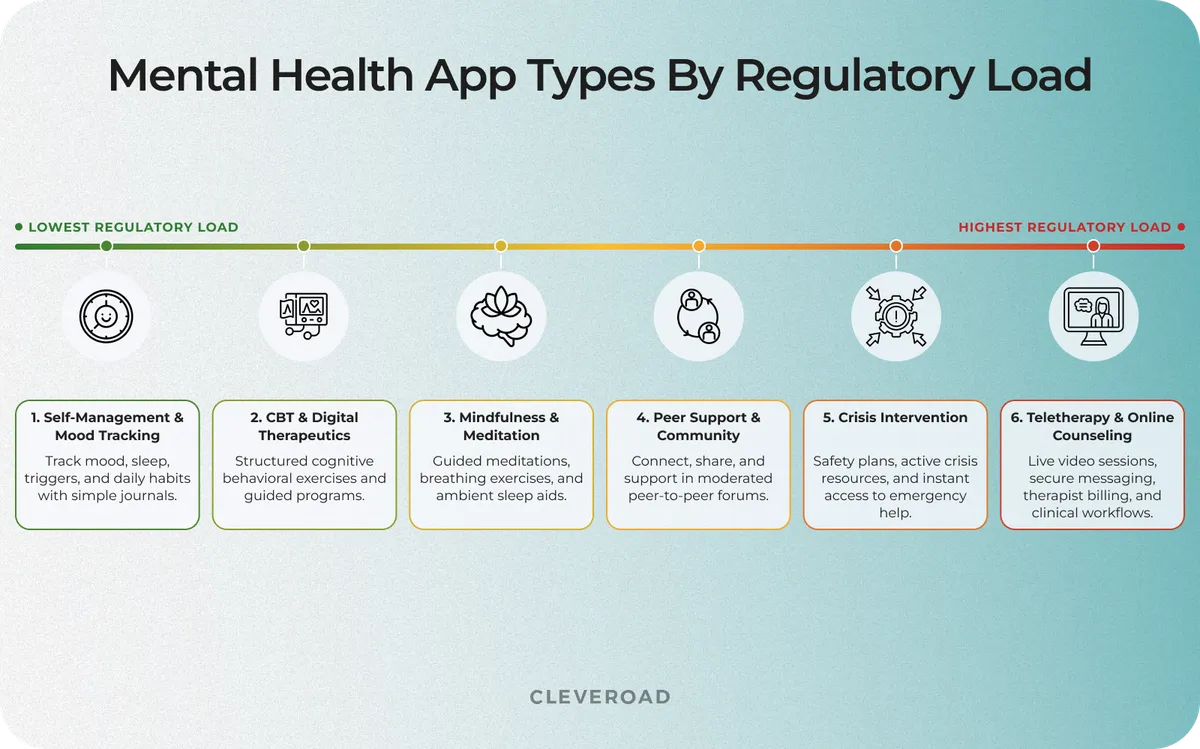
Mental Health App Types By Regulatory Load
Self-management and mood tracking
Self-management apps help users track mood, sleep, symptoms, medication, stress, and personal triggers. The app turns daily entries into clear trends that users and therapists can review quickly. This category has the lowest regulatory load while data stays with the user and the app makes no diagnostic or treatment claims. The scope changes once the product shares data with providers, integrates with an EHR, or becomes part of clinical care.
A mood tracker is often the best MVP because it delivers immediate value while helping validate demand before adding therapist access, clinical assessments, or AI features. Our guide to wellness app development covers how tracking, sleep, and mental wellness features fit into a broader consumer product.
CBT and digital therapeutics
Cognitive Behavioral Therapy (CBT) apps guide users through structured exercises such as thought records, cognitive reframing, behavioral activation, and exposure tasks. Some also let clinicians assign activities and review progress between sessions.
The regulatory load depends on the product claims. Educational tools may remain in the wellness category, while diagnostic or treatment claims require stronger clinical evidence and may trigger medical device oversight. Define the intended use before development to determine validation needs, marketing limits, and regulatory support.
Mindfulness and meditation
Mindfulness apps offer guided meditation, breathing exercises, sleep stories, and stress-management programs. They are relatively cheap to build, but difficult to differentiate from established platforms and free content.
The strongest strategy is a narrow audience focus, such as night-shift nurses, veterans with PTSD, or new parents. Before development, confirm that you have a unique content source, clinical partner, licensed program, or trusted community that can support retention.
Peer support and community
Peer support apps connect users through group discussions, direct messages, moderated communities, or scheduled sessions. They can reduce isolation, but safety controls matter more than engagement features.
From the first release, the platform needs reporting tools, trained moderators, crisis escalation rules, and clear response times. Before development starts, define who may join each community, how harmful content is detected, and when users move to professional support.
Crisis intervention and safety planning
Crisis support apps help users build a personal safety plan, recognize warning signs, list coping strategies, contact trusted people, and reach a crisis line in one tap. Some add location-specific emergency resources or let clinicians update a patient's safety plan directly.
Reliability is the whole product. A polished interface means little against an unavailable hotline link, a delayed alert, an incorrect location match, or a failed escalation at the moment it matters. Core requirements include tested crisis-resource directories, offline access to safety plans, visible emergency controls, and clear limits on what the app can provide.
Teletherapy and online counseling
Teletherapy apps connect patients with licensed therapists through video calls, secure messaging, scheduling, treatment plans, and billing. They may also include therapist matching, intake forms, clinical notes, and progress assessments.
This category carries the highest regulatory and technical load. A US-focused platform usually needs a HIPAA-ready environment, BAAs, role-based access, audit trails, consent management, secure communications, protected data storage, and compliance with state licensing rules. Adoption also depends on both patient convenience and efficient therapist workflows across scheduling, documentation, billing, and crisis escalation.
Explore Cleveroad's mental health software development services for therapy, psychiatry, addiction treatment, mindfulness, and remote behavioral care
Must-Have Features for a Mental Health App
Crisis screening at onboarding belongs in every mental health app, whether the product supports meditation, CBT, self-management, or teletherapy. A user who discloses self-harm risk or acute distress needs an immediate escalation path, not another article or breathing exercise.
Every other feature has to earn its place based on your app type, care model, and regulatory scope. A self-management app may need fast mood logging and reminders. A teletherapy platform also needs secure video, clinician dashboards, and protected health data controls.
Mood tracking and self-monitoring
Mood tracking is the daily-use backbone of most mental health apps. Users log mood, sleep, medication, stress, triggers, symptoms, and completed exercises.
Keep the logging flow short. Long forms and repeated questions drive drop-off in the first week, which is exactly when the habit either forms or does not, so build around one-tap inputs, short scales, voice notes, or quick journal prompts. You can also let users share selected records with a therapist. Once that data enters a clinical workflow, your compliance scope and access controls get stricter.
Based on the data users enter, the app can generate the following outputs:
- Mood and symptom trends
- Trigger patterns
- Medication adherence
- Sleep correlations
- Progress across therapy exercises
Crisis screening and safety planning
Crisis screening should appear during onboarding and at relevant points in the user journey. Ask validated questions about self-harm risk, severe distress, abuse, or immediate danger.
A high-risk response should trigger a predefined safety flow. That flow may include:
- A personal safety plan
- One-tap access to a crisis line, such as the 988 Suicide & Crisis Lifeline in the US
- Emergency contact options
- Location-specific support resources
- Clear instructions for urgent help
Test these flows under poor connectivity and incomplete user data before you launch. A crisis path that works on office wifi and fails on a weak mobile signal is not a crisis path.
CBT modules and psychoeducation
CBT features guide users through structured activities: thought records, cognitive reframing, behavioral activation, exposure tasks, and coping plans. Short educational materials explain symptoms, treatment methods, and self-care techniques.
Have a licensed clinician review every piece of therapeutic content before release. The same applies to scripts, assessments, and any recommendation that could influence a care decision.
Strong CBT modules usually include:
- Clear instructions
- Short exercises
- Progress tracking
- Reflection prompts
- Clinician-approved explanations
State plainly whether your content supports general wellness or forms part of a regulated treatment program. That single line in your app affects both your compliance position and your marketing copy.
Secure messaging and video sessions
Secure messaging and video calls apply mainly to teletherapy and online counseling platforms. They let patients contact therapists, attend sessions, exchange documents, and receive follow-up instructions.
The teletherapy scope may also require:
- Appointment reminders
- Waiting rooms
- Therapist availability
- Secure file exchange
- Session notes
- Consent records
AI chatbot and sentiment analysis
An AI chatbot can support users between sessions with check-ins, guided exercises, reminders, and answers drawn from approved content. Sentiment analysis can flag patterns in journal entries that deserve human review.
Keep AI on the support side of the care loop. Your app must disclose clearly that the user is interacting with software, and it must never present chatbot output as a clinician's diagnosis or treatment decision.
Use Cleveroad's AI Strategy Advisor to assess use-case fit, data constraints, regulatory exposure, and the level of human oversight your care product needs
Care-team dashboard and scheduling
The care-team dashboard gives therapists one view of patient progress, risk flags, completed exercises, session history, and upcoming appointments. This feature usually decides whether therapists adopt your app at all. A weak dashboard creates administrative work; a focused one helps clinicians prepare for sessions and react faster when something changes.
A clinician-facing dashboard may include the following capabilities:
- Patient status summaries
- Risk alerts
- Session scheduling and calendar synchronization
- Progress reports
- Role-based access
- Notes and follow-up tasks
The table below maps how critical all these features are against the five app types.
| Feature | Self-management | CBT | Meditation | Crisis | Teletherapy |
|---|---|---|---|---|---|
Mood tracking | Yes | Yes | Optional | Optional | Yes |
Crisis escalation | Yes | Yes | Yes | Yes | Yes |
AI chatbot | Optional | Optional | Optional | Optional | Optional |
Video calling | No | Optional | No | No | Yes |
CBT modules | Optional | Yes | No | Optional | Optional |
Peer community | Optional | Optional | Optional | Optional | Optional |
Care-team dashboard | No | Optional | No | Optional | Yes |
Cost to Build a Mental Health App
Mental health app development may cost from $45,000 to $300,000+. Your final budget depends on platform coverage, AI scope, EHR integration depth, and regulatory requirements.
Self-management or mood-tracking MVP
A self-management MVP usually costs $45,000-$70,000 and takes 3-4 months. That buys one mobile platform or a cross-platform app, a lightweight backend, a minimal admin panel, and a feature set covering mood tracking, reminders, progress reports, and crisis resources.
This tier works well if you want to validate demand, onboarding, and retention before investing in clinical workflows or integrations. A focused release also helps you build a minimum viable product around one clear user need.
CBT or AI-enabled mid-tier app
A CBT or AI-enabled app usually costs $90,000-$150,000 and takes 5-7 months. Typical scope covers structured therapy modules, AI-assisted support, role-based access, content management, progress dashboards, and crisis escalation logic, plus validated instruments such as the Patient Health Questionnaire-9 (PHQ-9) and Generalized Anxiety Disorder-7 (GAD-7).
Compliance work at this tier adds $5,000-$25,000, covering risk analysis, BAAs, encryption, access controls, audit logging, and baseline privacy and security policies.
Teletherapy or blended-care platform
A teletherapy or blended-care platform usually costs $150,000-$300,000+ and takes 7-12 months. This category supports direct clinical care, so both the technical and the compliance scope widen.
Common capabilities include:
- Secure video consultations
- Patient and therapist portals
- Scheduling, reminders, and billing workflows
- EHR integration and clinical notes
- Multi-role access and referral management
- Crisis escalation and administrative reporting
The platform will also need a full HIPAA-ready environment, BAAs, penetration testing, audit logs, and vendor risk reviews. Compliance costs here reach $40,000-$100,000 once enterprise buyers start requesting penetration test reports, security questionnaires, and vendor due diligence. Our guide to the cost of telemedicine app development explains how clinical workflows and integrations move the estimate.
The table below compares the three tiers on included functionality, platform coverage, timeline, and cost.
| Scope | What the MVP includes | Platforms | Timeline | Cost range |
|---|---|---|---|---|
Self-management or mood tracking | Mood logs, journaling, reminders, crisis resources, basic admin | One platform or cross-platform | 3-4 months | $45,000-$70,000 |
CBT or AI-enabled app | Assessments, CBT modules, AI support, role-based access, content management | iOS and Android or cross-platform plus web admin | 5-7 months | $90,000-$150,000 |
Teletherapy or blended care | Video sessions, scheduling, billing, EHR integration, multi-role portals, HIPAA controls | Mobile apps plus clinician and admin web portals | 7-12 months | $150,000-$300,000+ |
Treat these tiers as starting points rather than quotes. Two apps in the same tier can differ by $40,000+ depending on how many external systems they touch and whether a licensed clinician has to sign off on the content.
What drives the cost up
Clinical depth drives the budget more than the number of screens. The largest cost factors include following:
- Clinical content creation. A licensed clinician reviewing CBT programs, crisis scripts, and assessment copy is a separate line item from engineering, billed at a clinical consulting rate rather than a developer rate.
- Security audits. Penetration testing, risk assessments, and remediation land before launch, and enterprise buyers often require a second round after their own review.
- Accessibility. Screen-reader support, adaptable text, and clear navigation need testing against WCAG standards, which matters more here than in most consumer categories because impaired concentration is a symptom your users bring with them.
- AI safeguards. Testing output quality, crisis detection, escalation logic, and unsafe responses is slow work that cannot be automated away.
- EHR integration. Read access fits inside a normal sprint. Write-back, with its data mapping, validation, and audit logs, is its own milestone.
- Ongoing clinical updates. Programs, questionnaires, and safety resources need scheduled review, not one-time authoring.
Annual maintenance and clinical content updates typically run 25%-35% of the initial development budget, covering infrastructure, security patches, compliance updates, model evaluation, support, and new functionality.
Integrations That Make a Mental Health App Useful
A mental health app that does not connect with a clinician's existing tools becomes one more login they avoid. The integrations worth building put patient data inside the systems providers already use for records, scheduling, billing, and care coordination.
EHR and EMR integration
Start with read access and concise patient summaries through Fast Healthcare Interoperability Resources (FHIR). Clinicians should see relevant mood trends, appointments, assessments, and risk flags without opening a second system.
Treat full write-back into an EHR as a separate milestone. It demands stricter data mapping, validation rules, permissions, audit logs, and conflict handling.
Cleveroad used this approach for an online psychiatric care ecosystem. Our team built a HIPAA-compliant telehealth platform and synced appointment data with Kareo, the EHR the provider had used for years. We added a referral module and an admin panel for partner collaboration.
A staged approach reduces integration risk:
- Read patient and appointment data
- Display short clinical summaries
- Add controlled write-back
- Validate every data exchange
- Log all record updates
Explore how HL7 integrations connect healthcare apps with EHR and EMR systems.
Wearables and passive monitoring
Sleep and activity patterns often shift before a patient reports anything in session. Those signals help clinicians spot reduced sleep or missed routines while there is still time to act.
Use Apple Health or Google Health Connect as aggregation layers instead of integrating every wearable separately. One connection gives you data from many supported devices and spares your team years of per-vendor maintenance. Passive data should support clinical review, not trigger automatic conclusions. Patients also need clear controls over which data the app collects and shares.
By the way, we at Cleveroad have experience integrating wearables with healthcare applications. For a German nursing-service provider, Cleveroad delivered a remote patient monitoring system with a caregiver web app. The platform collected patient data continuously and notified caregivers when something needed attention, leaving the interpretation to a person rather than the system.
Scheduling, billing, and payer workflows
Calendar sync and appointment reminders cut missed sessions. Eligibility checks before an appointment prevent billing disputes after the care has already happened.
A teletherapy platform may need connections with:
- Google Calendar or Microsoft Outlook
- Practice management software
- Payment gateways
- Insurance eligibility services
- Claims and billing systems
- Employer benefit platforms
Employer and payer distribution depends on these connections. Your product can have excellent therapy features and still stall at procurement if scheduling and billing sit outside the buyer's daily workflow.
Our guide to mHealth app development explains how integrations, patient-facing features, and clinical workflows fit into one healthcare product
Cleveroad Expertise in Mental Health & TeleHealth App Development
To demonstrate our expertise in mental health software development, we would like to present two of our healthcare projects that show the range of work a mental health product can involve: building one from scratch around a licensed clinical program, and taking over an inherited platform that needed technical recovery before it could ship.
NLS mental health app
Our client is Nedley Health Solutions, a US mental health organization founded by Dr. Neil Nedley, creator of the Nedley Depression and Anxiety Recovery Program. The client wanted its proprietary program available through a free iOS app for people experiencing depression, anxiety, insomnia, and related conditions.
To address the client's business goals, our team built an iOS app from scratch. It lets users record daily progress, complete scheduled depression assessments, follow personalized seven-day timetables, and receive recommendations without a paywall.
The recommendation engine uses Big Data algorithms to compare each user with people who have similar profiles and identify the activities that helped that group most. The app then selects the next activity based on those patterns and adapts the timetable to age, weight, lifestyle, and onboarding data.
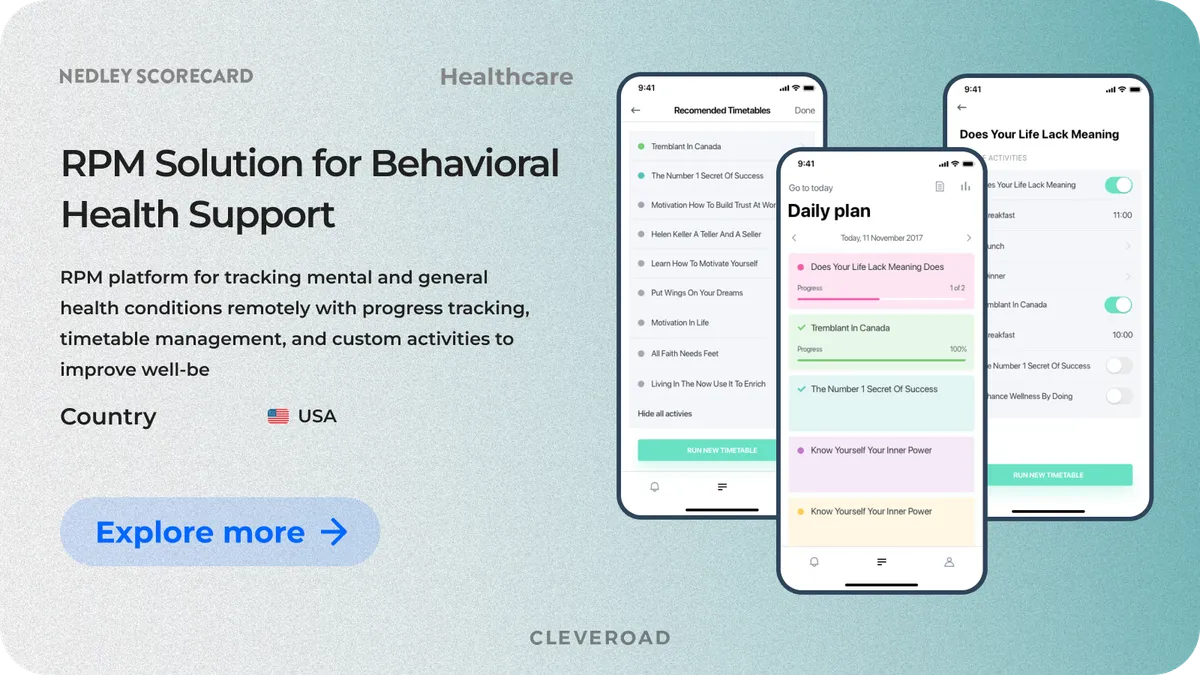
NLS app home screen showing a seven-day activity timetable alongside the user's most recent depression assessment score
As a result, our client received a polished iOS app that delivers the licensed Nedley Depression and Anxiety Recovery Program through a clear, personalized user experience. The solution gave our customer a scalable way to reach people who could not attend the program in person.
- Explore the mental health app case study to learn more details.

 USA
USA


Codex Labs telehealth platform
Cleveroad supported Codex Labs with DECODE.ME, an inherited healthcare platform that needed technical recovery and preparation for production use. Our team reviewed the existing codebase, resolved critical issues, strengthened the HIPAA-oriented infrastructure, and prepared the product for a public industry demonstration.
Within five months, Cleveroad assessed the inherited codebase, fixed critical backend issues, strengthened the HIPAA-ready infrastructure, and prepared a stable demo for release. Dozens of dermatologists then tested the platform during its first public presentation, and our team continues to expand its functionality with Codex Labs.
Watch Barbara Paldus, Founder and CEO of Codex Labs, describe the cooperation with Cleveroad and the work behind DECODE.ME.
Dr. Barbara Paldus, CEO at Codex Labs: Feedback on Cleveroad's Telemedicine Development Services
Why Choose Cleveroad as Your Mental Health App Development Partner
Cleveroad is a mental health software development partner with 15+ years of experience in MedTech. Our custom healthcare software development services cover mental health and wellness apps, EHR and EMR services, patient portals, telemedicine platforms, remote patient monitoring software, and AI-enabled healthcare products. We design them around clinical workflows, patient data protection, regional regulations, and the systems providers already use.
Working with Cleveroad gives you:
- Healthcare integration expertise. We connect mental health products with EHR and EMR systems, telehealth platforms, wearables, payment services, and insurance tools.
- Certified quality and security processes. ISO 9001 and ISO 27001-certified practices support controlled delivery and secure handling of sensitive healthcare data.
- Access to the right specialists. Our 280+ in-house engineers cover product discovery, design, development, QA, DevOps, AI, and healthcare integrations. A network of 2,100+ external specialists helps us add niche expertise when required.
- Confidential cooperation. We sign an NDA on request and restrict project access to authorized team members.
- Flexible cooperation models. Choose end-to-end development, a dedicated team, or staff augmentation. You can adjust the team size and delivery model as the product scope changes.
- Faster AI-assisted delivery. Our AI-first development approach applies coding copilots, AI agents, automated testing, and code review tools to shorten delivery cycles while engineers retain control over quality and security.
Build a compliant mental health app with Cleveroad
Rely on 15+ years of healthcare software development expertise to build a secure mental health app aligned with your care model, integrations, and compliance requirements
Mental health app development costs from $45,000 to $300,000+, depending on clinical depth and integrations.
- A self-management or mood-tracking MVP costs $45,000-$70,000.
- A CBT or AI-enabled app costs $90,000-$150,000.
- A teletherapy or blended-care platform costs $150,000-$300,000+.
Platform coverage, EHR integration, AI safeguards, security testing, and compliance requirements can all push the final estimate higher.
Every first release needs crisis screening, a safety plan, one-tap access to emergency resources such as the 988 Suicide & Crisis Lifeline, and clear escalation rules. The rest depends on your app type: a self-management MVP adds mood tracking, journaling, reminders, and progress reports, while a clinical product requires validated assessments like the PHQ-9, role-based access, secure communication, and a care-team dashboard.
Only when it handles protected health information for a covered healthcare provider, payer, or business associate. A direct-to-consumer wellness app usually falls outside HIPAA.
Falling outside HIPAA is not the same as falling outside regulation. The FTC's Health Breach Notification Rule has covered health apps since July 2024, and state privacy laws add their own duties. Work out who receives your data and how the app fits into care before you pick a compliance model.
Development usually takes 3 to 12 months.
A focused self-management MVP takes 3-4 months. A CBT or AI-enabled product takes 5-7 months, while a teletherapy platform with EHR integration and multi-role workflows needs 7-12 months or longer.
Take a journaling app that flags a change in tone for a clinician to read. That pattern, where AI surfaces something and a person decides what it means, is the safe shape. Approved-content search, reminders, journaling prompts, and note summaries all fit it, and each still requires privacy controls, output testing, and clear disclosure that the user is interacting with software.
AI should not independently diagnose users, prescribe treatment, or replace crisis support. Nevada bans AI from providing professional mental healthcare outright, and Illinois restricts therapeutic decision-making to licensed professionals, so any feature that touches care, safety, or escalation needs human oversight and a state-level legal review before release.

Evgeniy Altynpara is a CTO and member of the Forbes Councils’ community of tech professionals. He is an expert in software development and technological entrepreneurship and has 10+years of experience in digital transformation consulting in Healthcare, FinTech, Supply Chain and Logistics
Give us your impressions about this article
Give us your impressions about this article