Custom mHealth App Development in 2026: Types, Features, and Cost
Updated 16 Jul 2026
16 Min
4408 Views
Custom mHealth app development helps healthcare providers give patients convenient mobile access to appointments, virtual consultations, health records, medication plans, and ongoing care. A patient-facing mHealth solution can also connect these interactions with clinical systems and reduce manual work for medical staff.
With 15+ years of experience in healthcare software development, Cleveroad helps medical organizations plan and deliver secure, scalable mobile products. In this guide, we explain how to define the right feature set and select a suitable technology stack while avoiding common risks in mHealth app development. You can also explore our interactive telemedicine app demo to see how patient-side and provider-side workflows work in practice.
Key takeaways:
- Patient-facing mHealth apps improve access to care and support stronger patient engagement.
- A successful medical app requires intuitive UX, secure health data exchange, and compliance.
- App scope, integrations, platforms, and security requirements have the greatest cost impact.
- A clear product strategy helps healthcare organizations reduce development risks and prepare the app for future growth.
What is Custom mHealth App Development?
Custom mHealth app development is the process of creating a mobile healthcare application meeting the specific needs of patients and healthcare providers.
Unlike off-the-shelf software with predefined functionality, a custom mHealth app supports a specific care delivery model and clinical workflow. It can give patients access to health information, let them attend remote consultations, and help them manage appointments and medication plans. The app can also provide a direct communication channel between patients and their care teams.
Reasons to adopt mHealth for patient care
mHealth apps help you extend care beyond clinics and maintain regular contact with patients. They provide particular value for chronic disease management, preventive care, rehabilitation, and other scenarios that require frequent health checks. For example, patients can record symptoms and contact a doctor through a single mobile interface. The app can also send medication reminders. Care teams can use this data to detect changes earlier and adjust the care plan when needed.
Mobile appointment tools can also improve care continuity. A 2025 Applied Sciences study found that an automated confirmation system with reminders and quick response options reduced the no-show rate at a mental health outpatient clinic from 18.55% to 7.01%. More than 93% of surveyed patients also rated the system as intuitive and aligned with their expectations. The results come from one clinical setting, but they show how well-designed mobile communication can reduce missed visits and improve patient engagement.
Remote access also reduces the need for some in-person visits. Patients who live far from medical facilities can book virtual consultations, receive follow-up instructions, and access essential services without long trips. According to Grand View Research, the global mHealth apps market is projected to reach $49.9 billion in 2026 and $86.4 billion by 2030, with a 14.8% CAGR from 2025 to 2030.
These figures show both sides of mHealth adoption: expanding market demand and measurable improvements in patient attendance. However, value depends on whether the app solves a defined patient problem, supports clinical workflows, connects with existing systems, and protects sensitive medical data.
Promising trends in mHealth app development
mHealth development in 2026 focuses on personalized care and stronger integration with clinical systems. The key trends of developing mobile apps for healthcare include:
- AI-driven personalization. AI adapts reminders and care recommendations to each patient. It personalizes educational content, helps providers prioritize follow-ups, and detects risk patterns.
- AI-enabled wearables and remote patient monitoring. Connected medical devices collect real-time health data. Then, mHealth apps analyze this data and alert care teams when patient indicators require attention.
- Mobile telemedicine. Video consultations, secure messaging, appointment booking, and digital forms allow patients to access more services through one mobile interface.
- Digital medication support. Mobile apps provide e-prescriptions, refilling requests, dosage schedules, and medication reminders to support treatment adherence.
- Medical imaging access and analysis. Mobile solutions give authorized users secure access to diagnostic images and reports. Integration with medical imaging software development solutions can also support clinical review and treatment planning.
Explore Cleveroad’s mobile development services to build an end-to-end iOS or Android health app!
Key Types of Mobile Health Apps
Before diving into the details of custom mHealth app development, it’s crucial to determine what healthcare solutions exist. In general, mHealth software falls into the following types.
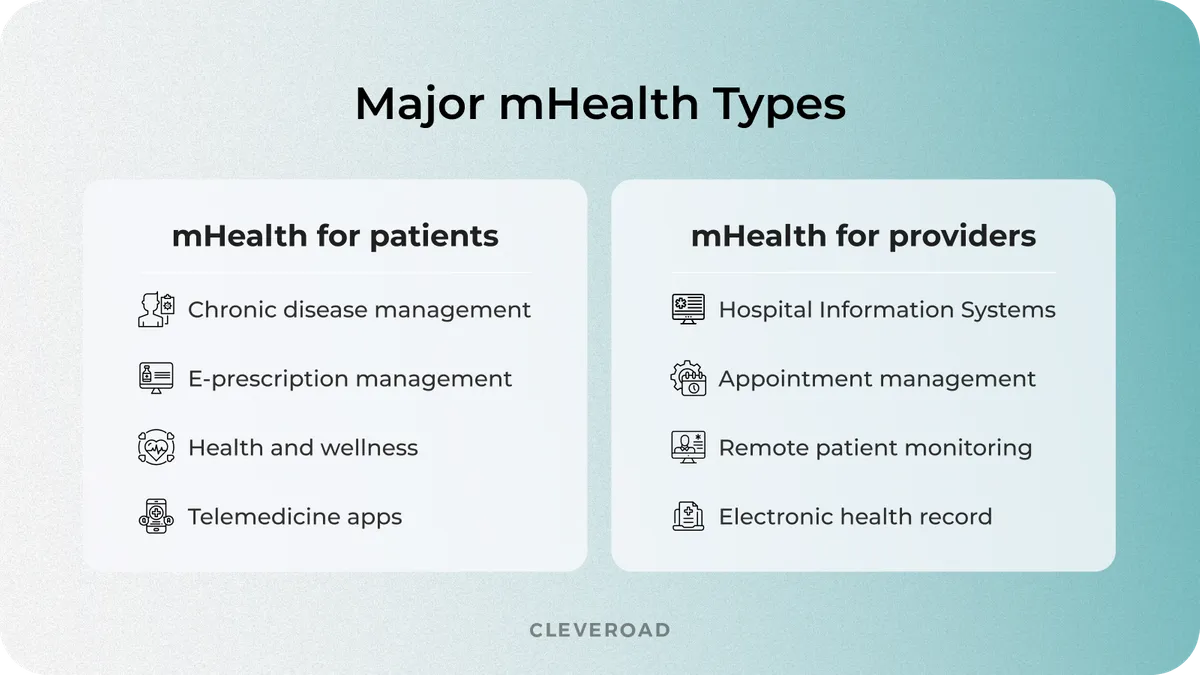
Categories of mHealth apps
mHealth for patients
Among the applications for patients, there are the following main solutions to ensure quality medical services and improve overall healthcare efficiency:
- Health and wellness apps. Health and wellness apps help users improve their well-being through small daily steps. They include mental health tools, meditation guides, self-monitoring for critical indicators, and many more.
- E-prescription management apps. E-prescription apps allow authorized clinicians to issue and submit digital prescriptions.
- Chronic disease management apps. These applications greatly simplify the provision of systematic care by allowing doctors to monitor the status of chronically ill patients online.
- Telemedicine apps. Telemedicine software development is a great way to receive and provide healthcare services online. They allow doctors to monitor, assess, diagnose, and consult patients even if they are not located in a medical organization.
A great example of telemedicine applications is patient portals. They allow the therapist immediate access to all patient health data while providing secure storage.
mHealth for providers
Provider-facing mHealth apps can improve medical operations through the following solutions:
- Electronic Health Record (EHR) apps. EHR shows full information about patients, and physicians can monitor the history of diseases, set reminders, communicate with patients, and more, making it essential to understand how to build EHR effectively.
- Remote patient monitoring. These applications, often combined with various wearables, allow for tracking and analyzing patients’ health conditions.
- Health insurance app. This software allows patients to find a doctor according to their insurance, receive important checkup reminders, fill out waiting room forms online, and book appointments.
- Hospital Information Systems. This system allows you to automate the workflow for medical institutions, combining a medical decision support system, electronic medical records, etc.
- Appointment management app. Such systems allow you to schedule and manage appointments, provide convenient scheduling, and reminders of upcoming meetings.
- Medical reference apps. These applications are extensive databases containing the necessary information about the drugs, treatment approaches, medical calculators, etc.
mHealth app development benefits both patients and healthcare providers. Let’s get acquainted with them to get a complete picture of all the advantages of mobile medicine.
How Do mHealth Apps Improve Patient Care and Clinical Workflows?
mHealth apps create value when they remove barriers in the patient journey and connect mobile interactions with clinical workflows. The following examples show how mobile solutions improve access to care and clinical coordination. They also show how AI can support earlier medical decisions.
Faster access to remote care
Telemedicine is a common requirement in mHealth products, but secure compliance implementation and reliable system performance can slow delivery. This challenge became critical when Codex Labs needed to complete DECODE.ME, their mobile teledermatology app, after two previous vendors failed to complete the product.
Cleveroad rebuilt the backend and prepared secure, scalable infrastructure designed to support HIPAA requirements, with Protected Health Information (PHI) stored in a Google Cloud Platform Fast Healthcare Interoperability Resources (FHIR) environment. Our team delivered a demo-ready product within five months, in time for its presentation at the 2025 AAD Innovation Meeting before dozens of dermatologists.
Watch Barbara Paldus, Founder and CEO of Codex Labs, discussing the collaboration with Cleveroad:
Dr. Barbara Paldus, CEO at Codex Labs: Feedback on Cleveroad’s Telemedicine Development Services
Connected records and care coordination
A connected mHealth app gives patients mobile access to test results, prescriptions, appointments, and care plans. Patients can follow treatment instructions and communicate with their care teams without relying on paper records or separate communication channels.
Healthcare professionals can review patient histories and update charts. They can exchange information with hospitals, pharmacies, specialists, and laboratories. EHR and hospital system integration connects mobile data with clinical records and reduces duplicate entry.
Caregivers can receive approved updates about medication schedules and appointments. They can also track changes in the patient’s care plan. Role-based access controls help healthcare organizations limit each user’s access to relevant information.
AI-assisted risk detection and personalization
AI helps mHealth apps analyze patient records, wearable data, symptoms, and treatment history. Predictive models can identify risk patterns and support earlier clinical review. They can also notify care teams and help prioritize follow-ups when patient indicators require attention.
A 2025 Scientific Reports study presented an explainable AI framework that reached 97.86% accuracy in personalized health risk prediction on the MIMIC-III dataset. Generative AI can also summarize patient-reported data, prepare visit notes, explain care plans, and support personalized in-app assistants.
Every clinical AI feature requires clinical validation, professional oversight, access controls, and ongoing monitoring. A healthcare organization should select AI capabilities according to the clinical need, data availability, technical feasibility, and regulatory requirements.
Use our AI Strategy Advisor to map suitable AI features to your mHealth app’s use case.
Discover Cleveroad’s healthcare software development services to build secure telecare solutions connected with IoT medical devices
The mHealth App Development Process
Now that you have learned about mobile medicine’s types, benefits and use cases, let’s dive deeper into the custom mHealth app development process.
1. Problem identification
First, you need to define the fundamental idea of your app. Consider whether the app should support telemedicine, automate internal workflows, enable remote monitoring, or provide health and wellness tools. Determining what goals you want to achieve with your medical solution is also important.
2. Finding an experienced IT vendor
Once you have decided on the idea, move on to choosing a reliable technical partner. The most cost-effective option today is outsourced mHealth app development. This will allow you to reduce the time and cost of finding and maintaining an in-house team and speed up the time-to-market.
When looking for a mHealth app development company, you should focus on their expertise in mobile development and experience in the healthcare domain. Also, pay attention to customer reviews on platforms like Clutch and GoodFirms and vendors’ portfolios. Finally, compare the regional talent pool, healthcare expertise, average hourly rate, and time-zone overlap. Central and Northern Europe (Estonia in particular) scores well on all four, combining experienced specialists with relatively low rates driven by low taxes and strong state support for the IT sector.
3. Solution Design stage
After you get in touch with the chosen software provider, the manager will set an appointment with the solution design team. The specialists will discuss the project with you and detail the requirements, defining the business goals, the scope of work, basic quality attributes, and key concerns. Based on this data, the team will provide you with a rough estimate and form a proposal.
Note: We at Cleveroad provide a Free Solution Design Workshop to align your healthcare needs with proper technical implementation through mHealth app development.
4. Discovery phase
The mHealth app development team transforms all previously collected requirements into a detailed development plan in this phase. Moreover, the experts define target platforms, feature scope, required integrations, and application architecture.
Also, the custom mHealth app development services include determining the functionality needed to implement your chosen monetization model. At the Discovery stage the team also defines all the necessary data security measures and compliance with industry regulations.
5. UI/UX design
mHealth app development requires a special approach to UI/UX design. The most important thing is that it should be simple and easy to understand for every user. Experienced designers create several prototypes so that you can choose the one you like best. After that, they carefully build the design of the future application screen by screen. After your confirmation, the finished wireframes and mockups proceed to development. When planning the overall budget, it’s also important to factor in the cost of AI in healthcare, especially if your app will use virtual assistants, AI-driven symptom checkers, patient risk alerts, or personalized health recommendations.
6. Development and QA
After the team completes the preparatory stages, mHealth app developers start building the product. The AI-assisted development team can use tools to generate routine code, prepare technical documentation, create test cases, and detect potential defects faster. Engineers review every AI-generated output to protect code quality and application security. This review also supports regulatory compliance.
You can start with building Minimum Viable Product (MVP), an app version with a basic set of features, to reduce the initial investment and time-to-market. Then, once it is up and running and you have collected your first feedback and gotten your first profit, you can start building a more feature-rich app.
7. Delivery and maintenance
Once your app is live and you’ve started delivering mobile health services, it’s worth continuing to work with your chosen software vendor. mHealth app developers will help you to update the app for new OS versions, fix possible bugs, and add new features to attract more users.
What to Consider Before You Start mHealth App Development
Before mHealth app development starts, assess five areas that can affect compliance, security, interoperability, and product stability. Addressing them early helps reduce release delays and protects patient data throughout the app lifecycle.
Keeping up with the confidentiality policy
It is very important to protect all data during mHealth app development since these apps contain a lot of personal information. That is why you need to follow the confidentiality policy and properly secure all data. If you build an app for the USA, you should make your app HIPAA-compliant. It means the app should meet all HIPAA regulations. If an app is built for EU-based citizens, then make sure that it is GDPR-compliant. Also, patients should know their personal data is protected, and they can remove all their data if they think it is necessary. In addition, patients need to approve that the app uses their data on their consent.
Find out how to build a HIPAA-compliant app from our complete guide!
Approval by regulatory bodies
Not every mHealth app requires FDA review. According to the FDA guidance on device software functions and mobile medical applications, regulatory oversight depends on the app’s intended function and potential risk to patients. Apps that diagnose or treat conditions, or control the operation of medical devices, may require an applicable regulatory pathway before release.
US healthcare organizations should also prepare for the proposed HIPAA Security Rule update. As of July 2026, it remains an NPRM, while the current Security Rule stays in effect. If adopted as proposed, the update would require encryption of ePHI at rest and in transit and multi-factor authentication, subject to limited exceptions.
Strong data security
Healthcare apps face phishing, account compromise, network attacks, and unauthorized data access. Apply these safety measures across the mobile app, backend, cloud infrastructure, connected devices, and administrative systems.
- Data encryption. Protect stored health data with AES-256 and secure data in transit with TLS 1.3 where the infrastructure supports it. NIST recognizes AES-256 within the AES standard and provides current guidance for TLS configuration.
- Access protection. Use multi-factor authentication, role-based permissions, automatic session timeouts, and audit logs to restrict access to ePHI.
- Staff and device controls. Train employees to detect phishing, maintain tested backups, segment Internet of Medical Things (IoMT) devices, and monitor abnormal activity.
Device interoperability
Wearables now feed most mHealth apps: fitness trackers push activity and calorie data, while blood pressure and ECG monitors stream readings into remote patient monitoring platforms. For example, fitness trackers are often integrated with fitness and mentoring apps because they track calories burned and remind users to be physically active or eat meals. In addition, more sophisticated devices, such as blood pressure and ECG monitors, are integrated with remote patient monitoring platforms or telemedicine applications.
Cleveroad has experience building telecare solutions that connect mobile apps with IoT medical devices. For a US-based healthcare company whose name remains protected by NDA, we developed a cross-platform app that receives real-time hydration data from an IoT sensor and synchronizes it with the client’s PaaS platform. We also built a web admin panel for user onboarding and account management, delivering an FDA-aligned system that lets patients track hydration levels from their mobile devices.
- Explore our IoT-Based System of Hydration Monitoring case in more detail.
App performance testing is mandatory
And last but not least, after custom mHealth app development, consider application performance testing. To ensure the app’s accessibility and reliability, you should perform load testing. If you tell them you want to bring a product to market as soon as possible and ask them to skip the testing phase, your app is at risk. It should undergo all testing phases to ensure proper performance under various conditions.
Make sure your app supports multiple mobile OS versions, since some users use iOS 18-based iPhones while others still use iOS 12. The same concerns Android OS versions. Don’t ignore crash monitoring - it will provide your users with an uninterrupted experience. Thorough quality assessment of mHealth apps helps the app meet security and usability requirements. It also verifies performance and compatibility across supported OS versions.
And, finally, you can add a notification about the mobile connection. That is, if a patient needs to watch a video but their mobile device isn’t connected to a Wi-Fi network, warn them that streaming will switch to mobile data (3G or 4G), which may incur carrier charges.
How Much Does It Cost to Build an mHealth App?
The cost of custom mHealth app development usually ranges from $75,000 to $200,000+. The final budget depends on the product scope, feature complexity, platforms, integrations, security requirements, and technologies such as AI or IoT.
| App scope | Estimated cost | Typical scope |
|---|---|---|
Basic | $75,000-$100,000 | One platform, core patient features, simple admin panel |
Medium | $100,000-$150,000 | iOS and Android coverage, EHR integration, telemedicine or wearable support |
Complex | $150,000-$200,000+ | Advanced integrations, AI features, remote monitoring, high-load infrastructure |
These figures provide an initial budget range rather than a fixed quote. A software vendor needs to review your workflows, compliance needs, integrations, and feature list before preparing an accurate estimate.
For a full breakdown of pricing factors and development stages, read our detailed healthcare app cost guide
Expertise by Cleveroad: HealthTech and MedTech
We already have experience in developing mHealth applications for various purposes, and we would like to share it with you.
The US-based client we worked with is the Nedley Depression and Anxiety Recovery Program, developed by Dr. Nedley (an internal medicine specialist). Our client wanted to create a unique Mental Health Application to help people to fight depressive disorders and work on their mental and general health conditions.
To meet the client’s goals, we developed an application to work with the Nedley Depression and Anxiety Recovery Program. Our developers implemented Big Data algorithms to recommend activities for each user by analyzing data collected from all users.
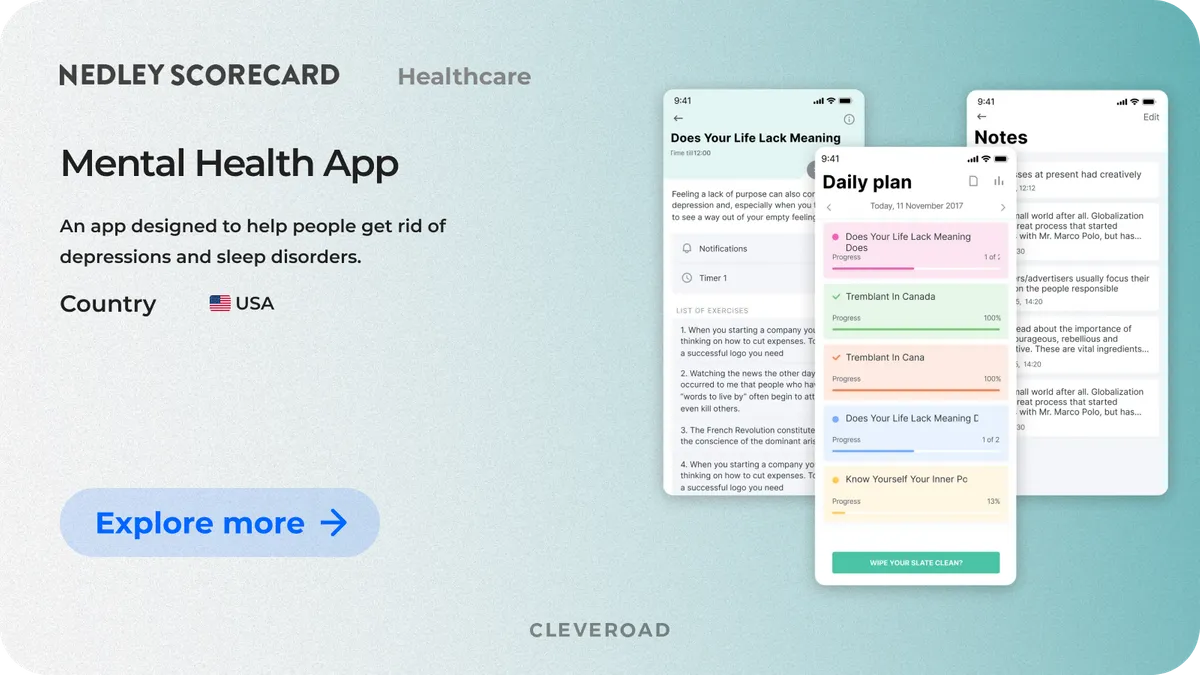
Mental Health App built by Cleveroad
As a result, Dr. Nedley launched the NLS app for his Depression and Anxiety Recovery Program, with Big Data-driven activity recommendations and personalized timetables that run for 7 days by default.
Read how Dr. Nedley characterizes a cooperation with Cleveroad on the NLS project:

 USA
USA


So, if you are looking for a mHealth app development company, Cleveroad will be an excellent choice. We are an IT service provider with 15+ years of experience in web and mobile development. Our specialists build healthcare and telemedicine solutions, like EHR, EMR, ERX, patient portals, and remote patient monitoring, that support clinics through digital transformation.
By choosing Cleveroad for mHealth app development, you will get such benefits:
- Complete consulting services with our domain experts to ensure your health app is compliant with all industry regulations
- Expertise in building mHealth software solutions complying with industry regulations (GDPR, HIPAA, PIPEDA, and more)
- On-demand services: Healthcare app creation from scratch or legacy systems modernization, cloud solutions development, IT consulting, UI/UX design, etc.
- ISO 9001-certified quality management and ISO 27001-certified information security throughout mHealth development
- Providing robust data security and signing NDA per your request
In sum, we can add that mHealth application development solutions substantially improve patients’ experience. So if you are looking for a good and reliable software development company to create a custom mobile medical app for your hospital or healthcare organization, the Cleveroad team is ready to help you! Appeal to us today and get a mobile health app delivered on time and within your budget.
Telehealth Software in Action: App Demo
The Cleveroad team designed a demo version of the Telemedicine platform, so you can see how the mHealth app can look and feel through examples of patient-side and provider-side solutions.


An mHealth app is a solution that connects people to a medical service, improving accessibility to and efficiency of healthcare. Some of these app types include mobile health app development for remote monitoring, medication management, and health education delivery.
Healthcare application developers create software catering to various medical applications, enabling efficient integration for healthcare professionals. For instance, a telehealth app facilitating virtual consultations improves patient care and streamlines hospital operations.
Healthcare app developers go to the next level for the health sector with instant updates on the patients while monitoring their vitals in real-time. Via mobile healthcare access, the convenience to reach the medical services increases, it minimizes the waiting, and allows secure communication with the physicians.
Thus, mHealth apps tailored to specific needs of various companies are created that adhere to mobile standards based on HIPAA compliance for insured communication in a prospect of digital healthcare and better patient outcomes.
The first stage of medical mobile application development is to understand what the app will resolve and determine the type of app, such as a fitness app or a telemedicine app. Then, a development team works with health professionals to design and develop the application, ensuring proper integration of medical information. After thorough testing, they release health and medical apps, providing continuous updates and maintenance for optimal performance and security.
The cost of custom mHealth development depends on many factors and can vary from $75,000 to $200,000 or more. If you want to integrate latest technologies, the cost may be even higher.
Another advantage of using custom mobile health solutions is that it helps to build applications that are tailored to needs of a particular field of medicine, thus accelerating efficiency and patient care in that specific area.
These apps help patients and healthcare professionals to conduct effective treatment and manage records efficiently. A tailored mHealth app improves medical outcomes and streamlines healthcare services, with features such as real-time health monitoring and individual health tracking.

Evgeniy Altynpara is a CTO and member of the Forbes Councils’ community of tech professionals. He is an expert in software development and technological entrepreneurship and has 10+years of experience in digital transformation consulting in Healthcare, FinTech, Supply Chain and Logistics
Give us your impressions about this article
Give us your impressions about this article