A Complete 2026 Guide to Transportation App Development
Updated 05 Feb 2026
15 Min
573 Views
Transportation app development in 2026 is no longer about a single mobile product. It is about building a reliable operational system that connects customers, drivers, operations teams, and enterprise logistics platforms in real time. Such systems support route execution, real-time delivery visibility, fleet coordination, and operational control across daily transportation workflows.
At Cleveroad, we have built transportation and logistics systems that integrate TMS, WMS, GPS tracking, and driver applications for companies in the US and EU. In these markets, system reliability and regulatory compliance directly affect operational costs and service quality.
In this article, we explain how transport app development is structured in practice. You will also see which features matter most when building a transportation app and what typically shapes its development cost.
Key takeaways covered in this guide:
- A transportation app is a multi-role system that must work consistently across customers, drivers, and operations teams.
- Standalone transportation apps rarely scale. Integration with TMS, WMS, ERP, and fleet systems determines long-term ROI.
- Early validation through Discovery and targeted Proof of Concept reduces technical and business risks before MVP development.
- MVPs are typically used for SaaS or standalone transportation products, while PoCs are often applied to validate integrations within existing logistics environments.
What Problems a Transport App Development Solves in Real Logistics Operations
A transportation app becomes necessary when operational growth outpaces manual coordination with spreadsheets and dissconnected tools. As delivery volumes increase, routing becomes more complex, and the logistics experts lose real-time visibility into fleet execution. At this stage, transportation software shifts from a supporting tool to a core operational system coordinating people, vehicles, and data flows.
Fragmented fleet visibility
Many companies struggle to maintain a consistent, real-time view of vehicles and delivery status across regions. Data often remains scattered between GPS providers, dispatch tools, customer portals, and manual reports as a transportation business startup scales. This fragmentation makes it difficult to respond to delays, reroute vehicles, or resolve delivery exceptions during daily operations.
Through transportation mobile app development, logistics teams consolidate fleet and delivery data into a single operational layer. A centralized transportation app provides live vehicle tracking, driver status updates, and visibility into delivery progress that operations teams can rely on.
Poor ETA accuracy
Unreliable ETAs in transport and logistics operations undermine customer trust and disrupt internal planning. ETA instability typically results from poor synchronization between routing logic, driver updates, and real-world execution data.
Modern logistic app development improves ETA accuracy through continuous tracking, automated status updates, and predictive delivery timing based on historical and live operational data.
Manual route planning
Manual routing depends heavily on dispatcher experience and static assumptions that rarely reflect real-world conditions. When creating a transportation app, routing logic must reflect real-world constraints. This includes traffic patterns, delivery windows, vehicle capacity, and service-level requirements across regions.
A well-designed logistic app uses an appropriate tech stack to automate route planning and dynamically adjust routes as conditions change. Automated routing and real-time adjustments reduce planning time and improve delivery consistency, allowing operations teams to scale without increasing dispatcher workload.
Lack of integration with WMS / ERP
Transportation apps operating without WMS and ERP integration struggle to scale in real logistics environments. Operations managers and back-office staff face duplicated data entry, inconsistent order statuses, and delayed financial reconciliation.
A skilled logistics solution provider designs transportation apps with an integration-first architecture. ERP and WMS connectivity ensures seamless data exchange across inventory, orders, billing, and delivery execution, supporting long-term operational stability rather than short-term fixes.
These operational challenges directly shape how transportation apps are designed in practice, influencing interface design, data flows, and how different user roles interact with the system. Cleveroad’s approach to transportation solutions reflects this operational-first mindset. Our team aligns interface design and data flows, as well as system integrations with real delivery workflows.
Discover how Cleveroad logistics software development services can help you solve transportation issues
Core Features for Transportation App Software Development
Transportation mobile application development requires building a multi-role system where customers, drivers, and operations teams interact through separate but tightly connected solutions. Let's take a closer look at the features required for each side:
Customer side
On the customer side, transport and logistics app solutions focus on enabling reliable booking, transparent execution, and accurate delivery visibility. This layer in logistics app development reflects real operational data and stays synchronized with dispatch and fleet execution, rather than acting as an isolated interface.
Key customer-facing capabilities typically include:
Ride or delivery booking with operational constraints. Customers schedule trips or deliveries using time windows and service options defined by the business. In transport app development, this booking logic must remain synchronized with fleet availability and dispatch rules to support successful transportation outcomes at scale.
Real-time GPS tracking with accurate ETAs. Modern logistics apps provide continuous visibility into vehicle location and delivery status, using live fleet data rather than static estimates.
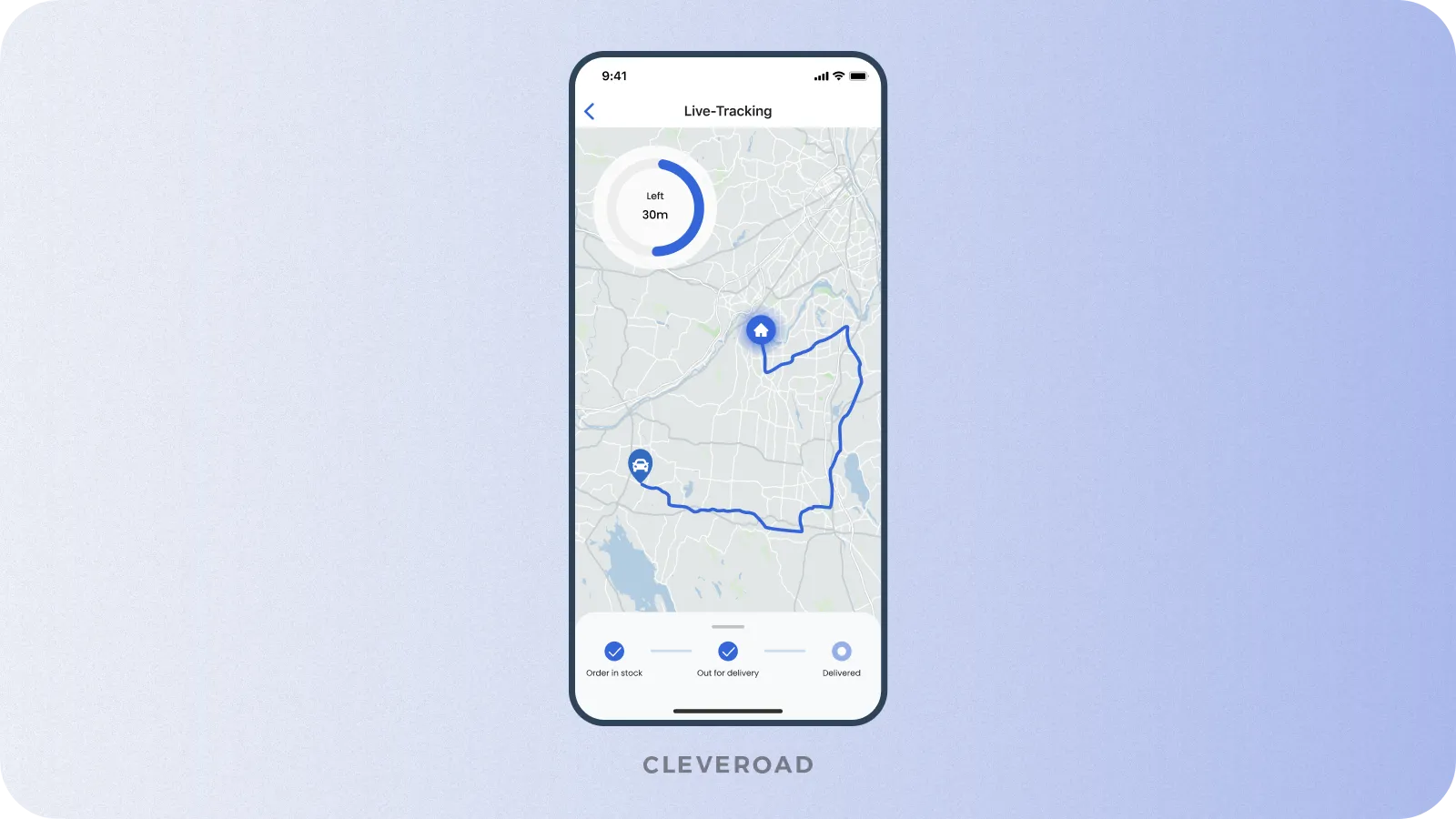
Real-time GPS tracking feature example designed by Cleveroad
Fare estimation and in-app payments. Pricing logic in a logistics mobile app reflects distance, service rules, and operational parameters, while payments remain tightly coupled with order and delivery data.
Trip history and delivery records. Customers access completed trips and delivery details inside transportation and logistics apps, supporting transparency, issue resolution, and long-term trust.
Customer-facing features in real-world transportation projects matter less than data accuracy, ETA reliability, and seamless integration with dispatch and fleet systems. Poor tracking or delayed updates quickly undermine trust, regardless of interface quality. Teams that work with experienced app development companies to build a transportation app for production use prioritize operational consistency over visual polish.
Admin panel
The admin panel serves as the operational control center of a transportation app. It supports real-time dispatch control, driver coordination, exception handling, and route management across daily operations. It enables exception handling for delays, route changes, and delivery disruptions, while SLA monitoring helps teams maintain service quality in a successful transportation app.
Moreover, the admin panel combines backend development for data processing, integrations, and performance monitoring with frontend development that supports clear decision-making for operations teams. When built by a logistics app development company, this component of the transportation app’s architecture provides reporting for operations managers, centralizing execution data and operational insights, as well as performance metrics in one system.
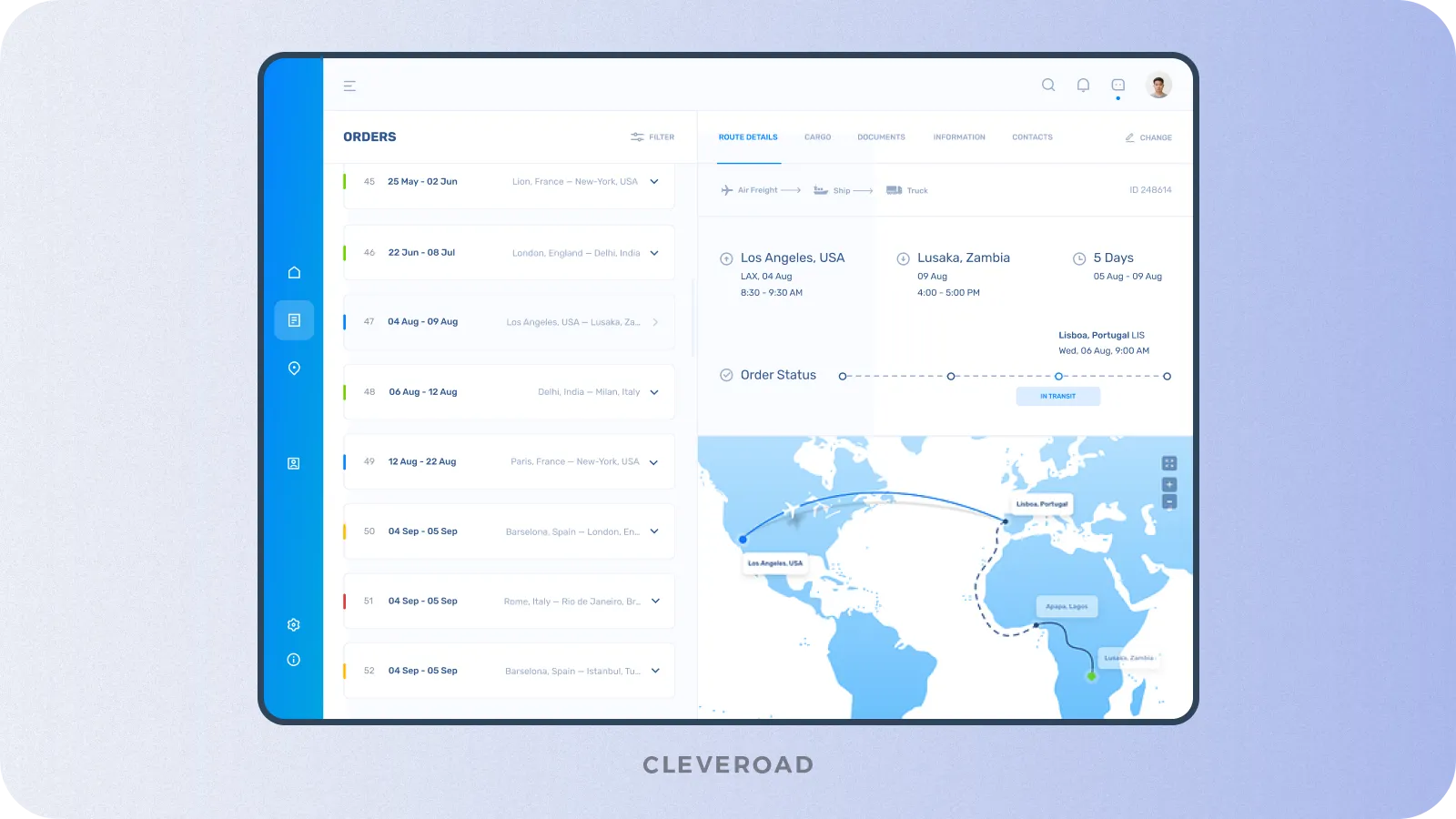
Example of Admin panel for transportation solution developed by Cleveroad (Source: Dribbble)
Driver side
The driver app is designed to help drivers organize their work efficiently, providing all the necessary tools and data. The essential functions for creating a transportation app for drivers include:
Driver registration and verification. Drivers can register in the app by providing their driver's license and insurance information. Verification of this data ensures customer trust and safe travel.
Ride acceptance and assignment. Drivers can accept ride requests sent by customers. This feature also allows them to assign bookings according to their availability and location.
Proof of delivery (POD) capture. This feature allows drivers to capture proof of delivery, such as photos of the delivery location or the recipient's signature. Proof of delivery provides accurate confirmation of order fulfillment.
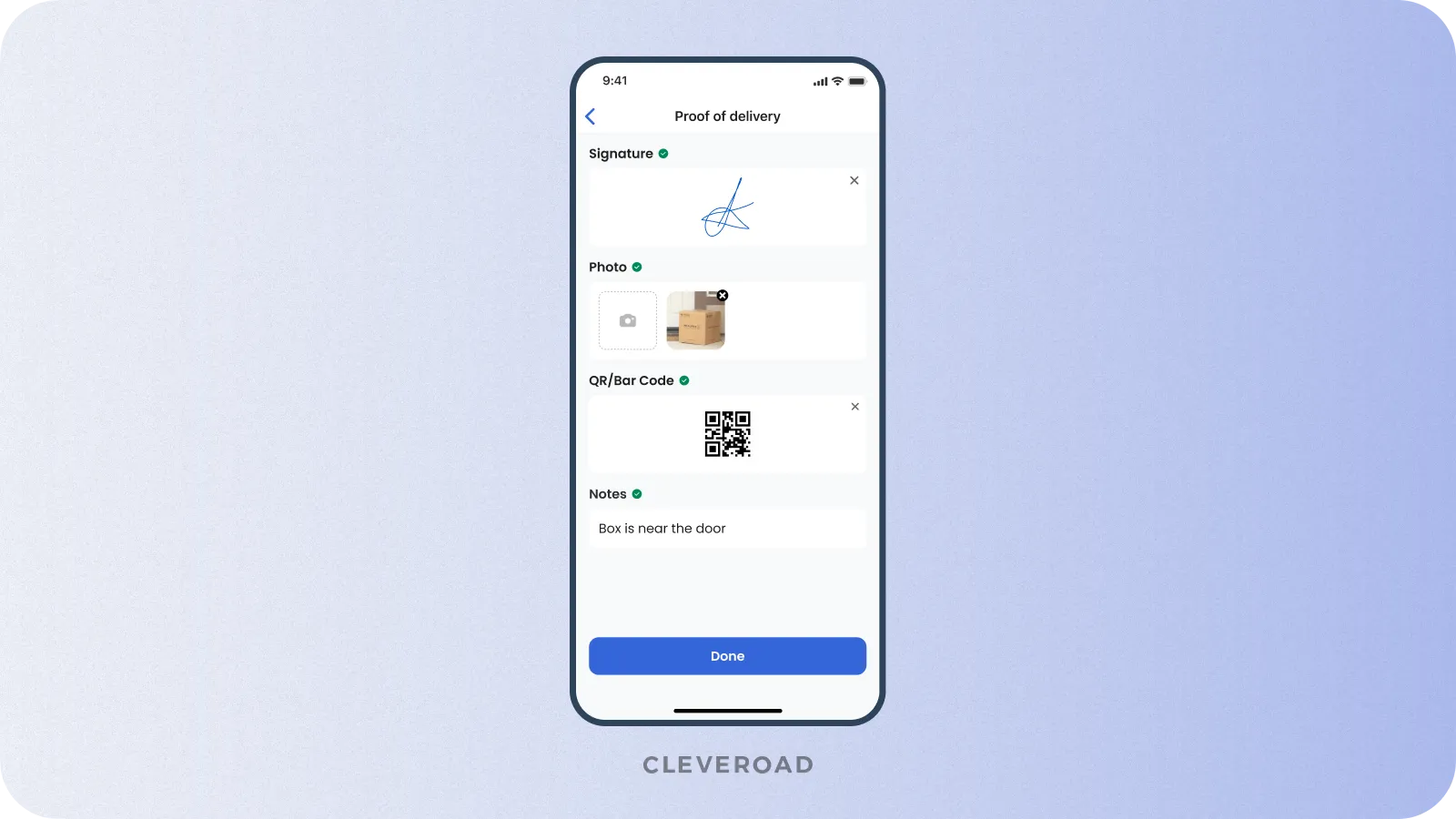
Example of proof-of-delivery capture designed by Cleveroad
GPS navigation and route optimization. GPS navigation helps drivers optimize their routes to deliver passengers or cargo as quickly and efficiently as possible. For efficient route optimization, the application must consider current road conditions, including weather, traffic, road repairs, and other essential factors.
Earnings tracking and payment details. The earnings tracking feature allows drivers to monitor their earnings for each trip. Payment details will help carriers manage their income structure and stay financially organized.
Communication with customers. Drivers can communicate with passengers through built-in communication tools. This feature allows drivers to answer any questions, clarify order details and boarding locations, and ensure a comfortable journey.
6 Steps to Build a Transportation App
Below we give a practical breakdown of the six core stages of transportation app development, based on a standard Software Development Life Cycle adapted for real logistics operations.
Step 1. Make preparations for transport app development
Before starting transportation app development, your company should focus on clarifying what you want to achieve rather than how the solution will be built. This step includes analyzing your business processes that need automation, defining who will use the app and in which roles, and understanding how transportation workflows should change as a result.
Preparation also involves reviewing the market and existing solutions. If the app is planned as a standalone or SaaS product, it is important to study competitors and possible monetization models. For solutions built as part of a broader business ecosystem, you should consider which systems the app must interact with to support daily operations.
Step 2. Choose a transportation app building vendor
When choosing a vendor for transportation mobile application development in the logistics sector, the first thing you should look for is proven technical experience in creating complex, data-driven products. A software development company should demonstrate proven skills in custom software development, mobile and web applications, and backend architecture setup.
A transportation app vendor must also demonstrate solid knowledge of the logistics domain, experience with fleet workflows, dispatch logic, ETA calculation, and real-time system integrations.
Review the potential vendor’s portfolio and look for relevant case studies to validate their experience delivering logistics solutions. Verified client reviews on independent platforms can further confirm how the team performs in real projects, including communication quality and delivery consistency.
Finally, assess the vendor’s delivery model and talent pool, as logistics platforms require stable, cross-functional teams that remain consistent throughout the project lifecycle, ensuring deep product understanding and reliable execution under real operational constraints.
Step 3. Prepare detailed transportation app requirements
The process begins with a Solution Design Workshop, a separate pre-project phase where stakeholders align on business goals, user roles, and operational constraints. This workshop, which Cleveroad provides free of charge, helps outline essential features, define system boundaries, and clarify how the future product should support real workflows.
The Discovery Phase follows as an independent stage that translates these validated inputs into a structured plan for a custom transportation management system. As a result, the client receives a Feature Breakdown List (FBL), documented business processes and flows, a Software Architecture Document (SAD), a design concept with UX maps, and a detailed project estimate with timeline and team composition, forming a clear and actionable foundation for development.
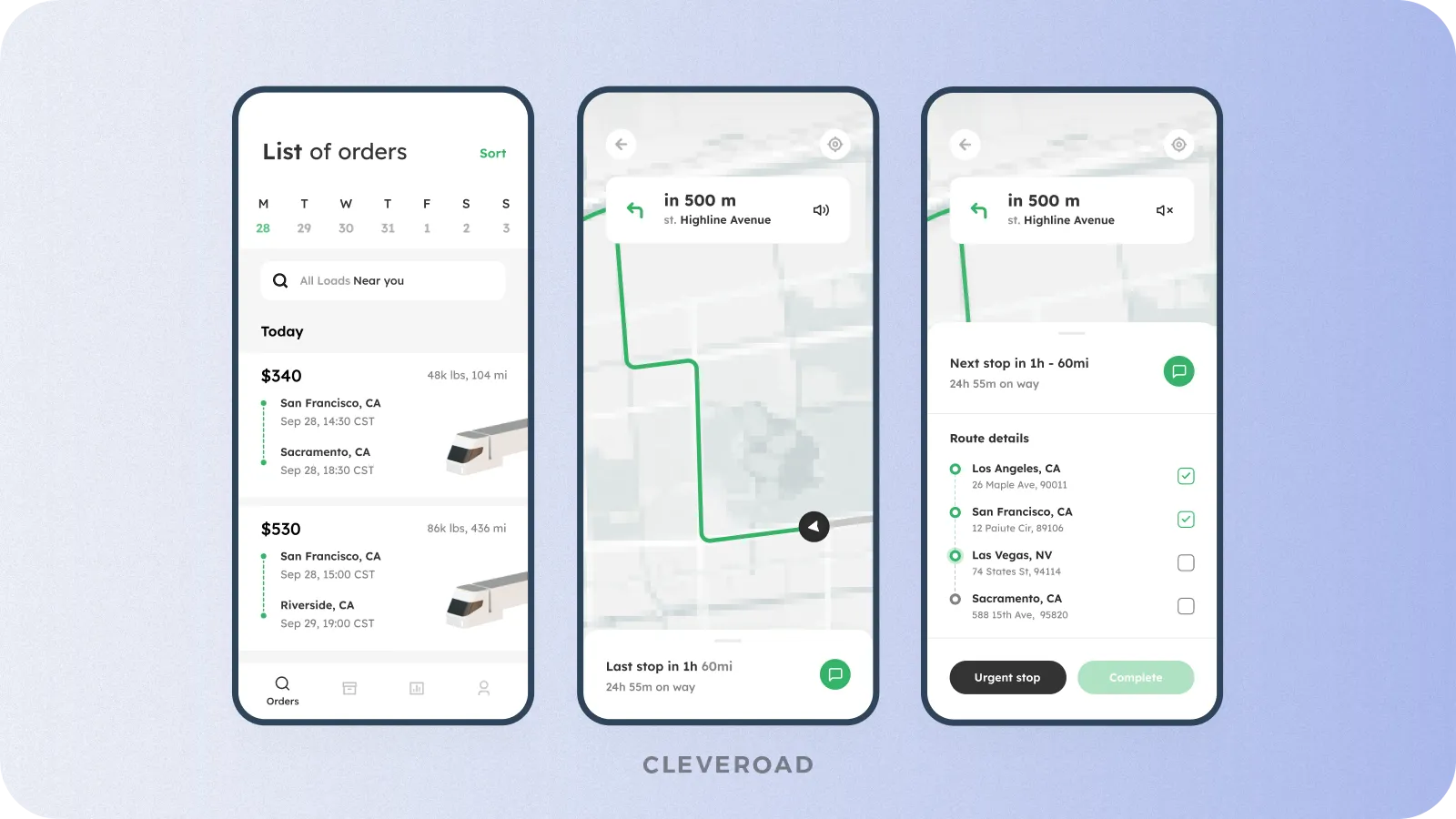
Transportation app example designed by Cleveroad (Source: Dribbble)
Step 4. Develop your transportation app
After completing all the preparatory steps, the team builds a transportation app. Developers create each part of your software during sprints, which usually last about two weeks. Before each one, the team will discuss the task with you, allowing you to make any necessary changes. Also, each sprint is accompanied by quality assurance to fix any possible bugs and ensure the system functions properly.
You may want to build a transportation app as a standalone solution or integrate it into your business environment. Thus, the engineering approaches will differ depending on your needs.
Let’s review both cases:
If you want to build a SaaS transportation app to offer it to logistics businesses, you can start by building a Minimum Viable Product (MVP). The MVP version of an app includes the minimum required set of features required to run the application and meet the basic expectations of users. This approach allows you to quickly test the app idea with minimal time and cost, assess market demand, and gather initial feedback, which is essential for further product improvement.
If you want to integrate an application into your logistics management systems, you can start with Proof of Concept (POC). A POC creates a limited iteration of transportation mobile app development to demonstrate and validate key technical, functional, or strategic aspects of the concept before implementing the full solution. This method allows you to reduce risk to your business, save time and investment on concept testing, and get user feedback early in the development process to create a more effective transport platform.
Technology stack for transportation app development may include:
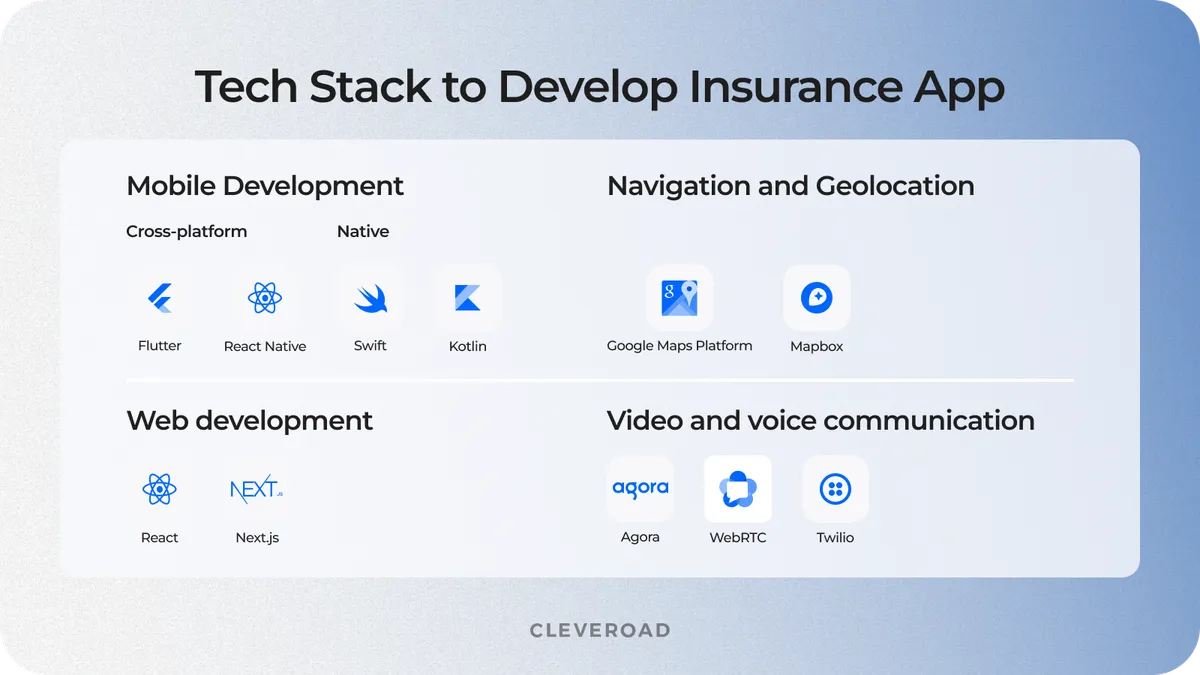
Cleveroad transportation app tech stack
Step 5. Deploy the transport solution
Once development and testing are complete, the team is ready to launch your transportation app. If you have an autonomous solution, we help you publish it to app stores (like Apple App Store or Google Play Store) or live servers. We can also assist in deploying the app on cloud computing services (e.g., AWS). If it is an integrated transport solution, our experts incorporate the app into your logistics business environment.
For integrated transportation solutions, deployment also includes connecting the app with existing business systems to ensure uninterrupted operations:
- Warehouse Management System — required to synchronize routes, orders, inventory, and delivery
- Enterprise Resource Planning systems and accounting software — to align transportation data with billing, invoicing, and financial reporting
- Fleet management and GPS providers — to enable real-time vehicle tracking and accurate ETAs
- Third-party logistics and carrier APIs — to support multi-carrier workflows and partner coordination
These integrations ensure the transportation app operates as part of a unified logistics environment rather than a standalone tool.
Step 6. Conduct maintenance and support
After the transportation app development and its release, our cooperation does not end. You may require support and maintenance services to improve your solution These services contain creating richer functionality and update it for new OS versions, code optimization, stability and performance improvements, and bug fixing.
Cleveroad’s Transportation Solutions Portfolio
We would like to present you transportation and logistics solutions delivered by Cleveroad for companies operating in real transportation environments.
Transport Management System with route planning
Our team built a Transportation Management System (TMS) and integrated it with existing logistics solutions for our client — a logistics company from the USA. The goal of the TMS was to automate route planning and transportation management.
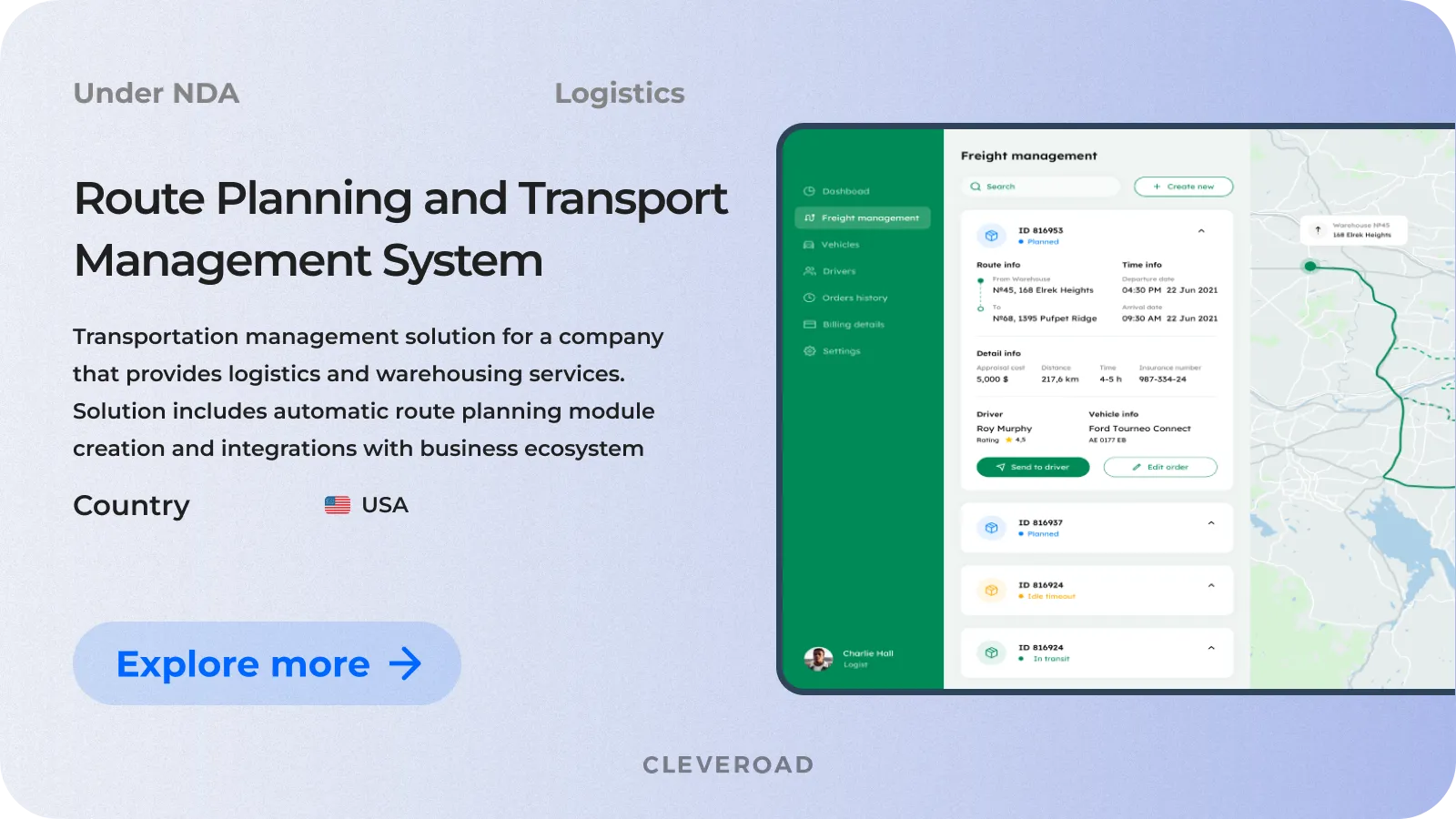
Transportation Management System with route planning developed by Cleveroad
To address client's business needs, we implemented the following modules:
- Route planning
- Fleet management
- Delivery points management
- Jobs for delivery
- Access system for company staff
We also built a route planning mobile app for truck drivers with navigation functionality. Moreover, our team provided reliable integration with the existing Warehouse Management System (WMS) and CRM.
As a result, the client received a custom TMS that improved control over vehicles and routes. Automation reduced delivery time and lowered logistics overhead by 27–36%.
P2P solution for on-demand rides and delivery
Another of our cases involves developing a digital solution for a transportation company in the USA. We created a P2P Ridesharing Solution (inspired by on-demand ride and delivery platforms) that connects drivers with riders throughout the area.
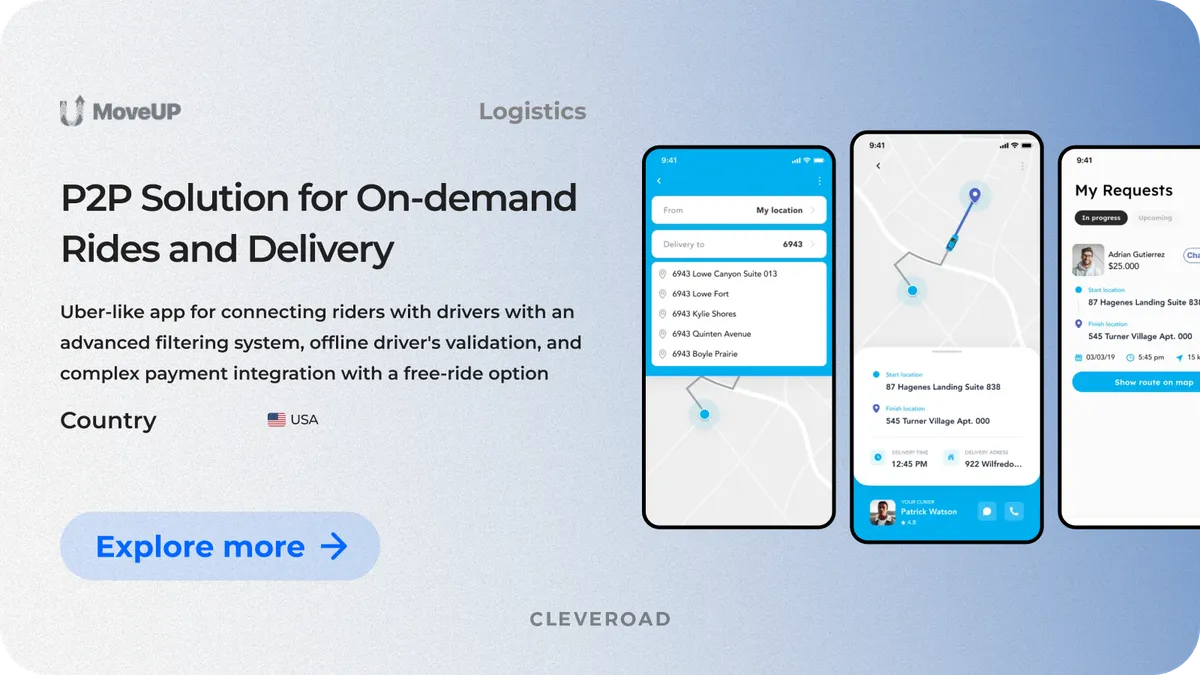
P2P ridesharing marketplace developed by Cleveroad
To support real-time matching and monetization, the solution included:
- Driver validation
- Event-driven tracking and communication system
- Sophisticated filtering system
- Free-ride option
- Integration with payment systems for in-app payments
As a result, the client received a full-fledged transportation app that allows the company to provide services and receive revenues according to the chosen business revenue model and increase the value of their business.
This is how John Salmon reviews our cooperation upon working on their solution:
John Salmon, Founder at Unified Potential, Inc.dba MoveUP. Feedback about cooperation with Cleveroad
How Much Does It Cost to Develop a Transportation App?
The average cost of transportation app development can range from $50,000 to $250,000+, depending on factors such as the type of solution, the number and complexity of features, design specifics, development time, and the platforms you want to cover.
To reduce the cost of app development, you can turn to Outsourcing or Outstaffing cooperation models. The model you choose depends on your company's needs:
Outstaffing works well when you already have an internal team but need to fill specific gaps related to app design, backend, or QA through technical staff augmentation services. By extending your team with experienced app developers, you retain direct control over the transportation process while addressing concrete transportation app needs without long-term hiring commitments.
Outsourcing is better suited for companies developing transportation solutions from scratch or planning rapid growth. A full-cycle vendor from the top mobile app development segment provides a dedicated team responsible for delivery, architecture, and app scalability, reducing time-to-market and coordination overhead.
To give you a hint, we’ve analyzed the hourly rates in the most popular outsourcing destinations, so you can select the most suitable region. These rates are compiled from Clutch, UpWork and GoodFirms.
| Popular outsourcing region | Avg hourly rate ($) |
|---|---|
North America | $150-$250 |
South America | $40-$70 |
Western Europe | $100-$150 |
Central and Eastern Europe | $50-$80 |
Asia | $40-$60 |
Australia | $150-$250 |
Hourly rates vary widely by region and directly influence the development budget for transportation projects. Vendors in North America, Western Europe, and Australia often charge higher rates, but this does not automatically lead to better app performance, especially in transportation and logistics where domain expertise matters more than location.
Asia and South America offer lower rates but may introduce communication and process risks for complex or public transportation initiatives. Central and Northern Europe often provide a balanced option, combining experienced engineering teams, predictable delivery, and competitive pricing suited for long-term transportation solutions.
Cleveroad Expertise in Logistics and Transportation App Development
If you are searching for an experienced IT partner for transport app development, the Cleveroad team is ready to help you. For over 15 years, we have been helping startups and enterprises to automate their logistics and transportation services with custom technical solutions. Our team has practical experience creating various logistics solutions, including Warehouse Management Systems (WMS), Transportation Management Systems (TMS), Enterprise Resource Planning (ERP), and other logistics software and mobile apps.
By partnering with Cleveroad, you will receive a number of benefits, including:
- Full-service logistics software development, including Solution Design and Discovery phases, development, quality assurance, and support services.
- Experience in integrating logistics and transportation solutions with external systems or 3rd party services such as Google Maps, Xero, SAP ERP, Salesforce, LogistaaS, UpKeep, Netsuite, etc.
- On-demand IT services: IT consulting, MVP/PoC creation, legacy software modernization, integration with IoT devices (e.g., GPS trackers), cloud-based development, DevOps services, etc.
- Consultation on the details of your transportation application with our Logistics Business Analysts and Solution Architects.
- Signing a Non-Disclosure Agreement (NDA) upon your request.
- Flexible cooperation models: outstaffing, dedicated development team, time & material, etc.
Build a resilient transport app from domain experts
Our team, with 15+ years of experience in logistics software development, is ready to build a transportation app allowing you to ensure timely deliveries
A transportation app is specialized software designed to manage, optimize, and enhance transportation and logistics processes. It offers functionalities like route optimization, real-time tracking, automated processes, and integration with various systems.
Creating a transport app involves several key steps. First, define the purpose of your app – whether it's a standalone SaaS-based solution or integrated into your logistics systems. Conduct market analysis to identify your target audience and competitors. Choose a monetization model. Then select necessary integrations like GPS, payment systems, and more. Finally, look for an experienced development team to design, develop, test, and deploy your app.
Transportation apps offer a range of benefits, such as cost and time savings, enhanced operational efficiency through real-time tracking, routine tasks automatization,improved customer experiences, better data analysis, etc.
The cost of developing a transportation app varies based on factors like the type of app, features, complexity, design, platforms, and more. Commonly, the cost for such a solution can range from $50,000 to $250,000 or more.

Evgeniy Altynpara is a CTO and member of the Forbes Councils’ community of tech professionals. He is an expert in software development and technological entrepreneurship and has 10+years of experience in digital transformation consulting in Healthcare, FinTech, Supply Chain and Logistics
Give us your impressions about this article
Give us your impressions about this article