Offshore Software Development Rates by Country in 2026
Updated 24 Dec 2025
17 Min
2881 Views
Why does offshore software development attract businesses and entrepreneurs? The answer is simple: offshoring allows companies facing local talent shortages or high development costs to leverage skilled developers from global tech hubs. This approach provides top-tier development services at competitive rates, enabling businesses to bring their software ideas to life without compromising quality or budget. Speaking of which, below you can examine offshore developer hourly rates by region:
- Central and Eastern Europe: $20 - $99
- Western Europe: $80 - $200
- Asia: $25 - $200
- North America: $100 - $300
- South America: $50 - $100
As an offshore IT company with 15+ years of experience, we created this guide to offshore software development, where we’ll help you define how the pricing is formed, what the specifics of the offshore outsourcing approach are, and we’ll provide tips for easier offshore collaboration cost estimation for your project.
Why to Hire Offshore Developers in 2026?
The main advantage of offshore software development is flexibility and the ability to effectively optimize spending by cooperating with top-tier experts. However, there are many more than that, and we’d like to briefly outline more advantages of remote collaboration.
Around-the-clock development cycle
Offshore teams distributed across multiple time zones create a true 24/7 development workflow, so work doesn’t stop when your local office clocks out. This “follow-the-sun” model can extend productive hours up to 16–24 hours a day, dramatically shrinking development timelines and accelerating milestone delivery. For example, according to SQ Magazine, outsourcing and offshore development can accelerate time-to-market by up to ~50 % compared to fully in-house builds
Continuous development cycles reduce idle time between handoffs, help resolve bugs quickly, and improve responsiveness to urgent customer needs. When integrated with agile workflows and strong communication practices, these around-the-clock cycles make progress predictable and measurable, speeding releases without sacrificing quality.
Scalability on demand
One of offshore development’s most strategic benefits is flexible scalability. For example, if your project roadmap calls for ramping up engineers for a major launch, reducing headcount after delivery, or anything else, offshore teams let you adjust capacity quickly without the HR complexity of hiring, firing, or retraining local staff.
This scalability is primarily about right-sizing skill sets for each project phase. You can augment your core team with specialists (such as QA engineers or DevOps engineers) as needed and scale back during maintenance phases. Additionally, Deloitte research finds that 59% of companies cite cost reduction as a key reason for outsourcing IT specialists. When you avoid long-term commitments with full-time staff, you can achieve much stronger budget predictability and better resource alignment with business goals.
Diverse tech expertise
Offshore hiring opens access to specialized skills and niche technologies that may be scarce or expensive locally. Statista research highlights that nearly 64% of IT leaders worldwide outsource software development offshore. For instance, regions such as Eastern Europe, South Asia, and Latin America have deep talent pools in AI, blockchain, cloud-native architectures, and advanced backend systems, giving you access to expertise you might struggle to find at home.
This broad access to skills means businesses can tackle complex, multi-layered solutions without spending months recruiting rare local talent, accelerating innovation, and delivering high-quality software on competitive timelines.
We are ready to share our technology expertise across industries, including Logistics, FinTech, Healthcare, and more. Feel free to see how we can help in more detail
What Forms Offshore Software Rates?
Offshore software development rates are influenced by multiple factors, including geographic location, technical complexity, and operational models. Understanding these drivers is key to estimating your offshore software development cost accurately and ensuring a balance between affordability and quality. So let’s review key factors affecting offshore software development rates in detail.
Your project complexity
The complexity of your project has a big impact on offshore pricing. Projects with advanced business logic, real-time processing, multiple integrations, or high scalability needs usually command higher rates as they require more experienced developers and longer development cycles. Even if two projects use the same technology stack, their offshore software development cost can vary a lot depending on things like architecture, performance requirements, and the number of features.
To get a clearer idea of what your project really needs, try to ask yourself questions like:
- Will it need to handle real-time data or a lot of users at once?
- How many external systems or APIs will it need to connect with?
- Are there complex workflows or business rules to implement?
- How much growth or scaling do you expect in the future?
- Will you need advanced tech like AI, ML, or blockchain?
- How many different user roles, dashboards, or interfaces will be required?
- Are there any compliance or security requirements that could add extra work?
Thinking through these questions gives you a realistic sense of the skills, time, and ultimately the offshore developers' rates your project will require. It’s a simple way to start planning your budget while keeping expectations clear.
In case you consider creating AI-based project, try out our AI business strategy advisor to get project recommendations tailored specifically to your business needs
Offshore team location
The location of your offshore development team is usually a primary determinant of cost. Rates vary significantly across regions due to differences in cost of living, local salary levels, availability of talent, and language proficiency. Teams in high-demand regions with strong English skills may charge more, but they often deliver faster and more reliable communication. Additionally, time zone differences can influence collaboration efficiency—teams closer to your time zone may reduce delays in feedback loops, while distant teams enable around-the-clock development.
Technology stack
The choice of technology stack directly affects offshore developers’ rates because it defines who you need to hire. Widely used frameworks rely on a large pool of engineers, making such specialists easier to find and more affordable. In contrast, advanced technologies like AI/ML, blockchain, or cloud-native architectures require developers with narrow, in-depth expertise. These specialists are rarer on the global market, take longer to recruit, and usually have higher expectations in terms of compensation.
As a result, their hourly rates are significantly higher than those of engineers working with more common technologies. Aligning your technology choices with real project needs helps you balance access to talent, development speed, and overall budget efficiency.
How much does it cost to hire an app developer? Read our extensive guide and learn about the actual costs, price-forming factors, and more
Engagement model
Not all offshore collaboration models work for every project – so your main task here is to assess what your business truly needs. Some businesses benefit from dedicated teams, while others prefer IT staff augmentation or project-based contracts. By aligning your needs with the right engagement model, you can avoid overspending while ensuring the development team delivers exactly what your business needs.
For example, we provide three flexible cooperation models:
- IT staff augmentation services. This model allows you to augment your development capabilities by hiring offshore specialists for your product development (e.g., UI/UX designer, web developer, QA engineer). Offshore staff becomes a part of your in-house team, and you can completely manage their work on all project stages.
- Dedicated team services. This model provides a scalable and flexible approach to software development by offering a full team of offshore specialists tailored to your project needs. This model ensures that developers, designers, QA engineers, and other experts work exclusively on your project, aligning with your goals and workflows.
- Custom software development services. This model provides end-to-end software development services, covering everything from idea validation to release. An offshore partner takes full responsibility for analysis, architecture, development, and delivery, building a tailored solution aligned with your business needs. This approach ensures a scalable, high-performing product designed for long-term success, while reducing delivery risks and management overhead.
Compliance requirements
Many governments worldwide actively support the growth of the tech sector through business-friendly policies, tax incentives, and investment programs. Countries with mature or emerging tech industries often provide simplified legal frameworks for foreign businesses, making it easier to establish partnerships with offshore development teams.
Additionally, adherence to international data protection standards, such as the GDPR and similar regulations, helps ensure a secure and compliant development environment. This gives businesses confidence and peace of mind when outsourcing software development projects.
Note: Cleveroad is an IT partner certified with ISO/IEC 27001:2013, stating our ability to provide high-quality, reliable, and secure software solutions in compliance with regulatory requirements.
Below, here’s a comprehensive comparison table of all the price drivers stated above:
| Factor | Key pricing drivers | Typical hourly rates ($) |
Offshore team location | Local wages, market demand, English proficiency, time-zone overlap |
|
Technology stack | Tech maturity, talent scarcity, required seniority |
|
Engagement model | Risk distribution, contract type, management effort |
|
Compliance requirements | Security standards, certifications, legal overhead |
|
Project complexity | Architecture complexity, integrations, scalability |
|
Offshore Software Development Rates by Country
Here’s an overview of four popular IT outsourcing offshore destinations, highlighting software offshore development rates in key countries.
Central and Eastern Europe offshore development rates
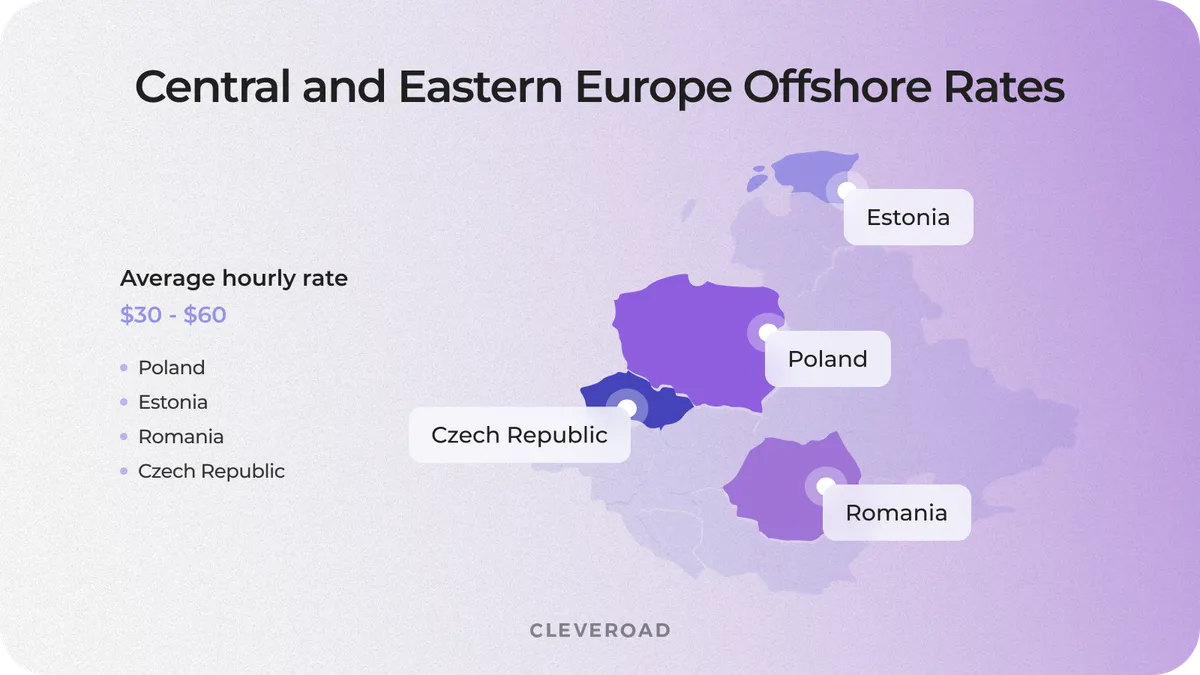
The Central and Eastern Europe (CEE region is a golden mean in terms of offshore development. The IT sector is constantly developing here, while the number of software development companies grows each year. According to Clutch, there are 2,230 IT firms in Northern, Central, and Eastern Europe. The offshore development cost in this region (namely, Estonia, the main EU tech hub) is $30-60/hour.
Central and Eastern Europe offshore rates
The offshore software for your project depends on the company you choose. Small companies usually charge less, but the majority of them won’t offer full-cycle software development. Besides, they don’t have additional options like solutions architects or database engineers for complex projects. Below, we list examples of several countries in Northern, Central, and Eastern Europe and their peculiarities in comparison with Estonia, the leader of the IT sector in its region.
- Estonia: A leading European IT hub with skilled specialists, a business-friendly environment, and direct EU market access. Offshore software development rates: $20-60/hour.
- Poland: Central and Eastern Europe’s second-largest tech hub, with 720 IT outsourcing companies and a large talent pool. Rates: $50-99/hour; junior developers are cheaper for smaller tasks.
- Czech Republic: Small but IT-focused market with limited software companies (~70), mostly handling internal software projects. Experienced developer salaries: $35,000-45,000/year.
- Romania: Rapidly growing IT sector after EU integration, with 300+ major outsourcing companies. Offshore software development rates: $25-49/hour, with large companies charging up to $100-149/hour for big projects.
Partner with a reliable offshore IT vendor
Our specialists are ready to quickly onboard to your project and provide top-tier assistance in creating innovative, secure, and user-friendly solutions to supplement your business growth
Western European offshore development rates
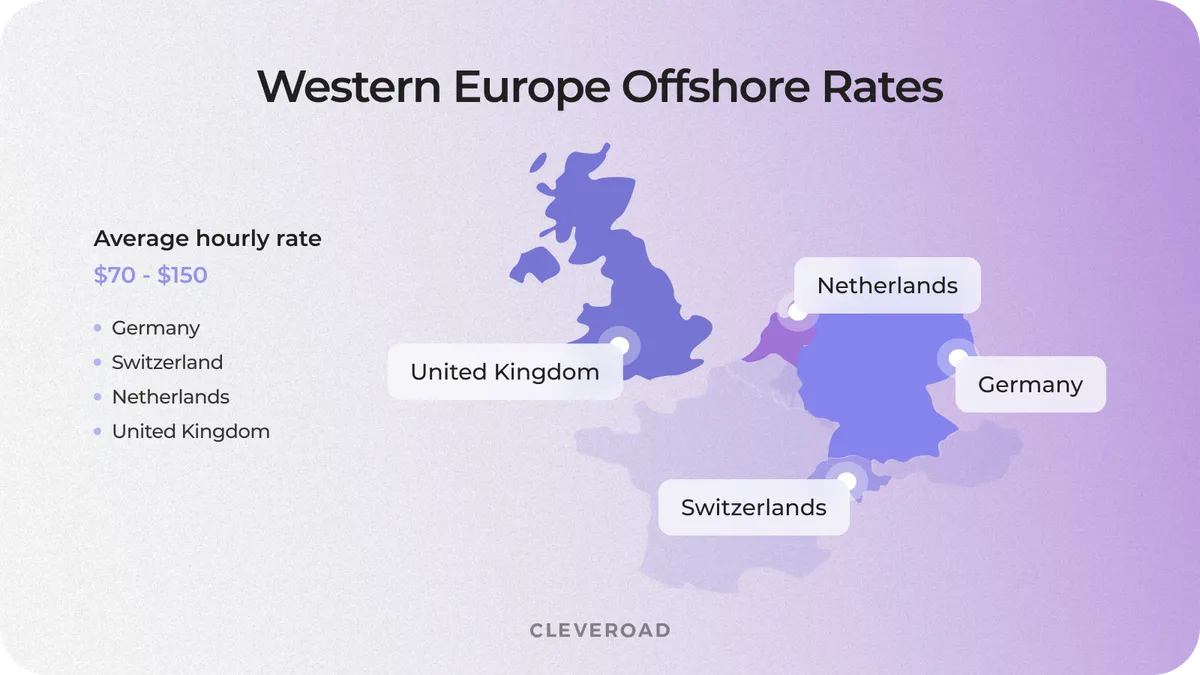
Western Europe is the region that attracts IT talent around the world. The Schengen Agreement created a relocation-friendly environment for developers from nearby countries. That’s why Western Europe became a motherland for more than 3,000 IT firms.
Western Europe offshore development rates
- Germany: Europe’s largest developer pool (~901,400). High labor costs lead to offshore development rates of $100-149/hour, with variation by city.
- United Kingdom: Second-largest IT talent pool in Europe. Average salaries ~$55,000/year; offshore rates range $100-200/hour depending on company expertise.
- Netherlands: Leading tech hub with ~320,000 skilled developers, strong in AI, fintech, and cloud. Offshore software development rates: $80-140/hour, higher in Amsterdam.
- Switzerland: High-cost, innovation-driven market with 300,000+ IT professionals. Rates reflect salaries and living costs: $100-170/hour, with Zurich and Geneva at the top.
Asian offshore development rates
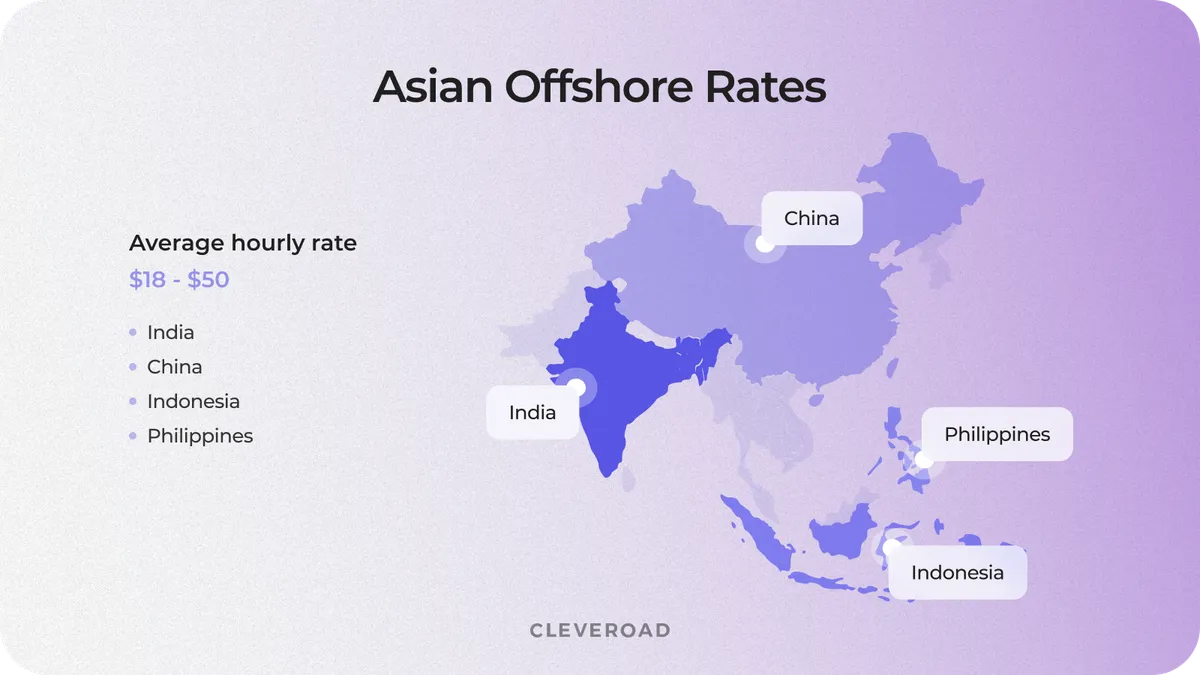
Asia is another popular outsourcing region known for its cost-effective offshore development rates and swiftly evolving level of tech expertise. Let’s review the most demanded countries for offshore development.
Asian offshore development rates
- India: Leading global outsourcing hub for startups and enterprises. Offshore developers' rates: $25-50/hour for reputable companies; smaller firms may charge under $25/hour.
- China: Rapidly growing IT sector with versatile pricing. Offshore software development cost ranges from $25-200/hour, depending on company size and expertise.
- Philippines: Strong English proficiency makes it attractive for outsourcing, though a limited talent pool restricts options. Offshore development rates: $10-25/hour for small teams, $25-49/hour for medium-sized companies.
American offshore development rates
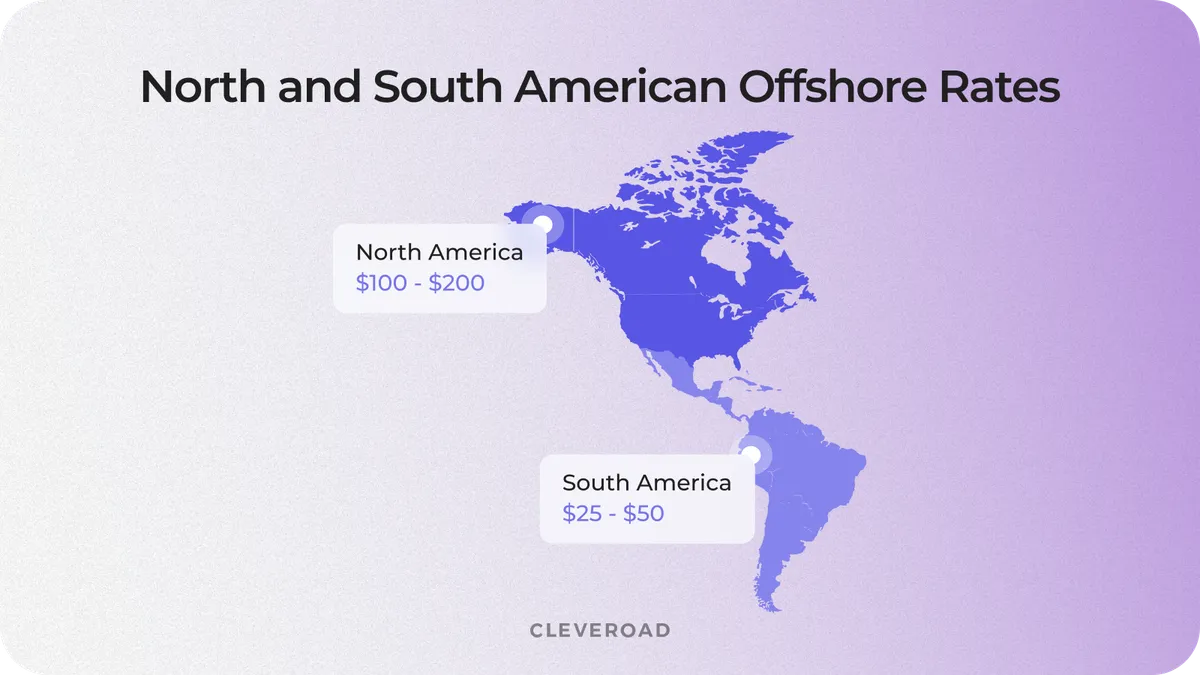
North and South America are two opposite sides in terms of the IT sector. While North America is the world-leading IT giant that gathered top-tier tech companies under the same roof, South America has a steadily evolving IT field with its own benefits. Both of these regions are worth mentioning.
American offshore development rates
- USA: Largest tech hub with high developer salaries. Offshore software development rates: $150-300/hour, depending on experience and company.
- Canada: Similar to the US, but with fewer outsourcing companies. Rates range: $100-200/hour; mid-level developers earn ~$65,000-70,000/year.
- South America: A Growing outsourcing market with favorable time zones for US clients. Offshore developers' rates: $50-100/hour; salaries ~$10,000-15,000/year in Brazil.
Below you can examine the detailed table representing the rate for different experts within a development team all over the world:
| IT specialist | American | Western Europe | CEE region | Asia |
Business Analyst | $110-$205 | $40 - $100 | $40-$63 | $30- $42 |
Solution Architect | $198-$292 | $60 - $150 | $50-$77 | $35-$48 |
UI/UX designer | $79-$163 | $35 - $90 | $36-$56 | $25-$36 |
Developer | $105-$187 | $40 - $120 | $25-$70 | $18-$42 |
QA engineers | $77-$169 | $30 - $80 | $25-$63 | $15-$36 |
Project Manager | $133-$233 | $50 - $130 | $45-$70 | $35-$48 |
How to Estimate the Cost of Your Offshore Project?
Estimating an offshore project budget starts with understanding what you’re building, who will build it, and how long it will take. While offshore software development costs vary by region and complexity, a structured approach helps you avoid surprises and plan investments realistically from the start.
Define project scope and requirements
Clear requirements are the foundation of accurate cost estimation. Start by outlining what your product must do today, not what it might do in the future. Focus on core features, user roles, integrations, and compliance needs. The more precise your scope, the easier it is to avoid scope creep and rework, which often inflate budgets.
A good practice is to describe user journeys, key workflows, and expected outcomes rather than just listing features. This helps development teams assess effort more accurately and align expectations early.
Estimate team size and skill level
Your project’s complexity determines the number of specialists and their seniority. For example, a small Minimum Viable Product (MVP), a simplified version of your product with only essential features, often requires just a few developers. Building an MVP allows you to validate your idea, test market demand, and gather user feedback before investing in full-scale development. This approach helps control the cost for offshore developers by focusing resources only on what delivers immediate value. In contrast, enterprise-grade systems usually demand a larger, cross-functional team due to higher scalability, security, and integration requirements.
Key roles that influence the cost for offshore developers include:
- Junior vs. senior developers (experience level directly affects rates)
- QA engineers for testing and quality control
- UI/UX designers for usability and adoption
- DevOps engineers for deployment and scalability
- Project managers or business analysts for coordination
Account for the development timeline
Time is a major cost driver. A shorter timeline often requires more developers working in parallel, increasing monthly spend even if total hours remain similar. Longer timelines may lower monthly costs but increase the overall budget due to extended involvement.
To estimate effectively, define key milestones, release phases, and dependencies. This allows you to align workload with offshore rates for software development and choose between faster delivery or phased rollout.
Include hidden and ongoing costs
Initial development is only part of the budget. Many projects underestimate expenses beyond coding, which can impact long-term ROI. Factoring these elements early gives you a more realistic total cost estimate and prevents budget overruns later.
Make sure to account for:
- Discovery and solution design phases
- Infrastructure and cloud services
- Third-party APIs and licensing fees
- Security, compliance, and audits
- Post-launch support, maintenance, and scaling
Keep in mind: You can always order a free initial estimate for your project at Cleveroad. We’ll conduct a solution workshop, identify your needs, and roughly estimate the solution that will match your business objectives.
How to Cut Costs During Offshore Team Management
As we have already disclosed all the essentials regarding offshore development rates, the Cleveroad team would like to share with you tips on how you can cut on investments during offshoring.
Define roles and responsibilities early
Unclear roles can lead to duplicated work or missed tasks, both of which waste time and money. From the start, outline who is responsible for what and ensure every team member understands their duties. This is vital for effectively comparing offshore software development rates. Whether it’s software developers, project managers, or QA engineers, setting clear expectations scales down confusion and optimizes workflow.
This structured approach prevents costly consequences and ensures accountability throughout the software development market, keeping projects within budget and avoiding unnecessary hourly rates for software developer spikes. Establishing top offshore practices helps teams achieve affordable rates while maintaining high quality.
Implement an effective project management strategy
A correct project management strategy decides the effectiveness, smoothness of collaboration, and success of solution delivery. For example, we at Cleveroad stick to Agile SDLC as this strategy ensures flexibility, transparency, and continuous improvement throughout the development process.
Agile methodologies such as Scrum and Kanban help reduce offshore costs by minimizing rework, keeping the scope under control, and making spending more predictable. Short development sprints with regular reviews enable teams to validate features early, identify issues before they become expensive, and prevent the development of unnecessary functionality. Clear sprint planning and backlog prioritization create a transparent burn rate, allowing businesses to track progress against their budget and adjust scope in real-time, preventing cost overruns that often arise from poor coordination or late-stage changes.
Establish clear communication
Miscommunication can lead to costly mistakes and delays, so establishing transparent, structured communication is essential. Use clear guidelines, regular check-ins, and collaborative tools such as Slack or Microsoft Teams to ensure smooth communication. Encourage an open dialogue where software engineers can ask questions, provide updates, and clarify expectations.
When everyone is on the same page, projects move faster, reducing inefficiencies and unnecessary expenses that may occur apart from paying offshore rates for software development. Clear communication helps build an offshore development team efficiently and keeps software development outsourcing smooth.
At Cleveroad, we prioritize seamless communication with our clients by conducting sprint reviews and regular meetings, scheduling them at convenient times for all parties involved.
To represent this, we’d like to share our vibrant case.
For one of our clients, the Australian Rowing Association, we helped bring their fitness app, Row Nation, to life. Understanding the challenges of coordinating across time zones, we proposed a communication approach that kept the client fully informed at every stage, ensuring smooth collaboration despite geographical differences.
To optimize costs, we recommended using Flutter for cross-platform development. This allowed a single developer to create both iOS and Android versions, eliminating the need for two separate specialists and reducing development expenses by around 50%. The result was a high-quality, fully functional app that delivered personalized training programs, workout analytics, and real-time integration with rowing machines.
Here’s what Georgia Neattie, director at the Australian Rowing Association says about our collaboration:
Georgia Neattie, director at the Australian Rowing Association provides feedback about collaboration with Cleveroad
Trace proper documentation
A lack of proper documentation can lead to misunderstandings, unnecessary rework, and time-consuming clarifications. A trustworthy offshore development partner helps you ensure that project documentation stays well-structured, covering technical requirements, workflows, and factors affecting offshore software development. The documentation includes technical requirements, regional and offshore architecture overviews, development workflows, API documentation, user guides, and more.
Hire remote development team
Read our e-book on the process of hiring a remorse team



Cleveroad – Your Reliable Offshore Software Development Partner
Cleveroad is an outsourcing software development company from the CEE region (Estonia) with over 15 years of experience in the field. We provide businesses of different scales with a great variety of IT services, including custom software development services, UI/UX design, mobile and web development, software testing, legacy software modernization, and much more.
Here’s how you will benefit from cooperating with us:
- Free solution design workshop to define project goals, explore tailored strategies, and assess feasibility - risk-free and without any initial financial commitment
- An expert team of 280+ in-house engineers (75% senior and middle level) with 200+ delivered software solutions
- Proficiency in integrating advanced tools, including API integrations, cloud-based CRM systems, secure payment processing solutions, data analytics platforms, and industry-specific enterprise software
- Guaranteed compliance with security and quality standards as well as essential legal requirements across numerous business domains, including HIPAA, GDPR, PCI DSS, PIPEDA, FDA, KYC, HL7 DORA, MiFID II, etc.
- R&D Centers in offshore collaboration located in Estonia, Poland and Ukraine that provide clients with access to top-tier expertise without the overhead costs
- Project Management Office (PMO) that ensures structured project execution by managing timelines, mitigating risks, and optimizing resource allocation, guaranteeing smooth development processes
To prove our expertise, here’s the selection of our vibrant cases of offshore product delivery:
- Online Services Ecosystem for Managing Auto Insurance. A digital ecosystem for a U.S. insurance company featuring a web and mobile app for policy management, claims processing, and customer interactions, enhancing efficiency and user experience.
- Route Planning and Transport Management System. A cloud-based logistics platform for U.S. clients that optimizes freight management, route planning, and real-time tracking, improving supply chain visibility and reducing operational costs.
- A Software System for Creators and Spectators of Sports Activities. A sports marketplace connecting retailers and customers for our client from the USA, offering seamless order processing, inventory management, and personalized recommendations for an enhanced shopping experience.
- Powerful SaaS retail operations platform. A retail management system for our US-based customers, streamlining inventory tracking, supplier coordination, and sales analytics, helping businesses optimize operations and drive growth.
Receive top-tier IT expertise at Cleveroad
Contact us. Our experts with 15+ years of experience in IT are ready to start building your software project, maintaining close communication with you at every development stage
Rates vary based on developer seniority, company size, and project complexity, but here are approximate rates estimation based on region:
- Central and Eastern Europe: $20 - $99
- Western Europe: $80 - $200
- Asia: $25 - $200
- North America: $100 - $300
- South America: $50 - $100
Key factors that shape software developer rates for offshore software development include:
- Team location: Differences in lower cost of living and local salaries across developing countries significantly influence the hourly rate for software development. Countries with the lowest rates often attract businesses seeking lower-cost options.
- Developer seniority: Junior, mid-level, and senior offshore software developers command different per-hour rates depending on experience and skill level.
- Technology stack: Niche technologies increase software development due to the specialized expertise required.
- Engagement model: Dedicated teams, staff augmentation, or fixed-price contracts affect per-hour billing.
- Project complexity: Integrations, scalability, compliance, and performance requirements impact how many hours and which specialists are needed.
- Compliance needs: Adhering to standards like GDPR, HIPAA, or ISO adds extra effort, influencing the hourly rate for software development and overall project cost.
Reducing costs is about planning strategically without compromising quality. Start with an MVP (Minimum Viable Product) to focus on core features and validate the idea before scaling. Mix senior and mid-level software developers, clearly define your project scope, and choose an affordable development destination with strong expertise. Early planning for scalability and long-term collaboration models can also significantly lower your cost for offshore developers over time. Leveraging remote developers and nearshore software development options can further reduce expenses while maintaining high-quality mobile app development or app development standards.
When estimating offshore software development costs, remember that coding isn’t the only expense. Hidden costs can include discovery and solution design, cloud infrastructure, third-party licenses, compliance and security audits, ongoing maintenance, and knowledge transfer. Factoring these in early ensures a realistic budget and prevents surprises after launch. Considering the average hourly rate for software, the cost of software development can quickly escalate if hidden expenses are overlooked. Choosing offshore software development services wisely helps control costs while accessing high-quality talent.

Evgeniy Altynpara is a CTO and member of the Forbes Councils’ community of tech professionals. He is an expert in software development and technological entrepreneurship and has 10+years of experience in digital transformation consulting in Healthcare, FinTech, Supply Chain and Logistics
Give us your impressions about this article
Give us your impressions about this article
Comments
1 commentsExcellent article