Healthcare App Development: Ultimate Guide for 2026
30 Jun 2026
28 Min
8161 Views
Healthcare app development helps you support remote care, automate clinical workflows, and improve patient engagement. As hospitals, clinics, labs, and healthtech startups continue their digital transformation, healthcare applications have become essential to delivering efficient, connected care.
At Cleveroad, we've spent more than 15 years building healthcare software, including EHR-integrated telemedicine platforms, AI-powered diagnostic tools, and other compliant healthcare solutions. Our healthcare portfolio demonstrates how custom healthcare applications can speed up clinical processes, enable secure data exchange, and support better patient outcomes.
This guide explains the main types of healthcare applications, essential features, development costs, compliance requirements, and the seven-step healthcare app development process.
Key Takeaways:
- Healthcare apps usually fall into three categories: medical professional apps, patient-facing apps, and healthcare administration solutions. In 2026, buyers also expect AI workflows and FHIR-based interoperability.
- A simple patient app may cost $40,000-$80,000, a mid-scope app $80,000-$150,000, and complex telemedicine platforms $150,000-$300,000+. HIPAA engineering can add 20%-30%.
- A reliable healthcare app development process includes seven stages, from discovery and compliance planning to release and certification. The main risk is choosing a vendor without proven experience in regulated healthcare delivery.
What Is a Healthcare Application?
A healthcare application is a web or mobile product that helps patients, clinicians, and healthcare organizations securely deliver care, exchange medical data, manage treatment workflows, support remote services, and coordinate operations across hospitals, clinics, labs, and other medical institutions.
Why the healthcare app market keeps growing
The healthcare app market continues to grow because patients and providers now use digital health tools as a regular part of care delivery, not as a secondary communication channel. Statistics prove it:
- The global mHealth market reached $71.59 billion in 2024 and may grow to $268.46 billion by 2034, according to Precedence Research.
- 63.4% of US adults used a mobile health app for a health-related purpose in the last 12 months, according to eMarketer.
- About 60% of respondents reported using a mobile app for health purposes, according to an NLM-indexed survey published in PLOS Digital Health.
These numbers show that healthcare apps are no longer experimental tools. Patients already use them to manage health tasks, while you need digital products that fit clinical workflows and compliance requirements. For your healthcare team, this demand creates a clear product requirement: healthcare apps must support secure data collection, remote care, patient engagement, clinical communication, and integration with existing medical systems.
Planning a healthcare product? See how our healthcare software development team builds compliant medical solutions
Types of Healthcare Apps
Healthcare apps fall into three main categories: apps for patients, apps for healthcare professionals, and apps for healthcare management. Each category serves a different user group, from people who book visits to clinicians who review patient data and administrators who manage workflows.
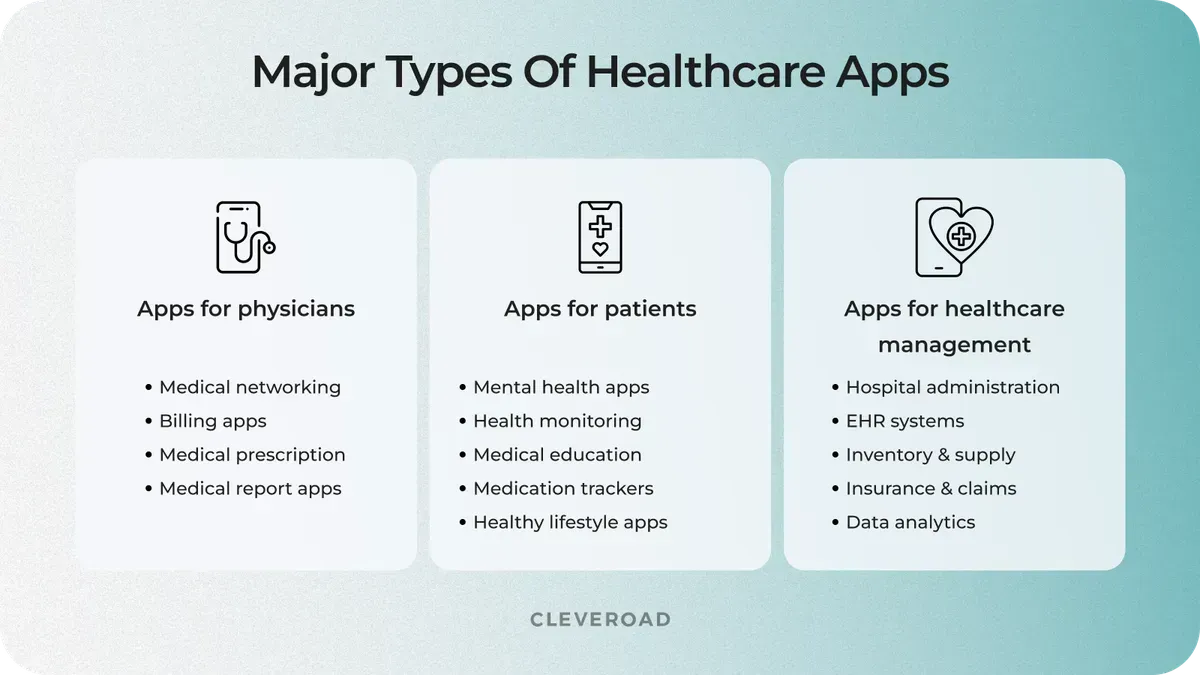
Types of healthcare applications
Apps for professionals and medical facilities
These platforms support physicians, nurses, and other clinical staff in daily routines like reviewing patient data, coordinating care, and documenting visits. Designed for professional use, the medical platforms are more complex and feature-rich, letting specialists use the app efficiently across various medical scenarios.
A first-hand example from Cleveroad's healthcare portfolio is a quality management system for medical device manufacturers. Our team built a SaaS QMS from scratch to replace an outdated system and support document management, training records, HR workflows, advanced RBAC, and AWS-based architecture. As a result, the client received a more flexible platform that simplified complex role relationships, reduced overall operational costs, and improved user interaction with the system.
Medical networking
Even though physicians are pretty busy and rare guests on popular social media, they also need a way to communicate with their colleagues, share expertise, and improve decision-making. The well-known medical networking apps are:
- Daily Rounds
- Doximity
- Sermo
Telehealth
Telemedicine apps enable physicians to schedule appointments with patients and provide consultations via in-app messaging or video calls. Telehealth apps are convenient for both medical facilities and patients as they reduce "no-shows" by 50%, and patients can receive medical consultations in the comfort of their homes. Famous telehealth apps are:
- GoodRx Care
- Doctor on Demand
- Teladoc
At Cleveroad, we develop reliable telemedicine systems tailored to clinical workflows. For example, for our UK-based client, a provider of healthcare consultations, we've built a custom telemedicine platform. It runs remote consultations, in-app scheduling, and EHR integration, with role-based access for admins, doctors, and patients and KYC/AML verification, meeting MHRA, CQC, and GDPR requirements.
Medical prescription apps
E-prescription app development lets physicians pick the right drugs for each patient, pack it into a convenient list, set and control dosage, avoid Adverse Drug Events (ADEs), or cancel prescriptions at any time. Some apps, like RxEasy and STAT, allow prescriptions to be printed so patients can easily present them at any pharmacy.
Medical records apps
Simply put, healthcare mobile app development for medical records is intended to simplify the collection and updating of patients’ health records. This includes vital indicators (blood pressure, temperature, etc.), medical examinations, prescriptions, appointments, and other information essential for physicians to track the overall treatment process. There are several apps that are quite popular among physicians:
- DrChrono Practice Management
- RXNT
- Meditab
Billing apps
Billing healthcare app development simplifies the overall billing process and digitizes operations such as claims management, payment processing, and patient registration in medical facilities. There are several popular billing apps as an example for mobile healthcare app development:
- Advanced MD
- EpicCare EMR
- Waystar
How to make a medical billing software to satisfy your medical practice needs? Learn about how it may help you speed up financial processes, features to implement, and more in our guide
Apps for patients
Patient-facing apps put a single care task in the patient's hands: booking a visit, tracking symptoms, managing medication, or reaching a clinician between appointments. The categories below are the most common starting points.
Mental health apps
Mental health app development aimed to make therapy more accessible, efficient, and flexible. They can assist with fighting depression, stress, anxiety, and sleep disorders with the help of pre-recorded meditations, breathing exercises, gamification elements, and more. Popular examples of mental health apps contain:
- Headspace
- Calm
- BetterHelp
Cleveroad partnered with a US-based mental health organization to build Nedley Scorecard: a cross-platform app that helps users manage insomnia, anxiety, and depression through structured self-assessments, progress tracking, and personalized recommendations. We developed a secure, HIPAA-compliant MVP with dynamic dashboards, user profiles, and data visualization tools. As a result, our client received a scalable, user-centered platform that supports mental wellness and enables data sharing with practitioners.

 USA
USA


Medical education
The main idea of developing an educational health app is to create a reliable database of up-to-date medical information for students, doctors, and regular users who want to learn more about healthcare. There are great examples of this type:
- Medscape
- Clinical Sense
- Lecturio Medical Education
Medication trackers
Medication tracking apps are quite popular in healthcare app development, thanks to their simplicity, which helps users take their pills on time. Besides simple scheduling and reminders, these apps can track specific drugs at nearby pharmacies, letting users know where the lowest price is. Among all medication trackers, there are several established solutions:
- ScriptSave WellRx
- Mango Health
- Medisafe Pill Reminder
Healthy lifestyle apps
This category brings together a range of applications, such as fitness, brain training, and self-improvement apps, that make a healthy lifestyle much easier to achieve. Notable examples of such applications are:
- Elevate: Brain Training
- Remente
- Results Wellness Lifestyle
Health monitoring
Health monitoring apps help patients track symptoms, vital signs, chronic conditions, medication intake, and treatment progress. These solutions often support remote patient monitoring, which allows you to collect patient health data outside the clinic and react faster to changes in patient status. Well-known examples include:
- WebMD
- Ada
- The Diary
Need more context on RPM software? Read our remote patient monitoring guide to see how RPM works, what devices it uses, and why it matters for healthcare providers in 2026
Apps for healthcare management
These solutions focus on improving operations and data management across hospitals, clinics, and other medical organizations. Through healthcare app development, your team can automate manual tasks, improve coordination, and make better clinical decisions. Such an app can range from hospital administration tools to data analytics dashboards, all designed to integrate cleanly with existing healthcare systems.
Hospital administration platforms
These systems help manage patient admissions, staff scheduling, and workflow optimization. They reduce administrative load and ensure smoother operations within medical facilities. Some popular examples of hospital administration apps include:
- CureMD
- AdvancedMD
- Tebra
Cleveroad developers also create and care management system software that simplify internal workflows and reduce administrative overhead. For example, we built a Clinic Management System for a healthcare provider looking to unify operations across departments: from admissions and billing to staff scheduling and performance analytics. The platform simplifies hospital processes, enhances data transparency, and aligns with modern mobile health app trends by providing secure, real-time access to critical information.
Electronic Health Record (EHR)
EHR applications store, process, and share patient data securely in real time. They serve as the backbone of various healthcare institutions by ensuring interoperability, compliance, and accuracy. The well-known EHR solutions are:
- Epic EMR
- Oracle Health EHR
- MEDITECH Expanse
Inventory & supply management
These apps control medical stock levels, prevent shortages, and reduce waste by tracking usage and expiration dates. To choose the right healthcare system, look for integration capabilities with pharmacy and procurement modules. Key examples for inventory and supply management applications are:
- Oracle Inventory Management
- Infor CloudSuite Healthcare
- Tecsys Elite Healthcare
Insurance & claims management
Such solutions automate billing, claims processing, and policy verification, helping clinics reduce delays and ensure accurate payments. When planning your healthcare app idea, consider the importance of HIPAA compliance and secure data flow. Insurance and claims management app examples include:
- Waystar
- Experian Health
- Availity
Data analytics dashboards
These tools visualize patient outcomes, financial performance, and resource allocation. In the right healthcare app development, analytics modules help executives make evidence-based decisions and optimize operations. For example, the key data analytics dashboards include:
- Tableau
- Microsoft Power BI
- Qlik Sense
What Features Should a Healthcare App MVP Include?
A healthcare app's Minimum Viable Product (MVP) should include only the features needed to validate the core care workflow. In most cases, this means secure user profiles, appointment or service access, patient data capture, communication tools, and compliance-ready data protection. The goal of a healthcare app MVP is not to launch a full clinical ecosystem from day one. The goal is to prove that one care workflow works safely, clearly, and reliably for real users.
Secure authorization and authentication
This is an essential and primary feature in healthcare app development. It is the process of verifying users' identities and ensuring that only authorized users can access sensitive information within the app. For instance, a two-factor authentication process may be implemented, requiring a password and a unique code sent to the user's phone or email, or biometric authentication, such as fingerprint or facial recognition, may be used.
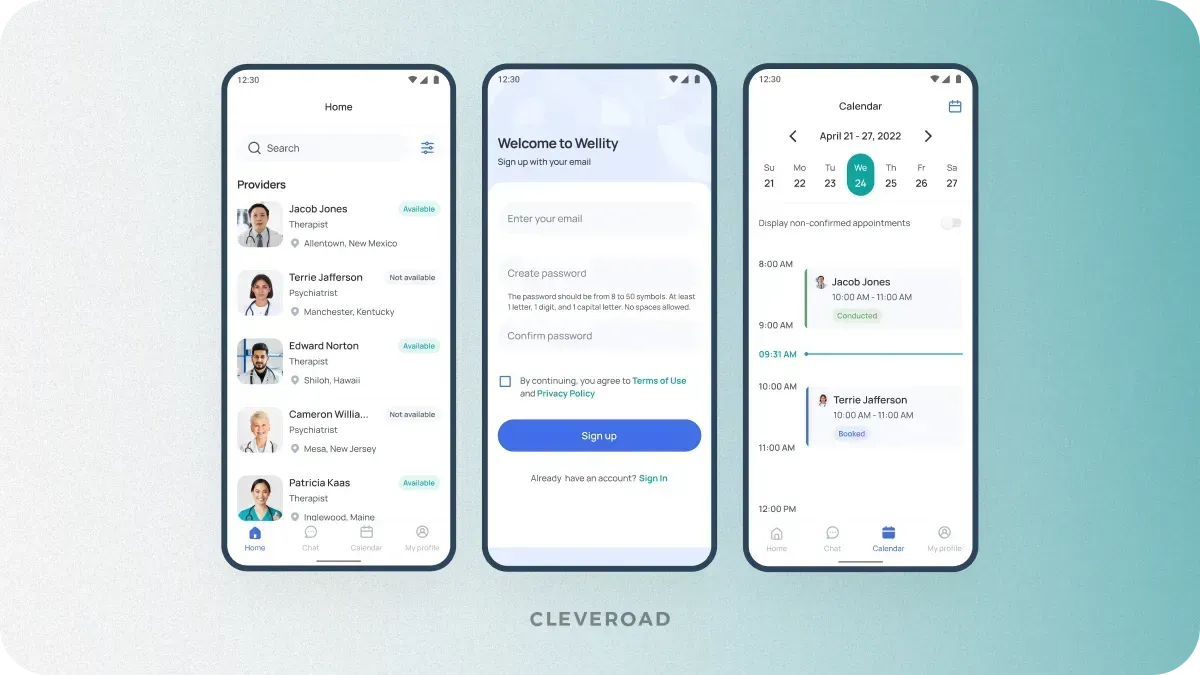
Authorization feature designed by Cleveroad
Data privacy and compliance
Healthcare app MVPs must protect patient data from the first release. At minimum, the product should include secure authentication, RBAC, encryption at rest and in transit, audit logging, and permission-based access to medical records.
At the MVP stage, the goal is to build a compliance-ready foundation. HIPAA, GDPR, HL7, FHIR, and other regional requirements should be mapped during discovery and reviewed in detail in the healthcare app compliance section below.
Profile screen
The profile functionality is an essential part of the telehealth app. The user should be able to fill in personal information, add a photo, record medical history, and manage and update it to keep it up to date. This significantly adds to personalization for both patients and practitioners.
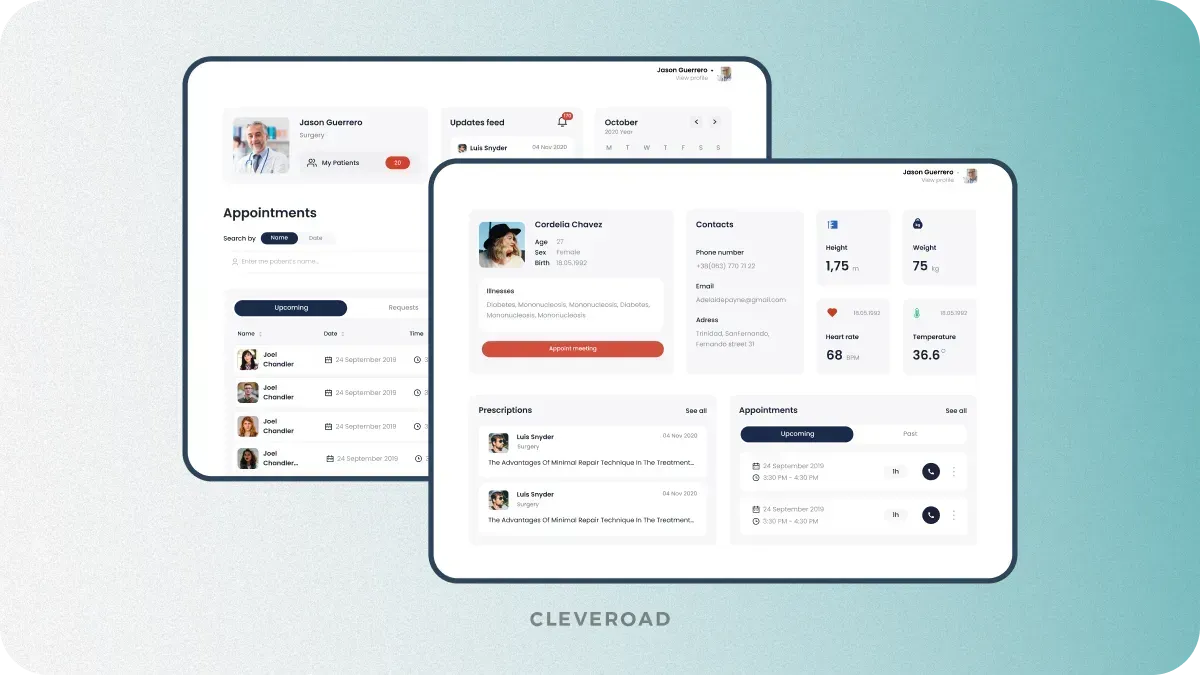
User profile screen feature example designed by Cleveroad
Search and filter options
Finding a physician should be simple yet effective. It's a good idea to add filters in medical mobile app development that let users find a doctor based on criteria such as specialization, experience, or appointment cost.
Appointment scheduling
This feature works well in both ways. The physician receives a calendar to schedule appointments and control their number during the week. In the meantime, patients can access the doctor's schedule to book quickly and conveniently for both parties.
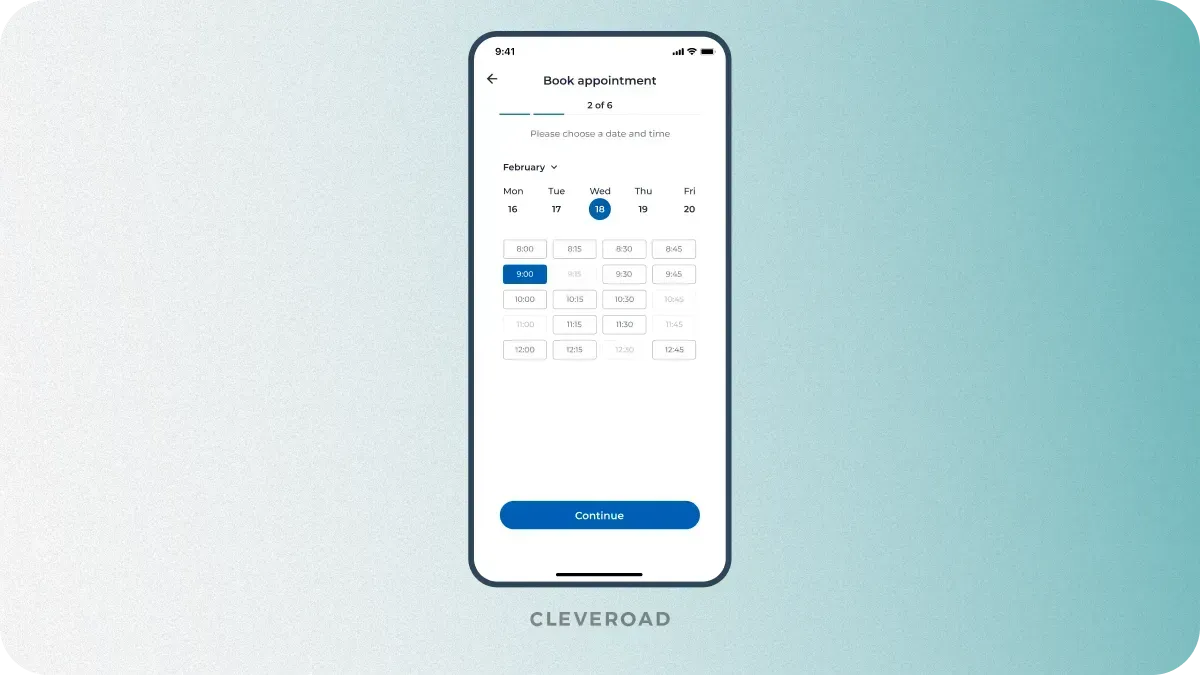
Appointment booking feature example designed by the Cleveroad team
Dashboards and analytics
Admins and physicians often rely on data dashboards to make informed decisions. Integrating analytics modules in your MVP lets users visualize patient trends, filter metrics, and track appointments or clinical outcomes in real time. As a medical mobile app development feature, it strengthens clinical workflows and business insight. Analytics modules let admins and clinicians track patient trends, filter metrics, and monitor outcomes in real time.
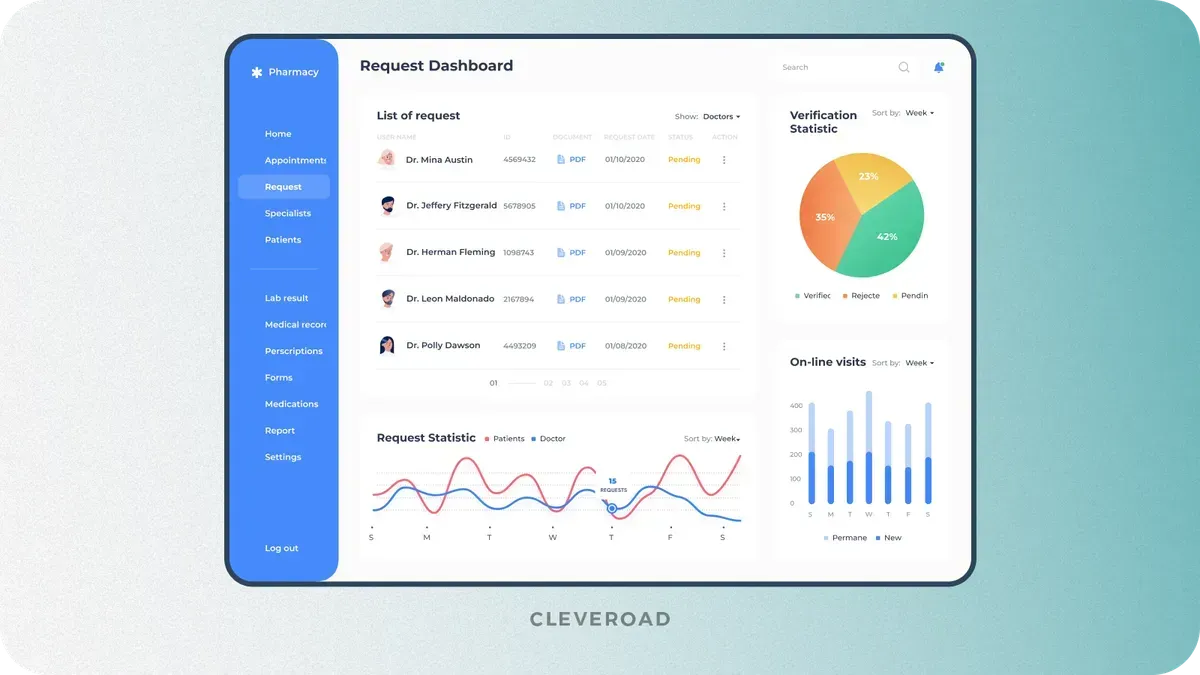
Admin dashboard for a telehealth platform created by Cleveroad (Source: Dribbble)
Video and voice calls
This feature is the foundation of all telehealth apps. Video calls are often made using WebRTC, HLS, or MediaStream protocols. These technologies enable real-time communication via the cameras and microphones of mobile devices. During video and audio calls, both parties should have a stable connection and no trouble with the audio or video.
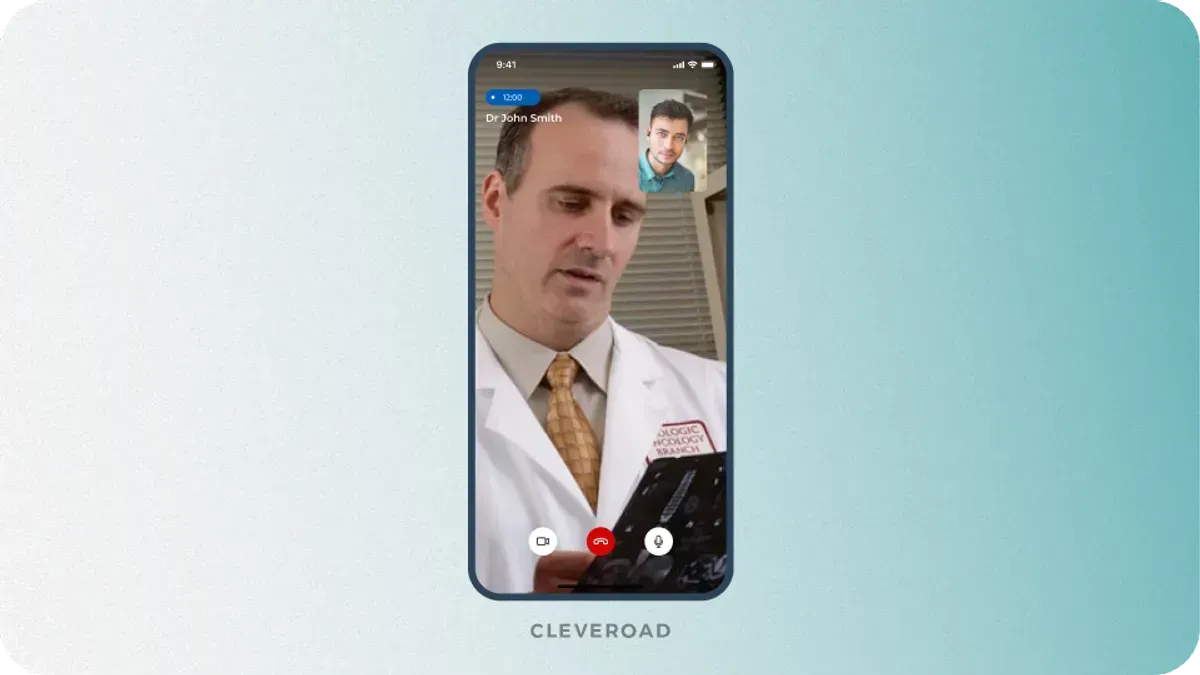
In-app video call feature example designed by Cleveroad
Payment options
This feature is useful for everyone. Users pay for the doctor's services; the platform holder receives a commission, and the doctors are paid for their work. The main way to add online payments is to implement a payment gateway. This could be PayPal, Stripe, or Braintree. Besides that, it's worth implementing payment directly from a patient's credit card.
Online chat
If the doctor can't see the patient at the moment, the user should be able to ask a question or leave a message for the physician via in-app chat. The chat is useful enough for both parties. The patient can send various documents and media files important to the consultation via the medical mobile app, while the doctor can clarify the course of treatment or send a file with the prescription.
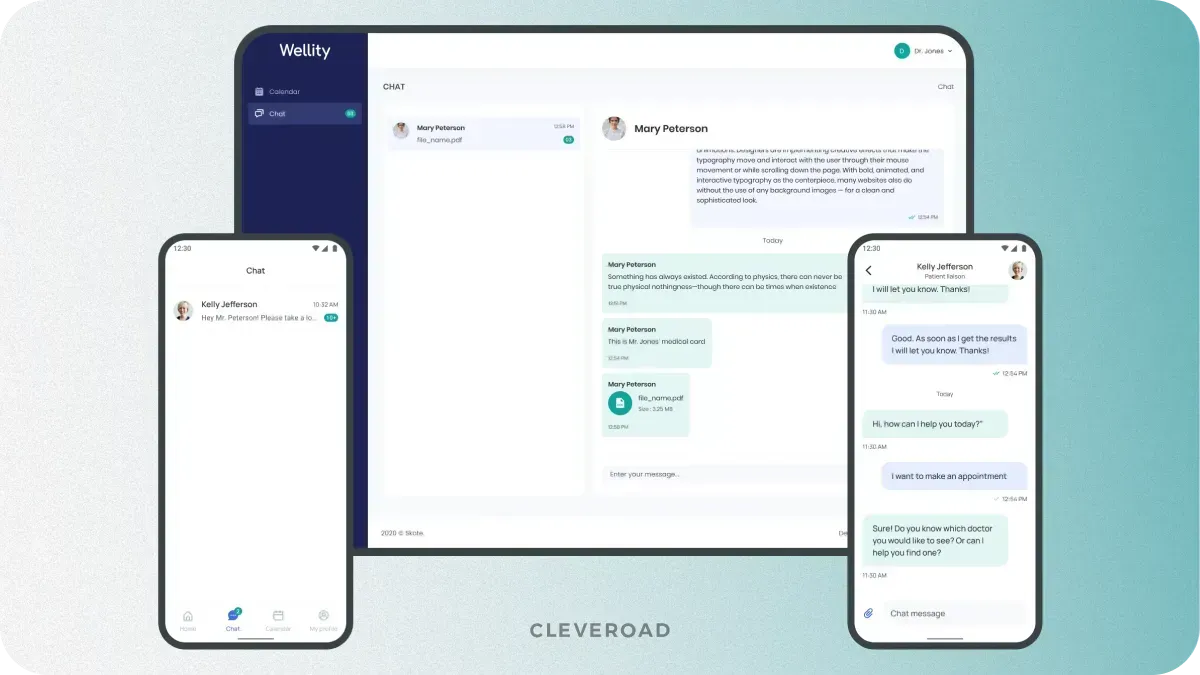
Chat module in healthcare apps feature example designed by the Cleveroad team
Reminders and notifications
Through reminders and notifications, medical apps not only keep users on track with timely alerts but also consider their location, enhancing the overall medication management experience. This feature ensures that patients never miss a dose and stay well-informed about their health.
AI assistant and clinical decision support
In 2026, AI features are increasingly common in healthcare app MVPs that support patient intake, clinical documentation, triage, or chronic care workflows. The key is to choose AI features that support the core workflow rather than overload the MVP.
Common use cases include ambient documentation that turns doctor-patient conversations into structured notes, symptom checkers that guide patients before a visit, and clinical decision support tools that help doctors review risks, alerts, and suggested next steps faster. AI should support clinician judgment, not replace it.
For example, an AI assistant can summarize patient-reported symptoms and medical history before a consultation. This helps clinicians prioritize cases faster and prepare for the visit with more context.
Need help choosing AI features? Our AI Strategy Advisor maps AI opportunities to your healthcare app use case
FHIR-based EHR/EMR integration
FHIR-based EHR/EMR integration is a must-have for healthcare apps that need to exchange patient data with systems such as Epic, Oracle Health, or other certified EHR platforms. FHIR R4 helps standardize access to clinical data, patient records, observations, medications, and care plans, thereby reducing integration complexity and supporting interoperability.
Under the ONC HTI-1 rule, certified health IT modules for standardized patient and population API services must reference HL7 FHIR R4 and publish a standardized FHIR-based service base URL, making FHIR alignment critical for healthcare apps in 2026.
These core features make your app functional and user-friendly from day one. At Cleveroad, we offer MVP development services to help you validate your idea with minimal risk and cost
How to Build a Healthcare App Step-by-Step
Professional healthcare app development is impossible without a clear understanding of your goals, app features, and a clear plan. Therefore, you should apply to a competent software development vendor. Reliable and experienced partners will assist you in selecting the type of custom healthcare app development you want, researching your target audience, identifying the problems your healthcare product will solve, and how.
Whether you're building a hospital-facing platform or a patient management app, an experienced software development partner will guide you through every stage: from ideation to deployment. With a custom approach, they'll ensure your healthcare app aligns with your business goals, addresses user pain points, and meets industry standards. By using professional health app development services, you can launch a solution that's functional, scalable, secure, and ready for real-world use.
Let’s go over the 7 steps of healthcare mobile application development to unblur this process for you.
Step 1. Problems' identification
What problem do you want to solve with your app? Maybe you want to create a fitness app to help users keep fit. Or you want to save users money when buying medications. The opportunities for medical app development are vast, so your initial requirements and the tech team's research will help pick the relevant type of medical app. Your final decision will impact the following factors that will be considered and studied by your software development partners:
- Number of competitors
- Barriers to entry
- Feature list
- Target audience
For example, if you are looking at how to create a fitness app, you’re likely to have a hard time. This type of app has probably the largest market share. In addition, you’ll have to compete with well-known apps like Fitness Buddy, Map My Run, JEFIT Workout Planner, and others. Business Analysts will carefully study the most popular rivals and come up with a truly unique solution that’ll make you stand out.
Step 2. Find a credible software development provider
The next step is to find a technical vendor with real experience in healthcare delivery, not just general app development expertise. For healthcare app development, the strongest signal is proven experience bringing HIPAA-compliant products to market.
When selecting a vendor, check the following criteria:
- Experience in healthcare software development services
- Portfolio with healthcare apps similar to your product
- Proven ability to deliver HIPAA-compliant products to production
- Clear healthcare app development process, including testing, security review, and debugging
- Realistic cost and timeline estimates
- Specialists who understand medical software regulations and healthcare data standards
After selecting several vendors, create an RFP for software development. An RFP defines the project scope, goals, requirements, evaluation criteria, expected timeline, and compliance expectations, so each vendor can prepare a clear proposal for your healthcare app.
Learn about how to hire a dedicated development team for your healthcare app project, regarding costs, valuable tips, and more
Step 3. Solution design stage
Upon agreeing to the partnership, the selected vendor will contact you to address initial inquiries and determine the primary objectives and business context. Then, you and your IT partner schedule a meeting with the Solution Team to discuss the project in more depth, analyze it, and specify requirements. The Solution Design team, composed of business analysts, solution architects, and, if needed, designers, reviews the application and preliminary information.
At Cleveroad, we offer a free Solution Design workshop to help you find the right technical approach to your healthcare challenge and define a clear path forward.
Step 4. Discovery phase
The Product Discovery Phase is a crucial step in any software development project, helping transform your project requirements into a comprehensive plan. It serves as a blueprint for the development process and ensures that the end product meets your needs and specifications. The goal of the Discovery Phase is to gather all necessary information and requirements to cut step from the healthcare development process and improve the final product's quality.
During this step, the healthcare mobile app development team collects information about the project, including the platforms to cover (Android, iOS, web), features to include, and third-party services to integrate. The specialists use this information to create a detailed plan that outlines the project’s scope, objectives, timelines, and milestones. By establishing a clear plan at the outset, the development team can identify potential roadblocks and make adjustments to ensure the project stays on track and is completed on time and within budget.
Step 5. Build a healthcare app MVP
As we've already covered, a Minimum Viable Product, or simply an MVP, is an app with only the essential features that allow users to solve their problems. MVP building is the best choice when:
- You need to validate the idea
- You're low on resources
- You need a fast time to market
Thus, before creating an MVP, you and your IT vendor should define the minimum feature set that delivers clear value to your target users. Focus on solving one or two core problems: it helps prioritize development efforts, reduce scope creep, and keep costs under control.
Once features are finalized, the team moves into design, development, and initial testing. At this stage, engineers build the backend and frontend components, and ensure the app meets baseline compliance and security requirements. The MVP should go through functional testing, usability checks, and smoke testing before release to ensure it works reliably and is ready for user feedback.
Step 6. Compliance testing and certification
At this stage, your app undergoes rigorous verification to ensure it meets all industry-specific data privacy requirements. In developing healthcare solutions, this step is not optional. It's essential for launching in real-world clinical environments. Testing covers multiple layers of compliance:
- HIPAA (for US-based apps) to safeguard protected health information (PHI)
- GDPR (for EU users) for handling personal data with consent and transparency
- HL7/FHIR integration to ensure your app communicates securely with EHR systems and other medical software platforms
- Additional regional or platform-specific certifications where needed (e.g., ISO/IEC 27001, SOC 2, Apple/Google store policies)
A qualified development partner will perform thorough security audits, code-level vulnerability scans, encryption validation, and integration checks. At Cleveroad, we offer full-cycle compliance support to ensure your app meets legal, technical, and ethical standards from the very beginning. This step protects you from regulatory setbacks and helps launch with confidence — a key success factor in medical mobile app development.
Step 7. Collect feedback, update, repeat
So, you've released your MVP. Now, it's time to collect and analyze user feedback. Don't neglect the audience's opinion; it can fuel your ideas for future updates. After the release, you can support the app by expanding its functionality and implementing various quality-of-life improvements. This process involves expanding the initial MVP by adding features users have requested.
The primary step is to analyze the feedback and prioritize features based on their impact and feasibility. Then, the development team can build and integrate the additional features into the app. This process may require changes to the app's architecture and additional testing and quality assurance measures.
As the app takes shape, it's important to continuously gather feedback from users and stakeholders to ensure the solution meets their needs. This can help identify areas for improvement and guide future healthcare application development efforts.
Key Trends in Healthcare App Development For 2026
Healthcare app development in 2026 is shaped by five main trends: agentic AI in EHR workflows, generative AI copilots for clinicians, FHIR R4 and HTI-1-driven interoperability, IoT and wearable data integration, and stronger cybersecurity with cloud infrastructure. These trends help you build apps that connect with medical systems, support clinical decisions, protect PHI, and scale across patients, care teams, and locations.
Agentic and generative AI in clinical workflows
AI agents automate routine tasks and support decision-making inside EHR-connected workflows, while generative AI helps clinicians synthesize notes, prepare visit summaries, and surface care gaps. Wolters Kluwer predicts that clinical-grade GenAI will become an important partner in daily workflows in 2026, with use cases such as automated documentation, synthesized clinical notes, care-gap surfacing, and clinician-patient communication support.
For healthcare app development, AI features should connect to patient records, role permissions, audit logs, and clinician review flows from the start.
FHIR R4 and the push for interoperability
FHIR R4 has become the practical API standard for healthcare app integrations in 2026 because certified EHR systems and digital health products need a consistent way to exchange patient data. It helps apps connect with EHR/EMR systems, access clinical records, share observations, medications, encounters, and documents, and reduce custom integration work.
The 21st Century Cures Act pushed healthcare organizations toward easier access, exchange, and use of electronic health information. ONC’s HTI-1 rule continues this direction by updating Health IT Certification Program requirements and strengthening standards for interoperability and information sharing. For healthcare app development, this means FHIR-based integration should be planned at the architecture stage, especially for products that need to work with Epic, Oracle Health, or other certified EHR platforms.
IoT and wearables
IoT in healthcare apps collect patient data continuously and support remote care through real-time health monitoring. Smartwatches, glucose monitors, ECG devices, pulse oximeters, and Bluetooth-enabled sensors can send live metrics to healthcare apps, helping you detect early symptoms, trigger alerts, and personalize care plans.
Healthcare app development should also account for device interoperability, encrypted data transfer, remote device management, and integration with ecosystems such as Apple HealthKit, Google Fit, or Bluetooth-enabled medical sensors. In one Cleveroad RPM case, our team built a custom mobile solution connected with wristbands and smartwatches for indoor and outdoor patient location monitoring through GPS, helping nursing service providers monitor patients remotely.
Cybersecurity & data anonymization
While healthcare data security is no longer a trend but a baseline requirement, what is trending today are more sophisticated approaches to cyber resilience and data minimization. The rise of AI-driven features and IoT integrations means that the attack surface in mobile health apps continues to expand, as well as the need for multi-layered protection.
Modern mobile app development for healthcare involves embedding security directly into the architecture via:
- Zero Trust frameworks – eliminate implicit trust and secure every access point within the system
- End-to-end encryption (beyond REST API level) – protect sensitive data throughout the entire transmission path
- Federated learning models – enable AI training on-device without storing patient data centrally
- Automated anomaly detection and real-time threat response – identify unusual activity early and prevent breaches before damage occurs
- Advanced data anonymization techniques – ensure compliance with HIPAA, GDPR, and evolving global privacy regulations while enabling data use in analytics
Security is no longer about encrypting fields, but it's about designing healthcare apps that are private by design, proactive against threats, and adaptive to evolving risks. Cleveroad helps implement these technologies as part of compliance-first architectures, ensuring your healthcare solution is protected across every touchpoint.
Learn more about healthcare data security, ways to secure your medical data, vital data security standards, and more in our guide
Cloud computing
Cloud-based infrastructure is one of the strongest enablers in medical application development. It ensures scalability, high availability, and real-time data synchronization across devices, platforms, and providers. Whether you're building a patient-facing app or an admin dashboard, cloud computing in healthcare allows you to store, process, and retrieve sensitive health data securely and flexibly.
Key advantages of cloud computing in health app development include:
- HIPAA-compliant cloud environments (AWS, Azure, GCP)
- On-demand infrastructure scaling for peak traffic
- Integrated CI/CD pipelines for faster release cycles
- Real-time backups and disaster recovery options
By combining cloud architecture with well-tested DevOps services, Cleveroad ensures your app can scale and evolve without risking stability or compliance.
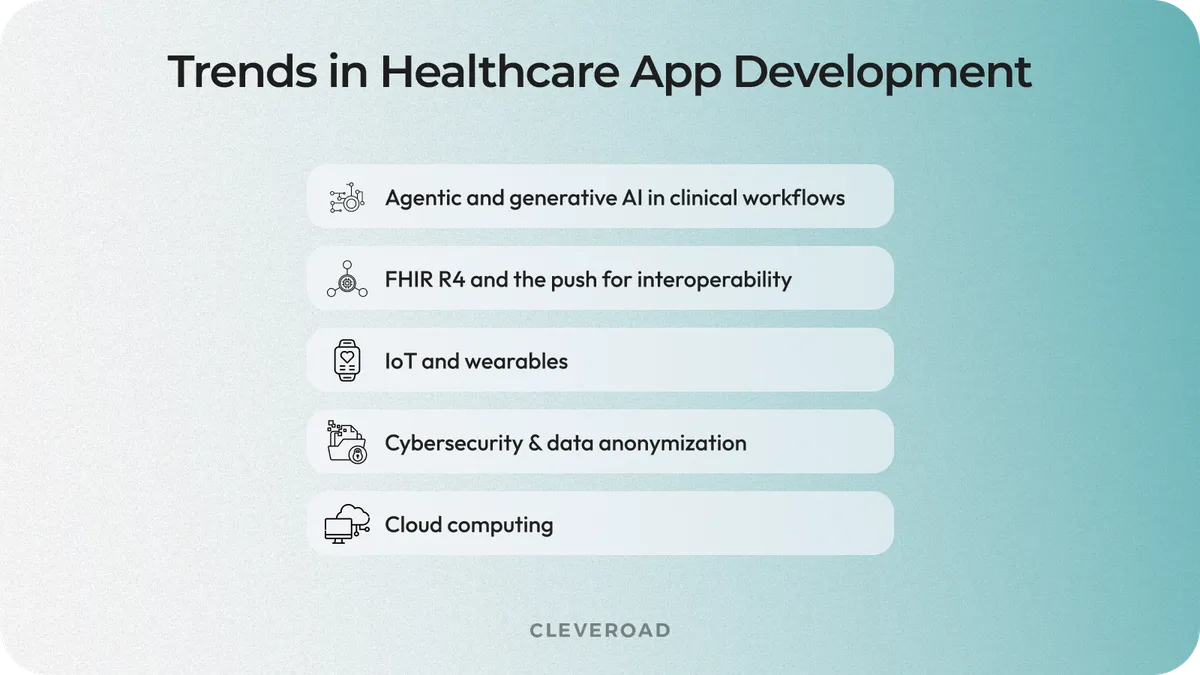
Key trends of healthcare application development
Best Practices for Medical App Development
Healthcare app development requires early planning around compliance, security, interoperability, usability, and clinical workflow fit. These best practices help you build products that protect patient data, support real care scenarios, and scale without costly rework.
Security and compliance
Security and compliance should shape the architecture of healthcare apps from the first discovery stage. At minimum, the app should include MFA, encryption, role-based access control (RBAC), audit logs, secure APIs, session control, and access rules for every user role.
The exact regulatory scope depends on the region, app type, and data the product processes. Depending on the use case, healthcare apps may need to comply with privacy laws such as HIPAA, GDPR, PIPEDA, and PHIPA; interoperability standards such as HL7 and FHIR; medical imaging standards such as DICOM; and e-signature rules such as eIDAS, ESIGN, and UETA.
Telemedicine products may also need to follow region-specific rules for virtual consultations, consent, prescriptions, and cross-border care delivery. These requirements influence architecture, data storage, integrations, user permissions, and vendor selection.
Interoperability
Interoperability should be planned as an architecture practice, not added after the MVP is built. If the healthcare app must connect with EHR/EMR systems, labs, devices, pharmacies, or hospital software, the team should define integration standards, API flows, data mapping rules, and access permissions during discovery.
FHIR R4 is the preferred standard for many modern healthcare integrations, especially for apps that exchange patient records, observations, medications, encounters, and care plans with EHR systems. HL7 integration may still be required for legacy hospital systems, so the architecture should support both modern FHIR-based APIs and older clinical data exchange formats when needed.
User-centric UI/UX design
UI/UX design services are vital for healthcare mobile application development. The target audience of healthcare apps is quite extensive. Aiming for maximum reach, your design should be as user-friendly as possible. To nail it, your tech experts should follow several important UI/UX design rules:
- Optimize the user journey inside your app. Create a user persona and, based on their desires and expectations, inspect each touchpoint in your app to identify weak spots in the design.
- Minimize the number of actions a user should take to complete a task. Your team may group related content to make it accessible in one click. For example, use the Progressive Reduction method. Start with your standard design layout and gradually remove unnecessary elements to reduce the number of actions required to complete a task.
- Show important information at the beginning of the user journey. If you’re making a fitness app, the burned calories and steps taken should be placed right away on the first screen. If it’s a pill reminder app, show the nearest scheduled pills and the time left before taking them.
- Make the design responsive. It’s worth considering how the app will look on screens of different sizes. Make sure that your app looks great on any screen size.
Integration with third-party applications
Most healthcare apps need to exchange data with at least one external system: an EHR/EMR, a lab information system, a pharmacy network, or a payment processor. Plan these integrations during discovery, since each one sets requirements for data mapping, API standards (FHIR R4 for clinical data, HL7 for legacy hospital systems), and access permissions. An app that skips integration planning usually hits a rebuild the first time it has to pull a patient record from Epic or Oracle Health.
How Much Does Healthcare App Development Cost?
Healthcare app development usually costs from $40,000 to $300,000+ in 2026, depending on feature scope, compliance requirements, EHR/FHIR integrations, AI features, and post-launch support.
| Scope | What it includes | Cost range |
|---|---|---|
Simple patient app | Booking, HIPAA storage, profiles | $40K–$80K |
Mid-scope MVP | Video calls, chat, dashboards, EHR basics | $80K–$150K |
Telemedicine / complex | Full EHR/FHIR integration, AI, multi-role | $150K–$300K+ |
HIPAA engineering add-on | Encryption, audit logs, RBAC, BAA, pentest | 20–30% (≈$15K–$40K) |
Ongoing maintenance | Updates, security monitoring | 15–20%/year |
These ranges align with 2026 healthcare app pricing benchmarks from GoodFirms, Pi Tech, Purrweb, Kellton, and other market sources. Most estimates show the same pattern: simple healthcare MVPs start around $40,000-$80,000, while complex HIPAA-ready products with EHR integrations, telemedicine, AI, and multi-role workflows can reach $150,000-$300,000+. Compliance and security work also increases the budget because healthcare apps need encryption, access control, audit trails, documentation, and testing before release. For a feature-level estimate, see our detailed breakdown of healthcare app development cost.
How Do You Make a Healthcare App HIPAA Compliant?
A HIPAA-ready healthcare app must protect PHI with encryption, audit logs, role-based access control (RBAC), secure authentication, PHI minimization, and controlled access to infrastructure, databases, and development environments. The team also needs signed Business Associate Agreements (BAAs) with vendors that process protected health data.
HIPAA compliance planning starts before development. First, define what PHI the app collects, where the data is stored, who can access it, how user activity is logged, and which third-party services process protected health data.
The HHS HIPAA guidance for professionals sets the regulatory baseline. Technical implementation then depends on the app type, data flows, hosting model, and integrations.
A practical example is Cleveroad's work with Codex Labs on DECODE.ME, a HIPAA-compliant teledermatology platform for private doctor-patient video consultations. Our team built a secure infrastructure with GCP FHIR-based storage and created a protected development setup that supported product iterations without direct access to patient data. For a full checklist, see our HIPAA requirements guide or review the official HHS HIPAA guidance for professionals.
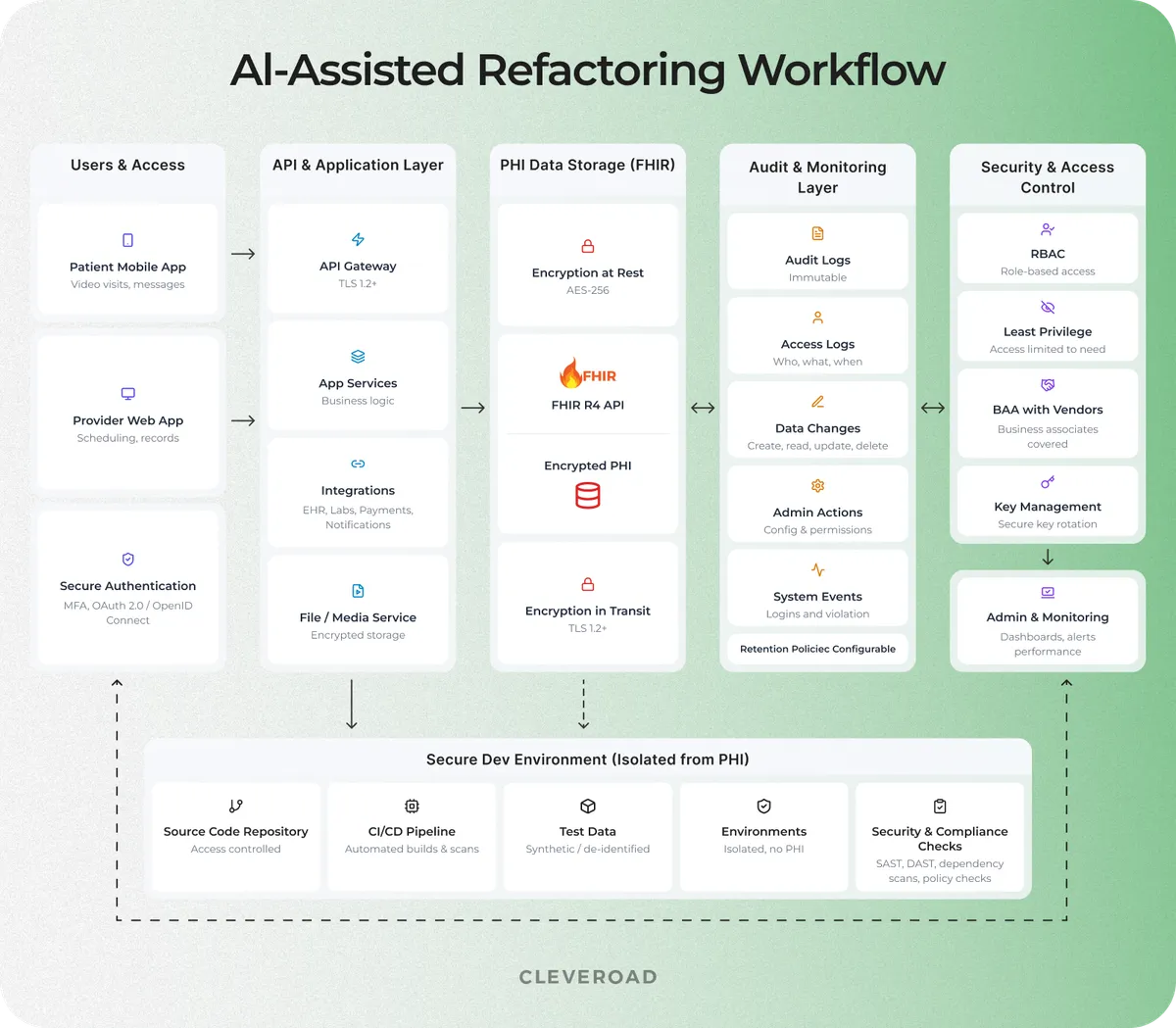
HIPAA-compliant architecture for a telehealth app
How Cleveroad Built DECODE.ME, a HIPAA-Compliant Teledermatology Platform
Codex Labs, a Silicon Valley plant-biotechnology company, turned to Cleveroad after two previous vendors failed to deliver even a stable demo of DECODE.ME. The client needed to rescue the inherited codebase, prepare the product for release, and meet a strict five-month deadline before the American Academy of Dermatology Innovation Meeting.
Cleveroad started with a full system assessment and code review. Our team identified critical backend issues, fixed blocking bugs, optimized backend performance, and stabilized the teledermatology platform to support private virtual doctor-patient consultations. We also built a HIPAA-compliant infrastructure for secure medical data handling. The solution used GCP FHIR-based storage and a secure development setup, enabling product iterations without direct access to patient data.
Within five months, Cleveroad prepared a working DECODE.ME demo for the AAD 2025 Innovation Meeting. The platform also passed the initial certification stages, which helped Codex Labs move from a stalled product to a release-ready teledermatology solution.
As a result, our client received a working teledermatology platform that, after its first presentation, attracted dozens of leading dermatologists to join. The solution is now live, actively used, and continues to grow its user base, while we maintain an ongoing partnership with Codex Labs to expand DECODE.ME functionality.
See how Barbara Paldus, Founder and CEO of Codex Labs, describes the cooperation and why she recommends Cleveroad as a reliable HealthTech partner.
Dr. Barbara Paldus, CEO at Codex Labs: Feedback on Cleveroad's Telemedicine Development Services
Why Choose Cleveroad for Healthcare App Development
Cleveroad is a healthcare app development company headquartered in Estonia. Since 2011, we have helped healthcare organizations, clinics, medical device manufacturers, and HealthTech companies build secure software for patient care, clinical workflows, remote monitoring, and healthcare operations.
Our healthcare software development services cover custom product development, legacy software modernization, third-party integrations, EHR/EMR systems, patient portals, telemedicine platforms, RPM solutions, and AI-assisted healthcare products.
Cleveroad follows healthcare security and compliance requirements, including HIPAA, GDPR, and PIPEDA. We are also certified with ISO 9001 and ISO/IEC 27001, which confirms our quality management and information security practices.
Our healthcare portfolio includes a wide variety of diverse projects. Here are some of most recent ones:
- Quality Management System: A B2B SaaS platform for medical device manufacturers that supports document management, actions, training records, HR workflows, RBAC, and processes required for FDA and ISO certification. Breanne Butler, Project Manager at Prime Path Medtech, shared positive feedback about Cleveroad’s work on this QMS solution.
- IoT system for monitoring EKG and blood oxygen level: A mobile telecare solution that connects with IoT devices and helps track heart rate and blood oxygen levels through a smartphone.
- E-learning system for official certification: A medical education platform with structured learning materials, subscription-based access, and continuous training functionality.
- IoT system for hydration monitoring: A software solution for an IoT hydration tracker that collects sensor data and helps create training and care programs through an admin panel.
If you're looking for a reliable healthcare software development partner to build a secure, scalable, and compliant healthcare application, our team is ready to support you at every stage — from discovery and architecture to development and long-term product scaling.
Let's build your healthcare app with a HIPAA-experienced team
Let's build your healthcare product together with a team that handles full-cycle development — from architecture and compliance to scalable delivery and integration.
Healthcare app development includes 7 core steps:
- Define the healthcare problem and target users
- Choose a healthcare-experienced software development provider
- Design the solution architecture
- Prepare requirements, feature scope, and prototypes
- Build the MVP
- Run compliance testing and certification checks
- Gather user feedback and improve the product
The safest approach is to start with discovery. At this stage, the team defines user roles, clinical workflows, compliance requirements, integrations, MVP scope, and technical risks before development.
Healthcare app development usually costs from $40,000 to $300,000+ in 2026.
App scope and estimated cost:
- Simple patient app: $40,000-$80,000
- Mid-scope MVP: $80,000-$150,000
- Telemedicine or EHR-connected platform: $150,000-$300,000+
- HIPAA engineering add-on: +20%-30%
The final budget depends on feature scope, HIPAA requirements, FHIR integrations, AI features, multi-role workflows, and post-launch support.
A healthcare app usually takes 3 to 9+ months to develop.
A simple MVP may take 3 to 4 months. A telemedicine platform, RPM system, or EHR-integrated product can take 6 to 9+ months. The timeline depends on compliance requirements, integrations, UX complexity, and the number of user roles.
To make a healthcare app HIPAA compliant, the team must protect PHI across storage, access, transmission, and development environments.
Core safeguards include:
- Encryption at rest and in transit
- RBAC and secure authentication
- Audit logs
- PHI minimization
- Access control for every user role
- Signed BAAs with vendors that process PHI
HIPAA compliance should be planned during discovery, not added before release.
A healthcare app can include AI features such as symptom checkers, clinical decision support, ambient documentation, visit summaries, care-gap detection, patient intake automation, risk scoring, and personalized recommendations.
For safe implementation, AI features should follow this rule: AI can assist clinicians, but clinicians must review clinical outputs before they affect care decisions. AI workflows also need secure access to patient data, role permissions, and audit logging.

Evgeniy Altynpara is a CTO and member of the Forbes Councils’ community of tech professionals. He is an expert in software development and technological entrepreneurship and has 10+years of experience in digital transformation consulting in Healthcare, FinTech, Supply Chain and Logistics
Give us your impressions about this article
Give us your impressions about this article
Comments
7 commentsThanks for sharing this informative article. A must-read for anyone interested in healthcare app development.

I have an idea to build an healthcare app but I don't know what steps I should follow. Your blog is really awesome with full of information.
Hi there, Thanks for sharing such an awesome blog with us. It's really helpful for me to build an healthcare app.
Hi there, I really appreciate your work! I am a researcher I do research everyday, but never find such articles, I visited your all pages, and it's really very impressive, Keep sharing such articles to help us. Good Luck
Such a wonderful Article In the last few years, the sciences and health care industries have been undergoing significant disruptions. This year's COVID-19 revealed how vulnerable the health care industry is to change and how it needs structural and technological change. If you are looking for a health mobile app development company, then no more Visit consagous.co Keep Posting
You are posting a very good article. Thanks for sharing this useful article with us. keep posting.
yes, 40% of physicians believe telehealth apps could reduce in-office visits. 74% of the hospitals that used mobile apps to collect patient data showed higher levels of efficiency than their counterparts not using any apps. mHealth is the future and we should find solid reasons to before investing in mHealth app.